Work on converting the ETS json file into spreadsheets to evaluate thresholds and labels – spreadsheet conversion is working. done! Now I need to figure out what those ETS parameters do!
Add a short bit to the D20 writeup that explains why linear interpolation isn’t the best option, and why we went with ETS – done
Work with Zach to get the website up today – working
Work this article into the exploit-space writeup: Why Is Cybersecurity Not a Human-Scale Problem Anymore?. Wow, actually, the company (Balbix) that was founded by the author (Gaurav Banga) seems to be doing most of what I was going to write about. Sent Darren a note to see if I should continue
Got a note from ProQuest saying my file needed to have blank pages at the beginning and end of the document. Fixed. And accepted!
Congratulations. Your submission, xxxxx has cleared all of the necessary checks and will soon be delivered to ProQuest for publishing.
Ok, back to Docker and building an InfluxDB image. Wow, that seems like a lifetime ago I was doing this
To save a custom image, create the container from a base image and then docker save image_name > image_name.tar. This puts it wherever you run the command in the system, Linux or Windows
#COVID-19 meeting at 1:30 today – proposal’s in. We have twitter data from January
I should try to put all the pieces together, but I am just done, and am stress-scrolling through Twitter, which really doesn’t help. Getting away from the computer for a while
Working with Zach and Aaron on the app. I think we’ll have something by this weekend
Added a starting zero on the regression
Added the regression to the json file, and posted to see if Zach can reach
Set up the hooks for export to excel workbook, with one tab per active country. I’ll work on that later today – done! countries
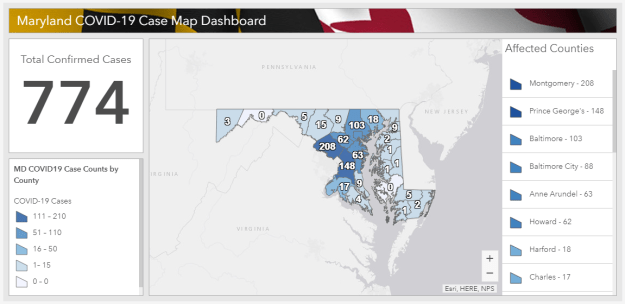
Got clarification from Wayne on some edits. Going to turn those around this morning and try to submit before COB today. Maryland is at 580 confirmed cases as of yesterday. I’d expect to see nearly 800 when they update the site this morning. Sent over all the edits. It’s in!
Waking up to the news these days makes me want to stay in bed with the radio off
Working on automating the process of downloading the spreadsheet, parsing out the countries, and calculating daily rates. The goal is to have a website up this weekend so you can see how your country is doing.
Tasks
Set up converter class – done
download spreadsheet – done
parse out countries – working on it
Made mockups of the mobile and webpage displays, and refined a few times based on comments
Got notes for Chapter 11 from Wayne. Switching gears and rolling that in. Put in changes for all the items I could read. There are a few still outstanding. I’ll submit tonight if Wayne doesn’t come back for a discussion.
Back to Docker. Need to connect to the WLS. Done!
Meetings
AIMS – status for all, plus technichal glitches. We’ll try Teams next time. Vadim has made GREAT progress. We might be able to get a real Yaw Flip soon as well
A2P – Infor demo. Meh.
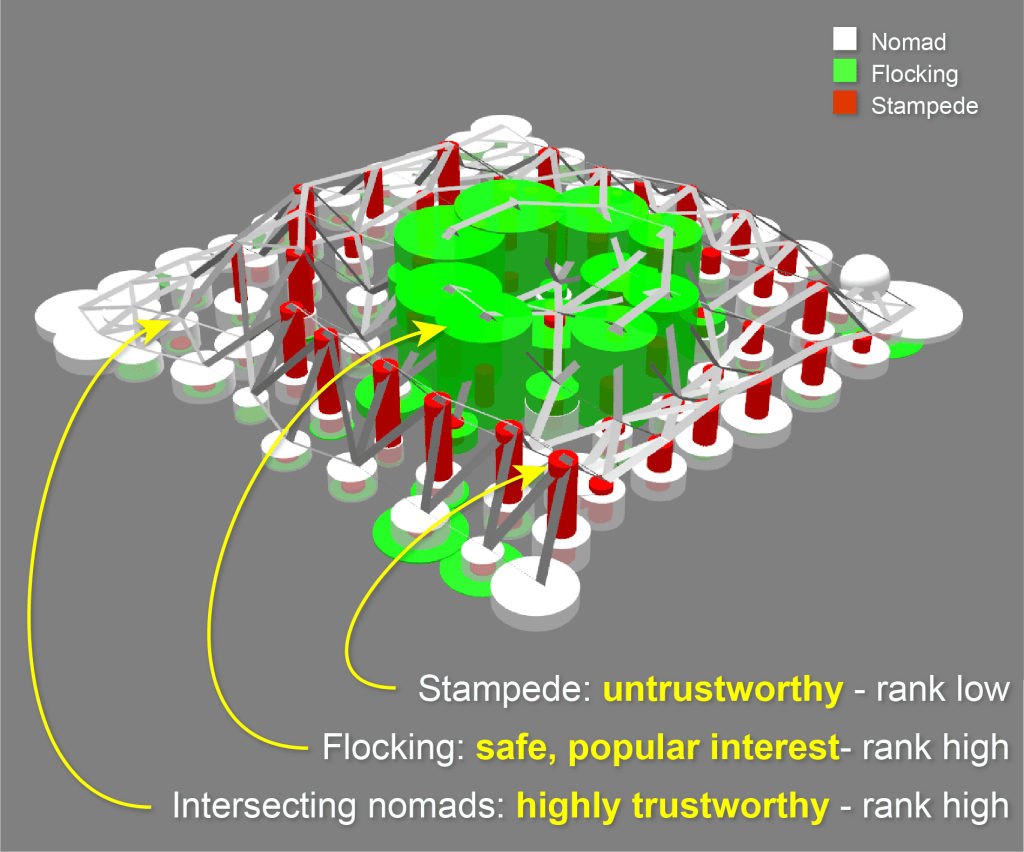
Stampede theory proposal deadline was delayed a couple of days
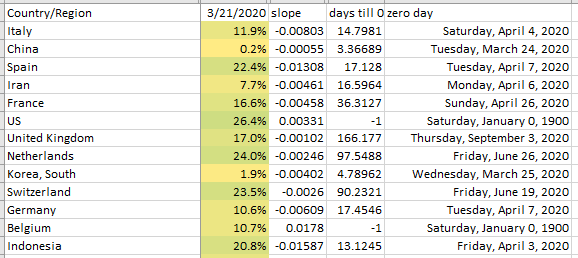
Well, I’ve got more predictions using death rates as described in this post. Based on the latest dataset from here (Github), I’ve created a spreadsheet that does a linear (least squares) extrapolation for when the number of new deaths per day drops to zero:
China is in this group as a sanity check, and as you can see, it’s very near zero, and so is South Korea. Italy, Germany, Spain, Iran, and Indonesia are currently all in the middle, with 2-3 weeks to go if nothing changes. France, the Netherlands, and Switzerland are far enough out that I think these may be low confinance values. The UK seems to be doing terribly. The worst performers are Belgium and the US, whose death rates are still going up, as indicated by the “-1” in the “days till” column.
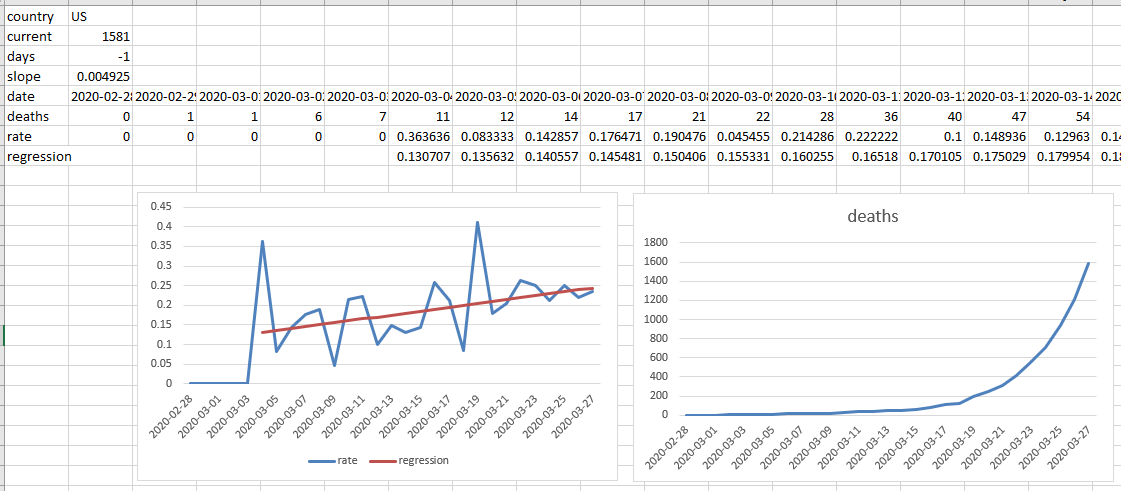
Here are plots of the data used to calculate the table. Due to the way that excel labels axis, I don’t have dates for the x-axis for all the charts. They all end on the seme date (3/21, the last day in the dataset with the two days I need to calculate rates), but some of them have fewer tata points so that the time before the outbreak doesn’t influence the calculations:
Working on Hours for misinfo proposal
ASRC
Had a good chat with Biruh about InfluxDB running in Docker. Since I’m running the Windows version, things are different enough that I’m going to need to download a linux distro image and run my own version of InfluxDB2 inside that. Which means I need to get smarter on Docker and making a custom image, etc. Got this book. We’ll see how that goes today.
Yesterday, I looked at the confirmed cases from this dataset. Today, I thought I’d look at the death rates. These are actually from yesterday. Maybe I’ll update at the end of the day. Everything is in a logarithmic scale because it’s impossible to tell the difference between one crazy exponential rate and another (It may be small-world power law as well, as per here). This is also with China excluded:
I mean, that’s not a good picture. I can see why California went on full non-essential lockdown today – we seem to be on the same trajectory as Iran, assuming the difference in slope is not related to manipulated or poorly-gathered information. South Korea, as per reports, really has appeared to adjust the trajectory. Note though, that the adjusted curve still seems to be exponential, but at a lower value.
My sense right now is that the economic impacts (however those would be charted) are going to look similar, with some kind of time delay that relates to spare capacity, like savings. My sense is that this is going to be bigger than the 2008 financial meltdown, but maybe in some kind of slow motion?
Since I can work from home, and work on government contracts, I’ve been sending money to food banks and similar charities. Hopefully, the best ways to contribute will become clear as the situation settles into the new “normal”. For some more thinking on the economic impact, there’s a short interview with John Ioannidis, who wrote in this article:
One of the bottom lines is that we don’t know how long social distancing measures and lockdowns can be maintained without major consequences to the economy, society, and mental health. Unpredictable evolutions may ensue, including financial crisis, unrest, civil strife, war, and a meltdown of the social fabric.
“A fiasco in the making? As the coronavirus pandemic takes hold, we are making decisions without reliable data” – StatNews, 3/17/2020
I tend to agree that the world at large is focusing on one, large immediate problem when it needs to be focusing on two large immediate problems. And that’s probably too much to expect.
We present a method that achieves state-of-the-art results for synthesizing novel views of complex scenes by optimizing an underlying continuous volumetric scene function using a sparse set of input views. Our algorithm represents a scene using a fully-connected (non-convolutional) deep network, whose input is a single continuous 5D coordinate (spatial location (x,y,z) and viewing direction (θ,ϕ)) and whose output is the volume density and view-dependent emitted radiance at that spatial location. We synthesize views by querying 5D coordinates along camera rays and use classic volume rendering techniques to project the output colors and densities into an image. Because volume rendering is naturally differentiable, the only input required to optimize our representation is a set of images with known camera poses. We describe how to effectively optimize neural radiance fields to render photorealistic novel views of scenes with complicated geometry and appearance, and demonstrate results that outperform prior work on neural rendering and view synthesis. View synthesis results are best viewed as videos, so we urge readers to view our supplementary video for convincing comparisons.
Let’s see if we can get InfluxDB working in Docker and start to generate and store data
I found a wonderful thing! It looks like you can change the default settings for where applications and their data are saved! Here’s a screenshot of where in the settings:
Going to verify that this is set for the admin accounts. It does!
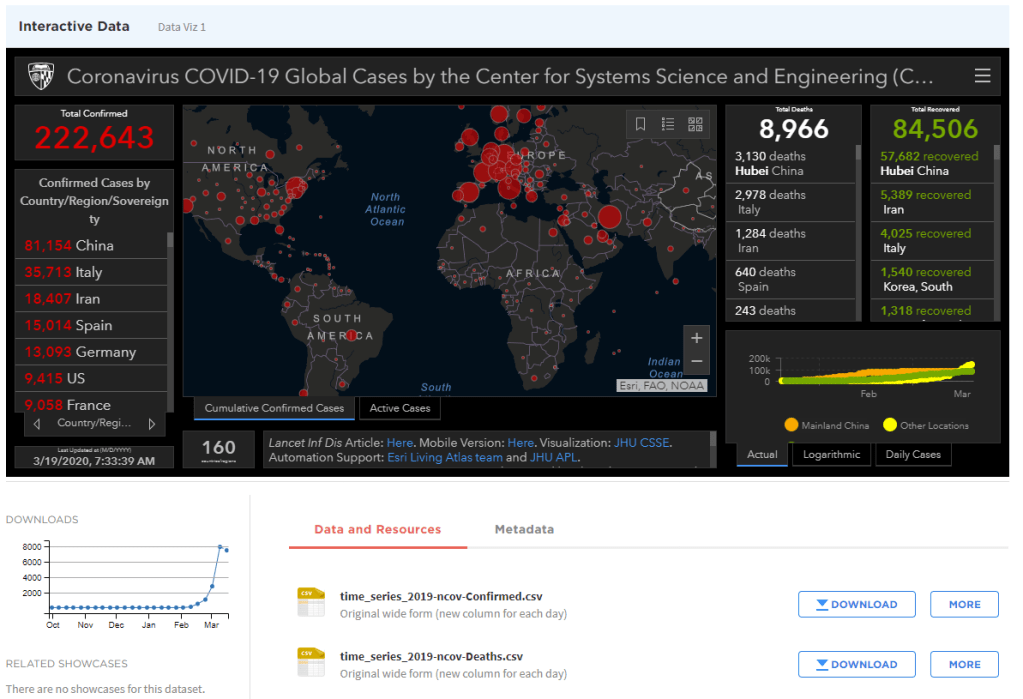
I found the data sources for the dashboard in the previous few posts. Yes, everything still looks grim:
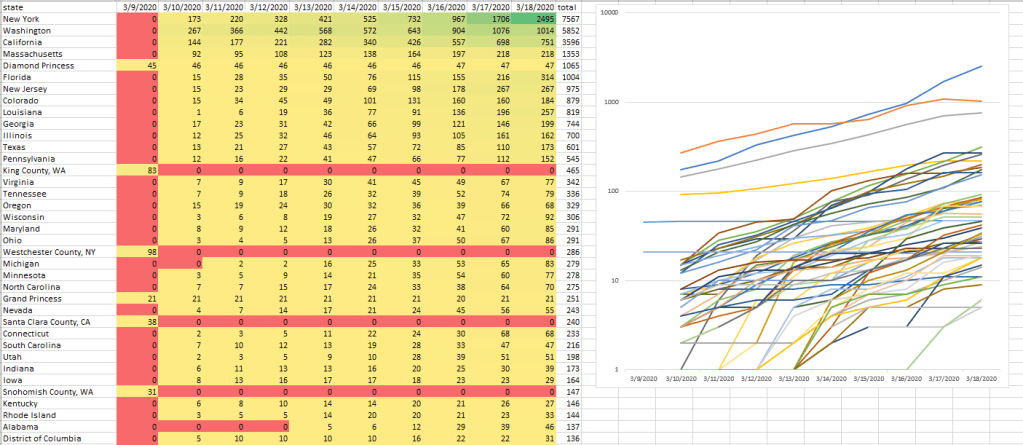
So rather than working on my dissertation, I thought I’d take a look at the data for the last 9(!) days in Excel:
This is for the USA. The data is sorted based on the cumulative total of new cases confirmed. If you look at the chart on the right, everything is in line with a pandemic in exponential growth. However, that’s not the whole story.
I like to color code the cells in my spreadsheets because colors help me visualize patterns in the data that I wouldn’t otherwise see. And one of the things that really stands out here is the red rows with one yellow cell on the left. These are all cases where the rate of confirmed new cases dropped to zero overnight. And they’re not near each other. They are in WA, NY, and CA. Is this a measuring problem or is something going right in these places?
Maybe we’ll find out more in the next few days. Now that I know how to get the data, I can do some of my own visualizations that look for outliers. I can also train up some sequence-to-sequence ML models to extrapolate trends.
One more thing. I had heard earlier (Twitter, I think?) that Vietnam was handling the crisis well. And it looks like it was, but things are back to being bad:
Ok, back to work
8:00 – 4:30 ASRC PhD, GOES
Working on the process section – done!
Working on the TACJ bookend – done! Made a new figure:
Submitted to Wayne. Here’s hoping it doesn’t fall through the cracks
Inattentional blindness is the psychological phenomenon that causes one to miss things in plain sight. It is a consequence of the selective attention in perception that lets us remain focused on important parts of our world without distraction from irrelevant details. Motivated by selective attention, we study the properties of artificial agents that perceive the world through the lens of a self-attention bottleneck. By constraining access to only a small fraction of the visual input, we show that their policies are directly interpretable in pixel space. We find neuroevolution ideal for training self-attention architectures for vision-based reinforcement learning tasks, allowing us to incorporate modules that can include discrete, non-differentiable operations which are useful for our agent. We argue that self-attention has similar properties as indirect encoding, in the sense that large implicit weight matrices are generated from a small number of key-query parameters, thus enabling our agent to solve challenging vision based tasks with at least 1000x fewer parameters than existing methods. Since our agent attends to only task-critical visual hints, they are able to generalize to environments where task irrelevant elements are modified while conventional methods fail.
AirSim is a simulator for drones, cars and more, built on Unreal Engine (we now also have an experimental Unity release). It is open-source, cross platform, and supports hardware-in-loop with popular flight controllers such as PX4 for physically and visually realistic simulations. It is developed as an Unreal plugin that can simply be dropped into any Unreal environment. Similarly, we have an experimental release for a Unity plugin.
Added notes for the dissertation revisions
Working on the GVSETS paper – meeting at 3:00. Got everything into SVN and coordinated across machines.
Create figures that show an agent version of the dungeon
Replicate the methods and detailed methods of the cartography slides
Text for each group by room can be compared by the rank difference between them and the overall. Put that in a spreadsheet, plot and maybe determine the DTW value?
Add the sim version of the dungeon and the rank comparison to the dissertation
Put all ethics on one slide – done
Swapped out power supply, but now the box won’t start. Dropped off to get repaired
Like a brain, an ant colony operates without central control. Each is a set of interacting individuals, either neurons or ants, using simple chemical interactions that in the aggregate generate their behaviour. People use their brains to remember. Can ant colonies do that?
7:00 – ASRC
Dissertation
More edits
Changed all the overviews so that they also reference the section by name. It reads better now, I think








 viztales
You must be logged in to post a comment.