Author Archives: pgfeldman

Phil 9.13.17

7:00 – 5:30 ASRC MKT

  • Continuing on the paper. Got Scott & Amundsen in the intro! Also used Plato’s cave.
  • Echoes of a Conspiracy: Birthers, Truthers, and the Cultivation of Extremism
    • A significant number of Americans express sympathies for conspiracy theories about Barack Obama’s birth and George Bush’s role in the 9/11 attacks. This study sought to test the role of ideological media in perpetuating these beliefs. Specifically, experiments were conducted to determine if ideologically homogeneous media echo-chambers could cultivate belief in conspiracy theories and whether debunking information would reverse this belief. Results found that media echo-chambers increased belief in conspiracy theories though debunking information reversed or minimized this effect. Results confirm the role of ideological media in spreading extremist attitudes but also demonstrate the value of debunking efforts.
  • Upcoming paper on the wisdom and culture of flocks.
  • Aligning Popularity and Quality in Online Cultural Markets Andres Abeliuk
    • Social influence is ubiquitous in cultural markets and plays an important role in recommendations for books, songs, and news articles to name only a few. Yet social influence is often presented in a bad light, often because it supposedly increases market unpredictability. Here we study a model of trial-offer markets, in which participants try products and later decide whether to purchase. We consider a simple policy which recovers product quality and ranks the products by quality when presenting them to market participants. We show that, in this setting, market efficiency always benefits from social influence. Moreover, we prove that the market converges almost surely to a monopoly for the product of highest quality, making the market both predictable and asymptotically optimal. Computational experiments confirm that the quality ranking policy quickly identifies “blockbusters”, outperforms other policies, and is highly predictable.
    • This is the paper that I’ve been looking for that shows overall quality of ranking is improved if songs are presented in a random order, and that cascades lead to random quality results. However, reading this paper got me to the following: “Unfortunately, popularity, which is easily distorted by noise in the process, is not a good proxy for quality: It leads to market unpredictability and even self-fulfilling prophecies, in which a perceived but initially false popularity becomes real over time (Salganik and Watts 2008).” Which gets us to:
  • Leading the Herd Astray: An Experimental Study of Self-Fulfilling Prophecies in an Artificial Cultural Market
    • Individuals influence each others’ decisions about cultural products such as songs, books, and movies; but to what extent can the perception of success become a “self-fulfilling prophecy”? We have explored this question experimentally by artificially inverting the true popularity of songs in an online “music market,” in which 12,207 participants listened to and downloaded songs by unknown bands. We found that most songs experienced self-fulfilling prophecies, in which perceived—but initially false—popularity became real over time. We also found, however, that the inversion was not self-fulfilling for the market as a whole, in part because the very best songs recovered their popularity in the long run. Moreover, the distortion of market information reduced the correlation between appeal and popularity, and led to fewer overall downloads. These results, although partial and speculative, suggest a new approach to the study of cultural markets, and indicate the potential of web-based experiments to explore the social psychological origin of other macro-sociological phenomena.
  • Good progress on the introduction and lit review
  • Discussion with Aaron about the next phase, which is the development of the Normative Maps. We walked through the idea of using the Research Browser combined with a chat interface to set up an online small-ish group that works through a problem along the lines of what M&D describe in C&C. With his game background, he thinks he can design something compelling. First goal will be to put together a paper prototype to evaluate. A paper that describes such a scenario is The effects of a normative intervention on group decision-making performance:
    • A space ship having crashed on the moon, a team of astronauts has to cover a distance of some 300 kilometres in order to reach the spot where they have a rendezvous with another team. Before embarking on this perilous undertaking, the members of the team have to decide which of the fifteen objects necessary for survival – oxygen reserves, concentrated food, signalling equipment, heating requisites, etc. – they will take with them. Those participating in the study were asked to draw up a list of priorities for these objects, first separately as individuals, and then in groups, by arriving at a consensus.

Phil 9.12.17

7:00 – 5:00 ASRC MKT

  • Meeting with Wayne yesterday after Fika. Get him a draft by the end of the week to discuss Monday?
  • More writing
  • Herding in humans (Ramsey M. Raafat, Nick Chater, and Chris Frith)
    • Herding is a form of convergent social behaviour that can be broadly defined as the alignment of the thoughts or behaviours of individuals in a group (herd) through local interaction and without centralized coordination. We suggest that herding has a broad application, from intellectual fashion to mob violence; and that understanding herding is particularly pertinent in an increasingly interconnected world. An integrated approach to herding is proposed, describing two key issues: mechanisms of transmission of thoughts or behaviour between agents, and patterns of connections between agents. We show how bringing together the diverse, often disconnected, theoretical and methodological approaches illuminates the applicability of herding to many domains of cognition and suggest that cognitive neuroscience offers a novel approach to its study.
  • Alignment in social interactions (M.Gallotti, M.T.Fairhurst, C.D.Frith)
    • According to the prevailing paradigm in social-cognitive neuroscience, the mental states of individuals become shared when they adapt to each other in the pursuit of a shared goal. We challenge this view by proposing an alternative approach to the cognitive foundations of social interactions. The central claim of this paper is that social cognition concerns the graded and dynamic process of alignment of individual minds, even in the absence of a shared goal. When individuals reciprocally exchange information about each other’s minds processes of alignment unfold over time and across space, creating a social interaction. Not all cases of joint action involve such reciprocal exchange of information. To understand the nature of social interactions, then, we propose that attention should be focused on the manner in which people align words and thoughts, bodily postures and movements, in order to take one another into account and to make full use of socially relevant information.
  • Herding and escaping responses of juvenile roundfish to square mesh window in a trawl cod end (This is the only case I can find of 3-D stampeding. Note the [required?] dimension reduction)
    • The movements of juvenile roundfish, mainly haddock Melanogrammus aeglefinus and whiting Merlangius merlangus, reacting to a square mesh window in the cod end of a bottom trawl were observed during fishing experiments in the North Sea. Two typical behavioral responses of roundfish are described as the herding response and the escaping response, which were analyzed from video recordings by time sequences of the movement parameters. It was found that most of the actively escaping fish approached the square mesh window at right angles by swimming straight ahead with very little change in direction, while most of the herded fish approached the net at obtuse angles and retreated by sharp turning. The herding and escaping responses showed significant difference when characterized by frequency distributions of swimming speed and angular velocity, and both responses showed large and irregular variations in swimming movement parameters like the panic erratic responses. It is concluded that an escaping or herding response to the square mesh window could be decided by an interaction between the predictable parameters that describe the stimuli of net and angular changes of fish response, such as approaching angle, turning angle and angular velocity.
  • Assessing the Effect of “Disputed” Warnings and Source Salience on Perceptions of Fake News Accuracy
    • What are effective techniques for combating belief in fake news? Tagging fake articles with “Disputed by 3rd party fact-checkers” warnings and making articles’ sources more salient by adding publisher logos are two approaches that have received large-scale rollouts on social media in recent months. Here we assess the effect of these interventions on perceptions of accuracy across seven experiments (total N=7,534). With respect to disputed warnings, we find that tagging articles as disputed did significantly reduce their perceived accuracy relative to a control without tags, but only modestly (d=.20, 3.7 percentage point decrease in headlines judged as accurate). Furthermore, we find a backfire effect – particularly among Trump supporters and those under 26 years of age – whereby untagged fake news stories are seen as more accurate than in the control. We also find a similar spillover effect for real news, whose perceived accuracy is increased by the presence of disputed tags on other headlines. With respect to source salience, we find no evidence that adding a banner with the logo of the headline’s publisher had any impact on accuracy judgments whatsoever. Together, these results suggest that the currently deployed approaches are not nearly enough to effectively undermine belief in fake news, and new (empirically supported) strategies are needed.
  • Some meetings on marketing. Looks like we’re trying to get on this panel. Wrote bioblurbs!
  • More writing. Reasonable progress.

Phil 9.11.17

7:00 – 5:00 ASRC MKT

From just before. We have been at war ever since. I wonder what would have happened if all that blood and treasure had been spent on building high-quality secular schools throughout the Middle East as a counterweight to the Saudi Wahhabi madrasas… 10page-cityroom-popup

  • Continuing on paper
  • Fika! Nice to see folks.

Phil 9.8.17

7:00 – 4:00 ASRC MKT

Phil 9.6.17

7:30 – 6:00 ASRC IRAD

  • Brief financial panic this morning.
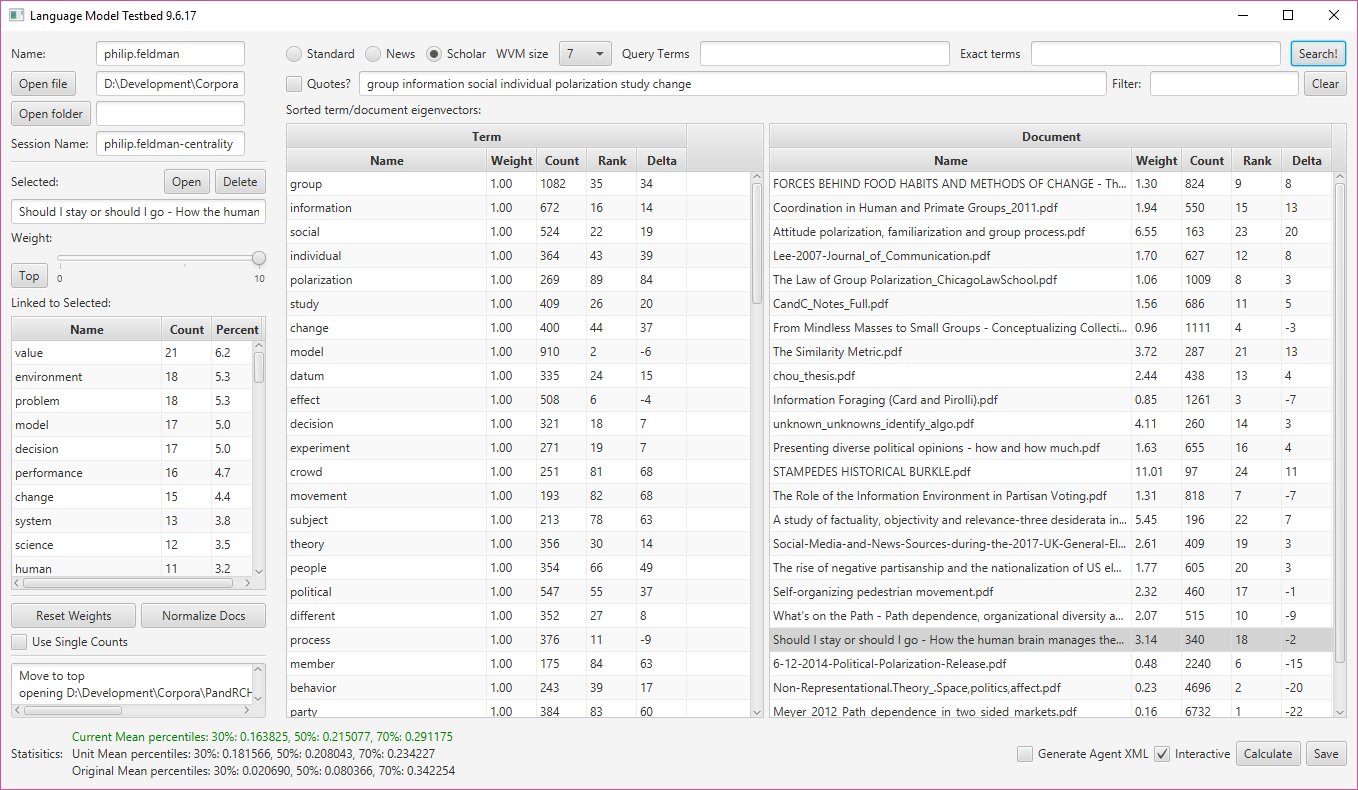
  • Need to figure out what the CHIIR paper is.
    • Running analytics on the LitReview folder
    • Need to clean up the C&C pfds
    • Brought in Sunstein, M&R and Cohen
    • Added Shared neural mechanisms underlying social warmth and physical warmth.
    • Here’s the LMN of the current normalized lit review: LMN_LitReview
    • Got the problem with the null pointer again. Seems to have something to do with a cleaned table. Maybe there is a missing word/paper?
    • Going to give Forces behind food habits and methods of change a skim. From 1943! M&D spend a lot of time on it in C&C.
      • Channel theory seems to be an archaic definition. In the paper, channels are ‘pathways’ that items move along, in this case from the source (store, farm, etc) to table. items move step by step through a channel and items are resisted or assisted by forces that have varying levels of alignment. There are also gatekeepers.
      • In P&RCH, the channels would be the IR system and the UI. Channel forces are different for lists, stories and maps.
      • Food outside and within consideration. Physical availability is not the only factor which determines availability of food to the individual. One of the determining factors is “cultural availability.” There are many edible materials which people never even consider for use because they do not think of them as food for themselves.
    • Grinding along with the paper

Phil 9.5.17

7:00 – 4:00 ASRC IRAD

  • Read some more Understanding Ignorance. He hasn’t talked about it, but it makes me look at game theory in a different way. GT is about making decisions with incomplete information. Ignorance results in decisions made using no or incorrect information. This is a modellable condition, and should result in observable results. Maybe something about output behaviors not mapping (at all? statistically equal to chance or worse?) to input information.
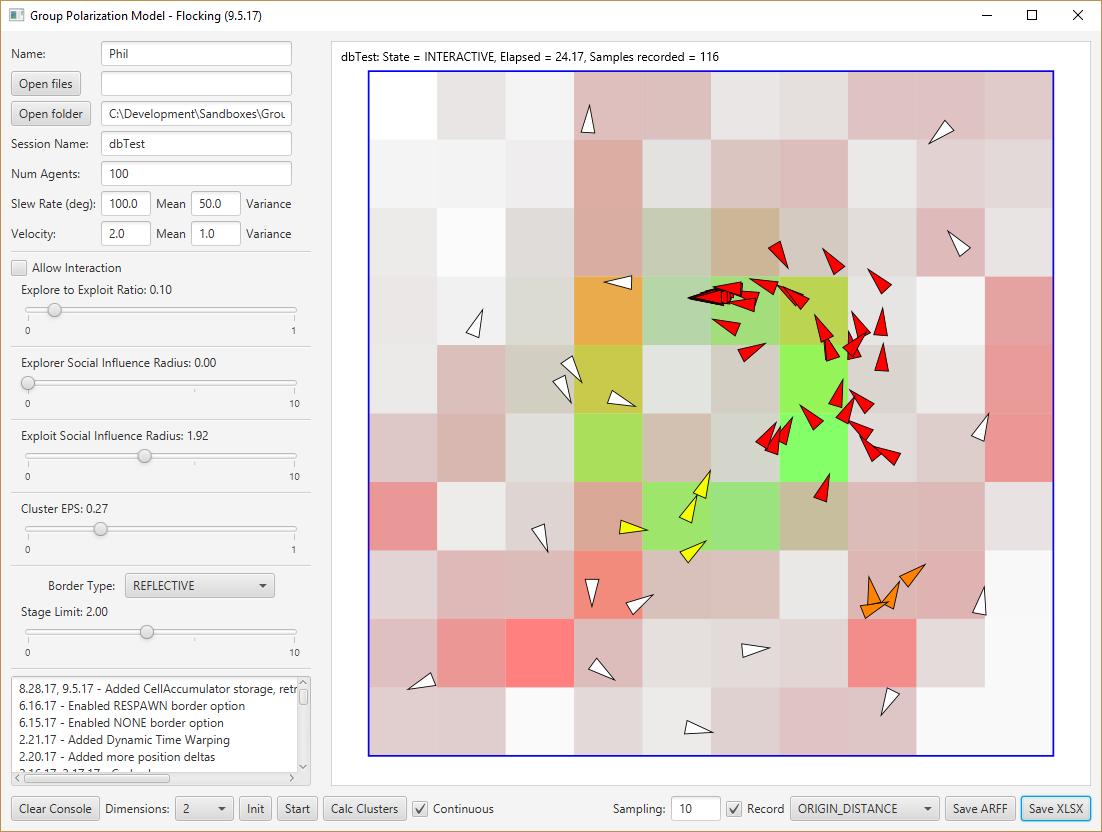
  • Heat maps!!!! 2017-09-05
  • Playing around with the drawing so we’re working off of a white background. Not sure if it’s better?
  • Adding a decay factor so new patterns don’t get overwhelmed by old ones 0.999 seems to be pretty good.
  • Need to export to excel – Done!2017-09-06
  • Advanced Analytic Status meeting.
  • NOAA meeting. Looks like they want VISIBILITY. Need to write up scenarios from spreadsheet generation to complete integration from allocation to contract to deliverable. With dashboards.
  • Latest version of the heatmaps, This produced the excel sheets above (dbTest_09_06_17-07_01_51) Going to leave it like this while I write the paper: 2017-09-06 (1)

Phil 9.4.17

8:00 – 10:30 ASRC IRAD

  • Started Understanding Ignorance. It’s more appropriate than I was expecting.
    • Four decisions shaped the writing of this book. I chose: (1) to attempt a comprehensive study that would examine many facets of ignorance; (2) to integrate perspectives drawn from contemporary studies in many disciplines; (3) to structure the discussion using four spatial metaphors for ignorance—place, boundary, limit, and horizon; and (4) to write a rather nontechnical, occasionally broad-brush text. [Kindle Locations 79-82]
    • Since what I’m working on with the map concept is to place an information horizon so that the ‘ignorance’ as encoded in the user interface is minimized, I’m particularly interested.
    • It also strikes me that ignorance is related to precision and recall. Focused information retrieval can increase ignorance of ‘adjacent’ subjects
  • Short day today, but I wanted to make some progress integrating CellAccumulator into the program so I can start writing the paper(s!) this week.
  • Found a bug that I need to spend more time hunting. I seem to be getting this error for a semi-random value StorageAndRetreival.draw(): CellAccumulator[64] is null! (line 140) when iterating over the raw list. My indexing function may not be exactly right.
    • Oops. It was doing what I told it…
      lt.set(iArray, null);
    • Now it’s working pretty well. I need to make it not accumulate when the sim is paused, etc 2017-09-04

Phil 9.1.17

7:00 – 3:00 ASRC IRAD

  • I think I need to rethink my work strategy. I actually don’t have to get PhD work done before going and doing work work. Does this mean I get to sleep later?
  • Working on adding in drawing of cells
  • I think I’m going to move the drawing of the StoRet cells back into StorageAndRetreival, and make it more like SmartShape.draw(ResizableCanvas rc) – Done
  • Finished initial framing out of StoRet. Next step will be to work out heatmaps as an initial case. That also means that I need StoRet to be able to iterate over agents
  • Wrote up an Accumulator class and got the positions of an agent mapping to the grid. Not enough motivation on a Friday afternoon to tie the pieces together, but the next step will be to have the LabeledTensor initialize with <CellAccumulator>, then build the heatmap. Then it’s probably time to start writing.
  • Renewed my ACM Membership. On the corporate card yet!

Phil 8.31.17

7:00 – 9:00, 10:00-4:30 IRAD

  • Something for my Visible from Space collection?
  • Saw this in the letters from CACM this month:

    Causal Connections for Predictive AI

    As part of the “ACM Panels in Print” section “Artificial Intelligence” (Feb. 2017), panelist David Blei said he believes computer science needs to identify the causal connections between data components, concluding that artificial intelligence, with its predictive capabilities, will be enhanced through causal inference. For example, the first step toward using AI in database systems is to analyze and create a data map of the complexity of the causal interconnections between the data components in a problem space. A data map connects a data component to other data components through causal interrelationships. A data map can be created through qualitative analysis of data collected for a particular problem. The qualitative analysis could then take the form of “thematic analysis,” (Braun, V. and Clarke, V. 2006) using systems diagramming to gain greater insight into the data. At that point it might be advantageous to start applying AI directly to the data.

    Researching the complexity of database systems, I have thus created such a data map, which is now ready to move to the next stage of automation where predictive analytics can help improve management of database systems. Using an analogy of the CODEX, or Control of Data Expediently, my research into causal connections has identified a potential role for AI in automating continuously changing best practice, thus representing an agile approach to deciphering the complexity of interconnections and promising to help create an autonomous way to deliver best practice in database management.

    Victoria Holt, Bath, U.K.

  • I looked at hew blog, research page and twitter account. Can’t find anything about mapping. Even looking at the thematic analysis and citing articles, I can’t find much about maps or mapping. Odd
  • Getting back to drawing the database. But first, updating my IDE, it seems…
  • Broke out DimensionInfo to TensorDimensionInfo since I need the mappingLow and mappingHigh to draw the borders
  • Changed the canvas drawBG to use StorageAndRetreival, since I need to know the projection I’m drawing
  • Killed JavaFX for a while. Had to reboot
  • More RFI work
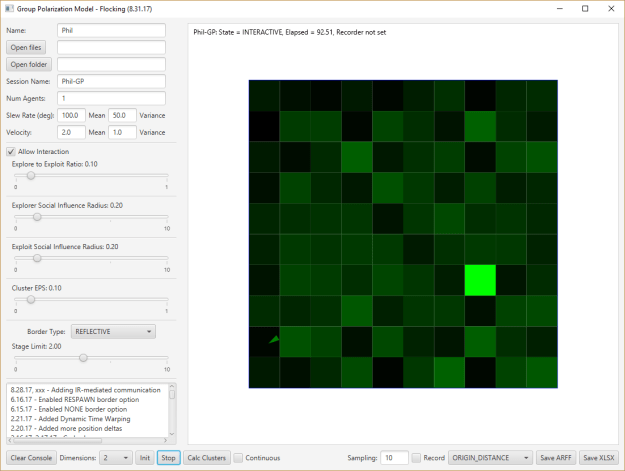
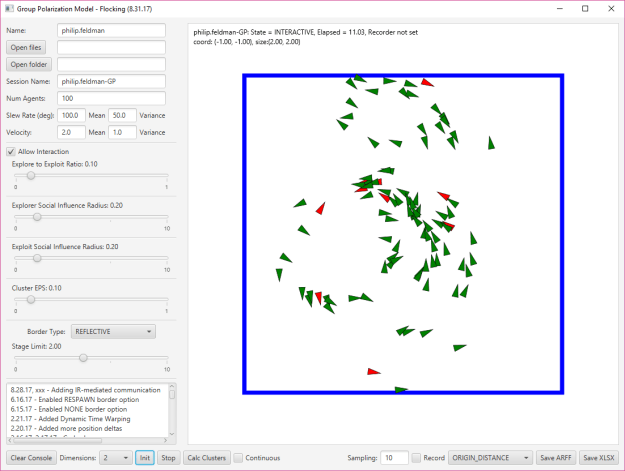
  • Ok, got the background scaled correctly and drawing the border. Had to deal with more hard-coded values. SAD! Anyway, here’s all the parts working: stageWithBorder

Phil 8.30.17

6:30 – 6:00 ASRC Research, proposals and job stuff

  • Redid my resume this morning. The word doc went fine, but when I went to generate the html versions, I had a momentary lapse of good sense and had Word output the pages.  Horrible mistake. I had to go and use the very fine HTML Cleaner website and put everything back together again. So 15 minutes of adding a paragraph and a picture turned into over an hour of work. Sigh.
  • If I have time, the next step today is to get the StorageAndRetrieval code drawing on the canvas. Started setting this up. The actual cell coloring could be done with another evaluateTensor method? Maybe later. Get the basics working first.
  • In a significant miracle, my PhD work is now my job, at least until the end of the year. Sprinkled with some proposal writing.
  • Spent most of the day working on the NNSA RFI

Phil 8.29.17

7:00 – 6:30 ASRC Research

  • Probably not going to get the StorageAndRetreival class done and integrated by Sept 1, so I’ll need to work out the paper based on what I have. But let’s see how far we get…
  • I think I’m going to start simply by placing the agent type in the IR cell and color accordingly. There will be three states, NULL (white) , EXPLORE (red) and EXPLOIT (green)
  • Fixing some things along the way. Stage dimension initial size was hard coded. Oops.
  • Adding a clear() to LabeledTensor and StorageAndRetreival
  • Working out how to recurse though a set of arrays. Putting here for later reference:
    class Recurse{
        int linecount = 0;
    
        boolean fillMat(int[] curIndices, int[] maxIndices, int curIndex){
            if(curIndex > curIndices.length-1){
                //System.out.printf("curIndex(%d) > %d\n", curIndex, curIndices.length-1);
                return true;
            }
            for(int i = 0; i < maxIndices[curIndex]; ++i) {
                curIndices[curIndex] = i;
                boolean done = fillMat(curIndices, maxIndices, curIndex+1);
                if(done) {
                    linecount++;
                    System.out.println(linecount+" [" + curIndex + "]: " + Arrays.toString(curIndices) + " = " + done);
                }
            }
            return false;
        }
    
        public static void main(String[] args){
            int[] initial = {0, 0, 0};
            int[] max = {3, 3, 3};
            System.out.println("Recurse!");
            Recurse r = new Recurse();
            r.fillMat(initial, max, 0);
        }
    }
  • Here’s the final version, with an Interface callback
    public boolean fillTensor(int[] curIndices, int[] maxIndices, int curIndex, TensorCellEvaluator tce){
        if(curIndex > curIndices.length-1){
            // if we get here, we're done
            return true;
        }
        for(int i = 0; i < maxIndices[curIndex]; ++i) {
            curIndices[curIndex] = i;
            boolean done = fillTensor(curIndices, maxIndices, curIndex+1, tce);
            if(done) {
                tce.evaluate(curIndices, lt);
            }
        }
        // if we get here, we're not none, keep going
        return false;
    }
  • Here’s the call with the implemented interface. It doesn’t do anything yet, but the pieces all work
    stoRet.fillTensor(indicies, maxIndicies, 0, new TensorCellEvaluator() {
        @Override
        public String evaluate(int[] indicies, LabeledTensor lt) {
            System.out.println(Arrays.toString(indicies));
            return Arrays.toString(indicies);
        }
    });
  • Interview with USDA team. Not a fit at all

Phil 8.28.17

Another weekend of scrambling to get everything done in time. Plus a good bike ride 🙂

7:00 – 5:00 Research (ASRC IRAD)

  • Started up the computer this morning and it freaked out. After a restart, it rebuilt all the program indices and many of my configs were gone. I’m guessing that it was a bad disk sector. Scary, since this is a pretty new box
  • Adding in the Information Retrieval part that will mediate interactions between agents
  • And now the changes to JavaUtils2 aren’t being recognized. Deleted reference and reimported. And not the project is rebuilding super slow????? This is just not my morning.
  • And now IntelliJ is frozen. Restarted. The error is still there, but it compiles no problem. Had to invalidate caches.
  • Started StorageAndRetreival class and have a rough framing running
  • Long discussion with the interns about using mapping for the HR space
  • Wrote up some more paragraphs on normative mapping for paper justification
  • Fuzzy thought for today. The map is actually a set of pointers to the data used to produce it. For example, a discussion that produces normative poles has a history of collapse that the normative poles could reference back to.

Phil 8.25.17

7:00 – 5:00 ASRC IRAD

  • Got Understanding Ignorance, which has a section on Ignorance as a Place. More on that later
  • Since I’m in the middle of LabledTensor, I’m going to add the ability to string together multiple ArrayLists to accommodate Long indexing
    • Created class LongArrayList, based on part of List. Can’t implement the interface, since the parameters are int, rather than long. Done! Also fixed a few formatting errors in the toString().

Phil 8.24.17

6:45 – 3:00 ASRC IRAD