Create spreadsheets (make a new directory for review-stars)
SBIR(s)
Meeting with Ron at 9:00 – lots of various details about phase 1 and LAIC
Read through and write up paragraphs for NASA – I am becoming confused, but managed to write up an approach on what I think makes sense. Sent it off to John, and we’ll have a meeting about it tomorrow morning
Ping Zach for a meeting to set up project
EXPENSE REPORT – this is chewing up hours. I don’t have a code that works
I want to write a paper about the one unambiguously good option that AI/ML + simulation provides – problem domain exploration and the industrialization of imagination. The failures in Vietnam, Iraq, and Afghanistan, not to mention 9/11 and Pearl Harbor have all been described as failures of imagination. These failures exist at multiple levels – the tactical (think Jimmy Doolittle), and the strategic (human nature). AI/ML allows us to safely explore these domains before the unimaginable occurs. Because these potentials can be visualized in narratives, it is possible to broadly and compellingly present these possibilities, and increase the effectiveness and resiliency of our choices in combat and combat-adjacent domains.
Enhanced simulation means that ML can explore tacticaloptions
Deliver the right amount of energy in the right place for the lowest cost
Language model maps means that ML can explore strategic options
This is a collection of simple PyTorch implementations of neural networks and related algorithms. These implementations are documented with explanations, and the website renders these as side-by-side formatted notes. We believe these would help you understand these algorithms better. We are actively maintaining this repo and adding new implementations.
GPT-Agents
Need to do some preliminary (e.g. stars) evaluations on the synthesized and ground truth data before meeting
3:30 Meeting
Went over results
Make a new 50k, 25k, and 12k model and do the same tests
AI is undergoing a paradigm shift with the rise of models (e.g., BERT, DALL-E, GPT-3) that are trained on broad data at scale and are adaptable to a wide range of downstream tasks. We call these models foundation models to underscore their critically central yet incomplete character. This report provides a thorough account of the opportunities and risks of foundation models, ranging from their capabilities (e.g., language, vision, robotics, reasoning, human interaction) and technical principles (e.g., model architectures, training procedures, data, systems, security, evaluation, theory) to their applications (e.g., law, healthcare, education) and societal impact (e.g., inequity, misuse, economic and environmental impact, legal and ethical considerations). Though foundation models are based on conventional deep learning and transfer learning, their scale results in new emergent capabilities, and their effectiveness across so many tasks incentivizes homogenization. Homogenization provides powerful leverage but demands caution, as the defects of the foundation model are inherited by all the adapted models downstream. Despite the impending widespread deployment of foundation models, we currently lack a clear understanding of how they work, when they fail, and what they are even capable of due to their emergent properties. To tackle these questions, we believe much of the critical research on foundation models will require deep interdisciplinary collaboration commensurate with their fundamentally sociotechnical nature.
Rather than say anything about Afghanistan here, I’d rather urge you to go read Thieves of State, by Sarah Chayes. Or, if you only have a few minutes, this blog post: The Ides of August
SBIR(s)
Sprint demos – done!
Lots more training – done!
GPT_Agents
Generated 10k synthetic reviews and added sentiment. Need to do that for ground truth now
We introduce a new domain expert mixture (DEMix) layer that enables conditioning a language model (LM) on the domain of the input text. A DEMix layer is a collection of expert feedforward networks, each specialized to a domain, that makes the LM modular: experts can be mixed, added or removed after initial training. Extensive experiments with autoregressive transformer LMs (up to 1.3B parameters) show that DEMix layers reduce test-time perplexity, increase training efficiency, and enable rapid adaptation with little overhead. We show that mixing experts during inference, using a parameter-free weighted ensemble, allows the model to better generalize to heterogeneous or unseen domains. We also show that experts can be added to iteratively incorporate new domains without forgetting older ones, and that experts can be removed to restrict access to unwanted domains, without additional training. Overall, these results demonstrate benefits of explicitly conditioning on textual domains during language modeling.
Get the review extraction working and produce some content. Got everything running and generating 10,000 reviews. We’ll see how the pattern of stars looks first, and then do a sentiment run on the stored data
Export the DB and run sentiment analysis
SBIR(s)
Had a long talk yesterday with Aaron about what to do with MARE. I think it becomes the framework for training and using our enhanced simulation scenario explorer. Basically AlphaZero but for physics-based games like tennis.
Got Andrew to buy off on the LAIC stories and show me how to put them properly(!) in Jira, so I’ll do that today
Just back from a conference in Huntsville. Lots of very expensive ways to deliver energy to a point in space at a particular time. I need to write up my thoughts in more detail later. Also EXPENSE REPORT!
We are thrilled to announce the launch of AI21 Studio, our new developer platform where you can use our state-of-the-art Jurassic-1 language models to build your own applications and services. Jurassic-1 models come in two sizes, where the Jumbo version, at 178B parameters, is the largest and most sophisticated language model ever released for general use by developers. AI21 Studio is currently in open beta, allowing anyone to sign up and immediately start querying Jurassic-1 using our API and interactive web environment.
The widespread use of experimental benchmarks in AI research has created competition and collaboration dynamics that are still poorly understood. Here we provide an innovative methodology to explore these dynamics and analyse the way different entrants in these challenges, from academia to tech giants, behave and react depending on their own or others’ achievements. We perform an analysis of 25 popular benchmarks in AI from Papers With Code, with around 2,000 result entries overall, connected with their underlying research papers. We identify links between researchers and institutions (that is, communities) beyond the standard co-authorship relations, and we explore a series of hypotheses about their behavior as well as some aggregated results in terms of activity, performance jumps and efficiency. We characterize the dynamics of research communities at different levels of abstraction, including organization, affiliation, trajectories, results and activity. We find that hybrid, multi-institution and persevering communities are more likely to improve state-of-the-art performance, which becomes a watershed for many community members. Although the results cannot be extrapolated beyond our selection of popular machine learning benchmarks, the methodology can be extended to other areas of artificial intelligence or robotics, and combined with bibliometric studies.
What’s also remarkable, though, Hassabis explained, is that it sometimes makes seemingly crazy sacrifices, like offering up a bishop and queen to exploit a positional advantage that led to victory. Such sacrifices of high-value pieces are normally rare. In another case the program moved its queen to the corner of the board, a very bizarre trick with a surprising positional value. “It’s like chess from another dimension,” Hassabis said.
SBIR
Standup – done
Respond to Steve – done multiple
Schedule story time with Andrew – done. Now I just need to put them in Jira
Schedule golf with Aaron? Done! Sim first (using MARE and enhanced sim), then prototype, then build a trade show version (indoor so no weather), then try fielding at some willing golf course? Paul could probably help with that
The emergent processes driving cultural history are a product of complex interactions among large numbers of individuals, determined by difficult-to-quantify historical conditions. To characterize these processes we have reconstructed aggregate intellectual mobility over two millennia through the birth and death locations of more than 150,000 notable individuals. The tools of network and complexity theory were then used to identify characteristic statistical patterns and determine the cultural and historical relevance of deviations. The resulting network of locations provides a macroscopic perspective of cultural history, which helps us to retrace cultural narratives of Europe and North America using large-scale visualization and quantitative dynamical tools and to derive historical trends of cultural centers beyond the scope of specific events or narrow time intervals.
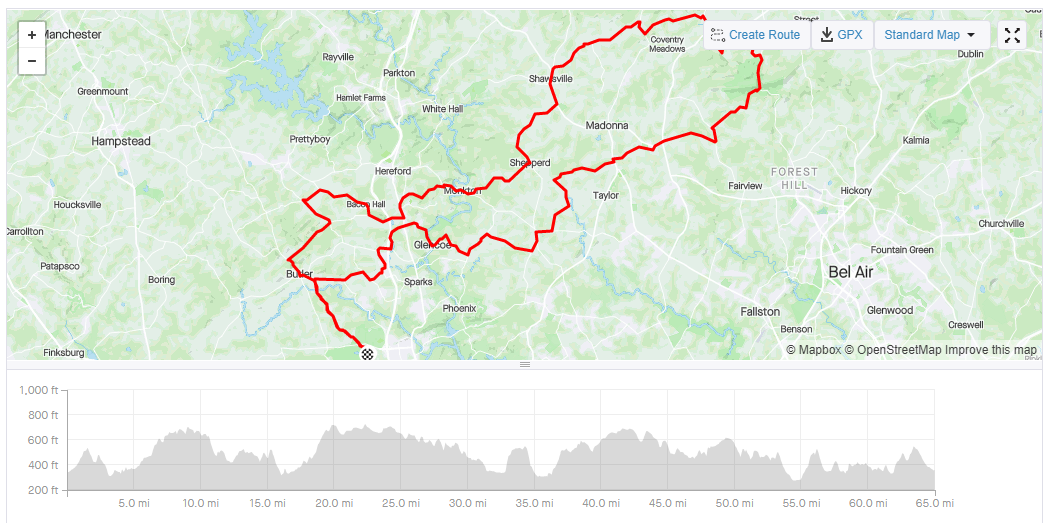
Had to get my truck serviced yesterday (oil change and recalls) which took a bunch of hours, so I brought my bike and went on a really nice ride on a wonderful day
Speaking of the truck. These folks (103 Creek Ridge Road,Greensboro, North Carolina 27406) will install lift kits from these folks. I could also do wheels and tires. Stay at Haw River State Park?
Book
Put the proposal in the Overleaf folder using proposal.tex as the root document
2:00 Meeting. We are getting very close! I need to make the TODOs vanish
SBIRs
The Delta tix did not save to PDF worth a damn, so I created a new document with screenshots that didn’t suck. Delta is horrible and expensive. I think if I have to go to Huntsville again I’ll try to take the train
Steve has many questions. Did some answering and pointed him at Microsoft Flight Simulator, which is getting more amazing all the time. It’s over 40 years old!
More stupid travel stuff. Clay suggests American for next time
Collective behavior provides a framework for understanding how the actions and properties of groups emerge from the way individuals generate and share information. In humans, information flows were initially shaped by natural selection yet are increasingly structured by emerging communication technologies. Our larger, more complex social networks now transfer high-fidelity information over vast distances at low cost. The digital age and the rise of social media have accelerated changes to our social systems, with poorly understood functional consequences. This gap in our knowledge represents a principal challenge to scientific progress, democracy, and actions to address global crises. We argue that the study of collective behavior must rise to a “crisis discipline” just as medicine, conservation, and climate science have, with a focus on providing actionable insight to policymakers and regulators for the stewardship of social systems.
Put my bids in for ICTAI-2021 reviews
GPT Agents
Building 6-epoch review, stars model – done! Need to verify they work
Daily share of news consumption on YouTube, a social media platform with more than 2 billion monthly users, has increased in the last few years. Constructing a large dataset of users’ trajectories across the full political spectrum during 2016–2019, we identify several distinct communities of news consumers, including “far-right” and “anti-woke.” Far right is small and not increasing in size over the observation period, while anti-woke is growing, and both grow in consumption per user. We find little evidence that the YouTube recommendation algorithm is driving attention to this content. Our results indicate that trends in video-based political news consumption are determined by a complicated combination of user preferences, platform features, and the supply-and-demand dynamics of the broader web.
GPT Agents
I now have 3 and 6 epoch runs for name, review, stars models.
Evaluate stars to see how much has changed
Maybe try to train up a bigger model? Start with the xl model and step back to find the largest model that will fit. Then train that with the name, review, stars corpora
Nope, the 117m model is the biggest that will fit. When I’ve got the time try the Huggingface Course and see how to do cloud training
3:00 Meeting. Went over results and the mapping tool proposal
Need to adjust the counts to relative percent for easier compare
Try training a model from scratch on the stars/votes corpora? Thaty way we could see if it learns the ratios better. This could be an artifact from finetuning
Create models for review+star since the name sets up the review
SBIRs
Sprint planning
Plan LM Epic – DSR-646
SMD conference – DSR-645
Long-ish chat with Rukan about transforms in scene graphs
The successes of deep learning critically rely on the ability of neural networks to output meaningful predictions on unseen data — generalization. Yet despite its criticality, there remain fundamental open questions on how neural networks generalize. How much do neural networks rely on memorization — seeing highly similar training examples — and how much are they capable of human-intelligence styled reasoning — identifying abstract rules underlying the data? In this paper we introduce a novel benchmark, Pointer Value Retrieval (PVR) tasks, that explore the limits of neural network generalization. While PVR tasks can consist of visual as well as symbolic inputs, each with varying levels of difficulty, they all have a simple underlying rule. One part of the PVR task input acts as a pointer, giving the location of a different part of the input, which forms the value (and output). We demonstrate that this task structure provides a rich testbed for understanding generalization, with our empirical study showing large variations in neural network performance based on dataset size, task complexity and model architecture. The interaction of position, values and the pointer rule also allow the development of nuanced tests of generalization, by introducing distribution shift and increasing functional complexity. These reveal both subtle failures and surprising successes, suggesting many promising directions of exploration on this benchmark.
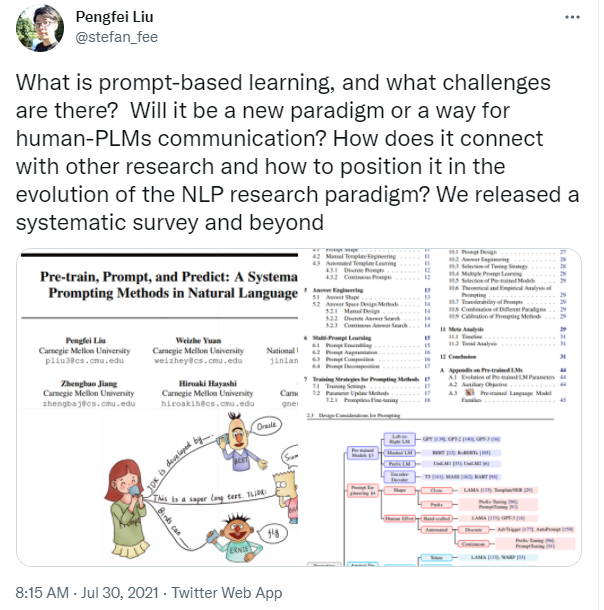
This paper surveys and organizes research works in a new paradigm in natural language processing, which we dub “prompt-based learning”. Unlike traditional supervised learning, which trains a model to take in an input x and predict an output y as P(y|x), prompt-based learning is based on language models that model the probability of text directly. To use these models to perform prediction tasks, the original input x is modified using a template into a textual string prompt x’ that has some unfilled slots, and then the language model is used to probabilistically fill the unfilled information to obtain a final string x, from which the final output y can be derived. This framework is powerful and attractive for a number of reasons: it allows the language model to be pre-trained on massive amounts of raw text, and by defining a new prompting function the model is able to perform few-shot or even zero-shot learning, adapting to new scenarios with few or no labeled data. In this paper we introduce the basics of this promising paradigm, describe a unified set of mathematical notations that can cover a wide variety of existing work, and organize existing work along several dimensions, e.g.the choice of pre-trained models, prompts, and tuning strategies. To make the field more accessible to interested beginners, we not only make a systematic review of existing works and a highly structured typology of prompt-based concepts, but also release other resources, e.g., a website this http URL including constantly-updated survey, and paperlist.
Sentence Transformers is a framework for sentence, paragraph and image embeddings. This allows to derive semantically meaningful embeddings (1) which is useful for applications such as semantic search or multi-lingual zero shot classification. As part of Sentence Transformers v2 release, there are a lot of cool new features:
Sharing your models in the Hub easily.
Widgets and Inference API for sentence embeddings and sentence similarity.
Better sentence-embeddings models available (benchmark and models in the Hub).
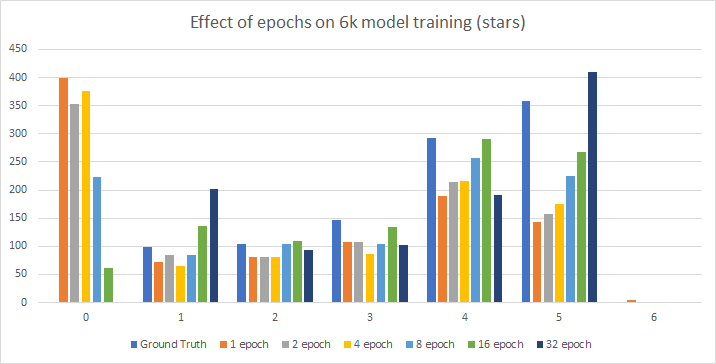
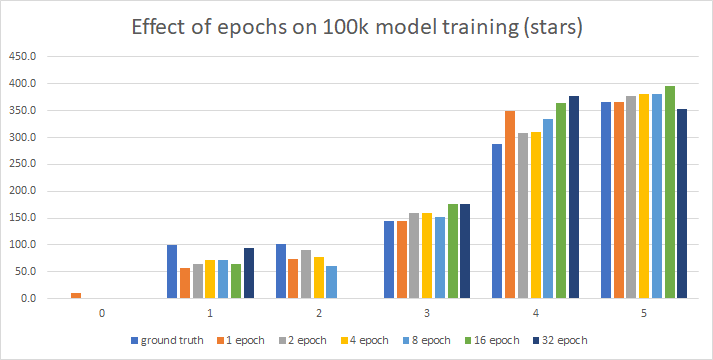
Finished the 6k epoch tests yesterday. Maybe finish creating models for 100k today?
SBIR
Abstract! Done!
See how Rukan is doing. Tell him about cubes and other shapes – done. Looks good
Book
Meeting with Michelle at 2:00. Worked on the positioning statement. It’s almost ready to go to an agent!
Community-level bans are a common tool against groups that enable online harassment and harmful speech. Unfortunately, the efficacy of community bans has only been partially studied and with mixed results. Here, we provide a flexible unsupervised methodology to identify in-group language and track user activity on Reddit both before and after the ban of a community (subreddit). We use a simple word frequency divergence to identify uncommon words overrepresented in a given community, not as a proxy for harmful speech but as a linguistic signature of the community. We apply our method to 15 banned subreddits, and find that community response is heterogeneous between subreddits and between users of a subreddit. Top users were more likely to become less active overall, while random users often reduced use of in-group language without decreasing activity. Finally, we find some evidence that the effectiveness of bans aligns with the content of a community. Users of dark humor communities were largely unaffected by bans while users of communities organized around white supremacy and fascism were the most affected. Altogether, our results show that bans do not affect all groups or users equally, and pave the way to understanding the effect of bans across communities.
SBIR
9:15 standup – nope
Write abstract!
GPT Agents
Creating spreadsheets to see how the different epochs affect accuracy in addition to format.
Running all the models (1 – 32 epochs) and putting the results in the database









You must be logged in to post a comment.