We present a new dataset of Wikipedia articles each paired with a knowledge graph, to facilitate the research in conditional text generation, graph generation and graph representation learning. Existing graph-text paired datasets typically contain small graphs and short text (1 or few sentences), thus limiting the capabilities of the models that can be learned on the data. Our new dataset WikiGraphs is collected by pairing each Wikipedia article from the established WikiText-103 benchmark (Merity et al., 2016) with a subgraph from the Freebase knowledge graph (Bollacker et al., 2008). This makes it easy to benchmark against other state-of-the-art text generative models that are capable of generating long paragraphs of coherent text. Both the graphs and the text data are of significantly larger scale compared to prior graph-text paired datasets. We present baseline graph neural network and transformer model results on our dataset for 3 tasks: graph -> text generation, graph -> text retrieval and text -> graph retrieval. We show that better conditioning on the graph provides gains in generation and retrieval quality but there is still large room for improvement.
Truck stuff – need to verify that they know it’s a 2016
Reviewing papers
SBIRs
Continuing to work on Svelte. Trying to get previous useful lessons to show up as pages, but they are svelte files, not HTML, so I’m not sure how to point to them
Pre-meeting
Scheduling. Orest wants to finish Oct 29, but we’re already a week into September, so I’m going to counter with Nov 5
Get slides done for Thurs meeting. Tried to get MARCOM to help with formatting, but the fuse is too short
Orest set up a meeting that conflicts with the GPT meeting. Trying to get him to move it, otherwise send a note that I will be about 15 min late
GPT Agents
Go over untrained model results
See if we can make the chess models talk about having tea with the Queen
Neural networks have been adapted to leverage the structure and properties of graphs. We explore the components needed for building a graph neural network – and motivate the design choices behind them.
Book
Working on tweaks for today’s meeting
2:00 Meeting
SBIRs
Continue with Svelte
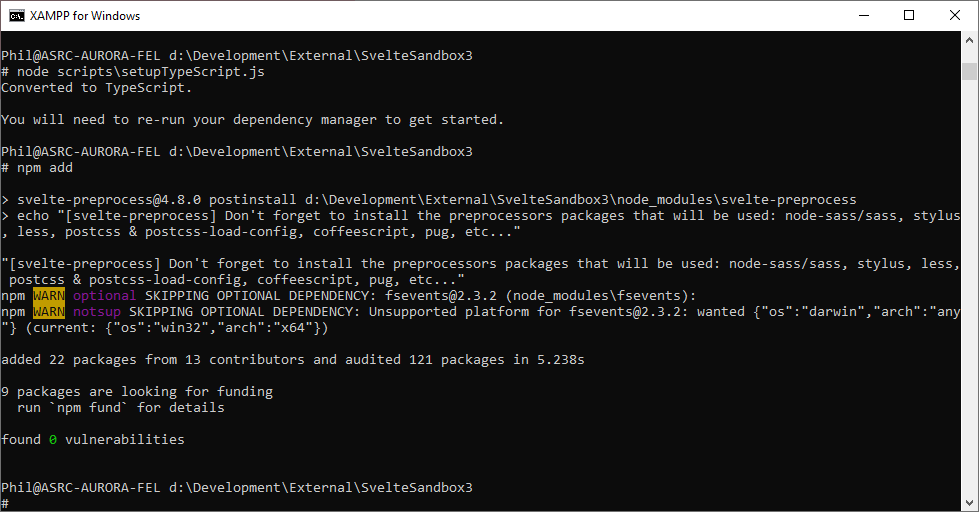
I seem to have been able to get typescript set up and running:
Work on finding a venue for the automating imagination paper
OED Definition of imagination:
The power or capacity to form internal images or ideas of objects and situations not actually present to the senses, including remembered objects and situations, and those constructed by mentally combining or projecting images of previously experienced qualities, objects, and situations. Also (esp. in modern philosophy): the power or capacity by which the mind integrates sensory data in the process of perception.
Also, using GNNs as ways of storing the relationships between the text generated by the GPT
No public health authority should rely on an AI system to make recommendations, of course. But as they grow in power and reach, AI systems could become another tool in leaders’ belts, allowing them to quickly parse existing scientific knowledge for insights that could help to guide in-the-moment decision-making. As the systems become better at citing their sources and explaining their output, their value as tools for guiding decision-making will only grow, because the validity of their predictions can be checked and vetted.
SBIRs
7:30 Meeting with Zach. I’m going to see if he agrees with the “front-end-first” approach I’d like to try. He agrees, so I’m working my way through the tutotial
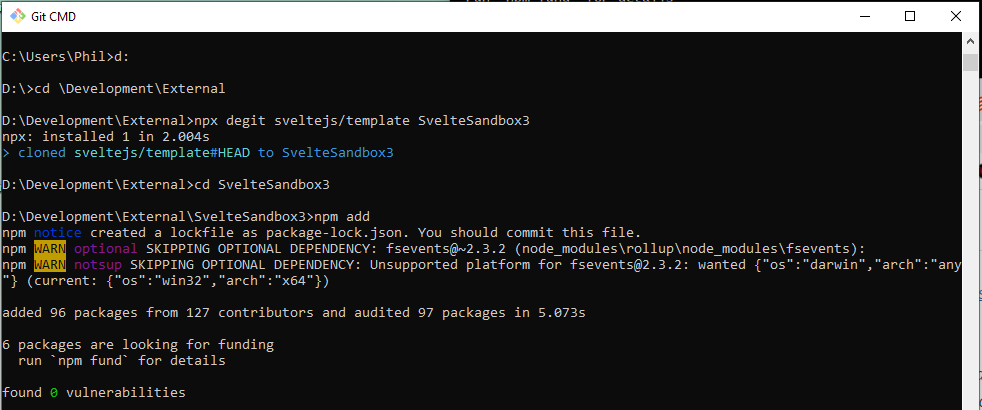
To install a template project as per here, you have to use the git command line app
Installing the template project from the GIT command line
That creates the following structure:
Project structure in IntelliJ
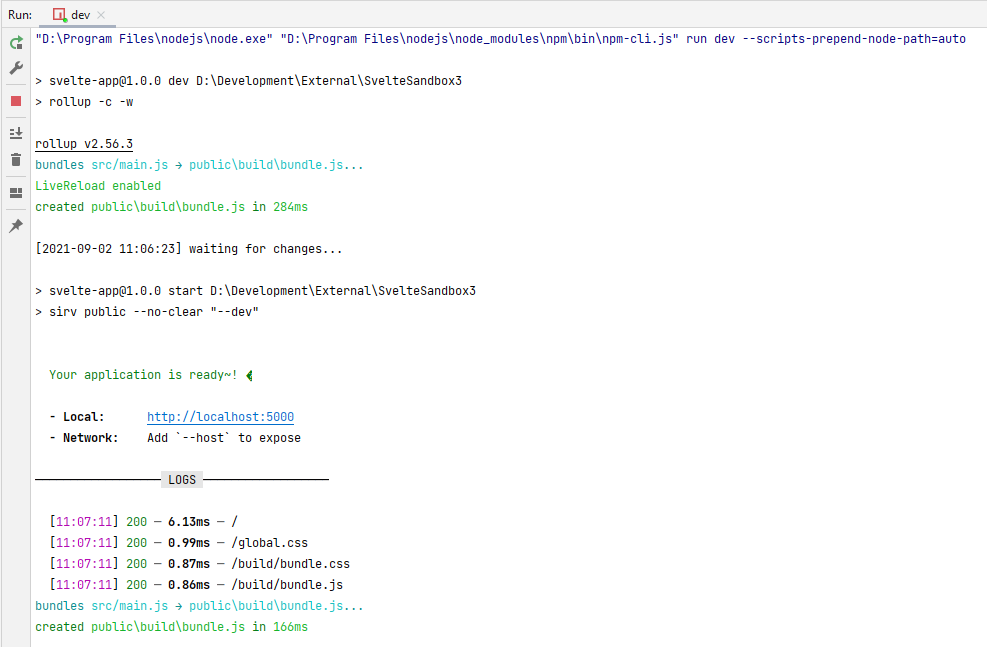
Then to run the app, I use the terminal and use <ctrl> enter:
Getting things running
This handles hot deployment in the browser, so I think I’m doing it right?
Looking more deeply at Svelte and thinking about building a standalone frontend that doesn’t interact with websockets, but fakes the functionality so that when the Python connections are added in it works?
So we’re officially done in Afghanistan now? One of these years, I’m going to try to figure out what the response to 9/11 cost, what the expectations were, and what actually happened
SBIRs
Working with Zach on the webapp. We may be able to do all this with websockets and no server
Sprint planning – done
Starting on websockets. Installed websockets. I installed asyncio, but it’s part of Python. That’s nice! Uninstalled and everything still works
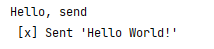
The hello world works!
Took a detour down SSL and got stuck on cert format issues? Look at that later
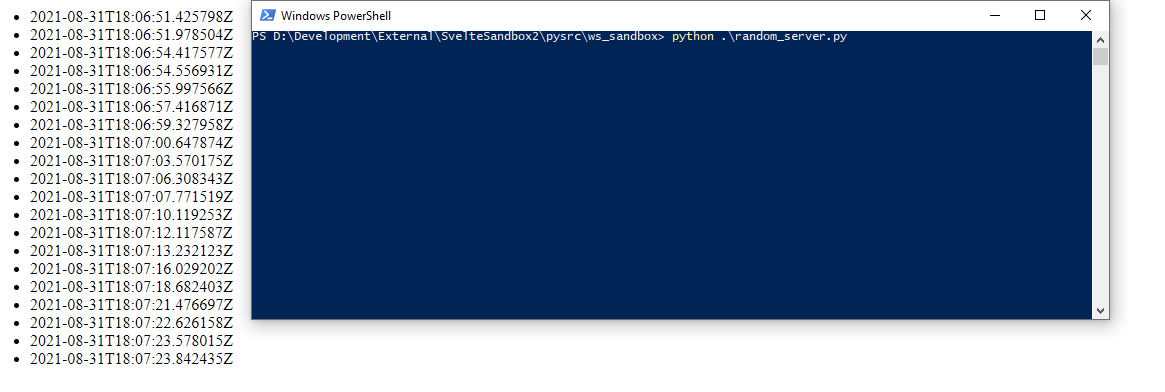
Sending data to the browser:
That works too!
GPT-Agents
Still cranking on generating reviews with the untrained model
3:00 Meeting. Made a bet with Shimei that the 800k chess model has forgotten that the Queen could drink tea. We’ll see if we can prompt the model to talk about something other than chess next week
If you want to summarize your research in a sentence… have an AI do it. SciTLDR sums up papers given an abstract, intro & conclusion. And it works impressively well: https://scitldr.apps.allenai.org (Via Twitter)
Recently, many datasets have been proposed to test the systematic generalization ability of neural networks. The companion baseline Transformers, typically trained with default hyper-parameters from standard tasks, are shown to fail dramatically. Here we demonstrate that by revisiting model configurations as basic as scaling of embeddings, early stopping, relative positional embedding, and Universal Transformer variants, we can drastically improve the performance of Transformers on systematic generalization. We report improvements on five popular datasets: SCAN, CFQ, PCFG, COGS, and Mathematics dataset. Our models improve accuracy from 50% to 85% on the PCFG productivity split, and from 35% to 81% on COGS. On SCAN, relative positional embedding largely mitigates the EOS decision problem (Newman et al., 2020), yielding 100% accuracy on the length split with a cutoff at 26. Importantly, performance differences between these models are typically invisible on the IID data split. This calls for proper generalization validation sets for developing neural networks that generalize systematically. We publicly release the code to reproduce our results.
SBIRs
Got the client communicating with the server using Websockets and the server relaying those messages to RabbitMQ!
Travel-time prediction constitutes a task of high importance in transportation networks, with web mapping services like Google Maps regularly serving vast quantities of travel time queries from users and enterprises alike. Further, such a task requires accounting for complex spatiotemporal interactions (modelling both the topological properties of the road network and anticipating events — such as rush hours — that may occur in the future). Hence, it is an ideal target for graph representation learning at scale. Here we present a graph neural network estimator for estimated time of arrival (ETA) which we have deployed in production at Google Maps. While our main architecture consists of standard GNN building blocks, we further detail the usage of training schedule methods such as MetaGradients in order to make our model robust and production-ready. We also provide prescriptive studies: ablating on various architectural decisions and training regimes, and qualitative analyses on real-world situations where our model provides a competitive edge. Our GNN proved powerful when deployed, significantly reducing negative ETA outcomes in several regions compared to the previous production baseline (40+% in cities like Sydney).
I think that the GNNs should be usable to produce the maps themselves. Need to try this with simulation
Created a folder for Graph Neural Network research
Ride down to DC today for this and hopefully not get wet!
Isaac Gym offers a high performance learning platform to train policies for wide variety of robotics tasks directly on GPU. Both physics simulation and the neural network policy training reside on GPU and communicate by directly passing data from physics buffers to PyTorch tensors without ever going through any CPU bottlenecks. This leads to blazing fast training times for complex robotics tasks on a single GPU with 2-3 orders of magnitude improvements compared to conventional RL training that uses a CPU based simulator and GPU for neural networks. We host the results and videos at this https URL and isaac gym can be downloaded at this https URL.
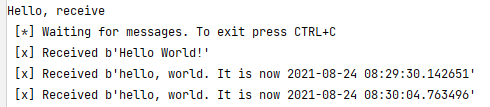
Update repo and switch to dev. Verify that everything still works – it does! And receives messages as well. Oddly it seems to b e splitting the messages between the Python and TypeScript listeners:
SveltKit console logs are black and Python is blue
GPT Agents
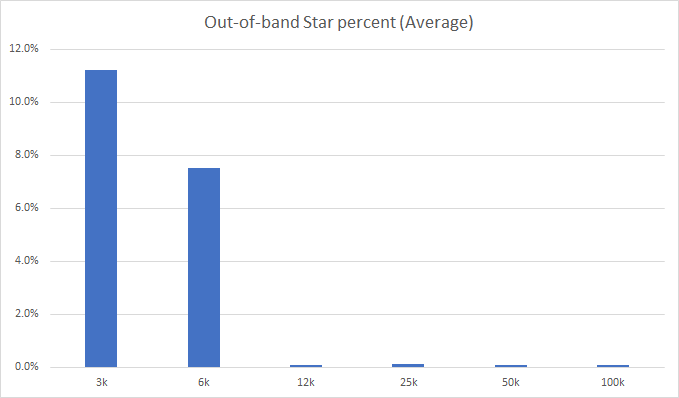
Make some spreadsheets that compare the stars/sentiment properties of the relative models. Done. The models are remarkably stable, even down to 3k. They make more mistakes with the specific meta training but that seems to be about it?
Trying to generate reviews from the untrained gpt2 models. The 117M model was (probably?) too small, so I’m trying the 774M model without finetuning. It requires two passes – the first creates the review (using a bigger prompt), and then I use the result and tack on “{}. I give it a star rating of“. Then I need to parse the ratings, which can be numbers or strings. I’ve kind of run out of energy so I’ll finish later.
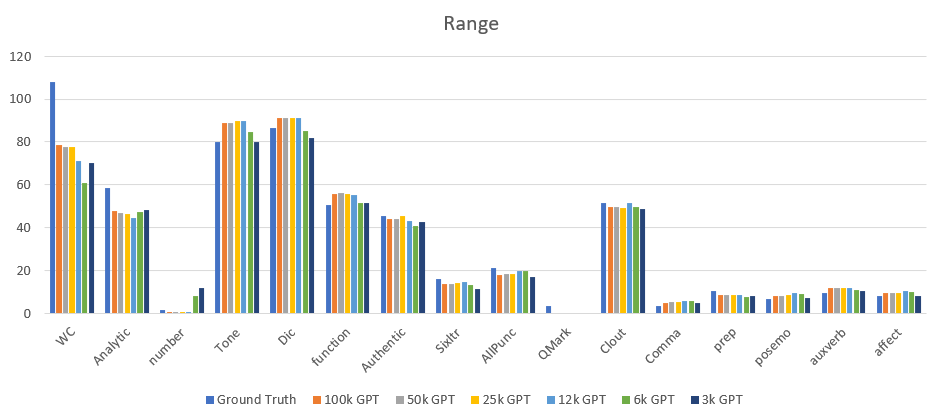
Brought all the model outputs from LIWC (manual here) and put them into a single spreadsheet. All the models are surprisingly stable, except for word count (WC):
Largest variation from max to min
Here are some values beyond WC:
Analytical thinking — a high number reflects formal, logical, and hierarchical thinking; lower numbers reflect more informal, personal, here-and-now, and narrative thinking
Clout — a high number suggests that the author is speaking from the perspective of high expertise and is confident; low Clout numbers suggest a more tentative, humble, even anxious style.
Authentic — higher numbers are associated with a more honest, personal, and disclosing text; lower numbers suggest a more guarded, distanced form of discourse.
Emotional tone — a high number is associated with a more positive, upbeat style; a low number reveals greater anxiety, sadness, or hostility. A number around 50 suggests either a lack of emotionality or different levels of ambivalence
Need to get the spreadsheets built for the 3k and 6k models. Done. This is pretty cool:
Build a spreadsheet (and template?) for the LWIWC data
SBIRs
7:30 meeting with Zach. Good progress. We’re almost using RabbitMQ to talk between server-side TypeScript and server-side Python. And we made a cool diagram
Matter evolved under the influence of gravity from minuscule density fluctuations. Nonperturbative structure formed hierarchically over all scales and developed non-Gaussian features in the Universe, known as the cosmic web. To fully understand the structure formation of the Universe is one of the holy grails of modern astrophysics. Astrophysicists survey large volumes of the Universe and use a large ensemble of computer simulations to compare with the observed data to extract the full information of our own Universe. However, to evolve billions of particles over billions of years, even with the simplest physics, is a daunting task. We build a deep neural network, the Deep Density Displacement Model (D3M3), which learns from a set of prerun numerical simulations, to predict the nonlinear large-scale structure of the Universe with the Zel’dovich Approximation (ZA), an analytical approximation based on perturbation theory, as the input. Our extensive analysis demonstrates that D3MD3M outperforms the second-order perturbation theory (2LPT), the commonly used fast-approximate simulation method, in predicting cosmic structure in the nonlinear regime. We also show that D3MD3M is able to accurately extrapolate far beyond its training data and predict structure formation for significantly different cosmological parameters. Our study proves that deep learning is a practical and accurate alternative to approximate 3D simulations of the gravitational structure formation of the Universe.
GPT-Agents
Generating content for the small-corpora models. 6k is done, working on 3k done
Generated sentiment
Do this to speed up the load of a mysql database (via stackoverflow)
mysql> use db_name;

mysql> SET autocommit=0 ; source the_sql_file.sql ; COMMIT ;
Need to get the spreadsheets built for the 3k and 6k models
Build a spreadsheet (and template?) for the LWIWC data
Sent Shimei reviews from the 50k, 25k, 12k, 6k, and 3k models
One of the really observable results is that the model tends to amplify the number of items that exist in larger quantities in the training corpora and reduce the number of items that are less common in the corpora. However, the tokens within a review seem to be unchanged. The average number of stars associated with a POSITIVE or NEGATIVE review seem very resilient.
SBIRs
Meeting with Zach – nope, need to delay until tomorrow
Need to look at this article in Science that does some multidimensional similarity mapping between COVID-19 variants.
Derek Smith, an evolutionary biologist at the University of Cambridge, has worked for decades on visualizing immune evasion in the influenza virus in so-called antigenic maps. The farther apart two variants are on Smith’s maps, the less well antibodies against one virus protect against the other. In a recently published preprint, Smith’s group, together with David Montefiori’s group at Duke University, has applied the approach to mapping the most important variants of SARS-CoV-2
Shape space was proposed over 20 years ago as a conceptual formalism in which to represent antibody/antigen binding. It has since played a key role in computational immunology. Antigens and antibodies are considered to be points in an abstract “shape space”, where coordinates of points in this space represent generalized physico-chemical properties associated with various (unspecified) physical properties related to binding, such as geometric shape, hydrophobicity, charge, etc. Distances in shape space between points representing antibodies and (the shape complement) of antigens are assumed to be related to their affinity, with small distances corresponding to high affinity.
In this paper, we provide algorithms, related to metric and ordinal multidimensional scaling algorithms first developed in the mathematical psychology literature, which construct explicit, quantitative coordinates for points in shape space given experimental data such as hemagglutination inhibition assays, or other general affinity assays. Previously, such coordinates had been conceptual constructs and totally implicit. The dimension of shape space deduced from hemagglutination inhibition assays for influenza is low, approximately five dimensional.
The deduction of the explicit geometry of shape space given experimental affinity data provides new ways to quantify the similarity of antibodies to antibodies, antigens to antigens, and the affinity of antigens to antibodies. This has potential utility in, e.g. strain selection decisions for annual influenza vaccines, among other applications. The analysis techniques presented here are not restricted to the analysis of antibody–antigen interactions and are generally applicable to affinity data resulting from binding assays.
SBIR(s)
Meeting with Zach on the Webapp Framework. Made a lot of progress, though I only kind of know what’s going on. We were able to access MySQL on the server and add a D3 chart:
Behold! SvelteKit with D3 and MySql!
Working on the NASA proposal
GPT Agents
Make spreadsheets for other models and compare to 100k
“Before we say “explainable AI” we must decide WHAT is it that we wish to explain. Are we about to explain the function that the system fitted to the data? or are we about to explain the world behind the data? Science writers seem unaware of the difference.” – Judea Pearl
From the syllabus: To realize the dreams and impact of AI requires autonomous systems that learn to make good decisions. Reinforcement learning is one powerful paradigm for doing so, and it is relevant to an enormous range of tasks, including robotics, game playing, consumer modeling and healthcare. This class will provide a solid introduction to the field of reinforcement learning and students will learn about the core challenges and approaches, including generalization and exploration. Through a combination of lectures, and written and coding assignments, students will become well versed in key ideas and techniques for RL. Assignments will include the basics of reinforcement learning as well as deep reinforcement learning — an extremely promising new area that combines deep learning techniques with reinforcement learning.
GPT-Agents
Generate synthesized data – running
Calculate sentiment
Create spreadsheets (make a new directory for review-stars)
SBIR(s)
9:15 standup – done
10:30 NASA meeting – done Write up a 3 page version that describes a minimum viable project and then future work that extends the MVP
Ping Zach for a meeting to set up project – done
Start framing out paper on Overleaf – done
EXPENSE REPORT – this is chewing up hours. I STILL don’t have a code that works











You must be logged in to post a comment.