Run each through the “vegetarian” options. I’m really curious how LIWC will look at the outputs of the models with relation to each other, and to the ground truth. Also get the counts of the occurrences of each prompt in the GT by star rating. My guess is that it won’t show up in some of the cases, which sets up the Twitter section really well.
4:15 Meeting
SBIRs
Fix duplicate entries in the DB topic file – done
Back up db – done
Create superclass that has most of the parts and then subclass the various implementations (Full, BuildView, ViewScript) – done
Work with Aaron on the stories/maps? Also, what is our plan for the paper? In process
WordPress has some serious lag. Need to back this up
GPT Agents
Delayed meeting until Friday. That should give me time to get the balanced data working and compare baseline models to the baseline data (American)
And the balanced data still isn’t working. I think that there are more paths to good reviews, so the GPT, even when fed balanced data generates unbalanced results. Training up single star models to verify this
Also, write a first pass on the introduction that uses the vegetarian Yelp as an example, and then set up to explain the method
Do I still need to train x-star models?
SBIRs
9:15 Standup
11:00 LAIC
Get the script running for the current map to show at the meeting today – done!
…clearly Biden was a net drag on McAuliffe. Overall, Virginians disapproved of Biden’s handling of the presidency by a 10-point margin, with nearly half saying they “strongly disapprove” — double the percentage who strongly approved. Nearly 3 in 10 Virginia voters said their vote was meant to express opposition to Biden, network exit polls found, compared to the 2 in 10 who said their vote was to express support for Biden. The economy was by far the most important issue driving Virginia voters, and people who put the economy at the top of their list favored Youngkin by a dozen percentage points. (Washington Post)
I just found this: https://github.com/google-research/tiny-differentiable-simulator It appears to be a NN-enhanced physics sim: “TDS can run thousands of simulations in parallel on a single RTX 2080 CUDA GPU at 50 frames per second:“ Here are the relevant papers:
“NeuralSim: Augmenting Differentiable Simulators with Neural Networks”, Eric Heiden, David Millard, Erwin Coumans, Yizhou Sheng, Gaurav S. Sukhatme. PDF on Arxiv
“Augmenting Differentiable Simulators with Neural Networks to Close the Sim2Real Gap”, RSS 2020 sim-to-real workshop, Eric Heiden, David Millard, Erwin Coumans, Gaurav Sukhatme. PDF on Arxiv and video
“Interactive Differentiable Simulation”, 2020, Eric Heiden, David Millard, Hejia Zhang, Gaurav S. Sukhatme. PDF on Arxiv
Finished training the balanced model and am re-running the original prompts
A really negative prompt will produce a low review distribution. Here’s an example of GPT generating reviews in response to a slightly negative set of prompts ([there are absolutely no vegetarian options], [there is not a single vegetarian option on the menu], [the menu has no vegetarian options]), compared with the ground truth of the Yelp database returning reviews and ratings that match the string ‘%no vegetarian options%‘:
Average star ratings
The distribution of star ratings is obviously different too:
As you can see on the right, the ground truth is distinctly different. The correlation coefficient between the two distributions on the right is -0.4, while it’s well above 0.9 when comparing any of the three distributions to the left.
So it’s clear that the model has a bias towards positive reviews. In fact, if you look at the baseline distribution from the first 1,000 reviews of restaurants in the ‘American’ category, we can see the underlying distribution that the model was trained on:
Star bias in the data
The new question to answer is what happens to the responses when the training data is balanced for stars? Also, I realize that I need to run a pass through the models with just a ‘review:‘ prompt.
Dammit, the ‘balanced’ training corpora isn’t. Need to fix that and re-train
Bad data
4:15 Meeting
SBIRs
MDA costing meeting
Work on building first pass map. It’s actually working pretty well! Need to write an example script for tomorrow
Create balanced (20k each) star corpora and train – done
Create low star corpora and train (1, 2, 3?)
Installed sentence-transformers, which probably broke sentiment.
SBIRs
Integrate TextComparePopup and try making a map. I’m pretty sure that there will be issues about putting topics into groups and listing topics from different groups – done, and seems to be working well. Tomorrow we try for real?
Spreadsheets for vegetarian 100k GT vs GT vs synth. Everything is good except for ‘no vegetarian options’ It’s the only options that does not appear in the first 100k rows. Going to try some longer prompts to see if I can nudge the model in a better direction. Do that at lunch
Hmmm. I can’t seem to produce a negative star distribution:
Building the db table/store for the NZ tweets – done. After screwing up the insert arguments, I’m running a 1k set of synthetic tweets to evaluate the test field.
As a J&J recipient, today is booster day! I will become a cocktail of J&J/Moderna antibodies at 10:00. Hopefully my wifi reception will improve dramatically with these new chips.
Leave NLT 9:15
GPT Agents
Run some other variations, or show that the usage of “several vegetarian options” is normal speech. The phrase ‘%vegetarian options%’ has 79 reviews in the training set and 4,911 in the holdout set. Going to do a quick boxplot to see if there’s much difference.
Pretty much what I expected – very hard to evaluate any difference:
Probably not a good example
Running ‘some vegetarian options’ and ‘no vegetarian’ on the 100k American model. It turns out that I ran the default ‘review:’ probe yesterday
SBIRs
Getting the separate behavior for the cmdr and sbrd nodes to work. Rather than having them bounce around, I need to have them head to targets at a speed. That means rewriting bits of Moveable node. Done!
Added a boxplot to the TextSimilarity framework. Might show at the meeting today?
Get the script tied into node display. Having some issues. Thinking about having an animated commander and subordinate node moving across the map
Set enum types for ForceNodes and MoveableNodes. Tomorrow I’ll add cmdr and sbrd nodes and try moving them around. This will need a setup() method in ScriptFrame that adds them as MoveableNodes
Try to get the query and probe for “%several vegetarian options%” running. This data is used in the “Why use this technique?” section of the introduction.
From the database
Run American 100k model with the prompt “several vegetarian options” and pull into spreadsheet – done. It looks good, too:
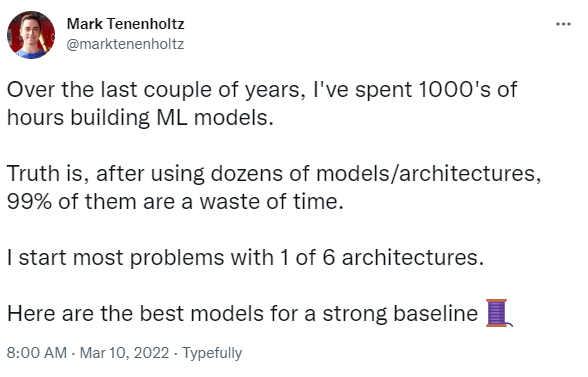
When evaluating models, you should pick the smallest one that can deliver the accuracy you need. It will predict faster and require fewer hardware resources for training and inference. Frugality goes a long way.
GPT Agents
Added some content to the paper
Meeting. Need to compare the stars from something like “%ethnic vegan%” that doesn’t appear much in the training set but shows up significantly in the later data and compare that to the gpt for the prompt “ethnic vegan”
SBIRs
Stories! Done!
Work with Aaron on document similarity
Add script section
Create initial maps
Plus one of heatmap
Fix bug that doesn’t save details
Sprint planning
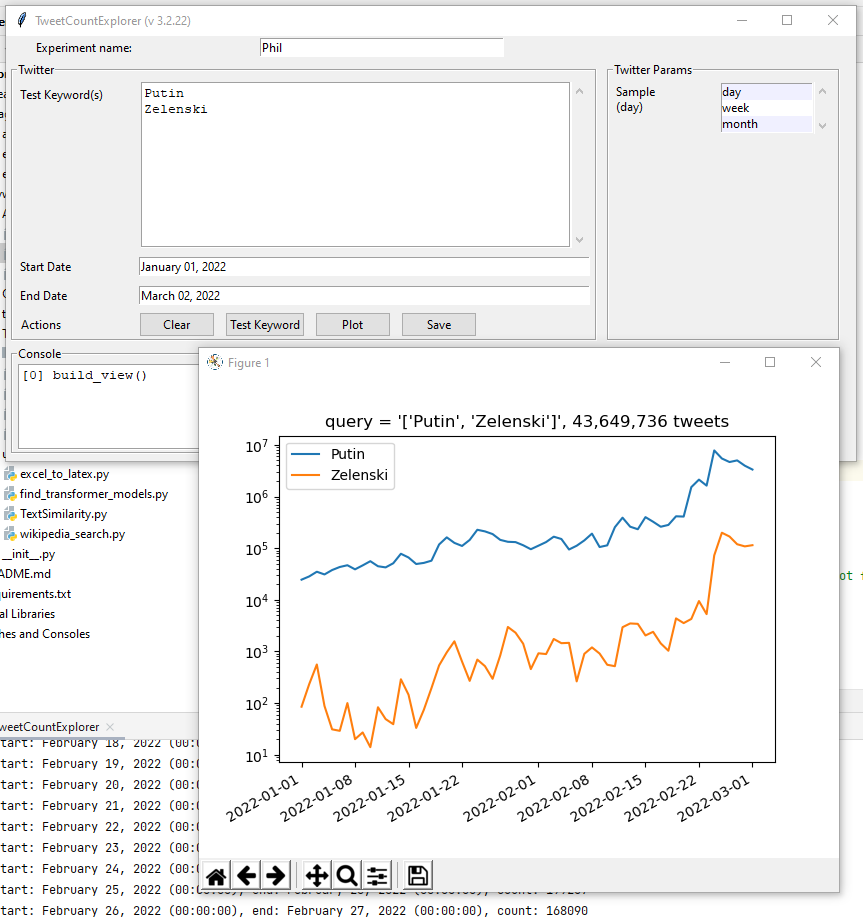
I have a much bigger application:
Now with hooks for showing a script!
Got a primitive script generator working. Next will be to load it and navigate a map
Do another review, and do something in the introduction that works with the idea that we are barely individuals. How that changes from childhood through adulthood to old age, and how technology has had a huge impact
SBIRs
9:15 Standup
3:00 Army
Timesheets!
GPT-Agents
Run the new LIWC data and generate two spreadsheets. One with the word numbers and one with the default settings. Done
A central goal of artificial intelligence in high-stakes decision-making applications is to design a single algorithm that simultaneously expresses generalizability by learning coherent representations of their world and interpretable explanations of its dynamics. Here, we combine brain-inspired neural computation principles and scalable deep learning architectures to design compact neural controllers for task-specific compartments of a full-stack autonomous vehicle control system. We discover that a single algorithm with 19 control neurons, connecting 32 encapsulated input features to outputs by 253 synapses, learns to map high-dimensional inputs into steering commands. This system shows superior generalizability, interpretability and robust-ness compared with orders-of-magnitude larger black-box learning systems. The obtained neural agents enable high-fidelity autonomy for task-specific parts of a complex autonomous system.
In “Uncertainty Baselines: Benchmarks for Uncertainty & Robustness in Deep Learning”, we introduce Uncertainty Baselines, a collection of high-quality implementations of standard and state-of-the-art deep learning methods for a variety of tasks, with the goal of making research on uncertainty and robustness more reproducible. The collection spans 19 methods across nine tasks, each with at least five metrics. Each baseline is a self-contained experiment pipeline with easily reusable and extendable components and with minimal dependencies outside of the framework in which it is written. The included pipelines are implemented in TensorFlow, PyTorch, and Jax. Additionally, the hyperparameters for each baseline have been extensively tuned over numerous iterations so as to provide even stronger results.
Book
Twitter and Tear Gas
SBIRs
Adding optional buttons to TopicCombo so it’s possible to add a topic and not set a seed.
Need to check for the case where I am adding a topic to the group that provided the seed. No need to link to yourself
Save graph to DB, hopefully
Woohoo!
Taking a break
Saving the full graph to the DB!
How it looks today
I’m going to add a button to “find closest group” based on text analysis. Probably start with Doc2vec paragraph embeddings
You must be logged in to post a comment.