Category Archives: thesis

Phil 3.31.16

7:00 – 4:00 VTX

  • Starting on What is Trust? A Conceptual Analysis and An Interdisciplinary Model.
  • Starting to set up the key and sitelist repo
  • It turns out that you can export xml configuration of the CSE and the annotations for that CSE. From webapps.stackexchange.com:
  • We can only have a total of 5k annotations. That’s not a problem – yet.
  • All the files are set up and transferred. New search engines are
    ONLY_COM = "cx=006834724223295726872:k0pebqyqa8m"
    ONLY_EDU = "cx=006834724223295726872:gded1dvdt94"
    ONLY_GOV = "cx=006834724223295726872:ydjrxqpedqq"
    ONLY_ORG = "cx=006834724223295726872:lsgxnigrfme"
    ONLY_US = "cx=006834724223295726872:dw0n0_hai6s"
  • Found a more credible source than boardactions.com (possibly just for New York state? But it has VA records..). Anyway, not only does it have a nice listing, it also has a pdf of the relevant board order. Which means we can build a good legal languagge model. Very nice: http://w3.nyhealth.gov/opmc/factions.nsf/physiciansearch?openform
  • Need to rethink the PoiObject class to be more general.

Phil 3.24.16

7:00 – 10:00, 11:00 – 3:00 VTX

  • Was going to continue The Law of Group Polarization, but got sucked into the following. On a related note, I peeked at the group sensemaking paper from CSCW and realized that they are dealing with group polarization issues.
  • Soooooooooo, I went back to check the links that the google search “link:http://dotearth.blogs.nytimes.com” brings up. In looking at the pages (mostly other blog-like sites), the link to dotearth is almost always in the blogroll list that’s off to the side on many of these sites. For example look at the lower right on climatecentral.org, and you’ll see the link.
  • I think this makes sense. These are the generic pages that point to other generic pages. So I went back to Google and searched for ‘Paul Krugman blog‘ and then looked for the oldest post that I could find in the result, which was this one from January 16. Top ratings means that it has to be linked to a lot, so I tried “link:krugman.blogs.nytimes.com/2016/01/23/how-to-make-donald-trump-president/“. Alas, that doesn’t return anything, though “link:krugman.blogs.nytimes.com” does.
  • So I went to the the Wikipedia most referenced pages page. Top ranked was Geographic coordinate system, which has over 600k inbound links. But –
  • Apparently, this is Google being coy. Searching for backlinks can be expensive. Moz has plans that start at $500/month. Bing also seems to have something with an API. Starting to check that out.
    • Added philfeldman.com to my bing webmaster profile. Had to add BingSiteAuth.xml to the site.
    • Nope, looks like it’s just the verified pages
  • Looking at SEMrush. Pretty straightforward and $15 buys you 7,500 lines of results.
    • Here’s the REST-ish API
    • Here’s the first format I’ve tried:
      http://api.semrush.com/analytics/v1/?key=xxxxxxxxxxxxxxxxxxxxxx&target=boardsanctions.com/&type=backlinks&target_type=root_domain&display_sort=page_score_desc&display_limit=10
    • The first thing I tried out was on my angular blog entry, and this is what comes back:
      page_score;source_title;source_url;target_url;anchor;external_num;internal_num;first_seen;last_seen
      1;Philip Feldman;http://philfeldman.com/resume.html;https://phifel.wordpress.com/;blog;7;2;1435698192;1452178691
      1;Phil Feldman Resume (WebGL);http://philfeldman.com/;https://phifel.wordpress.com/;My Primary Blog;15;4;1424207638;1452178080
      1;Phil Feldman Resume (WebGL);http://www.philfeldman.com/;https://phifel.wordpress.com/;My Primary Blog;15;4;1435689880;1452178091
    • Pretty good! Very clean. Then I tried boardsanctions.com:
      page_score;source_title;source_url;target_url;anchor;external_num;internal_num;first_seen;last_seen
      0;Plastic Surgery - Avoiding The Nightmare Case - Social Gaming Wiki FR;http://fr.socialgamingwiki.com/index.php/Plastic_Surgery_-_Avoiding_The_Nightmare_Case;http://boardsanctions.com/;Georgia Medical Board Actions;4;32;1454582397;1454582397
      0;Plastic Surgeon - Advice To Allow You Choose – TFC;http://www.tvfc.de/index.php?printable=yes&title=Plastic_Surgeon_-_Advice_To_Allow_You_Choose;http://boardsanctions.com/;Doctors to avoid;2;28;1452634501;1452634501
      0;Finding A Plastic Surgeon In Your Area – TheorieWiki;http://theoriewiki.org/index.php?oldid=8721&title=Finding_A_Plastic_Surgeon_In_Your_Area;http://boardsanctions.com/;Ohio Medical Board Actions;4;40;1451297137;1451297137
      0;How To Prepare For Your Breast Augmentation – TheorieWiki;http://theoriewiki.org/index.php?title=How_To_Prepare_For_Your_Breast_Augmentation;http://boardsanctions.com/;Doctor Complaints;4;33;1444916428;1453210146
      0;Finding A Plastic Surgeon In Your Area: Unterschied zwischen den Versionen – TheorieWiki;http://theoriewiki.org/index.php?diff=8723&oldid=8721&title=Finding_A_Plastic_Surgeon_In_Your_Area;http://boardsanctions.com/;Florida Medical Board Sanctions;4;39;1457400844;1457400844
      0;Benutzer:FelicaAngelo06 – TheorieWiki;http://theoriewiki.org/index.php?title=Benutzer%3AFelicaAngelo06;http://boardsanctions.com/;NC Medical Board Actions;5;35;1448297485;1458043290
      0;Benutzer:FelicaAngelo06 – TheorieWiki;http://theoriewiki.org/index.php?title=Benutzer%3AFelicaAngelo06;http://boardsanctions.com/;http://boardsanctions.com/;5;35;1448297485;1458043290
      0;Benutzer:FelicaAngelo06 – TheorieWiki;http://theoriewiki.org/index.php?printable=yes&title=Benutzer%3AFelicaAngelo06;http://boardsanctions.com/;NC Medical Board Actions;5;30;1456257160;1457931212
      0;Benutzer:FelicaAngelo06 – TheorieWiki;http://theoriewiki.org/index.php?printable=yes&title=Benutzer%3AFelicaAngelo06;http://boardsanctions.com/;http://boardsanctions.com/;5;30;1456257160;1457931212
      0;Finding A Plastic Surgeon In Your Area – TheorieWiki;http://theoriewiki.org/index.php?title=Finding_A_Plastic_Surgeon_In_Your_Area;http://boardsanctions.com/;Florida Medical Board Sanctions;4;33;1443858328;1457622408
    • Note that it’s a good thing I’m limiting the results to 10! The second thing to notice is every one of these links is SEO garbage. This one is my favorite. Now, this is ordered according to rank (however that’s calculated) and maybe there are better ways to order the results, but this does make me nervous about using backlinks without some checking. Maybe cosine similarity?
    • So the last thing, if we want to spend some money is to use the common crawl for backlinks. Not sure if it would make any difference, but there would be more insight. As an example, there’s wikireverse which did exactly that.

Phil 3.23.16

7:00 – 4:00 VTX

  • Continuing The Law of Group Polarization. Slow going. Mostly because there is so much good stuff.
    • Overall, I’m arguing that viewing Group Polarization through the lens of Connectivism, we can see how networked communities are often driven into bubbles and that property can be used to evaluate the trustworthiness of an information source. This has implications for design at different levels of abstraction.At the UI level, it implies that giving a user more interactive control over the makeup of their news feed can inform them about the range of diversity in views about a particular topic and where their feed falls on that spectrum. Because this implies the presence of a larger group, it it is possible to provide the user with the means (through direct manipulation) to interactively adjust the makeup of their news feeds and expose them to more trustworthy sourcesAt the document level, it imples that a mix of lexical and link analysis should be sufficient to allow for indexing a document on a trustworthiness scale.At the network level, it implies that the relationships of documents within a network should be sufficient to place documents on a trustworthiness scale.
    • Page 182 – And when one or more people in a group know the right answer to a factual question, the group is likely to shift in the direction of accuracy.
      • This is the effect of the Star Pattern. So how does someone find the right answer?
    • Looking around for automated ways of doing Delphi Method
    • Page 184: Group polarization has particular implications for insulated “outgroups” and (in the extreme case) for the treatment of conspiracies. Recall that polarization increases when group members identify themselves along some salient dimension, and especially when the group is able to define itself by contrast to another group. Outgroups are in this position-of self-contrast to others-by definition. Excluded by choice or coercion from discussion with others, such groups may become polarized in quite extreme directions, often in part because of group polarization. It is for this reason that outgroup members can sometimes be led, or lead themselves, to violent acts
    • Stopped at pg 186 – III. DELIBERATIVE TROUBLE.
  • Looking at IBM Bluemix briefly in case we have to go down that route
    • Registered.
    • Chrome, or at least the way I set up Chrome and bluemix do not get along. trying Firefox. Still not great, but better.
    • Since it looks like we’re not going to do wacky mash-ups, back to work on the rating app.
  • Hit the MySql max_packet limit. Changed to 4M. Other follow-on changes:
## of RAM but beware of setting memory usage too high
innodb_buffer_pool_size = 64M
innodb_additional_mem_pool_size = 8M
## Set .._log_file_size to 25 % of buffer pool size
innodb_log_file_size = 20M
innodb_log_buffer_size = 8M
innodb_flush_log_at_trx_commit = 1
innodb_lock_wait_timeout = 50

Phil 3.22.16

7:00 – 7:30

  • I think I want to install this??? https://github.com/dthree/cash
  • Still thinking about social trust and system trust. Today, Brussels was attacked by ISIS or ISIS sympathisers. An official when interviewed said that Belgium had been ‘prepared’ and was ready. No one was surprised that one group of people would try to kill another group of people. In other news, the iPhone from another set of killers was unflaggingly resisting attempts to unlock it. In many ways, every day (ironically because of the news) we are informed how horrible and untrustworthy people can be. And at the same time, every day, our machines generally do what they are supposed to do, and when looked at over time, get better at it. Is it any wonder that we have high system trust and low social trust (or high cynicism?).
  • This isn’t really new. Music can be pure. Musicians can be awful.
  • Continuing The Law of Group Polarization.
    • Page 181: Thus when the  context emphasizes  each  person’s  membership  in  the  social  group  engaging  in deliberation,  polarization  increases.  This finding  is  in  line  with  more  general evidence  that social  ties  among  deliberating  group  members  tend  to  suppress dissent  and  in  that  way  to  lead  to  inferior  decisions.
      • So a website with a strong point of view (Breitbart or Moveon or PETA for example) should have less variance among commenters, while more balanced should have more variance? Data may be here: http://www.journalism.org/2014/10/21/political-polarization-media-habits/. I would think that these could be compared against edit histories on Wikipedia for a more Star-like pattern?
    • Persuasive Arguments Theory (PAT)?
    • Interaction with others increases decision confidence but not decision quality: evidence against information collection views of interactive decision making.
      • So in this case, the paper was scanned and protected, so I couldn’t do OCR on it. The workaround was to export as jpg, then open the first jpg in Acrobat DC, select Tools->organize pages then Inset->from file, shift-click all the pages, select ‘insert after’ and read them in. Once that’s done go to ‘Enhance scans’ and run OCR on the file.
      • Anyway, the paper looks interesting, with quantitative support. I wonder why all this research seems to be focussed in the 1990s through early 2000s? The Wikipedia page on Group Polarization has a wider date range.
  • Working on the rating app. Worried that jsoup doesn’t seem to be pulling down pages that well
    • Got a 403 on https://stackoverflow.com/questions/10716828/joptionpane-showconfirmdialog using URL.openStream, but it works on Google.
    • Going to try a more web-scapey pattern. Checking out Jaunt.
  • Changing the selection lists
  • Adding a check to see what ratings have changed as a user check – Done
  • Need to start on the backlinks.
  • Meeting with Aaron about next steps based on the

Phil 3.18.16

7:30 – 4:00 VTX

  • Continuing Presenting Diverse Political Opinions: How and How Much – Finished. Wow.
    • Some subjects wrote that they specifically did not want a list of solely supportive  items and that they want opinion aggregators to represent a fuller spectrum of items, even if that includes challenge.
      • So here I’m wondering if interactivity in presenting the contents of the stories could be used as a proxy for these kinds of answers. Consistently setting values one way could mean more bubbly, while more change could imply star.
    • BubbleVsStarBehaviorMaybe
    • BubbleVsStarBehaviorMaybe2
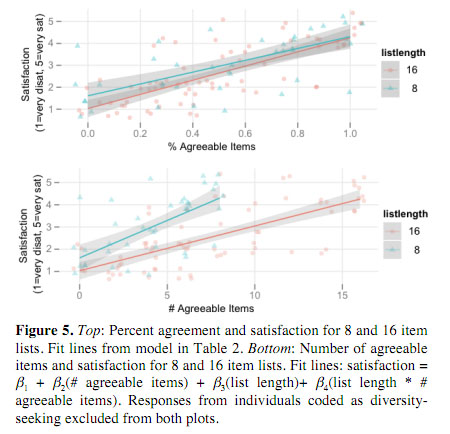
    • In a plot of the percent agreeable items and satisfaction (Figure 5, top), the slope of the fit lines for the two list lengths follow each other quite closely, suggesting that count does not matter. When we plot the number of agreeable items (Figure 5, bottom), we can see a clear divergence. Furthermore, 2 agreeable items out of a total of 8 is superior to 2 agreeable items out of a total of 16(t(7.373) = 3.3471,  p<0.05). Clearly, the  presence of challenging items, not just the count of agreeable items,drives satisfaction. We conclude that the remaining subjects as  a group are  challenge-averse, though a few individuals may be support-seeking
  • News aggregator API list: http://www.programmableweb.com/category/News%20Services/apis?category=20250. I’m wondering if a study of slider ranking hooked up to a news aggregator feed might be useful.
  • Still working on the test harness to exercise the GoogleCSE.
  • Added command line args
  • Fixed stupid threading errors.
  • Checked in.

Phil 3.11.16

8:00 – VTX

  • Created new versions of the Friday crawl scheduler, one for GOV, one for ORG.
  • The gap between inaccurate viral news stories and the truth is 13 hours, based on this paper: Hoaxy – A Platform for Tracking Online Misinformation
  • Here’s a rough list on why UGC stored in a graph might be the best way to handle the BestPracticesService.
    • Self generating, self correcting information using incentivized contributions (every time a page you contributed to is used, you get money/medals/other…)
    • Graph database, maybe document elements rather than documents
      BPS has its own network, but it connects to doctors and possibly patients (anonymized?) and their symptoms.
    • Would support Results-driven medicine from a variety of interesting dimensions. For example we could calculate the best ‘route’ from symptoms to treatment using A*. Conversely, we could see how far from the optimal some providers are.
    • Because it’s UGC, there can be a robust mechanism for keeping information current (think Wikipedia) as well as handling disputes
    • Could be opened up as its own diagnostic/RDM tool.
    • A graph model allows for easy determination of provenience.
    • A good paper to look at: http://www.mdpi.com/1660-4601/6/2/492/htm. One of the social sites it looked at was Medscape, which seems to be UGC
  • Got the new Rating App mostly done. Still need to look into inbound links
  • Updated the blacklists on everything

Phil 3.10.16

7:00 – 3:30 VTX

  • Today’s thought. Trustworthiness is a state that allows for betrayal.
  • Since it’s pledge week on WAMU, I was listening to KQED this morning, starting around 4:45 am. Somewhere around 5:30(?) they ran an environment section that talked about computer-generated hypotheses. Trying to run that down with no luck.
  • Continuing A Survey on Assessment and Ranking Methodologies for User-Generated Content on the Web.
    • End-user–based framework approaches use different methods to allow for the differences between individual end-users for adaptive, interactive, or personalized assessment and ranking of UGC. They utilize computational methods to personalize the ranking and assessment process or give an individual end-user the opportunity to interact with the system, explore content, personally define the expected value, and rank content in accordance with individual user requirements. These approaches can also be categorized in two main groups: human centered approaches, also referred to as interactive and adaptive approaches, and machine-centered approaches, also referred to as personalized approaches. The main difference between interactive and adaptive systems compared to personalized systems is that they do not explicitly or implicitly use users’ previous common actions and activities to assess and rank the content. However, they give users opportunities to interact with the system and explore the content space to find content suited to their requirements.
    • Looks like section 3.1 is the prior research part for the Pertinence Slider Concept.
    • Evaluating the algorithm reveals that enrichment of text (by calling out to
      search engines) outperforms other approaches by using simple syntactic conversion

      • This seems to work, although the dependency on a Google black box is kind of scary. It really makes me wonder what would happen if we analyzed the links created by a search of each sentence (where the subject is contained in the sentence?) would look like ant what we could learn…I took the On The Media retweet of a Google Trends tweet [“Basta” just spiked 2,550% on Google search as @hillaryclinton said #basta during #DemDebate][https://twitter.com/GoogleTrends/status/707756376072843268] and fed that into Google which returned:
        4 results (0.51 seconds)
        Search Results
        Hillary Clinton said 'basta' and America went nuts | Sun ...
        national.suntimes.com/.../7/.../hillary-clinton-basta-cnn-univision-debate/
        9 hours ago - America couldn't get enough of a line Hillary Clinton dropped during Wednesday night's CNN/Univision debate after she ... "Basta" just spiked 2,550% on Google search as @hillaryclinton said #basta during #DemDebate.
        Hillary is Asked If Trump is 'Racist' at Debate, But It Gets ...
        https://www.ijreview.com/.../556789-hillary-was-asked-if-trump-was-raci...
        "Basta" just spiked 2,550% on Google search as @hillaryclinton said #basta during #DemDebate. — GoogleTrends (@GoogleTrends) March 10, 2016.
        Election 2016 | Reuters.com
        live.reuters.com/Event/Election_2016?Page=93
        Reuters
        Happening during tonight's #DemDebate, below are the first three tracks: ... "Basta" just spiked 2,550% on Google search as @hillaryclinton said #basta during # ...
        Maysoon Zayid (@maysoonzayid) | Twitter
        https://twitter.com/maysoonzayid?lang=en
        Maysoon Zayid added,. GoogleTrends @GoogleTrends. "Basta" just spiked 2,550% on Google search as @hillaryclinton said #basta during #DemDebate.
    • Found Facilitating Diverse Political Engagement with the Living Voters Guide, which I think is another study of the Seattle system presented at CSCW in Baltimore. The survey indicates that it has a good focus on bubbles.
    • Encouraging Reading of Diverse Political Viewpoints with a Browser Widget. Possibly more interesting are the papers that cite this…
    • Can you hear me now?: mitigating the echo chamber effect by source position indicatorsDoes offline political segregation affect the filter bubble? An empirical analysis of information diversity for Dutch and Turkish Twitter usersEvents and controversies: Influences of a shocking news event on information seeking
  • Finished and committed the CrawlService changes. Jenkens wasn’t working for some reason, so we spun on that for a while. Tested and validated on the Integration sysytem.
  • Worked some more on the Rating App. It compiles all the new persisted types in the new DB. Realized that the full website text should be in the result, not the rating.
  • Modified Margarita’s test file to use Theresa’s list of doctors.
  • Wrote up some notes on why a graph DB and UGC might be a really nice way to handle the best practices part of the task

Phil 3.9.16

7:00 – 2:30 VTX

  • Good discussion with Wayne yesterday about getting lost in a car with a passenger.
    • The equivalent of a trapper situated in an environment who may not know where he is but is not lost is analogous to people exchanging information where the context is well understood, but new information is being created in that context. Think of sports enthusiasts or researchers. More discussion will happen about the actions in the game than the stadium it was played in. Similarly, the focus of a research paper is the results as opposed to where the authors appear in the document. Events can transpire to change that discussion (The power failure at the 2013 Superbowl, for example) but even then most of the discussion involves how the blackout affected gameplay.
    • Trustworthy does not mean infallible. GPS gets things wrong, but we still depend on it. It has very high system trust. Interestingly, a Google Search of ‘GPS Conspiracy’ returns no hits about how GPS is being manipulated, while ‘Google Search Conspiracy’ returns quite a few appropriate hits.
    • GPS can also be considered a potential analogy to how our information gathering behaviors will evolve. Where current search engines index and rank existing content, a GPS synthesises a dynamic route based on an ever-increasing set of constraints (road type, tolls, traffic, weather, etc). Similarly, computational content generation (of which computational journalism is just one of the early trailblazers) will also generate content that is appropriate for the current situation (in 500 feet turn right). Imagine a system that can take a goal “I want to go to the moon” and creates an assistant that constantly evaluates the information landscape to create a near optimal path to that goal with turn-by-turn directions.
    • Studying how to create Trustworthy Anonymous Citizen Journalism is important then for:
      • Recognising individuals for who they are rather than who they say they are
      • Synthesizing trustworthy (quality?) content from the patterns of information as much as the content (Sweden = boring commute, Egypt = one lost, 2016 Republican Primaries = lost and frustrated direction asking, etc). The dog that doesn’t bark is important.
      • Determining the kind of user interfaces that create useful trustworthy information on the part of the citizen reporters and the interfaces and processes that organize, synthesise, curate and rank the content to the news consumer.
      • Providing a framework and perspective to provide insight into how computational content generation potentially reshapes Information Retrieval as it transitions to Information Goal Setting and Navigation.
  • Continuing A Survey on Assessment and Ranking Methodologies for User-Generated Content on the Web.
  • Finish tests – Done. Found a bug!
  • Submit paperwork for Wall trip in Feb. Done
  • Get back to JPA
    • Set up new DB.
    • Did the initial populate. Now I need to add in all the new data bits.
  • Margarita sent over a test json file. Verified that it worked and gave her kudos.

Phil 3.8.16

7:00 – 3:00 VTX

  • Continuing A Survey on Assessment and Ranking Methodologies for User-Generated Content on the Web. Dense paper, slow going.
    • Ok, Figure 3 is terrible. Blue and slightly darker blue in an area chart? Sheesh.
    • Here’s a nice nugget though regarding detecting fake reviews using machine learning: For assessing spam product reviews, three types of features are used [Jindal and Liu 2008]: (1) review-centric features, which include rating- and text-based features; (2) reviewer-centric features, which include author based features; and (3) product-centric features. The highest accuracy is achieved by using all features. However, it performs as efficiently without using rating-based features. Rating-based features are not effective factors for distinguishing spam and nonspam because ratings (feedback) can also be spammed [Jindal and Liu 2008]. With regard to deceptive product reviews, deceptive and truthful reviews vary concerning the complexity of vocabulary, personal and impersonal use  of language, trademarks, and personal feelings. Nevertheless, linguistic features of a text are simply not enough to distinguish between false and truthful reviews. (Comparison of deceptive and truthful travel reviews). Here’s a later paper that cites the previous. Looks like some progress has been made: Using Supervised Learning to Classify Authentic and Fake Online Reviews 
    • And here’s a good nugget on calculating credibility. Correlating with expert sources has been very important: Examining approaches for assessing credibility or reliability more closely indicates that most of the available approaches use supervised learning and are mainly based on external sources of ground truth [Castillo et al. 2011; Canini et al. 2011]—features such as author activities and history (e.g., a bio ofan author), author network and structure, propagation (e.g., a resharing tree of a post and who shares), and topical-based affect source credibility [Castillo et al. 2011; Morris et al. 2012]. Castillo et al. [2011] and Morris et al. [2012] show that text- and content-based features are themselves not enough for this task. In addition, Castillo et al. [2011] indicate that authors’ features are by themselves inadequate. Moreover, conducting a study on explicit and implicit credibility judgments, Canini et al. [2011] find that the expertise factor has a strong impact on judging credibility, whereas social status has less impact. Based on these findings, it is suggested that to better convey credibility, improving the way in which social search results are displayed is required [Canini et al. 2011]. Morris et al. [2012] also suggest that information regarding credentials related to the author should be readily accessible (“accessible at a glance”) due to the fact that it is time consuming for a user to search for them. Such information includes factors related to consistency (e.g., the number of posts on a topic), ratings by other users (or resharing or number of mentions), and information related to an author’s personal characteristics (bio, location, number of connections).
    • On centrality in finding representative posts, from Beyond trending topics: Real-world event identification on twitterThe problem is approached in two concrete steps: first by identifying each event and its associated tweets using a clustering technique that clusters together topically similar posts, and second, for each cluster of event, posts are selected that best represent the event. Centrality-based techniques are used to identify relevant posts with high textual quality and are useful for people looking for information about the event. Quality refers to the textual quality of the messages—how well the text can be understood by any person. From three centrality-based approaches (Centroid, LexRank [Radev 2004], and Degree), Centroid is found to be the preferred way to select tweets given a cluster of messages related to an event [Becker et al. 2012]. Furthermore, Becker et al. [2011a] investigate approaches for analyzing the stream of tweets to distinguish between relevant posts about real-world events and nonevent messages. First, they identify each event and its related tweets by using a clustering technique that clusters together topically similar tweets. Then, they compute a set of features for each cluster to help determine which clusters correspond to events and use these features to train a classifier to recognizing between event and nonevent clusters.
  • Meeting with Wayne at 4:15
  • Crawl Service
    • had the ‘&q=’ part at the wrong place
    • Was setting the key = to the CSE in the payload, which caused much errors. And it’s working now! Here’s the full payload:
      {
       "query": "phil+feldman+typescript+angular+oop",
       "engineId": "cx=017379340413921634422:swl1wknfxia",
       "keyId": "key=AIzaSyBCNVJb3v-FvfRbLDNcPX9hkF0TyMfhGNU",
       "searchUrl": "https://www.googleapis.com/customsearch/v1?",
       "requestId": "0101016604"
      }
    • Only the “query” field is required. There are hard-coded defaults for engineId, keyId and searchUrlPrefix
    • Ok, time for tests, but before I try them in the Crawl Service, I’m going to try out Mockito in a sandbox
    • Added mockito-core to the GoogleCSE2 sandbox. Starting on the documentation. Ok – that makes sense
    • Added SearchRequestTest to CrawlService

Phil 3.7.16

VTX 8:00 – 5:00

  • Continuing A Survey on Assessment and Ranking Methodologies for User-Generated Content on the Web. Also, Wayne found a very interesting paper at CSCW: On the Wisdom of Experts vs. Crowds : Discovering Trustworthy Topical News in Microblogs. Looks like they are able to match against known experts. System trust plus expert trust? Will read in detail later.
  • I’ve been trying to simplify the concept of information bubbles and star patterns, particularly based on the Sweden and Gezi/Egypt papers, and I started thinking about getting lost in a car as a simple model. A car or other shared vehicle is interesting because it’s not possible to leave when it’s moving, and it’s rarely practical to leave anywhere other than the start and destination.
  • For case 1, imagine that you are in a car with a passenger driving somewhere that you both know, like a commute to work. There is no discussion of the route unless something unusual happens.Both participants look out over the road and see things that they recognise so the confidence that they are where they should be is high. The external world reinforces their internal model.
  • For case 2, imagine that two people are driving to a location where there is some knowledge of the area, but one person believes that they are lost and one person believes that they are not. My intuition is that this can lead to polarizing arguments, where each party points to things that they think that they know and use it to support their point.
  • In case 3, both people are lost. At this point, external information has to be trusted and used. They could ask for directions, get a map, etc. These sources have to be trusted, but they may not be trustworthy. Credibility cues help determine who gets asked. As a cyclist, I get asked for directions all the time, because people assume me to be local. I have also been the second or third person asked by someone who is lost. They are generally frustrated and anxious. And if I am in an area I know, and speak with authority, the relief I see is palpable.
  • Case 4 is a bit different and assumes the presence of an expert. It could be a GPS or a navigator, such as is used in motorsports like the WRC. Here, trust in the expert is very high. So much so that misplaced trust in GPS has lead to death. In this case, the view out the window is less important than the expert. The tendency to follow and ignore the evidence is so high that the evidence has to pile up in some distinctive way to be acknowledged.
  • Case 5 is kind of the inverse of case four. Imagine that there are two people in a vehicle who are trained in navigation as opposed to knowing a route. I’m thinking of people who live in the wilderness, but there are also navigation games like rallyes. In this case, the people are very grounded in their environment and never really lost, so I would expect their behavior to be different
  • These five cases to me seem to contain the essence of the difference between information bubbles and and star patterns. In a cursory look through Google Scholar, I haven’t seen much research into this. What I have found seems to be related to the field of Organizational Science. This is the best I’ve found so far:
  • Anyway, it seems possible to make some kind of simple multiplayer game that explores some of these concepts and would produce a very clean data set. Generalizations could definitely carry over to News, Politics, Strategy, etc.
  • Need to think about bias.
  • Starting on Crawl Service
    • Running the first gradle build clean in the command line. I’m going to see if this works without intellij first
    • Balaji said to set <serviceRegistry>none</serviceRegistry> in the srs/main/resources crawlservice-config.xml, but it was already set.
    • Found the blacklist there too. Might keep it anyway. Or is it obsolete?
    • To execute is  java -jar build/libs/crawlservice.war
    • Trying to talk to CrawlService. Working in Postman on http://localhost:8710/crawlservice/search
    • changed the SearchRequest.java and CrawlRequest.java to be able to read in and store arguments
    • Had to drill into SearchQuery until I saw that SearchRequest is buried in there.
    • Trying to put together the uri in GoogleWebSearch.getUri to handle the SearchRequest.
    • A little worried about there not being a CrawlQuery
    • It builds but I’m afraid to run it until tomorrow.
  • Still hanging fire on updating the JPA on the new curation app..

Phil 3.3.16

7:00 – 4:30 VTX

Phil 3.2.16

5:00-ish 4:00 – VTX

  • Call Charlestown
  • Meeting with Dr. Pan
    • The new ground truth framework looks good. Saving outbound and inbound links is also worth doing.
    • Beware of low percentage patterns. finding the 1% answer is very hard for machine learning, while finding the 49% answer is much better.
    • SVMs are probably a good way to start since they are resistant to overfitting
    • Multiple passes may be required to filter the data to get a meaningful result. Patterns like the .edu/.gov ratio may be very helpful
    • The subReddit Change My View is an interesting UGC site that should provide good examples of information networks on both sides of a controversial point, and a measure of success. It would certainly be interesting to do a link analysis.
  • Starting on A Survey on Assessment and Ranking Methodologies for User-Generated Content on the Web. If I’m right, I should have a Game Theory/Information Economics model to frame this. Here’s hoping.
    • As an aside, parsing my saved documents to get authors, general terms, and ACM Reference Format terms should be done to compare the produced networks. Looks like PDFBox should do the trick.
    • Elaheh Momeni – Lots of stuff on UGC
      • Data Mining
      • Collective Intelligence
      • Machine Learning
      • User Generated Content Mining
      • Social Computing
    • Claire Cardie
      • argument mining and argument generation including the identification of supported vs. unsupported claims and opinions,
      • social-computational methods for improving communication and interactions in on-line settings,
      • NLP for e-rulemaking,
      • sentiment analysis: extraction and summarization of fine-grained opinions in text,
      • discourse-aware methods for opinion and argument extraction,
      • deception detection in on-line reviews,
      • noun phrase coreference resolution.
    • Nick Diakopoulos
      • Research in computational and data journalism with an emphasis on algorithmic accountability, narrative data visualization, and social computing in the news.
  • New Weapon in Day Laborers’ Fight Against Wage Theft: A Smartphone App – NYTimes. Short documentary on YouTube. Sol Aramendi is the author?
  • Spent time when I should be sleeping thinking about rating webpages. Rather than the current single list, I think at least four categories are needed:
    • Accessible yes/no (404, etc)
    • Match – did the person show up yes/no/possible-can’t tell
    • Target Characterization
      • Positive – gave to charity, published a paper
      • Neutral – phone book listing
      • Negative – conviction, confession
    • Source type
      • Official Document
      • Home Page
      • Microblog
      • Blog
      • News organization
      • Federal Government
      • State Government
      • Commercial Entity – Rating site, etc
      • Non-commercial Entity – Nonprofit, clubs, interest group
      • Educational – yearbook, program, course listing
      • Machine-generated for unclear purpose
      • Spam
    • Content Characterization (can be multiple)
      • Medical
      • Legal
      • Commercial
      • Official
      • Marketing
      • Other
      • Spam
    • Quality Characterization
      • Low – confusing, conflicting unrelated information
      • Minimal – some useful information (Machine harvested from better sources)
      • High – clear, providing high quality information
    • Source Characterization
      • Very trustworthy – I’d give them my SSN
      • Trustworthy – I’d use a credit card here
      • Credible – I’d use this site to support an argument
      • Neutral – Not sure, but wouldn’t avoid
      • Not Credible – Not rooted in things that I believe/trust
      • Distrustworthy – I’m pretty sure this site is misinformation
      • Very Distrustworthy – Conspiracy theories, Lizardmen, etc
    • Relevant Text – In addition, I think we need a text area that the user can paste text from the webpage that contains the match in context, or something that exemplifies the source characterisation
    • Notes – To cover anything that’s not covered above
  • So now Gregg is handling Crawl Service file generation?
  • Discussion with Katy and Jeremy about the list above?
  • Pondering how to adjust the ratingObject everything is a string, except for content characterization, which can have multiples. I could do a bitfield or a separate table. Leaning towards the bitfieled.

Phil 3.1.16

7:00 – 4:30 VTX

Phil 2.29.16

7:00 – 3:00 VTX

  • Seminar today, sent Aaron a reminder.
    • Some discussion about your publication quantity. Amy suggests 8 papers as the baseline for credibility: So here are some preliminary thoughts about what could come out of my work:
      • Page Rank document return sorting Pertinence
      • User Interfaces for trustworthy input
      • Rating the raters / harnessing the Troll
      • Trustworthiness inference using network shape
      • Adjusting relevance through GUI pertinence
      • Something about ranking of credibility cues – Video, photos, physical presence, etc.
      • Something about the patterns of posting indicating the need for news. Sweden vs. Gezi. And how this can be indicative of emerging crisis informatics need
      • Something about fragment synthesis across disciplines and being able to use it to ‘cross reference’ information?
      • Fragment synthesis vs. community fragmentation.
    • 2013 SenseCam paper
    • Narrative Clip
  • Continuing Incentivizing High-quality User-Generated Content.
    • Looking at the authors
    • The proportional mechanism therefore improves upon the baseline mechanism by disincentivizing q = 0, i.e., it eliminates the worst reviews. Ideally, we would like to be able to drive the equilibrium qualities to 1 in the limit as the number of viewers, M, diverges to infinity; however, as we saw above, this cannot be achieved with the proportional mechanism.
    • This reflects my intuition. The lower the quality of the rating, the worse the proportional rating system is, and the lower the bar for quality for the contributor. The three places that I can think of offhand that have high-quality UCG (Idea Channel, StackOverflow and Wikipedia) all have people rating the data (contextually!!!) rather than a simple up/downvote.Idea Channel – The main content creators read the comments and incorporate the best in the subsequent episode.Stackoverflow – Has become a place to show of knowledge, and there are community mechanisms of enforcement, and the number of answers are low enough that it’s possible to look over all of them.Others that might be worth thinking aboutQuora? Seems to be an odd mix of questions. Some just seem lazy (how do I become successful) or very open ended (What kind of guy is Barak Obama). The quality of the writing is usually good, but I don’t wind up using it much. So why is that?Reddit. So ugly that I really don’t like using it. Is there a System Quality/Attractiveness as well as System Trust?

      Slashdot. Good headline service, but low information in the comments. Occasionally something insightful, but often it seems like rehearsed talking points.

    • So the better the raters, the better the quality. How can the System evaluate rater quality? Link analysis? Pertinence selection? And if we know a rater is low-quality, can we use that as a measure in its own right?
  • Trying to test the redundant web page filter, but the urls for most identical pages are actually slightly different:
  • I think tomorrow I might parse the URL or look at page content. Tomorrow.

Phil 2.18.16

7:00 – 6:00 VTX

I think that this is more an issue of information economics. The incentives in social publication is honor, glory and followers. Maybe some money from ad revenue sharing (Though this is changing?). Traditional news media offers a more direct model where the product (news) is sold to readers and/or advertisers so that the news-making product can be made.

Connectivism states that there is now an emphasis on leaning how to find information as opposed to knowing the information (since information obsolescence happens more rapidly, the value of the information is lower than the knowledge of how to find current knowledge).

Since traditional news media tends to aggregate information to produce stories because it makes learning entertaining and worth the price paid (cash or time watching commercials). However, if the friction to finding free alternatives of the initial information for the story is low, then the value of the story becomes lower, since now all you’re paying for is a pleasing presentation.

Blogs and other free sources make this more difficult for the consumer, since what appears credible may not be, but may be confused with an actual information source nonetheless. Or, looking at confirmation bias, a free pleasing story may have higher value for a consumer than a (non-free) well researched story that disputes the reader’s beliefs.

There is also an emotional cost for checking rumors that you agree with. Going to Snopes to find out that the politician that you hate didn’t actually do that stupid thing you just saw in your feed.  So the traditional few-channel media is being subsumed by networks that we construct to support our biases?

  • Banged away at the white paper. Done! Off to Key West for a long weekend!