Author Archives: pgfeldman

Phil 1.10.19

7:00 – 4:00 ASRC

  • The fragility of decentralised trustless socio-technical systems
    • The blockchain technology promises to transform finance, money and even governments. However, analyses of blockchain applicability and robustness typically focus on isolated systems whose actors contribute mainly by running the consensus algorithm. Here, we highlight the importance of considering trustless platforms within the broader ecosystem that includes social and communication networks. As an example, we analyse the flash-crash observed on 21st June 2017 in the Ethereum platform and show that a major phenomenon of social coordination led to a catastrophic cascade of events across several interconnected systems. We propose the concept of “emergent centralisation” to describe situations where a single system becomes critically important for the functioning of the whole ecosystem, and argue that such situations are likely to become more and more frequent in interconnected socio-technical systems. We anticipate that the systemic approach we propose will have implications for future assessments of trustless systems and call for the attention of policy-makers on the fragility of our interconnected and rapidly changing world.
  • Realized this morning that the weight matrix is a connectivity matrix between the neurons. That means that there are some very interesting things that we could do with partially connected layers. Sending signals just to adjacent downstream nodes in 2D – nD
  • More DNN post. Need to incorporate neuron graphs with the weight graphs, and update the sections of code about graphing. Done! And yet, somehow I’m still tweaking…
  • Working on the NoI. It’s a grind… Done? Sent off to John D.
  • Back to Docker
    • docker build -t friendlyhello . # Create image using this directory’s Dockerfile
    • docker run -p 4000:80 friendlyhello # Run “friendlyname” mapping port 4000 to 80
    • docker run -d -p 4000:80 friendlyhello # Same thing, but in detached mode
    • docker container ls # List all running containers docker container ls -a # List all containers, even those not running
    • docker container stop <hash> # Gracefully stop the specified container
    • docker container kill <hash> # Force shutdown of the specified container
    • docker container rm <hash> # Remove specified container from this machine
    • docker container rm $(docker container ls -a -q) # Remove all containers
    • docker image ls -a # List all images on this machine
    • docker image rm <image id> # Remove specified image from this machine
    • docker image rm $(docker image ls -a -q) # Remove all images from this machine
    • docker login # Log in this CLI session using your Docker credentials
    • docker tag <image> username/repository:tag # Tag <image> for upload to registry
    • docker push username/repository:tag # Upload tagged image to registry
    • docker run username/repository:tag # Run image from a registry
  • Ok, let’s see how to integrate with IntelliJ – Nope, reworking the data structures for better queries (and best practices as well). Sigh.


Phil 1.9.18

ASRC NASA(?) 7:00 – 6:30

  • Selective Exposure to Misinformation: Evidence from the consumption of fake news during the 2016 U.S. presidential campaign
    • Though some warnings about online “echo chambers” have been hyperbolic, tendencies toward selective exposure to politically congenial content are likely to extend to misinformation and to be exacerbated by social media platforms. We test this prediction using data on the factually dubious articles known as “fake news.” Using unique data combining survey responses with individual-level web trac histories, we estimate that approximately 1 in 4 Americans visited a fake news website from October 7-November 14, 2016. Trump supporters visited the most fake news websites, which were overwhelmingly pro-Trump. However, fake news consumption was heavily concentrated among a small group — almost 6 in 10 visits to fake news websites came from the 10% of people with the most conservative online information diets. We also find that Facebook was a key vector of exposure to fake news and that fact-checks of fake news almost never reached its consumers.
  • Need to write justifications for Don – Done
  • More DNN from scratch
    • Added plotting of neurons converging to values. Now I need to change the writeup
  • Aaron’s sick. Not sure what the task for today should be. Antibubbles?
  • Downloading and installing Docker
    • Has to run as admin
    • Got Hello world running after getting this error:
      • C:\Windows\System32>docker run hello-world
      • docker: error during connect: Post http://%2F%2F.%2Fpipe%2Fdocker_engine/v1.39/containers/create: open //./pipe/docker_engine: The system cannot find the file specified. In the default daemon configuration on Windows, the docker client must be run elevated to connect. This error may also indicate that the docker daemon is not running.
      • See ‘docker run –help’.
    • You have to run the “Docker” app
    • Created a “Hello World” in python and containerized it. It runs!
    • Had to set up virtualization on the laptop
  • Connected to the ASRC gitlab and set up the IDE to use it
  • Write up a 250 word Notice of Intent
    • Notice of Intent (NOI) to Propose Material in a NOI is confidential and will be used for NASA planning purposes only, unless otherwise stated in the FA. An NOI is submitted by logging into NSPIRES at http://nspires.nasaprs.com. Space is provided for the applicant to provide, at a minimum, the following information, although additional special requests may also be indicated:
      • A Short Title of the anticipated proposal (50 characters or less); 7
      • A Full Title of the anticipated proposal (which should not exceed 254 characters and is of a nature that is understandable by a scientifically trained person);
      • A brief description of the primary research area(s) and objective(s) of the anticipated work (the information in this item does not constrain in any way the proposal summary that must be submitted with the final proposal); and
      • The names of any Co-Is and/or Collaborators as known at the time the NOI is submitted. In order to enter these names those team members must have previously accessed and registered in NSPIRES themselves; a Principle Investigator (PI) cannot do this for them. 
  • Meeting with Shimei. Long! Discussed the NN code, RPGs and D&D, mapmaking
    • Send list of map quality markers from dissertation
    • Send some links about D&D and Play-by-post

Phil 1.8.18

7:00 – ASRC NASA

  • Software meeting at 9:00 in Beltsville
    • Products group
    • Attach an adder to the overhead?
    • 12.5% per bill on contract, so 10 contracts support one person
    • Currently covered for 3 months
    • AIMS 2019, TACLAMBDA have been approved (for the next 3 months?)
    • $300k from corporate across all groups.
    • Tasking for the next three months
    • Taking 2 modules out of A2P and making them compatible with AIMS.
    • Erik Velte runs TACLAMBDA
    • Evaluate the modules within A2P and migrate to TACLAMBDA (90% phil)
    • Some kind of machine learning for visa applications (RFP)?
    • Machine learning BAA?
    • We’re all ASTS, with TS signed by Eric/T
    • JPSS/NPP – changing from instrument data to telemetry
  • Sprint planning Meeting
  • Working on nn blog post

Phil 1.7.19

7:00 – 5:00 ASRC

  • Call Tim – The week looks dry
  • Schedule Physical – try tomorrow?
  • Continue with A guided tour through a dirt-simple “deep” neural network. Finished learning, started graphing
  • Downloaded the latest antibubbles and ran processing
  • More financial forecasting?
  • Sprint review?
    • Prepping by adding in all the things that I wound up doing
  • Worked on getting Aaron’s code working, which required installing MSVC 2017 which required me redistributing apps to clear up space on the SSD drive.

Phil 1.5.19

It seems to me that this might also be important for validating machine learning models. Getting a critical level for false classification might really help

  • The quest for an optimal alpha
    • Researchers who analyze data within the framework of null hypothesis significance testing must choose a critical “alpha” level, α, to use as a cutoff for deciding whether a given set of data demonstrates the presence of a particular effect. In most fields, α = 0.05 has traditionally been used as the standard cutoff. Many researchers have recently argued for a change to a more stringent evidence cutoff such as α = 0.01, 0.005, or 0.001, noting that this change would tend to reduce the rate of false positives, which are of growing concern in many research areas. Other researchers oppose this proposed change, however, because it would correspondingly tend to increase the rate of false negatives. We show how a simple statistical model can be used to explore the quantitative tradeoff between reducing false positives and increasing false negatives. In particular, the model shows how the optimal α level depends on numerous characteristics of the research area, and it reveals that although α = 0.05 would indeed be approximately the optimal value in some realistic situations, the optimal α could actually be substantially larger or smaller in other situations. The importance of the model lies in making it clear what characteristics of the research area have to be specified to make a principled argument for using one α level rather than another, and the model thereby provides a blueprint for researchers seeking to justify a particular α level.

Working more on A guided tour through a dirt-simple “deep” neural network

jaybookman

femexplore

Phil 1.4.19

7:00 – 5:30 ASRC NASA

  • Ping Shimei – Tuesday at 4:00
  • Ping Don – Wednesday at 4:00
  • Hammerhead – print shipping label. Use Karoo box on bookshelf
  • Antibubbles is coming along really well. If Saturday is really going to be a rainy day, maybe get started on the PHP story code? Note: Check in the html source how pictures are referenced
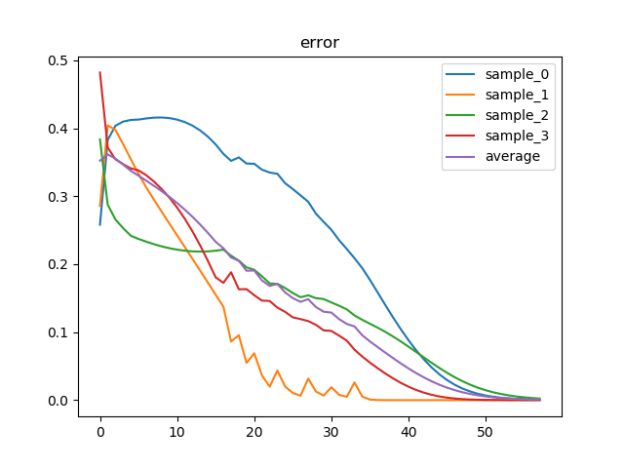
  • Try changing the error chart so that each sample is a seperate line (along with the average?) Done. I like this a lot! outputerror
  • Walk through SimpleLayer in the order that it’s used
    • Creation
    • Training
    • Learning
    • Graphing
  • Beat on the prediction plumbing with Aaron. The parts that collect the error and produce a forecast are there, but not working right?

Phil 1.3.19

7:00 – 5:30 ASRC NASA

  • Realized that error calculation for Holt can simply be error from the horizontal line from each prediction. There would be a distribution for T-1, T-2, T-3 … T-n. Later, when we get fancy, we can use the phi curve. So dumb.
  • Continuing my deep neural network writeup
  • Continuing Holt-Winters work with Aaron – probability distributions!
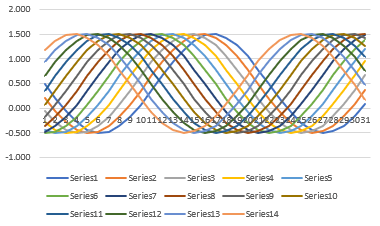
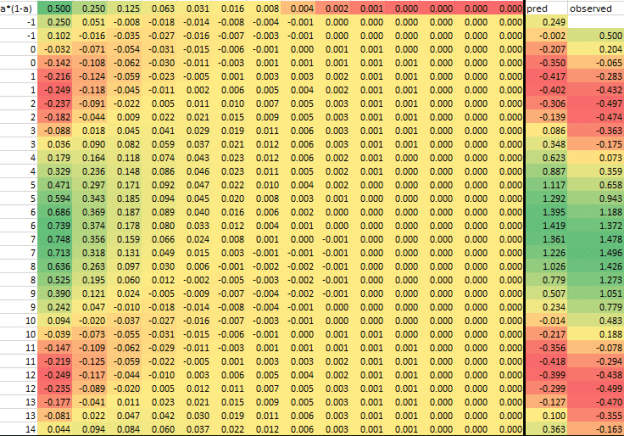
    • Ok, I think I’ve got this stupid thing figured out. Below is a screenshot of the table of predictions. These predictions are based on applying exponential smoothing to a history of sine waves:
      • sinewaves
    • The table consists of a set of predictions and their observed values (not sure why the time steps in the column on the left are duplicated. Need to fix that:
      • predictions
    • I can then make a table that contains each prediction as a line stretching into the future:
      • populations
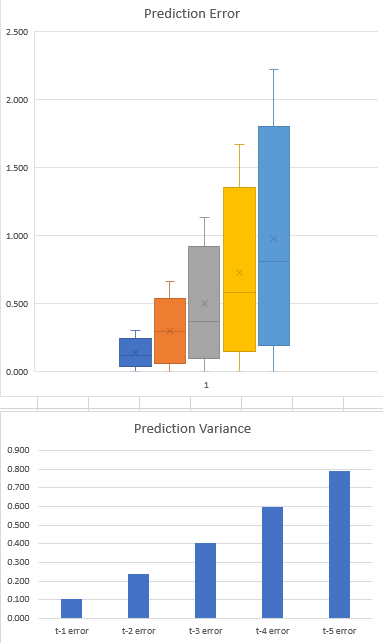
    • This “population of prediction errors” can then be used to calculate the amount of error in our forecast:
      • charts
    • This will work for any of the prediction schemes. We just have to store all predictions and observed.
    • Here’s the spreadsheet: ExponentialSmoothing2
  • Ping Shimei – campus closed
  • Ping Don – campus closed
  • Hammerhead 


Phil 1.2.19

Gotta get used to writing dates

7:00 – 5:00 ASRC PhD NASA

  • Continuing my deep neural network writeup
  • Continuing Holt-Winters work with Aaron
  • Continuing to read Clockwork Muse
    • Martindale spends the book talking about poetry, but I’m listening to Kind of Blue right now and I realize that Jazz is similar. The thought leaders are in some state where they are paying attention to each other and not much else. That’s how we get a trajectory that leads to Bitches Brew.
    • I think this is probably a generally applicable pattern. The thing that I need to think through is how a small group of highly creative people in what could be described as an echo-ish chamber differs from mass activity in a large attractor like authoritarianism.
    • We want to know how many dimensions are needed to account for the similarities among poets. Fortunately, once we have correlated all of the poets with one another, a procedure called multidimensional scaling will tell us just this.* Multidimensional scaling tells us that the twenty-one French poets differ along three· main dimensions. These three dimensions account for 94 percent of the similarity matrix. (Page 114)
  • I have spent the day doing PHENOMENALLY STUPID MATH (Holt exponential smoothing with drecksnest damping). Excel file: ExponentialSmoothing2

Phil 12.31.18

7:00 – 4:30 ASRC NASA

  • Set up appt for physical
  • This is fabulous! Seeing Theory
    • Seeing Theory was created by Daniel Kunin while an undergraduate at Brown University. The goal of this website is to make statistics more accessible through interactive visualizations (designed using Mike Bostock’s JavaScript library D3.js).
  • Working on cleaning up and validating my Very Simple Perceptron class. I think I’m going to write the whole thing up as its own blog post
  • Why Trump Reigns as King Cyrus
    • This isn’t the religious right we thought we knew. The Christian nationalist movement today is authoritarian, paranoid and patriarchal at its core. They aren’t fighting a culture war. They’re making a direct attack on democracy itself.


Phil 12.29.18

Credibility in Online Social Networks: A Survey

  • The importance of information credibility in society cannot be underestimated given that it is at the heart of all decision-making. Generally, more information is better; however, knowing the value of this information is essential for decision-making processes. Information credibility defines a measure of the fitness of information for consumption. It can also be defined in terms of reliability, which denotes the probability that a data source will appear credible to the users. A challenge in this topic is that there is a great deal of literature that has developed different credibility dimensions. Additionally, information science dealing with online social networks has grown in complexity, attracting interest from researchers in information science, psychology, human-computer interaction, communication studies, and management studies, all of whom have studied the topic from different perspectives. This work will attempt to provide an overall review of the credibility assessment literature over the period 2006–2017 as applied to the context of the microblogging platform, Twitter. Known interpretations of credibility will be examined, particularly as they relate to the Twitter environment. In addition, we investigate levels of credibility assessment features. We then discuss recent works, addressing a new taxonomy of credibility analysis and assessment techniques. At last, a cross-referencing of literature is performed while suggesting new topics for future studies of credibility assessment in social media context.

Phil 12.28.18

7:00 – 4:30 ASRC NASA

  • Human mind excels at quantum-physics computer game 3o6ozkvdtdarNDhGEw
  • Continuing on the proposal:
    • [Optional] What are your success metrics for the AI system (i.e., how will you know whether the system has succeeded or failed)?
      • Discuss the spectrum of success, from classification of behavior type by syntax patterns (LSTM) to human-based manifold learning (t-sne, xxx2vec, etc) for map generation, to development of new spatial neural frameworks, potentially based on grid neurons.
    • [Optional] What else we should know?
      • I want to say something about how this is based on animal studies, and how the idea of intelligence being expensive computation has to affect any kind of collective system. Still thinking about that.
      • Also, the economic power of maps, as discussed here
    • How will you sustain and grow the impact of this work beyond this grant? How could your project and its impact grow beyond what you’ve proposed in this application?
    • Need to add a brief description of each paper and include the venue and a link

Phil 12.27.18

7:00 – 11:00 PhD

  • How Much of the Internet Is Fake? Turns Out, a Lot of It, Actually.
    • Fake people with fake cookies and fake social-media accounts, fake-moving their fake cursors, fake-clicking on fake websites — the fraudsters had essentially created a simulacrum of the internet, where the only real things were the ads.
  • More proposal. With respect to bot traffic, there is standalone, monolithic and complex behaviors that can also be tracked and used to assess the underlying information. Adversarial herding is an example.
  • Ran out of steam. Hung up on these questions:
    • [Optional] What are your success metrics for the AI system (i.e., how will you know whether the system has succeeded or failed)?
      • Discuss the spectrum of success, from classification of behavior type by syntax patterns (LSTM) to human-based manifold learning (t-sne, xxx2vec, etc) for map generation, to development of new spatial neural frameworks, potentially based on grid neurons.
    • [Optional] What else we should know?
      • I want to say something about how this is based on animal studies, and how the idea of intelligence being expensive computation has to affect any kind of collective system. Still thinking about that.
      • Also, the economic power of maps, as discussed here
    • How will you sustain and grow the impact of this work beyond this grant? How could your project and its impact grow beyond what you’ve proposed in this application?
    • Need to add a brief description of each paper and include the venue and a link

Phil 12.26.18

7:00 – 9:00, 1:00 – 4:30

  • Proposal framing: more on global maps and navigating in common spaces. What this means to points of view, etc.
  • Good progress. Should finish tomorrow

Phil 12.24.18

PhD 7:00 – 3:00