Phil 3.16.17

7:00 – 8:00, 4:00 – 5:30 Research

8:30 – 3:30 BRC

  • Added subtasks for the clustering optimizer
  • Meeting with Aaron and Heath about scalability
  • Converting a panda data frame to a numpy ndarray – done
    df = createDictFrame(rna, cna)
    df = df.sort_values(by='sum', ascending=True)
    mat = df.as_matrix()
  • Working on polynomials – donepolyLine
  • Played with the Mandelbrot set as well. Speedy!
  • This came across my feed: Scikit-Learn Tutorial Series

Phil 3.15.17

7:00 – 8:00 Research

8:30 – 5:00 BRC

  • Heath was able to upgrade to Python 3.5.2
    • Ran array_thoughts. Numbers are better than my laptop
    • Attempting just_dbscan: Some hiccups due to compiling from sources. (No module named _bz7). Stalled? Sent many links.
    • Success! Heath installed a binary Python rather than compiling from sources. A little faster than my laptop. No GPUs, CPU, not memory bound.
  • Continuing my tour of the SciPy Lecture Notes
  • Figuring out what a matplotlib backend is
  • Looks like there are multiple ways to serve graphics: http://matplotlib.org/faq/howto_faq.html#howto-webapp
  • More on typing Python
  • Class creation, inheritance and superclass overloading, with type hints:
    class Student(object):
        name = 'noName'
        age = -1
        major = 'unset'
    
        def __init__(self, name: str):
            self.name = name
    
        def set_age(self, age: int):
            self.age = age
    
        def set_major(self, major: str):
            self.major = major
    
        def to_string(self) -> str:
            return "name = {0}\nage = {1}\nmajor = {2}"\
                .format(self.name, self.age, self.major)
    
    
    class MasterStudent(Student):
        internship = 'mandatory, from March to June'
    
        def to_string(self) -> str:
            return "{0}\ninternship = {1}"\
                .format(Student.to_string(self), self.internship)
    
    
    anna = MasterStudent('anna')
    print(anna.to_string())
  • Finished the Python part, Numpy next
  • Figured out how to to get a matrix shape, (again, with type hints):
    import numpy as np
    
    
    def set_array_sequence(mat: np.ndarray):
        for i in range(mat.shape[0]):
            for j in range(mat.shape[1]):
                mat[i, j] = i * 10 + j
    
    
    a = np.zeros([10, 3])
    set_array_sequence(a)
    print(a.shape)
    print(a)

Phil Pi Day!

Research

  • I got accepted into the Collective Intelligence conference!
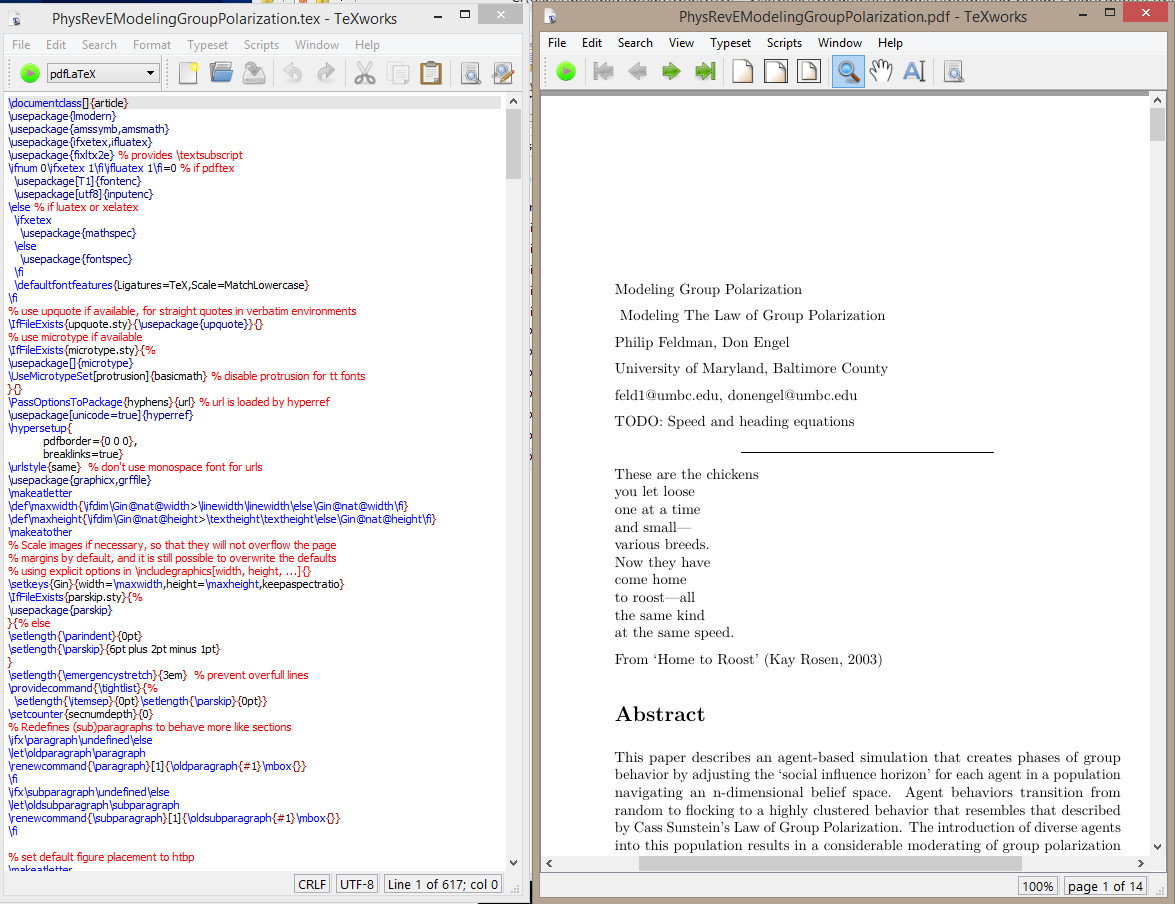
  • Working on LaTex formatting. Slow but steady.
  • Ok, the whole doc is in, but the 2 column charts are not locating well. I need to rerig them so that they are single column. Fixed! Not sure about the gray bg. Maybe an outline instead?

Aaron 3.13.17

  • Sprint Review
    • Covered issues with having customers present with Sprint Reviews; ie. don’t do it, it makes them take 3x as long and cover less.
    • Alternative facts presented about design tasks.
  • ClusteringService
    • Send design content to other MapReduce developer.
    • Sent entity model queries out regarding claim data.
  • Cycling
    • I went out for the 12.5 mile loop today. It was 30 degrees with a 10-12 mph wind, but it was… easy? I didn’t even lose my breath going up “Death Hill”. I guess its about time to move onto the 15 mile loop for lunchtime rides.
  • Sprint Grooming / Sprint Planning
    • It was decided to roll directly from grooming to planning activities.

Phil 3.13.17

7:00 – 8:00, 5:00 – 7:00 Research

  • Back to learning LaTex. Read the docs, which look reasonable, if a little clunkey.
  • Working out how to integrate RevEx
  • Spent a while looking at Overleaf and ShareLatex, but decided that I like TexStudio better. Used the MikTex package manager to download revtex 4.1.
  • Looked for “aiptemplate.tex” and “aipsamp.tex” and found them with all associated files here: ftp://ftp.tug.org/tex/texlive/Contents/live/texmf-dist/doc/latex/revtex/sample/aip. And it pretty much just worked. Now I need to start stuffing text into the correct places.

8:30 – 2:30 BRC

  • Got a response from the datapipeline folks about their demo code. sked them to update the kmeans_single_iteration.py and functions.py files.
  • The SciKit DBSCAN is very fast
    setup duration for 10000 points = 0.003002166748046875
    DBSCAN duration for 10000 points = 1.161818265914917
  • Drilling down into the documentation. Starting with the SciPy Lecture Notes
    • Python has native support for imaginary numbers. Huh.
    • Static typing is also coming. This is allowed, but doesn’t seem to do anything yet:
      def calcL2Dist(t1:List[float], t2:List[float]) -> float:
    • This is really nice:
      In [35]: def variable_args(*args, **kwargs):
         ....:     print 'args is', args
         ....:     print 'kwargs is', kwargs
         ....:
      
      In [36]: variable_args('one', 'two', x=1, y=2, z=3)
      args is ('one', 'two')
      kwargs is {'y': 2, 'x': 1, 'z': 3}
  • in my ongoing urge to have interactive applications, I found Bokeh, which seems to create javascript??? More traditionally, wxPython appears to be a set of bindings to the wxWidgets library. Installed, but I had to grab the compiled wheel from here (as per S.O.). I think I’m going to look closely at Bokeh though, if it can talk to the running Python, then we could have some nice diagnostics. And the research browser could possibly work through this interface as well.

Phil 3.10.17

Elbow Tickets!

7:00 – 8:00 Research

  • artisopensource.net
  • Accurat is a global, data-driven research, design, and innovation firm with offices in Milan and New York.
  • Formatting paper for Phys Rev E. Looks like it’s gotta be LaTex, or more specifically, RevTex. My entry about formats
    • Downloaded RevTex
    • How to get Google Docs to LaTex
    • Introduction to LaTex
    • Installing TexX slooooow…TexLive
    • That literally took hours. Don’t install the normal ‘big!’ default install?
    • Installing pandoc
    • Tried to just export a PDF, but that choked. reading the manual at C:\texlive\2016\tlpkg\texworks\texworks-help\TeXworks-manual\en
    • Compiled the converted doc! Not that I actually know what all this stuff does yet… LatexGP
    • And then I thought, ‘gee, this is more like coding – I wonder if there is a plugin for IntelliJ?’. Yest, but this page ->BEST DEVELOPMENT SETUP FOR LATEX – says to use texStudio. downloading to try. This seems to be very nice. Not sure if it will work without a LaTexInstall, but I’ll tray that on my home box. It would be a much faster install if it did. And it’s been updated very recently – Jan 2017
      • Aaaand the answer is no, it needs an install. Trying MikTex this time. Well that’s a LOT faster!

8:30 – 10:30, 11:00 – 2:00 BRC

Phil 3.9.17

7:00 – 7:30, 4:00-5:30  Research

9:30 – 3:30BRC

  • Neat thing from Flickr on finding similar images.
  • How to install pyLint as an external tool in IntelliJ.
  •  How to find out where your python modules are installed:
    C:\Windows\system32>pip3 show pylint
    Name: pylint
    Version: 1.6.5
    Summary: python code static checker
    Home-page: https://github.com/PyCQA/pylint
    Author: Python Code Quality Authority
    Author-email: code-quality@python.org
    License: GPL
    Location: c:\users\philip.feldman\appdata\local\programs\python\python35\lib\site-packages
    Requires: colorama, mccabe, astroid, isort, six
  • Looking at building scikit DBSCAN clusterer. I think the plan will be to initially use TF as IO. read in the protobuf and eval() out the matrix to scikit. Do the clustering in scikit, and then use TF to write out the results. Since TF and scikit are very similar, that should aid in the transfer from Python to TF, while allowing for debugging and testing in the beginning. And we can then benchmark.
  • Working on running the scikit.learn plot_dbscan example, and broke the scipy install. Maybe use the Windows installers? Not sure what that might break. Will try again and follow error messages first.
  • This looks like the fix: http://stackoverflow.com/questions/28190534/windows-scipy-install-no-lapack-blas-resources-found
    • Sorry to necro, but this is the first google search result. This is the solution that worked for me:
      1. Download numpy+mkl wheel from http://www.lfd.uci.edu/~gohlke/pythonlibs/#numpy. Use the version that is the same as your python version (check using python -V). Eg. if your python is 3.5.2, download the wheel which shows cp35
      2. Open command prompt and navigate to the folder where you downloaded the wheel. Run the command: pip install [file name of wheel]
      3. Download the SciPy wheel from: http://www.lfd.uci.edu/~gohlke/pythonlibs/#scipy (similar to the step above).
      4. As above, pip install [file name of wheel]
  • got a new error where
    TypeError: unorderable types: str() < int()
    • After some searching, here’s the SO answer
    • Changed line 406 from fixes.py from:
      if np_version < (1, 12, 0):

      into

      if np_version < (1, 12):
    • Success!!! DBSCAN_cluster_test
  • Sprint Review

Phil 3.8.17

7:00 – 8:00 Research

  • Tweaking the Sunstein letter
  • Trying to decide what to do next. There is a good deal of work that can be done in the model, particularly with antibelief. Totalitarianism may actually go further?
    • Arendt says:The advantages of a propaganda that constantly “adds the power of organization”[58] to the feeble and unreliable voice of argument, and thereby realizes, so to speak, on the spur of the moment, whatever it says, are obvious beyond demonstration. Foolproof against arguments based on a reality which the movements promised to change, against a counterpropaganda disqualified by the mere fact that it belongs to or defends a world which the shiftless masses cannot and will not accept, it can be disproved only by another, a stronger or better, reality.
      • [58] Hadamovsky, op. cit., p. 21. For totalitarian purposes it is a mistake to propagate their ideology through teaching or persuasion. In the words of Robert Ley, it can be neither “taught” nor “learned,” but only “exercised” and “practiced” (see Der Weg zur Ordensburg, undated).
    • On the same page: The moment the movement, that is, the fictitious world which sheltered them, is destroyed, the masses revert to their old status of isolated individuals who either happily accept a new function in a changed world or sink back into their old desperate superfluousness. The members of totalitarian movements, utterly fanatical as long as the movement exists, will not follow the example of religious fanatics and die the death of martyrs (even though they were only too willing to die the death of robots). [59]
      • [59] R. Hoehn, one of the outstanding Nazi political theorists, interpreted this lack of a doctrine or even a common set of ideals and beliefs in the movement in his Reichsgemeinschaft and Volksgeme’mschaft, Hamburg, 1935: “From the point of view of a folk community, every community of values is destructive”
  • This implies that there a stage where everything outside the cluster is attacked and destroyed, rather than avoided. So there’s actually four behaviors: Explore, Confirm, Avoid, and something like Lie/Destroy/Adhere. This last option cuts the Gordian Knot of game theory – its premise of making decisions with incomplete information – by substituting self-fulfilling fictional information that IS complete. And here, diversity won’t help. It literally is the enemy.
  • And this is an emergent phenomenon. From Konrad Heiden’s Der Führer. Hitler’s Rise to Power: Propaganda is not “the art of instilling an opinion in the masses. Actually it is the art of receiving an opinion from the masses.”  

8:30 – 6:00 BRC

  • Figured out part of my problem. The native python math is sloooooow. Using numpy makes everything acceptably fast. I’m not sure if I’m doing anything more than calculating in numpy and then sticking the result in TensorFlow, but it’s a start. Anyway, here’s the working code:
    import time
    import numpy as np
    import tensorflow as tf
    
    def calcL2Dist(t1, t2):
        sub = np.subtract(t1, t2)
        squares = np.square(sub)
        dist = np.sum(squares)
        return dist
    
    def createCompareMat(sourceMat, rows):
        resultMat = np.zeros([rows, rows])
        for i in range(rows):
            for j in range(rows):
                if i != j:
                    t1 = sourceMat[i]
                    t2 = sourceMat[j]
                    dist = calcL2Dist(t1, t2)
                    resultMat[i, j] = dist
        return resultMat
    
    def createSequenceMatrix(rows, cols, scalar=1.0):
        mat = np.zeros([rows, cols])
        for i in range(rows):
            for j in range(cols):
                val = (i+1)*10 + j
                mat[i, j] = val * scalar
        return mat
    
    for t in range(5, 8):
        side = (t*100)
    
        sourceMat = createSequenceMatrix(side, side)
    
        resultMat = tf.Variable(sourceMat) # Use variable
    
        start = time.time()
        with tf.Session() as sess:
            tf.global_variables_initializer().run() # need to initialize all variables
    
            distMat = createCompareMat(sourceMat=sourceMat, rows=side)
    
            resultMat.assign(distMat).eval()
            result = resultMat.eval()
            #print('modified resultMat:\n', result)
            #print('modified sourceMat:\n', sourceMat)
        stop = time.time()
        duration = stop-start
        print("{0} cells took {1} seconds".format(side*side, duration))
  • Working on the Sprint review. I think we’re in a reasonably good place. We can do our clustering using scikit, at speeds that are acceptable even on my laptop. Initially, we’ll use TF mostly for transport between systems, and then backfill capability.
  • This is really important for the Research Browser concept:

Phil 3.7.17

7:00 – 8:00 Research

  • The meeting with Don went well. We’re going to submit to Physical Review E. I need to fix a chart and then we need to make the paper more ‘Math-y’
  • Creating a copy of the paper for PRE – done
  • Fix the whisker chart – done
  • Compose a letter to Cass Sunstein asking for his input. Drafted. Getting sanity checks
  • On Building a “Fake News” Classification Model

8:30 – 6:00 BRC

  • Ran into an unexpected problem, the creation of the TF graph for my dictionary is taking exponential time to construct. SAD!
  • Debugging TF slides. Includes profiler. Pick up here tomorrow

Aaron 3.6.17

  • TensorFlow
    • Didn’t get to do much on this today; Phil is churning away learning matrix operations and distance calculations to let us write a DBSCAN plug-in
  • Architecture
    • Drawing up architecture document with diagram

Phil 3.6.17

6:30 – 7:00 , 4:00 – 6:00 Research

7:30 – 3:30, BRC

  • From LearningTensorflow.com: KMeans tutorial. Looks pretty good
  • This looks interesting: Large-Scale Evolution of Image ClassifiersNeural networks have proven effective at solving difficult problems but designing their architectures can be challenging, even for image classification problems alone. Evolutionary algorithms provide a technique to discover such networks automatically. Despite significant computational requirements, we show that evolving models that rival large, hand-designed architectures is possible today. We employ simple evolutionary techniques at unprecedented scales to discover models for the CIFAR-10 and CIFAR-100 datasets, starting from trivial initial conditions. To do this, we use novel and intuitive mutation operators that navigate large search spaces. We stress that no human participation is required once evolution starts and that the output is a fully-trained model.
  • Working on calculating distance between two vectors. Oddly, these do not seem to be library functions. This seems to be the way to do it:
    def calcL2Dist(t1, t2):
        dist = -1.0
        sub = tf.subtract(t1, t2)
        squares = tf.square(sub)
        sum = tf.reduce_sum(squares)
        return sum
  • Now I’m trying to build a matrix of distances. Got it working after some confusion. Here’s the full code. Note that the ‘source’ matrix is declared as a constant, since it’s immutable(?)
    import numpy as np
    import tensorflow as tf;
    
    def calcL2Dist(t1, t2):
        dist = -1.0
        sub = tf.subtract(t1, t2)
        squares = tf.square(sub)
        dist = tf.reduce_sum(squares)
        return dist
    
    def initDictRandom(rows = 3, cols = 5, prefix ="doc_"):
        dict = {}
        for i in range(rows):
            name = prefix+'{0}'.format(i)
            dict[name] = tf.Variable(np.random.rand(cols), tf.float32)
        return dict
    
    def initDictSeries(rows = 3, cols = 5, offset=1, prefix ="doc_"):
        dict = {}
        for i in range(rows):
            name = prefix+'{0}'.format(i)
            array = []
            for j in range(cols):
                array.append ((i+offset)*10 + j)
            #dict[name] = tf.Variable(np.random.rand(cols), tf.float32)
            dict[name] = tf.constant(array, tf.float32)
        return dict
    
    def createCompareDict(sourceDict):
        distCompareDict = {}
        keys = sourceDict.keys();
        for n1 in keys:
            for n2 in keys:
                if n1 != n2:
                    name = "{0}_{1}".format(n1, n2)
                    t1 = sourceDict[n1]
                    t2 = sourceDict[n2]
                    dist = calcL2Dist(t1, t2)
                    distCompareDict[name] = tf.Variable(dist, tf.float32)
        return distCompareDict
    
    sess = tf.InteractiveSession()
    dict = initDictSeries(cols=3)
    dict2 = createCompareDict(dict)
    init = tf.global_variables_initializer()
    sess.run(init)
    
    
    print("{0}".format(sess.run(dict)).replace("),", ")\n"))
    print("{0}".format(sess.run(dict2)).replace(",", "])\n"))
  • Results:
    {'doc_0': array([ 10.,  11.,  12.], dtype=float32)
     'doc_2': array([ 30.,  31.,  32.], dtype=float32)
     'doc_1': array([ 20.,  21.,  22.], dtype=float32)}
    {'doc_1_doc_2': 300.0])
     'doc_0_doc_2': 1200.0])
     'doc_1_doc_0': 300.0])
     'doc_0_doc_1': 300.0])
     'doc_2_doc_1': 300.0])
     'doc_2_doc_0': 1200.0}
  • Looks like the data structures that are used in the tutorials are all using panda.
    • Successfully installed pandas-0.19.2

Phil 3.4.17

Aaron 3.3.17

  • Architecture Status
    • Sent out the reasonably in-depth write-up of the proposed design for complex automatic clustering yesterday and expected to get at least a few questions or comments back; I ended up having to spend far more of my day than I wanted responding.
    • The good news is that the overall design is approved and one of our other lead MapReduce developers is up to speed on what we need to do. I’ll begin sending him some links and we’ll follow up on starting to generate code in between the sprints.
  • TensorFlow
    • I haven’t gotten even a fraction of the time spent researching this that I wanted, so I’m well behind the learning curve as Phil blazes trails. My hope is that his lessons learned can help me come up to speed more quickly.
    • I’m going to continue some tutorials/videos today to get caught up so next week I can chase down the Protobuff format I need to generate with the comparison tensor.
    • I did get a chance to watch some more tutorials today covering cross-entropy loss method that made a lot of sense.
  • Cycling
    • I went for a brief ride today (only 5 miles) and managed to fall off my bike for the first time. I went to stop at an intersection and unclipped my left foot fine, when I went to unclip my right foot, the cold-weather boot caught on the pedal and sent me crashing onto the curb. Fortunately I was bundled up enough that I didn’t get badly hurt, just bent my thumbnail back. Got back on the bike and completed the rest of the ride. I was still too sore to do the 12.5 mile today, especially in 20 mph winds.

Phil 3.3.17

7:00 – 8:00 Research

  • Finished formats and determine requirements for journals. Here’s the blog entry with all the information

8:30 – 4:00 BRC

  • CS231n: Convolutional Neural Networks for Visual Recognition (Stanford)
  • So this is going to seem very newbie, but I’ve finally figured out how to populate a dictionary of arrays:
    import numpy as np
    
    dict = {'doc1':[], 'doc2':[], 'doc3':[]}
    
    for doc in dict:
        dict[doc] = np.random.rand(5)
    
    for doc in dict:
        print("{0}: {1}".format(doc, dict[doc]))
    • It turns out that you HAVE to set the array relationship when the key is defined. Here’s how you do it programmatically
      import numpy as np
      
      dict = {}
      
      for i in range(5):
          name = 'doc_{0}'.format(i)
          dict[name] = np.random.rand(5)
      
      for doc in dict:
          print("{0}: {1}".format(doc, dict[doc]))
    • Which gives the following results
      doc_0: [ 0.53396248  0.10014123  0.40849079  0.76243954  0.29396581]
      doc_2: [ 0.21438903  0.68745032  0.1640486   0.51779412  0.05844617]
      doc_1: [ 0.36181216  0.78839326  0.90174006  0.29013203  0.76752794]
      doc_3: [ 0.44230569  0.63054045  0.80872794  0.83048027  0.87243106]
      doc_4: [ 0.08283319  0.72717925  0.29242797  0.90089588  0.34012144]
  • Continuing to walk through fully_connected.py along with the tutorial
    • math_ops.py – TF doc looks very handy
    • gen_nn_ops.py – TF doc looks like the rest of the coed we’ll need
    • ReLU. The Rectified Linear Unit has become very popular in the last few years. It computes the function f(x)=max(0,x)”>f(x)=max(0,x)f(x)=max(0,x). In other words, the activation is simply thresholded at zero (see image above on the left). There are several pros and cons to using the ReLUs: (Def from here)
  • Discovered the Large-Scale Linear Model tutorial. It looks similar-ish to clustering. These are some of the features in tf.contrib.learn, which is also the home of the kmeans clusterer
    • Feature columns and transformations

      Much of the work of designing a linear model consists of transforming raw data into suitable input features. tf.learn uses the FeatureColumn abstraction to enable these transformations.

      A FeatureColumn represents a single feature in your data. A FeatureColumn may represent a quantity like ‘height’, or it may represent a category like ‘eye_color’ where the value is drawn from a set of discrete possibilities like {‘blue’, ‘brown’, ‘green’}.

      In the case of both continuous features like ‘height’ and categorical features like ‘eye_color’, a single value in the data might get transformed into a sequence of numbers before it is input into the model. The FeatureColumn abstraction lets you manipulate the feature as a single semantic unit in spite of this fact. You can specify transformations and select features to include without dealing with specific indices in the tensors you feed into the model.

    • WOOHOO! Found what I was looking for! 
      • The input function must return a dictionary of tensors. Each key corresponds to the name of a FeatureColumn. Each key’s value is a tensor containing the values of that feature for all data instances. See Building Input Functions with tf.contrib.learn for a more comprehensive look at input functions, and input_fn in the linear models tutorial code for an example implementation of an input function.
      • So, working with that assumption, here’s a dictionary of tensors.
        import numpy as np
        import tensorflow as tf;
        
        sess = tf.Session()
        
        dict = {}
        
        for i in range(5):
            name = 'doc_{0}'.format(i)
            var = tf.Variable(np.random.rand(5), tf.float32)
            dict[name] = var
        
        init = tf.global_variables_initializer()
        sess.run(init)
        
        print("{0}".format(sess.run(dict)).replace("]),", "])\n"))
      • Which, remarkably enough, runs and produces the following!
        {'doc_2': array([ 0.17515295,  0.93597391,  0.38829954,  0.49664442,  0.07601639])
         'doc_0': array([ 0.40410072,  0.24565424,  0.9089159 ,  0.02825472,  0.28945943])
         'doc_1': array([ 0.060302  ,  0.58108026,  0.21500697,  0.40784728,  0.89955796])
         'doc_4': array([ 0.42359652,  0.0212912 ,  0.38216499,  0.5089103 ,  0.5616441 ])
         'doc_3': array([ 0.41851737,  0.76488499,  0.63983758,  0.17332712,  0.07856653])}

Aaron 3.2.17

  • TensorFlow
    • Started the morning with 2 hours of responses to client concerns about our framework “bake-off” that were more about their lack of understanding machine learning and the libraries we were reviewing than real concerns. Essentially the client liaison was concerned we had elected to solve all ML problems with deep neural nets.
    • [None, 784] is a 2D tensor of any number of rows with 784 dimensions (corresponding to total pixels)
    • W,b are weights and bias (these are added as Variables which allow the output of the training to be re-entered as inputs) These can be initiated as tensors full of 0s to start.
    • W has a shape of [784,10] because we want evidence of each of the different classes we’re trying to solve for. In this case that is 10 possible numbers. b has a shape of 10 so we can add its results to the output (which is the probability distribution via softmax of those 10 possible classes equalling a total of 1)
  • ETL/MapReduce
    • Made the decision to extract the Hadoop content from HBase via a MicroService and Java, build the matrix in Protobuff format, and perform TensorFlow operations on it then. This avoids any performance concerns about hitting our event table with Python, and lets me leverage the ClusteringService I already wrote the framework for. We also have an existing design pattern for MapReduce dispatched to Yarn from a MicroService, so I can avoid blazing some new trails.
  • Architecture Design
    • I submitted an email version of my writeup for tensor creation and clustering evaluation architecture. Assuming I don’t get a lot of pushback I will be able to start doing some of the actual heavy lifting and get some of my nervousness about our completion date resolved. I’d love to have the tensor built early so that I could focus on the TensorFlow clustering implementation.
  • Proposal
    • More proposal work today… took the previously generated content and rejiggered it to match the actual format they wanted. Go figure they didn’t respond to my requests for guidance until the day before it was due… at 3 PM.