Phil 10.16.17

6:30 – 5:00 ASRC MKT

  • Stochastic Modeling And Analytics In Healthcare Delivery SystemsThis book focuses on the research and best practices in healthcare engineering and technology assessment. With contributions from researchers in the fields of healthcare system stochastic modeling, simulation, optimization and management
  • I just realized that the Research Browser is Augmented Data Discovery, and is about to 2-3 years out from peak hype. Something to think about while writing proposals and pitching to management. 
  • Starting to look through Risk Taking to see if I can find scenarios
    • Add fields for user
      • Age – done
      • Gender – done
      • Game name (change by game so that a small number of players don’t recognize each other easily over repeated games
    • Something to think about is whether one scenario would be to create a scenario which is then used in the game.
    • Found it! Appendix E! Aaaaaaaaaaaand Adobe Acrobat is busted so I can’t scan it. Reinstalling. And it’s better, but still busted. Scanned in Photoshop, which works just fine
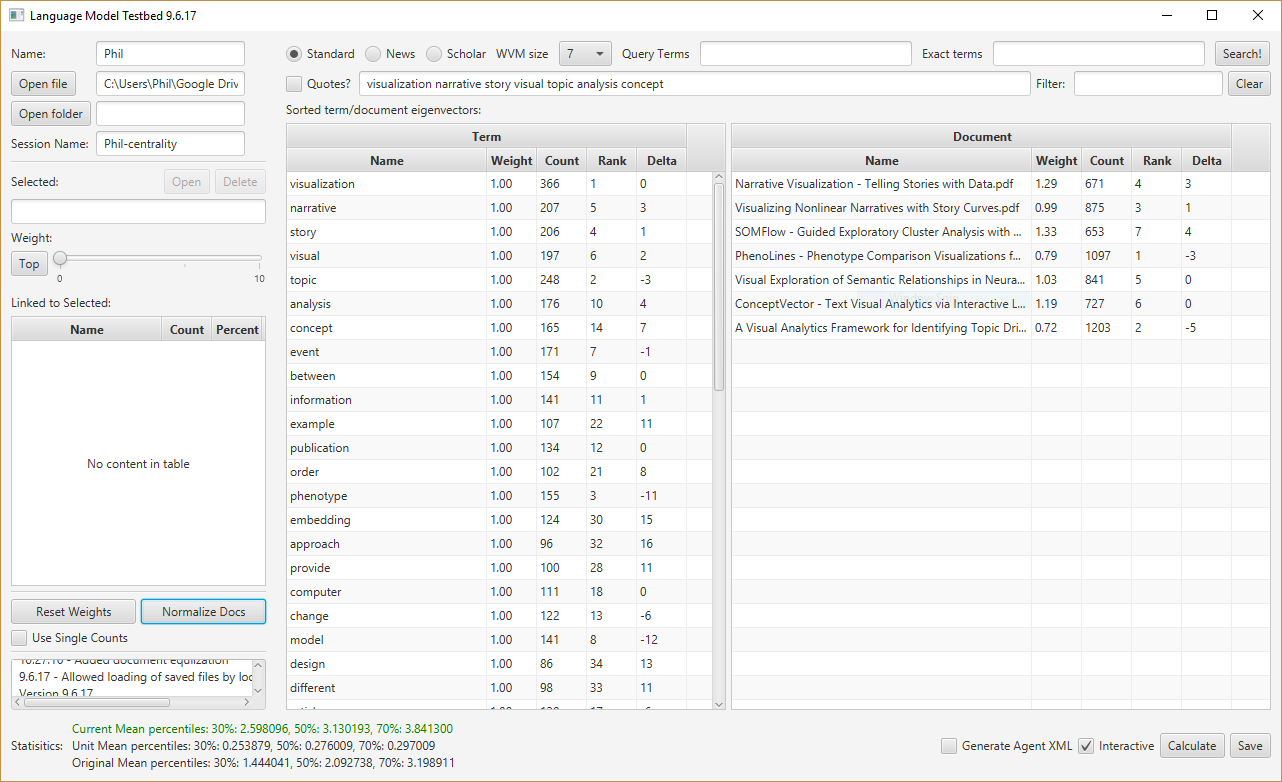
  • Tweaking CorpusManger so that the TF-IDF output has counts rather than the floating point value to see if that produces better results in search. This is from the serendipity corpus:
    • TF-IDF raw: information serendipity system encounter discovery serendipitous visualization 
    • TF-IDF normalized: information encounter serendipity system datum discovery serendipitous
    • BOW raw: information serendipity system encounter serendipitous discovery result
    • BOW normalized: visualization computer information search system serendipity encounter
    • That works much better with the wordrank algorithm. Keeping it.
  • Fika, talked a little about CM and LMN. Wajanat and Julie are interested. Maybe as a way of quantitatively ranking the centrality of concepts and people in a qualitative study.
Phil 10.15.17

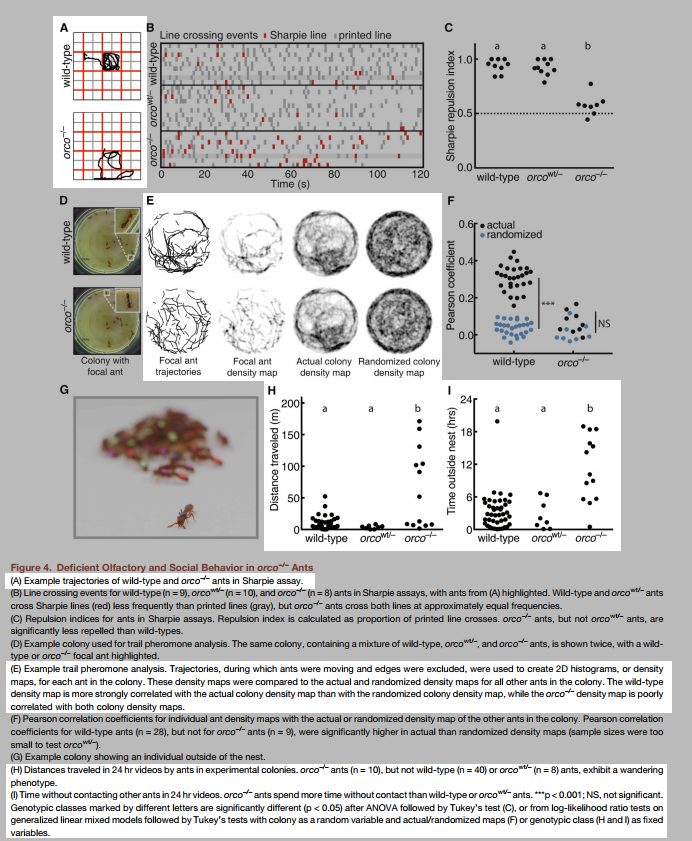
orco Mutagenesis Causes Loss of Antennal Lobe Glomeruli and Impaired Social Behavior in Ants

  • An example of how group behavior patterns reveal a mediated communication problem – Life inside ant colonies is orchestrated with diverse pheromones, but it is not clear how ants perceive these social signals. It has been proposed that pheromone perception in ants evolved via expansions in the numbers of odorant receptors (ORs) and antennal lobe glomeruli. Here, we generate the first mutant lines in the clonal raider ant, Ooceraea biroi, by disrupting orco, a gene required for the function of all ORs. We find that orco mutants exhibit severe deficiencies in social behavior and fitness, suggesting they are unable to perceive pheromones. Surprisingly, unlike in Drosophila melanogaster, orco mutant ants also lack most of the ∼500 antennal lobe glomeruli found in wild-type ants. These results illustrate that ORs are essential for ant social organization and raise the possibility that, similar to mammals, receptor function is required for the development and/or maintenance of the highly complex olfactory processing areas in the ant brain
  • orco Mutagenesis
  • Some random thoughts while riding.
    • The difference between a ‘large group’ and a ‘small group’ is the threshold at which multiple incremental interactions can happen between all members.
      • A group that has a fully connected trust network is fundamentally different from a group that doesn’t. A ‘large group’ requires transitive trust.
        • From HBR: It’s not just biases inside our heads that skew our judgment. We often rely on trusted third parties to verify the character or reliability of other people. These third parties, in effect, help us “roll over” our positive expectations from one known and trusted party to another who is less known and trusted. In such situations, trust becomes, quite literally, transitive. Unfortunately, as the Bernie Madoff case illustrates, transitive trust can lull people into a false sense of security. The evidence suggests that Madoff was a master at cultivating and exploiting social connections. One of his hunting grounds was the Orthodox Jewish community, a tight-knit social group.
      • This can be affected by communications technology in many ways, which the above study points to.
      • Again, the relationship between awareness and trust becomes an issue.

Phil 10.13.17

7:15 – 8:15, 1:00 – 4:00 ASRC MKT 9:00 – 1:00 IRAD

Phil 10.12.17

ASRC MKT 7:00 – 8:30, 2:30 – 3:00, IRAD 8:30 – 2:30

Phil 10.11.17

7:00 – 3:30 ASRC MKT

  • Call ACK today about landing pad 7s. Nope – closed today
  • The Thirteenth International Conference on Spatial Information Theory (COSIT 2017)
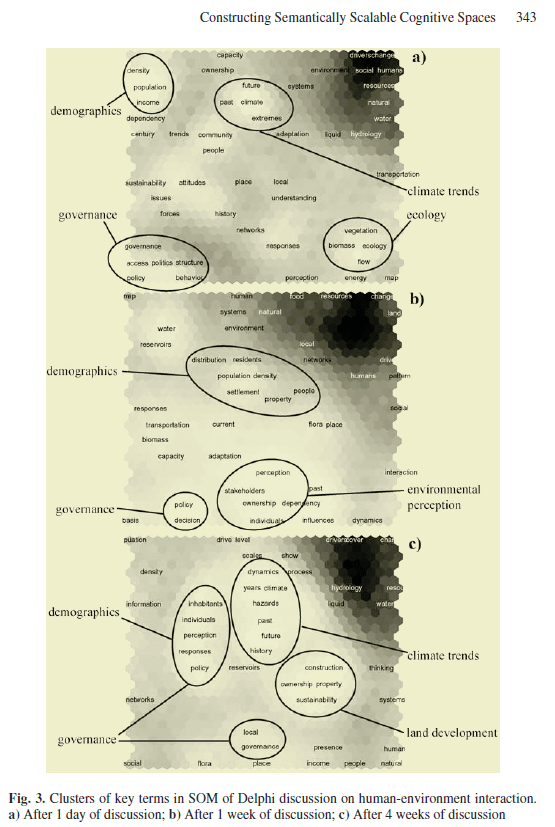
  • Topic-Relevance Map: Visualization for Improving Search Result Comprehension
    • We introduce topic-relevance map, an interactive search result visualization that assists rapid information comprehension across a large ranked set of results. The topic-relevance map visualizes a topical overview of the search result space as keywords with respect to two essential information retrieval measures: relevance and topical similarity. Non-linear dimensionality reduction is used to embed high-dimensional keyword representations of search result data into angles on a radial layout. Relevance of keywords is estimated by a ranking method and visualized as radiuses on the radial layout. As a result, similar keywords are modeled by nearby points, dissimilar keywords are modeled by distant points, more relevant keywords are closer to the center of the radial display, and less relevant keywords are distant from the center of the radial display. We evaluated the effect of the topic-relevance map in a search result comprehension task where 24 participants were summarizing search results and produced a conceptualization of the result space. The results show that topic-relevance map significantly improves participants’ comprehension capability compared to a conventional ranked list presentation.
  • Important to remember for the Research Browser: Where to Add Actions in Human-in-the-Loop Reinforcement Learning
    • In order for reinforcement learning systems to learn quickly in vast action spaces such as the space of all possible pieces of text or the space of all images, leveraging human intuition and creativity is key. However, a human-designed action space is likely to be initially imperfect and limited; furthermore, humans may improve at creating useful actions with practice or new information. Therefore, we propose a framework in which a human adds actions to a reinforcement learning system over time to boost performance. In this setting, however, it is key that we use human effort as efficiently as possible, and one significant danger is that humans waste effort adding actions at places (states) that aren’t very important. Therefore, we propose Expected Local Improvement (ELI), an automated method which selects states at which to query humans for a new action. We evaluate ELI on a variety of simulated domains adapted from the literature, including domains with over a million actions and domains where the simulated experts change over time. We find ELI demonstrates excellent empirical performance, even in settings where the synthetic “experts” are quite poor.
  • This is interesting. DARPA had a Memex project that they open-sourced
  • Got PHP and xdebug set up on my home machines, mostly following these instructions. The dll that matches the PHP install needs to be downloaded from here and placed in the /php directory. Then add the following to the php.ini file:
    [XDebug]
    zend_extension = "C:\xampp\php\ext\php_xdebug.dll"
    xdebug.profiler_append = 0
    xdebug.profiler_enable = 1
    xdebug.profiler_enable_trigger = 1
    xdebug.profiler_output_dir = "C:\xampp\tmp"
    xdebug.profiler_output_name = "cachegrind.out.%t-%s"
    xdebug.remote_enable = 0
    xdebug.remote_handler = "dbgp"
    xdebug.remote_host = "127.0.0.1"
    xdebug.remote_port = "9876"
    xdebug.trace_output_dir = "C:\xampp\tmp"

    Then go to settings->Languages & Frameworks -> PHP, and either attach to the php CLI or refresh. The debugger should become visible: PHPsetup

  • Reworking the CHI DC to a CHIIR DC
    • There is a new version of the LaTex templates as of Oct 2 here. I wonder if that fixes the CHI problems?
    • Put things in the right format, got the pix in the columns. Four pages! Working on fixing text.
    • Finished first pass (time for multiple passes! Woohoo!)
    • Working on paragraph
    • Start schema for PolarizationGame
  • Theresa asked me to set up a new set of CSEs. Will need a credit card and the repository location. Waiting for that.

Phil 10.10.17

6:30 – 5:30 ASRC MKT

  • Spent about an hour going over Aaron’s presentation for tomorrow
  • DC submission is tomorrow at 3:00. No word back from Wayne about an AM meeting, so I guess it will be this afternoon?
  • Read Cindy’s comments. Interesting and perceptive.
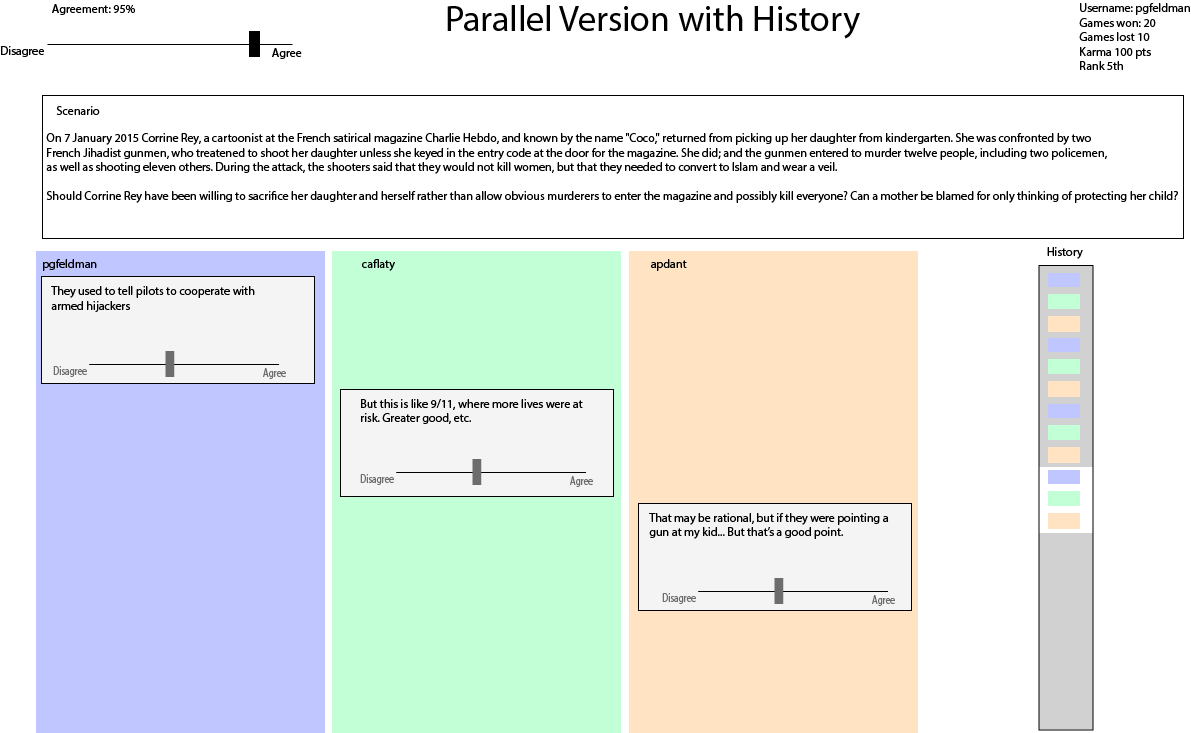
  • More followup on yesterday’s discussions. Here are some strawman screen mockups for the game:
    • Design thoughts
    • Design thoughts2
    • Roughly, the idea is to turn a chat room into a “polarization game”. For phase 1,
      • Players are randomly chosen from the pool of available players. If we have cross-platform texting, we could handle this in a cross-platform way. Some of the controls from the browser version would have to be implemented in some compatible way. Maybe emoji characters? (Arrows, etc)
      • There is some scenario that the users discuss.
      • The game ends when all players agree on an outcome.
      • Something to evaluate is how much of the discussion should be visible.
        • Should it “fade out” (as shown), or should there be a searchable history? Parallel Version with History
        • Should all threads be shown simultaniously
      • Points are given to participants of a game that unanimously agree
      • Double points are given to the person who comes up with the agreed-upon outcome
      • Points are retained across games. Honor, glory, and prizes are awarded the winners.
        • This means leaderboards and other associated social promotion mechanisms.
        • Registration page, icon choice, etc
      • Might as well build in biometrics and ip address tracking so that we can flag suspicious games (E.g. where one person plays all roles)
    • The initial runs will be in a controlled setting (at UMBC), so we can evaluate more aspects of the player’s experience.
      • Semi-structured interviews
      • Surveys (which could be an add-on to the game that pays in points)
  • Starting to do a deep dive into the Twillo API. Starting with a chat app.
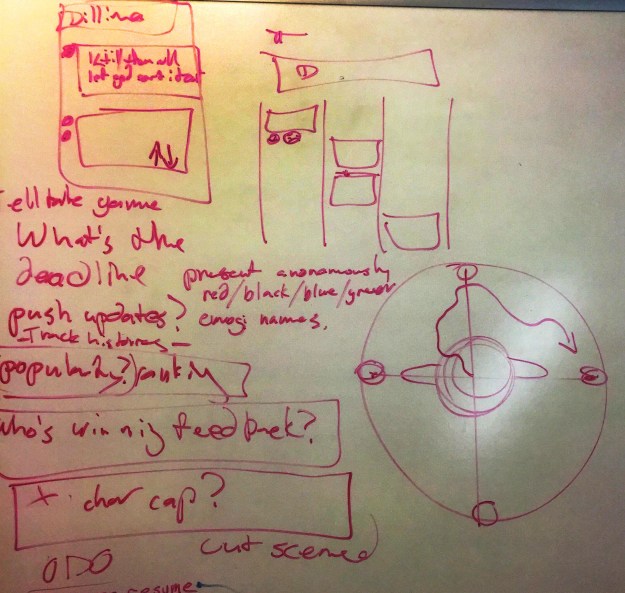
  • Discussion with the interns about ways they would like to use the system, just to see if there was a strong need to support chat. Here’s the whiteboard: whiteboard
    • Some discussion about how long the game would last. If it were quick/real-time-ish, then it could live on a browser. Long term needs push notifications.
    • Although the user has a login, create anonymous discussants so that a history doesn’t build up that other users can react against
    • How do the posts get displayed? Time? Score?
    • Is there feedback on who’s arguments are getting the most votes?
    • To keep things playable, there may need to be a character cap. More than 140, less than xxx.
    • Cut scenes of the resolution of the dilemma would be cool.
  • Looking at the setup of the umbc server
    • Got the vpn (https://vpn.umbc.edu) set up and running
    • As configured, the box is PHP/mysql. I can live with that. I can’t remember the mySQL password though. Doh!
  • Meeting with Wayne
    • Got the edits back for the CHI DC. Leaning towards the CHIIR DC though. Amy agrees – says that the CHI DC is a ‘cattle call’
  • Some discussion about my review. Discovered that the article process for a journal is much more relaxed. There is time for multiple interactions with the authors.

Phil 10.9.17

7:00 – 9:30, 5:00 – 7:00 ASRC MKT

  • Writing up review. I also stumbled across a good book on Complex Systems in Finance and Economics that is tangentially related to the paper. They have a chart on page 764 that shows the development trajectories of the multiple threads in the related fields.
  • Radiolab did a revisit to the trolley problem with respect to self-driving cars. In the end discussion, they state that the problem is a small edge condition. I think under normal conditions that’s true. Under catastrophic conditions like a post earthquake evacuation, every trip could be the trolley problem. With TaaS, who gets picked up first? who has priority on the road? Pinged Radiolab about that. Curious if they will respond.
  • Good chat with Cindy. She found a bunch of stuff, including this part about moral dilemmas. We also started thinking about the chat game design. And we found her comments! Seems like WordPress isn’t alerting me when they get submitted.
  • Nvivo for Mac

Phil 10.6.17

ASRC MKT 7:00 – 4:00

Phil 10.5.17

7:00 – 9:00, 10:00 – 5:00 ASRC MKT

  • Playing with getting LaTex to do the correct formatting without using the new template. Getting pretty far, and starting to think that maybe the way to do this is from scratch? Yeah, I know, this way leads to madness…
  • What I should be doing is looking into the way to build the game and save the data. Should this be a browser plugin? A standalone web page? Where does the back end live?
  • Possible platforms to use
  • Studies that used created chatrooms and gamification.
    • Designing for reportability: sustainable gamification, public engagement, and promoting environmental debate
      • There is a growing emphasis in many countries on matters such as participation in e-government, e-democracy, the provision of forums for online debate, and so on. A critical issue in all of these cases is one of encouraging engagement across a broad spectrum of potentially interested parties and stakeholders. In this paper, we use an ethnographic study of an online event, designed to encourage debate, to explore some critical issues in how the mechanisms productive of debate have shifted in company with the Web 2.0 phenomenon. By contrasting this with a prior study of how players managed their gameplay in a multiplayer pervasive game, we focus upon how different ways of constructing games and events can have serious implications for their ordinary everyday reportability in routine face-to-face interactions. We conclude that designing for reportability should be an active consideration when designing the resources for online debate and consider some ways in which that might be accomplished.
    • Bicker Manor: a cross-media environmental campaign using missions
      • In this paper, we describe the design and implementation of a cross-media environmental campaign called Bicker Manor. We describe how the experience allowed players to participate using mobile phones by sending SMS and MMS messages, the web and interactive television. We describe how the experience used characters to playfully challenge players to complete missions with an environmental twist, before describing a generic, reusable mission framework and implementation with associated authoring and orchestration tools. Finally, we briefly describe the pilot of the experience and initial findings from an ongoing evaluation.
    • Analysing How People Orient to and Spread Rumours in Social Media by Looking at Conversational Threads
      • As breaking news unfolds people increasingly rely on social media to stay abreast of the latest updates. The use of social media in such situations comes with the caveat that new information being released piecemeal may encourage rumours, many of which remain unverified long after their point of release. Little is known, however, about the dynamics of the life cycle of a social media rumour. In this paper we present a methodology that has enabled us to collect, identify and annotate a dataset of 330 rumour threads (4,842 tweets) associated with 9 newsworthy events. We analyse this dataset to understand how users spread, support, or deny rumours that are later proven true or false, by distinguishing two levels of status in a rumour life cycle i.e., before and after its veracity status is resolved. The identification of rumours associated with each event, as well as the tweet that resolved each rumour as true or false, was performed by journalist members of the research team who tracked the events in real time. Our study shows that rumours that are ultimately proven true tend to be resolved faster than those that turn out to be false. Whilst one can readily see users denying rumours once they have been debunked, users appear to be less capable of distinguishing true from false rumours when their veracity remains in question. In fact, we show that the prevalent tendency for users is to support every unverified rumour. We also analyse the role of different types of users, finding that highly reputable users such as news organisations endeavour to post well-grounded statements, which appear to be certain and accompanied by evidence. Nevertheless, these often prove to be unverified pieces of information that give rise to false rumours. Our study reinforces the need for developing robust machine learning techniques that can provide assistance in real time for assessing the veracity of rumours. The findings of our study provide useful insights for achieving this aim.
    • Sarah-Kristin Thiel has a lot of work in this area
    • From game design elements to gamefulness: defining “gamification”
    • Gamification for Behavior Change: Lessons from Developing a Social, Multiuser, Web-Tablet Based Prevention Game for Youths
  • I think this may be a book with scenarios in it: Risk taking: A study in cognition and personality. It comes up in the literature a lot. Ordered.
  • Here’s one of the studies that uses the above: Correlates of Risky Decision-Making. It identifies a risk-taking personality type. Is this an explorer? Can this test be used on individuals and groups?

Phil 10.4.17

7:00 – 3:00 ASRC MKT

Phil 10.3.17

Phil 7:00 – 5:00 ASRC MKT

Phil 10.2.17

8:00 – 5:00 ASRC MKT

  • The CHIIR paper is submitted! Incorporated all of Wayne’s points (that I could decipher)
  • Change the angle recording code so that it is WRT the average heading of the population. Might make a better figure 7. Started.
  • Security training – one hour – done
  • Do Charlestown things – done
  • Fika
    • Anita skimmed the paper and liked what she saw.
    • NVivo webinar
    • $120/year
  • Meeting with Wayne?
    • The CHI deadline is next week: https://chi2018.acm.org/authors/doctoral-consortium/
    • Extended Abstracts from CHI 17 (search for SESSION: Doctoral Consortium)
    • Some extended discussion about GLOBE. Might have the opportunity to look at the code with some guidance. Otherwise, it’s going up on GitHub soon. I’d like to see the code that finds similar remotely observed data on the globe as a way to find similar papers. In this scenario, that could be used to equate new GEOS data (soil, vegetation, lighting, etc) to use places that are burning to places that are at high risk for burning.

Phil 9.29.17

7:00 – 5:00 ASRC MKT

  • Sent out copies of the draft to academic/work management. Waiting for comments
  • Fix concepts
  • Fix Keywords – going to try the LMN on the lit review and see what pops up 2017-09-29
  • Get page numbers
  • Register for easychair, and make sure what the actual deadline is. Registered, but there is no date information WRT the submission. Going to submit Saturday night out of an abundance of caution.
  • I had some more thoughts about how behavior patterns emerge from the interplay between trust and awareness. I think the following may be true:
    • Healthy behaviors emerge when trust and awareness are equivalent.
    • Low trust and low awareness is reasonable. It’s like walking through a dark, unknown space. You go slow, bump into things, and adjust.
    • Low trust and high awareness is paralytic.
    • High trust and low awareness is reckless. Runaway conditions like echo chambers.
    • Diversity is a mechanism for extending awareness, but it depends on trusting those who are different. That may be the essence of the explore/exploit dilemma.
    • In a healthy group context, trust falls off as a function of awareness. That’s why we get flocking. That is the pattern that emerges when you trust more those who are close, while they in turn do the same, building a web of interaction. It’s kind of like interacting ripples?
    • This may work for any collection of entities that have varied states that undergo change in some predictable way. If they were completely random, then awareness of the state is impossible, and trust should be zero.
      1. Human agent trust chains might proceed from self to family to friends to community, etc.
      2. Machine agent trust chains might proceed from self to direct connections (thumb drives, etc) to LAN/WAN to WAN
      3. Genetic agent trust chain is short – self to species. Contact is only for reproduction. Interaction would reflect the very long sampling times.
      4. Note that (1) is evolved and is based on incremental and repeated interactions, while (2) is designed and is based on arbitrary rules that can change rapidly. Genetics are maybe dealing with different incentives? The only issue is persisting and spreading (which helps in the persisting)
    • Computer-mediated-communication disturbs this process (as does probably every form of mass communication) because the trust in the system is applied to the trust of the content. This can work in both ways. For example, lowering trust in the press allows for claims of Fake News. Raising the trust of social networks that channel anonymous online sources allows for conspiracy thinking.
    • An emerging risk is how this affects artificial intelligence, given that currently high trust in the algorithms and training sets is assumed by the builders
      • Low numbers of training sets mean low diversity/awareness,
      • Low numbers of algorithms (DNNs) also mean low diversity/awareness
      • Since training/learning is spread by update, the installed base is essentially multiple instances of the same individual. So no diversity and very high trust. That’s a recipe for a stampede of 10,000 self driving cars.

Phil 9.28.17

7:00 – 4:00 ASRC MKT

  • from ABC news. Artificially amplifying (both) poles and establishing norms
    • “They were taking both sides of the argument this past weekend, and pushing them out from their troll farms as much as they could to try to just raise the noise level in America and to make a big issue seem like an even bigger issue,” Lankford said at a hearing of the Senate Homeland Security and Government Affairs Committee.
  • Got all the LaTex packages installed so that I can compile the paper at home
  • Adding in references – done
  • Fix concepts
  • Fix Keywords