Phil 7.20.18

Listening to We Can’t Talk Anymore? Understanding the Structural Roots of Partisan Polarization and the Decline of Democratic Discourse in 21st Century America. Very Tajfel

  • David Peritz
  • Political polarization, accompanied by negative partisanship, are striking features of the current political landscape. Perhaps these trends were originally confined to politicians and the media, but we recently reached the point where the majority of Americans report they would consider it more objectionable if their children married across party lines than if they married someone of another faith. Where did this polarization come from? And what it is doing to American democracy, which is housed in institutions that were framed to encourage open deliberation, compromise and consensus formation? In this talk, Professor David Peritz will examine some of the deeper forces in the American economy, the public sphere and media, political institutions, and even moral psychology that best seem to account for the recent rise in popular polarization.

Sent out a Doodle to nail down the time for the PhD review

Went looking for something that talks about the cognitive load for TIT-FOR-TAT in the Iterated Prisoner’s Dilemma and can’t find anything. Did find this though, that is kind of interesting: New tack wins prisoner’s dilemma. It’s a collective intelligence approach:

  • Teams could submit multiple strategies, or players, and the Southampton team submitted 60 programs. These, Jennings explained, were all slight variations on a theme and were designed to execute a known series of five to 10 moves by which they could recognize each other. Once two Southampton players recognized each other, they were designed to immediately assume “master and slave” roles – one would sacrifice itself so the other could win repeatedly.
  • Nick Jennings
    • Professor Jennings is an internationally-recognized authority in the areas of artificial intelligence, autonomous systems, cybersecurity and agent-based computing. His research covers both the science and the engineering of intelligent systems. He has undertaken fundamental research on automated bargaining, mechanism design, trust and reputation, coalition formation, human-agent collectives and crowd sourcing. He has also pioneered the application of multi-agent technology; developing real-world systems in domains such as business process management, smart energy systems, sensor networks, disaster response, telecommunications, citizen science and defence.
  • Sarvapali D. (Gopal) Ramchurn
    • I am a Professor of Artificial Intelligence in the Agents, Interaction, and Complexity Group (AIC), in the department of Electronics and Computer Science, at the University of Southampton and Chief Scientist for North Star, an AI startup.  I am also the director of the newly created Centre for Machine Intelligence.  I am interested in the development of autonomous agents and multi-agent systems and their application to Cyber Physical Systems (CPS) such as smart energy systems, the Internet of Things (IoT), and disaster response. My research combines a number of techniques from Machine learning, AI, Game theory, and HCI.

7:00 – 4:30 ASRC MKT

  • SASO Travel request
  • SASO Hotel – done! Aaaaand I booked for August rather than September. Sent a note to try and fix using their form. If nothing by COB try email.
  • Potential DME repair?
  • Starting Deep Learning with Keras. Done with chapter one
  • Two seedbank lstm text examples:
    • Generate Shakespeare using tf.keras
      • This notebook demonstrates how to generate text using an RNN with tf.keras and eager execution.This notebook is an end-to-end example. When you run it, it will download a dataset of Shakespeare’s writing. The notebook will then train a model, and use it to generate sample output.
    • CharRNN
      • This notebook will let you input a file containing the text you want your generator to mimic, train your model, see the results, and save it for future use all in one page.


Phil 7.19.18

7:00 – 3:00 ASRC MKT

  • More on augmented athletics: Pinarello Nytro electric road bike review m2_0229_670
  • WhatsApp Research Awards for Social Science and Misinformation ($50k – Applications are due by August 12, 2018, 11:59pm PST)
  • Setting up meeting with Don for 3:30 Tuesday the 24th. He also gave me some nice leads on potential people for Dance my PhD:
    • Dr. Linda Dusman
      • Linda Dusman’s compositions and sonic art explore the richness of contemporary life, from the personal to the political. Her work has been awarded by the International Alliance for Women in Music, Meet the Composer, the Swiss Women’s Music Forum, the American Composers Forum, the International Electroacoustic Music Festival of Sao Paulo, Brazil, the Ucross Foundation, and the State of Maryland in 2004, 2006, and 2011 (in both the Music: Composition and the Visual Arts: Media categories). In 2009 she was honored as a Mid- Atlantic Arts Foundation Fellow for a residency at the Virginia Center for the Creative Arts. She was invited to serve as composer in residence at the New England Conservatory’s Summer Institute for Contemporary Piano in 2003. In the fall of 2006 Dr. Dusman was a Visiting Professor at the Conservatorio di musica “G. Nicolini” in Piacenza, Italy, and while there also lectured at the Conservatorio di musica “G. Verdi” in Milano. She recently received a Maryland Innovation Initiative grant for her development of Octava, a real-time program note system (octavaonline.com).
    • Doug Hamby
      • A choreographer who specializes in works created in collaboration with dancers, composers, visual artists and engineers. Before coming to UMBC he performed in several New York dance companies including the Martha Graham Dance Company and Doug Hamby Dance. He is the co-artistic director of Baltimore Dance Project, a professional dance company in residence at UMBC. Hamby’s work has been presented in New York City at Lincoln Center Out-of-Doors, Riverside Dance Festival, New York International Fringe Festival and in Brooklyn’s Prospect Park. His work has also been seen at Fringe Festivals in Philadelphia, Edinburgh, Scotland and Vancouver, British Columbia, as well as in Alaska. He has received choreography awards from the National Endowment for the Arts, Maryland State Arts Council, New York State Council for the Arts, Arts Council of Montgomery County, and the Baltimore Mayor’s Advisory Committee on Arts and Culture. He has appeared on national television as a giant slice of American Cheese.
  • Sent out a note with dates and agenda to the committee for the PhD review thing. Thom can open up August 6th
  • Continuing extraction of seed terms for the sentence generation. And it looks like my tasking for next sprint will be to put together a nice framework for plugging in predictive patterns systems like LSTM and multi-layer perceptrons.
  • This seems to be working:
    agentRelationships GreenFlockSh_1
    	 sampleData 0.0
    		 cell cell_[4, 6]
    		 influences AGENT
    			 influence GreenFlockSh_0 val =  0.8778825396520958
    			 influence GreenFlockSh_2 val =  0.8859173062045552
    			 influence GreenFlockSh_3 val =  0.9390368569108515
    			 influence GreenFlockSh_4 val =  0.9774328763377834
    		 influences SOURCE
    			 influence UL_point val =  0.032906293611796644
  • Sprint planning
    • VP-613: Develop general TensorFlow/Keras NN format
      • LSTM
      • MLP
      • CNN
    • VP-616: SASO Preparation
      • Slides
      • Poster
      • Demo


Phil 7.18.18

divylmzuyaeqjbk

There was no colusion“…”Anyone involved in that meddling to justice.

Premises for Data Science Magical Realism

  • What follows are some premises for data science magical realism stories based (very, very loosely) on experiences I’ve had or heard about — premises, that is, for stories about impossible, absurd, magical things happening to data scientists in ordinary data science situations. Enjoy!
  • More from David Masad

Program Synthesis in 2017-18

  • A high-level overview of the recent ideas and representative papers in program synthesis as of mid-2018.
  • Alex (Oleksandr) Polozov, a researcher in the Deep Procedural Intelligence group at Microsoft Research AI, Redmond. I work on neural program synthesis from input-output examples and natural language, intersections of machine learning and software engineering, and neuro-symbolic architectures. I am particularly interested in combining neural and symbolic techniques to tackle the next generation of AI problems, including program synthesis, planning, and reasoning.

UMAP Uniform Manifold Approximation and Projection for Dimension Reduction | SciPy 2018 |(video) (paper)

  • UMAP (Uniform Manifold Approximation and Projection) is a novel manifold learning technique for dimension reduction. UMAP is constructed from a theoretical framework based in Riemannian geometry and algebraic topology. The result is a practical scalable algorithm that applies to real world data. The UMAP algorithm is competitive with t-SNE for visualization quality, and arguably preserves more of the global structure with superior run time performance. Furthermore, UMAP as described has no computational restrictions on embedding dimension, making it viable as a general purpose dimension reduction technique for machine learning.
  • This could be nice for building maps

7:00 – 5:00 ASRC MKT

  • Progress on getting my keys back!
  • Got everyone’s response on the Doodle, but only 4 of the 5 line up…
  • Finish first pass through PhD review slides
  • Start SASO slides and poster?
  • Continue with exporting terms from the sim and importing them into python. One of the things that will matter is the tagging of the data with the seed terms from the sim as well as the cell name so that reconstructions can be compared for accuracy.
  • Added the cell location to each <sampleData> so that there can be some kind of tagging/ground truth about the maps we’re inferring.
  • Working on iterating through the etree hierarchy. I can now read in the file, parse it and get elements that I’m looking for.
  • Tomorrow will be pulling the seed words out of the code in an ordered list. Generated sentences will need to be timestamped to that conversations can be reconstructed. That being said, it could be interesting to take seed words out of a generated sentence and add them to the embedding seed words. Something to think about.

Phil 7.17.18

I wrote up some thoughts about Trump’s press conference with Putin.

7:00 – 4:30 ASRC MKT

  • Still can’t connect to the Service center (Betriebsdienst Zentrum) at Zurich U. Tried pinging the conference organizer, who appears to be based on the campus – done. And some progress!
  • Travel report for SASO – done
  • Hotel in Trento – wait till tomorrow.
  • Ping Aaron M. about Doodle – Done
  • Set up meeting with Don – done
  • Start on slides – started

Phil 7.16.18

Vacation is over. Here are some pix

7:00 – 3:00 ASRC MKT

  • No problem logging into timesheet or email from the US. Odd.
  • Expense Report. Bring Receipts!
  • Call Zurich about keys – called. No one there today, call tomorrow before 9:00 +41 44 634 03 09
  • Get hotel in Trento

3:00 – 6:00 Fika, then meeting with Wayne

  • Schedule a meeting with Don to discuss LSTM agent text, and composer/choreographer for Dance my PhD
  • Put together a proposal for the mid-PhD that includes
    • Current work
    • LSTM next step
    • The Wayne Problem
      • Keep the committee as is (defend summer of 2019)
      • Adjust committee (who becomes co-chair?)
    • What to do about JuryRoom
      • Make it post-PhD work
      • Build an instantiation of the theory, but don’t do anything with it (unpublishable, but next steps would be)
      • Build a low-fi version of the website for lab testing
      • Build a 1,000 – 10,000 user version (MySQL, PHP, Angular)
      • Build a 10,000 – 1,000,000 user version
      • Build a fully scaled version

phil 7.12.18

Stampede thinking:

  • Lazy, not biased: Susceptibility to partisan fake news is better explained by lack of reasoning than by motivated reasoning
    • Gordon Pennycook
    • David Rand
    • Why do people believe blatantly inaccurate news headlines (“fake news”)? Do we use our reasoning abilities to convince ourselves that statements that align with our ideology are true, or does reasoning allow us to effectively differentiate fake from real regardless of political ideology? Here we test these competing accounts in two studies (total N = 3446 Mechanical Turk workers) by using the Cognitive Reflection Test (CRT) as a measure of the propensity to engage in analytical reasoning. We find that CRT performance is negatively correlated with the perceived accuracy of fake news, and positively correlated with the ability to discern fake news from real news – even for headlines that align with individuals’ political ideology. Moreover, overall discernment was actually better for ideologically aligned headlines than for misaligned headlines. Finally, a headline-level analysis finds that CRT is negatively correlated with perceived accuracy of relatively implausible (primarily fake) headlines, and positively correlated with perceived accuracy of relatively plausible (primarily real) headlines. In contrast, the correlation between CRT and perceived accuracy is unrelated to how closely the headline aligns with the participant’s ideology. Thus, we conclude that analytic thinking is used to assess the plausibility of headlines, regardless of whether the stories are consistent or inconsistent with one’s political ideology. Our findings therefore suggest that susceptibility to fake news is driven more by lazy thinking than it is by partisan bias per se – a finding that opens potential avenues for fighting fake news.

From Alessandro Bozzon (Scholar):

  • I am Assistant Professor with the Web Information Systemsgroup, at the Delft University of Technology. I am Research Fellow at the AMS Amsterdam Institute for Advanced Metropolitan Solutions, and a Faculty Fellow with the IBM Benelux Center of Advanced Studies.

    My research lies at the intersection of crowdsourcing, user modeling, and web information retrieval. I study and build novel Social Data science methods and tools that combine the cognitive and reasoning abilities of individuals and crowds, with the computational powers of machines, and the value of big amounts of heterogeneous data.

    I am currently active in three investigation lines related to Social Data Science: Intelligent Cities (SocialGlass; Crowdsourced Knowledge Creation in Online Social Communities (SEALINCMedia COMMIT/StackOverflow); and Enterprise Crowdsourcing (with IBM Benelux CAS).

  • Modeling CrowdSourcing Scenarios in Socially-Enabled Human Computation Applications
    • User models have been defined since the 1980s, mainly for the purpose of building context-based, user-adaptive applications. However, the advent of social networked media, serious games, and crowdsourcing/human computation platforms calls for a more pervasive notion of user model, capable of representing the multiple facets of social users and performers, including their social ties, interests, capabilities, activity history, and topical affinities. In this paper, we define a comprehensive model able to cater for all the aspects relevant for applications involving social networks and human computation; we capitalize on existing social user models and content description models, enhancing them with novel models for human computation and gaming activities representation. Finally, we report on our experiences in adopting the proposed model in the design and implementation of three socially enabled human computation platforms.
  • Sparrows and Owls: Characterisation of Expert Behaviour in StackOverflow
    • Question Answering platforms are becoming an important repository of crowd-generated knowledge. In these systems a relatively small subset of users is responsible for the majority of the contributions, and ultimately, for the success of the Q/A system itself. However, due to built-in incentivization mechanisms, standard expert identification methods often misclassify very active users for knowledgable ones, and misjudge activeness for expertise. This paper contributes a novel metric for expert identification, which provides a better characterisation of users’ expertise by focusing on the quality of their contributions. We identify two classes of relevant users, namely sparrows and owls, and we describe several behavioural properties in the context of the StackOverflow Q/A system. Our results contribute new insights to the study of expert behaviour in Q/A platforms, that are relevant to a variety of contexts and applications.

Phil 7.8.18

Scott Klemmer Keynote 2

  • What are interesting things that we can do with computers and teaching – 2011
  • Objective truth <-> Contextual truth
  • Design is in the middle, between objective and subjective truth
  • The act of assessing work is a good way to improve understanding
  • Problem finding as opposed to problem solving
  • “A negotiation around the valuation criteria” Jeff Nicholson
  • Negotiations also happen between the creators and the users, particularly in software design. The initial design is the starting point of that journey
  • What counts as preferred shifts over time
  • Talkabout – The subway model. Pick a time that you’re going to show up, and we’ll put you in a group. Small groups discuss topics.
  • Assigning to globally diverse discussion groups increase grades by greater amounts than more local, less diverse groups. Open-ended questions
  • DSCN0348DSCN0349DSCN0350DSCN0351DSCN0352

Participated in the panel on innovation in crowds (invited). There is a video, so I can figure out who to add:

  • Christopher Tucci,
  • Gianluigi Viscusi (GG)
  • Rosy Mondardini
  • Thomas Malone
  • Joel Chan
  • Philip Feldman

Eszter Hargitti – U of Zurich

  • Awareness of what is possible
  • The ability to create and share content
  • Wikigroan?
  • DSCN0353DSCN0354DSCN0355

When Ties Bind And When Ties Divide: The Effects Of Communication Networks On Group Processes And Performance DSCN0356.JPG_1DSCN0357.JPG_2

  • Network structural variance

Enhancing Collective Intelligence of Human-Machine Teams DSCN0358DSCN0359

  • Cognitive and ethnic diversity predict collective intelligence
  • Group structure, high level communication and equality of communication
  • It’s the quality of the individuals and the quality of the connections
  • Coordination technologies – connect humans

Implicit Coordination in Peer Production Networks DSCN0360DSCN0361DSCN0362DSCN0363

Collective Intelligence Systems for Analogical Search (must read! Joel Chan is at UMD)

  • Really interesting, worth reading. Purpose and mechanism may be related to belief spaces. Definitely trainable using NN to find purpose mechanism

Rational Collective Learning in the Laboratory

  • Groupthink. as a failure of design
  • Randomy constructed groups can make good design choices given failing parts with a history.

Phil 7.7.18

8:00 – 9:00 ASRC MKT

  • At CI 2018. Hell of a time setting up eduroam. Nice venue, though. Winston Churchill called for the unification of Europe from that podium. Probably without PowerPoint DSCN0310
  • Patrick Meier – keynote – Digital humanitarian efforts
    • Mission is to pioneer the next generation of humanitarian technology
    • DSCN0313
    • DSCN0315
  • Poster pitches
    • Multiple barriers to crowdsourcing, ranging from operational to strategic
    • Anita Wollie – trust in AI Embedded agency, Virtual agency, Physical Agency
    • Croudoscope – qualitative and quantitative surveys – open coments. Not lists, but graphs
    • Market volitility with High-Frequency trading an hmans
    • How many people constitutes a ‘crowd’
    • Is novelty an advantage in crowdfunding
    • QUEST – annotating questions on stackoverflow-style probles’
    • Cyber-physical systems – e.g. smart transportation systems
  • Papers
  • Keynote 2
    • Optimizing the Human-Machine Partnership with Zooniverse DSCN0321 DSCN0322
      • Lucy Fortson
      • Galaxy Zoo
      • Zooniverse is on its third iteration and now supports project building
      • Can also point to a project
  • Session 2
    • Collective Intelligence for Deep Reinforcement Learning (MIT, mostly)
      • Evolutionary strategies (Salimans 2017) DSCN0327
    • Social learning strategies for matters of taste (This is a must-read!)
      • DSCN0326DSCN0325DSCN0324
    • Photo Sleuth: Combining Collective Intelligence and Computer Vision to
      Identify Historical Portraits

      • Good discussion of how to blend human and ML person identification
    • Toward Safer Crowdsourced Content Moderation
    • How Intermittent Breaks in Interaction Improve Collective

Phil 7.1.18

On vacation, but oddly enough, I’m back on my morning schedule, so here I am in Bormio, Italy at 4:30 am.

I forgot my HDMI adaptor for the laptop. Need to order one and have it delivered to Zurich – Hmmm. Can’t seem to get it delivered from Amazon to a hotel. Will have to buy in Zurich

Need to add Gamerfate to the lit review timeline to show where I started to get interested in the problem – tried it but didn’t like it. I’d have to redo the timeline and I’m not sure I have the excel file

Add vacation pictures to slides – done!

Some random thoughts

  • When using the belief space example of the table, note that if we sum up all the discussions about tables, we would be able to build a pretty god map of what matters to people with regards to tables
  • Manifold learning is what intelligent systems do as a way of determining relationships between things (see curse of dimensionality). As groups of individuals, we need to coordinate our manifold learning activities so that we can us the power of group cognition. When looking at how manifold learning schemes like t-sne and particularly embedding systems such as word2vec create their own unique embeddings, it becomes clear that our machines are not yet engaged in group cognition, except in the simplest way of re-using trained networks and copied hyperparameters. This is very prone to stampedes
  • In conversation at dinner, Mike M mentioned that he’d like a language app that is able to indicate the centrality of a term an order that list so that it’s possible to learn a language in a “prioritized” way that can be context-dependent. I think that LMN with a few tweaks could do that.

Continuing the Evolution of Cooperation. A thing that strikes me is that once a TIT FOR TAT successfully takes over, then it becomes computationally easier to ALWAYS COOPERATE. That could evolve to become dominant and be completely vulnerable to ALWAYS DEFECT

Phil 6.28.18

7:00 – ASRC MKT

  • Updated the change list to mention the xml fix
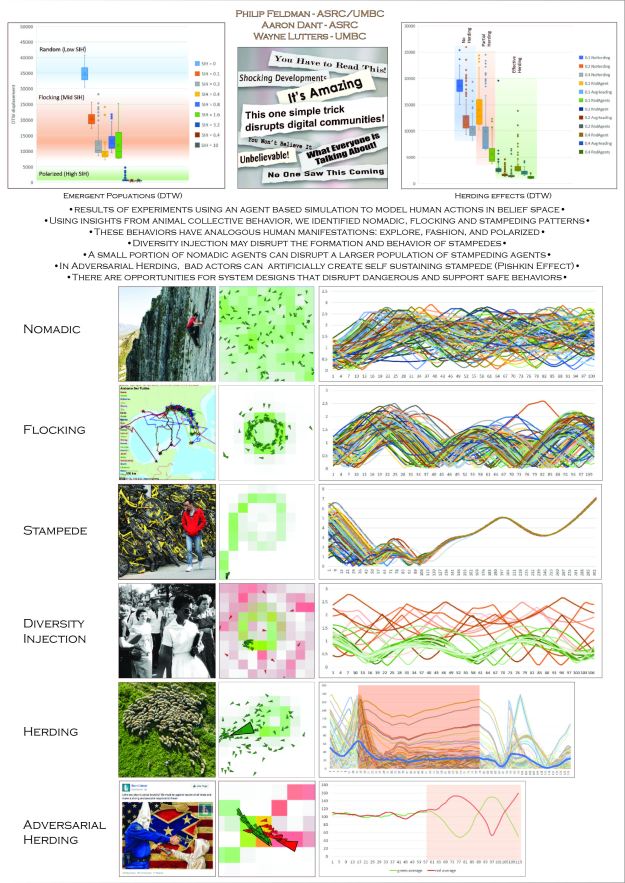
  • The new version of “This One Simple Trick” is on ArXive
  • Last minute stuff for travel
  • Call TW Ellis $250
  • Cal Ben Cardin

Phil 6.27.18

7:00 – 12:00 ASRC MKT

  • Print out documents! Done. Got passport drive too.
  • Need to write an extractor that lets the user navigate the xml file containing influences of selected agents. This could be a sample-by sample network. Maybe two modes?
    • Select an agent and see all the other agents come in and out of influcene
    • Select an number of agents and only watch the mutual influence.
    • There is an integrated JavaFX charts that I could use, or it could be an uploaded webapp? JavaFX would be easier in the short term, but a webapp would help more with JuryRoom…
    • Another option would be Python, since that’s where the LSTM code will live.
    • On the whole, two days before leaving on travel is probably the wrong time to start coding
  • Fixed a bug in the xml file generation
  • copied the new jar file onto the thumb drive
  • copied the xml file onto the thumb drive

12:00 – 4:00 ASRC A2P

  • Pomoting things to QA – done! Or at least, up to date with the excel files

Phil 6.26.18

7:00 – 5:00 ASRC MKT

  • Started back with the Evolution of Cooperation
  • Social loafing (Scholar results)
    • In social psychologysocial loafing is the phenomenon of a person exerting less effort to achieve a goal when they work in a group than when they work alone. This is seen as one of the main reasons groups are sometimes less productive than the combined performance of their members working as individuals, but should be distinguished from the accidental coordination problems that groups sometimes experience. Research on social loafing began with rope pulling experiments by Ringelmann, who found that members of a group tended to exert less effort in pulling a rope than did individuals alone. In more recent research, studies involving modern technology, such as online and distributed groups, have also shown clear evidence of social loafing. Many of the causes of social loafing stem from an individual feeling that his or her effort will not matter to the group.
  • NELA2017 contains almost every news article from 92 sources between April 2017 and October 2017, amounting to over 136K articles. This data set is the first release of NELA datasets. This version of the data set can be found on github and a full description and use cases can be found in our 2018 ICWSM paper.
  • Submitted “One Simple Trick” final to SASO
  • Updated ArXive
  • Fixed a bug that prevented population interactions in FlockingAgentManager.initializeAgents():
                // add to the global list
                allBoidsList.add(fs);
    
                // add a pointer to the global list to each shape
                fs.setFlockingShapeList(allBoidsList);
    
                // Add to the flock so that we can get flock headings
                List flock = flockListsMap.get(flockName);
                flock.add(fs);

    Seriously, what was I thinking?

  • Continued GUI tweaking. I think it looks pretty good, and it fits (mostly) on my laptop Version6.26.18
  • Verified that the influences record agents from different flocks and sources.
  • Copied all CI 2018 things I can think of onto the thumb drive

Phil 6.25.18

7:00 – 9:00 ASRC MKT

  • Update laptop – Intellij, Java, GroupPolarazation codebase
  • Add XML output for influence – done!
  • Refactored the GUI to work with smaller (laptop) screens)

9:00 – 2:30 ASRC A2P

  • Debug what’s going on with the excel reading. Try a new config file first?
  • Ground slowly through options
    • Replaced the config file
    • Stepped through the debugger, and noticed that the worksheet was null. Tried a different worksheet/config, and that was *not* null
    • Created a new workbook and copied everything over without formatting. That worked on the converter, but didn’t work with A2P
    • Reformatted the new workbook and wound up using the Funding Summary Details data with the formatting, which is *crazy*….
    • Had some issues getting connected to the server. Pageant forgot my key.

3:00 – 4:00 ASRC MKT

  • Fika. No, not really. Wound up chatting with Will

Phil 6.23.18

Registered for SASO

ArXive papers with Github repos

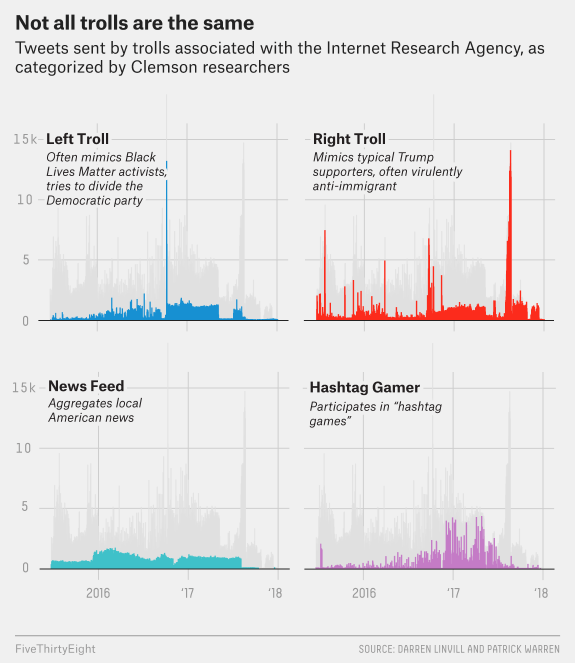
Mapping interest communities in Russian Facebook Ads. Preliminary visualisation reveals a number of broad interest groups around ethnicity; reveals a bit of Internet Research Agency’s strategy...

  • Dr Bharath Ganesh
    • Bharath is a political geographer focusing on data science and local government and the ethics and politics of researching violent online extremism.

More good stuff from Ian Couzin

  • Revealing the hidden networks of interaction in mobile animal groups allows prediction of complex behavioral contagion
    • We know little about the nature of the evolved interaction networks that give rise to the rapid coordinated collective response exhibited by many group-living organisms. Here, we study collective evasion in schooling fish using computational techniques to reconstruct the scene from the perspective of the organisms themselves. This method allows us to establish how the complex social scene is translated into behavioral response at the level of individuals and to visualize, and analyze, the resulting complex communication network as behavioral change spreads rapidly through groups. Thus, we can map, for any moment in time, the extent to which each individual is socially influential during collective evasion and predict the magnitude of such behavioral epidemics before they actually occur

This playlist contains tutorials to learn how to use Keras, a neural network API written in Python. Each video focuses on a specific concept and shows how the full implementation is done in code using Keras and Python.