Phil 8.7.18

8:00 – ASRC MKT

  • Looking for discussion transcripts.
  • Podcasts
    • Do you get your heart broken by the Nationals, Wizards, Caps and Redskins every single year but you still come back for more? The DMV Sports Roundtable is the podcast for you – Washington’s sports teams from the fans’ perspective – and plenty of college coverage too.
    • Join UCB Theatre veterans Cody Lindquist & Charlie Todd as they welcome a panel of NYC’s most hilarious comedians, journalists, and politicians to chug two beers on stage and discuss the politics of the week. It’s like Meet The Press, but funnier and with more alcohol. Theme song by Tyler Walker.
    • Rasslin Roundtable: Wrestling podcast centered around the latest PPV
    • TSN 1290 Roundtable: Kevin Olszewski hosts the Donvito Roundtable, airing weekdays from 11am-1pm CT on TSN 1290 Winnipeg. Daily discussion about the Winnipeg Jets, the NHL, and whatever else is on his mind!
    • The Game Design Round Table Focusing on both digital and tabletop gaming, The Game Design Round Table provides a forum for conversation about critical issues to game design.
    • Story Works Round Table Before you can be a successful author, you have to write a great story. Each week, co-hosts, Alida Winternheimer, author and writing coach at Word Essential, Kathryn Arnold, emerging writer, & Robert Scanlon, author of the Blood Empire series, have conversations about the craft of writing fiction. They bring diverse experiences and talents to the table from both the traditional and indie worlds. Our goal is for each episode to be a fun, lively discussion of some aspect of story craft that that enlightens, as well as entertains.
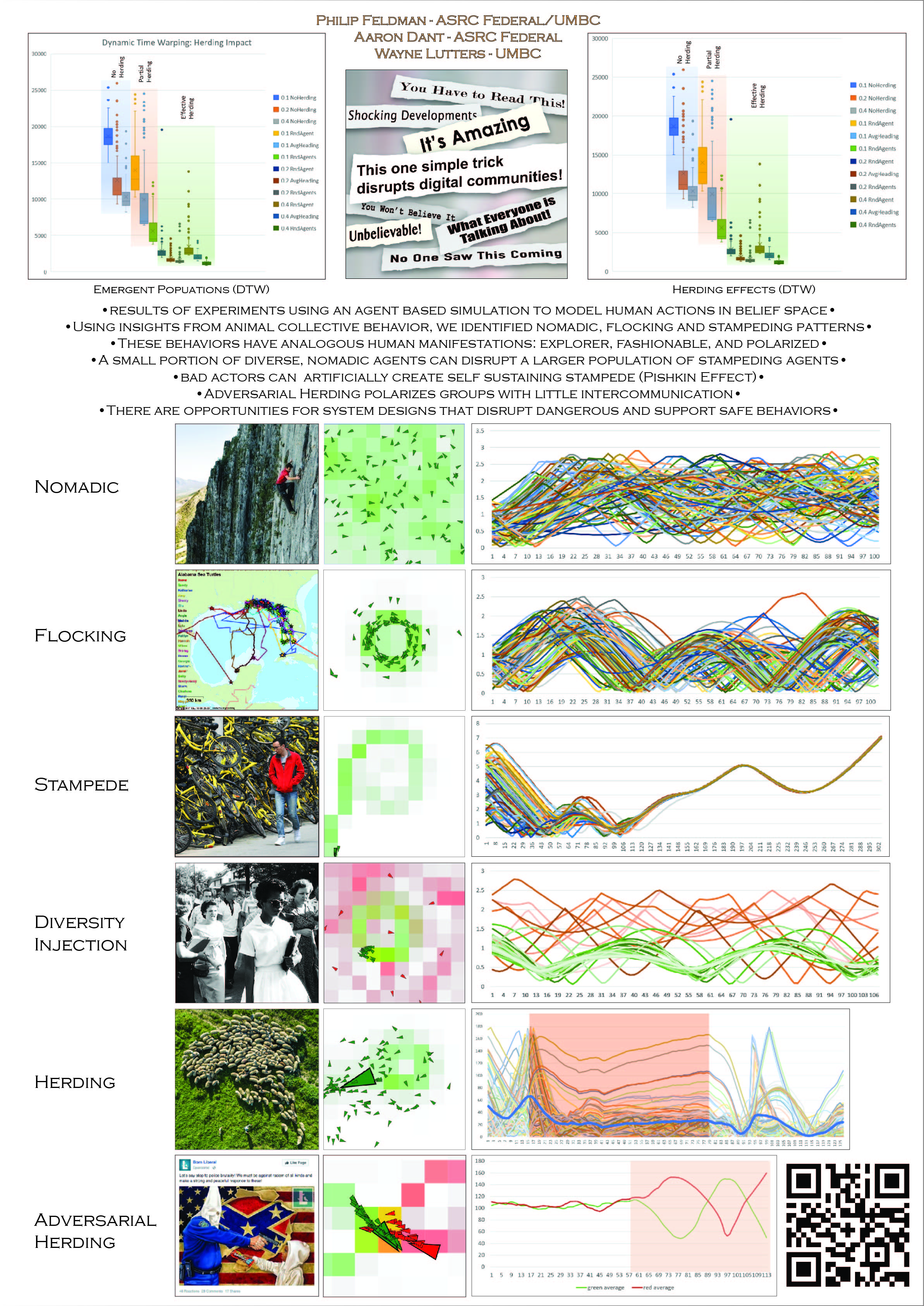
  • Some good pix of bike-share graveyards in China that would be good stampede pix from The Atlantic (set 1) (set 2) Bicycles of various bike-sharing services are seen in Shanghai.
  • Starting back on the SASO slides. Based on Wayne’s comments, I’m reworking the Stephens’ slide
    • Flashes of Insight: Whole-Brain Imaging of Neural Activity in the Zebrafish (video)(paper)(paper)

Phil 8.6.18

7:00 – 5:00 ASRC CONF

  • Heard about this on the Ted Radio Hour: Crisis Trends
    • Crisis Trends empowers journalists, researchers, school administrators, parents, and all citizens to understand the crises their communities face so we can work together to prevent future crises. Crisis Trends was originally funded by the Robert Wood Johnson Foundation. CurrentTrends
  • Committee talk today!
    • Tweaked the flowchart slides
    • Added pix to either end of the “model(?)” slide showing that the amount of constraint is maximum at either end. On the nomadic side, the environment is the constraint. Imagine a solitary activity in a location so dangerous that any false move would result in death or injury. Think of freeclimbing: b16-540x354
    • On the other end of the spectrum is the maximum social constraint of totalitarianism, which is summed up nicely in this play on the constitutional basis for English law “Everything not forbidden is allowed” by T. H. White THWhite
    • The presentation went pretty well. There is a consensus that I should look for existing sources of discussions that reach consensus. Since this has to be a repeated discussion about the same topic, I think that sports are the only real option.
  • Added a slide on tracking changes to the Latex presentation slides for next week
  • Amusing ourselves to Trump
    • The point of Amusing Ourselves to Death is that societies are molded by the technologies atop which they communicate. Oral cultures teach us to be conversational, typographic cultures teach us to be logical, televised cultures teach us that everything is entertainment. So what is social media culture teaching us?
  • It’s Looking Extremely Likely That QAnon Is A Leftist Prank On Trump Supporters
    • There’s a growing group of Trump supporters who are convinced that the president is secretly trying to save the world from a global pedophilia ring.

Phil 8.3.18

7:00 – 3:30 ASRC MKT

  • Slides and walkthrough – done!
  • Ramping up on SASO
  • Textricator is a tool for extracting text from computer-generated PDFs and generating structured data (CSV or JSON). If you have a bunch of PDFs with the same format (or one big, consistently formatted PDF) and you want to extract the data to CSV or JSON, _Textricator_ can help! It can even work on OCR’ed documents!
  • LSTM links for getting back to things later
  • Who handles misinformation outbreaks?
    • Misinformation attacks— the deliberate and sustained creation and amplification of false information at scale — are a problem. Some of them start as jokes (the ever-present street sharks in disasters) or attempts to push an agenda (e.g. right-wing brigading); some are there to make money (the “Macedonian teens”), or part of ongoing attempts to destabilise countries including the US, UK and Canada (e.g. Russia’s Internet Research Agency using troll and bot amplification of divisive messages).

      Enough people are writing about why misinformation attacks happen, what they look like and what motivates attackers. Fewer people are activelycountering attacks. Here are some of them, roughly categorised as:

      • Journalists and data scientists: Make misinformation visible
      • Platforms and governments: Reduce misinformation spread
      • Communities: directly engage misinformation
      • Adtech: Remove or reduce misinformation rewards

Phil 8.2.18

7:00 – 5:00 ASRC MKT

  • Joshua Stevens (Scholar)
    • At Penn State I researched cartography and geovisual analytics with an emphasis on human-computer interaction, interactive affordances, and big data. My work focused on new forms of map interaction made possible by well constructed visual cues.
  • A Computational Analysis of Cognitive Effort
    • Cognitive effort is a concept of unquestionable utility in understanding human behaviour. However, cognitive effort has been defined in several ways in literature and in everyday life, suffering from a partial understanding. It is common to say “Pay more attention in studying that subject” or “How much effort did you spend in resolving that task?”, but what does it really mean? This contribution tries to clarify the concept of cognitive effort, by introducing its main influencing factors and by presenting a formalism which provides us with a tool for precise discussion. The formalism is implementable as a computational concept and can therefore be embedded in an artificial agent and tested experimentally. Its applicability in the domain of AI is raised and the formalism provides a step towards a proper understanding and definition of human cognitive effort.
  • Efficient Neural Architecture Search with Network Morphism
    • While neural architecture search (NAS) has drawn increasing attention for automatically tuning deep neural networks, existing search algorithms usually suffer from expensive computational cost. Network morphism, which keeps the functionality of a neural network while changing its neural architecture, could be helpful for NAS by enabling a more efficient training during the search. However, network morphism based NAS is still computationally expensive due to the inefficient process of selecting the proper morph operation for existing architectures. As we know, Bayesian optimization has been widely used to optimize functions based on a limited number of observations, motivating us to explore the possibility of making use of Bayesian optimization to accelerate the morph operation selection process. In this paper, we propose a novel framework enabling Bayesian optimization to guide the network morphism for efficient neural architecture search by introducing a neural network kernel and a tree-structured acquisition function optimization algorithm. With Bayesian optimization to select the network morphism operations, the exploration of the search space is more efficient. Moreover, we carefully wrapped our method into an open-source software, namely Auto-Keras for people without rich machine learning background to use. Intensive experiments on real-world datasets have been done to demonstrate the superior performance of the developed framework over the state-of-the-art baseline methods.
  • I think I finished the Dissertation Review slides. Walkthrough tomorrow!

Phil 8.1.18

7:00 – 6:00 ASRC MKT

  • I need to add some things to both talks
    • Use Stephens to show how we can build vectors out of ‘positions’ in high dimension space, and then measure distances (hypotenuse, cosine similarity, etc). Also, how the use of stories show alignment over time and create a trajectory – done
    • Add slide that shows the spectrum from low-dimensional social space to high-dimensional environmental space.
      • Aligning in social spaces is easier because we negotiate the terrain we interact on
      • Aligning in environmental spaces is harder because there is no negotiation
    • Add slides for each of the main parts
      • Social influence
      • Dimension Reduction
      • Heading
      • Velocity
      • State (what we tend to think about)
    • Add demo slide that walks through each part of the demo – done
      • Single population with different SIH
      • Small explorer population interacting with stampeding groups
      • Adversarial Herding
      • Opposed AH
      • Map building
  • Capturing the interplay of dynamics and networks through parameterizations of Laplacian operators
    • We study the interplay between a dynamical process and the structure of the network on which it unfolds using the parameterized Laplacian framework. This framework allows for defining and characterizing an ensemble of dynamical processes on a network beyond what the traditional Laplacian is capable of modeling. This, in turn, allows for studying the impact of the interaction between dynamics and network topology on the quality-measure of network clusters and centrality, in order to effectively identify important vertices and communities in the network. Specifically, for each dynamical process in this framework, we define a centrality measure that captures a vertex’s participation in the dynamical process on a given network and also define a function that measures the quality of every subset of vertices as a potential cluster (or community) with respect to this process. We show that the subset-quality function generalizes the traditional conductance measure for graph partitioning. We partially justify our choice of the quality function by showing that the classic Cheeger’s inequality, which relates the conductance of the best cluster in a network with a spectral quantity of its Laplacian matrix, can be extended to the parameterized Laplacian. The parameterized Laplacian framework brings under the same umbrella a surprising variety of dynamical processes and allows us to systematically compare the different perspectives they create on network structure.

Phil 7.31.18

7:00 – 6:00 ASRC MKT

  • Thinking that I need to forward the opinion dynamics part of the work. How heading differs from position and why that matters
  • Found a nice adversarial herding chart from The EconomistBrexit
  • Why Do People Share Fake News? A Sociotechnical Model of Media Effects
    • Fact-checking sites reflect fundamental misunderstandings about how information circulates online, what function political information plays in social contexts, and how and why people change their political opinions. Fact-checking is in many ways a response to the rapidly changing norms and practices of journalism, news gathering, and public debate. In other words, fact-checking best resembles a movement for reform within journalism, particularly in a moment when many journalists and members of the public believe that news coverage of the 2016 election contributed to the loss of Hillary Clinton. However, fact-checking (and another frequently-proposed solution, media literacy) is ineffectual in many cases and, in other cases, may cause people to “double-down” on their incorrect beliefs, producing a backlash effect.
  • Epistemology in the Era of Fake News: An Exploration of Information Verification Behaviors among Social Networking Site Users
    • Fake news has recently garnered increased attention across the world. Digital collaboration technologies now enable individuals to share information at unprecedented rates to advance their own ideologies. Much of this sharing occurs via social networking sites (SNSs), whose members may choose to share information without consideration for its authenticity. This research advances our understanding of information verification behaviors among SNS users in the context of fake news. Grounded in literature on the epistemology of testimony and theoretical perspectives on trust, we develop a news verification behavior research model and test six hypotheses with a survey of active SNS users. The empirical results confirm the significance of all proposed hypotheses. Perceptions of news sharers’ network (perceived cognitive homogeneity, social tie variety, and trust), perceptions of news authors (fake news awareness and perceived media credibility), and innate intentions to share all influence information verification behaviors among SNS members. Theoretical implications, as well as implications for SNS users and designers, are presented in the light of these findings.
  • Working on plan diagram – done
  • Organizing PhD slides. I think I’m getting near finished
  • Walked through slides with Aaron. Need to practice the demo. A lot.

Phil 7.29.18

Bandit Algorithms

  • Is this story true? It may be. The Gittins book was first published in 1989
  • The name comes from the 1950s when Frederick Mosteller and Robert Bush decided to study animal learning and ran trials on mice and then on humans. The mice faced the dilemma of choosing to go left or right, after starting in the bottom of a T-shaped maze, not knowing each time at which end they will find food. To study a similar learning setting in humans, a “two-armed bandit” machine was commissioned where humans could choose to pull either the left or the right arm of the machine, each giving a random payoff with the distribution of payoffs for each arm unknown to the human player.
  • William R. Thompson. On the likelihood that one unknown probability exceeds another in view of the evidence of two samples. Biometrika, 1933.

Phil 7.27.18

Ted Underwood

  • my research is as much about information science as literary criticism. I’m especially interested in applying machine learning to large digital collections
  • Git repo with code for upcoming book: Distant Horizons: Digital Evidence and Literary Change
  • Do topic models warp time?
    • The key observation I wanted to share is just that topic models produce a kind of curved space when applied to long timelines; if you’re measuring distances between individual topic distributions, it may not be safe to assume that your yardstick means the same thing at every point in time. This is not a reason for despair: there are lots of good ways to address the distortion. The mathematics of cosine distance tend to work better if you average the documents first, and then measure the cosine between the averages (or “centroids”).
  • The Historical Significance of Textual Distances
    • Measuring similarity is a basic task in information retrieval, and now often a building-block for more complex arguments about cultural change. But do measures of textual similarity and distance really correspond to evidence about cultural proximity and differentiation? To explore that question empirically, this paper compares textual and social measures of the similarities between genres of English-language fiction. Existing measures of textual similarity (cosine similarity on tf-idf vectors or topic vectors) are also compared to new strategies that use supervised learning to anchor textual measurement in a social context.

7:00 – 8:00 ASRC MKT

  • Continued on slides. I think I have the basics. Need to start looking for pictures
  • Sent response to the SASO folks about who’s presenting what.

9:00 – ASRC IRAD

Phil 7.25.18

7:00 – 3:00 ASRC

  • Send out email with meeting time
  • Rather than excerpts from the talks, do a demo of the relevant bits with conclusions and implications. Get the laptop running all the pieces. That means Python and TF and all the other bits.
  • Submitted tuition expenses
  • Submitted Fall 2018 approval
  • Got SASO travel approval!
  • More DNN study
    • Finished CNNs
    • Working on embeddings and W2V. Thought I’d try it on the laptop, but keras can’t find it’s back end and I’m getting other weird errors. One of the big ones was that I didn’t install tk with python. Here’s the answer from stackoverflow: python_fix
    • And now we’re waiting a very long time for a tf ‘hello world’ to run… But it did!
    • Had to also install pydot and graphviz-2.38.msi. Then add the graphviz bin directory to the path.
    • But now everything runs on the laptop, which will help with the demos!
    • Skipped the GloVe and pre-trained embeddings. Ready to start on DNNs tomorrow.

Phil 7.24.18

7:00 – 3:00 ASRC MKT

    • Finished The Radio in Fascist Italy
      • Philip Cannistraro
      • Journal of European Studies
      • scholars have generally agreed that the control of the mass media by the state is a fundamental prerequisite for the establishment and maintenance of totalitarian dictatorships (pg 127)
      • It is not so widely acknowledged, however, that contemporary totalitarian governments have been largely responsible for the initial growth of the mass media-particularly films and the radio-in their respective countries. (pg 127)
      • In their efforts to expose entire populations to official propaganda, totalitarian regimes encouraged and sponsored the development of the mass media and made them available to every· citizen on a large scale basis. (pg 127)
      • Marconi shrewdly reminded Mussolini that it would be politically wise to place control of the radio in the hands of the state, pointing out the radio’s great potential for propaganda purposes (pg 128)
      • “How many hearts recently beat with emotion when hearing the very voice of the Duce! All this means but one thing: the radio must be extended and extended rapidly. It will contribute much to the general culture of the people” (pg 129)
      • … to insure that EIAR’s programmes conformed to the requirements of the regime’s cultural and political policies. The High Commission included government representatives from each major area of culture: literature, journalism., the fine arts, music, poetry, theatre, and films. The programmes Commission screened the transcripts and plans of all and censored the content of all broadcasts. (pg 130)
      • His broadcast, ‘The Bombardment of Adrianople’, was awaited by the public with great interest and was heralded by critics as the most significant cultural event of the Italian radio.ts Marinetti’s colourful language and emotion-packed presentation blasted un expected life into the Italian radio. His flam.boyant style introduced the concept of the ‘radio personality’ in Fascist Italy, and the success of his talk encouraged those who, like Marinetti himself, hoped to make the radio a new art form. Broadcasts by Marinetti, most of which were lectures on Futurism, continued to be heard on Italian radio each month for more than a decade. (pg 131)
      • The regime quickly recognized the effectiveness of this technique in· arousing listener interest, and it was an easy matter to transfer microphones to mass rallies from where the enthusiastic cheers of the spectators could be heard by radio audiences. (pg 132)
      • The popular announcer Cesare Ferri created the characters ‘Nonno Radio’ (Grandfather Radio) and ‘Zia Radio’ (Aunt Radio), speaking to Italian youth with unprecedented familiarity in terms they easily understood. (pg 132)
      • In order to popular arouse interest in its program.me EIAR sought to stimulate indirect audience participation through public contests for short stories, poems, songs, In and children’s fairy tales. addition, surveys were conducted among listeners to discover trends in popular taste. (pg 133)
      • The radio had an important task to fulfil in the totalitarian state, that of binding the Italians together into one nation through common ideals and a common cultural experience inspired by Fascism. (pg 134)
      • Mussolini proclaimed Radio Rurale a great achievement of the Fascist revolution, for contemporary observers saw it as a new instrument with which to integrate rural existence into the mainstream. of national life. (pg 135)
      • The measures taken by the regime to overcome cultural and political provincialism by creating a mass radio audience in the countryside met with qualified success. (pg 137)
      • Regarded by many as an important step towards the creation of a truly popular culture, Radio Btdilla’s purpose was to give the working classes of the city and the countryside the means of acquiring a radio at a modest cost. Through the radio art, instruction, music, poetry-all the cultural masterworks–cease to become the privilege and unjust monopoly of a few elitist groups’. (pg 139)
      • ‘The ministry, in carrying out its delicate functions of vigilance over radio broadcasting, must guide itself by criteria that are essentially of a political and cultural nature.’ (pg 140)
      • Once the radio had been integrated into the structure of the Ministry of Popular Culture, the Fascists began to develop m.ore effective ways of using broadcasting as a cultural medium. While the number and variety of programmes had begun to increase by the beginning of the decade, it was only after 1934 that they became politically sophisticated. (pg 141)
      • Fascist racial doctrines became a major theme of radio propaganda during World War II. An Italo-German accord signed in 1940 to co-ordinate radio propaganda between the two countries included measures to ‘intensify anti-Jewish propaganda’ on the Italian radio as well as in foreign broadcasts.78 The Inspectorate for Radio Broadcasting organized an important series of anti-Semitic prograrnm.es that centred around the ‘Protocols of Zion’, and talks such as ‘Judaism. versus Western Culture’, the ‘Jewish International’, and ‘Judaism. Wanted this War’, were broadcast from 1941 to 1943. (pg 143)
      • information received from the Vatican radio during World War II was generally regarded more accurate than the obvious propaganda broadcasts of the Allies (pg 147)
      • On the radio he astutely employed direct, forceful language, shouting short and vivid sentences to create a sense of drama and arouse emotional reactions. ‘This ‘maniera forte’ that characterized Appelius’ radio talks had a great appeal for many Italians, especially for the ‘little man’ who wanted to be talked to on his own level in terms he could readily understand.121 In his broadcasts Appelius screamed insults and ranted and raved at the foul enemies of Fascism. with a powerful barrage of verbal abuse, inciting his audiences to unmitigated hatred and scorn against the evil ‘anglo-sassoni’ and their allies. (pg 150)
      • In the broad context of Fascist cultural aspirations, all the media aimed at similar goals: the diffusion of standard images and themes that reflected the ideological values of Fascism.; the creation of a mass culture that conformed the needs of the Fascist state in its capacity as a totalitarian to government. (pg 154)
    • Next on the list, Radio: The Intimate Medium
      • Lou Orfanella
      • Radio has always had a special power. It has exerted this power from our grandparents gathered in the living room to listen to an FDR fireside chat as it crackled from a big wooden cabinet filled with glass tubes to our own summer nights of making out as Wolfman Jack howled through the dashboard speakers. There is an intimacy, a one-to-one connection that no other medium can match. (pg 53)
      • “I’m the guy that gets up with them in the morning. I’m in the shower with them, I go to work with them. It is a very intimate time.” (pg 53)
      • Something emergent in talk radio:
        • As Dan Ingram explains: “I felt they were making a major mistake, and for over fifteen years, WABC had ratings around one-point- something, until the conservative, fascist talk shows began to draw the same kind of audience that must have turned out for the spectacle of seeing someone stoned to death in Biblical times.” (pg 54)
        • Bruce Morrow, who still draws high ratings with his broadcasts over WCBS-FM, feels that “People listen because somewhere along the line, Top Forty radio became the closest thing we ever had to a national personality. Rock ‘n’ Roll became the nearest thing we’ve had to an American voice” (pg 55) – Pop culture as dimension reduction/polarization/consensus?
    • From Incivility to Outrage: Political Discourse in Blogs, Talk Radio, and Cable News
      • Sarah Sobieraj and Jeffrey M. Berry
      • Political Communication
      • The country appears to be moving toward a parliamentary-type legislature with the party in power ruling and the party out of power biding its time and doing its best to bring down its opponents. It strains credulity to believe that the new and expanded ideological media has had nothing to do with this trend. For those media commentators outside of mainstream news organizations, the red meat is good versus evil and heroes working at great odds against powerful villains. This favors the most ideological within parties, helping them raise money and gain votes in primaries when they oppose more moderate candidates (pg 36)
    • Continue on SASO slides
    • More LSTM
    • To get a level of visualization from Keras, I had to download graphviz from here, and then add the C:\Program Files (x86)\Graphviz2.38\bin directory to the path and restart Intellij. But now I have pix of the network! model


  • Might need to help Aaron out putting together GUI code. Did manage to get everything up and running on my local machine.
  • DOJ CATS slide walkthrough. Found the schema for the DB?
  • 3:30 Meeting with Don to discuss LSTM and topic identification. It occurs to me that this could be the paper that allows me to end the PHD by pointing out the way that JuryRoom would build maps. Possible UIST or DIS paper if framed this way?
    • Meeting went well, though we never got to the dance my PhD parts. Don suggests starting with simple statistical analysis on bag-of-words or tf-idf text
    • Don then introduced me to Aaron Mannes, and we had a nice chat about navigating belief spaces and radicalization. He also suggested looking at qntfy.com.
      • Qntfy is a technology solutions provider bridging data science and human behavior. We make complex psychological and behavioral data accessible, scalable and actionable for both individuals and organizations.

Phil 7.23.18

7:00 – ASRC MKT

  • Starting on the SASO slides. Found my diversity injection slide story:
    • Max Hawkins
      • (From NPR’s Invisibilia) “I just started thinking about these loops that we get into,” he says. “And about how the structure of your life … completely determines what happens in it.” Max’s once beautiful routine suddenly seemed unfulfilling. He felt like he was growing closer to people in his own bubble and becoming isolated from those outside of it. “There was something … that just made me feel trapped,” he says. “Like I was reading a story that I’d read before or I was playing out someone else’s script.” As any computer developer would do, Max turned to technology to craft his way out — a series of randomization applications.
    • Reading Review: Totalitarianism: The Revised Standard Version
      • …they have chosen to identify totalitarianism in terms of a set of six interrelated traits or characteristics-Fried- rich’s oft-referred-to “totalitarian syndrome” (9-io).25 The syndrome includes an official ideology (orientation), a single party typically led by one man (dimension reduction), a terroristic police (herding), a communications monopoly (social influence horizon), a weapons monopoly (??) and a centrally directed economy (dimension reduction)
  • Continued to spin up on LSTM effort. Got my dev environment COMPLETELY up to date. Continued with Deep learning & Keras

3:00 – 5:00 Fika & meeting with Wayne

  • Worked on the slides for PhD status. I realize that this is actually a good time to have demos with conclusions.
  • Talked about options if IRAD falls through
  • Need to think about what are the best ways for the work to have impact

Phil 7.22.18

Modeling relatedness and demography in social evolution

  • With any theoretical model, the modeler must decide what kinds of detail to include and which simplifying assumptions to make. It could be assumed that models that include more detail are better, or more correct. However, no model is a perfect description of reality and the relative advantage of different levels of detail depends on the model’s empirical purpose. We consider the specific case of how relatedness is modeled in the field of social evolution. Different types of model either leave relatedness as an independent parameter (open models), or include detail for how demography and life cycle determine relatedness (closed models). We exploit the social evolution literature, especially work on the evolution of cooperation, to analyze how useful these different approaches have been in explaining the natural world. We find that each approach has been successful in different areas of research, and that more demographic detail is not always the most empirically useful strategy.