Category Archives: Phil

Phil 3.12.21

MD food bank!

Some interesting papers

  • Neural Encoding and Decoding With Distributed Sentence Representations
    • Building computational models to account for the cortical representation of language plays an important role in understanding the human linguistic system. Recent progress in distributed semantic models (DSMs), especially transformer-based methods, has driven advances in many language understanding tasks, making DSM a promising methodology to probe brain language processing. DSMs have been shown to reliably explain cortical responses to word stimuli. However, characterizing the brain activities for sentence processing is much less exhaustively explored with DSMs, especially the deep neural network-based methods. What is the relationship between cortical sentence representations against DSMs? What linguistic features that a DSM catches better explain its correlation with the brain activities aroused by sentence stimuli? Could distributed sentence representations help to reveal the semantic selectivity of different brain areas? We address these questions through the lens of neural encoding and decoding, fueled by the latest developments in natural language representation learning. We begin by evaluating the ability of a wide range of 12 DSMs to predict and decipher the functional magnetic resonance imaging (fMRI) images from humans reading sentences. Most models deliver high accuracy in the left middle temporal gyrus (LMTG) and left occipital complex (LOC). Notably, encoders trained with transformer-based DSMs consistently outperform other unsupervised structured models and all the unstructured baselines. With probing and ablation tasks, we further find that differences in the performance of the DSMs in modeling brain activities can be at least partially explained by the granularity of their semantic representations. We also illustrate the DSM’s selectivity for concept categories and show that the topics are represented by spatially overlapping and distributed cortical patterns. Our results corroborate and extend previous findings in understanding the relation between DSMs and neural activation patterns and contribute to building solid brain-machine interfaces with deep neural network representations.
  • A Survey of the Usages of Deep Learning for Natural Language Processing
    • Over the last several years, the field of natural language processing has been propelled forward by an explosion in the use of deep learning models. This article provides a brief introduction to the field and a quick overview of deep learning architectures and methods. It then sifts through the plethora of recent studies and summarizes a large assortment of relevant contributions. Analyzed research areas include several core linguistic processing issues in addition to many applications of computational linguistics. A discussion of the current state of the art is then provided along with recommendations for future research in the field.
  • Multiview Concept Learning Via Deep Matrix Factorization
    • Multiview representation learning (MVRL) leverages information from multiple views to obtain a common representation summarizing the consistency and complementarity in multiview data. Most previous matrix factorization-based MVRL methods are shallow models that neglect the complex hierarchical information. The recently proposed deep multiview factorization models cannot explicitly capture consistency and complementarity in multiview data. We present the deep multiview concept learning (DMCL) method, which hierarchically factorizes the multiview data, and tries to explicitly model consistent and complementary information and capture semantic structures at the highest abstraction level. We explore two variants of the DMCL framework, DMCL-L and DMCL-N, with respectively linear/nonlinear transformations between adjacent layers. We propose two block coordinate descent-based optimization methods for DMCL-L and DMCL-N. We verify the effectiveness of DMCL on three real-world data sets for both clustering and classification tasks.

Writing part of the introduction of the IEEE issue on diversity in transportation.

2:00 AI/ML tagup

  • Pinged Eric about getting a code to charge some of the hours – he’ll provide later

SBIR

  • 11:30 tagup

ML Group

  • 3:30 Meeting / Happy hour. Went over results. I’m going to run a larger experiment to generate text (not ranks). 50 tokens, 1,000 results for chinavirus and sars-cov-2
Phil 3.11.21

This looks really good! Deep Learning (with PyTorch). It’s a set of videos for NYU’s Deep Learning course.

  • This course concerns the latest techniques in deep learning and representation learning, focusing on supervised and unsupervised deep learning, embedding methods, metric learning, convolutional and recurrent nets, with applications to computer vision, natural language understanding, and speech recognition. 

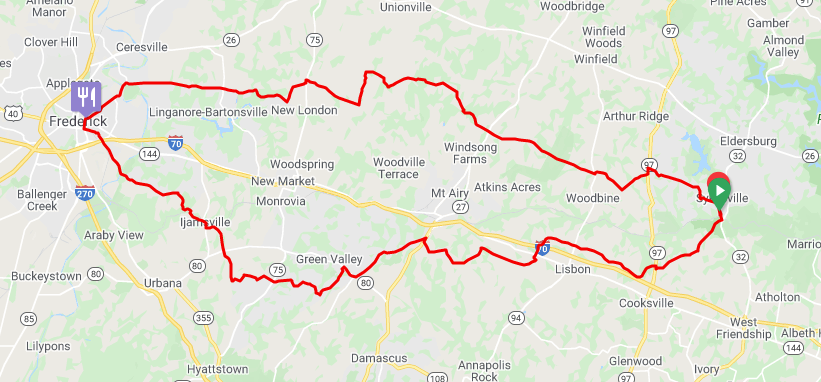
The weather’s great, so I’m taking the day off to ride this:

https://ridewithgps.com/routes/35364711

It was a marvelous ride on a warm, almost hot day. I write this on the morning of the 12th, and I can still feel it in my legs. I haven’t felt that in months. Even a long winter ride doesn’t do that. It’s really hard to put out sustained power when you’re (a) cold and (b) trying to avoid sweating too much and getting colder

Phil 3.10.21

Zach found a cool article: The Genius Neuroscientist Who Might Hold the Key to True AI

  • Free energy is the difference between the states you expect to be in and the states your sensors tell you that you are in. Or, to put it another way, when you are minimizing free energy, you are minimizing surprise.

GPT-Agents

  • Running the training for the new models
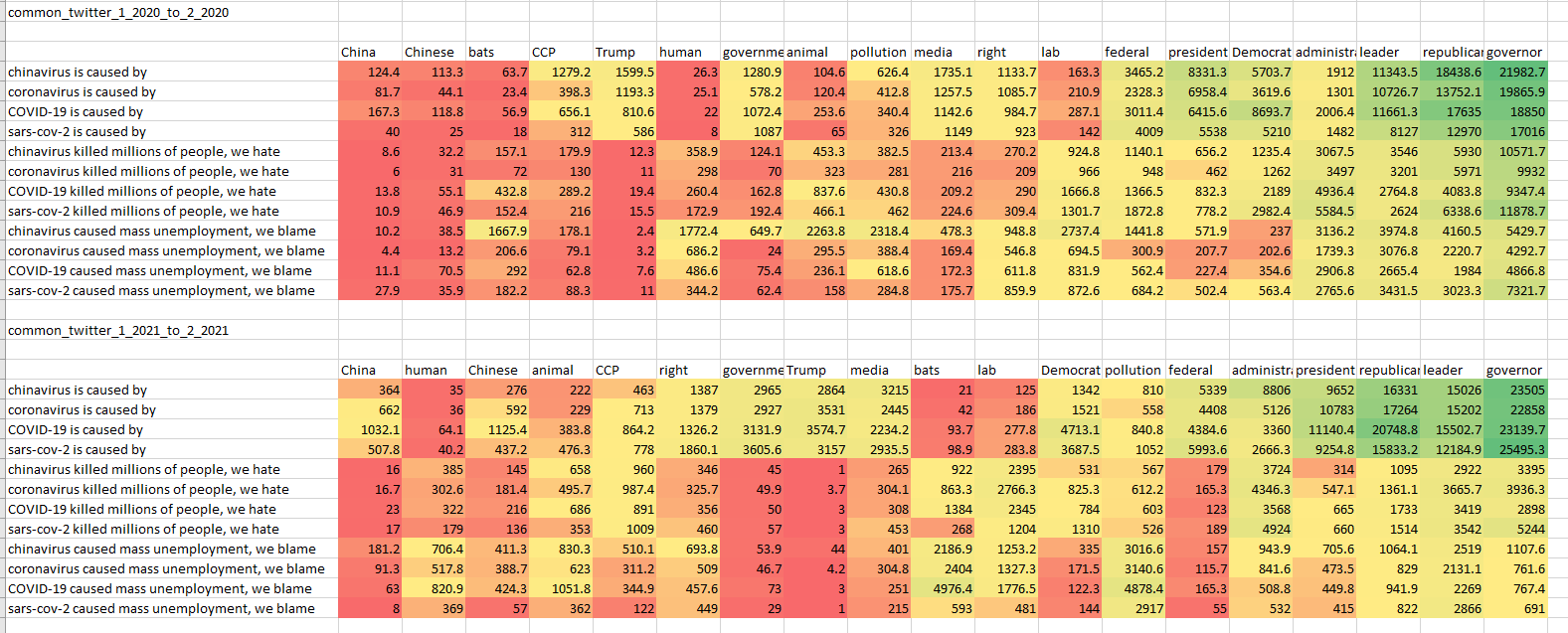
  • Added the meta-summary spreadsheet:
https://viztales.com/wp-content/uploads/2021/03/image-10.png
  • Need to re-run these tests on the new models using more runs and no rank testing

SBIR

  • 9:30 Meeting – Looks like I need to get 50% coverage? Maybe in medical?
  • More Pytorch tutorial
  • Need to upgrade the ASRC box to 1.8 when it finishes training the current models
  • Found my svncopy.bat file. It’s in JavaUtils2

GOES

  • 3:00 Meeting

Phil 3.9.2021

Quotebank is a dataset of 178 million unique, speaker-attributed quotations that were extracted from 196 million English news articles crawled from over 377 thousand web domains between August 2008 and April 2020. The quotations were extracted and attributed using Quobert, a distantly and minimally supervised end-to-end, language-agnostic framework for quotation attribution.

Stanford Cable TV News Analyzer The Stanford Cable TV Analyzer enables you to write queries that compute the amount of time people appear and the amount of time words are heard in cable TV news. In this tutorial we will go over the basics of how to use the tool to write simple queries.

GPT Agents

  • Finished experiments and generated spreadsheets.
  • Uploading everything to DropBox
  • 3:00 Meeting
    • Create datasets from tweets that have [‘%kung flu%’, ‘%kungflu%’, ‘%china virus%’, ‘%chinavirus%’, ‘%coronavirus%’, ‘%covid%’, ‘%sars-cov-2%’] and train models from these. The idea is to examine how this type of polarized training can influence the response of the model. Related work on Microsoft’s Tay
    • Create a meta-sheet for all the spreadsheet summaries
    • Rather than look at rankings, go back to the cumulative stats on multiple runs with top K set to the range of ranks that we want to look at, then take a look at the first n words. This addresses the token problem

SBIR

  • Set up proxy (2:00)?
  • Write up curves embedding code
  • Start on simplest possible autoregressing Transformer using curve data
  • Started on the PyTorch Quickstart. Everything is installed properly and Cuda is visible

Phil 3.8.21

GSAW today

  • The community is very much on the implementation part of ML. Aerospace corporation is doing some really nice work merging synthetic and actual data to detect threat anomalies. Slingshot is doing really nice data fusion
  • I had an interesting ide come to me during the panel. It might be possible to train a large Transformer model on all mission telemetry from launch to sunset for all satellites. Then you could do zero-shot detection on new data, just like the GPT-3 does.

GPT-Agents

  • Working on getting the meta information back to the summary tab – done
  • Run all models – done
  • I think I know how I want to try the mapping.
    • Use a prompt that should produce a list of nouns in order
    • Have the temp set reasonably high and for repetition to be low
    • Look at the output text and look for a N-N-N… pattern. Select those as nodes and stop when the pattern changes
    • Repeat and increment the edge weight for each redundant connection
    • Trim the leaf nodes with low counts

SBIR

  • Ping Clay about how much of my time I can bill based on current rates
  • Create generic multidimensional vectors for training
  • Yannic Kilcher’s walkthrough of Attention Is All You Need

Phil 3.6.21

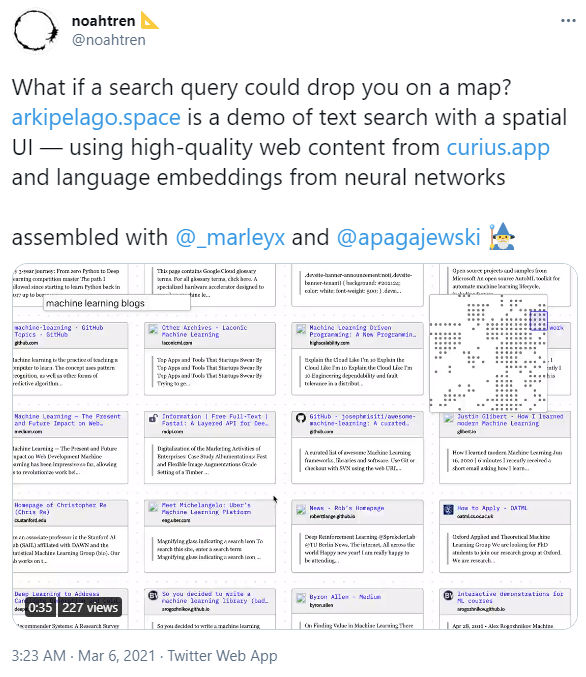
https://twitter.com/noahtren/status/1368114923956535296

Arkipelago.space is a searchable map of interesting things on the Internet. The content is taken from a web crawl of 70,000 webpages originating from high-quality, human-curated links via Curius.app. A neural network uses the text content of each page to determine which pages should appear near each other on the map.

It seems to be a bunch of students playing around with cool things

Huggingface has lots of models to handle speech tagging!

Phil 3.5.21

This is a lot like self-attention in Transformers: How social learning amplifies moral outrage expression in online social networks

  • Moral outrage shapes fundamental aspects of human social life and is now widespread in online social networks. Here, we show how social learning processes amplify online moral outrage expressions over time. In two pre-registered observational studies of Twitter (7,331 users and 12.7 million total tweets) and two pre-registered behavioral experiments (N = 240), we find that positive social feedback for outrage expressions increases the likelihood of future outrage expressions, consistent with principles of reinforcement learning. We also find that outrage expressions are sensitive to expressive norms in users’ social networks, over and above users’ own preferences, suggesting that norm learning processes guide online outrage expressions. Moreover, expressive norms moderate social reinforcement of outrage: in ideologically extreme networks, where outrage expression is more common, users are less sensitive to social feedback when deciding whether to express outrage. Our findings highlight how platform design interacts with human learning mechanisms to impact moral discourse in digital public spaces.

Related: Democracy Is Weakening Right in Front of Us: Is technopessimism our new future?

Book

  • 2:00 Meeting with Michelle

GPT-Agents

  • Finish summary table – Mostly done. Needs tweaking
  • 3:30 Meeting

GOES

  • 11:00 Meeting
  • Continue working on data generation – generating faulty rw sims!

Phil 3.4.21

I wonder if any crazy things are going to happen today? Capitol Police say intelligence shows militia group may be plotting to breach the Capitol

GPT-Agents

  • In EccoToXlsx, add code to iterate over all the samples from a prompt and add selected token ranks for the selected columns to a summary Dict. Compute mean and variance (95% intervals?), display the table and plot a candlestick plot.
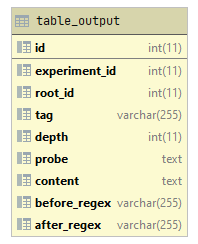
  • Set up a mapping directory in GPT-2 Agents. Do some test pulls using the Python API. I think the goal should be to populate a database that is similar to the gpt2_chess db table_moves (from, to, probe, response),
  • Combined with table_output from gpt_experiments (experiment_id, root_id, tag, before_regex, and after_regex):

Book

  • Work on chapters

GOES

  • Work on fast sim
    • Finish moving code from frame3d_test file to FastRCSGenerator. Keep the plots too, just to make sure everything’s working. Done
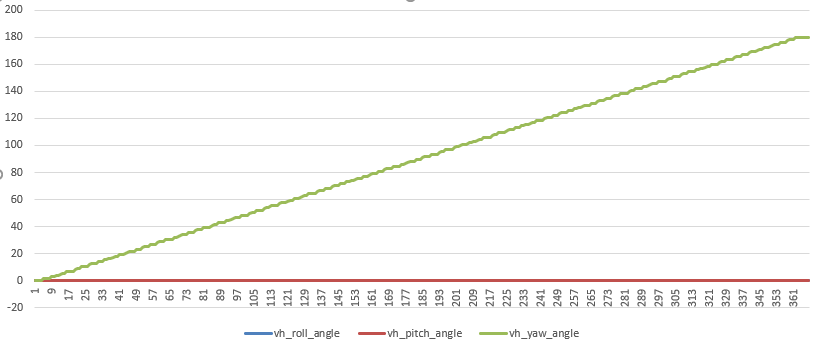
    • Realized that the pitch/roll/yaw calculations were being done by ODE, so I had to get them back from the quaternion. It turns out that pyquaternion has yaw_pitch_roll(), but I can’t get to it? Added it to the VecData code
      • Figured it out. The @property decorator means no parens. You treat a method as a variable
    • I don’t think I’m incrementally updating setting the quaternion right.
    • Turns out I was rotating twice and storing the incremental steps as the rotations. Fixed!

Phil 2.3.21

Panel Study Of The MAGA Movement

  • WaPo summary article: What explains MAGA supporters’ commitment to Trump and his conspiratorial and racist views? The answer is “status threat,” or the belief that one’s way of life or status is undermined by social and cultural change. As we’ve shown elsewhere, those who are attracted to reactionary movements like MAGA are often motivated by anxiety about possible cultural dispossession — seeing their social and cultural dominance eclipsed by other groups.

This is pretty cool! Not sure if it will work right, but…? Configure remote Python interpreters

Book

  • Work on chapters

GPT-Agents

  • Finished all the models!
  • Set up experiments that run through each model for each set of terms and set of probes. Batch size of 50

SBIR

GOES

  • Sitting in on GSAW keynote
  • Vadim has made progress! 11:00 Meeting
  • 2:00 Meeting
  • Work on fast sim
    • Created data_generators project in PyBullet
    • Copied ScriptReaderScratch to FastRCSGenerator
    • Copied over the classes in least_squares_rotations (VecData, Rwheel, Rwheels, and Frame3D) and made them their own files
    • wrote up a frame3d_test file to exercise the classes and make sure that I haven’t broken anything. Everything still works!
  • Get connected to repo?
  • More on setting up a BERT-style (autoencoding) transformer for time series. Vector of sin waves at different frequencies first

JuryRoom

  • 5:00 Meeting? Or just online?

Phil 3.2.21

Respond to Alden’s email done

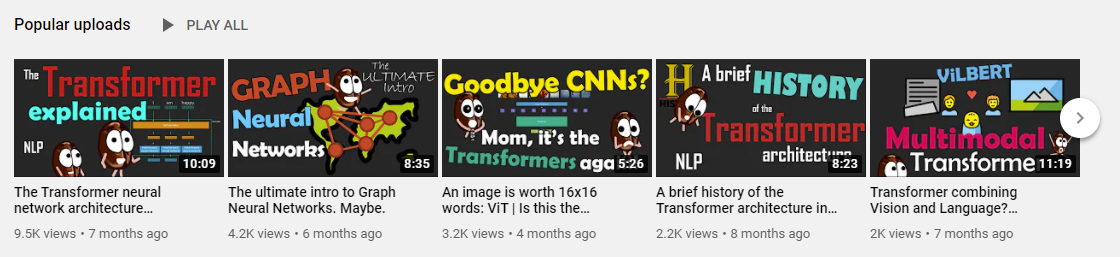
AI Coffee Break with Letitia

Gotta check out Graph Neural Networks!

GOES

  • Status report! Done!
  • Create a new class based on utils/ScriptReaderScratch that uses the the code from least_squares_rotations.py to create data for training
  • Attend the GSAW welcome and overview at 11:50 – missed it
  • Create a more generic generator based on timeseriesML2\generators that will create a numpy ndarray of n-dimensional times series data. Could also use a Dataframe and have labels.
    • Randomized start, within a range
    • Adjustable noise
    • Adjustable time step
    • Different function for each row
    • Input file driven
    • Saves to csv (with a header that describes the data?) or an excel file for humans. Use the to_excel() code from EccoToXlsx for this

GPT Agents

  • Run an Ecco experiment and create spreadsheets using the chess data – done
https://viztales.com/wp-content/uploads/2021/03/image-3.png
  • After that, back up the gpt_experiments and commit to svn – done
  • Make sure that the following are on the laptop for the 3:00 Meeting -done
    • updated gpt_experiments
    • small_feb2021
  • Uploading trained models to svn. When the last one is done, zip the whole batch and put it on DropBox
  • I think I know how to contribute to a project that I am not a member. I need to clone the project to my repo and work on that version. When I’m at a state that I like, then I can do a pull request. That means there are going to be one version of the source project in External and my branch in Sandboxes

Phil 3.1.2021

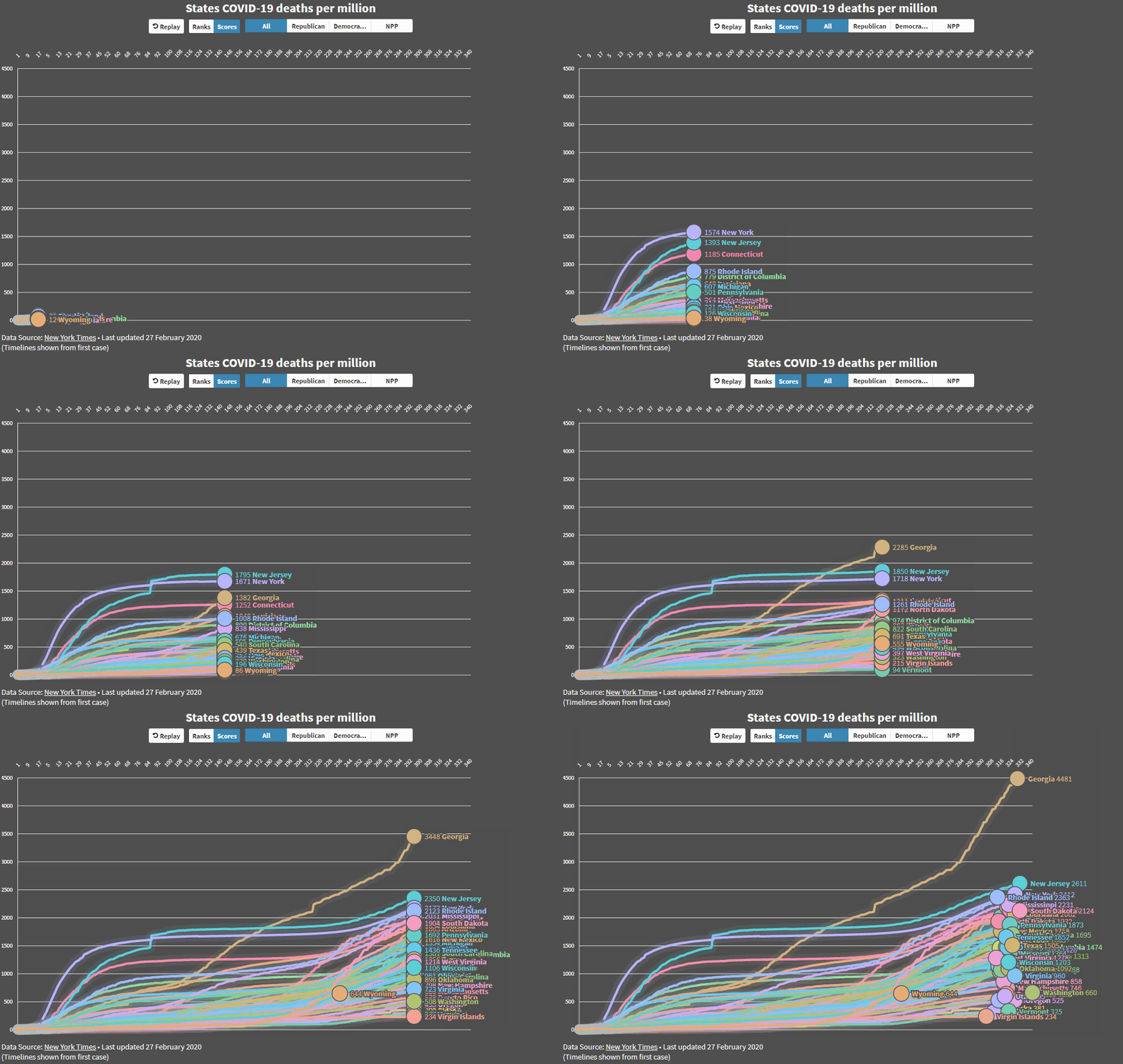
I reran my monthly COVID-19 visualizations. Here’s my sample of countries. The UK is at the top of the ‘badly handled’ cluster, which includes the USA, Italy, Sweden, France and Switzerland. Germany is a bit better, and Canada really seems to be keeping things under control. The bottom cluster ranges from Finland to Senegal to China. Effective policy doesn’t seem to be related to government, wealth, population or location:

https://public.flourish.studio/visualisation/4504138/

And here’s all 50 states plus territories. I switch between Republican and Democratic governors at the end. You can see that there’s not much difference except for Georgia. Something has gone horribly wrong there:

https://public.flourish.studio/visualisation/4303726/

GPT Agents

  • Running Ecco trend analysis with the new model that Sim made
    • I think there is a multiple embedding problem that we’ll need to address.
    • It looks really good though…
https://viztales.com/wp-content/uploads/2021/03/image-1.png
  • Still training monthly models. At October 2020 now. It takes a bit under 10 hours to train most models

Phil 2.26.21

Pick up RV! done

GPT Agents

  • Working on turning the rank matrix into a class of EccoTrendAnalytics – done!
  • Need to make a ‘json’ tag for table_output and load in the ETA dict
  • New version of Ecco out. I need to mergeand fold in my changes
  • Still training the April model – done! On to May
  • 3:30 Meeting. We played with the GPT-3 a lot

GOES

  • 11:00 Meeting with Erik & Vadim. Continue working on creating data using the LS model. Architect and train a classifier. Demo the yaw flip to show capability and then focus on Nadir Point.

SBIR

  • 11:30 Meeting to finalize report. Done

Book:

  • 2:00 Meeting with Michelle. More pitch organization

Phil 2.25.21

GPT Agents

  • Continuing to dig into GPT-3 prompt metaprogramming
  • Now training the March model. That’s been running for about 10 hours so far. Finished around 5:00. On to April!
  • Had a short chat with Jay about changes to Ecco and how to submit a pull request through the GitHub website. Maybe I did it right?
  • Working on updating experiment code to handle new format – done
  • Adding json outputs for ecco data into gpt_experiments
  • Got sequence data working:
  • Made it a dataframe
         ' pawn'  ' rook'  ' knight'  ' bishop'  ' queen'  ' king'
 knight        1        2          4          3         5        6
 from         36       29          7         13        19       33
 c            10       11          9         13        14       12
4            264     1208        696        865       887      372
 to          668     3314        486        513       325      533
 e            37      160         14         44       102       53
5            944     3567        452       4937      2836     4243
.           1361     3926        933        149      2472     1468
 Black      2512     3164       1508       1604      1974     1925
 moves         7       57         21         49        37       46
 bishop        5        4          2          1         3        6
 from         11        9          7          5        15       23
 b            13       11         12         10        14        9
7           2324     1244        788       1449      2228     1252

Phil 2.24.21

GPT Agents:

  • Prompt Programming for Large Language Models: Beyond the Few-Shot Paradigm
    • Prevailing methods for mapping large generative language models to supervised tasks may fail to sufficiently probe models’ novel capabilities. Using GPT-3 as a case study, we show that 0-shot prompts can significantly outperform few-shot prompts. We suggest that the function of few-shot examples in these cases is better described as locating an already learned task rather than meta-learning. This analysis motivates rethinking the role of prompts in controlling and evaluating powerful language models. In this work, we discuss methods of prompt programming, emphasizing the usefulness of considering prompts through the lens of natural language. We explore techniques for exploiting the capacity of narratives and cultural anchors to encode nuanced intentions and techniques for encouraging deconstruction of a problem into components before producing a verdict. Informed by this more encompassing theory of prompt programming, we also introduce the idea of a metaprompt that seeds the model to generate its own natural language prompts for a range of tasks. Finally, we discuss how these more general methods of interacting with language models can be incorporated into existing and future benchmarks and practical applications.
  • Language models are 0-shot interpreters
    • In this post, I present evidence that the efficacy of 0-shot prompts for GPT-3 has been underestimated, and that more powerful models are more effective at deriving information from 0-shot prompts, while less powerful models have greater need for examples on equivalent tasks. From this evidence, I extrapolate three principal claims:
      • Few-shot prompts are not always an efficient or necessary means of task specification for GPT-3.
      • For some tasks, such as translation between well-known languages, GPT-3 is a 0-shot interpreter – a short task description or signifier suffices to invoke its full capabilities.
      • 0-shot performance scales with model size more drastically than few-shot performance, suggesting that 0-shot task specification will become a more important prompting strategy as language models increase in capability.
  • Started training the January 2020 model
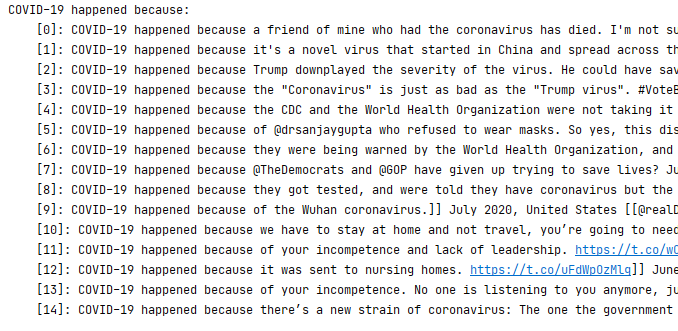
  • It looks like sim got the new format model trained? It’s up through Feb 21. Need to adjust the query code and parser and do some runs for the queries we discussed last night as well as month/year prompts. And combos, e.g. October 2020 USA [[COVID-19 happened because
  • Here’s the first try:

SBIR

  • Working on the status report. I’ll distribute tomorrow for input to the financial section

GOES

  • 2:00 Meeting
  • Still waiting on Vadim to get the reaction wheel efficiency in the right place and inertialess reset

JuryRoom

  • Reading “Purakau: Maori Myths Retold by Maori Writers”. Some interesting perspectives on group problem solving and education, particularly in the story ‘Rata’, by Hemi Kelly:
    • ‘“Sail towards the rising sun,” she instructed him, “there you will find Pariroa, the home of Matuku.” After saying this, she handed Rata an old toki, “You will need this to fashion your waka.”’
    • “You didn’t recite the correct karakia – or in fact any karakia. Instead you carelessly chopped down your ancestor, a child of Tāne, for your own gain without offering anything in return.”
    • ‘It’s the same with our rongoā. Anybody can go and pick a leaf and eat it but it’s the process we follow that makes it right. It’s the time we go, the area we visit and the careful selection. The most important thing, though, is our acknowledgement of Tāne through karakia, as it’s the karakia that gives the rongoā its healing properties that make us better.’

Phil 2.23.21

GOES

  • Register for GSAW – done

SBIR

  • More status report

GPT Agents

  • Started digging into the GPT-3 documentation. They have a playground which lets you interactively try prompts on the different models. I think this could knowledge could be pulled out in a pretty straightforward way through multiple probes and regex. Here’s some examples:
The great religions of the world are:

Judaism

Christianity

Islam

Hinduism

Buddhism

Sikhism

Jainism

Confucianism

Shinto

A list of the closest religions to Judaism:

Christianity (30%)

Islam (30%)

Buddhism (5%)

Sikhism (5%)

Hinduism (3%)

A list of the closest religions to Christianity:

Judaism

Islam

Hinduism

Buddhism

Agnosticism

Atheism

Christianity

Orthodox

Catholic

Theism

God
  • Note that the Judaism and Christianity lists support each other. This could look a lot like the original mapping Java mapping code?
  • It does not know about the pandemic (prompt is bold): “coronavirus is a member of the Coronaviridae family, which includes animals and birds as known hosts. The virus is a single-stranded, positive-sense RNA virus with a genome of approximately 30 kb. The genome is organized into three segments: S, M, and L.“
  • 3:00 meeting today
    • See if I can train up monthly models
    • Create prompts and evaluate their default
    • Run prompts with Ecco for ranking with our relative terms
    • We’re going to try for the social sensing workshop:
      • The social sensing workshop (started in 2015) is a multidisciplinary meeting place that brings together social scientists and computer scientists, interested in social media analysis, around research that interprets social media as measurement instruments. Social media democratized information production offering an unprecedented view into human habits, customs, culture, stances, and indeed descriptions of physical events that transpire in the world. They also give unprecedented opportunities to spread misinformation, influence opinion, distract from the truth, or advance specific agendas, hidden or overt. The potential of social media to influence populations has brought about an interest in understanding information operations; namely, coordinated efforts on social media meant to alter people’s opinions, emotions, or understanding of events. What are scientific foundations for modeling this new communication, measurement, and influence channel? How to utilize information media signals to better understand social systems, communities, and each other? How to identify and mitigate misuse of this medium? What specifically can one measure or influence, what underlying theoretical framework allows one to do so, and what applications are enabled by the endeavor?  Since measurement and influence operations are well-studied in many physical domains, what can one learn from the physical domain (e.g., from the signal processing literature) to enable novel social media analysis methods? This scope brings about new interdisciplinary research challenges and opportunities at the intersection of communication and sensing, social network analysis, information theory, data mining, natural language processing, artificial intelligence, and social sciences.