
Took the day off for Barbara’s birthday
Author Archives: pgfeldman
Phil 3.24.17
No research this morning. Had flu-like symptoms from midnight to 2:00 or so and slept in. Considering how bad I felt last night, I’m pleasantly surprised to feel good enough to get into work at 9:00.
I did take the Superpedestrian wheel out (yes, as I was getting sick) for my 18 mile hilly loop. It took around an hour and performed really well. It just flattens hills, while behaving like a normal bike at all other times.
Google Says Its Job Is to Promote Climate Change Conspiracy Theories
9:00 – 4:00 BRC
- My fix from yesterday doesn’t work on Aaron’s machine. Verified that it works on any of my cmd-line interfaces. Weird.
- Testing to see if my Excel has been fixed. Nope.
- More work on getting Python imports to behave. All written up here.
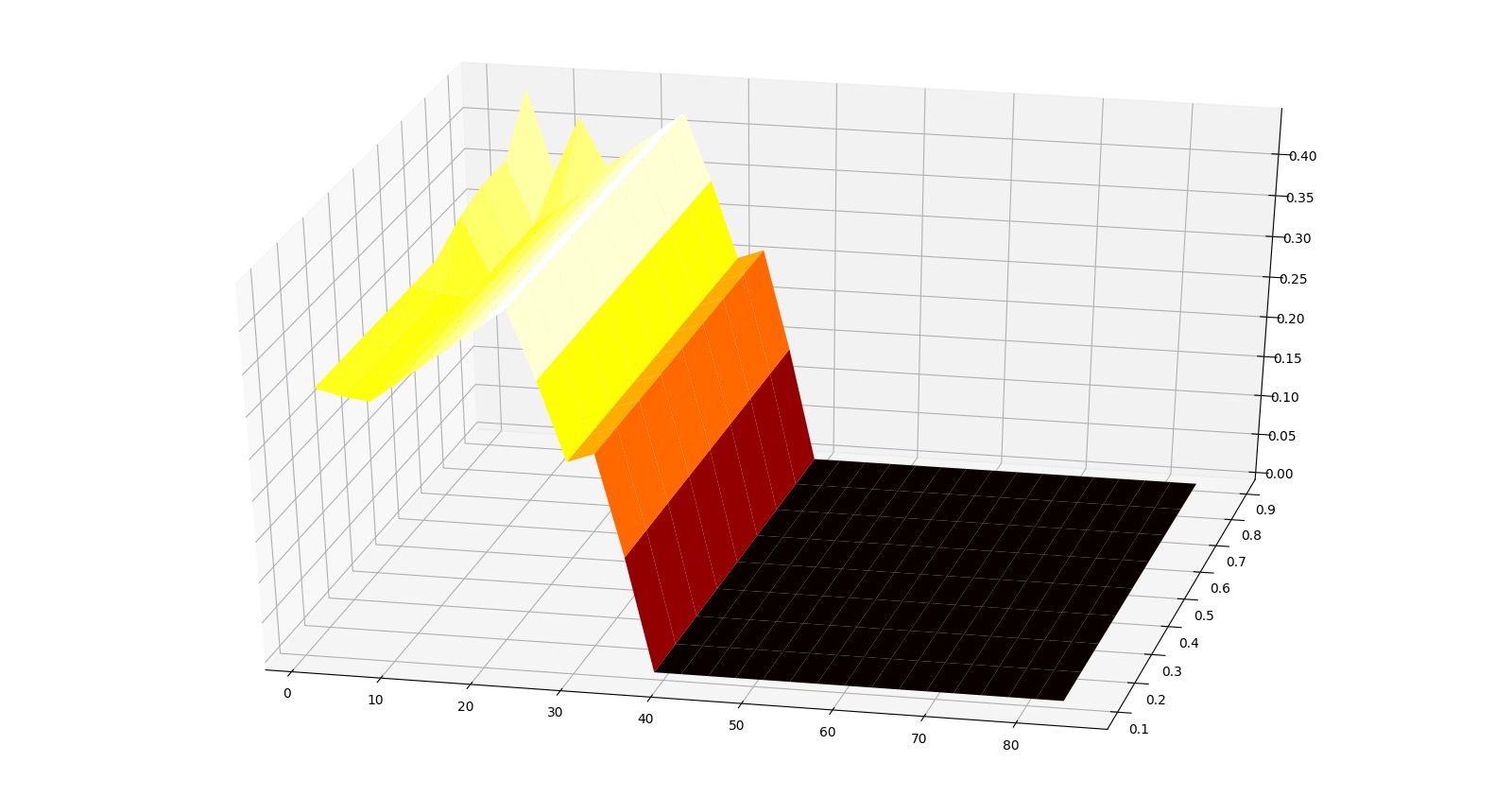
- Got the data sheets working with the plots:

plt.imshow(df, extent=[3, points/3, 0.9, 0.1], aspect='auto', cmap=plt.cm.get_cmap("hot")) plt.colorbar() This took a while to figure out. The X, Y arrays are used to create the mesh. The df.as_matrix() contains the Z values. Just make sure that row size and column size match!
fig = plt.figure() ax = Axes3D(fig) X = co.get_min_cluster_array() Y = co.get_eps_array() X, Y = np.meshgrid(X, Y) Z = df.as_matrix() ax.plot_surface(X, Y, Z, cmap=plt.cm.get_cmap("hot")) plt.show() - Next is to save the best cluster run with its EPS and cluster size
- Wound up just using the number of clusters for now. That seems to be a better fitness test. Also, I discovered that all Dataframes are references, so it’s important to make a deep copy if you’re trying to keep the best one around! Here are the best results so far:
-


Phil 3.23.17
7:00 – 8:00, 4:00 – 5:00 Research
- Finished the first pass at the poster in LaTex. I dunno. I might try Illustrator and make something pretty(er).
- Built the latests paper and poster and sent to Don for this afternoon’s meeting
- Facebook is rolling out its new tool against fake news.
- FiveThirtyEight’s take on r/TheDonald
8:30 – 10:30, 12:30 – 3:30 BRC
- I don’t think my plots are right. Going to add some points to verify…
- First, build a matrix of all the values. Then we can visualize as a surface, and look for the best values after calculation
- Okay………. So there is a very weird bug that Aaron stumbled across in running python scripts from the command line. There are many, many, many thoughts on this, and it comes from a legacy issue between py2 and py3 apparently. So, much flailing:
python -i -m OptimizedClustererPackage.DBSCAN_clusterer.py
python -m OptimizedClustererPackage\DBSCAN_clusterer.py
C:\Development\Sandboxes\TensorflowPlayground\OptimizedClustererPackage>C:\Users\philip.feldman\AppData\Local\Programs\Python\Python35\python.exe -m C:\Development\Sandboxes\TensorflowPlayground\OptimizedClustererPackage\DBSCAN_clusterer.py
…etc…etc…etc…
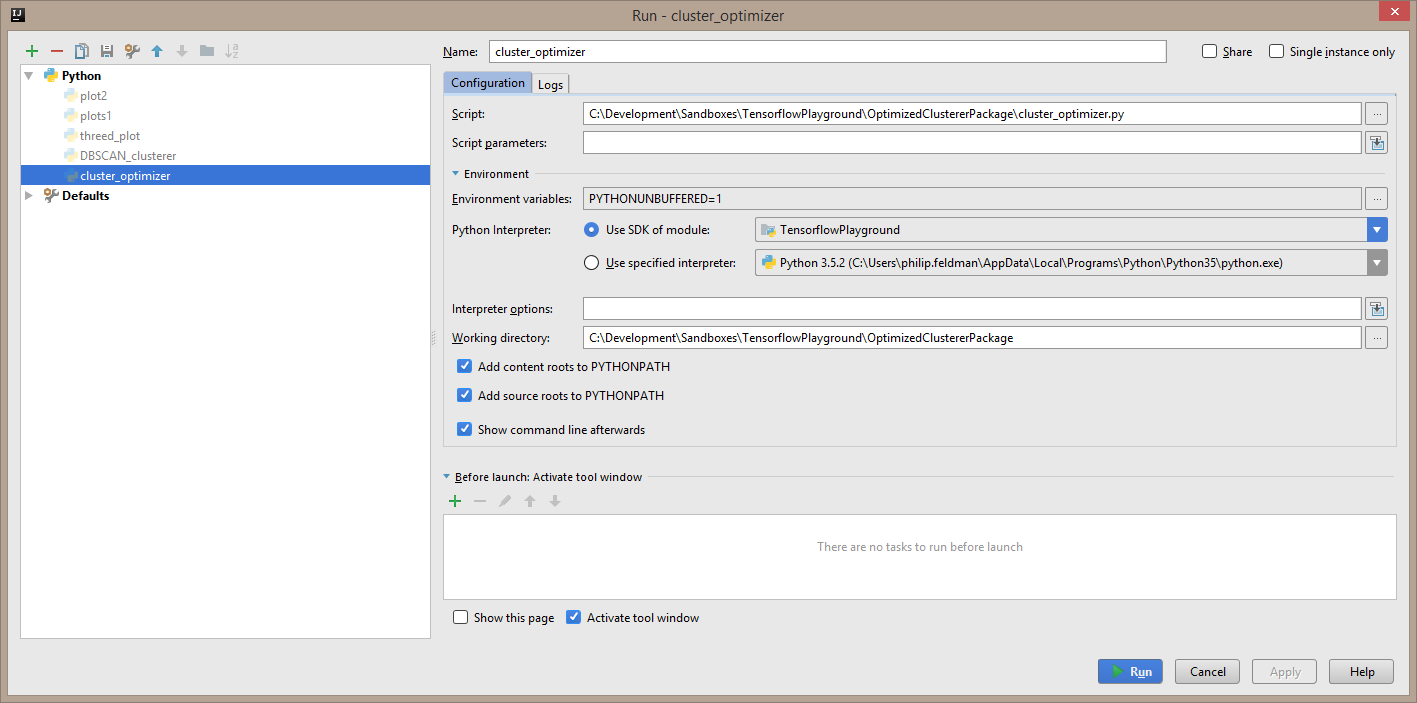
- After I’d had enough of this, I realized that the IDE is running all of this just fine, so something works. So, following this link, I set the run config to “Show command line afterwards”:
 The outputs are very helpful:
C:\Users\philip.feldman\AppData\Local\Programs\Python\Python35\python.exe C:\Users\philip.feldman\.IntelliJIdea2017.1\config\plugins\python\helpers\pydev\pydev_run_in_console.py 60741 60742 C:/Development/Sandboxes/TensorflowPlayground/OptimizedClustererPackage/cluster_optimizer.py
- Editing out the middle part, we get
C:\Users\philip.feldman\AppData\Local\Programs\Python\Python35\python.exe C:/Development/Sandboxes/TensorflowPlayground/OptimizedClustererPackage/cluster_optimizer.py
And that worked! Note the backslashes on the executable and the forward slashes on the argument path.
- Update #1. Aaron’s machine was not able to run a previous version of the code, so we poked at the issues, and I discovered that I had left some code in my imports that was not in his code. It’s the Solution #4: Use absolute imports and some boilerplate code“section from this StackOverflow post. Specifically, before importing the local files, the following four lines of code need to be added:
import sys # if you haven't already done so
from pathlib import Path # if you haven't already done so
root = str(Path(__file__).resolve().parents[1])
sys.path.append(root)
- After which, you can add your absolute imports as I do in the next two lines:
from OptimizedClustererPackage.protobuf_reader import ProtobufReader
from OptimizedClustererPackage.DBSCAN_clusterer import DBSCANClusterer
- And that seems to really, really, really work (so far).
Phil 3.22.17
8:30 – 6:00 BRC
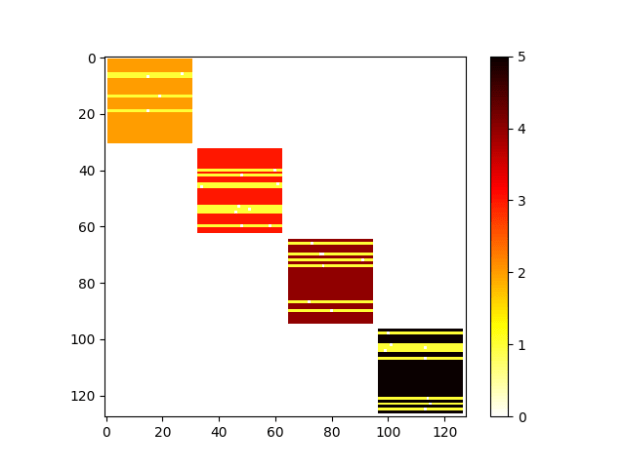
- Working on GA optimizer. I have the fitness function running and it seems reasonable. First, here’s the data with one clustering run:
- And here’s the PDF of fitness by min cluster size
 note that there are at least three pdfs, though the overall best overall value doesn’t change
 - Aaron is importing now. for some output, I now write the cluster iterations to a text file
Phil 3.21.17
7:00 – 8:00 Research
- Modeling the Evolution of Ideological Landscapes Through Opinion Dynamics
- More poster. Tightening *everything*. Progress! Should be ready for Don on Thursday
8:30 – 3:00 BRC
- Switching gears from LaTex to Python takes effort. Neither is natural or comfortable yet
- Sent Jeremy a note on conferences and vacation. Using the hours on my paycheck stub, which *could* be correct…
- More clustering. Adding output that will be used for the optimizer
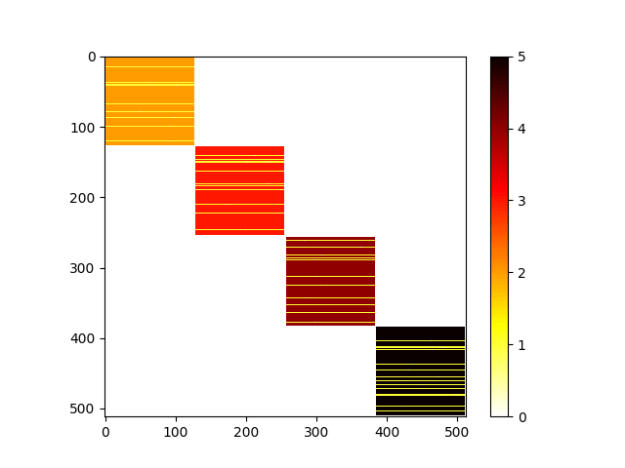
clusters = 4
Total  = 512
clustered = 437
unclustered = 75
- Built out the optimizer and filled it with a placeholder function. Will fill in after lunch
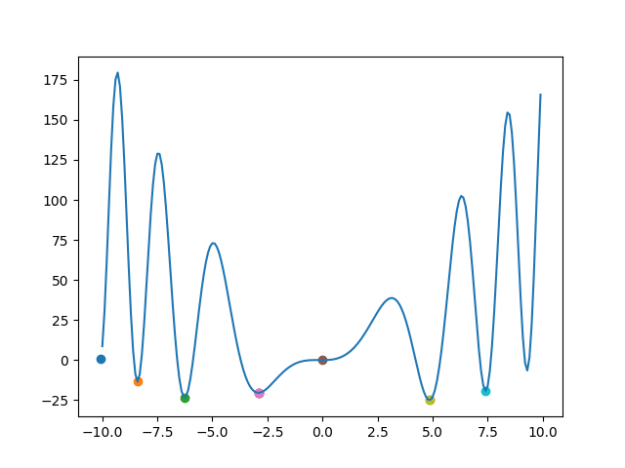
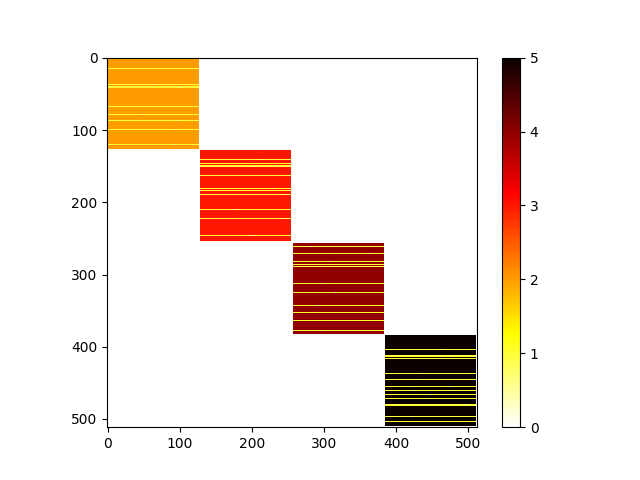
- Had to leave to take care of dad, who fainted. But here are my thoughts on the GA construction. The issue with fitness test is that we have two variables to optimize, the EPS and the minimum cluster size, based on the number of clusters and the number of unclustered. I want to unitize the outputs sop that 2.0 is best and 0.0 is worst. The unclustered should be 1.0 – unclustered/total. The number of clusters should be clusters/(total/min_cluster_size).
- The way the GA should work is that we start with a set of initial EPSs (0 – 1) and a set of cluster sizes (3 – total/3). We try each, throw the bottom half away, keep the top result and breed a new set by interpolating (random distances?) between the remaining. We also randomly generate a new allele or two in case we get trapped on a local maxima. When we are no longer getting any improvement (some epsilon) we stop. All the points can be plotted and we can try to fit a polyline as well (one for eps and for minimum cluster? Could plot as a surface…)
Phil 3.20.17
Spring!
7:00 – 8:30 Research
- Morning thought. If the perimeter is set to ‘lethal’, what is the SHR that required the lowest replenishment in an “All Exploit” scenario? Also, how many explorers are needed to keep a runaway echo chamber in range?
- Need to factor in some of what Arendt talks about in her Bose-Einstein Condensate model of end-stage totalitarianism. Also ordered this
- MASON is a fast discrete-event multiagent simulation library core in Java, designed to be the foundation for large custom-purpose Java simulations, and also to provide more than enough functionality for many lightweight simulation needs. MASON contains both a model library and an optional suite of visualization tools in 2D and 3D. Documentation here.
- Working on poster. Going to try LaTex mostly to get better at it. Need to pull up my TEI poster to see the format we use. Using the beamerposter format. So far, pretty painless.
9:00 – 5:00 BRC
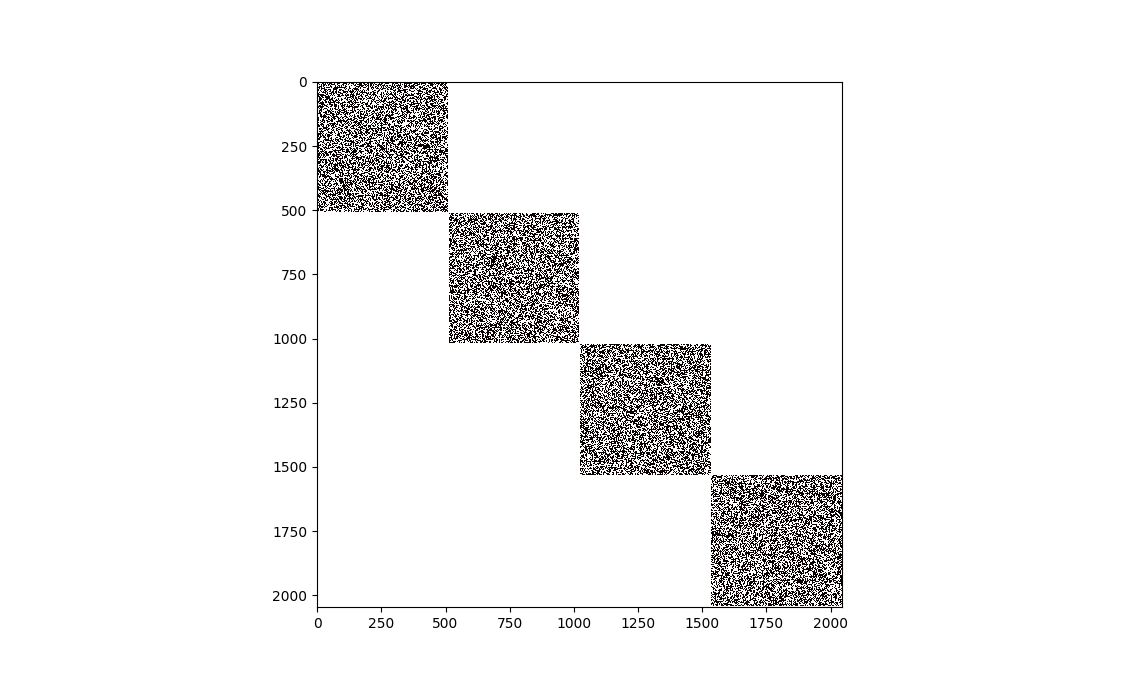
- Create the framework
- Reader – built the generator part
- Clusterer – have simple DBSCAN working. It’s pickier than I would have thought

- Optimizer
- Writer
- Request time “off” for collective intelligence (June 15-16) and HCIC (June 25- 29), and vacation (June 4 – 11)
3.19.17
Monday task!!!
Call OPM at 1-888-767-6738 after scrum
And this looks pretty interesting: https://github.com/unitedstates. Found it looking for bill full text to feed into the LMN system. Here’s an example of tagged xml
<?xml version="1.0"?>
<bill bill-stage="Introduced-in-House" dms-id="H7B2411C180AA4EF7AE87C3F9B3844016" public-private="public" bill-type="olc">
<metadata xmlns:dc="http://purl.org/dc/elements/1.1/">
<dublinCore>
<dc:title>113 HR 1237 IH: To authorize and request the President to award the Medal of Honor posthumously to Major Dominic S. Gentile of the United States Army Air Forces for acts of valor during World War II.</dc:title>
<dc:publisher>U.S. House of Representatives</dc:publisher>
<dc:date>2013-03-18</dc:date>
<dc:format>text/xml</dc:format>
<dc:language>EN</dc:language>
<dc:rights>Pursuant to Title 17 Section 105 of the United States Code, this file is not subject to copyright protection and is in the public domain.</dc:rights>
</dublinCore>
</metadata>
<form>
<distribution-code display="yes">I</distribution-code>
<congress>113th CONGRESS</congress>
<session>1st Session</session>
<legis-num>H. R. 1237</legis-num>
<current-chamber>IN THE HOUSE OF REPRESENTATIVES</current-chamber>
<action>
<action-date date="20130318">March 18, 2013</action-date>
<action-desc><sponsor name-id="B001281">Mrs. Beatty</sponsor> introduced the following bill; which was referred to the <committee-name committee-id="HAS00">Committee on Armed Services</committee-name></action-desc>
</action>
<legis-type>A BILL</legis-type>
<official-title>To authorize and request the President to award the Medal of Honor posthumously to Major Dominic S. Gentile of the United States Army Air Forces for acts of valor during World War II.</official-title>
</form>
<legis-body id="HC4FC3A2EC9CD480F8E7100E4CF3C2F3C" style="OLC">
<section id="HED5DF0B8F90849ECB7D6A49028BC38E1" section-type="section-one"><enum>1.</enum><header>Authorization and request for award of Medal of Honor to Dominic S. Gentile for acts of valor during World War II</header>
<subsection id="H21C369FA21D644EB9F38767C54E49A0B"><enum>(a)</enum><header>Findings</header><text display-inline="yes-display-inline">Congress makes the following findings:</text>
<paragraph id="H6A5FBF181F68426CB457AB237F565723"><enum>(1)</enum><text display-inline="yes-display-inline">Major Dominic S. Gentile of the United States Army Air Forces destroyed at least 30 enemy aircraft during World War II, making him one of the highest scoring fighter pilots in American history and earning him the title of <quote>Ace of Aces</quote>.</text></paragraph>
<paragraph id="HF3355B912FA6432295B768BE5B58842A"><enum>(2)</enum><text>Major Gentile was the first American fighter pilot to surpass Captain Eddie Rickenbacker’s WWI record of 26 enemy aircraft destroyed.</text></paragraph>
<paragraph id="H18EE27FA1F7A48CB8AE62301BF0B31ED"><enum>(3)</enum><text>Major Gentile was awarded several medals in recognition of his acts of valor during World War II, including two Distinguished Service Crosses, seven Distinguished Flying Crosses, the Silver Star, the Air Medal, and received similar honors from Great Britain, Italy, Belgium, and Canada.</text></paragraph>
<paragraph id="H2F7E271C44E84E5DBC95C9F58127B93E"><enum>(4)</enum><text display-inline="yes-display-inline">Major Gentile was born in Piqua, Ohio, and died January 23, 1951, after which he was posthumously appointed to the rank of major.</text></paragraph>
<paragraph id="HA6F4601200454270939A016AC9B9F96D"><enum>(5)</enum><text>Major Gentile is buried in Columbus, Ohio. Gentile Air Force Station in Kettering, Ohio, is named in his honor and he was inducted into the National Aviation Hall of Fame in 1995.</text></paragraph></subsection>
<subsection display-inline="no-display-inline" id="H5B70830D32B64B4B858A89AAC16A8A4D"><enum>(b)</enum><header>Authorization</header><text display-inline="yes-display-inline">Notwithstanding the time limitations specified in <external-xref legal-doc="usc" parsable-cite="usc/10/3744">section 3744</external-xref> of title 10, United States Code, or any other time limitation with respect to the awarding of certain medals to persons who served in the Armed Forces, the President is authorized and requested to award the Medal of Honor posthumously under section 3741 of such title to former Major Dominic S. Gentile of the United States Army Air Forces for the acts of valor during World War II described in subsection (c).</text></subsection>
<subsection commented="no" display-inline="no-display-inline" id="H0003A92F45354335B4497C04FE62D068"><enum>(c)</enum><header>Acts of valor described</header><text display-inline="yes-display-inline">The acts of valor referred to in subsection (b) are the actions of then Major Dominic S. Gentile who, as a pilot of a P–51 Mustang in the Army’s 336th Fighter Squadron, Fourth Fighter Group, of the Eighth Air Force in Europe during World War II, distinguished himself conspicuously by gallantry and intrepidity at the risk of his life above and beyond the call of duty by destroying at least 30 enemy aircraft during his service in the United State Army Air Forces.</text></subsection></section>
</legis-body>
</bill>
Phil 3.17.17
7:00 – 8:00 Research
- Troll Paper
- Looks interesting: An Intelligent Interface for Organizing Online Opinions on Controversial Topics. From IUI 2017
8:30 – 6:00 BRC
- Use of Genetic Algorithms for Finding Roots of Algebraic Equations
- Matplotlib today
- That is just cool. Interactive, too:
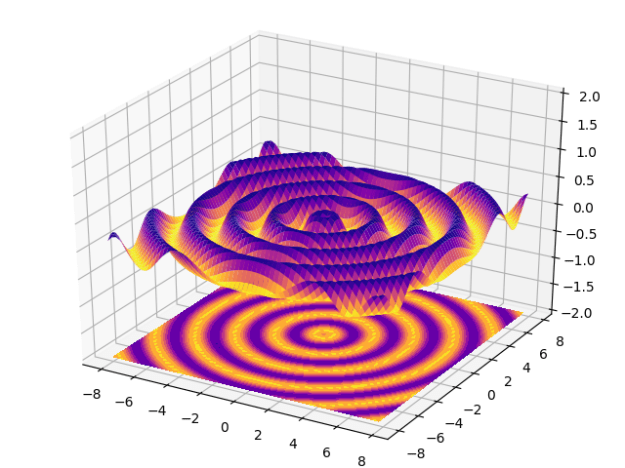
- That is just cool. Interactive, too:
- Scipy next. Done! Local minima finding is awesome. We can have our own functions match the fmin interface and then feed in our clusterer and our minima finder
- Tried installing MayAvi, but it chokes on VTK, which won’t play with python 3.5 yet.Not a huge deal, but frustrating way to end the week.
Phil 3.16.17
7:00 – 8:00, 4:00 – 5:30 Research
- More troll paper
- Meeting with Wayne
- See if I can get this on the schedule: Human Computer Interaction Consortium
- June 25th – 29th
8:30 – 3:30 BRC
- Added subtasks for the clustering optimizer
- Meeting with Aaron and Heath about scalability
- Converting a panda data frame to a numpy ndarray – done
df = createDictFrame(rna, cna)
df = df.sort_values(by='sum', ascending=True)
mat = df.as_matrix()
- Working on polynomials – done

- Played with the Mandelbrot set as well. Speedy!
- And for going deeper down the rabbit hole (later!!!) – How To Quickly Compute The Mandelbrot Set In Python. This includes direct Cuda and Cython.
- This came across my feed: Scikit-Learn Tutorial Series
Phil 3.15.17
7:00 – 8:00 Research
- Information Wars: A Window into the Alternative Media Ecosystem
- By Kate Starbird, (Scholar)
Professor, Human Centered Design & Engineering, University of Washington
- By Kate Starbird, (Scholar)
- Started reviewing the Tumblr trolling paper. Set up a Tumblr account
8:30 – 5:00 BRC
- Heath was able to upgrade to Python 3.5.2
- Ran array_thoughts. Numbers are better than my laptop
- Attempting just_dbscan: Some hiccups due to compiling from sources. (No module named _bz7). Stalled? Sent many links.
- Success! Heath installed a binary Python rather than compiling from sources. A little faster than my laptop. No GPUs, CPU, not memory bound.
- Continuing my tour of the SciPy Lecture Notes
- Figuring out what a matplotlib backend is
- Looks like there are multiple ways to serve graphics: http://matplotlib.org/faq/howto_faq.html#howto-webapp
- More on typing Python
- Class creation, inheritance and superclass overloading, with type hints:
class Student(object): name = 'noName' age = -1 major = 'unset' def __init__(self, name: str): self.name = name def set_age(self, age: int): self.age = age def set_major(self, major: str): self.major = major def to_string(self) -> str: return "name = {0}\nage = {1}\nmajor = {2}"\ .format(self.name, self.age, self.major) class MasterStudent(Student): internship = 'mandatory, from March to June' def to_string(self) -> str: return "{0}\ninternship = {1}"\ .format(Student.to_string(self), self.internship) anna = MasterStudent('anna') print(anna.to_string()) - Finished the Python part, Numpy next
- Figured out how to to get a matrix shape, (again, with type hints):
import numpy as np


def set_array_sequence(mat: np.ndarray):
    for i in range(mat.shape[0]):
        for j in range(mat.shape[1]):
            mat[i, j] = i * 10 + j


a = np.zeros([10, 3])
set_array_sequence(a)
print(a.shape)
print(a)
Phil Pi Day!
Research
- I got accepted into the Collective Intelligence conference!
- Working on LaTex formatting. Slow but steady.
- Ok, the whole doc is in, but the 2 column charts are not locating well. I need to rerig them so that they are single column. Fixed! Not sure about the gray bg. Maybe an outline instead?
Phil 3.13.17
7:00 – 8:00, 5:00 – 7:00 Research
- Back to learning LaTex. Read the docs, which look reasonable, if a little clunkey.
- Working out how to integrate RevEx
- Spent a while looking at Overleaf and ShareLatex, but decided that I like TexStudio better. Used the MikTex package manager to download revtex 4.1.
- Looked for “aiptemplate.tex” and “aipsamp.tex” and found them with all associated files here: ftp://ftp.tug.org/tex/texlive/Contents/live/texmf-dist/doc/latex/revtex/sample/aip. And it pretty much just worked. Now I need to start stuffing text into the correct places.
8:30 – 2:30 BRC
- Got a response from the datapipeline folks about their demo code. sked them to update the kmeans_single_iteration.py and functions.py files.
- The SciKit DBSCAN is very fast
setup duration for 10000 points = 0.003002166748046875
DBSCAN duration for 10000 points = 1.161818265914917
- Drilling down into the documentation. Starting with the SciPy Lecture Notes
- Python has native support for imaginary numbers. Huh.
- Static typing is also coming. This is allowed, but doesn’t seem to do anything yet:
def calcL2Dist(t1:List[float], t2:List[float]) -> float:
- This is really nice:
In [35]: def variable_args(*args, **kwargs):
   ....:     print 'args is', args
   ....:     print 'kwargs is', kwargs
   ....:

In [36]: variable_args('one', 'two', x=1, y=2, z=3)
args is ('one', 'two')
kwargs is {'y': 2, 'x': 1, 'z': 3}
- in my ongoing urge to have interactive applications, I found Bokeh, which seems to create javascript??? More traditionally, wxPython appears to be a set of bindings to the wxWidgets library. Installed, but I had to grab the compiled wheel from here (as per S.O.). I think I’m going to look closely at Bokeh though, if it can talk to the running Python, then we could have some nice diagnostics. And the research browser could possibly work through this interface as well.
Phil 3.10.17
Elbow Tickets!
7:00 – 8:00 Research
- artisopensource.net
- Accurat is a global, data-driven research, design, and innovation firm with offices in Milan and New York.
- Formatting paper for Phys Rev E. Looks like it’s gotta be LaTex, or more specifically, RevTex. My entry about formats
- Downloaded RevTex
- How to get Google Docs to LaTex
- Introduction to LaTex
- Installing TexX slooooow…

- That literally took hours. Don’t install the normal ‘big!’ default install?
- Installing pandoc
- Tried to just export a PDF, but that choked. reading the manual at C:\texlive\2016\tlpkg\texworks\texworks-help\TeXworks-manual\en
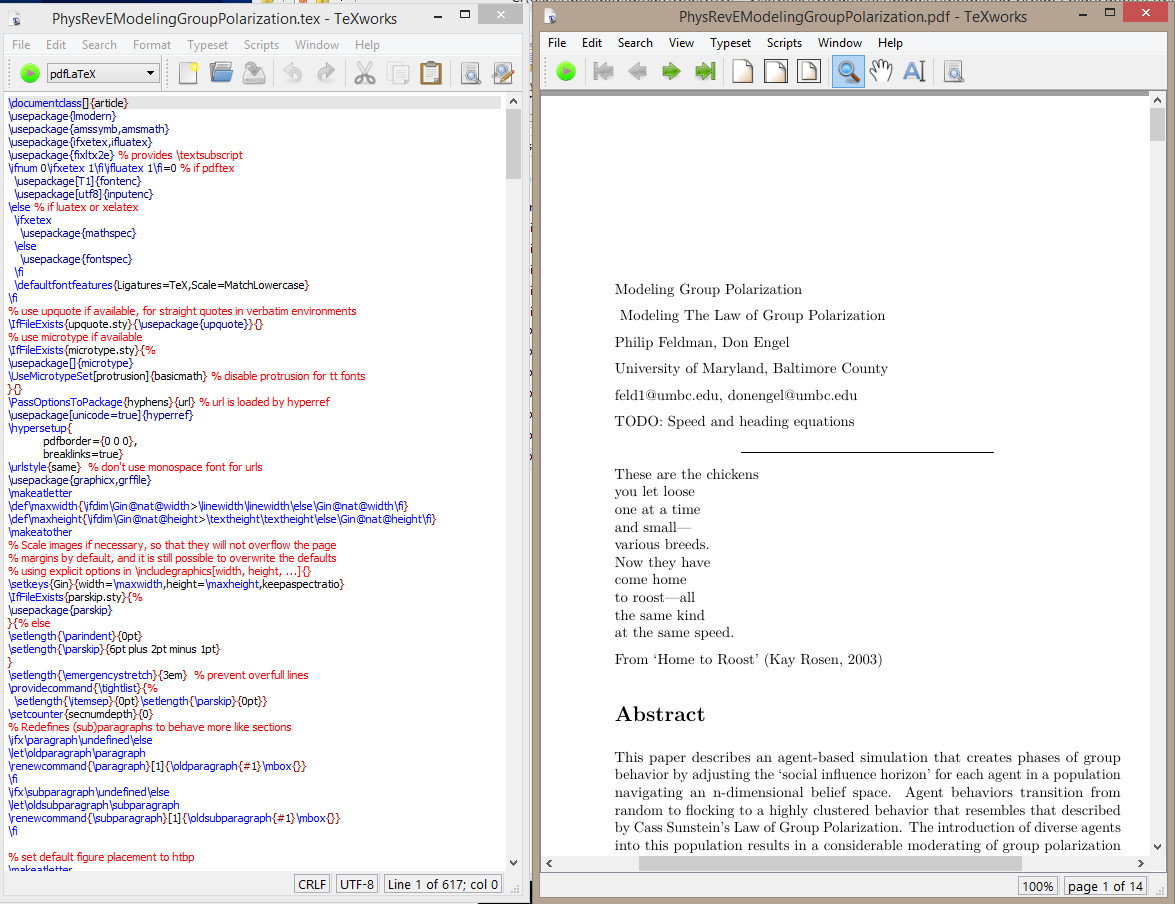
- Compiled the converted doc! Not that I actually know what all this stuff does yet…
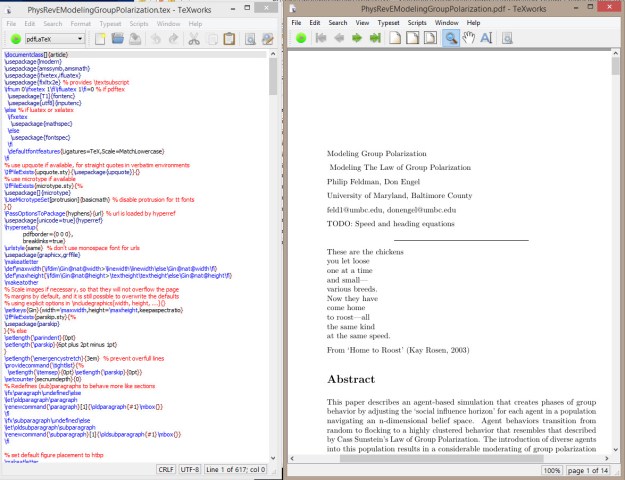
- And then I thought, ‘gee, this is more like coding – I wonder if there is a plugin for IntelliJ?’. Yest, but this page ->BEST DEVELOPMENT SETUP FOR LATEX – says to use texStudio. downloading to try. This seems to be very nice. Not sure if it will work without a LaTexInstall, but I’ll tray that on my home box. It would be a much faster install if it did. And it’s been updated very recently – Jan 2017
- Aaaand the answer is no, it needs an install. Trying MikTex this time. Well that’s a LOT faster!
8:30 – 10:30, 11:00 – 2:00 BRC
- This looks very cool: t-SNE algo in R and Python, made with same dataset
Phil 3.9.17
7:00 – 7:30, 4:00-5:30 Research
- Short session this morning. Dr. Appt at 8:00
- Sending Sunstein letter. done!
- Lee Boot visualization
9:30 – 3:30BRC
- Neat thing from Flickr on finding similar images.
- How to install pyLint as an external tool in IntelliJ.
- How to find out where your python modules are installed:
C:\Windows\system32>pip3 show pylint
Name: pylint
Version: 1.6.5
Summary: python code static checker
Home-page: https://github.com/PyCQA/pylint
Author: Python Code Quality Authority
Author-email: code-quality@python.org
License: GPL
Location: c:\users\philip.feldman\appdata\local\programs\python\python35\lib\site-packages
Requires: colorama, mccabe, astroid, isort, six
- Looking at building scikit DBSCAN clusterer. I think the plan will be to initially use TF as IO. read in the protobuf and eval() out the matrix to scikit. Do the clustering in scikit, and then use TF to write out the results. Since TF and scikit are very similar, that should aid in the transfer from Python to TF, while allowing for debugging and testing in the beginning. And we can then benchmark.
- Working on running the scikit.learn plot_dbscan example, and broke the scipy install. Maybe use the Windows installers? Not sure what that might break. Will try again and follow error messages first.
- This looks like the fix: http://stackoverflow.com/questions/28190534/windows-scipy-install-no-lapack-blas-resources-found
- Sorry to necro, but this is the first google search result. This is the solution that worked for me:
- Download numpy+mkl wheel from http://www.lfd.uci.edu/~gohlke/pythonlibs/#numpy. Use the version that is the same as your python version (check using python -V). Eg. if your python is 3.5.2, download the wheel which shows cp35
- Open command prompt and navigate to the folder where you downloaded the wheel. Run the command: pip install [file name of wheel]
- Download the SciPy wheel from: http://www.lfd.uci.edu/~gohlke/pythonlibs/#scipy (similar to the step above).
- As above, pip install [file name of wheel]
- Sorry to necro, but this is the first google search result. This is the solution that worked for me:
- got a new error where
TypeError: unorderable types: str() < int()
- After some searching, here’s the SO answer
- Changed line 406 from fixes.py from:
if np_version < (1, 12, 0):into
if np_version < (1, 12): - Success!!!

- Sprint Review
Phil 3.8.17
7:00 – 8:00 Research
- Tweaking the Sunstein letter
- Trying to decide what to do next. There is a good deal of work that can be done in the model, particularly with antibelief. Totalitarianism may actually go further?
- Arendt says:The advantages of a propaganda that constantly “adds the power of organization”[58] to the feeble and unreliable voice of argument, and thereby realizes, so to speak, on the spur of the moment, whatever it says, are obvious beyond demonstration. Foolproof against arguments based on a reality which the movements promised to change, against a counterpropaganda disqualified by the mere fact that it belongs to or defends a world which the shiftless masses cannot and will not accept, it can be disproved only by another, a stronger or better, reality.
- [58] Hadamovsky, op. cit., p. 21. For totalitarian purposes it is a mistake to propagate their ideology through teaching or persuasion. In the words of Robert Ley, it can be neither “taught” nor “learned,” but only “exercised” and “practiced” (see Der Weg zur Ordensburg, undated).
- On the same page: The moment the movement, that is, the fictitious world which sheltered them, is destroyed, the masses revert to their old status of isolated individuals who either happily accept a new function in a changed world or sink back into their old desperate superfluousness. The members of totalitarian movements, utterly fanatical as long as the movement exists, will not follow the example of religious fanatics and die the death of martyrs (even though they were only too willing to die the death of robots). [59]
- [59] R. Hoehn, one of the outstanding Nazi political theorists, interpreted this lack of a doctrine or even a common set of ideals and beliefs in the movement in his Reichsgemeinschaft and Volksgeme’mschaft, Hamburg, 1935: “From the point of view of a folk community, every community of values is destructive”
- Arendt says:The advantages of a propaganda that constantly “adds the power of organization”[58] to the feeble and unreliable voice of argument, and thereby realizes, so to speak, on the spur of the moment, whatever it says, are obvious beyond demonstration. Foolproof against arguments based on a reality which the movements promised to change, against a counterpropaganda disqualified by the mere fact that it belongs to or defends a world which the shiftless masses cannot and will not accept, it can be disproved only by another, a stronger or better, reality.
- This implies that there a stage where everything outside the cluster is attacked and destroyed, rather than avoided. So there’s actually four behaviors: Explore, Confirm, Avoid, and something like Lie/Destroy/Adhere. This last option cuts the Gordian Knot of game theory – its premise of making decisions with incomplete information – by substituting self-fulfilling fictional information that IS complete. And here, diversity won’t help. It literally is the enemy.
- And this is an emergent phenomenon. From Konrad Heiden’s Der Führer. Hitler’s Rise to Power: Propaganda is not “the art of instilling an opinion in the masses. Actually it is the art of receiving an opinion from the masses.”
8:30 – 6:00 BRC
- Figured out part of my problem. The native python math is sloooooow. Using numpy makes everything acceptably fast. I’m not sure if I’m doing anything more than calculating in numpy and then sticking the result in TensorFlow, but it’s a start. Anyway, here’s the working code:
import time import numpy as np import tensorflow as tf def calcL2Dist(t1, t2): sub = np.subtract(t1, t2) squares = np.square(sub) dist = np.sum(squares) return dist def createCompareMat(sourceMat, rows): resultMat = np.zeros([rows, rows]) for i in range(rows): for j in range(rows): if i != j: t1 = sourceMat[i] t2 = sourceMat[j] dist = calcL2Dist(t1, t2) resultMat[i, j] = dist return resultMat def createSequenceMatrix(rows, cols, scalar=1.0): mat = np.zeros([rows, cols]) for i in range(rows): for j in range(cols): val = (i+1)*10 + j mat[i, j] = val * scalar return mat for t in range(5, 8): side = (t*100) sourceMat = createSequenceMatrix(side, side) resultMat = tf.Variable(sourceMat) # Use variable start = time.time() with tf.Session() as sess: tf.global_variables_initializer().run() # need to initialize all variables distMat = createCompareMat(sourceMat=sourceMat, rows=side) resultMat.assign(distMat).eval() result = resultMat.eval() #print('modified resultMat:\n', result) #print('modified sourceMat:\n', sourceMat) stop = time.time() duration = stop-start print("{0} cells took {1} seconds".format(side*side, duration)) - Working on the Sprint review. I think we’re in a reasonably good place. We can do our clustering using scikit, at speeds that are acceptable even on my laptop. Initially, we’ll use TF mostly for transport between systems, and then backfill capability.
- This is really important for the Research Browser concept:


You must be logged in to post a comment.