Author Archives: pgfeldman

Phil 7.17.17

Big, tough ride on Saturday. Still tired!

7:00 – 8:00 Research

  • Is this an AI stampede/echo chamber??
    • “There was no reward to sticking to English language,” says Dhruv Batra, visiting research scientist from Georgia Tech at Facebook AI Research (FAIR). As these two agents competed to get the best deal–a very effective bit of AI vs. AI dogfighting researchers have dubbed a “generative adversarial network”–neither was offered any sort of incentive for speaking as a normal person would. So they began to diverge, eventually rearranging legible words into seemingly nonsensical sentences. Supporting Facebook papers
  • More C&C:
  • In general, no one remains entirely passive when faced with what emanates from other people. They are approved of, or argued with in one of those interior dialogues, those silent conversations, in which the group with whom we are communicating is no longer outside us but within us – which is what ‘thinking’ means. Arguments are adopted because they are better formulated, or because we believe we have discovered them ourselves, although we are often repeating, without being aware of it, those we have heard at the time. And when we exclaim ‘I’ve always thought so, but I didn’t dare say it,’ or, ‘I’ve always said so, that’s plain,’ it matters little whether we are sincere or not. It is a cry for recognition by the group.
  • Thus the consensus of the great majority of the groups undergoes a polarization effect. The effect is weak when communication is carried on passively and impersonally, but grows stronger as soon as communication becomes intense and touches people personally. This signifies that the convergence observable in a group depends more on the level of participation and on reciprocal action between its members than on their individual qualities.  [p 87]
    • This also explains why the explore <-> flocking <-> stampede spectrum can be modeled by so few variables (heading, speed, and influence radius), as processed by the agent. This is a personal process with global effects.
  • Thurstone scale  A Thurstone scale has a number of “agree” or “disagree” statements. It is a unidimensional scale to measure attitudes towards people.
    • This also could be a way of determining dimensions that have large ranges as opposed to highly constrained ones
  • It is revealing that a situation in which one has to choose in a personal fashion renders the judgments and choices more extreme, whereas a situation demanding an impersonal choice favors compromise, or almost does. [p 91]
  • We should bear in mind that all this related to the portrait of no one young man in particular. What would happen now if the participants were presented with photographs of familiar people, socially typical, such as workers or intellectuals? Inasmuch as their characteristics stand out more and attitudes towards them are more marked, it might be expected that the results might be more extreme. This was indeed the case. After the group discussion. it turned out that judgments on the characteristics became more extreme, even on the less important ones. [p 91]

8:45 – 5:00 BRI

  • Working out how to fit the location/document message into the GEM and GeoMesa
  • Using a HashMap to dedupe locations from the document
  • Think I got it built. My mistake was thinking that the GEM had an inheritance structure. Next thing is to send the message to GeoMesa
  • Off into the rain!

Phil 7.14.17

7:00 – 8:00 Research

  • Wrote up some notes from meeting with Aaron
  • More C&C
    • The conflicts or differences between members of the group are normally resolved by convergence towards an extreme position. Yet, depending on whether the discussion is public or private, or the dialogue exterior or interior, the convergence will be more, or less, close to that position. In other words, discussion, in its current meaning, depending on whether the individuals involved are active or passive, determines the extent to which the decision will become polarized. [p 81]
      • The book doesn’t cover CMC discussion, but the following two papers appear to perform similar experiments to the Moscovici work
    • Group and computer-mediated discussion effects in risk decision making
      • Managers individually and in 3-person groups made multiattribute risk choices (two investment alternatives, each with multiple outcomes). Two group decisions were reached during face-to-face discussion, and two were reached during (real-time) computer-mediated discussion. In comparison with prediscussion individual preferences, groups’ multiattribute risk choices and attitudes after face-to-face discussion were risk averse for gains and risk seeking for losses, a tendency predicted by prospect theory and consistent with choice shift and other group extremitization research. By contrast, group decisions during computer-mediated discussion did not shift in the direction of prospect theory predictions. The results are consistent with persuasive-arguments theory, in that computer-mediated discussion contained less argumentation than face-to-face discussion. Social decision schemes were used to evaluate alternative assumptions about the group process. A “(prospect-theory) norm-wins” decision scheme described group choice well in the face-to-face discussion condition, but not in the computer-mediated discussion condition. Another decision scheme, first-advocate wins, which described choices well in both face-to-face and computer-mediated discussions, was explored in a discussion of the role of communication in group decision making.
    • Group Polarization and Computer-Mediated Communication
      • Group polarization is the tendency of people to become more extreme in their thinking following group discussion. It may be beneficial to some, but detrimental to other, organizational decisions. This study examines how computer-mediated communication (CMC) may be associated with group polarization. Two laboratory experiments were carried out. The first experiment, conducted in an identified setting, demonstrated that removal of verbal cues might not have reduced social presence sufficiently to impact group polarization, but removal of visual cues might have reduced social presence sufficiently to raise group polarization. Besides confirming the results of the first experiment, the second experiment showed that the provision of anonymity might also have reduced social presence sufficiently to raise group polarization. Analyses of process data from both experiments indicated that the reduction in social presence might have increased group polarization by causing people to generate more novel arguments and engage in more one-upmanship behavior. Collectively, process and outcome data from both experiments reveal how group polarization might be affected by level of social presence. Specifically, group discussion carried out in an unsupported setting or an identified face-to-face CMC setting tends to result in weaker group polarization. Conversely, group discussion conducted in an anonymous face-to-face CMC setting or a dispersed CMC setting (with or without anonymity) tends to lead to stronger group polarization. Implications of these results for further research and practice are provided

8:30 – BRI

  • Added publishers and subscribers to NLP, Gecoder, and Crawl. This is how I think it should work:
  • Publisher (NLP):
    <publishers>
        <publisher id="masterdata-nlp" name="masterdata-nlp" default="true">
            <exchange>eip_exchange</exchange>
            <routingKey>eip.masterdata.nlp</routingKey>
        </publisher>
    </publishers>
  • Subscriber (Geocoder, single channel):
    <subscribers>
        <subscriber name="subscriber-masterdata-nlp">
            <exchange>eip_exchange</exchange>
            <routingKey>eip.masterdata.nlp.#</routingKey>
        </subscriber>
    </subscribers>
  • Subscriber (MDS, two channels):
    <subscribers>
        <subscriber name="subscriber-masterdata">
            <exchange>eip_exchange</exchange>
            <routingKey>eip.masterdata.#</routingKey>
        </subscriber>
        <subscriber name="subscriber-masterdata-nlp">
            <exchange>eip_exchange</exchange>
            <routingKey>eip.masterdata.nlp.#</routingKey>
        </subscriber>
    </subscribers>
  • That seems to be working fine. Now I need to parse out the LOCATION facts. Here’s the loop that gets the document ID and all the locations:
    String idString = event.getId();
    List<Fact> fList = event.getFacts();
    for(Fact f : fList){
        Result r = (Result)(f.getValue());
        Map<String, List<NamedEntity>> neMap = r.getNamedEntities();
        if(neMap.containsKey("LOCATION")) {
            List<NamedEntity> locList = neMap.get("LOCATION");
            System.out.println(locList.toString());
        }
    }
  • Now I need to assemble a message with document ID and all the locations that have lat/longs. I think the way to do this is to build an event that contains a set of geo-coordinate facts.
    • From Matt:
      • you send an Event with the same metadata fields (domain, id, tag, etc…) as the incoming event. Your event has a facts field. In that field you’ll add the Location entity
      • yes. Fact.value is the object and Fact.index is its index
  • Started to build the event in AMQPMessageListener.onMessage():
    Event gcDocEvent = new Event(event.getId(), event.getType(), event.getDomain(), event.getTag(),
            System.currentTimeMillis(), "MessagingService", "event containing geolocation facts",geoFactList.toString(),geoFactList,
            "1.2.0-SNAPSHOT");

Phil 7.13.17

7:00 – 8:00, 4:00 – 6:00 Research

  • Nice (and tasty!) meeting with Wayne
    • Put together outlines of papers by September 16th(?)
      • Precision and recall considered harmful (started, targeted at CHIIR)
      • Gatekeepers and information diversity (IR and UI) (This could be the above paper, or it might be more generalized)
      • Lone wolves, flocks, and stampedes in information space: (human, genetic, and AI)
      • Maps as mediating objects between human and machine knowledge
  • Meeting today with Aaron
    • Using the ProPublica API seems like a good choice for quality data
    • Much discussion on how projections should be chosen and how much bias is introduced, particularly WRT axis choice. My thoughts are that the axis should be the areas that have highest variance, but there may be better options…
  • More C&C
    • Showing the relationship that exists between , on the one hand, the conflict of opinion and differences in information and, on the other , the eyeball confrontations that lead to consensus. [p 79]
      • There was a presentation at Collective Intelligence 2017 that talked about how the ordering of results would affect the ‘quality’ of downloaded  (vs ‘liked’) items. Random ordering (with no visible rating) of results with no rating provided the most consistent results. Ordering based on visible ratings led to first-mover cascades, regardless of ‘quality’. Ratings and order do seem to behave in some ways for proxies for ‘eyeball confrontations’?
    • The mere presence of other people already produces a movement in this direction. It is hardly surprising that, through looking at and listening to them, one becomes a participant in the dialogue, engaging within oneself in one of those imaginary conversations with which we are all familiar. This is sufficient to spark off a ‘fictitious polemic’ with our friends or superiors, in which we argue with them, and which on occasion leads us to modify our attitudes or choices. [p 80]
      • I think forum lurking is an example of this, though we may seek forums where our imaginary conversations are in line with the crowd.
    • Hannah Arendt’s take: The power of judgment rests on a potential agreement with others, and the thinking process which is active in judging something is not, like the thought process of our reasoning, a dialogue between me and myself, but finds itself, always and primarily, even if I am quite alone in making up my mind, in an anticipated communication with others with whom I know I must finally come to some agreement [ p 80]

8:30 – 3:30 BRI

  • Got Hbase working, now working on NLP
  • NLP is running fine, generting locations. Now I need to catch those in GeoCoder and see if I can get coordinates
    • The Geocoder test failed because “lon”: “-122.0850862” != “lon”: “-122.0850861”
  • Adding in <publisher> role for NLP and reading in with MDS and GeoCoder


Phil 7.12.17

7:00 – 8:00 Research

  • Continuing C&C
    • The authors of this study therefore varied the degree of cohesion in the groups formed in their laboratory, whose task was to reach an agreement on the risks to be recommended to the fictitious persons of the questionnaire with which we are now very familiar. The results obtained were in conformity with expectations. It turned out that groups having less cohesion recommended daring options, and groups having more cohesion prudent ones. According to the former groups, the fictitious persons would jump at the chance of changing their job and lifestyle; according to the latter groups, they would be content with their present lot. At the same time it was discovered that groups conscious of their cohesion were little subject to tensions and contradictions; this means that their members showed more esteem for their group and desired more strongly to be together than did members of groups possessing less cohesion. They also declared that agreement was reached with their fellows in greater personal intimacy and in a more favourable atmosphere. These are indications that they have done everything to maintain harmony and minimize the differences between them by avoiding factors leading to discord. In short, as the long-standing theory of Festinger (1950) had predicted, cohesion increases the pressure to conform and leads to the search for a compromise in the group[p 73]
      • In reading this, I think that there may be a pattern where large, diverse groups split into progressively smaller, more cohesive groups, each on their own trajectory. An example of this could be the pattern of schism (and to a lesser degree union) in Christianity
    • Clearly, by favouring divergence, and then debate, through the heterogeneous nature of individuals, through their belonging to different professions, through the distance between individual positions, through a lesser cohesiveness in groups or increased trust among their members, consensus is polarized. Moreover, is it not characteristic of such a consensus for common choices not to be decided in advance by a majority rule or compromise, but discovered during adequate discussion? With this as a basis they are rooted in the collectivity as much as in individuals. This is why those who meet together have an interest in not resembling one another. And yet it is true that birds of a feather flock together. All our collective relationships hinge on this paradox. [p 76]
      • Is this a manifestation of explore/exploit? I think so.
    • Thus it is knowledge gleaned from several sources that fuels discussion among them. They are the cornerstones of a well-informed society, a collective organism that is endowed with the power of thought. But the organism shares out among individuals the task of selecting and exploiting the various kinds of knowledge, as well as the job of imparting meaning to words (Putnam, 1979). [p 76]
      • Looks like the authors may think this too
    • In half the groups all their members listened to the proofs in the same order; in the other half, each member listened to them set out in a special order that differed for each member. The first set of information was homogeneous, the second heterogeneous. Moreover, twelve juries listened to proofs that inculpated the accused, and the twelve others to proofs that exculpated him. According to the usual procedure, after listening in court to the facts presented, the jurors assessed separately the degree of guilt of the accused. Then, meeting together as a jury, they discussed the case before evaluating once more separately the degree of guilt. Here we are very close to a real life situation; hence the great significance of the findings.The following is what emerged: consultation together, yet again, led to more decisive verdicts. The difference was even more marked in the groups where each juror heard the proofs in a different order than in those which listened to them in the same order. In other words, when the task of cognition is divided up, the groups polarize more than when the task is uniform. One consequence among others is the following. It is often recommended that jurors should be selected from people whose social origins and intellectual training are as diverse as possible, that is, based on reality, in order to ensure fairer verdicts. The suspicion is that in this way they may be either more clement or more severe. In any case, the analysis of the discussions themselves showed that those jurors who had listened to the proofs presented in a different order mentioned a wider variety of facts than did the others, particularly towards the end of their discussion. [p 77]
      • This is near the core of the Precision and Recall Considered Harmful argument.

9:00 – 4:00 BRI

  • Working on getting all of my pieces working.
  • Got CrawlService running in IntelliJ!
  • Payload is coming in just fine using:
    {
    "query": "Illinois&exactTerms=William Malik&orTerms=police arrest officer charge report",
    "requestId": "IntegrationTestWilliamMalik"
    }
  • However, nothing is going to the MDS or NLP. It looks like no crawl is happening?
  • Found out why. Here’s the exception:
    org.springframework.beans.factory.BeanCreationException: Error creating bean with name 'crawler4jCrawlController' defined in class path resource [com/vistronix/crawlservice/config/CrawlerConfig.class]: 
    Bean instantiation via factory method failed; 
    nested exception is org.springframework.beans.BeanInstantiationException: 
    Failed to instantiate [edu.uci.ics.crawler4j.crawler.CrawlController]: 
    Factory method 'crawler4jCrawlController' threw exception; 
    nested exception is java.lang.Exception: couldn't create the storage folder: /data/crawl/1499883629556 does it already exist ?
  • Created /data/crawl folder with rwx permissions
  • Working on getting MDS working. Hbase is not the default, so the following args have to be added to the VM: -DdataStore.type=hbase -DdataStore.host=localhost -DdataStore.port=2181

Phil 7.11.17

7:00 – 8:00 Research

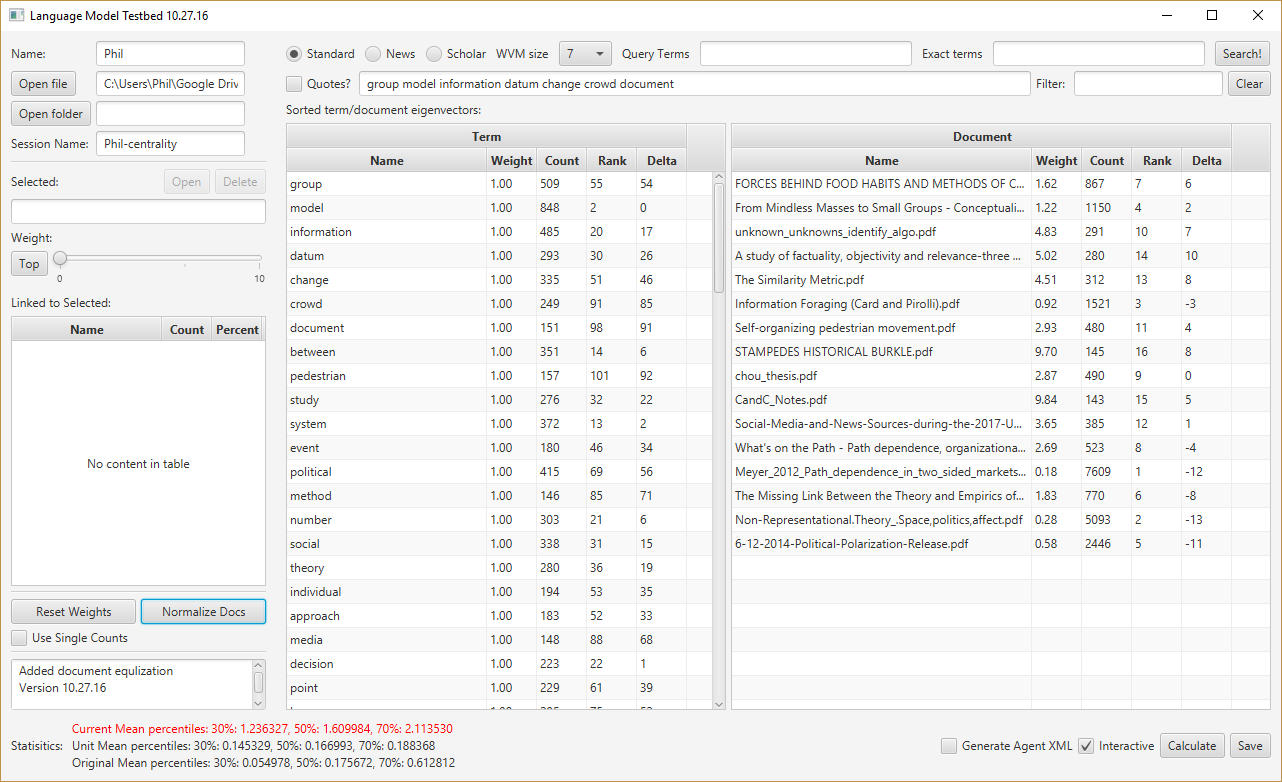
  • Played around with the lit review section using LMN. Here’s a screenshot of the docs as of yesterday: LMN_screenshot_7.11.17
  • Continuing C&C
    • Thus, as a hypothesis concerning the polarization of groups, it may be concluded that the consensus reached will be the more extreme:
      (a) when individuals participate more directly in the discussions;
      (b) when the differences between them, their knowledge and their opinions are more marked;
      (c) when what is at stake in the discussions is perceived by them as valuable. [p 67]

      • What interests me here is (b). I think that there are several measures of difference that matter
        1. The information distance, as determined by amplitude and variance. There is a difference between agreement about two extreme positions that are broadly based and two narrow positions.
        2. The heading alignment. It is possible to arrive at a position from different directions. Is it easier if the headings are similar?
        3. Velocity. Is there a situation where one piece of information is held fixed and everything else is allowed to change? (e.g. The Leader is always right, though the position is in constant flux [Trump supporters know Trump lies. They just don’t care.])
        4. Exogenous visibility. What does the information horizon look like to the discussants? Do they feel as though they are relatively close or far apart? The VI/Emacs disagreements seem both vast and trivial, depending on framing, for example.
    • Plainly, there is no halo effect on questions that are not included in it (the discussion) [p 69]
      • So in emergent groups, what is the discussion? Or do we look for polarizing behavior and infer the point of discussion from that? I think that this implies axis on a dimension-reduced map that might make sense. 
    • we assumed that where discussion had created tension, shifts in the direction of a consensus should be more frequent. To verify this, the distance was measured between the two individuals whose opinions diverged most before the beginning of the discussion. A distance of 1 meant that these two opinions were separated by one point on a seven-point attitude scale. The opinions of the others, whether identical or not among themselves, were located between those of the two individuals who differed most. In the same way a distance of 6 meant that one of the individuals in the group was located at the favourable pole and another at the unfavourable pole. Thus they were opposites; the opinions of the rest were distributed between these poles. It is here, where conflict was greatest, that the maximum polarization should be recorded. In fact, the shifts towards an extreme consensus turned out to be more frequent in the groups when the gap was more than three points than when it was below that figure. [p 69]
    • The finding was simple: the common choices were much more extreme in the groups of five than in those of four, which themselves were more extreme than those in the groups of three. Moreover, they polarized more when they engaged in discussion among themselves than when they proceeded to a silent exchange of notes [p 70]

9:00 – 4:30 BRC

  • Setting up test instance
    • CrawlService – Cloned
    • NLPService – Cloned
    • MasterDataService – Cloned
    • gtc-test-fixtures – Cloned
    • Added Chrome and Postman
    • Added the rmq dash: sudo rabbitmq-plugins enable rabbitmq_management, which runs at http://localhost:15672 with default login and password of guest
    • MasterDataService runs and is visible here: http://localhost:8890/masterdataservice/events
    • To make things easier to run, added a slew of aliases:
      alias mrmq='sudo rabbitmq-plugins enable rabbitmq_management'
      alias ovpn='cd /home/pfeldman/openVPNconfig && sudo openvpn --config bellrock.ovpn && cd ..'
      alias run_crawl='java -jar /home/pfeldman/IdeaProjects/CrawlService/build/libs/crawlservice.war &'
      alias run_geocoder='java -jar /home/pfeldman/IdeaProjects/GeoCoderService/build/libs/geocoderservice.war &'
      alias run_mds='java -jar /home/pfeldman/IdeaProjects/MasterDataService/build/libs/masterdataservice.war &'
      alias run_nlp='java -jar /home/pfeldman/IdeaProjects/NLPService/build/libs/nlpservice.war &'
      alias startdfs='/home/pfeldman/hadoop-2.7.3/sbin/start-dfs.sh'
      alias starthbase='/home/pfeldman/hbase-1.3.1/bin/start-hbase.sh'
      alias startrmq='service rabbitmq-server start'
      alias stopdfs='/home/pfeldman/hadoop-2.7.3/sbin/stop-dfs.sh'
      alias stophbase='/home/pfeldman/hbase-1.3.1/bin/stop-hbase.sh'
      alias stoprmq='service rabbitmq-server start'
      
    • Have the full stack running, but was unable to get crawlservice running with this payload from scheduling service:

Phil 7.10.17

7:00 – 8:00

  • Social Media and News Sources during the 2017 UK General Election
    • Platforms like Twitter and sources like Wikipedia are important parts of the information diet for many citizens. In this data memo, we analyse Twitter data on bot activity and junk news for a week in the final stages of campaigning of the 2017 UK General Election and also present data on Wikipedia page consultations about those parties and leaders. (1) Content about the Labour Party strongly dominated Twitter traffic in this period. (2) Social media users in the UK shared five links to professional news and information for every one link to junk news. (3) Wikipedia queries have gone from being mostly about the Conservative Party and Prime Minister Theresa May to being mostly about the Labour Party and the Labour leader Jeremy Corbyn. (4) In comparison to the first week of the campaign period, we find that users are sharing slightly better quality news content, that automated accounts are generating more traffic about the election, and that more of the automation uses Labour-related hashtags (though may not be from the Labour Party itself). (5) In comparison to trends in other countries, we find that UK users shared better quality information than that which many US users shared during the 2016 US election, but worse quality news and information than was shared during the French 2017 election.
  • Recognizing safety and liveness
    • Informally, a safety property stipulates that “bad things” do not happen during execution of a program and a liveness property stipulates that “good things” do happen (eventually) (Lamport 1977). Distinguishing between safety and liveness properties is useful because proving that a program satisfies a safety property involves an invariance argument while proving that a program satisfies a liveness property involves a well-foundedness argument. Thus, knowing whether a property is safety or liveness helps when deciding how to prove that the property holds.
      • Read about this in this month’s Communications of the ACM. I wonder if it could be applied to the types of social models I’m building and trying to trace in user data.
  • Continuing C&C
    • In contrast to the consensual form, we can understand that the normalized form, which gives only a subordinate role to some members of the group, creates a certain distance, causing the group not to loom so large in the life and consciousness of individuals, so that in the end it appears strange and abstract. Immediately the participants become detached from one another, and instead of being actors become mere spectators in the discussions. [p 62]
    • Since controversy is in proportion to the participation of members, few conflicts are observed, unless it be in the ranks of the leaders. It is as if individuals tended to minimize their ‘investment’ and their attachment to the collectivity, remaining aloof from intrigues, and, so far as possible, conforming to the opinions and actions that were suggested to them. [p 62]
      • Is this what happens on forums and low-participation social systems like comments?
    • Although the one satisfies the need to participate in a more intense way, and one of which people cannot be deprived for long, the other at least provides a substitute for it. [p 62]
      • This could be another affordance of the system. Some way to grade participation and discussion as a threshold of entering?
    • There can scarcely be any doubt that, by meeting and talking together, a group’s members bring out the values predominant among them, ones to which they are attached. In some way their substance is given shape, so that what we hold in common, but is concealed, becomes manifest. [p 65]
    • …consensual participation probably has the effect of raising the level of collective involvement, whereas normative participation lowers it. One may conclude that the former polarizes the decisions leading to consensus, whereas the latter modifies them. The former causes the members of the group to converge on the pole of values already shared by them before they took part in the decision, and the latter towards the just mean. [p 65]

8:30 – 4:30 BRC

Phil 7.7.17

6:00 – ?? Research

  • Continuing C&C
    • This tension arises less from the content of the argument or the difference that exists between them than because the disagreement manifests itself through someone else who has to be faced up to [p 55]
      • So what are the implications of CMC, where the ‘distance’ can be moderated? The spectrum can run from video chat to text chat to forum, to search results. What’s the sweet, frictionless spot that creates stapedes?
    • Thus, throughout controversies and counter-arguments, which resemble body-blows, the members of the group covertly exert upon one another an influence that emphasizes what can draw them closer. Between them can be observed a synchronized, imitative process which transforms every word into a signal, every gesture into a model, and every piece of information into an argument. All the forms of the rhetoric of mind and body become maneuvers through which the distances between the participants grow smaller and the frictions between them are deadened. [p 55]
    • But most frequently, by the very fact of being called upon to discuss, each individual feels himself to be an actor in the ritual and a member of the group instituting it. In this way, group cohesion is reinforced at regular intervals. [p57]
    • Numerous studies justify the assertion that people are more disposed to start out on that painful intellectual and affective path when they have to deal with opposing arguments coming from several sources rather than from one source alone. It is as if a group speaking with several voices were more conspicuous and offered greater room for maneuver than a group with only one voice.
      • Higher dimensions == less constraint?

8:30 – 4:30 BRI

  • Continuing GeoMesa with Hbase. Notes are here

Phil 7.6.17

7:15 – 8:15 Research

  • Continuing C&C
    • For the collectivity it is imperative to overcome its consuming tendency to impose a uniformity upon individuals and encourage their inclination to follow the law of least effort and obey. It is true that by causing them to abandon their personal arguments and interests, the collectivity ensures, for its own benefit, that decisions are made easy. But this is at the price of a passivity that deprives it of the energy and active initiative of individuals. They have to struggle against themselves in order to form a living entity, and the entity has to struggle against itself in order to be made up of individuals. This is in fact the necessity noted by Pascal in his time:The multitude that is not reduced to a unity is confusion; the unity that does not depend upon the multitude is tyranny.’ [p 50]
    • Depth psychology
    • How and why this occurs emerges from a fine study by Freedman and Fraser (1966), the American psychologists, which deals with a familiar situation. We see volunteers going from door to door to get householders to sign a petition whose purpose was ‘to preserve the beauty of California’. Naturally, almost everyone signed it, since the beauty of the countryside, like child health or world peace, is a theme that strikes a chord. A fortnight later, these same people were asked to put up a board on their lawn: ‘Drive carefully’. Almost half agreed to do so, whereas the figure would have been much lower if they had not signed the petition. In fact, they had made the first step and then took part in an action. The participants deemed themselves infused with civic spirit, and loyal to their principles [p 52]
      • I think this is a way to reduce dimensions and as such reduce distance to make it easier to follow.
    • I’m wondering if there is some kind of sentiment analysis that can tell how much mutual support is going on in a community, and if it’s reactionary or progressive. This would be in addition to the amplitude and variance measures for beliefs in the community.
    • Hbase needs to connect to port 9000. Add this to hbase/conf/hbase-site.xml
      <configuration>
       <property>
       <name>hbase.cluster.distributed</name>
       <value>true</value>
       </property>
       <property>
       <name>hbase.rootdir</name>
       <value>hdfs://localhost:9000/hbase</value>
       </property>
      </configuration>

Phil 7.5.17

7:00 – 8:00 Research

  • Working on catching up with Aaron and Wayne
  • More C&C. Tried to get things done yesterday, but… Yeah…
    • This does not warrant classing the group with the crowd, which is prey to over-enthusiasm and violence [p40]
    • If we wish to understand the nature of groups, it seems advisable to concentrate on the way they change , and in the way that they change individuals, rather than on their ability to aggregate individuals as part of a whole [p42]
    • …the danger lies less in anomie or disorder than in routine and apathy [p 42]
    • Acts of decision, as well as acts of consenting, are above all acts of participation. For various reasons their value springs from the bond that they create between individuals and from the impression each one receives that he counts in the eyes of everybody as soon as he begins to participate. [p47]
    • Consequently much effort is expended to become a member of an association, to be elected to a committee, to have the right to meet together and communicate with certain people, and so on.
      • But what if that effort becomes low or frictionless as we find online? And what about being an anonymous part of a group?

8:30 – 4:30 BRI

  • Installing Hadoop
  • Need to get a hotel near CCRi for Thursday night -done
  • Got my Hadoop running by deleting my log files. Yes, that makes no sense.
  • Starting on the geomesa-quickstart-hbase. More notes here

Phil 7.3.17

6:45 – 7:45 Research

9:00 – BRI

  • Starting to keep track of GeoMesa setup here
  • Installing RocketChat. Need a host
  • Helped Aaron with the Google CSE writeup for Gregg

Phil 6.30.17

8:30 – 4:30 BRI

Phil 6.29.17

Research

  • Travel from HCIC 2017
  • Continued to read Conflict and Consensus
  • Continued to work on P&R Considered Harmful

Phil 6.28.17

HCIC 2017

  • Thought for the day – board games to explain paper production (Journal and conference) and proposal writing
    • John Walton (Board games, etc) Elizabeth Swenson (Application Crunch)
      • Joe Dumit – Science studies Fracking simulation board games
  • John Tang, Gina Venolia and Kori Inkpen, Microsoft
    • Breaking the Future of Social Media
    • Discussant: Dan Russell
    • Multi stream clusters – how do we view? (Scoop)
    • Interactions among the streamers and between the streamers and the viewers. Also, how does the design scale? Twitch doesn’t scale, BTW – you can’t keep up
    • Likes as a percentage of viewers upvoting affects who sees what Paper at CHI
    • Can be hard to stream under particular circumstances. High crowds, degrated conditions, etc. Leads to short viewing due to frustration
    • SXSW covered with multiple parallel streams
      • Note – stabilized shoulder mount for a streamer with extra batteries? Better mic? Camera?
    • If there is a crash, the preview allows an overview and lets people continue an interrupted stream.
    • Many short glances, most of the time is in long watches/views. Browse/browse/browse/stay
    • Interaction engagement – all deliberate. Lurking is the absence of action, but there is a surprisingly low percentage of that.
    • Sweet spot is high flexibility environments like trade shows, where the remote audience can interact.
    • How do you get effects at at sale with a prototype
      • Recruit crowds from Turk – reflects incentives. Can test usability and engagement at a higher level of interaction, which exercises the platform more
      • Corporate Volunteers – viewed by interest. very linear. More interested in the talks, rather than the wandering.
      • Unknown – power law. many short, few long (and much higher lurking)
    • Breaking existing commercial boundaries to enable the future
      • Many semi-overlapping ecosystems. How to standardize? Standards didn’t work. incentivised to lock-in
      • Maybe a standard for subsets of data to support a commons? Universities may be a good place to take the lead on this?
      • How to unify?
  • Dan Russell discussant
    • We already have a lot of streaming cameras
    • 911 Truthers based on self-selected partial information.
    • Can’t reverse engineer context
    • Reverse effects cause and effect can get confused
    • Google moderator wound up requiring an intermediary to select the questions
    • Only studies with real money matter
    • Is the MCR mechanism of handling multiple feeds the way to handle social media? Possible for ABC to buy feeds from Fox?
  • Questions
    • Sharing PII is also a problem. Not only costs but risks
    • Is the value in the liveness, or in the history? Attention value is value.
    • Value is transparency? Authenticness? David Brin, the transparent society Trustworthiness of the messenger, rather than the anonymous streamer?
    • Social information proximity vs IR gatekeeping?
    • We’re having trouble differentiating between perspectives? There are different small groups that don’t relate to a giant company. A small group may be important.
    • Events of civic interest vs. novel and entertaining live streams
    • Gare Steinberg’s incredible sad true love story
    • There is a difference between a trained, effective producer? What about predators choosing prey from a flock? What does an effective liver performer do?
    • Becoming a temporary media company that produces a curated stream. An improvisational theatre company
    • Tweak the Tweet Palen & Starbird
    • It is very interesting to watch representatives of Google and MSFT discuss research as startups, where acquisition is the large scale corporate research model.
  • Short talk and working session: Charlotte Lee 
    • HCDE Comics – Reflecting on Living in the Present and Designing for the Future
    • Philip Agre – Critical Technical Practice
    • Check out the memex as inspiration for the Research Browser
    • You can draw in pencil all day long at a coffee shop, but when you start inking people will stop and notice.
  • See if ASRC could support HCIC. What’s he cost/value proposition. What does it mean to be part of the consortium?
  • Reworking Design as Critical Fabulations – Daniela Rosner
    • Building core memory as quilts
    • Core rope memory
    • “Valorization of individuals has to recede” in collaborative processes.
    • To believe what is physically impossible might be possible in a different way
  • Discussant – Stacy
    • It’s a book chapter! In what book?
    • Design shift from individualism (includes small teams) to collective
    • Situated, and contextual
    • Not having a solution and moving on, but creating a process.
    • Who gets to tell the stories
    • There is a reviewer 2 meme. I did not know that.
    • Interviews are fabulating?
    • Grounded theory is a way of academically acknowledging and defining path dependency.
    • corememoryshield.com/report.html
    • Creating different physical instantiations that provide different audiences.
    • Inquire into your method’s history. What are the ways of knowing, and Who is knowing?
    • Who are the actual people doing the tasks, and what are the behind-the scenes work to create the product (Read papers by Lilly Irani. Such command of the language!)
    • Identifying devalued labor. How. And what does it mean to track and understand than that. There is a difference between the dialogic practice of group work and the business model of an industry that maximises profit through celebrity creation.
    • There is a difference between a performer and a creator of the source material for that performance.
  • Michael Muller and Q. Vera Liao, IBM
    • Exploring AI Ethics and Values through Participatory Design Fictions
    • The developers of robots believe that they represent the user. THis may be true in that there are no customers yet. Except for LAWS systems?
    • Value Sensitive Design (chlorine water treatment and chlorine gas)
      • Theoretical
      • Contextual
      • Ethnographic
    • We do not have an agreed-upon list of values.
    • Value sensitive inquiry instead? Descriptive ethics. Not at normative ethics yet
    • How do you speak your values about something that you don’t yet have?
    • Using design fictions
    • Problems with current popular fictions (Books – personal view, and media – complex interweavings of corporate interests)
    • Ponder a spectrum from utopia to dystopia and timeframes
    • Exercise that was confusing and too fast. But generally on story completion
    • Slideshare.net slides
  • Discussant: Kristin Eschenfelder
    • Would you kill the fat robot?
    • An echo chamber (like Nazi-ism) might be indicated by the alignment of philosophies around a desired outcome. Because there is no external validity?
    • Moral Machine MIT Media Lab
    • There is a difference in commercial ethics and philosophical ethics.

Phil 6.27.17

HCIC 2017

  • What if Robots designed your next homes (Maya  Cakmak)
    • PR2 robot
    • Homes are designed for people, home tasks are performed for people
    • Are homes of the rich different from the homes of the lower classes?
    • Affordances for robots. Actually means that the home is becoming part of the robot. Like an automated factory. Structure that is needed for robots
    • Hotels and warehouses are intermediate, semi-structured environments that afford robots better
    • What about home gantry robots? With it’s own storage for non=-human tools?
  • Technology- centered design – Amanda Lazar
    • Solutionism – Solves problems before they exist
    • The MAYA principle – Most Advanced yet Acceptable
    • What happens when the technology is explicitly at the center of the design process? Making this explicit opens up some opportunities. Variant of the flying shiny logos problem (Overton window)
    • How things affect you, your family, and people you know in that order
  • Daniel Russel. Unintended consequences. Ramps are one thing, people and cats and dogs are another
  • Lana – what about the schedule of change. Like wiring up houses for networks and then wifi comes along
  • National Robotics Initiative
  • Should robots be designed around current accessibility standards. THen robots can grow out of their disabilities over time?
  • Are we too tied to practices now? Washing machines lead to clothing that survive the washing machines. Ecosystems. What are all the dependencies that need to simultaneously shift?
  • What about friction? And how we deal with slaves?
  • Futures Beyond Design Panel (Brent Hecht, Lilly Irani, Silvia Lindtner, Scott Mainwaring)
    • Brent – Design as an optimization process
      • But externalities! How do we internalize these ideas so that unintended consequences are minimized
      • The great decoupling – computers displace workers
      • Importance of data sets (google’s powers of search are heavily dependent on Wikipedia user sourced data
      • Designing technologies for a world where data creators are compensated in a meaningful way
        • It would be neat if the research browser could do this. Maybe show a ticker that shows a ticker with ‘you would have made $xx’
    • Scott
      • How technological infrastructures are produced?
      • Three-ring-binder project in Maine. Fiber to rural areas. But how does this affect the users? Who are the users and how do we know them? Many misconceptions. Culture can change rapidly but what’s the difference between minority rights, women’s rights and LGBT rights?
    • Sylvia Lindtner
      • Making Cruel Machine Dreams
      • The maker movement (Is this human value add?) References Clay Shirky’s Here Comes Everybody
      • The means of production need to be placed back in the hands of the proletariat?
      • Precarious work as opposed to techno utopianism? Who profits? The 3D printer manufacturers
      • Shenzhen is really a policy experiment. Which concentrated the means of production
    • Lilly
      • When impact requires more than design. The case for crowds.
      • Turkopticon – Turkers reviewing employers in the system.
      • Turker organization – Turker Nation, CloudMeBaby, etc
      • Dynamo: Safe space for turk worker activism (forum with upvoting) – but for precarious labor in general
      • Need to support the understanding of labor laws and have a legal understanding
      • Platform Cooperativism
    • John Zimmerman – Carnage Mellon
      • Won’t the ‘computers will take our jobs’ problem fix itself?
      • Shouldn’t stop us from thinking about how to minimize disruption and pain
      • Lilly – Culture matters in how these technologies are integrated
    • What is an example of a project that embodies these ides
      • Sylvia – civilla
      • Scott – HatchTheFuture.org Facebook’s communities of action??
      • Brent – Machine Learning can be tuned to populations so that it does not have disparate impacts. A chrome plugin that supports selective boycotts.
      • Lilly. Platform Cooperativism. Stockse is a photo collective made by ex Getty people. But what does participatory management look like when there are 10,000 members?
    • How do we do this? How do we engage as academics?
      • Lilly: Who represents the crowdsourcing workers?
      • Brent: Personas vs. Sociatals?
      • How to communicate complex political and social ideas in a easily consumed way

Phil 6.26.17

HCIC 2017

  • Carl DiSalvo – Alternate Histories of Design Futures
    • What else might design be – different interpretations of the world
    • Speculation (Speculative Design?)
    • Design as critique to critiquing design
    • Designers domesticate technologies
    • Speculative design is to trigger thoughts, not to become a product per-se. THis is about nudging in a direction. It’s more like art harnessed to thinking about interaction
    • Fantastic futures, extraordinary objects intended to be provocative
    • Archigram 
    • Global Tools.
    • 21st Century Speculative Design MOMA curates and legitimates Speculative Design
    • Design and Violence
    • Core77
    • From representation to events
    • Vernacular Futures -> cheap futures. Cheap stuff that we buy. Fidget spinners???
    • Speculative Enactments (SIGCHI paper)
    • prefiguration
    • Mundane work of performing on the world (Signage)
    • Implications for design
      • How can computation become integral to our design and experiences (Bill Gaver – Your Data Catcher)
      • Turkopticon
  • Katherine Isbister – Reflections on Carl’s presentation
    • Interdependent wearables
    • Magic circle of play (new games movement, whole earth catalog, etc)
    • Global Game Jam
    • Feynman diagrams spreading through interpersonal transmission. In other words, they do not get used unless someone shows you. The difference from personal contact vs reading.
  • Legitimate peripheral participation
  • Brave New Alps
  • Prefiguration in Contemporary Activism
  • Analog game movement – write rulesets that reflect the vision of the architect. No, that didn’t work. Then creating the experience locally. Now a co-creation process that’s half product/half event? Practice being transmitted through objects. De-centering the designer, recentering the practice.
    • Douglas Wilson (Folk Games) No Autour.
  • Repair maintenance vs event. Events become objectified and bounded. It can be treated as a product.
  • Star Trek & CMC (Lana Yarosh)
    • Technology constraints and technologies
  • Discussion as speculative fiction Wendy Kellogg – Microsoft Research
    • Apologetics
    • Research through design
    • Artifacts embody myriad choices that can’t be captured in a written document
    • Generalizing through juxtaposition? Dourish 2014 – LSI is a theory of meaning