Author Archives: pgfeldman

Phil 1.29.18

7:00 – 5:30 ASRC MKT

  • The phrase “Epistemic Game Theory” occurred to me in the shower. Looked it up and found these two things:
  • When it’s easier to agree than discuss, it should be easier to stampede:
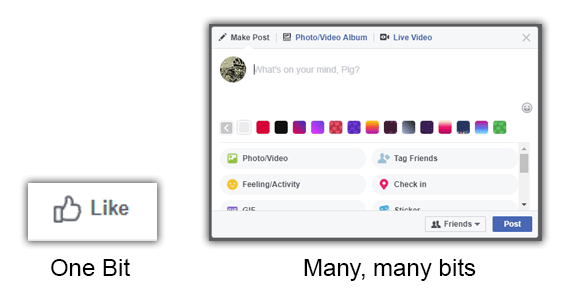
  • Like vs. words
  • This is also a piece of Salganik’s work as described in Leading the Herd Astray: An Experimental Study of Self-Fulfilling Prophecies in an Artificial Cultural Market
  • An article on FB optimization and how to change the ratio of likes to comments, etc
  • I don’t think people did. It’s just that it’s easier to not think too much 🙂 people are busy selling tools that do everything for people, and people are happy buying tools to limit thinking. The analogy of replacing cognitive load with perception by VIS misleads in this regard. (Twitter)
  • Continuing BIC
    • Dimension reduction is a form of induced conceptual myopia (pg 89)? Conceptual Myopia
  • AI Roundup workshop today
    • Zenpeng, Biruh, Phil, Aaron, Eric, Eric, Kevin
    • Eric – Introductory remarks. Budget looks good for 2018. Direction, chance to overlap, get leaders together for unique differentiators and something that we can build a business around. There has to be a really good business case with revenue in the out years
    • Aaron – CDS for A2P. Collaborate on analytics, ML, etc. Non corporate focused. Emerging technologies and trends. Helping each other out. Background in IC software dev.
    • Pam Scheller – SW Aegis. BD. EE, MS Computer engineering.
    • Biruh, TF, LIDAR, Generalized AI as hobby.
    • Zhenpeng Lee – Physics, Instrument Data Processing for GOES-R. FFT. GOES_R radiometric analysis. 7k detector rows? Enormous data sets. Attempting to automate processing the analysis of these data sets. Masters in Computer Science from JHU. Written most of his code from scratch.
    • Kevin Wainwright. Software engineering Aegis. C&C, etc. Currently working on a cloud based analytics with ML for big data, anomaly detection, etc. Looking for deviation from known flight paths
    • Eric Velte. History degree. Aegis. Situational awareness. Chief technologists for missions solutions group. Software mostly. Data analytics for the last two years. Big Data Analytics Platform.
    • Cornel as engineer, Zero G heat transfer, spacecraft work. Technology roadmaps for thermal control. Then business development, mostly for DoD. Research Sports research – head of Olympic Committee research kayaks, women’s 8, horse cooling, bobsleds.
    • Mike Beduck. Chemical Engineering and computer science. Visualization, new to big data. Closed system sensor fusion. RFP response, best practices. Repository for analytics
    • George. Laser physics. Cardiac imaging analysis. Software development, 3D graphics. Medical informatics. CASI ground systems. More GOES-R/S. Image and signal processing and analysis.
    • Anton is lurling and listening. Branding and marketing.
  • A2P WIP
    • Put a place on sharepoint for papers and other documents – annotated bibliography.
    • Floated the JuryRoom app. Need to mention that the polarizing discussion closes at consensus.
  • Zhenpeng Lee AIMS – GOES-R. What went wrong and how to fix. ML to find pattern change in 20k sensor streams. Full training on each day’s data, then large scale clustering. Trends are seasonal? Relationships between sensors? Channel has 200-600 detectors. “Machine Learning of Situational Awareness” MLP written in Java. TANH activation function.
    • Eric Haught: Long term quest for condition-based maintenance.
    • Aaron – we are all trying to come up with a useful cross platform approach to anomaly detection.
    • Training size: 100k samples? Sample selection reduce to 200? Not sure what the threshold sensitivity is
  • Eric Velte – Devops. Centralize SW dev and support into a standardized framework. NO SECURITY STACK!!!!!
  • Dataforbio? Video series

Phil 1.28.18

Rain!

  • A full-throated defense of simulation from Joanna Bryson in Artificial Intelligence and Pro-Social Behaviour (pg 290)
    • The role of simulations in science has been at times confused, not only by occasional bad practice (as with any method), but also by claims by some of the method’s innovators that simulations were a “third way” to do science (after induction and deduction, Axelrod 1997 ). However, more recently a consensus has been reached that simulation and modelling more generally are indeed a part of ordinary science (Dunbar 2002 ; Kokko 2007 ; Seth et al. 2012). The part that they are is theory building. Every model is a theory—a very-well specified theory. In the case of simulations, the models are theories expressed in so much detail that their consequences can be checked by execution on a computer. Science requires two things: theories that explain the world, and data about the world which can be used to compare and validate the theories. A simulation provides no data about the world, but it can provide a great deal of ‘data’ about a theory. First, the very process of constructing a simulation can show that a theory is incoherent—internally contradictory, or incomplete, making no account for some part of the system intended to be explained (Axelrod 1997 ; Whitehouse et al. 2012 ). Secondly, modelling in general can show us a fuller range of consequences for a theory. This allows us to make specific, formal hypotheses about processes too complex to entirely conceptualise inside a single human brain (Dunbar 2002 ; Kokko 2007 ). The wide-spread acceptance of simulations as a part of the scientific method can be seen by their inclusion in the highest levels of academic publication, both in the leading general science journals and in the flagship journals for specific fields ranging from biology through political science. Fortunately, a theory expressed formally as a simulation can also be expressed in the traditional, informal, ordinary-language way as well.
  • Also this, from the same article:
    • Recently in the megafauna literature there has been a new hypothesis: individuals in populations might benefit from information transmission, of which vigilance against predators is just a special case (Crockford et al. 2012 ; Chivers and Ferrari 2014 ; Hogan and Laskowski 2013 ; Derex et al. 2013 ). Transmission of behaviour may be at least as important as information about localised threats (Jaeggi et al. 2008 ; Dimitriu et al. 2014 ). Note that behaviour itself, when transmitted horizontally (that is, not by genes to offspring), must be transmitted as information via perception (Shannon 2001 ).
  • On Discovering the Number of Document Topics via Conceptual Latent Space
    • Topic modeling is a widely used technique in knowledge discovery and data mining. However, finding the right number of topics in a given text source has remained a challenging issue. In this paper, we study the concept of conceptual stability via nonnegative matrix factorization. Based on this finding, we propose a method to identify the correct number of topics and offer empirical evidence in its favor in terms of classification accuracy and the number of topics that are naturally present in the text sources. Experiments on real-world text corpora demonstrate that the proposed method has outperformed state-of-the-art latent Dirichlet allocation and nonnegative matrix factorization models.
  • Beyond the Ranked List: User-Driven Exploration and Diversification of Social Recommendation
    • The beyond-relevance objectives of recommender systems have been drawing more and more attention. For example, a diversity-enhanced interface has been shown to associate positively with overall levels of user satisfaction. However, little is known about how users adopt diversity-enhanced interfaces to accomplish various real-world tasks. In this paper, we present two attempts at creating a visual diversity-enhanced interface that presents recommendations beyond a simple ranked list. Our goal was to design a recommender system interface to help users explore the different relevance prospects of recommended items in parallel and to stress their diversity. Two within-subject user studies in the context of social recommendation at academic conferences were conducted to compare our visual interfaces. Results from our user study show that the visual interfaces significantly reduced the exploration efforts required for given tasks and helped users to perceive the recommendation diversity. We show that the users examined a diverse set of recommended items while experiencing an improvement in overall user satisfaction. Also, the users’ subjective evaluations show significant improvement in many user-centric metrics. Experiences are discussed that shed light on avenues for future interface designs.
  • Setting up a Dissertation main points page on Phlog
  • This is an interesting map, from allgeneralizationsarefalse.commedia-bias-chart_3-0_hi-res
  • Don’t know what to do with this, but wow: Audio Adversarial Examples: Targeted Attacks on Speech-to-Text
    • We construct targeted audio adversarial examples on automatic speech recognition. Given any audio waveform, we can produce another that is over 99.9% similar, but transcribes as any phrase we choose (at a rate of up to 50 characters per second). We apply our iterative optimization-based attack to Mozilla’s implementation DeepSpeech end-to-end, and show it has a 100% success rate. The feasibility of this attack introduce a new domain to study adversarial examples.

Phil 1.26.18

7:00 – 4:00 ASRC MKT

  • Tweaked my hypotheses from this post. I need to promote to a Phlog page.
  • Using Self-Organizing Maps to solve the Traveling Salesman Problem
    • The Traveling Salesman Problem is a well known challenge in Computer Science: it consists on finding the shortest route possible that traverses all cities in a given map only once. To solve it, we can try to apply a modification of the Self-Organizing Map (SOM) technique. Let us take a look at what this technique consists, and then apply it to the TSP once we understand it better.
  • Starting JuryRoom project with Jeremy.
    • Angular material  design
    • VerdictBox (Scenario and verdict)
    • Chat message
    • Live discussion cards (right gutter)
    • Topics (alphabetic, ranking, trending) with sparklines
    • Progress!!!!!! JuryRoom

Phil 1.25.18

ASRC MKT 7:00 –

  • Domo arigato, Mr. Roboto, tell us your secret (good article on recognizing behavior patterns, rather than words)
    • Everybody that has an interest in influencing public opinion will happily pay a handful of Dollars to amplify their voices. Governments, political groups, corporations, traders, and just simple plain trolls will continue to shout through bot armies—as long as it is so cheap. Bots are cheaper than buying ad space, less risky than a network of spies, more efficient and less prone to failure than creating 50 fake accounts by hand. If bots could be identified and tagged, the fake news industry would suffer a heavy blow. Here is how we can make this happen.
  • More Angular
  • Wireframing with Jeremy

Phil 1.24.18

7:00 – 5:00 ASRC MKT

  • H1: Groups are defined by a common location, orientation, and velocity (LOV) through a navigable physical or cognitive space. The amount of group cohesion and identification is proportional to the amount of similarity along all three axis.
  • H2: Group Behavior emerges from mutual influence, based on awareness and trust. Mutual influence is facilitated by Dimension Reduction: The lower the number of dimensions, the easier it is to produce a group.
  • H3: Group behavior has three distinct patterns: Nomadic, Flocking and Stampeding. These behaviors are dictated by the level of trust and awareness between individuals having similar LOVs
    • H3a: The trustworthiness of the underlying information space can be inferred from the group behaviors through belief space. All agents  seek out fitness peaks (reward gradients) and avoids valleys (risk gradients) within the space. (Risk = negative heading alignment, increase speed. Reward = positive heading alignment, decrease speed.)
      • Nomadic emphasizes environmental gradients as an individual or small group of agents. This supports the broadest awareness of the belief space, though it may be difficult to infer fitness peaks. Gradient discovery is  less influences by additional social effects,
      • Flocking behavior results from environmentally constrained social gradient seeking. For example, distance attenuates social influence. If an agent finds a risk or reward, that information cascades through the population as a function of the environmental constraints. (Note: In-group and out group could be manifestations of pure social gradient creation.)
      • Stampede emphasizes social gradients. This becomes easier as groups become larger and a strong ‘social reality’ occurs. When social influence is dominant at the expense of environmental awareness, a runaway stampede can occur. The beliefs and associated information that underlie a stampede can be inferred to be untrustworthy.
  • H4: Individual trajectories through these spaces, when combined with large numbers of other individual trajectories produce maps which reflect the dimensions that define the groups in that space.
  • These conclusions can be derived though
  • Continuing with BIC
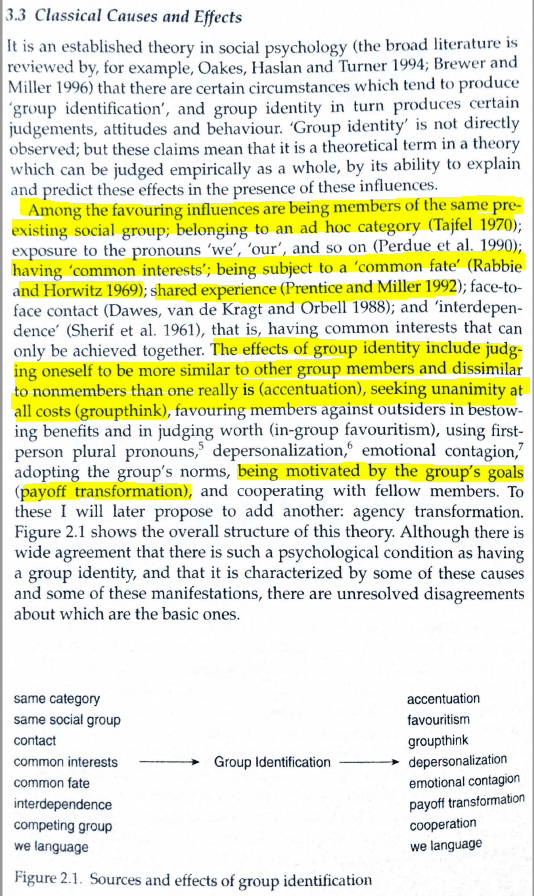
    • GroupIdentification
  • Fundamentals of Data Visualization
    • I’m very excited to announce my latest project, a book on data visualization. The working title is “Fundamentals of Data Visualization”. The book will be published with O’Reilly, and a preview is available here. The entire book is written in R Markdown, and the figures are made with ggplot2. The source for the book is available on github.
  • Sex differences in the use of social information emerge under conditions of risk
    • Social learning provides an effective route to gaining up-to-date information, particularly when information is costly to obtain asocially. Theoretical work predicts that the willingness to switch between using asocial and social sources of information will vary between individuals according to their risk tolerance. We tested the prediction that, where there are sex differences in risk tolerance, altering the variance of the payoffs of using asocial and social information differentially influences the probability of social information use by sex. In a computer-based task that involved building a virtual spaceship, men and women (N = 88) were given the option of using either asocial or social sources of information to improve their performance. When the asocial option was risky (i.e., the participant’s score could markedly increase or decrease) and the social option was safe (i.e., their score could slightly increase or remain the same), women, but not men, were more likely to use the social option than the asocial option. In all other conditions, both women and men preferentially used the asocial option to a similar degree. 
  • Thinking Fast and Slow on Networks: Co-evolution of Cognition and Cooperation in Structured Populations
    •  In line with past work in well-mixed populations, we find that selection favors either the intuitive defector (ID) strategy which never deliberates, or the dual-process cooperator (DC) strategy which intuitively cooperates but uses deliberation to switch to defection in Prisoner’s Dilemma games. We find that sparser networks (i.e. smaller average degree) facilitate the success of DC over ID, while also reducing the level of deliberation that DC agents engage in; and that these results generalize across different kinds of networks.
  • Joanna J Bryson 7:30 AM – 24 Jan 2018: This didn’t happen because humans are evil. It happens because intelligence is computation—an expensive physical process—and therefore limited. Thread very worth reading.
  • A bit more Angular
  • Compared the speed of execution for LSTM on my and Aaron’s boxes. His newer card is a bit faster than my TITAN
  • Most of the day was spent putting together the ppt for the ML/AI workshop on Monday

Phil 1.23.18

7:00 – 5:00 ASRC MKT

  • Lesser-known trolley problem variations
  • News presented as a list: The 270 people connected to the Russia probes
  • continuing BIC
    • Group as Frame
    • Categorizatino and bias
  • Groups are defined by a common location, orientation, and velocity through a physical or virtual space. They influence each other dependent on awareness and trust. The lower the number of dimensions, the easier it is to produce a group.
  • Russia’s Full Spectrum Propaganda
    • This post examines one full spectrum case to illustrate the method. @DFRLab examined this case in an earlier post; since then, further evidence emerged, which changed and improved our understanding of the technique.
  • More Angular. Nice progress. I had some issues where I wanted to keep an old version of the app directory and did a refactor. This (of course) refactored the calling program, so I broke quite a few things figuring it out. That being said, Angular 1.5 is really, really nice.
  • Long chat about handling Trolls in the discussion app

Phil 1.22.18

7:00 – 4:00 ASRC MKT

  • Continuing Beyond Individual Choice
  • Pinged Kate Starbird to see if she has any time-series data that could be used to build maps
  • Parametrizing Brexit: Mapping Twitter Political Space to Parliamentary Constituencies
    • In this paper, a proof of concept study is performed to validate the use of social media signal to model the ideological coordinates underpinning the Brexit debate. We rely on geographically-enriched Twitter data and a purpose-built, deep learning algorithm to map the political value space of users tweeting the referendum onto Parliamentary Constituencies. We find a significant incidence of nationalist sentiments and economic views expressed on Twitter, which persist throughout the campaign and are only offset in the last days when a globalist upsurge brings the British Twittersphere closer to a divide between nationalist and globalist standpoints. Upon combining demographic variables with the classifier scores, we find that the model explains 41% of the variance in the referendum vote, an indication that not only material inequality, but also ideological readjustments have contributed to the outcome of the referendum. We conclude with a discussion of conceptual and methodological challenges in signal-processing social media data as a source for the measurement of public opinion.
  • Nice little echo chamber to study: Why 9/11 Truthers Are Obsessed With the Plasco High-Rise Fire in Tehran
    • One month after the fire, AE911Truth released a paper confirming its own unsolicited suggestion that the Plasco building was demolished with pre-planted explosives. Most of the links in footnotes of the paper point to YouTube videos and the organization’s own PDF documents. As proof of its claims, it cites puffs of smoke emanating from the collapsing building (demolition squibs), large clouds of dust and ash (proof of highly energetic explosive material), and the presence of supposedly molten material in the debris pile (nano-thermite’s persistent exothermic reaction). Since truthers made these exact same observations about WTC7, and since WTC7 must have been a controlled demolition, then clearly the Plasco Building was demolished as well. In a perfect infinite loop of anti-logic—like a snake slithering into its own asshole—an exact refutation of AE911Truth’s beliefs has instead vindicated them completely.
  • Good quick view into the left/right views of the Trump presidency year one:
    • o-brodner0121-web
    • o-lester0121full
  • Good progress on Angular. Since I’m using the CLI, I was having issues with getting to assets. Jeremy was able to guide me to the angular-cli.json file, which had all the hidden knowledge.
  • Discussion with Aaron about the product baseline

Phil 1.19.18

7:00 – 5:00 ASRC

  • Look! Adversarial Herding: https://twitter.com/katestarbird/status/954802718018686976
  • Reconnected with Wayne. Arranging a time to meet the week of the 29th. Sent him a copy of the winter sim conference paper
  • Continuing with Beyond Individual Choice. Actually, wound up adding a section on how attention and awareness interplay, and how high social trust makes for much more efficient way to approach games such as the prisoner’s dilemma on my thoughts about trust and awareness
  • Starting Angular course
    • Architecture overview
  • Meeting with Jeremy, Heath and Aaron on Project structure/setup
  • More Angular. Yarn requires Python 2.x, which I hope doesn’t break my Python 3.x
  • Could not get the project to serve once built
  • Adversarial herding via The Opposition
    • Clint WattsClint is a consultant and researcher modeling and forecasting threat actor behavior and developing countermeasures for disrupting and defeating state and non-state actors. As a consultant, Clint designs and implements customized training and research programs for military, intelligence and law enforcement organizations at the federal, state and local level. In the private sector, he helps financial institutions develop best practices in cybersecurity intelligence operations. His research predominately focuses on terrorism forecasting and trends seeking to anticipate emerging extremist hotspots and anticipate appropriate counterterrorism responses. More recently, Clint used modeling to outline Russian influence operations via social media and the Kremlin’s return to Active Measures.

Phil 1.18.2018

7:30 – 4:30 ASRC MKT

  • Truth Decay (RAND corporation ebook)
    • An Initial Exploration of the Diminishing Role of Facts and Analysis in American Public Life
  • Reading more Beyond Individual Choice
    • TheoryDemands
  • Got my Angular setup running. Thanks, Jeremy!
  • Reading up on WSO2 IaaS – Done. Did not know that was a thing.
  • Helped Aaron a bit with his dev box horror show
  • Spent a good chunk of the afternoon jumping through hoops to get an online Angular course approved. It seems as though you get approval, send it to HR(?), buy (it) yourself, then submit the expense through Concur. That’s totally efficient…

Phil 1.17.18


7:00 – 3:30 ASRC MKT

  • Harbinger, another DiscussionGame comparable: We are investigating how people make predictions and how to improve forecasting of current events.
  • Working over time, constructing a project based on beliefs and ideas, can be regarded as working with a group of yourself. You communicate with your future self through construction. You perceive your past self through artifacts. Polarization should happen here as a matter of course, since the social similarity (and therefore influence) is very high.
  • Back to Beyond Individual Choice
    • Diagonals
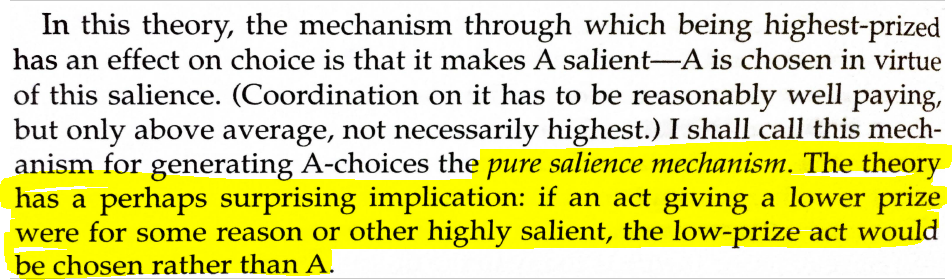
    • Salience
  • Back to Angular – prepping for integration of PolarizationGame into the A2P platform. Speaking of which, there needs to be a REST API that will support registered, (optionally?) identified bots. A bot that is able to persuade a group of people over time to reach a unanimous vote would be an interesting Turing-style test. And a prize
    • Got Tour of Heroes running again, though it seems broken…
  • Nice chat with Jeremy.
    • He’ll talk to Heath about what it would take to set up an A2P instance for the discussion system that could scale to millions of players
    • Also mentioned that there would need to be a REST interface for bots
    • Look through Material Design
      • Don’t see any direct Forum (threaded discussion) details on the home site, but I found this Forum example GIF
    • Add meeting with Heath and Jeremy early in the sprint to lay out initial detailed design
    • Stub out non-functional pages as a deliverable for this (next?) sprint
    • He sent me an email with all the things to set up. Got the new Node, Yarn and CLI on my home machine. Will do that again tomorrow and test the VPN connections
  • Sprint planning
    • A2P GUI and Detailed Design are going to overlap

Phil 1.16.2018

ASRC MKT 7:00 – 4:30

  • Tit for tat in heterogeneous populations
    • The “iterated prisoner’s dilemma” is now the orthodox paradigm for the evolution of cooperation among selfish individuals. This viewpoint is strongly supported by Axelrod’s computer tournaments, where ‘tit for tat’ (TFT) finished first. This has stimulated interest in the role of reciprocity in biological societies. Most theoretical investigations, however, assumed homogeneous populations (the setting for evolutionary stable strategies) and programs immune to errors. Here we try to come closer to the biological situation by following a program that takes stochasticities into account and investigates representative samples. We find that a small fraction of TFT players is essential for the emergence of reciprocation in a heterogeneous population, but only paves the way for a more generous strategy. TFT is the pivot, rather than the aim, of an evolution towards cooperation.
    • It’s a Nature Note, so a quick read. In this case, the transition is from AllD->TFT->GTFT, where evolution stops.
  • A strategy of win-stay, lose-shift that outperforms tit-for-tat in the Prisoner’s Dilemma game
    • The Prisoner’s Dilemma is the leading metaphor for the evolution of cooperative behaviour in populations of selfish agents, especially since the well-known computer tournaments of Axelrod and their application to biological communities. In Axelrod’s simulations, the simple strategy tit-for-tat did outstandingly well and subsequently became the major paradigm for reciprocal altruism. Here we present extended evolutionary simulations of heterogeneous ensembles of probabilistic strategies including mutation and selection, and report the unexpected success of another protagonist: Pavlov. This strategy is as simple as tit-for-tat and embodies the fundamental behavioural mechanism win-stay, lose-shift, which seems to be a widespread rule. Pavlov’s success is based on two important advantages over tit-for-tat: it can correct occasional mistakes and exploit unconditional cooperators. This second feature prevents Pavlov populations from being undermined by unconditional cooperators, which in turn invite defectors. Pavlov seems to be more robust than tit-for-tat, suggesting that cooperative behaviour in natural situations may often be based on win-stay, lose-shift.
    • win-stay = exploit, lose-shift = explore
  • Five rules for the evolution of cooperation
    • Cooperation is needed for evolution to construct new levels of organization. The emergence of genomes, cells, multi-cellular organisms, social insects and human society are all based on cooperation. Cooperation means that selfish replicators forgo some of their reproductive potential to help one another. But natural selection implies competition and therefore opposes cooperation unless a specific mechanism is at work. Here I discuss five mechanisms for the evolution of cooperation: kin selection, direct reciprocity, indirect reciprocity, network reciprocity and group selection. For each mechanism, a simple rule is derived which specifies whether natural selection can lead to cooperation.
  • Added a paragraph to the previous work section to include Tit-for-Tat and Milti-armed Bandit previous work.
  • Worked with Aaron on setting up sprint goals

Phil 1.15.18

7:00 – 3:30 ASRC MKT

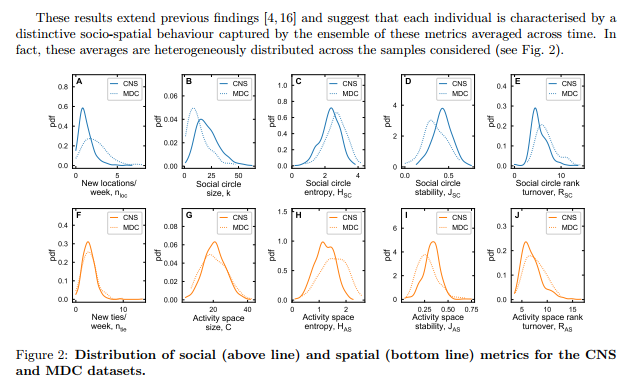
  • Individual mobility and social behaviour: Two sides of the same coin
    • According to personality psychology, personality traits determine many aspects of human behaviour. However, validating this insight in large groups has been challenging so far, due to the scarcity of multi-channel data. Here, we focus on the relationship between mobility and social behaviour by analysing two high-resolution longitudinal datasets collecting trajectories and mobile phone interactions of ∼ 1000 individuals. We show that there is a connection between the way in which individuals explore new resources and exploit known assets in the social and spatial spheres. We point out that different individuals balance the exploration-exploitation trade-off in different ways and we explain part of the variability in the data by the big five personality traits. We find that, in both realms, extraversion correlates with an individual’s attitude towards exploration and routine diversity, while neuroticism and openness account for the tendency to evolve routine over long time-scales. We find no evidence for the existence of classes of individuals across the spatio-social domains. Our results bridge the fields of human geography, sociology and personality psychology and can help improve current models of mobility and tie formation.
    • This work has ways of identifying explorers and exploiters programmatically.
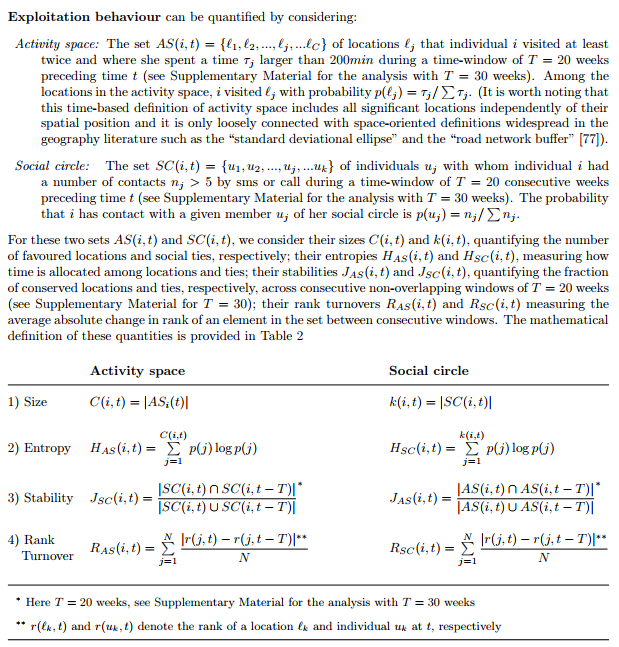
    • Exploit
    • SocialSpatial
  • Reading the Google Brain team’s year in review in two parts
    • From part two: We have also teamed up with researchers at leading healthcare organizations and medical centers including StanfordUCSF, and University of Chicago to demonstrate the effectiveness of using machine learning to predict medical outcomes from de-identified medical records (i.e. given the current state of a patient, we believe we can predict the future for a patient by learning from millions of other patients’ journeys, as a way of helping healthcare professionals make better decisions). We’re very excited about this avenue of work and we look to forward to telling you more about it in 2018
    • FacetsFacets contains two robust visualizations to aid in understanding and analyzing machine learning datasets. Get a sense of the shape of each feature of your dataset using Facets Overview, or explore individual observations using Facets Dive.
  • Found this article on LSTM-based prediction for robots and sent it to Aaron: Deep Episodic Memory: Encoding, Recalling, and Predicting Episodic Experiences for Robot Action Execution
  • Working through Beyond Individual Choice – Actually, wound up going Complexity LabsGame Theory course
    • Social traps are stampedes? Sliding reinforcers (lethal barrier)
    • The transition from Tit-for-tat (TFT) to generous TFT to cooperate always, to defect always has similarities to the excessive social trust stampede as well.
    • Unstable cycling vs. evolutionarily stable strategies
    • Replicator dynamic model: Explore/Exploit
      • In mathematics, the replicator equation is a deterministic monotone non-linear and non-innovative game dynamic used in evolutionary game theory. The replicator equation differs from other equations used to model replication, such as the quasispecies equation, in that it allows the fitness function to incorporate the distribution of the population types rather than setting the fitness of a particular type constant. This important property allows the replicator equation to capture the essence of selection. Unlike the quasispecies equation, the replicator equation does not incorporate mutation and so is not able to innovate new types or pure strategies.
    • Fisher’s Fundamental Theorem “The rate of increase in fitness of any organism at any time is equal to its genetic variance in fitness at that time.
    • Explorers are a form of weak ties, which is one of the reasons they add diversity. Exploiters are strong ties
  • I also had a thought about the GPM simulator. I could add an evolutionary component that would let agents breed, age and die to see if Social Influence Horizon and Turn Rate are selected towards any attractor. My guess is that there is a tension between explorers and stampeders that can be shown to occur over time.

Phil 1.14.18

Pondering what a good HI-LO game would be for a presentation:

  • Ask the audience to choose A or B, based on what they think the most likely answer is. Show of hands, B, then A.
  • Describe the H/L chart and cooperative game theory, and how traditional game theory can’t account for why LL makes less sense to us than HH
  • fig-1-2x

Phil 1.13.18

I think that burst-coast may be another one of those general patterns in collective intelligence

  • Disentangling and modeling interactions in fish with burst-and-coast swimming reveal distinct alignment and attraction behaviors
    • The development of tracking methods for automatically quantifying individual behavior and social interactions in animal groups has open up new perspectives for building quantitative and predictive models of collective behavior. In this work, we combine extensive data analyses with a modeling approach to measure, disentangle, and reconstruct the actual functional form of interactions involved in the coordination of swimming in Rummy-nose tetra (Hemigrammus rhodostomus). This species of fish performs burst-and-coast swimming behavior that consists of sudden heading changes combined with brief accelerations followed by quasi-passive, straight decelerations. We quantify the spontaneous stochastic behavior of a fish and the interactions that govern wall avoidance and the reaction to a neighboring fish, the latter by exploiting general symmetry constraints for the interactions. In contrast with previous experimental works, we find that both attraction and alignment behaviors control the reaction of fish to a neighbor. We then exploit these results to build a model of spontaneous burst-and-coast swimming and interactions of fish, with all parameters being estimated or directly measured from experiments. This model quantitatively reproduces the key features of the motion and spatial distributions observed in experiments with a single fish and with two fish. This demonstrates the power of our method that exploits large amounts of data for disentangling and fully characterizing the interactions that govern collective behaviors in animals groups.

Phil 1.12.18

7:00 – 3:30 ASRC MKT

  • Continuing to write up thoughts here. Done! Posted to Phlog
  • Would expect this, based on M&Ds work: The Wisdom of Polarized Crowds
    • As political polarization in the United States continues to rise, the question of whether polarized individuals can fruitfully cooperate becomes pressing. Although diversity of individual perspectives typically leads to superior team performance on complex tasks, strong political perspectives have been associated with conflict, misinformation and a reluctance to engage with people and perspectives beyond one’s echo chamber. It is unclear whether self-selected teams of politically diverse individuals will create higher or lower quality outcomes. In this paper, we explore the effect of team political composition on performance through analysis of millions of edits to Wikipedia’s Political, Social Issues, and Science articles. We measure editors’ political alignments by their contributions to conservative versus liberal articles. A survey of editors validates that those who primarily edit liberal articles identify more strongly with the Democratic party and those who edit conservative ones with the Republican party. Our analysis then reveals that polarized teams—those consisting of a balanced set of politically diverse editors—create articles of higher quality than politically homogeneous teams. The effect appears most strongly in Wikipedia’s Political articles, but is also observed in Social Issues and even Science articles. Analysis of article “talk pages” reveals that politically polarized teams engage in longer, more constructive, competitive, and substantively focused but linguistically diverse debates than political moderates. More intense use of Wikipedia policies by politically diverse teams suggests institutional design principles to help unleash the power of politically polarized teams.
    • C&C is not in the citations, but overall this looks good. Add this to the initial game paper.
  • Nice article on how establishment of norms can be a tipping point on which gradient to climb in a complex landscape: Tipping into the future
    • A history of tipping points from an ecological perspective and how they inform resilience thinking in global development.
  • The NOAA demo went well, it seems.