Category Archives: Writing

Phil 11.29.17

7:00 – 4:30 ASRC MKT

Pattern is a web mining module for the Python programming language.

  • It has tools for data mining (Google, Twitter and Wikipedia API, a web crawler, a HTML DOM parser), natural language processing (part-of-speech taggers, n-gram search, sentiment analysis, WordNet), machine learning (vector space model, clustering, SVM), network analysis and visualization.
  • Promoted Speaker–listener neural coupling underlies successful communication notes to Phlog
  • Added some bits to the JCSCW Flocking and herding article

  • Alignment in social interactions
    • According to the prevailing paradigm in social-cognitive neuroscience, the mental states of individuals become shared when they adapt to each other in the pursuit of a shared goal. We challenge this view by proposing an alternative approach to the cognitive foundations of social interactions. The central claim of this paper is that social cognition concerns the graded and dynamic process of alignment of individual minds, even in the absence of a shared goal. When individuals reciprocally exchange information about each other’s minds processes of alignment unfold over time and across space, creating a social interaction. Not all cases of joint action involve such reciprocal exchange of information. To understand the nature of social interactions, then, we propose that attention should be focused on the manner in which people align words and thoughts, bodily postures and movements, in order to take one another into account and to make full use of socially relevant information.
    • The concept of alignment has since evolved and is used to describe the multi-level, dynamic, and interactive mechanisms that underpin the sharing of people’s mental attitudes and representations in all kinds of social interactions (Dale, Fusaroli, & Duran, 2013). (pp 253)
    • The underlying justification for subsuming all these cases under the same mechanism is that cognition and action cannot be separated. The sharing of minds and bodies can then be conceptualized in terms of an integrated system of alignment, defined as the dynamic coupling of behavioural and/or cognitive states of two people (Dumas, Laroche, & Lehmann, 2014). (pp 253)
    • we are interested in the explanatory significance of alignment for a more general theory of social interaction, not in instrumental behaviour and/or alignment per se. (pp 254)
    • The central claim of this paper is that the alignment of minds, which emerges in social interactions, involves the reciprocal exchange of information whereby individuals adjust minds and bodies in a graded and dynamic manner. As these processes of alignment unfold, interacting partners will exchange information about each other’s minds and therefore act socially, whether or not a shared goal is in place. (pp 254)
    • In particular, in recent theoretical and empirical work on social cognition, reciprocity is increasingly recognized as a useful resource to capture the ‘‘jointness” of a joint action. Interpersonal understanding can be achieved by reading into one another’s mind reciprocally (Butterfill, 2013), and an explanation of the processes whereby the alignment of minds and bodies unfolds in space and time should involve an account of reciprocity (Zahavi & Rochat, 2015). In the process of a reciprocal exchange of information, individuals may adapt to varying degrees to one another. This is certainly the case in instances of temporal synchronisation and coordination in which physical alignment in time and space has been theorized to depend on cognitive models of adaptation (Elliott, Chua, & Wing, 2016; Hayashi & Kondo, 2013; Repp & Su, 2013) and thus on reciprocal interactions (D’Ausilio, Novembre, Fadiga, & Keller, 2015; Keller, Novembre, & Hove, 2014; Tognoli & Kelso, 2015). The behaviour of one player results in a change in behaviour of the other in a reciprocal way so as to achieve temporal synchrony. Interestingly, though not surprisingly, this reciprocal exchange of information results in physical alignment, which in turn has also been shown to result in greater degrees of affiliation and greater mental alignment (Hove & Risen, 2009; Rabinowitch & Knafo-Noam, 2015; Wiltermuth & Heath, 2009). Specifically, we suggest that, rather than a focus on the sharedness of the intended goal, we should attend to the graded exchange of information that creates alignment. The most social of interactions, in our formulation, are those in which ‘‘live” (‘‘online”, see Schilbach, 2014) information is exchanged dynamically (i.e. over time, across multiple points) bidirectionally and used to adapt behaviour and align with another (Jasmin et al., 2016). (pp 255)
    • Indeed, it is possible to have reciprocity and thus social interaction without cooperation. This would be the case, for example, in a competitive scenario in which the minds of the subjects are aligned at the appropriate level of description, and the sharing is essential to solve social dilemmas involving antagonistic behaviour (Bratman, 2014). In these exchanges, what is needed for the minds of the agents to attune to one another is that they adapt thoughts, bodily postures and movements, to take one another into account and reason as a team, even though the team might consist of competitive actors where none is aware that they are acting from the perspective of the same group and in the pursuit of some common goal (Bacharach, 2006). (pp 255)
    • fundamentally social nature has to do with the process whereby systems reciprocate thoughts and experiences, rather than with the endpoint i.e. the goal. It turns out that two features are often taken to be central to the process whereby interacting agents align minds and bodies. First, the interacting agents must be aware that they are doing something together with others. Second, the success of their joint performance is taken as a measure of how shared the participants’ goals are. (pp 255)
    • our suggestion is that what matters for the relevant alignment of minds and bodies to occur is the reciprocal exchange of information, not awareness of the reciprocal exchange of information. (pp 255)
      • This is all that is needed for flocking to happen. It is the range of that exchange that determines the phase change from independent to flock to stampede. Trust is involved in the reciprocity too, I think
    • Becoming mutually aware that we are sharing attitudes, dispositions, bodily postures, perhaps goals, does not mean that the ‘jointness’ of our actions has become available to each of us for conscious report. Reciprocity of awareness is emphatically not the same as awareness of reciprocity. The process of reciprocally exchanging information and mutually adapting to one another need not necessarily result in any degree of shared awareness. (pp 256)
    • In animals, a signal, for example about the source of food, that is too weak for an individual fish to follow can be followed by a group through the simple rules of bodily alignment that create shoaling behaviour (Grunbaum, 1998). Shoaling behaviour can also be observed in humans (Belz, Pyritz, & Boos, 2013), who can achieve group advantage through more complex forms of adjustment than just bodily alignment. Pairs of participants trying to detect a weak visual signal can achieve a greater group advantage when they align the terms they use to report their confidence in what they saw (Fusaroli et al., 2012). Indeed, linguistic alignment at many levels can be observed in dialogue (Pickering & Garrod, 2004) and can improve comprehension (Adank, Hagoort, & Bekkering, 2010; Fusaroli et al., 2012). (pp 256)
    • Much research has been driven, so far, by the implicit goal of identifying optimal group performance as a proxy for mental alignment (Fusaroli et al., 2012), however, there is conceptual room and empirical evidence for arguing that optimal task performance is not a good index of mental alignment or ‘optimal sociality’. In other words, taking achievement of a shared goal as the paradigm of a social interaction leads to the binary conception of sociality according to which an interaction is either (optimally) social, or it is not. (pp 256)
      • This is a problem that I have with opinion dynamics models. Convergence on a particular opinion isn’t the only issue. There is a dynamic process where opinions fall in and out of favor. This is the difference between the contagion model, which is one way (uninfected->infected) and motion through belief space. The goal really doesn’t matter, except in a subset of cases (Though these may be very important)
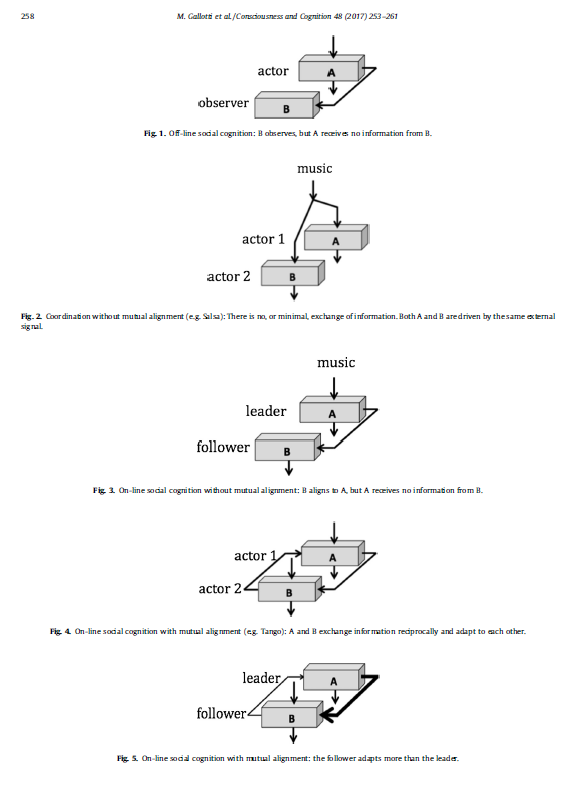
    • Two systems can interact when they have access to information relating to each other (Bilek et al., 2015). There are different ways of exchanging information between systems and hence different types of interaction (Liu & Pelowski, 2014), but in every case some kind of alignment occurs (Coey, Varlet, & Richardson, 2012; Huygens, 1673). (pp 257)
    • Such offline interaction can be contrasted with the case of online social interactions, where both participants act. The distinction between offline and online social interaction tasks is now acknowledged as crucial for advancing our understanding of the cognition processes underlying social interaction (Schilbach, 2014). (pp 257)
    • In contrast to salsa, consider the case of tango in which movements are improvised and as such require constant, mutual adaptation (Koehne et al., 2015; Tateo, 2014). Tango dancers have access to information relating to each other and, by virtue of the task, they exchange information with one another across time in a reciprocal and bidirectional fashion. The juxtaposition of tango with salsa highlights a spectrum of degrees of mutual reciprocity, with a richer form of interaction and greater need for alignment in tango compared with salsa.
    • we will take reciprocity to be the primary requirement for social interactions. We suggest that reciprocity can be identified with a special kind of alignment, mutual alignment, involving adjustment in both parties to the interaction. However, not all cases of joint action lead to mutual alignment. It is important to distinguish this mutual alignment from other types of alignment, which do not involve a reciprocal exchange of information between the agents. (pp 257)
    • In contrast to salsa, consider the case of tango in which movements are improvised and as such require constant, mutual adaptation (Koehne et al., 2015; Tateo, 2014). Tango dancers have access to information relating to each other and, by virtue of the task, they exchange information with one another across time in a reciprocal and bidirectional fashion. The juxtaposition of tango with salsa highlights a spectrum of degrees of mutual reciprocity, with a richer form of interaction and greater need for alignment in tango compared with salsa. (pp 257)
    • AlignmentInSocialInteractions(pp 258)
    • The biggest challenge currently facing philosophers and scientists of social cognition is to understand social interactions. We suggest that this problem is best approached at the level of processes of mental alignment rather than through joint action tasks based on shared goals, and we propose that the key process is one of reciprocal, dynamic and graded adaptation between the participants in the interaction. Defining social interactions in terms of reciprocal patterns of alignment shows that not all joint actions involve reciprocity and also that social interactions can occur in the absence of shared goals. This approach has two particular advantages. First, it emphasises the key point that interactions can only be fully understood at the level of the group, rather than the individual. The pooling together of individual mental resources generates results that exceed the sum of the individual contributions. But, second, our approach points towards the mechanisms of adaptation that must be occurring within each individual in order to create the interaction (Friston & Frith, 2015). (pp 259)
    • This picture of social interaction in terms of mental alignment suggests two important theoretical developments. One is about a possible way to characterize the idea that types of social interaction lie on a continuum of possible solutions. If we focus on the task or the shared goal being pursued by agents jointly, as the current literature suggests, then only limited subdivisions of types of interaction will emerge. If, however, our focus extends so as to integrate the nature of the interaction, conceived of in terms of information exchange, then we can arrive at a higher degree of resolution of the space in which social interaction lie. This will define a spectrum of types of interaction (not just offline versus online social cognition), suggesting a dimensional rather than a discrete picture. After all, alignment comes in degrees and a spectrum-like definition of sociality implies that there is a variety of forms of alignment and hence of interactions. (pp 269)
      • My work would indicate that meaningful transitions occur for Unaligned (pure explore), Complex (flocking), and Total (stampede).
  • Continuing to work on The Socio-Temporal Brain: Connecting People in Time here
    • Not as good as I thought it would be. Some useful items, but there is no brain analysis of chorusing animals, just the co-mention
  • Continuing Research Browser white paper. Added note to work through linking multiple tags to the same item with visibility controls. Kindle has a feature like this.
  • Reading section 16.7 on personalized web services  (pp 372 – 375) for words and concepts for Augmented Data Discovery. Then Where to Add Actions in Human-in-the-Loop Reinforcement LearningPolicy Shaping: Integrating Human Feedback with Reinforcement Learning, and AXIS: Generating Explanations at Scale with Learner sourcing and Machine Learning
 

Phil 11.28.17

7:00 – 8:00 Research, 8:30 – 4:30 ASRC MKT

  • Continuing Speaker–listener neural coupling underlies successful communication here. Done! Will promote to Phlog later.
  • Collective cognition in animal groups
    • Iain Couzin
    • The remarkable collective action of organisms such as swarming ants, schooling fish and flocking birds has long captivated the attention of artists, naturalists, philosophers and scientists. Despite a long history of scientific investigation, only now are we beginning to decipher the relationship between individuals and group-level properties. This interdisciplinary effort is beginning to reveal the underlying principles of collective decision-making in animal groups, demonstrating how social interactions, individual state, environmental modification and processes of informational amplification and decay can all play a part in tuning adaptive response. It is proposed that important commonalities exist with the understanding of neuronal processes and that much could be learned by considering collective animal behavior in the framework of cognitive science.
  • The Socio-Temporal Brain: Connecting People in Timethis looks like it might explicitly link human neural coupling and flocking.
    • Temporal and social processing are intricately linked. The temporal extent and organization of interactional behaviors both within and between individuals critically determine interaction success. Conversely, social signals and social context influence time perception by, for example, altering subjective duration and making an event seem ‘out of sync’. An ‘internal clock’ involving subcortically orchestrated cortical oscillations that represent temporal information, such as duration and rhythm, as well as insular projections linking temporal information with internal and external experiences is proposed as the core of these reciprocal interactions. The timing of social relative to non-social stimuli augments right insular activity and recruits right superior temporal cortex. Together, these reciprocal pathways may enable the exchange and respective modulation of temporal and social computations.
    • timing is not encapsulated but interacts closely with the social processes that emerge from interpersonal interactions [1–3]. As interactional behaviors play out in time, their temporal signatures carry important information. They guide attention, convey a message, and mold bonds between individuals. Moreover, interactional behaviors in turn give meaning to time and influence its perception and representation. A range of disorders that jointly compromise temporal and social processes attest to this relation (pp 760)
    • We review here the many ways in which timing intersects with social processing. We explore this intersection for the communicative behavior of an individual as well as for the behavioral coordination between communicating agents. We detail neuroimaging evidence on how temporal and social information are represented in the brain and identify points of structural and functional convergence (pp 760)
    • The temporal coordination of behavior in animals is referred to as chorusing. Chorusing describes sporadic behaviors such those of flying birds (Figure I), which may change direction and speed in a manner resembling a single superorganism [87]. In addition, it describes behaviors that occur repeatedly and with some amount of temporal regularity, as in the mating calls of male frogs. Although less frequent than sporadic chorusing, rhythmic chorusing is displayed by a range of taxa including insects, reptiles, birds, and mammals [88, 89]. (pp 761)
    • Research into the functionality of chorusing suggests species differences. For some, it seems to be a mere byproduct of competitive interactions. For others, it reduces the risk of predation [98]. By analogy with the selfish-herd principle, overlapping with others in time makes it harder for predators to single out individual prey. Last, there are species in which chorusing serves as a fitness display in the context of sexual selection [99] and as a means to foster social bonds [100]. Because of its pervasiveness and social context, some suggest chorusing to be the driving evolutionary force for a species’ timing sense [88]. (pp 761)
    • The degree of temporal coordination between interaction partners relates to interaction success. For example, it produces affective consequences [21]. This was revealed by a study in which pairs of strangers discussed four topics and completed an affective state questionnaire before and after each topic. Results provided evidence for emerging synchrony between discussion partners (Figure 1) and for its causal effect on ensuing positive affect. Related research showed that individuals more readily empathize with a synchronous as compared to a non-synchronous partner [22] and that synchronous dyads are more creative [23] and trusting [24] than nonsynchronous dyads. (pp 762)
  • Word Embeddings Quantify 100 Years of Gender and Ethnic Stereotypes
    • Word embeddings use vectors to represent words such that the geometry between vectors captures semantic relationship between the words. In this paper, we develop a framework to demonstrate how the temporal dynamics of the embedding can be leveraged to quantify changes in stereotypes and attitudes toward women and ethnic minorities in the 20th and 21st centuries in the United States. We integrate word embeddings trained on 100 years of text data with the U.S. Census to show that changes in the embedding track closely with demographic and occupation shifts over time. The embedding captures global social shifts – e.g., the women’s movement in the 1960s and Asian immigration into the U.S – and also illuminates how specific adjectives and occupations became more closely associated with certain populations over time. Our framework for temporal analysis of word embedding opens up a powerful new intersection between machine learning and quantitative social science.
    • bias
    • I think this is really close to the belief trajectories I’m trying to tease out. In the figures above, note that it is possible to extract both trajectories and normative terms. Plus, the paper has a really good writeup of methods in the appendices.
  • Continuing to write up use cases/RB proposal
  • Also still doing stuff for the HHS RFI
  • Relevant to the Research Browser:
    • Extracting Automata from Recurrent Neural Networks Using Queries and Counterexamples <- Agent generation is a thing!
      • We address the problem of extracting an automaton from a trained recurrent neural network (RNN). We present a novel algorithm that uses exact learning and abstract interpretation to perform efficient extraction of a minimal automaton describing the state dynamics of a given RNN. We use Angluin’s L* algorithm as a learner and the given RNN as an oracle, employing abstract interpretation of the RNN for answering equivalence queries. Our technique allows automaton-extraction from the RNN while avoiding state explosion, even when the state vectors are large and fine differentiation is required between RNN states. 
        We experiment with automata extraction from multi-layer GRU and LSTM based RNNs, with state-vector dimensions and underlying automata and alphabet sizes which are significantly larger than in previous automata-extraction work. In some cases, the underlying target language can be described with a succinct automata, yet the extracted automata is large and complex. These are cases in which the RNN failed to learn the intended generalization, and our extraction procedure highlights words which are misclassified by the seemingly “perfect” RNN.
    • Policy Shaping: Integrating Human Feedback with Reinforcement Learning
      • A long term goal of Interactive Reinforcement Learning is to incorporate nonexpert human feedback to solve complex tasks. Some state-of-the-art methods have approached this problem by mapping human information to rewards and values and iterating over them to compute better control policies. In this paper we argue for an alternate, more effective characterization of human feedback: Policy Shaping. We introduce Advise, a Bayesian approach that attempts to maximize the information gained from human feedback by utilizing it as direct policy labels. We compare Advise to state-of-the-art approaches and show that it can outperform them and is robust to infrequent and inconsistent human feedback.
    • AXIS: Generating Explanations at Scale with Learnersourcing and Machine Learning
      • While explanations may help people learn by providing information about why an answer is correct, many problems on online platforms lack high-quality explanations. This paper presents AXIS (Adaptive eXplanation Improvement System), a system for obtaining explanations. AXIS asks learners to generate, revise, and evaluate explanations as they solve a problem, and then uses machine learning to dynamically determine which explanation to present to a future learner, based on previous learners’ collective input. Results from a case study deployment and a randomized experiment demonstrate that AXIS elicits and identifies explanations that learners find helpful. Providing explanations from AXIS also objectively enhanced learning, when compared to the default practice where learners solved problems and received answers without explanations. The rated quality and learning benefit of AXIS explanations did not differ from explanations generated by an experienced instructor.


Phil 11.20.17

7:00 – 5:30 ASRC MKT (2 hrs) and IRAD (6 hrs)

  • Interesting chat with Rhena last night which included thoughts on cultural affordances. Western European culture proceeds from possession, which fits well in a list-based search result. So what about other cultures. Native Americans proceed from Great Spirit, and African cultures from connection. The other thing was whether growth and healing are on the same spectrum. No conclusions, just some potential directions.
  • Continuing with The Group Polarization Phenomenon here
  • Started a list of belief/direction terms
  • Angular! Not so much
  • Wrote up ResearchBrowser Epic, then talked to Aaron about it. Need to scale it back to a web-based, productized version of LMN and CorpusManager. Kind of like Overview
  • Chat with Wayne
    • Tool design
      • add ignore list (common, non-critical content words in interviews showing up as central — impact of delete?)
      • put that ignore list into the exported excel spreadsheet as a footnote or other tab.
    • Deliberative systems
      • Information Based IS
      • (Classic systems IBIS and G-IBIS)
      • Revealing network dependencies in issues based voting systems
      • HCC meets urban planing
      • Best source of literature for UI for “reddit with winning conditions”
    • Conference stuff
      • CHIIR+herd -> JCMC if not published?
      • Game -> CSCW (April)
      • Any HT overlap?

Phil 11.8.17

ASRC MKT 7:00 – 5:00, with about two hours for personal time

  • After the fall of DNAinfo, it’s time to stop hoping local news will scale
    • I think people understand that this sensation of unreality has a lot to do with the platforms that deliver our news, because Facebook and Google package journalism and bullshit identically. But I’d argue that it also has a lot to do with the death of local news to a degree few of us recognize.
    • This is not unheard of in digital local news: People pay to drink with the investigative reporters at The Lens in New Orleans and to watch Steelers games with the staff of The Incline in Pittsburgh.
  • And as a counterbalance: Weaken from Within
    • The turtle didn’t know and never will, that information warfare — it is the purposeful training of an enemy on how to remove its own shell.
  • Rescuing Collective Wisdom when the Average Group Opinion Is Wrong
    • Yet the collective knowledge will remain inaccessible to us unless we are able to find efficient knowledge aggregation methods that produce reliable decisions based on the behavior or opinions of the collective’s members.
    • Our analysis indicates that in the ideal case, there should be a matching between the aggregation procedure and the nature of the knowledge distribution, correlations, and associated error costs. This leads us to explore how machine learning techniques can be used to extract near-optimal decision rules in a data-driven manner.
  • Inferring Relations in Knowledge Graphs with Tensor Decompositions
  • From today’s Pulse of the Planet episode:
    • Colin Ellard is a cognitive neuroscientist and the author of Places of the Heart: the Psychogeography of Everyday Life. He says that the choices we make in siting a house or even where we choose to sit in a crowded room give us clues about the way humans have evolved.  The idea of prospect and refuge is an inherently biological idea. It goes back through the history of human beings. In fact for any kind of animal selecting a habitat, kind of the holy grail of good habitat choice can be summed up by the principal of seeing but not being seen.
      Ideally what we want is a set of circumstances where we have some protection, visual protection, in the sense of not being able to be easily located ourselves, and that’s Refuge. But we also want to be able to know what’s going on around us. We need to be able to see out from wherever that refuge is. And that’s Prospect. The operation of our preference for situations that are high in both refuge and prospect is something that cuts across everything we build or everywhere we find ourselves.
  • So, prospect-refuge theory sounds interesting. It seems to come from psychology rather than ecology-related fields. Still, it’s a discussion of affordances. Searching around, I found this: Methodological characteristics of research testing prospect–refuge theory: a comparative analysis. Couldn’t get it directly, so I’m trying ILL.
    • Prospect–refuge theory proposes that environments which offer both outlook and enclosure provoke not only feelings of safety but also of spatially derived pleasure. This theory, which was adopted in environmental psychology, led Hildebrand to argue for its relevance to architecture and interior design. Hildebrand added further spatial qualities to this theory – including complexity and order – as key measures of the environmental aesthetics of space. Since that time, prospect–refuge theory has been associated with a growing number of works by renowned architects, but so far there is only limited empirical evidence to substantiate the theory. This paper analyses and compares the methods used in 30 quantitative attempts to examine the validity of prospect–refuge theory. Its purpose is not to review the findings of these studies, but to examine their methodological bases and biases and comment on their relevance for future research in this field.
    • This is the book by Hildebrand: The Wright Space: Patterns and Meaning in Frank Lloyd Wright’s Houses. Ordered.
  • Ok, back to Angular2
    • Done with chapter 3.

Phil 11.3.17

7:00 – ASRC MKT

  • Good comments from Cindy on yesterday’s work
  • Facebook’s 2016 Election Team Gave Advertisers A Blueprint To A Divided US
  • Some flocking activity? AntifaNov4
  • I realized that I had not added the herding variables to the Excel output. Fixed.
  • DINH Q. LÊ: South China Sea Pishkun
    • In his new work, South China Sea Pishkun, Dinh Q. Lê references the horrifying events that occurred on April 30th 1975 (the day Saigon fell) as hundreds of thousands of people tried to flee Saigon from the encroaching North Vietnamese Army and Viet Cong. The mass exodus was a “Pishkun” a term used to describe the way in which the Blackfoot American Indians would drive roaming buffalo off cliffs in what is known as a buffalo jump.
  • Back to writing – got some done, mostly editing.
  • Stochastic gradient descent with momentum
  • Referred to in this: There’s No Fire Alarm for Artificial General Intelligence
    •  AlphaGo did look like a product of relatively general insights and techniques being turned on the special case of Go, in a way that Deep Blue wasn’t. I also updated significantly on “The general learning capabilities of the human cortical algorithm are less impressive, less difficult to capture with a ton of gradient descent and a zillion GPUs, than I thought,” because if there were anywhere we expected an impressive hard-to-match highly-natural-selected but-still-general cortical algorithm to come into play, it would be in humans playing Go.
  • In another article: The AI Alignment Problem: Why It’s Hard, and Where to Start
    • This is where we are on most of the AI alignment problems, like if I ask you, “How do you build a friendly AI?” What stops you is not that you don’t have enough computing power. What stops you is that even if I handed you a hypercomputer, you still couldn’t write the Python program that if we just gave it enough memory would be a nice AI.
    • I think this is where models of flocking and “healthy group behaviors” matters. Explore in small numbers is healthy – it defines the bounds of the problem space. Flocking is a good way to balance bounded trust and balanced awareness. Runaway echo chambers are very bad. These patterns are recognizable, regardless of whether they come from human, machine, or bison.
  • Added contacts and invites. I think the DB is ready: polarizationgameone
  • While out riding, I realized what I can do to show results in the herding paper. There are at least three ways to herd:
    1. No herding
    2. Take the average of the herd
    3. Weight a random agent
    4. Weight random agents (randomly select an agent and leave it that way for a few cycles, then switch
  • Look at the times it takes for these to converge and see which one is best. Also look at the DTW to see if they would be different populations.
  • Then re-do the above for the two populations inverted case (max polarization)
  • Started to put in the code changes for the above. There is now a combobox for herding with the above options.

Phil 11.2.17

ASRC MKT 7:00 – 4:30

  • Add a switch to the GPM that makes the adversarial herders point in opposite directions, based on this: Russia organized 2 sides of a Texas protest and encouraged ‘both sides to battle in the streets’
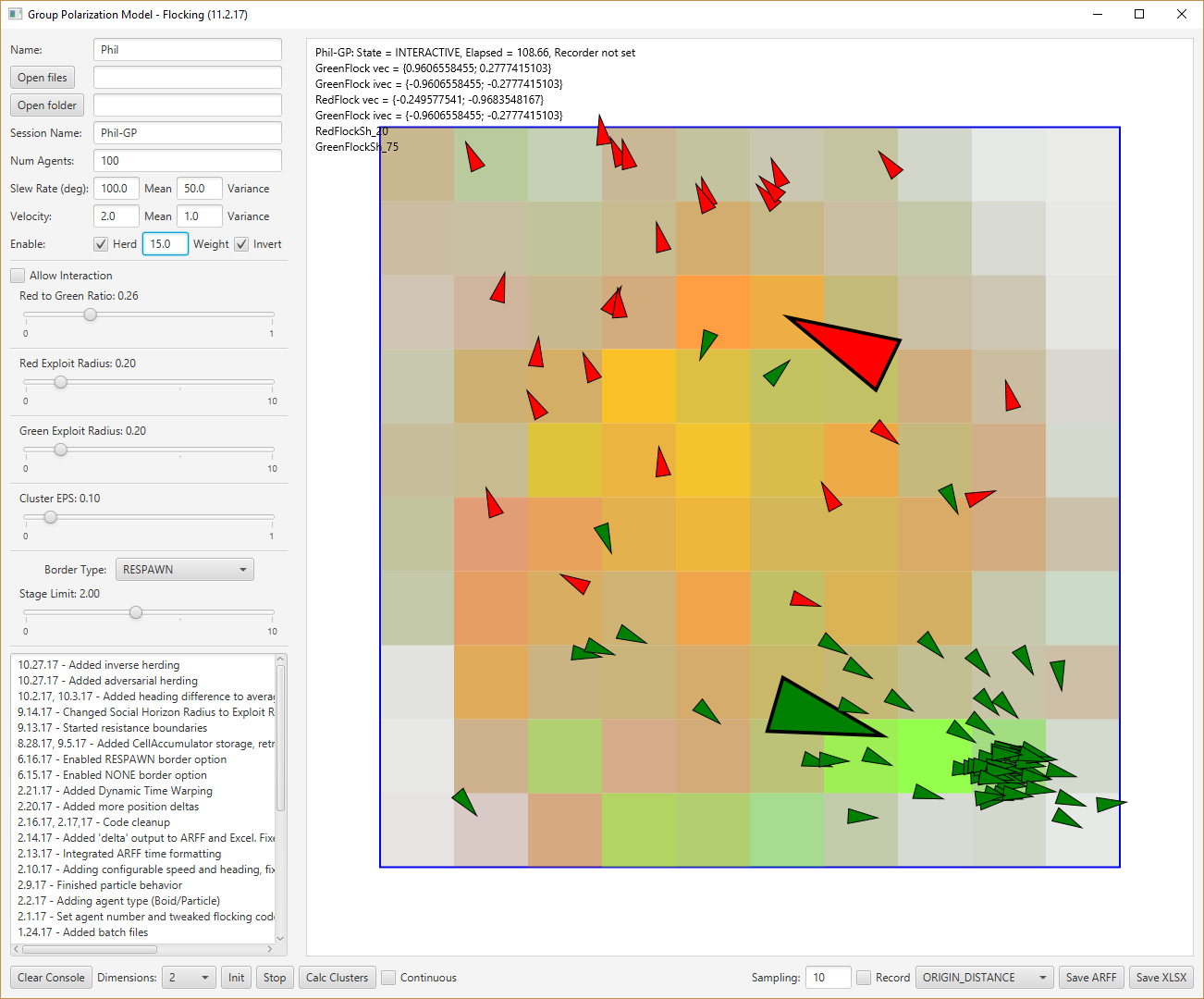
  • It’s in and running. Here’s a screenshot: 2017-11-02 There are some interesting things to note. First, the vector is derived from the average heading of the largest group (green in this case). This explains why the green agents are more tightly clustered than the red ones. In the green case, the alignment is intrinsic. In the red case, it’s extrinsic. What this says to me is that although adversarial herding works well when amplifying the heading already present, it is not as effective when enforcing a heading that does not already predominant. That being said, when we have groups existing in opposition to each other, that is a tragically easy thing to enhance.
  • Hierarchical Representations for Efficient Architecture Search
    • We explore efficient neural architecture search methods and present a simple yet powerful evolutionary algorithm that can discover new architectures achieving state of the art results. Our approach combines a novel hierarchical genetic representation scheme that imitates the modularized design pattern commonly adopted by human experts, and an expressive search space that supports complex topologies. Our algorithm efficiently discovers architectures that outperform a large number of manually designed models for image classification, obtaining top-1 error of 3.6% on CIFAR-10 and 20.3% when transferred to ImageNet, which is competitive with the best existing neural architecture search approaches and represents the new state of the art for evolutionary strategies on this task. We also present results using random search, achieving 0.3% less top-1 accuracy on CIFAR-10 and 0.1% less on ImageNet whilst reducing the architecture search time from 36 hours down to 1 hour.
  • Continuing with the schema. Here’s where we are today: polarizationgameone

Phil 11.1.17

Phil 7:00 – ASRC MKT

    • The identity of the machine is just as important as the identity of the human, argues Jeff Hudson.
    • Agent-based simulation for economics: The Tool Central Bankers Need Most Now
    • Introducing Vega-Lite 2.0 (from MIT Interactive Data Lab)
      • Vega-Lite enables concise descriptions of visualizations as a set of encodings that map data fields to the properties of graphical marks. Vega-Lite uses a portable JSON format that compiles to full specifications in the larger Vega language. Vega-Lite includes support for data transformations such as aggregation, binning, filtering, and sorting, as well as visual transformations such as stacking and faceting into small multiples.
    • Wayne says ‘awareness’ is too overloaded, at least in CSCW where it means ‘a shared awareness’. What about alertness, cognition, or perception?
    • Started Simulating Flocking and Herding in Belief Space. Shared with Wayne, Aaron and Cindy
    • Yay, finally got the array problems solved. The problem is that a PHP array is actually a set. But you can convert any set into a zero-indexed array using array_values(). So now all my arrays begin at zero, as God intended.
    • Meeting with the lads. Some really good stuff.
      • Add tmanage
        • dungeon_master
        • game
        • scenario
        • min_players
        • max_players
        • time_to_live
        • state (waiting, running, timeout, terminated, success)
        • open (true/false)
        • visible
      • Add trating
        • target_message
        • relevance
        • quality
        • vote
        • rating_player
      • Add ttopics
        • title
        • description
        • parent
      • Add tplayerstate
        • player
        • game
        • state (waiting, playing, finished, terminated)
      • Add tcontact
        • player
        • name
        • email
        • facebook (oAuth)
        • google (oAuth)
      • Add tinvite
        • contact
        • game
        • player


  • Humans + Machines (CNAS livestream)
    12:30 – 1:35 PM
    Dr. Jeff Clune, Assistant Professor of Computer Science, University of Wyoming
    Kimberly Jackson Ryan, Senior Human Systems Engineer, Draper Laboratory
    Dr. John Hawley, Engineering Psychologist, Army Research Laboratory
    Dr. Caitlin Surakitbanharn, Research Scientist, Purdue University
    Dan Lamothe, National Security Writer, The Washington Post (moderator)

Phil 10.31.17

7:00 – 4:30 ASRC MKT

    • Wrote up notes from yesterday’s meeting
    • Look for JCMC requirements
    • Change the rest of the “we” to “I” in the DC, then submit. Done, did a spell check because I had forgotten to integrate a spell checker!
    • Saw this today on the Google Research Blog: Closing the Simulation-to-Reality Gap for Deep Robotic Learning. In it they show how simulation can be used to improve deep learning because of the vast increase in conditions that can be simulated rather than found or built in the real world. The reason that it’s important in my work is that the simulation can feed and support the training of the classifiers once the simulation becomes sufficiently realistic.
    • Because I can’t stop reading horrible things, ordered Totalitarianism, Terrorism and Supreme Values: History and Theory, by  Peter Bernholz
    • Not the most exciting thing, but yay!
      ID	posted		message					playerID	parentID
      1	1509458541	message 0 of 20 by Abbe, Karleen	5	6	
      2	1509458541	message 1 of 20 by Abbey, Abbi	7	6	
      3	1509458541	message 2 of 20 by Abbey, Abbi, responding to message 1	7	6	2
      4	1509458542	message 3 of 20 by Abbe, Karleen, responding to message 2	5	6	3
      5	1509458542	message 4 of 20 by Abbe, Karleen, responding to message 1	5	6	2
      6	1509458542	message 5 of 20 by Abbe, Karleen, responding to message 4	5	6	5
      7	1509458542	message 6 of 20 by Abbe, Karleen, responding to message 3	5	6	4
      8	1509458542	message 7 of 20 by Abbe, Karleen, responding to message 1	5	6	2
      9	1509458542	message 8 of 20 by Abbe, Karleen, responding to message 1	5	6	2
      10	1509458542	message 9 of 20 by Aaren, Abbie, responding to message 2	3	6	3
      11	1509458542	message 10 of 20 by Abbey, Abbi, responding to message 5	7	6	6
      12	1509458542	message 11 of 20 by Abbe, Karleen, responding to message 10	5	6	11
      13	1509458542	message 12 of 20 by Abbey, Abbi, responding to message 7	7	6	8
      14	1509458542	message 13 of 20 by Aaren, Abbie	3	6	
      15	1509458542	message 14 of 20 by Abbe, Karleen, responding to message 8	5	6	9
      16	1509458542	message 15 of 20 by Abbe, Karleen, responding to message 11	5	6	12
      17	1509458542	message 16 of 20 by Abbe, Karleen	5	6	
      18	1509458542	message 17 of 20 by Abbe, Karleen, responding to message 4	5	6	5
      19	1509458542	message 18 of 20 by Aaren, Abbie, responding to message 14	3	6	15
      20	1509458542	message 19 of 20 by Aaren, Abbie, responding to message 2	3	6	3
      
    • cleaning up some cases where scenario is set to null. Fixed. It’s the first array index problem. Grrrrr. Ok, broke some things trying to make things better….
    • Then it’s time to make some REST interfaces
    • Meeting with Cindy. Much progress!
      • User-specified scenarios, seeded with some fun topics like conspiracy theories
      • Private deliberations.
      • Esperanto for verdict: verdikto
      • Lobbies for collecting users
      • Game starts when an DM-specified minimum is met, though there may be time to accumulate into a max as well
      • Game ‘dies’ if no contribution (by all players?) in a certain window
      • One user can kill a game by withdrawing. This can be attached to a user (troll), so the player can anonymously block in the future
      • Games can be respawned, optionally without a triggering troll from the last time
      • Games/Scenarios can be cloned
      • Highest-quality games that reach a verdict are featured on the site. Quality could be determined by tagging or NLP+heuristics.


Phil 10.30.17

7:00 – 4:30 ASRC MKT

  • The discussion and conclusion
  • Tweaked the “Future Work” section of the CHIIR DC proposal to reflect the herding work. More words means less bullet points!
  • Updated Java and XAMMP on my home machine
  • Pointed the IDE at the correct places
  • I don’t think I have PhpInspections (EA Extended) installed at work? It does nice things – Have it now
  • Working through creating a strawman game. Having some issues with a one-to-many relationship with RedBeanPHP. Ah – it’s because you have to sync the beans. I think rather than have a game point at all the players, I’ll have the players point at the scenario, and the chat messages point at the game and players.
  • Got that mostly working, but having a null player issues
  • Important PHP issue – arrays don’t need to start at zero! The bean arrays are indexed with respect to their db id!
  • Meeting with Wayne
  • The DC is good to submit
  • Start working on a JCMC article that connects the flocking model to qualitative theory.
  • Keep on working on the game. Possible project for a class/group in either 729 – design and evaluate class (Komlodi) or 728 – Online Communities & Social Media (Branham)

Phil 10.27.17

7:00 – 5:00 ASRC MKT

  • Nicely written paper on GANs:
    • Abstract: We describe a new training methodology for generative adversarial networks. The key idea is to grow both the generator and discriminator progressively: starting from a low resolution, we add new layers that model increasingly fine details as training progresses. This both speeds the training up and greatly stabilizes it, allowing us to produce images of unprecedented quality, e.g., CELEBA images at 10242. We also propose a simple way to increase the variation in generated images, and achieve a record inception score of 8.80 in unsupervised CIFAR10. Additionally, we describe several implementation details that are important for discouraging unhealthy competition between the generator and discriminator. Finally,we suggest a new metric for evaluating GAN results, both in terms of image quality and variation. As an additional contribution, we construct a higher-quality version of the CELEBA dataset.
    • With cool video
    • And code
  • Working on adding UI and batch interaction for the adversarial herding
    • Enable/disable switch – Done
    • Field for power – don’t know what the scale should be so no slider yet – Done
    • Set<String, Set<Flockingshape, weight>> If this doesn’t work, make shape comparable by name. Done!
      HashMap<FlockingShape, Double> alignedShapeMap;
      if(flock.size() > 0 && !alignedFlockMap.containsKey(flockName)){
          alignedShapeMap = new HashMap<>();
          alignedFlockMap.put(flockName, alignedShapeMap);
      }else{
          alignedShapeMap = alignedFlockMap.get(flockName);
      }
    • Do I want to delay the triggering of the herding on a separate timer? Waiting on this.
    • It’s done, and the results are kind of scary. If I set the weight of the herder to 15, I can change the change the flocking behavior of the default to echo chamber.
    • Normal: No Herding
    • Herding weight set to 15, other options the same: HerdingWeight15
  • Did some additional tweaking to see if having highly-weighted herders ignore each other (they would be coordinated through C&C) would have any effect. It doesn’t. There is enough interaction through the regular populations to keep the alignment space reduced.
  • It looks like there is a ‘sick echo chamber’ pattern. If the borders are reflective, and the herding weight + influence radius is great enough, then a wall-hugging pattern will emerge.
    • The influence weight is sort of a credibility score. An agent that has a lot of followers, or says a lot of the things that I agree with has a lot of influence weight The range weight is reach.
    • Since a troll farm or botnet can be regarded as a single organization,  interacting with any one of the agents is really interacting with the root entity.  So a herding agent has high influence and high reach. The high reach explains the border hugging behavior.
    • It’s like there’s someone at the back of the stampede yelling YOUR’E GOING THE RIGHT WAY! KEEP AT IT! And they never go off the cliff because they are a swarm Or, it never goes of the cliff, because it manifests as a swarm.
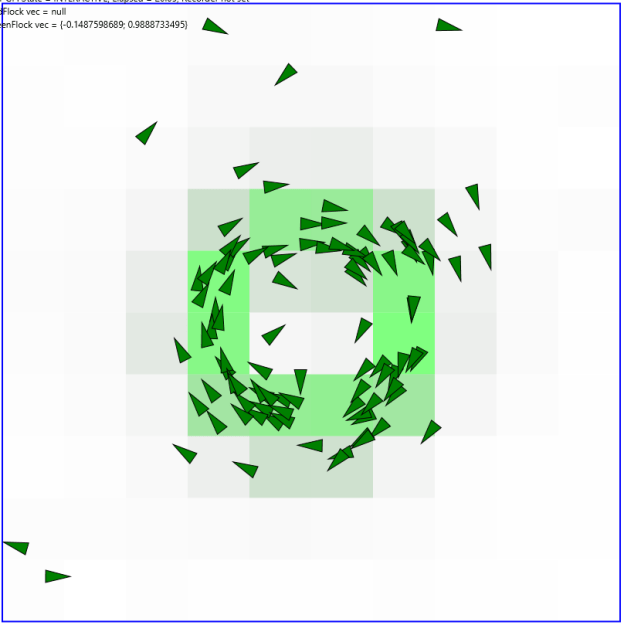
    • A loud, distributed voice pointing in a bad direction means wall hugging. Note that there is some kind of floating point error that lets wall huggers creep off the edge.Edgecrawling
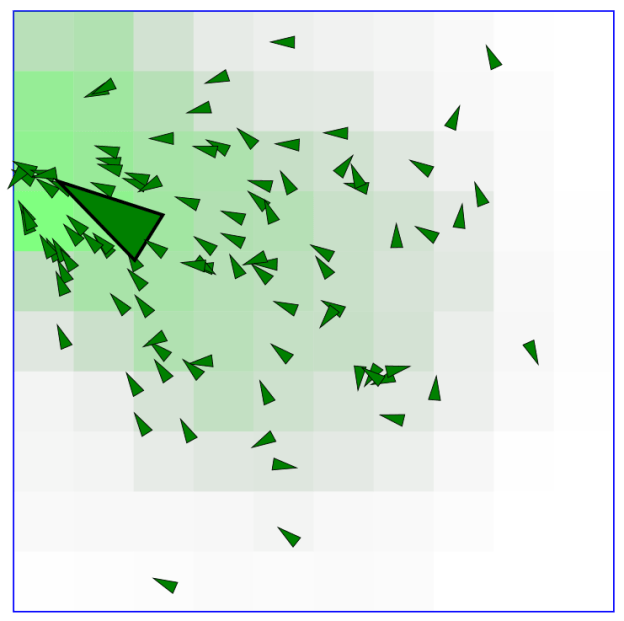
    • With a respawn border, we get the situation where the overall heading of the flock doesn’t change even as it gets destroyed as it goes over the border. Again, since the herding algorithm is looking at the overall population, it never crosses the border but influences all the respawned agents to head towards the same edge: DirectionPreserving
  • Paper thoughts:
    • Armys have different patterns from emergent groups. They are imposed formations and reflect a commander’s will
    • From a distance, they look different, but close up, they may look the same. One of the reasons for the success of the Roman Legion was the use of formations against the less sophisticated structures of their adversaries [ref]

Phil 10.11.17

7:00 – 3:30 ASRC MKT

  • Call ACK today about landing pad 7s. Nope – closed today
  • The Thirteenth International Conference on Spatial Information Theory (COSIT 2017)
  • Topic-Relevance Map: Visualization for Improving Search Result Comprehension
    • We introduce topic-relevance map, an interactive search result visualization that assists rapid information comprehension across a large ranked set of results. The topic-relevance map visualizes a topical overview of the search result space as keywords with respect to two essential information retrieval measures: relevance and topical similarity. Non-linear dimensionality reduction is used to embed high-dimensional keyword representations of search result data into angles on a radial layout. Relevance of keywords is estimated by a ranking method and visualized as radiuses on the radial layout. As a result, similar keywords are modeled by nearby points, dissimilar keywords are modeled by distant points, more relevant keywords are closer to the center of the radial display, and less relevant keywords are distant from the center of the radial display. We evaluated the effect of the topic-relevance map in a search result comprehension task where 24 participants were summarizing search results and produced a conceptualization of the result space. The results show that topic-relevance map significantly improves participants’ comprehension capability compared to a conventional ranked list presentation.
  • Important to remember for the Research Browser: Where to Add Actions in Human-in-the-Loop Reinforcement Learning
    • In order for reinforcement learning systems to learn quickly in vast action spaces such as the space of all possible pieces of text or the space of all images, leveraging human intuition and creativity is key. However, a human-designed action space is likely to be initially imperfect and limited; furthermore, humans may improve at creating useful actions with practice or new information. Therefore, we propose a framework in which a human adds actions to a reinforcement learning system over time to boost performance. In this setting, however, it is key that we use human effort as efficiently as possible, and one significant danger is that humans waste effort adding actions at places (states) that aren’t very important. Therefore, we propose Expected Local Improvement (ELI), an automated method which selects states at which to query humans for a new action. We evaluate ELI on a variety of simulated domains adapted from the literature, including domains with over a million actions and domains where the simulated experts change over time. We find ELI demonstrates excellent empirical performance, even in settings where the synthetic “experts” are quite poor.
  • This is interesting. DARPA had a Memex project that they open-sourced
  • Got PHP and xdebug set up on my home machines, mostly following these instructions. The dll that matches the PHP install needs to be downloaded from here and placed in the /php directory. Then add the following to the php.ini file:
    [XDebug]
    zend_extension = "C:\xampp\php\ext\php_xdebug.dll"
    xdebug.profiler_append = 0
    xdebug.profiler_enable = 1
    xdebug.profiler_enable_trigger = 1
    xdebug.profiler_output_dir = "C:\xampp\tmp"
    xdebug.profiler_output_name = "cachegrind.out.%t-%s"
    xdebug.remote_enable = 0
    xdebug.remote_handler = "dbgp"
    xdebug.remote_host = "127.0.0.1"
    xdebug.remote_port = "9876"
    xdebug.trace_output_dir = "C:\xampp\tmp"

    Then go to settings->Languages & Frameworks -> PHP, and either attach to the php CLI or refresh. The debugger should become visible: PHPsetup

  • Reworking the CHI DC to a CHIIR DC
    • There is a new version of the LaTex templates as of Oct 2 here. I wonder if that fixes the CHI problems?
    • Put things in the right format, got the pix in the columns. Four pages! Working on fixing text.
    • Finished first pass (time for multiple passes! Woohoo!)
    • Working on paragraph
    • Start schema for PolarizationGame
  • Theresa asked me to set up a new set of CSEs. Will need a credit card and the repository location. Waiting for that.

Phil 9.14.17

7:00 – 4:00 ASRC MKT

  • Reducing Dimensionality from Dimensionality Reduction Techniques
    • In this post I will do my best to demystify three dimensionality reduction techniques; PCA, t-SNE and Auto Encoders. My main motivation for doing so is that mostly these methods are treated as black boxes and therefore sometime are misused. Understanding them will give the reader the tools to decide which one to use, when and how.
      I’ll do so by going over the internals of each methods and code from scratch each method (excluding t-SNE) using TensorFlow. Why TensorFlow? Because it’s mostly used for deep learning, lets give it some other challenges 🙂
      Code for this post can be found in this notebook.
    • This seems important to read in preparation for the Normative Mapping effort.
  • Stanford  deep learning tutorial. This is where I got the links to PCA and Auto Encoders, above.
  • Ok, back to writing:
    • The Exploration-Exploitation Dilemma: A Multidisciplinary Framework
    • Got hung up explaining the relationship of the social horizon radius, so I’m going to change it to the exploit radius. Also changed the agent flocks to red and green: GPM
    • There is a bug, too – when I upped the CellAccumulator hypercube size from 10-20. The max row is not getting set