Category Archives: research

Phil7.25.16

7:00 – 4:00 VTX

  • Rollers
  • Reworking the lit review. Meeting set up with Wayne for tomorrow at 4:00.
  • Still thinking about modelling. I could use sets of strings that would define a CAs worldview and then compare individuals by edit distance.
    • Not sure how to handle weights, a number, or repetitions of the character?
    • Comparing a set of CAs using centrality could see what the most important items are in that (overall and sub) population. how close the individual CA conforms to that distribution is a measure of the ‘belonging’?
    • CAs could adjust their internal model. Big changes should be hard, little changes should be easy. Would the dropping of a low ranked individual item result in a big change in edit distance with a group that doesn’t have the item?
    • Working on infrastructure that builds, collects and maintains Factoids

Phil 7.22.16

7:00 – 1:00 VTX

  • More bubble modelling. Found a nice paper from a financial perspective that looks like a good source for similar models.
  • Split out the calculation and spreadsheet functions to support snapshots and debugging.
    • Set up the base class to be the control. Explorers only look outside their SD, while confirmers and avoiders stay within. Not sure how to tease out the difference between those. I think it will have something to do with the way they look for information, which is beyond the scope of this model for now. Also switched to a random distribution. Here’s an initial result. Much more work to follow

GP

  • I was riding and thinking about something I read on fivethirtyeight.comThis isn’t the most artful way to say it, but it’s like, where do you go when the only people who seem to agree with you on taxes hate black people?” It’s by Ben Howe, a redstate commentator. And it makes me think that rather than basing the sim on only one value, there should be a cluster. Confirmed could look for a match in the cluster while avoiders would clusters if they hit somethings that doesn’t match. And the distance from the value should matter. Adopting a very different concept should take more energy than a similar one. And this makes me think that the CAs have to have a bit more alife in them. They need to budget their energy with reference to their internal and external states.
  • And then mom died. Here’s the OPM web page that matters: https://www.opm.gov/retirement-services/my-annuity-and-benefits/life-events/death/report-of-death/

Phil 6.21.16

7:00 – 5:00 VTX

  • Finished MostRecent.
  • Checked Data directory into SVN
  • Testing rating algorithms. Seems to be working pretty well 🙂
  • Rated all day. Should finish tomorrow.
  • Worked through paragon and fallen angel patterns with Aaron. Pulled out by bayesian spreadsheets and realized I no longer understood them…

Phil 6.20.16

7:00 – 7:00 VTX

  • Building chair corpus = Current and Cited
  • Filled MostCited.
  • Rating a few more pages. Still not getting any name hits.
  • Going to advanced search and entering items into each field, I get a different looking query:
    https://www.google.ca/search?as_q=New+York&as_epq=Nader+Golian&as_oq=+license+board+practice+patient+physician+order+health+practitioner+medicine+medical
    • These seem to be the important differences
    • as_q=New+York — This is a ‘normal’ query
    • as_epq=Nader+Golian — This must be in the results
    • as_oq=+license+board+practice+patient+physician+order+health+practitioner+medicine+medical — at least one of these must be in the result
  • Going to add a test to look for the name in the query (and the state?) and at least check the NA box and throw up a dialog. Could also list the number of occurrences by default in the notes

1:00 – Patrick’s proposal

  • Framing of problem and researcher
  • Overview of the problem space
    • Ready to Hand
    • Extension of self
  • Assistive technology abandonment
    • Ease of Acquisition
    • Device Performance
    • Cost and Maintenance
    • Stigma
    • Alignment with lifestyles
  • Prior Work
    • Technology Use
    • Methods Overview
      • Formative User Needs
      • Design Focus Groups
      • Design Evaluation and Configuration Interviews
    • Summary of Findings
    • Priorities
      • Maintain form factor
      • Different controls for different regions
      • Familiarity
      • Robustness to environmental changes
    • Potential of the wheelchair
      • Nice diagram. Shows the mapping from a chair to a smartphone
    • Inputs to wheelchair-mounted devices
    • Force sensitive device, new gestures and insights
    • Summary (This looks like research through design. Why no mention?)
      • Prototypes
      • Gestures
      • Demonstration
  • Proposed Work
    • Passive Haptic Rehabilitation
      • Can it be done
      • How effective
      • User perception
      • Study design!!!
    • Physical Activity and Athletic Performance
      • Completed: Accessibility of fitness trackers. (None of this actually tracks to papers in the presentation)
      • Body location and sensing
      • Misperception
        • Semi-structured interviews
        • Low experience / High interest (Lack of system trust!)
    • Chairable Computing for Basketball
      • Research Methods
        • Observations
        • Semi-structured interviews
        • Prototyping
        • Data presentation – how does one decide what they want from what is available?
  • What is the problem – Helena
    • Assistive technologies are not being designed right. We need to improve the design process.
    • That’s too general – give me a citation that says that technology abandonment WRT wheelchair use has high abandonment
    • Patrick responds with a bad design
    • Helena – isn’t the principal user-centered design. How has the HCI community done this before WRT other areas than wheelchairs to interact with computing systems
    • Helena – Embodied interaction is not a new thing, this is just a new area.Why didn’t you group your work. Is the prior analysis not embodied? Is your prior work not aligned with this perspective
  • How were the design principles used o develop an refine the pressure sensors?

More Reading

  • Creating Friction: Infrastructuring Civic Engagement in Everyday Life
    • This is the confirming information bubble of the ‘ten blue links’: Because infrastructures reflect the standardization of practices, the social work they do is also political: “a number of significant political, ethical and social choices have without doubt been folded into its development” ([67]: 233). The further one is removed from the institutions of standardization, the more drastically one experiences the values embedded into infrastructure—a concept Bowker and Star term ‘torque’ [9]. More powerful actors are not as likely to experience torque as their values more often align with those embodied in the infrastructure. Infrastructures of civic engagement that are designed and maintained by those in power, then, tend to reflect the values and biases held by those in power.
  • Meeting with Wayne. My hypothesis and research questions are backwards but otherwise good.

Phil 6.15.16

7:00 – 10:00, 12:00 – 4:00 VTX

  • Got the official word that I should be charging the project for research. Saved the email this time.
  • Continuing to work on the papers list
  • And in the process of looking at Daniele Quercia‘s work, I found Auralist: introducing serendipity into music recommendation which was cited by
    An investigation on the serendipity problem in recommender systems. Which has the following introduction:

    • In the book ‘‘The Filter Bubble: What the Internet Is Hiding from You’’, Eli Pariser argues that Internet is limiting our horizons (Parisier, 2011). He worries that personalized filters, such as Google search or Facebook delivery of news from our friends, create individual universes of information for each of us, in which we are fed only with information we are familiar with and that confirms our beliefs. These filters are opaque, that is to say, we do not know what is being hidden from us, and may be dangerous because they threaten to deprive us from serendipitous encounters that spark creativity, innovation, and the democratic exchange of ideas. Similar observations have been previously made by Gori and Witten (2005) and extensively developed in their book ‘‘Web Dragons, Inside the Myths of Search Engine Technology’’ (Witten, Gori, & Numerico, 2006), where the metaphor of search engines as modern dragons or gatekeepers of a treasure is justified by the fact that ‘‘the immense treasure they guard is society’s repository of knowledge’’ and all of us accept dragons as mediators when having access to that treasure. But most of us do not know how those dragons work, and all of us (probably the search engines’ creators, either) are not able to explain the reason why a specific web page ranked first when we issued a query. This gives rise to the so called bubble of Web visibility, where people who want to promote visibility of a Web site fight against heuristics adopted by most popular search engines, whose details and biases are closely guarded trade secrets.
    • Added both papers to the corpus. Need to read and code. What I’m doing is different in that I want to add a level of interactivity to the serendipity display that looks for user patterns in how they react to the presented serendipity and incorporate that pattern into a trustworthiness evaluation of the web content. I’m also doing it in Journalism, which is a bit different in its constraints. And I’m trying to tie it back to Group Polarization and opinion drift.
  • Also, Raz Schwartx at Facebook: , Editorial Algorithms: Using Social Media to Discover and Report Local News
  • Working on getting all html and pdf files in one matrix
  • Spent the day chasing down a bug where if the string being annotated is too long (I’ve set the  number of wordes to 60), then we skip. THis leads to a divide by zero issue. Fixed now

Phil 6.13.16

6:30 – 2:30 VTX

Phil 6.2.16

7:00 – 5:00 VTX

  • Writing
  • Write up sprint story – done
    • Develop a ‘training’ corpus known bad actors (KBA) for each domain.

      • KBAs will be pulled from http://w3.nyhealth.gov/opmc/factions.nsf, which provides a large list.
      • List of KBAs will be added to the content rating DB for human curation
      • HTML and PDF data will be used to populate a list of documents that will then be scanned and analyzed to prepare TF-IDF and LSI term-document tables.
      • The resulting table will in turn be analyzed using term centrality, with the output being an ordered list of terms to be evaluated for each domain.

  • Building view to get person, rating and link from the db – done, or at least V1
    CREATE VIEW view_ratings AS
      select io.link, qo.search_type, po.first_name, po.last_name, po.pp_state, ro.person_characterization from item_object io
        INNER JOIN query_object qo ON io.query_id = qo.id
        INNER JOIN rating_object ro on io.id = ro.result_id
        INNER JOIN poi_object po on qo.provider_id = po.id;
  • Took results from w3.nyhealth.gov and ran them through the whole system. The full results are in the Corpus file under w3.nyhealth.gov-PDF-centrality_06_02_16-13_12_09.xlsx and w3.nyhealth.gov-WEB-centrality_06_02_16-13_12_09.xlsx. The results seem to make incredibly specific searches. Here are the two first examples. Note that there are very few .com sites.:

Phil 5.31.16

7:00 – 4:30 VTX

  • Writing. Working on describing how maintaining many codes in a network contains more (and more subtle) information than grouping similar codes.
  • Working on the UrlChecker
    • In the process, I discovered that the annotation.xml file is unique only for the account and not for the CSE. All CSEs for one account are contained in one annotation file
    • Created a new annotation called ALL_annotations.xml
    • fixed a few things in Andy’s file
    • Reading in everything. Now to produce the new sets of lists.
    • I think it’s just easier to delete all the lists and start over.
    • Done and verified. You run UrlChecker from the command line, with the input file being a list of domains (one per line) and the ALL_annotations.xml file.
  • https://cwiki.apache.org/confluence/display/CTAKES/cTAKES+3.2
  • Need to add a Delete or Hide button to reduce down a large corpus to a more effective size.
  • Added. Tomorrow I’ll wire up the deletion of a row or cilumn and the recreation of the initialMatrix

Phil 5.30.16

7:00 – 10:00 Thesis/VTX

  • Built a new matrix for the coded lit review. I had coded a couple of more papers
  • Working on copying over the read papers into a new folder that I can run text analytics over
  • After carefully reading through the doc manager list and copying over each paper, I just discovered I could have exported selected.
  • Ooops: Exception in thread “JavaFX Application Thread” java.lang.IllegalArgumentException: Invalid column index (16384).  Allowable column range for EXCEL2007 is (0..16383) or (‘A’..’XFD’)
    • Going to add a limit of
      SpreadsheetVersion.EXCEL2007.getMaxColumns()-8

      columns for now. Clearly that can be cut down.

    • Figuring out where to cut the terms. I’m summing the columns of the LSI calculation, starting at the highest value and then dividing that by the sum of all values. The top 20% of rank weights gives 280 columns. Going to try that first
    • Success! Some initial thoughts
      • The coded version is much more ‘crisp’
      • There are interesting hints in the LSI version
      • Clicking on a term or paper to see the associated items is really nice.
      • I think that document subgroups might be good/better, and it might be possible to use the tool to help build those subgroups. This goes back to the ‘hiding’ concept. (hide item / hide item and associated)

Phil 5.9.16

7:00 – 4:00 VTX

  • Started the paper describing the slider interface
  • TF-IDF today!
    • Read docs from web and PDF
    • Calculate the rank
    • Create matrix of terms and documents, weighted by occurrence.
  • Hmm. What I’m actually looking for is the lowest-occurring terms within a document that occur over the largest number of documents. I’ve used this page as a starting point. After flailing for many hours in java, I wound up walking through the algorithm in Excel and I think I’ve got it. This is the spreadsheet that embodies my delusional thinking ATM.

Phil 5.6.16

7:00 – 4:00 VTX

  • Today’s shower thought is to compare the variance of the difference of two (unitized) rank matrices. The maximum difference would be (matrix size), so we do have a scale. If we assume a binomial distribution (there are many ways to be slightly different, only two ways to be completely different), then we can use a binomial (one tailed?) distribution centered on zero and ending at (matrix size). That should mean that I can see how far one item is from the other? But it will be withing the context of a larger distribution (all zeros vs all ones)…
  • Before going down that rabbit hole, I decided to use the bootstrap method just to see if the concept works. It looks mostly good.
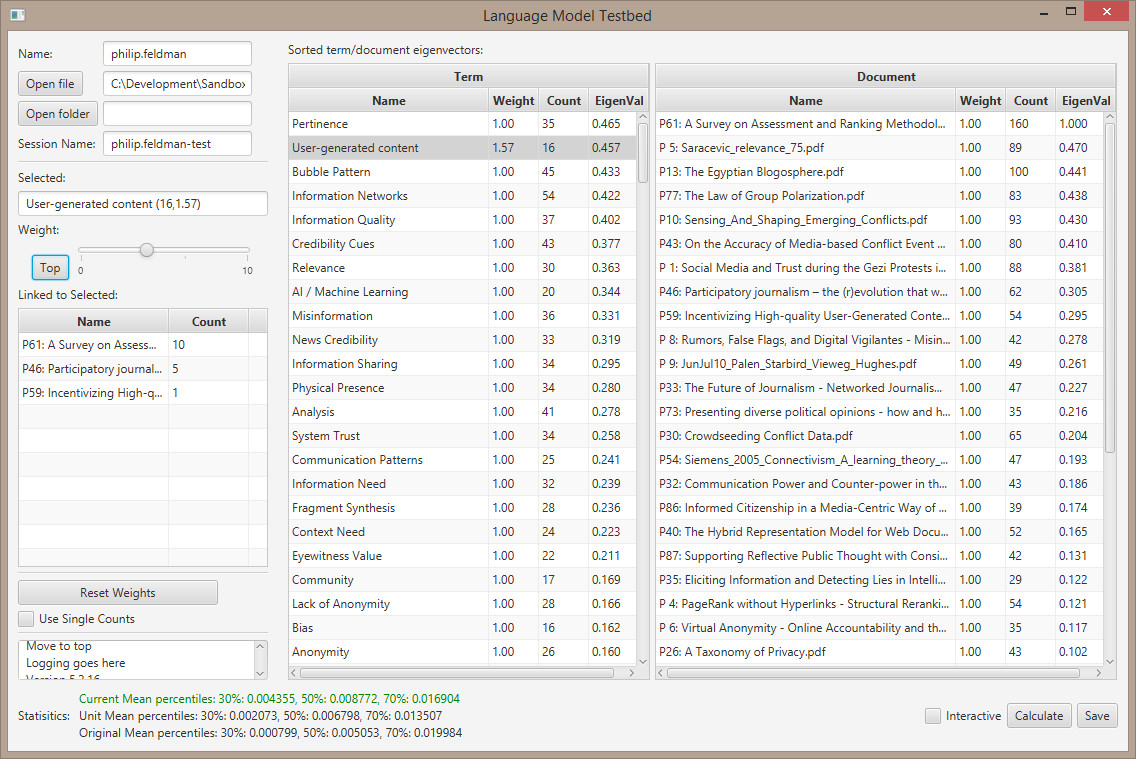
    • Verified that scaling a low-ranked item (ACLED) by 10 has less impact than scaling the highest ranking item (P61) by 1.28.
    • Set the stats text to red if it’s outside 1 SD and green if it’s within.
    • I think the terms can be played around with more because the top one (Pertinence) gets ranked at .436, while P61 has a rank of 1.
    • There are some weird issues with the way the matrix recalculates. Some states are statistically similar to others. I think I can do something with the thoughts above, but later.
  • There seems to be a bug calculating the current mean when compared to the unit mean. It may be that the values are so small? It’s occasional….
  • Got the ‘top’ button working.
  • And that’s it for the week…

LMT With Data2

Oh yeah – Everything You Ever Wanted To Know About Motorcycle Safety Gear

Phil 5.5.16

7:00 – 5:30 VTX

  • Continuing An Introduction to the Bootstrap.
  • This helped a lot. I hope it’s right…
  • Had a thought about how to build the Bootstrap class. Build it using RealVector and then use Interface RealVectorPreservingVisitor to do whatever calculation is desired. Default methods for Mean, Median, Variance and StdDev. It will probably need arguments for max iteration and epsilon.
  • Didn’t do that at all. Wound up using ArrayRealVector for the population and Percentile to hold the mean and variance values. I can add something else later
  • I think to capture how the centrality affects the makeup of the data in a matrix. I think it makes sense to use the normalized eigenvector to multiply the counts in the initial matrix and submit that population (the whole matrix) to the Bootstrap
  • Meeting with Wayne? Need to finish tool updates though.
  • Got bogged down in understanding the Percentile class and how binomial distributions work.
  • Built and then fixed a copy ctor for Labled2DMatrix.
  • Testing. It looks ok, but I want to try multiplying the counts by the eigenVec. Tomorrow.

Phil 5.3.16

7:00 – 3:30 VTX

  • Out riding, I realized that I could have a column called ‘counts’ that would add up the total number of ‘terms per document’ and ‘documents per terms ‘. Unitizing the values would then show the number of unique terms per document. That’s useful, I think.
  • Helena pointed to an interesting CHI 2016 site. This is sort of the other side of extracting pertinence from relevant data. I wonder where they got their data from?
    • Found it!. It’s in a public set of Google docs, in XML and JSON formats. I found it by looking at the GitHub home page. In the example code  there was this structure:
      source: {
          gdocId: '0Ai6LdDWgaqgNdG1WX29BanYzRHU4VHpDUTNPX3JLaUE',
          tables: "Presidents"
        }

      That gave me a hint of what to look for in the document source of the demo, where I found this:

      var urlBase = 'https://ca480fa8cd553f048c65766cc0d0f07f93f6fe2f.googledrive.com/host/0By6LdDWgaqgNfmpDajZMdHMtU3FWTEkzZW9LTndWdFg0Qk9MNzd0ZW9mcjA4aUJlV0p1Zk0/CHI2016/';
      

      And that’s the link from above.

    • There appear to be other useful data sets as well. For example, there is an extensive CHI paper database sitting behind this demo.
    • So this makes generalizing the PageRank approach much more simple since it looks like I can pull the data down pretty simply. In my case I think the best thing would be to write small apps that pull down the data and build Excel spreadsheets that are read in by the tool for now.
  • Exporting a new data set from Atlas. Done and committed. I need to do runs before meeting with Wayne.
  • Added Counts in and refactored a bit.
  • I think I want a list of what a doc or term is directly linked to and the number of references. Addid the basics. Wiring up next. Done! But now I want to click on an item in the counts list and have it be selected? Or at least highlighted?
  • Stored the new version on dropbox: https://www.dropbox.com/s/92err4z2posuaa1/LMN.zip?dl=0
  • Meeting with Wayne
    • There’s some bug with counts. Add it to the WeightedItem.toString() and test.
    • Add a ‘move to top’ button near the weight slider that adds just enough weight to move the item to the top of the list. This could be iterative?
    • Add code that compares the population of ranks with the population of scaled ranks. Maybe bootstrapping? Apache Commons Math has KolmogorovSmirnovTest, which has public double kolmogorovSmirnovTest(double[] x, double[] y, boolean strict), which looks promising.
  • Added ability to log out of the rating app.

Phil 4.29.16

7:00 – 5:00 VTX

  • Expense reports and timesheets! Done.
  • Continuing Informed Citizenship in a Media-Centric Way of Life
    • The pertinence interface may be an example of a UI affording the concept of monitorial citizenship.
      • Page 219: The monitorial citizen, in Schudson’s (1998) view, does environmental surveillance rather than gathering in-depth information. By implication, citizens have social awareness that spans vast territory without having in-depth understanding of specific topics. Related to the idea of monitorial instead of informed citizenship, Pew Center (2008) data identified an emerging group of young (18–34) mobile media users called news grazers. These grazers ind what they need by switching across media platforms rather than waiting for content to be served.
    • Page 222: Risk as Feelings. The abstract is below. There is an emotional hacking aspect here that traditional journalism has used (heuristically?) for most(?) of its history.
      • Virtually all current theories of choice under risk or uncertainty are cognitive and consequentialist. They assume that people assess the desirability and likelihood of possible outcomes of choice alternatives and integrate this information through some type of expectation-based calculus to arrive at a decision. The authors propose an alternative theoretical perspective, the risk-as-feelings hypothesis, that highlights the role of affect experienced at the moment of decision making. Drawing on research from clinical, physiological, and other subfields of psychology, they show that emotional reactions to risky situations often diverge from cognitive assessments of those risks. When such divergence occurs, emotional reactions often drive behavior. The risk-as-feelings hypothesis is shown to explain a wide range of phenomena that have resisted interpretation in cognitive–consequentialist terms.
    • At page 223 – Elections as the canon of participation

  • Working on getting tables to sort – Done

  • Loading excel file -done
  • Calculating – done
  • Using weights -done
  • Reset weights – done
  • Saving (don’t forget to add sheet with variables!) – done
  • Wrapped in executable – done
  • Uploading to dropbox. Wow – the files with JavaFX are *much* bigger than Swing.

Phil 4.25.16

5:30 – 4:00 VTX

  • Saw this on Twitter about visualizing networks with D3
  • Working my way through the JavaFX tutorial. It is a lot like a blend of Flex and a rethought Swing. Nice, actually…
  • Here is the list of stock components
  • Starting with the ope file dialog – done.
  • Yep, there’s a spinner. And here’s dials and knobs
  • And here’s how to do a word cloud.
  • Here’s a TF-IDF implementation in JAVA. Need to build some code that reads in from our ‘negative match’ ‘positive match’ results and start to get some data driven terms
  • Tregex is a utility for matching patterns in trees, based on tree relationships and regular expression matches on nodes (the name is short for “tree regular expressions”). Tregex comes with Tsurgeon, a tree transformation language. Also included from version 2.0 on is a similar package which operates on dependency graphs (class SemanticGraph, calledsemgrex).
  • Semgrex
  • Sprint review
    • Google CSEs
      • Switched over from my personal CSEs to Vistronix CSEs
      • Added VCS rep for CSEs
      • Figured out how to save out and load CSE from XML
      • Added a few more CSEs ONLY_NET, MOBY_DICK
      • Wrote up care and feeding document for Confluence
      • Added blacklists
    • Rating App
      • Re-rigged the JPA classes to be Ontology-agnostic Version 2 of nearly everything)
      • Upped my JQL game to handle SELECT IN WHERE precompiled queries
      • Reading in VA and PA data now
      • Added the creation of a text JSON object that formalizes the rating of a flag
      • Got hooked up to the Talend DB!!!
      • Deployed initial version(s)
      • Added backlink logging using SemRush
    • Future work
      • Developed Excel ingest
      • Still working on PDF and Word ingest