Category Archives: Lit Review

Phil 8.30.18

7:00 – 5:00  ASRC MKT

  • Target Blue Sky paper for iSchool/iConference 2019: The chairs are particularly looking for “Blue Sky Ideas” that are open-ended, possibly even “outrageous” or “wacky,” and present new problems, new application domains, or new methodologies that are likely to stimulate significant new research. 
  • I’m thinking that a paper that works through the ramifications of this diagram as it relates to people and machines. With humans that are slow responding with spongy, switched networks the flocking area is large. With a monolithic densely connected system it’s going to be a straight line from nomadic to stampede. Nomad-Flocking-Stampede2
    • Length: Up to 4 pages (excluding references)
    • Submission deadline: October 1, 2018
    • Notification date: mid-November, 2018
    • Final versions due: December 14, 2018
    • First versions will be submitted using .pdf. Final versions must be submitted in .doc, .docx or La Tex.
  • More good stuff on BBC Business Daily Trolling for Cash
    • Anger and animosity is prevalent online, with some people even seeking it out. It’s present on social media of course as well as many online forums. But now outrage has spread to mainstream media outlets and even the advertising industry. So why is it so lucrative? Bonny Brooks, a writer and researcher at Newcastle University explains who is making money from outrage. Neuroscientist Dr Dean Burnett describes what happens to our brains when we see a comment designed to provoke us. And Curtis Silver, a tech writer for KnowTechie and ForbesTech, gives his thoughts on what we need to do to defend ourselves from this onslaught of outrage.
  • Exposure to Opposing Views can Increase Political Polarization: Evidence from a Large-Scale Field Experiment on Social Media
    • Christopher Bail (Scholar)
    • There is mounting concern that social media sites contribute to political polarization by creating “echo chambers” that insulate people from opposing views about current events. We surveyed a large sample of Democrats and Republicans who visit Twitter at least three times each week about a range of social policy issues. One week later, we randomly assigned respondents to a treatment condition in which they were offered financial incentives to follow a Twitter bot for one month that exposed them to messages produced by elected officials, organizations, and other opinion leaders with opposing political ideologies. Respondents were re-surveyed at the end of the month to measure the effect of this treatment, and at regular intervals throughout the study period to monitor treatment compliance. We find that Republicans who followed a liberal Twitter bot became substantially more conservative post-treatment, and Democrats who followed a conservative Twitter bot became slightly more liberal post-treatment. These findings have important implications for the interdisciplinary literature on political polarization as well as the emerging field of computational social science.
  • Setup gcloud tools on laptop – done
  • Setup Tensorflow on laptop. Gave up un using CUDA 9.1, but got tf doing ‘hello, tensorflow’
  • Marcom meeting – 2:00
  • Get the concept of behaviors being a more scalable, dependable way of vetting information.
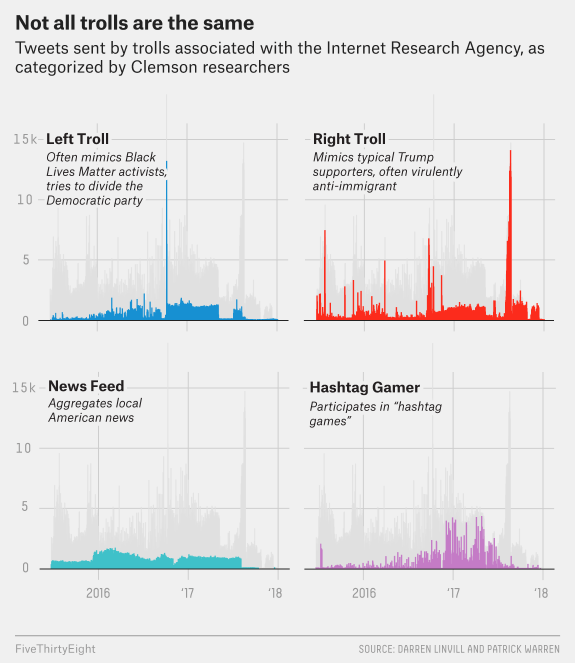
    • Eg Watching the DISI of outrage as manifested in trolling
      • “Uh. . . . not to be nitpicky,,,,,but…the past tense of drag is dragged, not drug.”: An overview of trolling strategies
        • Dr Claire Hardaker (Scholar) (Blog)
          • I primarily research aggression, deception, and manipulation in computer-mediated communication (CMC), including phenomena such as flaming, trolling, cyberbullying, and online grooming. I tend to take a forensic linguistic approach, based on a corpus linguistic methodology, but due to the multidisciplinary nature of my research, I also inevitably branch out into areas such as psychology, law, and computer science.
        • This paper investigates the phenomenon known as trolling — the behaviour of being deliberately antagonistic or offensive via computer-mediated communication (CMC), typically for amusement’s sake. Having previously started to answer the question, what is trolling? (Hardaker 2010), this paper seeks to answer the next question, how is trolling carried out? To do this, I use software to extract 3,727 examples of user discussions and accusations of trolling from an eighty-six million word Usenet corpus. Initial findings suggest that trolling is perceived to broadly fall across a cline with covert strategies and overt strategies at each pole. I create a working taxonomy of perceived strategies that occur at different points along this cline, and conclude by refining my trolling definition.
        • Citing papers
  • FireAnt (Filter, Identify, Report, and Export Analysis Toolkit) is a freeware social media and data analysis toolkit with built-in visualization tools including time-series, geo-position (map), and network (graph) plotting.
  • Fix marquee – done
  • Export to ppt – done!
    • include videos – done
    • Center title in ppt:
      • model considerations – done
      • diversity injection – done
  • Got the laptop running Python and Tensorflow. Had a stupid problem where I accidentally made a virtual environment and keras wouldn’t work. Removed, re-connected and restarted IntelliJ and everything is working!

Phil 8.29.18

7:00 – 4:30 ASRC MKT

  • Editing videos
  • Need to think about short CHI paper about designing for culture/robot interactions. The trolly problem at scale? How would the sim be set up? The amount of randomness at the initial condition? Stiffness vs. connectivity? Beleif space is still important and is actually used as a concept in path planning
  • Visual Exploration and Comparison of Word Embeddings
    • Word embeddings are distributed representations for natural language words, and have been wildly used in many natural language processing tasks. The word embedding space contains local clusters with semantically similar words and meaningful directions, such as the analogy. However, there are different training algorithms and text corpora, which both have a different impact on the generated word embeddings. In this paper, we propose a visual analytics system to visually explore and compare word embeddings trained by different algorithms and corpora. The word embedding spaces are compared from three aspects, i.e., local clusters, semantic directions and diachronic changes, to understand the similarity and differences between word embeddings.
  • Much work on slides
  • Can’t get Google to recognise my account?
    curl.exe -H "Content-Type: application/json" -H "Authorization: Bearer "$(gcloud auth application-default print-access-token) https://speech.google
    apis.com/v1/speech:recognize -d @sync-request.json
    curl: (6) Could not resolve host: ya29.c.EloHBu32-0nBAqimi1Zumlot6rjGtGpUk27qTTESRLW4vtd1LY4ihxBIesU3ga-kmwCaM7YZS-JRo_KNjaC_bj13dWazBcKr4YtAEQYFzSpSBx3DwdS46DTt0bg
    {
      "error": {
        "code": 403,
        "message": "The request is missing a valid API key.",
        "status": "PERMISSION_DENIED"
      }
    }

    No idea what host: ya29.c.EloHBu32-0nBAqimi1Zumlot6rjGtGpUk27qTTESRLW4vtd1LY4ihxBIesU3ga-kmwCaM7YZS-JRo_KNjaC_bj13dWazBcKr4YtAEQYFzSpSBx3DwdS46DTt0bg is

  • Found a problem with the poster. There are two herding DTW charts. Must be reprinted

Phil 8.26.18

Listening to On Being with guest Mahzarin Banaji (Scholar)

  • The other thing that I do is to actually create inputs into my mind of my own making. I do think that in some ways our brains are simple and that they will believe that things are real even if they’re not. So, that’s what movies do. That’s what novels do for us. So what if I have a series of 1,000 pictures that rotate through on my screen saver of people who come from many parts of the world that I will never, ever see or even think about. Look, just take an example close by. I have no idea what life for a farmer in Iowa is. I bet it’s hard. I bet I have no idea what they have to deal with. I don’t think I will ever truly understand.But, right now, they are a distant group in my mind. I live in Cambridge, Massachusetts, and I don’t think about farming and farmers. If my screensaver literally just points out the existence of such people and what their issues might be, I believe that my brain is going to begin to care at some level. And if I show myself possibilities that don’t exist easily, that’s even better.
  • A nice example of diversity injection

Phil 8.23.18

7:00 – 5:30 ASRC MKT

dlr99umvaaed9rk

  • Slides
    • Groups/tribes stay the same, but the topics change
    • Past polarizing topics:
      • Confederate statues
      • Kneeling for the national anthem
      • #blacklivesmatter
      • Hoodies
      • Crack cocaine
      • 1968 Olympics Black Power salute
      • Alabama bus boycott
    • Stiffening a group creates a stampede (In-group high SIH)
    • Adding group-invisible diversity disrupts the velocity and direction of a stampede
    • Arendt/Moscovici slide “So we’re doomed, right! Except…”
    • See what velocity of the disrupted stampede looks like
  • Why Trump Supporters Believe He Is Not Corrupt
    • The answer may lie in how Trump and his supporters define corruption. In a forthcoming book titled How Fascism Works, the Yale philosophy professor Jason Stanley makes an intriguing claim. “Corruption, to the fascist politician,” he suggests, “is really about the corruption of purity rather than of the law. Officially, the fascist politician’s denunciations of corruption sound like a denunciation of political corruption. But such talk is intended to evoke corruption in the sense of the usurpation of the traditional order.”
  • Climate science proposals are being reviewed by Ryan Zinke’s old football buddy. Seriously.
    • But what if the corruption isn’t hidden at all, but right out in the open? What if, when it’s identified, the perpetrator doesn’t apologize, or demonstrate any remorse or shame, and there’s no punishment? What then? We don’t really have good narratives around what happens in that situation, which is why the Trump administration so often leaves us sputtering and gawking. It can’t just be a motley collection of incompetent grifters, each misruling their own little fiefdom, trying to stay in their boss’s good graces, succeeding less through wits than a congenital lack of shame and the unstinting institutional support of GOP donors. Can it?

Phil 8.22.18

7:00 – 4:00 ASRC MKT

Phil 8.21.18

7:00 – 3:00 ASRC MKT

  • Rework the slides
    • Explicit introduction, lit review, methods, results, conclusion and discussion slides
    • Slide for the difference between opinion dynamics & consensus formation as a static end  and part of a dynamic process. (Tribe membership may be static, belief of the tribe is highly dynamic. It’s the story for the group)
    • Revisit stampede/flock/nomad slide in the conclusions
    • Lose the following slides:
      • Belief space
      • Theory slide replace with a slide that breaks out the to knobs of dimension reduction and social influence horizons. The slide is called “the simple trick” Explain how herding affects these knobs by presenting simple issues and making the network stiffer through weight and connection
    • Get rid of optical polarization
  • Fanning the Flames of Hate: Social Media and Hate Crime
    • This paper investigates the link between social media and hate crime using Facebook data. We study the case of Germany, where the recently emerged right-wing party Alternative für Deutschland (AfD) has developed a major social media presence. We show that right-wing anti-refugee sentiment on Facebook predicts violent crimes against refugees in otherwise similar municipalities with higher social media usage. To further establish causality, we exploit exogenous variation in major internet and Facebook outages, which fully undo the correlation between social media and hate crime. We further find that the effect decreases with distracting news events; increases with user network interactions; and does not hold for posts unrelated to refugees. Our results suggest that social media can act as a propagation mechanism between online hate speech and real-life violent crime.
  • Facebook is rating the trustworthiness of its users on a scale from zero to 1
    • Facebook has begun to assign its users a reputation score, predicting their trustworthiness on a scale from zero to 1.
    • Tessa Lyons, product manager who is in charge of fighting misinformation (video)
  • Social Science One
    • implements a new type of partnership between academic researchers and private industry to advance the goals of social science in understanding and solving society’s greatest challenges. The partnership enables academics to analyze the increasingly rich troves of information amassed by private industry in responsible and socially beneficial ways. It ensures the public maintains privacy while gaining societal value from scholarly research. And it enables firms to enlist the scientific community to help them produce social good, while protecting their competitive positions.
  • Lost Causes Is this fashion in economic theory (found via Twitter)?Causal
  • Poster printing – UMBC Commonvision

Phil 8.18.18

This looks good:

  • Created almost 25 years ago, when the web was in its infancy, Propaganda Critic is dedicated to promoting techniques of propaganda analysis among critically minded citizens.

    In 2018, realizing that traditional approaches to propaganda analysis were not well-suited for making sense out of our contemporary political crisis, we completely overhauled Propaganda Critic to take into account the rise of ‘computational propaganda.’ In addition to updating all of the original content, we added nearly two dozen new articles exploring the rise of computational propaganda, explaining recent research on cognitive biases that influence how we interpret and retain information, and presenting recent case studies of how propaganda techniques have been used to disrupt democracy around the world.

Continuing to work on the SASO writeup – it’s coming along. Slower than I’d like…

This is just too good:

  • Data Organization in Spreadsheets
    • Spreadsheets are widely used software tools for data entry, storage, analysis, and visualization. Focusing on the data entry and storage aspects, this article offers practical recommendations for organizing spreadsheet data to reduce errors and ease later analyses. The basic principles are: be consistent, write dates like YYYY-MM-DD, do not leave any cells empty, put just one thing in a cell, organize the data as a single rectangle (with subjects as rows and variables as columns, and with a single header row), create a data dictionary, do not include calculations in the raw data files, do not use font color or highlighting as data, choose good names for things, make backups, use data validation to avoid data entry errors, and save the data in plain text files.

Phil 8.17.18

7:00 – 4:30 ASRC MKT

Phil 8.16.18

7:00 – 4:30 ASRC MKT

  • R2D3 is an experiment in expressing statistical thinking with interactive design. Find us at @r2d3usR2D3
  • Foundations of Temporal Text Networks
    • Davide Vega (Scholar)
    • Matteo Magnani (Scholar)
    • Three fundamental elements to understand human information networks are the individuals (actors) in the network, the information they exchange, that is often observable online as text content (emails, social media posts, etc.), and the time when these exchanges happen. An extremely large amount of research has addressed some of these aspects either in isolation or as combinations of two of them. There are also more and more works studying systems where all three elements are present, but typically using ad hoc models and algorithms that cannot be easily transferred to other contexts. To address this heterogeneity, in this article we present a simple, expressive and extensible model for temporal text networks, that we claim can be used as a common ground across different types of networks and analysis tasks, and we show how simple procedures to produce views of the model allow the direct application of analysis methods already developed in other domains, from traditional data mining to multilayer network mining.
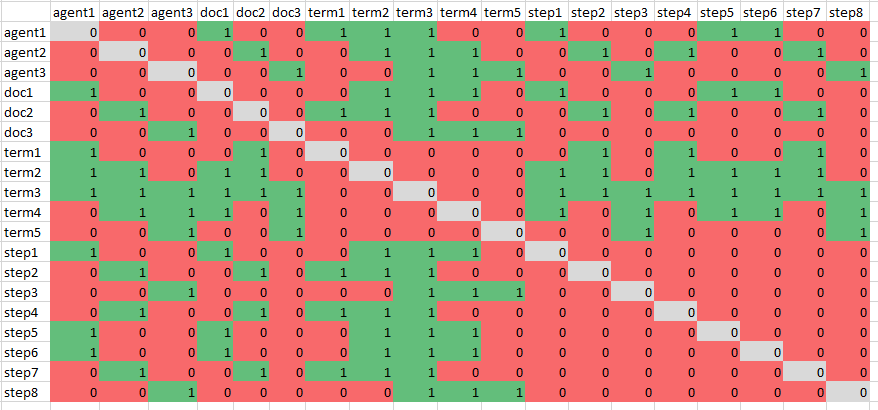
      • Ok, I’ve been reading the paper and if I understand it correctly, it’s pretty straightforward and also clever. It relates a lot to the way that I do term document matrices, and then extends the concept to include time, agents, and implicitly anything you want to. To illustrate, here’s a picture of a tensor-as-matrix: tensorIn2DThe important thing to notice is that there are multiple dimensions represented in a square matrix. We have:
        • agents
        • documents
        • terms
        • steps
      • This picture in particular is of an undirected adjacency matrix, but I think there are ways to handle in-degree and out-degree, though I think that’s probably better handled by having one matrix for indegree and one for out.
      • Because it’s a square matrix, we can calculate the steps between any node that’s on the matrix, and the centrality, simply by squaring the matrix and keeping track of the steps until the eigenvector settles. We can also weight nodes by multiplying that node’s row and column by the scalar. That changes the centrality, but ot the connectivity. We can also drop out components (steps for example) to see how that changes the underlying network properties.
      • If we want to see how time affects the development of the network, we can start with all the step nodes set to a zero weight, then add them in sequentially. This means, for example, that clustering could be performed on the nonzero nodes.
      • Some or all of the elements could be factorized using NMF, resulting in smaller, faster matrices.
      • Network embedding could be useful too. We get distances between nodes. And this looks really important: Network Embedding as Matrix Factorization: Unifying DeepWalk, LINE, PTE, and node2vec
      • I think I can use any and all of the above methods on the network tensor I’m describing. This is very close to a mapping solution.
  • The Shifting Discourse of the European Central Bank: Exploring Structural Space in Semantic Networks (cited by the above paper)
    • Convenient access to vast and untapped collections of documents generated by organizations is a valuable resource for research. These documents (e.g., Press releases, reports, speech transcriptions, etc.) are a window into organizational strategies, communication patterns, and organizational behavior. However, the analysis of such large document corpora does not come without challenges. Two of these challenges are 1) the need for appropriate automated methods for text mining and analysis and 2) the redundant and predictable nature of the formalized discourse contained in these collections of texts. Our article proposes an approach that performs well in overcoming these particular challenges for the analysis of documents related to the recent financial crisis. Using semantic network analysis and a combination of structural measures, we provide an approach that proves valuable for a more comprehensive analysis of large and complex semantic networks of formal discourse, such as the one of the European Central Bank (ECB). We find that identifying structural roles in the semantic network using centrality measures jointly reveals important discursive shifts in the goals of the ECB which would not be discovered under traditional text analysis approaches.
  • Comparative Document Analysis for Large Text Corpora
    • This paper presents a novel research problem, Comparative Document Analysis (CDA), that is, joint discovery of commonalities and differences between two individual documents (or two sets of documents) in a large text corpus. Given any pair of documents from a (background) document collection, CDA aims to automatically identify sets of quality phrases to summarize the commonalities of both documents and highlight the distinctions of each with respect to the other informatively and concisely. Our solution uses a general graph-based framework to derive novel measures on phrase semantic commonality and pairwise distinction, where the background corpus is used for computing phrase-document semantic relevance. We use the measures to guide the selection of sets of phrases by solving two joint optimization problems. A scalable iterative algorithm is developed to integrate the maximization of phrase commonality or distinction measure with the learning of phrase-document semantic relevance. Experiments on large text corpora from two different domains—scientific papers and news—demonstrate the effectiveness and robustness of the proposed framework on comparing documents. Analysis on a 10GB+ text corpus demonstrates the scalability of our method, whose computation time grows linearly as the corpus size increases. Our case study on comparing news articles published at different dates shows the power of the proposed method on comparing sets of documents.
  • Social and semantic coevolution in knowledge networks
    • Socio-semantic networks involve agents creating and processing information: communities of scientists, software developers, wiki contributors and webloggers are, among others, examples of such knowledge networks. We aim at demonstrating that the dynamics of these communities can be adequately described as the coevolution of a social and a socio-semantic network. More precisely, we will first introduce a theoretical framework based on a social network and a socio-semantic network, i.e. an epistemic network featuring agents, concepts and links between agents and between agents and concepts. Adopting a relevant empirical protocol, we will then describe the joint dynamics of social and socio-semantic structures, at both macroscopic and microscopic scales, emphasizing the remarkable stability of these macroscopic properties in spite of a vivid local, agent-based network dynamics.
  • Tensorflow 2.0 feedback request
    • Shortly, we will hold a series of public design reviews covering the planned changes. This process will clarify the features that will be part of TensorFlow 2.0, and allow the community to propose changes and voice concerns. Please join developers@tensorflow.org if you would like to see announcements of reviews and updates on process. We hope to gather user feedback on the planned changes once we release a preview version later this year.

Phil 8.13.18

7:00 – 4:30 ASRC MKT

Phil 8.11.18

The Communicative Constitution of Hate Organizations Online: A Semantic Network Analysis of “Make America Great Again”

  • In the context of the 2016 U.S. Presidential Election, President Donald Trump’s use of Twitter to connect with followers and supporters created unprecedented access to Trump’s online political campaign. In using the campaign slogan, “Make America Great Again” (or its acronym “MAGA”), Trump communicatively organized and controlled media systems by offering his followers an opportunity to connect with his campaign through the discursive hashtag. In effect, the strategic use of these networks over time communicatively constituted an effective and winning political organization; however, Trump’s political organization was not without connections to far-right and hate groups that coalesced in and around the hashtag. Semantic network analyses uncovered how the textual nature of #MAGA organized connections between hashtags, and, in doing so, exposed connections to overtly White supremacist groups within the United States and the United Kingdom throughout late November 2016. Cluster analyses further uncovered semantic connections to White supremacist and White nationalist groups throughout the hashtag networks connected to the central slogan of Trump’s presidential campaign. Theoretically, these findings contribute to the ways in which hashtag networks show how Trump’s support developed and united around particular organizing processes and White nationalist language, and provide insights into how these networks discursively create and connect White supremacists’ organizations to Trump’s campaign.


Phil 8.9.18

7:00 – 3:00 ASRC MKT

  • Working on the herding slide
  • Animals Teach Robots to Find Their Way
    • Michael Milford – “I always regard spatial intelligence as a gateway to understanding higher-level intelligence. It’s the mechanism by which we can build on our understanding of how the brain works.”
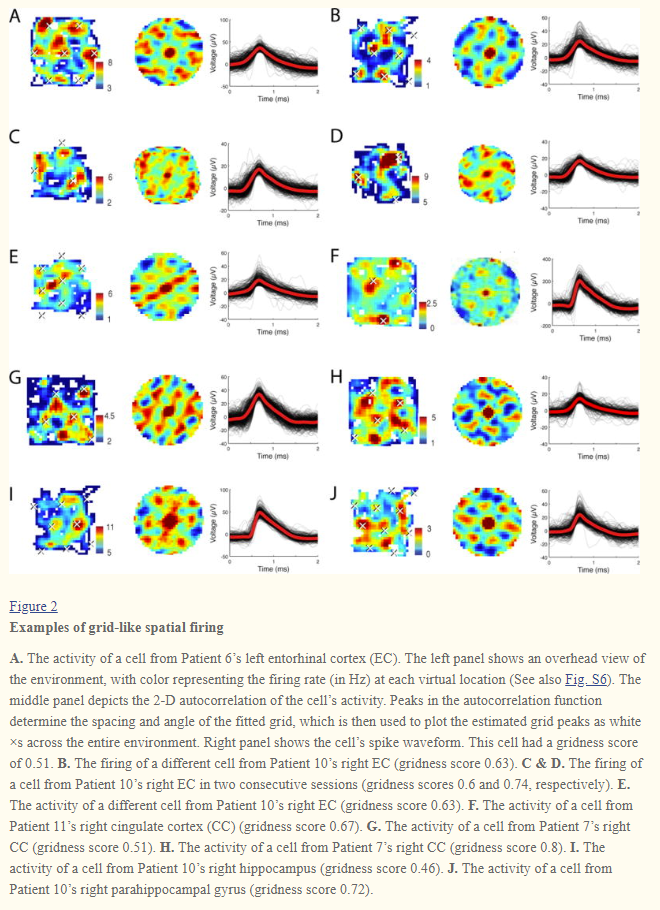
  • Direct recordings of grid-like neuronal activity in human spatial navigation
    • Grid cells in the entorhinal cortex appear to represent spatial location via a triangular coordinate system. Such cells, which have been identified in rats, bats, and monkeys, are believed to support a wide range of spatial behaviors. By recording neuronal activity from neurosurgical patients performing a virtual-navigation task we identified cells exhibiting grid-like spiking patterns in the human brain, suggesting that humans and simpler animals rely on homologous spatial-coding schemes. Human grid cells
  • The cognitive map in humans: spatial navigation and beyond
    • The ‘cognitive map’ hypothesis proposes that brain builds a unified representation of the spatial environment to support memory and guide future action. Forty years of electrophysiological research in rodents suggest that cognitive maps are neurally instantiated by place, grid, border and head direction cells in the hippocampal formation and related structures. Here we review recent work that suggests a similar functional organization in the human brain and yields insights into how cognitive maps are used during spatial navigation. Specifically, these studies indicate that (i) the human hippocampus and entorhinal cortex support map-like spatial codes, (ii) posterior brain regions such as parahippocampal and retrosplenial cortices provide critical inputs that allow cognitive maps to be anchored to fixed environmental landmarks, and (iii) hippocampal and entorhinal spatial codes are used in conjunction with frontal lobe mechanisms to plan routes during navigation. We also discuss how these three basic elements of cognitive map based navigation—spatial coding, landmark anchoring and route planning—might be applied to nonspatial domains to provide the building blocks for many core elements of human thought.
  • Spatial scaffold effects in event memory and imagination
    • Jessica Robin
    • Spatial context is a defining feature of episodic memories, which are often characterized as being events occurring in specific spatiotemporal contexts. In this review, I summarize research suggesting a common neural basis for episodic and spatial memory and relate this to the role of spatial context in episodic memory. I review evidence that spatial context serves as a scaffold for episodic memory and imagination, in terms of both behavioral and neural effects demonstrating a dependence of episodic memory on spatial representations. These effects are mediated by a posterior-medial set of neocortical regions, including the parahippocampal cortex, retrosplenial cortex, posterior cingulate cortex, precuneus, and angular gyrus, which interact with the hippocampus to represent spatial context in remembered and imagined events. I highlight questions and areas that require further research, including differentiation of hippocampal function along its long axis and subfields, and how these areas interact with the posterior-medial network.
  • Identifying the cognitive processes underpinning hippocampal-dependent tasks (preprint, not peer-reviewed)
    • Autobiographical memory, future thinking and spatial navigation are critical cognitive functions that are thought to be related, and are known to depend upon a brain structure called the hippocampus. Surprisingly, direct evidence for their interrelatedness is lacking, as is an understanding of why they might be related. There is debate about whether they are linked by an underlying memory-related process or, as has more recently been suggested, because they each require the endogenous construction of scene imagery. Here, using a large sample of participants and multiple cognitive tests with a wide spread of individual differences in performance, we found that these functions are indeed related. Mediation analyses further showed that scene construction, and not memory, mediated (explained) the relationships between the functions. These findings offer a fresh perspective on autobiographical memory, future thinking, navigation, and also on the hippocampus, where scene imagery appears to play a highly influential role.
  • Home early to wait for FedEx. And here’s a fun thing: dkgpgukx0aatbal

Phil 8.8.18

7:00 – 4:00 ASRC MKT

  • Oh, look, a new Tensorflow (1.10). Time to break things. I like the BigTable integration though.
  • Learning Meaning in Natural Language Processing — A Discussion
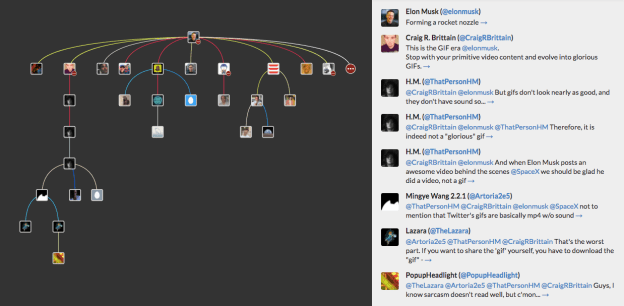
    • Last week a tweet by Jacob Andreas triggered a huge discussion on Twitter that many people have called the meaning/semantics mega-thread. Twitter is a great medium for having such a discussion, replying to any comment allows to revive the debate from the most promising point when it’s stuck in a dead-end. Unfortunately Twitter also makes the discussion very hard to read afterwards so I made three entry points to explore this fascinating mega-thread:

      1. a summary of the discussion that you will find below,
      2. an interactive view to explore the trees of tweets, and
      3. commented map to get an overview of the main points discussed:
  • The Current Best of Universal Word Embeddings and Sentence Embeddings
    • This post is thus a brief primer on the current state-of-the-art in Universal Word and Sentence Embeddings, detailing a few

      • strong/fast baselines: FastText, Bag-of-Words
      • state-of-the-art models: ELMo, Skip-Thoughts, Quick-Thoughts, InferSent, MILA/MSR’s General Purpose Sentence Representations & Google’s Universal Sentence Encoder.

      If you want some background on what happened before 2017 😀, I recommend the nice post on word embeddings that Sebastian wrote last year and his intro posts.

  • Treeverse is a browser extension for navigating burgeoning Twitter conversations. right_pane
  • Detecting computer-generated random responding in questionnaire-based data: A comparison of seven indices
    • With the development of online data collection and instruments such as Amazon’s Mechanical Turk (MTurk), the appearance of malicious software that generates responses to surveys in order to earn money represents a major issue, for both economic and scientific reasons. Indeed, even if paying one respondent to complete one questionnaire represents a very small cost, the multiplication of botnets providing invalid response sets may ultimately reduce study validity while increasing research costs. Several techniques have been proposed thus far to detect problematic human response sets, but little research has been undertaken to test the extent to which they actually detect nonhuman response sets. Thus, we proposed to conduct an empirical comparison of these indices. Assuming that most botnet programs are based on random uniform distributions of responses, we present and compare seven indices in this study to detect nonhuman response sets. A sample of 1,967 human respondents was mixed with different percentages (i.e., from 5% to 50%) of simulated random response sets. Three of the seven indices (i.e., response coherence, Mahalanobis distance, and person–total correlation) appear to be the best estimators for detecting nonhuman response sets. Given that two of those indices—Mahalanobis distance and person–total correlation—are calculated easily, every researcher working with online questionnaires could use them to screen for the presence of such invalid data.
  • Continuing to work on SASO slides – close to done. Got a lot of adversarial herding FB examples from the House Permanent Committee on Intelligence. Need to add them to the slide. Sobering.
  • And this looks like a FANTASTIC ride out of Trento: ridewithgps.com/routes/27552411
  • Fixed the border menu so that it’s a toggle group

Phil 8.6.18

7:00 – 5:00 ASRC CONF

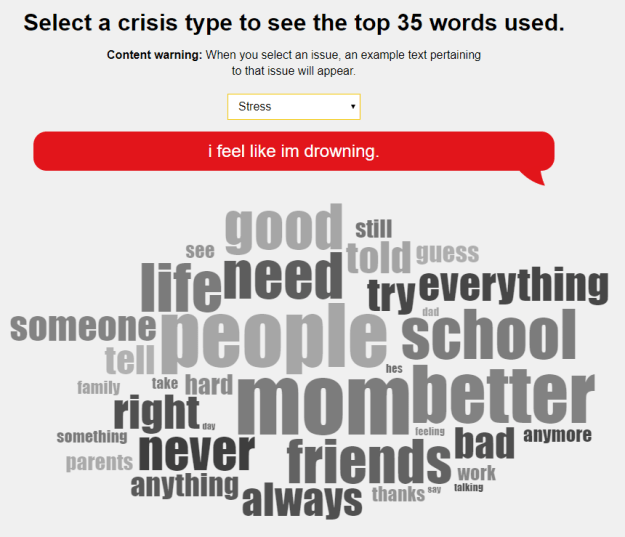
  • Heard about this on the Ted Radio Hour: Crisis Trends
    • Crisis Trends empowers journalists, researchers, school administrators, parents, and all citizens to understand the crises their communities face so we can work together to prevent future crises. Crisis Trends was originally funded by the Robert Wood Johnson Foundation. CurrentTrends
  • Committee talk today!
    • Tweaked the flowchart slides
    • Added pix to either end of the “model(?)” slide showing that the amount of constraint is maximum at either end. On the nomadic side, the environment is the constraint. Imagine a solitary activity in a location so dangerous that any false move would result in death or injury. Think of freeclimbing: b16-540x354
    • On the other end of the spectrum is the maximum social constraint of totalitarianism, which is summed up nicely in this play on the constitutional basis for English law “Everything not forbidden is allowed” by T. H. White THWhite
    • The presentation went pretty well. There is a consensus that I should look for existing sources of discussions that reach consensus. Since this has to be a repeated discussion about the same topic, I think that sports are the only real option.
  • Added a slide on tracking changes to the Latex presentation slides for next week
  • Amusing ourselves to Trump
    • The point of Amusing Ourselves to Death is that societies are molded by the technologies atop which they communicate. Oral cultures teach us to be conversational, typographic cultures teach us to be logical, televised cultures teach us that everything is entertainment. So what is social media culture teaching us?
  • It’s Looking Extremely Likely That QAnon Is A Leftist Prank On Trump Supporters
    • There’s a growing group of Trump supporters who are convinced that the president is secretly trying to save the world from a global pedophilia ring.