Category Archives: Lit Review

Phil 11.19.18

6:00 – 2:30 ASRC PhD, NASA

  • Antonio didn’t make much in the way of modifications, so I think the paper is now done. Ask tomorrow if it’s alright to put this version on ArXive.
  • ‘Nothing on this page is real’: How lies become truth in online America
    • A new message popped onto Blair’s screen from a friend who helped with his website. “What viral insanity should we spread this morning?” the friend asked. “The more extreme we become, the more people believe it,” Blair replied.
    • “No matter how racist, how bigoted, how offensive, how obviously fake we get, people keep coming back,” Blair once wrote, on his own personal Facebook page. “Where is the edge? Is there ever a point where people realize they’re being fed garbage and decide to return to reality?”
  • Blind appears to be the LinkedIn version of Secret/Whisper
    • Blind is an anonymous social networking platform for professionals. Work email-verified professionals can connect with coworkers and other company/industry professionals by holding meaningful conversations on a variety of different topics.
  • Started reading Third Person. It really does look like the literature is thin:
    • A crucial consideration when editing our previous volume, Second Person, was to give close attention to the underexamined area of tabletop role-playing games. Generally speaking, what scholarly consideration these games have received has cast them as of historical interest, as forerunners of today’s digital games. In his chapter here, Ken Rolston-the designer of major computer role-playing games such as the Elder Scrolls titles Morrowind and Oblivion-says that his strongest genre influences are tabletop RPGs and live-action role-playing (IARP) games. He considers nonwired RPGs to be a continuing vital force, and so do we. (Page 7)
  • Quick meeting with Wayne
    • CHI Play 2019
      • CHI PLAY is the international and interdisciplinary conference (by ACM SIGCHI) for researchers and professionals across all areas of play, games and human-computer interaction (HCI). We call this area “player-computer interaction.”  22–25 October 2019
    • Conversation Map: An Interface for Very-Large-Scale Conversations
      • Very large-scale conversation (VLSC) involves the exchange of thousands of electronic mail (e-mail) messages among hundreds or thousands of people. Usenet newsgroups are good examples (but not the only examples) of online sites where VLSCs take place. To facilitate understanding of the social and semantic structure of VLSCs, two tools from the social sciences—social networks and semantic networks—have been extended for the purposes of interface design. As interface devices, social and semantic networks need to be flexible, layered representations that are useful as a means for summarizing, exploring, and cross-indexing the large volumes of messages that constitute the archives of VLSCs. This paper discusses the design criteria necessary for transforming these social scientific representations into interface devices. The discussion is illustrated with the description of the Conversation Map system, an implemented system for browsing and navigating VLSCs.
    • Terra Nova blog
    • Nic Ducheneaut
      • My research pioneered the use of large-scale, server-side data for modeling behavior in video games. At Xerox PARC I founded the PlayOn project, which conducted the longest and largest quantitative study of user behavior in World of Warcraft (500,000+ players observed over 5 years). At Ubisoft, I translated my findings into practical recommendations for both video game designers and business leaders. Today, as the co-founder and technical lead of Quantic Foundry, I help game companies bridge analytics and game design to maximize player engagement and retention.
    • Nick Yee
      • I’m the co-founder and analytics lead of Quantic Foundry, a consulting practice around game analytics. I combine social science, data science, and an understanding of the psychology of gamers to generate actionable insights in gameplay and game design.
    • Celia pierce
      • Celia Pearce is a game designer, artist, author, curator, teacher, and researcher specializing in multiplayer gaming and virtual worlds, independent, art, and alternative game genres, as well as games and gender. 
    • T. L. Taylor
      • T.L. Taylor is is a qualitative sociologist who has focused on internet and game studies for over two decades. Her research explores the interrelations between culture and technology in online leisure environments. 
    • MIT10: A Reprise – Democracy and Digital Media
      • Paper proposals might address the following topics/issues:
        • politics of truth/lies, alternative facts
        • media, authoritarianism, and polarization
        • diversity in gaming / livestreaming / esports
        • making or breaking publics with algorithmic cultures/machine learning/AI
        • environmental media (from medium theory to climate change) and activism
        • media infrastructures as public utilities or utility publics?
        • social media, creating consensus, and bursting filter bubbles
        • designing media technologies for inclusion
        • the #metoo movement and its impact
        • social media platforms (FaceBook, Twitter, Instagram, etc), politics, and civic responsibility
        • Twitter, viral videos, and the new realities of political advertising
      • Please submit individual paper proposals, which should include a title, author(s) name, affiliation, 250-word abstract, and 75-word biographical statement to this email address: media-in-transition@mit.edu — by February 1, 2019. Early submissions are encouraged and we will review them on a rolling basis. Full panel proposals of 3 to 4 speakers can also be submitted, and should include a panel title and the details listed above for each paper, as well as a panel moderator. We notify you of the status of your proposals by February 15, 2019 at the latest.
  • Continuing Characterizing Online Public Discussions through Patterns of Participant Interactions. Sheesh, that’s a long article. 21 pages!
  • More Grokking: Here’s a very simple full NN:
    # based on https://github.com/iamtrask/Grokking-Deep-Learning/blob/master/Chapter6%20-%20Intro%20to%20Backpropagation%20-%20Building%20Your%20First%20DEEP%20Neural%20Network.ipynb
    import numpy as np
    import matplotlib.pyplot as plt
    
    # variables ------------------------------------------
    
    # one weight for each column (or light - the things we're sampling)
    weight_array = np.random.rand(3)
    alpha = 0.1
    
    # the samples. Columns are the things we're sampling
    streetlights_array = np.array([[1, 0, 1],
                                   [ 0, 1, 1 ],
                                   [ 0, 0, 1 ],
                                   [ 1, 1, 1 ],
                                   [ 0, 1, 1 ],
                                   [ 1, 0, 1 ]])
    
    # The data set we want to map to. Each entry in the array matches the corresponding streetlights_array roe
    walk_vs_stop_array = np.array([0, 1, 0, 1, 1, 0])
    
    error_plot_mat = [] # for drawing plots
    weight_plot_mat = [] # for drawing plots
    iter = 0
    max_iter = 1000
    epsilon = 0.001
    total_error = 2 * epsilon
    
    while total_error > epsilon:
        total_error = 0
        for row_index in range(len(walk_vs_stop_array)):
            input_array = streetlights_array[row_index]
            goal_prediction = walk_vs_stop_array[row_index]
    
            prediction = input_array.dot(weight_array)
            error = (goal_prediction - prediction) ** 2
            total_error += error
    
            delta = prediction - goal_prediction
            weight_array = weight_array - (alpha * (input_array * delta))
    
            print("[{}] Error: {}, Weights: {}".format(iter, total_error, weight_array))
            error_plot_mat.append([total_error, error])
            weight_plot_mat.append(weight_array.copy())
    
            iter += 1
            if iter > max_iter:
                break
    
    
    f1 = plt.figure(1)
    plt.plot(error_plot_mat)
    plt.title("error")
    plt.legend(["total_error", "error"])
    #f1.show()
    
    f2 = plt.figure(2)
    plt.plot(weight_plot_mat)
    names = []
    for i in range(len(weight_array)):
        names.append("weight[{}]".format(i))
    plt.legend(names)
    plt.title("weights")
    
    #f2.show()
    plt.show()
  • And here is it learning

Phil 11.16.18

7:00 – 4:00 PhD/NASA ASRC

Phil 11.15.18

ASRC PhD, NASA 7:00 – 5:00

  • Incorporate T’s changes – done!
  • Topic Modeling with LSA, PLSA, LDA & lda2Vec
    • This article is a comprehensive overview of Topic Modeling and its associated techniques.
  • More Grokking. Here’s the work for the day:
    # based on https://github.com/iamtrask/Grokking-Deep-Learning/blob/master/Chapter5%20-%20Generalizing%20Gradient%20Descent%20-%20Learning%20Multiple%20Weights%20at%20a%20Time.ipynb
    import numpy as np
    import matplotlib.pyplot as plt
    import random
    
    # methods ----------------------------------------------------------------
    def neural_network(input, weights):
        out = input @ weights
        return out
    
    def error_gt_epsilon(epsilon: float, error_array: np.array) -> bool:
        for i in range(len(error_array)):
            if error_array[i] > epsilon:
                return True
        return False
    
    # setup vars --------------------------------------------------------------
    #inputs
    toes_array =  np.array([8.5, 9.5, 9.9, 9.0])
    wlrec_array = np.array([0.65, 0.8, 0.8, 0.9])
    nfans_array = np.array([1.2, 1.3, 0.5, 1.0])
    
    #output goals
    hurt_array  = np.array([0.2, 0.0, 0.0, 0.1])
    wl_binary_array   = np.array([  1,   1,   0,   1])
    sad_array   = np.array([0.3, 0.0, 0.1, 0.2])
    
    weights_array = np.random.rand(3, 3) # initialise with random weights
    '''
    #initialized with fixed weights to compare with the book
    weights_array = np.array([ [0.1, 0.1, -0.3], #hurt?
                             [0.1, 0.2,  0.0], #win?
                             [0.0, 1.3,  0.1] ]) #sad?
    '''
    alpha = 0.01 # convergence scalar
    
    # just use the first element from each array fro training (for now?)
    input_array = np.array([toes_array[0], wlrec_array[0], nfans_array[0]])
    goal_array = np.array([hurt_array[0], wl_binary_array[0], sad_array[0]])
    
    line_mat = [] # for drawing plots
    epsilon = 0.01 # how close do we have to be before stopping
    #create and fill an error array that is big enough to enter the loop
    error_array = np.empty(len(input_array))
    error_array.fill(epsilon * 2)
    
    # loop counters
    iter = 0
    max_iter = 100
    
    while error_gt_epsilon(epsilon, error_array): # if any error in the array is big, keep going
    
        #right now, the dot product of the (3x1) input vector and the (3x3) weight vector that returns a (3x1) vector
        pred_array = neural_network(input_array, weights_array)
    
        # how far away are we linearly (3x1)
        delta_array = pred_array - goal_array
        # error is distance squared to keep positive and weight the system to fixing bigger errors (3x1)
        error_array = delta_array ** 2
    
        # Compute how far and in what direction (3x1)
        weights_d_array = delta_array * input_array
    
        print("\niteration [{}]\nGoal = {}\nPred = {}\nError = {}\nDelta = {}\nWeight Deltas = {}\nWeights: \n{}".format(iter, goal_array, pred_array, error_array, delta_array, weights_d_array, weights_array))
    
        #subtract the scaled (3x1) weight delta array from the weights array
        weights_array -= (alpha * weights_d_array)
    
        #build the data for the plot
        line_mat.append(np.copy(error_array))
        iter += 1
        if iter > max_iter:
            break
    
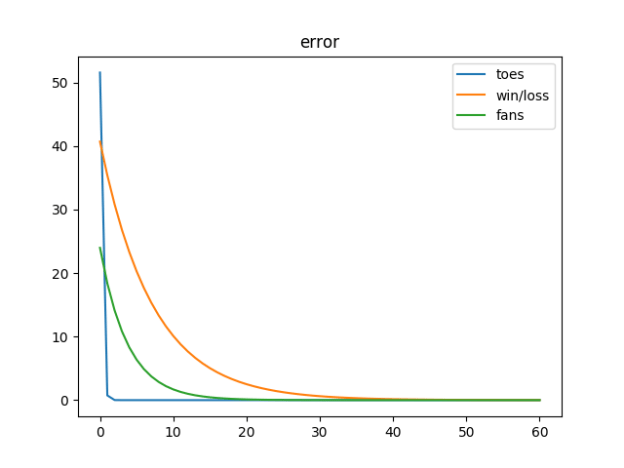
    plt.plot(line_mat)
    plt.title("error")
    plt.legend(("toes", "win/loss", "fans"))
    plt.show()
  • Here’s a chart! Learning
  • Continuing Characterizing Online Public Discussions through Patterns of Participant Interactions

Phil 11.14.18

7:00 – 4:00 ASRC PhD, NASA

  • Discovered Critical Roll D&D Youtube channel
  • Talk to Aaron about adding a time (or post?) constraint to dungeon runs. Faster runs/fewer posts get higher scores. This might be a way to highlight the difference between homogeneous and heterogeneous party composition lexical variance.
  • Added the conversation analytic link to the Belief Spaces doc
  • Added the following bit to my main blog post on Lists, Stories and Maps
  • Add to the Stories, Lists and Maps writeup something about the cognitive power of stories. There is, in many religions and philosophies, the concept of “being in the moment” where we become simply aware of what’s going on right now, without all the cognitive framing and context that we normally bring to every experience [citation needed]. This is different from “mindfulness”, where we try to be aware of the cognitive framing and context. To me, this is indicative of how we experience life through the lens of path dependency, which is a sort of a narrative. If this is true, then it explains the power of stories, because it allows us to literally step into another life. This explains phrases like “losing yourself in a story”.
  • This doesn’t happen with lists. It only happens in special cases in diagrams and maps, where you can see yourself in the map. Which is why the phrase “the map is not the territory” is different from “losing yourself in the story”. In the first case, you confuse your virtual and actual environment. In the latter, you confuse your virtual and actual identity. And since that story becomes part of your path through life, the virtual is incorporated into the actual life narrative, particularly if the story is vivid.
  • So narratives are an alignment mechanism. Simple stories that collapse information into a already existing beliefs can be confirming and reinforcing across a broad population. Complicated stories that challenge existing beliefs require a change in alignment to incorporate. That’s computationally expensive, and will affect fewer people, all things being equal.
  • Which leads me to thinking that the need for novelty is what creates the heading and velocity driven behavior we see in belief space behavior. I think this needs to be a chapter in the dissertation. Just looking for some background literature, I found these:
    • Novelty-Seeking in Rats-Biobehavioral Characteristics and Possible Relationship with the Sensation-Seeking Trait in Man
      • A behavioral trait in rats which resembles some of the features of high-sensation seekers in man has been characterized. Given that the response to novelty is the basis of the definition of sensation-seeking, individual differences in reactivity to novelty have been studied on behavioral and biological levels. Certain individuals labeled as high responders (HR) as opposed to low responders (LR) have been shown to be highly reactive when exposed to a novel environment. These groups were investigated for free-choice responses to novel environments differing in complexity and aversiveness, and to other kinds of reinforcement, i.e. food and a drug. The HR rats appeared to seek novelty, variety and emotional stimulation. Only HR individuals have been found to be predisposed to drug-taking: they develop amphetamine self-administration whereas LR individuals do not. They also exhibit a higher sensitivity to the reinforcing properties of food. On a biological level, compared to LR rats, HR animals have an enhanced level of dopaminergic activity in the nucleus accumbens both under basal conditions or following a tail-pinch stress. HR and LR rats differ in reactivity of the corticotropic axis: HR rats exposed to a novel environment have a prolonged secretion of corticosterone compared to LR rats. The association of novelty, drug and food seeking in the same individual suggests that these characteristics share common processes. Differences in dopaminergic activity between HR and LR rats are consistent with results implicating these dopaminergic neurons in response to novelty and in drug-taking behavior. Given that rats self-administer corticosterone and that HR rats are more sensitive to the reinforcing properties of corticoste-roids, it could be speculated that HR rats seek novelty for the reinforcing action of corticosterone. These characteristics may be analogous to some for the features found in human high-sensation seekers and this animal model may be useful in determinating the biological basis of this human trait.
    • The Psychology and Neuroscience of Curiosity
      • Curiosity is a basic element of our cognition, but its biological function, mechanisms, and neural underpinning remain poorly understood. It is nonetheless a motivator for learning, influential in decision-making, and crucial for healthy development. One factor limiting our understanding of it is the lack of a widely agreed upon delineation of what is and is not curiosity. Another factor is the dearth of standardized laboratory tasks that manipulate curiosity in the lab. Despite these barriers, recent years have seen a major growth of interest in both the neuroscience and psychology of curiosity. In this Perspective, we advocate for the importance of the field, provide a selective overview of its current state, and describe tasks that are used to study curiosity and information-seeking. We propose that, rather than worry about defining curiosity, it is more helpful to consider the motivations for information-seeking behavior and to study it in its ethological context.
    • Theory of Choice in Bandit, Information Sampling and Foraging Tasks
      • Decision making has been studied with a wide array of tasks. Here we examine the theoretical structure of bandit, information sampling and foraging tasks. These tasks move beyond tasks where the choice in the current trial does not affect future expected rewards. We have modeled these tasks using Markov decision processes (MDPs). MDPs provide a general framework for modeling tasks in which decisions affect the information on which future choices will be made. Under the assumption that agents are maximizing expected rewards, MDPs provide normative solutions. We find that all three classes of tasks pose choices among actions which trade-off immediate and future expected rewards. The tasks drive these trade-offs in unique ways, however. For bandit and information sampling tasks, increasing uncertainty or the time horizon shifts value to actions that pay-off in the future. Correspondingly, decreasing uncertainty increases the relative value of actions that pay-off immediately. For foraging tasks the time-horizon plays the dominant role, as choices do not affect future uncertainty in these tasks.
  • How Political Campaigns Weaponize Social Media Bots (IEEE)
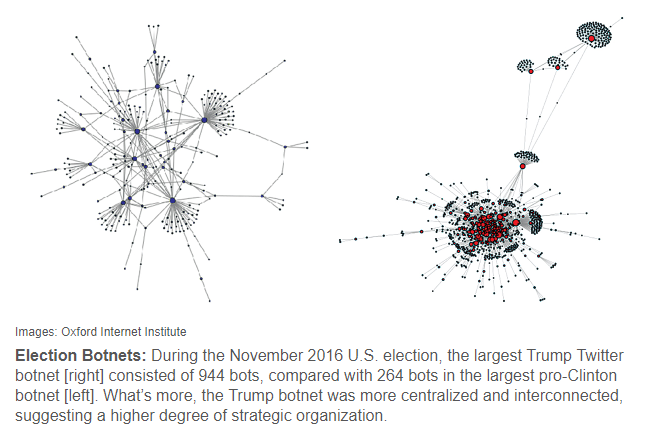
    • TrumpClintonBotnets
  • Starting Characterizing Online Public Discussions through Patterns of Participant Interactions
  • More Grokking ML

Phil 11.13.18

7:00 – 4:30

  • Bills
  • Get oil change kit from Bob’s
  • Antonio paper – done first complete pass
  • Sent Wayne a note to see if he knows of any online D&D research. My results are thin (see below)
  • Nice chat with Aaron about mapping in the D&D space. We reiterated that the goal of the first paper should be able to do the following:
    • map a linear dungeon
    • map the belief space adjacent to the dungeon (PC debates to consensus on how to proceed)
    • map the space in an open dungeon
    • map the belief space adjacent to an open dungeon
    • Additionally, we should be able to show that diversity (or lack of it) is recognizable. A mixed party should have a broader lexical set than a party of only fighters
    • We also realized that mapping could be a very good lens for digital anthropology. An interesting follow on paper could be an examination of how users run through a known dungeon, such as The Tomb of Horrors to see how the map generates, and to compare that to a version where the names of the items have been disguised so it’s not obvious that it’s the same game
  • Ordered these books. There doesn’t seem to be much else in the space, so I’m curious about the reference section
    • Second Person: Role-Playing and Story in Games and Playable Media (MIT Press)
      • Games and other playable forms, from interactive fictions to improvisational theater, involve role playing and story—something played and something told. In Second Person, game designers, authors, artists, and scholars examine the different ways in which these two elements work together in tabletop role-playing games (RPGs), computer games, board games, card games, electronic literature, political simulations, locative media, massively multiplayer games, and other forms that invite and structure play.  Second Person—so called because in these games and playable media it is “you” who plays the roles, “you” for whom the story is being told—first considers tabletop games ranging from Dungeons & Dragons and other RPGs with an explicit social component to Kim Newman’s Choose Your Own Adventure-style novel Life’s Lottery and its more traditional author-reader interaction. Contributors then examine computer-based playable structures that are designed for solo interaction—for the singular “you”—including the mainstream hit Prince of Persia: The Sands of Time and the genre-defining independent production Façade. Finally, contributors look at the intersection of the social spaces of play and the real world, considering, among other topics, the virtual communities of such Massively Multiplayer Online Role Playing Games (MMORPGs) as World of Warcraft and the political uses of digital gaming and role-playing techniques (as in The Howard Dean for Iowa Game, the first U.S. presidential campaign game).
    • Third Person: Authoring and Exploring Vast Narratives (The MIT Press)
      • The ever-expanding capacities of computing offer new narrative possibilities for virtual worlds. Yet vast narratives—featuring an ongoing and intricately developed storyline, many characters, and multiple settings—did not originate with, and are not limited to, Massively Multiplayer Online Games. Thomas Mann’s Joseph and His Brothers, J. R. R. Tolkien’s Lord of the Rings, Marvel’s Spiderman, and the complex stories of such television shows as Dr. Who, The Sopranos, and Lost all present vast fictional worlds. Third Person explores strategies of vast narrative across a variety of media, including video games, television, literature, comic books, tabletop games, and digital art. The contributors—media and television scholars, novelists, comic creators, game designers, and others—investigate such issues as continuity, canonicity, interactivity, fan fiction, technological innovation, and cross-media phenomena. Chapters examine a range of topics, including storytelling in a multiplayer environment; narrative techniques for a 3,000,000-page novel; continuity (or the impossibility of it) in Doctor Who; managing multiple intertwined narratives in superhero comics; the spatial experience of the Final Fantasy role-playing games; World of Warcraft adventure texts created by designers and fans; and the serial storytelling of The Wire. Taken together, the multidisciplinary conversations in Third Person, along with Harrigan and Wardrip-Fruin’s earlier collections First Person and Second Person, offer essential insights into how fictions are constructed and maintained in very different forms of media at the beginning of the twenty-first century.
  • A Support System to Accumulate Interpretations of Multiple Story Timelines
    • The story base interpretation is subjectively summarised and segmented from the first-person viewpoint. However, we often need to objectively represent an entire image by integrated knowledge. Yet, this is a difficult task. We proposed a novel approach, named the synthetic evidential study (SES), for understanding and augmenting collective thought processes through substantiated thought by interactive media. In this study, we investigated the kind of data that can be obtained through the SES sessions as interpretation archives and whether the database is useful to understand multiple story timelines. For the purpose, we designed a machine-readable interpretation data format and developed support systems to create and provide data that are easy to understand. We conducted an experiment using the simulation of the projection phase in SES sessions. From the results, we suggested that a “meta comment” which was deepened interpretation comment by the others in the interpretation archives to have been posted when it was necessary to consider other participants’ interpretation to broaden their horizons before posting the comment. In addition, the construction of networks to represent the relationships between the interpretation comments enabled us to suggest the important comments by using the degree centrality.

Phil 11.12.18

7:00 – 7:00 ASRC PhD

  • Call Tim Ellis – done
  • Tags – done
  • Bills – nope, including MD EV paperwork -done
  • Get oil change kit from Bob’s – closed
  • Fika – done
  • Finish Similar neural responses predict friendship – Done!
  • Discrete hierarchical organization of social group sizes
    • The ‘social brain hypothesis’ for the evolution of large brains in primates has led to evidence for the coevolution of neocortical size and social group sizes, suggesting that there is a cognitive constraint on group size that depends, in some way, on the volume of neural material available for processing and synthesizing information on social relationships. More recently, work on both human and non-human primates has suggested that social groups are often hierarchically structured. We combine data on human grouping patterns in a comprehensive and systematic study. Using fractal analysis, we identify, with high statistical confidence, a discrete hierarchy of group sizes with a preferred scaling ratio close to three: rather than a single or a continuous spectrum of group sizes, humans spontaneously form groups of preferred sizes organized in a geometrical series approximating 3–5, 9–15, 30–45, etc. Such discrete scale invariance could be related to that identified in signatures of herding behaviour in financial markets and might reflect a hierarchical processing of social nearness by human brains.
  • Work on Antonio’s paper – good progress
  • Aaron added a lot of content to Belief Spaces, and we got together to discuss. Probably the best thing to come out of the discussion was an approach to the dungeons that at one end is an acyclic, directed, linear graph of connected nodes. The map will be a line, with any dilemma discussions connected with the particular nodes. At the other end is an open environment. In between are various open and closed graphs that we can classify with some level of complexity.
  • One of the things that might be interesting to examine is the distance between nodes, and how that affects behavior
  • Need to mention that D&D are among the oldest “digital residents” of the internet, with decades-old artifacts.

Phil 11.9.18

7:00 – ASRC PhD/BD/NASA

  • Started to write up the study design for Belief Spaces/Places in a Google doc
  • More Grokking ML – ok progress
  • Riot – a glossy Matrix collaboration client for the web. http://riot.im
  • Lets Chat is a persistent messaging application that runs on Node.js and MongoDB. It’s designed to be easily deployable and fits well with small, intimate teams. (GitHub)
  • Mattermost is an open source, self-hosted Slack-alternative. As an alternative to proprietary SaaS messaging, Mattermost brings all your team communication into one place, making it searchable and accessible anywhere. It’s written in Golang and React and runs as a production-ready Linux binary under an MIT license with either MySQL or Postgres. (GitHub)
  • PHPbb is hosted on Dreamhost
  • Sprint planning
  • Analysis of visitors’ mobility patterns through random walk in the Louvre museum
    • This paper proposes a random walk model to analyze visitors’ mobility patterns in a large museum. Visitors’ available time makes their visiting styles different, resulting in dissimilarity in the order and number of visited places and in path sequence length. We analyze all this by comparing a simulation model and observed data, which provide us the strength of the visitors’ mobility patterns. The obtained results indicate that shorter stay-type visitors exhibit stronger patterns than those with the longer stay-type, confirming that the former are more selective than the latter in terms of their visitation type.
  • Same Story, Different Story The Neural Representation of Interpretive Frameworks
    • Differences in people’s beliefs can substantially impact their interpretation of a series of events. In this functional MRI study, we manipulated subjects’ beliefs, leading two groups of subjects to interpret the same narrative in different ways. We found that responses in higher-order brain areas—including the default-mode network, language areas, and subsets of the mirror neuron system—tended to be similar among people who shared the same interpretation, but different from those of people with an opposing interpretation. Furthermore, the difference in neural responses between the two groups at each moment was correlated with the magnitude of the difference in the interpretation of the narrative. This study demonstrates that brain responses to the same event tend to cluster together among people who share the same views.
  • Similar neural responses predict friendship
    • Computational Social Neuroscience Lab 
      • The Computational Social Neuroscience Lab is located in the Department of Psychology at UCLA.We study how our brains allow us to represent and navigate the social world. We take a multidisciplinary approach to research that integrates theory and methods from cognitive neuroscience, machine learning, social network analysis, and social psychology.
    • Authors
    • Research has borne out this intuition: social ties are forged at a higher-than expected rate between individuals of the same age, gender, ethnicity, and other demographic categories. This assortativity in friendship networks is referred to as homophily and has been demonstrated across diverse contexts and geographic locations, including online social networks [2, 3, 4, 5(Page 2)
    • When humans do forge ties with individuals who are dissimilar from themselves, these relationships tend to be instrumental, task-oriented (e.g., professional collaborations involving people with complementary skill sets [7]), and short-lived, often dissolving after the individuals involved have achieved their shared goal. Thus, human social networks tend to be overwhelmingly homophilous [8]. (Page 2)
      • This means that groups can be more efficient, but prone to belief stampede
    • Remarkably, social network proximity is as important as genetic relatedness and more important than geographic proximity in predicting the similarity of two individuals’ cooperative behavioral tendencies [4] (Page 2)
    • how individuals interpret and respond to their environment increases the predictability of one another’s thoughts and actions during social interactions [14], since knowledge about oneself is a more valid source of information about similar others than about dissimilar others. (Page 2)
      • There is a second layer on top of this which may be more important. How individuals respond to social cues (which can have significant survival value in a social animal) may be more important than day-to-day reactions to the physical environment.
    • Here we tested the proposition that neural responses to naturalistic audiovisual stimuli are more similar among friends than among individuals who are farther removed from one another in a real-world social network. Measuring neural activity while people view naturalistic stimuli, such as movie clips, offers an unobtrusive window into individuals’ unconstrained thought processes as they unfold [16(page 2)
    • Social network proximity appears to be significantly associated with neural response similarity in brain regions involved in attentional allocation, narrative interpretation, and affective responding (Page 2)
    • We first characterized the social network of an entire cohort of students in a graduate program. All students (N = 279) in the graduate program completed an online survey in which they indicated the individuals in the program with whom they were friends (see Methods for further details). Given that a mutually reported tie is a stronger indicator of the presence of a friendship than an unreciprocated tie, a graph consisting only of reciprocal (i.e., mutually reported) social ties was used to estimate social distances between individuals. (Page 2)
      • I wonder if this changes as people age. Are there gender differences?
    • The videos presented in the fMRI study covered a range of topics and genres (e.g., comedy clips, documentaries, and debates) that were selected so that they would likely be unfamiliar to subjects, effectively constrain subjects’ thoughts and attention to the experiment (to minimize mind wandering), and evoke meaningful variability in responses across subjects (because different subjects attend to different aspects of them, have different emotional reactions to them, or interpret the content differently, for example). (Page 3)
      • I think this might make the influence more environmental than social. It would be interesting to see how a strongly aligned group would deal with a polarizing topic, even something like sports.
    • Mean response time series spanning the course of the entire experiment were extracted from 80 anatomical regions of interest (ROIs) for each of the 42 fMRI study subjects (page 3)
      • 80 possible dimensions. It would be interesting to see this in latent space. That being said, there is no dialog here, so no consensus building, which implies no dimension reduction.
    • To test for a relationship between fMRI response similarity and social distance, a dyad-level regression model was used. Models were specified either as ordered logistic regressions with categorical social distance as the dependent variable or as logistic regression with a binary indicator of reciprocated friendship as the dependent variable. We account for the dependence structure of the dyadic data (i.e., the fact that each fMRI subject is involved in multiple dyads), which would otherwise underestimate the standard errors and increase the risk of type 1 error [20], by clustering simultaneously on both members of each dyad [21, 22].
    • For the purpose of testing the general hypothesis that social network proximity is associated with more similar neural responses to naturalistic stimuli, our main predictor variable of interest, neural response similarity within each student dyad, was summarized as a single variable. Specifically, for each dyad, a weighted average of normalized neural response similarities was computed, with the contribution of each brain region weighted by its average volume in our sample of fMRI subjects. (Page 3)
    • To account for demographic differences that might impact social network structure, our model also included binary predictor variables indicating whether subjects in each dyad were of the same or different nationalities, ethnicities, and genders, as well as a variable indicating the age difference between members of each dyad. In addition, a binary variable was included indicating whether subjects were the same or different in terms of handedness, given that this may be related to differences in brain functional organization [23]. (page 3)
    • Logistic regressions that combined all non-friends into a single category, regardless of social distance, yielded similar results, such that neural similarity was associated with a dramatically increased likelihood of friendship, even after accounting for similarities in observed demographic variables. More specifically, a one SD increase in overall neural similarity was associated with a 47% increase in the likelihood of friendship (logistic regression: ß = 0.388; SE = 0.109; p = 0.0004; N = 861 dyads). Again, neural similarity improved the model’s predictive power above and beyond observed demographic similarities, χ2(1) = 7.36, p = 0.006. (Page 4)
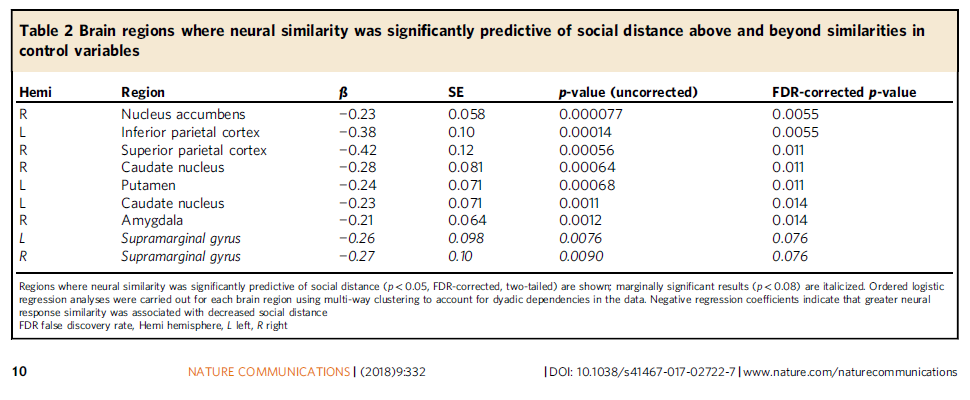
    • To gain insight into what brain regions may be driving the relationship between social distance and overall neural similarity, we performed ordered logistic regression analyses analogous to those described above independently for each of the 80 ROIs, again using cluster-robust standard errors to account for dyadic dependencies in the data. This approach is analogous to common fMRI analysis approaches in which regressions are carried out independently at each voxel in the brain, followed by correction for multiple comparisons across voxels. We employed false discovery rate (FDR) correction to correct for multiple comparisons across brain regions. This analysis indicated that neural similarity was associated with social network proximity in regions of the ventral and dorsal striatum … Regression coefficients for each ROI are shown in Fig. 6, and further details for ROIs that met the significance threshold of p < 0.05, FDR-corrected (two tailed) are provided in Table 2. (Page 4)
      • So the latent space that matters involves something on the order of 7 – 9 regions? I wonder if the actions across regions are similar enough to reduce further. I need to look up what each region does.
    • Table 2Figure6
    • Results indicated that average overall (weighted average) neural similarities were significantly higher among distance 1 dyads than dyads belonging to other social distance categories … distance 4 dyads were not significantly different in overall neural response similarity from dyads in the other social distance categories. All reported p-values are two-tailed. (Page 4)
    • Within the training data set for each data fold, a grid search procedure [24] was used to select the C parameter of a linear support vector machine (SVM) learning algorithm that would best separate dyads according to social distance. (Page 5)
    • As shown in Fig. 8, the classifier tended to predict the correct social distances for dyads in all distance categories at rates above the accuracy level that would be expected based on chance alone (i.e., 25% correct), with an overall classification accuracy of 41.25%. Classification accuracies for distance 1, 2, 3, and 4 dyads were 48%, 39%, 31%, and 47% correct, respectively. (Page 6)
    • where the classifier assigned the incorrect social distance label to a dyad, it tended to be only one level of social distance away from the correct answer: when friends were misclassified, they were misclassified most often as distance 2 dyads; when distance 2 dyads were misclassified, they were misclassified most often as distance 1 or 3 dyads, and so on. (Page 6)
    • The results reported here are consistent with neural homophily: people tend to be friends with individuals who see the world in a similar way. (Page 7)
    • Brain areas where response similarity was associated with social network proximity included subcortical areas implicated in motivation, learning, affective processing, and integrating information into memory, such as the nucleus accumbens, amygdala, putamen, and caudate nucleus [27, 28, 29]. Social network proximity was also associated with neural response similarity within areas involved in attentional allocation, such as the right superior parietal cortex [30,31], and regions in the inferior parietal lobe, such as the bilateral supramarginal gyri and left inferior parietal cortex (which includes the angular gyrus in the parcellation scheme used [32]), that have been implicated in bottom-up attentional control, discerning others’ mental states, processing language and the narrative content of stories, and sense-making more generally [33, 34, 35]. (Page 7)
    • However, the current results suggest that social network proximity may be associated with similarities in how individuals attend to, interpret, and emotionally react to the world around them. (Page 7)
      • Both the environmental and social world
    • A second, not mutually exclusive, possibility pertains to the “three degrees of influence rule” that governs the spread of a wide range of phenomena in human social networks [43]. Data from large-scale observational studies as well as lab-based experiments suggest that wide-ranging phenomena (e.g., obesity, cooperation, smoking, and depression) spread only up to three degrees of geodesic distance in social networks, perhaps due to social influence effects decaying with social distance to the extent that the they are undetectable at social distances exceeding three, or to the relative instability of long chains of social ties [43]. Although we make no claims regarding the causal mechanisms behind our findings, our results show a similar pattern. (Page 8)
      • Does this change with the level of similarity in the group?
    • pre-existing similarities in how individuals tend to perceive, interpret, and respond to their environment can enhance social interactions and increase the probability of developing a friendship via positive affective processes and by increasing the ease and clarity of communication [14, 15]. (Page 8)

Phil 11.7.18

Let the House Subcommittee investigations begin! Also, better redistricting?

7:00 – 5:00 ASRC PhD/BD

  • Rather than Deep Learning with Keras, I’m starting on Grokking Deep Learning. I need better grounding
    • Installed Jupyter
  • After lunch, send follow-up emails to the technical POCs. This will be the basis for the white paper: Tentative findings/implications for design. Modify it on the blog page first and then use to create the LaTex doc. Make that one project, with different mains that share overlapping content.
  • Characterizing Online Public Discussions through Patterns of Participant Interactions
    • Public discussions on social media platforms are an intrinsic part of online information consumption. Characterizing the diverse range of discussions that can arise is crucial for these platforms, as they may seek to organize and curate them. This paper introduces a computational framework to characterize public discussions, relying on a representation that captures a broad set of social patterns which emerge from the interactions between interlocutors, comments and audience reactions. We apply our framework to study public discussions on Facebook at two complementary scales. First, we use it to predict the eventual trajectory of individual discussions, anticipating future antisocial actions (such as participants blocking each other) and forecasting a discussion’s growth. Second, we systematically analyze the variation of discussions across thousands of Facebook sub-communities, revealing subtle differences (and unexpected similarities) in how people interact when discussing online content. We further show that this variation is driven more by participant tendencies than by the content triggering these discussions.
  • More latent space flocking from Innovation Hub
    • You Share Everything With Your Bestie. Even Brain Waves.
      •  Scientists have found that the brains of close friends respond in remarkably similar ways as they view a series of short videos: the same ebbs and swells of attention and distraction, the same peaking of reward processing here, boredom alerts there. The neural response patterns evoked by the videos — on subjects as diverse as the dangers of college football, the behavior of water in outer space, and Liam Neeson trying his hand at improv comedy — proved so congruent among friends, compared to patterns seen among people who were not friends, that the researchers could predict the strength of two people’s social bond based on their brain scans alone.

    • Similar neural responses predict friendship
      • Human social networks are overwhelmingly homophilous: individuals tend to befriend others who are similar to them in terms of a range of physical attributes (e.g., age, gender). Do similarities among friends reflect deeper similarities in how we perceive, interpret, and respond to the world? To test whether friendship, and more generally, social network proximity, is associated with increased similarity of real-time mental responding, we used functional magnetic resonance imaging to scan subjects’ brains during free viewing of naturalistic movies. Here we show evidence for neural homophily: neural responses when viewing audiovisual movies are exceptionally similar among friends, and that similarity decreases with increasing distance in a real-world social network. These results suggest that we are exceptionally similar to our friends in how we perceive and respond to the world around us, which has implications for interpersonal influence and attraction.
    • Brain-to-Brain coupling: A mechanism for creating and sharing a social world
      • Cognition materializes in an interpersonal space. The emergence of complex behaviors requires the coordination of actions among individuals according to a shared set of rules. Despite the central role of other individuals in shaping our minds, most cognitive studies focus on processes that occur within a single individual. We call for a shift from a single-brain to a multi-brain frame of reference. We argue that in many cases the neural processes in one brain are coupled to the neural processes in another brain via the transmission of a signal through the environment. Brain-to-brain coupling constrains and simplifies the actions of each individual in a social network, leading to complex joint behaviors that could not have emerged in isolation.
  • Started reading Similar neural responses predict friendship

Phil 11.6.18

7:00 – 2:00 ASRC PhD/BD

  • Today’s big though: Maps are going top be easier than I thought. We’ve been doing  them for thousands of years with board games.
  • Worked with Aaron on slides, including finding fault detection using our technologies. There is quite a bit, with pioneering work from NASA
  • Uploaded documents – done
  • Called and left messages for Dr. Wilkins and Dr. Palazzolo. Need to send a follow-up email to Dr. Palazzolo and start on the short white papers
  • Leaving early to vote
  • The following two papers seem to be addressing edge stiffness
  • Model of the Information Shock Waves in Social Network Based on the Special Continuum Neural Network
    • The article proposes a special class of continuum neural network with varying activation thresholds and a specific neuronal interaction mechanism as a model of message distribution in social networks. Activation function for every neuron is fired as a decision of the specific systems of differential equations which describe the information distribution in the chain of the network graph. This class of models allows to take into account the specific mechanisms for transmitting messages, where individuals who, receiving a message, initially form their attitude towards it, and then decide on the further transmission of this message, provided that the corresponding potential of the interaction of two individuals exceeds a certain threshold level. The authors developed the original algorithm for calculating the time moments of message distribution in the corresponding chain, which comes to the solution of a series of Cauchy problems for systems of ordinary nonlinear differential equations.
  • A cost-effective algorithm for inferring the trust between two individuals in social networks
    • The popularity of social networks has significantly promoted online individual interaction in the society. In online individual interaction, trust plays a critical role. It is very important to infer the trust among individuals, especially for those who have not had direct contact previously in social networks. In this paper, a restricted traversal method is defined to identify the strong trust paths from the truster and the trustee. Then, these paths are aggregated to predict the trust rate between them. During the traversal on a social network, interest topics and topology features are comprehensively considered, where weighted interest topics are used to measure the semantic similarity between users. In addition, trust propagation ability of users is calculated to indicate micro topology information of the social network. In order to find the topk most trusted neighbors, two combination strategies for the above two factors are proposed in this paper. During trust inference, the traversal depth is constrained according to the heuristic rule based on the “small world” theory. Three versions of the trust rate inference algorithm are presented. The first algorithm merges interest topics and topology features into a hybrid measure for trusted neighbor selection. The other two algorithms consider these two factors in two different orders. For the purpose of performance analysis, experiments are conducted on a public and widely-used data set. The results show that our algorithms outperform the state-of-the-art algorithms in effectiveness. In the meantime, the efficiency of our algorithms is better than or comparable to those algorithms.
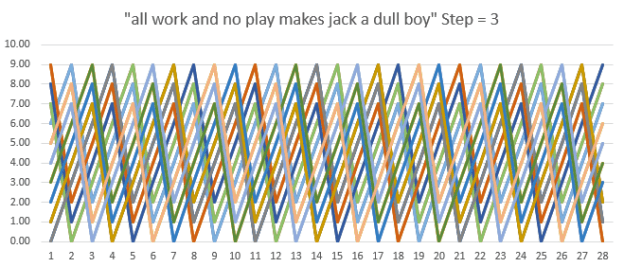
  • Back to LSTMs. Made a numeric version of “all work and no play in the jack_torrance generatorAWANPMJADB
  • Reading in and writing out weight files. The predictions seems to be working well, but I have no insight into the arguments that go into the LSTM model. Going to revisit the Deep Learning with Keras book

Phil 10.29.18

7:00 – 5:00 ASRC PhD

  • This looks like a Big Deal from Google – Working together to apply AI for social good
    • Google.org is issuing an open call to organizations around the world to submit their ideas for how they could use AI to help address societal challenges. Selected organizations will receive support from Google’s AI experts, Google.org grant funding from a $25M pool, credit and consulting from Google Cloud, and more.
    • We look forward to receiving your application on or before 11:59 p.m. PT on January 22, 2019, and we encourage you to apply early given that we expect high volume within the last few hours of the application window. Thank you!
    • Application Guide
    • Application form (can’t save, compose offline using guide, above)
  • Finished my writeup on Meltdown
  • Waiting for a response from Antonio
  • Meeting with Don at 9:00 to discuss BAA partnership.
    • Don is comfortable with being PI or co-PI, whichever works best. When we call technical POCs, we speak on his behalf
    • We discussed how he could participate with the development of theoretical models based on signed graph Laplacians creating structures that can move in belief space. He thinks the idea has merit, and can put in up to 30% of his time on mathematical models and writing
    • ASRC has already partnered with UMBC. ASRC would sub to UMBC
    • Ordinarily, IP is distributed proportional to the charged hours
    • Don has access to other funding vehicles that can support the Army BAA, but this would make things more complicated. These should be discussed if we can’t make a “clean” agreement that meets our funding needs
  • Pinged Brian about his defense.
  • Some weekend thoughts
    • Opinion dynamics systems describe how communication within a network occurs, but disregards the motion of the network as a whole. In cases when the opinions converge, the network is stiff.
    • Graph laplacians could model “othering” by having negative weights. It looks like these are known as signed laplacians, and useful to denote difference. The trick is to discover the equations of motion. How do you model a “social particle”?
  • Just discovered the journal Swarm Intelligence
    • Swarm Intelligence is the principal peer reviewed publication dedicated to reporting research and new developments in this multidisciplinary field. The journal publishes original research articles and occasional reviews on theoretical, experimental, and practical aspects of swarm intelligence. It offers readers reports on advances in the understanding and utilization of systems that are based on the principles of swarm intelligence. Emphasis is given to such topics as the modeling and analysis of collective biological systems; application of biological swarm intelligence models to real-world problems; and theoretical and empirical research in ant colony optimization, particle swarm optimization, swarm robotics, and other swarm intelligence algorithms. Articles often combine experimental and theoretical work.
  • I think it’s time to start ramping up on the text generation!
      • Updated my home box to tensorflow 1.11.0. Testing to see if it still works using the Deep Learning with Keras simple_nueral_net.py example. Hasn’t broken (yet…), but is taking a long time… Worked! And it’s much faster the second time. Don’t know why that is and can’t find anything online that talks to that.
        Loss: 0.5043802047491074
        Accuracy: 0.8782
        Time =  211.42629722093085
      • Found this keras example for generating Nietsche


    • Trying it out. This may be a overnight run… But it is running.
  • Had a good discussion with Aaron about how mapmaking could be framed as an ML problem. More writeup tomorrow.

Phil 10.28.18

We know from the House Intelligence Committee report that the Russians were pushing a Syrian message among the other more “organic” messages. But this seems to indicate that they did get traction.

Mail bomb suspect made numerous references on Facebook to Russian associates and echoed pro-Kremlin views

  • The posts showed fixations on certain subjects, including Miami sports teams, youth soccer, Native American themes and businesses Sayoc was seeking to promote. But in April 2016, after several months of not posting on Facebook, the account abruptly changed subjects to link to videos celebrating Syria’s fight against ISIS.
  • “He just pops up four months later and just relentlessly shares stories about ISIS and terrorists,” said Albright. “The turn is just remarkable… He found ideas that never let go from that point on.”

Phil 10.22.18

7:00 – 5:30 ASRC PhD

      • Need to finish workshop paper this week
      • Jeff Atwood said I should look at 10 year old code to frighten myself and found a permuter class that could be used for hyperparameter tuning! It’s here:
        trunk/Java_folders/Projects/EntryRelationDb/src/main/java/com/edgeti/EntryRelationDb/Permutations.java
      • Fika
      • Meeting with Wayne.
        • We have a 12% chance of getting in the iConference, so don’t expect much. On the other hand, that opens up content for Antonio’s paper?


Phil 10.21.18

Finished Meltdown. Need to write up some notes.

Think about using a CMAC or Deep CMAC for function learning, because NIST. Also, can it be used for multi-dimensional learning?

  • Cerebellar model articulation controller
  • Adaptive Noise Cancellation Using Deep Cerebellar Model Articulation Controller
  • RCMAC Hybrid Control for MIMO Uncertain Nonlinear Systems Using Sliding-Mode Technology
    • A hybrid control system, integrating principal and compensation controllers, is developed for multiple-input-multiple-output (MIMO) uncertain nonlinear systems. This hybrid control system is based on sliding-mode technique and uses a recurrent cerebellar model articulation controller (RCMAC) as an uncertainty observer. The principal controller containing an RCMAC uncertainty observer is the main controller, and the compensation controller is a compensator for the approximation error of the system uncertainty. In addition, in order to relax the requirement of approximation error bound, an estimation law is derived to estimate the error bound. The Taylor linearization technique is employed to increase the learning ability of RCMAC and the adaptive laws of the control system are derived based on Lyapunov stability theorem and Barbalat’s lemma so that the asymptotical stability of the system can be guaranteed. Finally, the proposed design method is applied to control a biped robot. Simulation results demonstrate the effectiveness of the proposed control scheme for the MIMO uncertain nonlinear system
  • Github CMAC TF projects


Phil 10.19.18

Phil 7:00 – 3:30 ASRC PhD

  • Sprint review
  • Reading Meltdown: Why our systems fail and What we can do about it, and I found some really interesting work that relates to social conformity, flocking, stampeding and nomadic behaviors:
    • We show that a deviation from the group opinion is regarded by the brain as a punishment,” said the study’s lead author, Vasily Klucharev. And the error message combined with a dampened reward signal produces a brain impulse indicating that we should adjust our opinion to match the consensus. Interestingly, this process occurs even if there is no reason for us to expect any punishment from the group. As Klucharev put it, “This is likely an automatic process in which people form their own opinion, hear the group view, and then quickly shift their opinion to make it more compliant with the group view.” (Page 154)
      • Reinforcement Learning Signal Predicts Social Conformity
        • Vasily Klucharev
        • We often change our decisions and judgments to conform with normative group behavior. However, the neural mechanisms of social conformity remain unclear. Here we show, using functional magnetic resonance imaging, that conformity is based on mechanisms that comply with principles of reinforcement learning. We found that individual judgments of facial attractiveness are adjusted in line with group opinion. Conflict with group opinion triggered a neuronal response in the rostral cingulate zone and the ventral striatum similar to the “prediction error” signal suggested by neuroscientific models of reinforcement learning. The amplitude of the conflict-related signal predicted subsequent conforming behavioral adjustments. Furthermore, the individual amplitude of the conflict-related signal in the ventral striatum correlated with differences in conforming behavior across subjects. These findings provide evidence that social group norms evoke conformity via learning mechanisms reflected in the activity of the rostral cingulate zone and ventral striatum.
    • When people agreed with their peers’ incorrect answers, there was little change in activity in the areas associated with conscious decision-making. Instead, the regions devoted to vision and spatial perception lit up. It’s not that people were consciously lying to fit in. It seems that the prevailing opinion actually changed their perceptions. If everyone else said the two objects were different, a participant might have started to notice differences even if the objects were identical. Our tendency for conformity can literally change what we see. (Page 155)
      • Gregory Berns
        • Dr. Berns specializes in the use of brain imaging technologies to understand human – and now, canine – motivation and decision-making.  He has received numerous grants from the National Institutes of Health, National Science Foundation, and the Department of Defense and has published over 70 peer-reviewed original research articles.
      • Neurobiological Correlates of Social Conformity and Independence During Mental Rotation
        • Background

          When individual judgment conflicts with a group, the individual will often conform his judgment to that of the group. Conformity might arise at an executive level of decision making, or it might arise because the social setting alters the individual’s perception of the world.

          Methods

          We used functional magnetic resonance imaging and a task of mental rotation in the context of peer pressure to investigate the neural basis of individualistic and conforming behavior in the face of wrong information.Results

          Conformity was associated with functional changes in an occipital-parietal network, especially when the wrong information originated from other people. Independence was associated with increased amygdala and caudate activity, findings consistent with the assumptions of social norm theory about the behavioral saliency of standing alone.

          Conclusions

          These findings provide the first biological evidence for the involvement of perceptual and emotional processes during social conformity.

        • The Pain of Independence: Compared to behavioral research of conformity, comparatively little is known about the mechanisms of non-conformity, or independence. In one psychological framework, the group provides a normative influence on the individual. Depending on the particular situation, the group’s influence may be purely informational – providing information to an individual who is unsure of what to do. More interesting is the case in which the individual has definite opinions of what to do but conforms due to a normative influence of the group due to social reasons. In this model, normative influences are presumed to act through the aversiveness of being in a minority position
      • A Neural Basis for Social Cooperation
        • Cooperation based on reciprocal altruism has evolved in only a small number of species, yet it constitutes the core behavioral principle of human social life. The iterated Prisoner’s Dilemma Game has been used to model this form of cooperation. We used fMRI to scan 36 women as they played an iterated Prisoner’s Dilemma Game with another woman to investigate the neurobiological basis of cooperative social behavior. Mutual cooperation was associated with consistent activation in brain areas that have been linked with reward processing: nucleus accumbens, the caudate nucleus, ventromedial frontal/orbitofrontal cortex, and rostral anterior cingulate cortex. We propose that activation of this neural network positively reinforces reciprocal altruism, thereby motivating subjects to resist the temptation to selfishly accept but not reciprocate favors.
  • Working on Antonio’s paper. I think I’ve found the two best papers to use for the market system. It turns out that freight has been doing this for about 20 years. Agent simulation and everything