Category Archives: Simulation

Phil 1.16.2018

ASRC MKT 7:00 – 4:30

  • Tit for tat in heterogeneous populations
    • The “iterated prisoner’s dilemma” is now the orthodox paradigm for the evolution of cooperation among selfish individuals. This viewpoint is strongly supported by Axelrod’s computer tournaments, where ‘tit for tat’ (TFT) finished first. This has stimulated interest in the role of reciprocity in biological societies. Most theoretical investigations, however, assumed homogeneous populations (the setting for evolutionary stable strategies) and programs immune to errors. Here we try to come closer to the biological situation by following a program that takes stochasticities into account and investigates representative samples. We find that a small fraction of TFT players is essential for the emergence of reciprocation in a heterogeneous population, but only paves the way for a more generous strategy. TFT is the pivot, rather than the aim, of an evolution towards cooperation.
    • It’s a Nature Note, so a quick read. In this case, the transition is from AllD->TFT->GTFT, where evolution stops.
  • A strategy of win-stay, lose-shift that outperforms tit-for-tat in the Prisoner’s Dilemma game
    • The Prisoner’s Dilemma is the leading metaphor for the evolution of cooperative behaviour in populations of selfish agents, especially since the well-known computer tournaments of Axelrod and their application to biological communities. In Axelrod’s simulations, the simple strategy tit-for-tat did outstandingly well and subsequently became the major paradigm for reciprocal altruism. Here we present extended evolutionary simulations of heterogeneous ensembles of probabilistic strategies including mutation and selection, and report the unexpected success of another protagonist: Pavlov. This strategy is as simple as tit-for-tat and embodies the fundamental behavioural mechanism win-stay, lose-shift, which seems to be a widespread rule. Pavlov’s success is based on two important advantages over tit-for-tat: it can correct occasional mistakes and exploit unconditional cooperators. This second feature prevents Pavlov populations from being undermined by unconditional cooperators, which in turn invite defectors. Pavlov seems to be more robust than tit-for-tat, suggesting that cooperative behaviour in natural situations may often be based on win-stay, lose-shift.
    • win-stay = exploit, lose-shift = explore
  • Five rules for the evolution of cooperation
    • Cooperation is needed for evolution to construct new levels of organization. The emergence of genomes, cells, multi-cellular organisms, social insects and human society are all based on cooperation. Cooperation means that selfish replicators forgo some of their reproductive potential to help one another. But natural selection implies competition and therefore opposes cooperation unless a specific mechanism is at work. Here I discuss five mechanisms for the evolution of cooperation: kin selection, direct reciprocity, indirect reciprocity, network reciprocity and group selection. For each mechanism, a simple rule is derived which specifies whether natural selection can lead to cooperation.
  • Added a paragraph to the previous work section to include Tit-for-Tat and Milti-armed Bandit previous work.
  • Worked with Aaron on setting up sprint goals

Phil 1.14.18

Pondering what a good HI-LO game would be for a presentation:

  • Ask the audience to choose A or B, based on what they think the most likely answer is. Show of hands, B, then A.
  • Describe the H/L chart and cooperative game theory, and how traditional game theory can’t account for why LL makes less sense to us than HH
  • fig-1-2x

Phil 1.13.18

I think that burst-coast may be another one of those general patterns in collective intelligence

  • Disentangling and modeling interactions in fish with burst-and-coast swimming reveal distinct alignment and attraction behaviors
    • The development of tracking methods for automatically quantifying individual behavior and social interactions in animal groups has open up new perspectives for building quantitative and predictive models of collective behavior. In this work, we combine extensive data analyses with a modeling approach to measure, disentangle, and reconstruct the actual functional form of interactions involved in the coordination of swimming in Rummy-nose tetra (Hemigrammus rhodostomus). This species of fish performs burst-and-coast swimming behavior that consists of sudden heading changes combined with brief accelerations followed by quasi-passive, straight decelerations. We quantify the spontaneous stochastic behavior of a fish and the interactions that govern wall avoidance and the reaction to a neighboring fish, the latter by exploiting general symmetry constraints for the interactions. In contrast with previous experimental works, we find that both attraction and alignment behaviors control the reaction of fish to a neighbor. We then exploit these results to build a model of spontaneous burst-and-coast swimming and interactions of fish, with all parameters being estimated or directly measured from experiments. This model quantitatively reproduces the key features of the motion and spatial distributions observed in experiments with a single fish and with two fish. This demonstrates the power of our method that exploits large amounts of data for disentangling and fully characterizing the interactions that govern collective behaviors in animals groups.

Phil 1.5.17

7:00 – 3:30 ASRC MKT

  • Saw the new Star Wars film. That must be the most painful franchise to direct “Here’s an unlimited amount of money. You have unlimited freedom in these areas over here, and this giant pile is canon, that you  must adhere to…”
  • Wikipedia page view tool
  • My keyboard has died. Waiting on the new one and using the laptop in the interim. It’s not quite worth setting up the dual screen display. Might go for the mouse though. On a side note, the keyboard on my Lenovo Twist is quite nice.
  • More tweaking of the paper. Finished methods, on to results
  •  Here’s some evidence that we have mapping structures in our brain: Hippocampal Remapping and Its Entorhinal Origin
      • The activity of hippocampal cell ensembles is an accurate predictor of the position of an animal in its surrounding space. One key property of hippocampal cell ensembles is their ability to change in response to alterations in the surrounding environment, a phenomenon called remapping. In this review article, we present evidence for the distinct types of hippocampal remapping. The progressive divergence over time of cell ensembles active in different environments and the transition dynamics between pre-established maps are discussed. Finally, we review recent work demonstrating that hippocampal remapping can be triggered by neurons located in the entorhinal cortex.


  • Added a little to the database section, but spent most of the afternoon updating TF and trying it out on examples

Phil 1.4.17

7:00 – 3:00 ASRC MKT

  • Confidence modulates exploration and exploitation in value-based learning
    • Uncertainty is ubiquitous in cognitive processing, which is why agents require a precise handle on how to deal with the noise inherent in their mental operations. Previous research suggests that people possess a remarkable ability to track and report uncertainty, often in the form of confidence judgments. Here, we argue that humans use uncertainty inherent in their representations of value beliefs to arbitrate between exploration and exploitation. Such uncertainty is reflected in explicit confidence judgments. Using a novel variant of a multi-armed bandit paradigm, we studied how beliefs were formed and how uncertainty in the encoding of these value beliefs (belief confidence) evolved over time. We found that people used uncertainty to arbitrate between exploration and exploitation, reflected in a higher tendency towards exploration when their confidence in their value representations was low. We furthermore found that value uncertainty can be linked to frameworks of metacognition in decision making in two ways. First, belief confidence drives decision confidence — that is people’s evaluation of their own choices. Second, individuals with higher metacognitive insight into their choices were also better at tracing the uncertainty in their environment. Together, these findings argue that such uncertainty representations play a key role in the context of cognitive control.

  • Artificial Intelligence, AI in 2018 and beyond
    • Eugenio Culurciello
    • These are my opinions on where deep neural network and machine learning is headed in the larger field of artificial intelligence, and how we can get more and more sophisticated machines that can help us in our daily routines. Please note that these are not predictions of forecasts, but more a detailed analysis of the trajectory of the fields, the trends and the technical needs we have to achieve useful artificial intelligence. Not all machine learning is targeting artificial intelligences, and there are low-hanging fruits, which we will examine here also.
  • Synthetic Experiences: How Popular Culture Matters for Images of International Relations
    • Many researchers assert that popular culture warrants greater attention from international relations scholars. Yet work regarding the effects of popular culture on international relations has so far had a marginal impact. We believe that this gap leads mainstream scholars both to exaggerate the influence of canonical academic sources and to ignore the potentially great influence of popular culture on mass and elite audiences. Drawing on work from other disciplines, including cognitive science and psychology, we propose a theory of how fictional narratives can influence real actors’ behavior. As people read, watch, or otherwise consume fictional narratives, they process those stories as if they were actually witnessing the phenomena those narratives describe, even if those events may be unlikely or impossible. These “synthetic experiences” can change beliefs, reinforce preexisting views, or even displace knowledge gained from other sources for elites as well as mass audiences. Because ideas condition how agents act, we argue that international relations theorists should take seriously how popular culture propagates and shapes ideas about world politics. We demonstrate the plausibility of our theory by examining the influence of the US novelist Tom Clancy on issues such as US relations with the Soviet Union and 9/11.
  • Continuing with paper tweaking. Added T’s comments, and finished Methods.

Phil 12.28.12

8:30 – 4:30 ASRC MKT

  • Still sick. Nearing bronchitis?
  • Confessions of a Digital Nazi Hunter
  • Phenotyping of Clinical Time Series with LSTM Recurrent Neural Networks
    • We present a novel application of LSTM recurrent neural networks to multi label classification of diagnoses given variable-length time series of clinical measurements. Our method outperforms a strong baseline on a variety of metrics.
    • Scholar Cited by
      • Mapping Patient Trajectories using Longitudinal Extraction and Deep Learning in the MIMIC-III Critical Care Database
        • Electronic Health Records (EHRs) contain a wealth of patient data useful to biomedical researchers. At present, both the extraction of data and methods for analyses are frequently designed to work with a single snapshot of a patient’s record. Health care providers often perform and record actions in small batches over time. By extracting these care events, a sequence can be formed providing a trajectory for a patient’s interactions with the health care system. These care events also offer a basic heuristic for the level of attention a patient receives from health care providers. We show that is possible to learn meaningful embeddings from these care events using two deep learning techniques, unsupervised autoencoders and long short-term memory networks. We compare these methods to traditional machine learning methods which require a point in time snapshot to be extracted from an EHR.
  • Continuing on white paper
  • Moved the Flocking and Herding paper over to the WSC17 format for editing. Will need to move to the WSC18 format when that becomes available

Phil 12.27.17

8:00 – 4:00 ASRC MKT

  • Granted permission for the CHIIR18 DC.
  • Continuing on white paper. And we’ll see what Aaron has to say about the stampede paper today?
  • It occurs to be that it could make sense to read the trajectories in using the ARFF format. Looks straightforward, though I’d have to output each agent on an axis-by-axis basis. That would in turn mean that we’d have to save each ParticleStatement and save it out .
  • A new optimizer using particle swarm theory (1995)
    • The optimization of nonlinear functions using particle swarm methodology is described. Implementations of two paradigms are discussed and compared, including a recently developed locally oriented paradigm. Benchmark testing of both paradigms is described, and applications, including neural network training and robot task learning, are proposed. Relationships between particle swarm optimization and both artificial life and evolutionary computation are reviewed.
    • Cited by 12155

Phil 12.21.17

7:00 – 4:00 ASRC MKT

  • And now the days start to get longer!
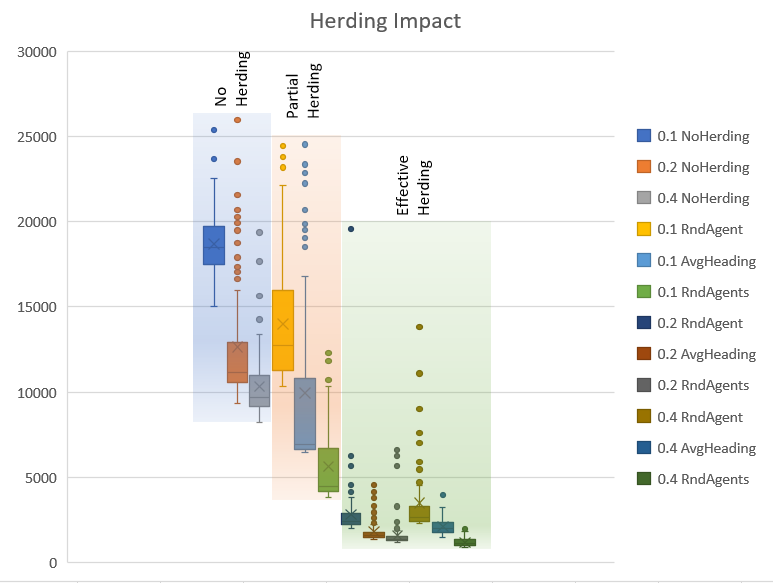
  • Working on flocking and herding paper. Adding in the adversarial herding parts. Spent a lot of time working on getting a chart that tells the herding story. I’m somewhat ok with this: HerdingImpact
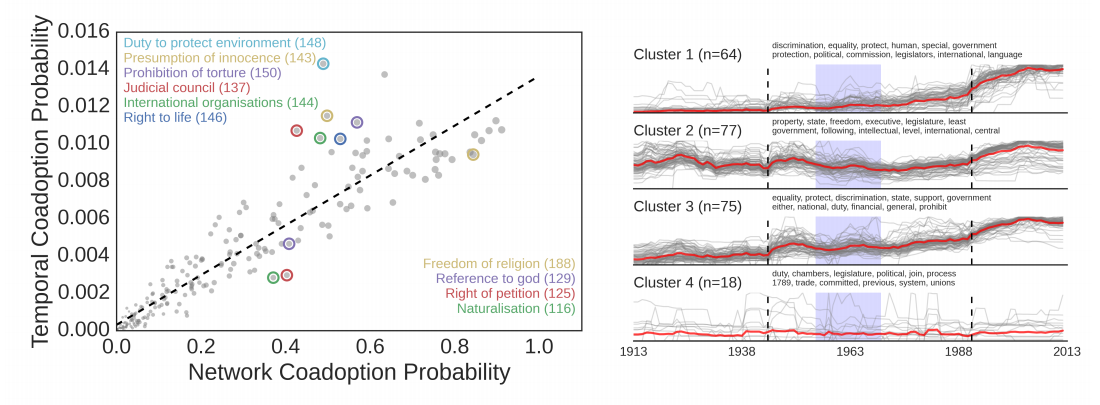
  • Some work on plotting norms using legal documents: Inferring Mechanisms for Global Constitutional Progress
    • Constitutions help define domestic political orders, but are known to be influenced by two international mechanisms: one that reflects global temporal trends in legal development, and another that reflects international network dynamics such as shared colonial history. We introduce the provision space; the growing set of all legal provisions existing in the world’s constitutions over time. Through this we uncover a third mechanism influencing constitutional change: hierarchical dependencies between legal provisions, under which the adoption of essential, fundamental provisions precedes more advanced provisions. This third mechanism appears to play an especially important role in the emergence of new political rights, and may therefore provide a useful roadmap for advocates of those rights. We further characterise each legal provision in terms of the strength of these mechanisms.
    • provisionSpace
  • A Lively Discussion, Even for KSJ: Edmond Awad on His ‘Moral Machine’
    • To collect vast amounts of data on human perspectives about such decisions, Awad and his team launched the Moral Machine website, in which visitors play an interactive game that presents them with a choice of two decisions in a variety of randomly generated crash scenarios. As in the trolley problem, the visitor must choose to swerve or stay the course, sacrificing either the people in the car or one group of pedestrians to save other pedestrians.
    • About Moral Machine
      • Recent scientific studies on machine ethics have raised awareness about the topic in the media and public discourse. This website aims to take the discussion further, by providing a platform for 1) building a crowd-sourced picture of human opinion on how machines should make decisions when faced with moral dilemmas, and 2) crowd-sourcing assembly and discussion of potential scenarios of moral consequence.
      • And this looks like it produced some really good marketing via news coverage
      • “We had four million users visit the website,” Awad said. “Three million of those actually completed the decision-making task, and they clicked on 37 million individual decisions. There’s also the survey that comes after, which is a little bit more work, and we still have over half a million survey responses.” The Scalable Cooperation group plans to publish the full results of the study in an upcoming paper.

Phil 12.19.17

7:00 – 5:00 ASRC MKT

  • Trust, Identity Politics and the Media
    • Essential to a free and functioning democracy is an independent press, a crucial civil society actor that holds government to account and provides citizens access to the impartial information they need to make informed judgments, reason together, exercise their rights and responsibilities, and engage in collective action. In times of crisis, the media fulfills the vital role of alerting the public to danger and connecting citizens to rescue efforts, as Ushahidi has done in Kenya. Or, it can alert the international community to human rights abuses as does Raqqa is Being Slaughtered Silently. But, the very capabilities that allow the media to alert and inform, also allow it to sow division – as it did in Rwanda leading up to and during the genocide– by spreading untruths, and, through “dog whistles,” targeting ethnic groups and inciting violence against them. This panel will focus on two topics: the role of media as a vehicle for advancing or undermining social cohesion, and the use of media to innovate, organize and deepen understanding, enabling positive collective action.
      • Abdalaziz Alhamza, Co-Founder, Raqqa is Being Slaughtered Silently
      • Uzodinma Iweala, CEO and Editor-in-Chief, Ventures Africa; Author, Beasts of No Nation; Producer, Waiting for Hassana (moderator)
      • Ben Rattray, Founder and CEO, Change.org
      • Malika Saada Saar, Senior Counsel on Civil and Human Rights, Google
  • Continuing Consensus and Cooperation in Networked Multi-Agent Systems here Done! Promoted to phlog.
  • An Agent-Based Model of Indirect Minority Influence on Social Change and Diversity
    • The present paper describes an agent-based model of indirect minority influence. It examines whether indirect minority influence can lead to social change as a function of cognitive rebalancing, a process whereby related attitudes are affected when one attitude is changed. An attitude updating algorithm was modelled with minimal assumptions drawing on social psychology theories of indirect minority influence. Results revealed that facing direct majority influence, indirect minority influence along with cognitive rebalancing is a recipe for social change. Furthermore, indirect minority influence promotes and maintains attitudinal diversity in local ingroups and throughout the society. We discuss the findings in terms of social influence theories and suggest promising avenues for model extensions for theory building in minority influence and social change.
  • Ok, time to switch gears and start on the flocking paper. And speaking of which, is this a venue?
    • Winter Simulation Conference 2017 – INFORMS Meetings Browser times out right now, so is it still valid?
    • Created a new LaTex project, since this is a modification of the CHIIR paper and started to slot pieces in. It is *hard* switching gears. Leaving it in the sigchi format for now.
    • I went to change out the echo chamber distance from average with heading from average (which looks way better), but everything was zero in the spreadsheet. After poking around a bit, I was “fixing” the angle cosine to lie on (-1, 1), by forcing it to be 1.0 all the time. Fixed. EchoChamberAngle
  • Sprint planning. I’m on the hook for writing up the mapping white paper and strawman design

Phil 12.14.17

7:00 – 11:00 ASRC MKT

Phil 12.13.17

7:00 – 5:00 ASRC MKT

  • Schedule physical
  • Write up fire stampede. Done!
  • Continuing Consensus and Cooperation in Networked Multi-Agent Systems here
  • Would like to see how the credibility cues on the document were presented. What went right and what went wrong: Schumer calls cops after forged sex scandal charge
  • Finished linking the RB components to the use cases. Waiting on Aaron to finish SIGINT use case
  • Working on building maps from trajectories. Trying http://graphstream-project.org
    • Updating Labeled2DMatrix to read in string values. I had never finished that part! There are some issues with what to do about column headers. I think I’m going to add explicit headers for the ‘Trajectory’ sheet
  • Strategized with Aaron about how to approach the event tomorrow. And Deep Neural Network Capsules. And Social Gradient Descent Agents.
    • deep neural nets learn by back-propagation of errors over the entire network. In contrast real brains supposedly wire neurons by Hebbian principles: “units that fire together, wire together”. Capsules mimic Hebbian learning in the way that: “A lower-level capsule prefers to send its output to higher level capsules whose activity vectors have a big scalar product with the prediction coming from the lower-level capsule”
      • Sure sounds like oscillator frequency locking / flocking to me……

Phil 12.11.17

7:00 – 3:00 ASRC MKT

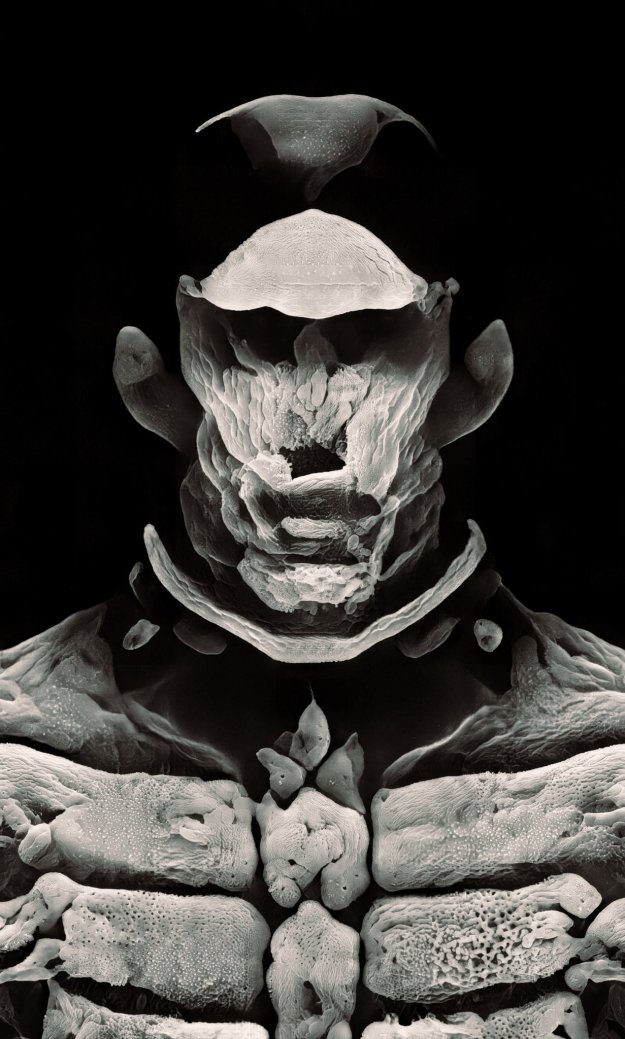
  • Machine learning art gallery from NIPS this year: img_20171208_212755
  • I’m reading this article on the prehistory of Bitcoin, and am realizing that there are several implications for ensuring immutability of data. For example, the entire set of records could be hashed to produce a unique has that would be disrupted if any of the records were altered.
  • Continuing Schooling as a strategy for taxis in a noisy environment here. Done! Promoted to Phlog
  • Still collecting data for web access times at work. Average time to open/finish loading a page is something around 5 seconds at work, 2 seconds at home.
  • Neural correlates of causal power judgments
    • Denise Dellarosa Cummins
    • Causal inference is a fundamental component of cognition and perception. Probabilistic theories of causal judgment (most notably causal Bayes networks) derive causal judgments using metrics that integrate contingency information. But human estimates typically diverge from these normative predictions. This is because human causal power judgments are typically strongly influenced by beliefs concerning underlying causal mechanisms, and because of the way knowledge is retrieved from human memory during the judgment process. Neuroimaging studies indicate that the brain distinguishes causal events from mere covariation, and also distinguishes between perceived and inferred causality. Areas involved in error prediction are also activated, implying automatic activation of possible exception cases during causal decision-making.
  • Writing up the Academic scenario

3:00 – 4:00 Fika – end of semester shindig

4:00 – 6:00 Meeting w/Wayne

  • Basically a status report. Maybe look at computational ecology journals if CHIIR falls through in a bad way
  • Look at workshops as well – Max Plank could be fun
  • Workshopped a workshop title with Wayne and Shimei


Phil 12.6.17

7:00 – 6:00 ASRC MKT

  • Best Free Alternative PDF Viewer to Adobe Reader
  • Downloaded Modeling Political Information Transmission as a Game of Telephone and gave it a skim. It  looks very much like this is an example of dimension reduction. To refine the idea, there need to be several conditions that lead to a stampeed
    • Dimension reduction and alignment need to occur across a population. It’s no good to have dimension reduction if everyone is pointing in a different direction.
    • The belief has to be ‘containing’ in some way. Either by social interaction (trust), or a lack of awareness of other ideas, it needs to be difficult to break out of.
      • This can be manipulated by external actors posing as trusted members of the group. Direction and level of uniformity can be influenced.
    • It has to be dynamic. A static belief provides the implicit ability to move away from it in any direction. A belief that is evolving fast enough maintains alignment by focusing the need for novelty (exploration?) in one direction.
  • Starting Schooling as a strategy for taxis in a noisy environment here
  • Demo
  • Chaining of matrices should be possible. Imaging an author/term matrix and a document/term matrix. Raising the weight of the author raises the weights on the associated terms. Those terms can be multiplied by the weights in the document term matrix which should result in a correct(?) re-weighting.
  • Chat with Shimei after picking up my gps
    • The Rat Park Experiment
    • Smoking and the bandit: A preliminary study of smoker and non-smoker differences in exploratory behavior measured with a multi-armed bandit task
      • Advantageous decision-making is an adaptive trade-off between exploring alternatives and exploiting the most rewarding option. This trade-off may be related to maladaptive decision-making associated with nicotine dependence; however, explore/exploit behavior has not been previously investigated in the context of addiction. The explore/exploit trade-off is captured by the multi-armed bandit task, in which different arms of a slot machine are chosen to discover the relative payoffs. The goal of this study was to preliminarily investigate whether smokers differ from non-smokers in their degree of exploratory behavior. Smokers (n = 18) and non-smokers (n = 17) completed a six-armed bandit task as well as self-report measures of behavior and personality traits. Smokers were found to exhibit less exploratory behavior (i.e. made fewer switches between slot machine arms) than non-smokers within the first 300 trials of the bandit task. The overall proportion of exploratory choices negatively correlated with self-reported measures of delay aversion and nonplanning impulsivity. These preliminary results suggest that smokers make fewer initial exploratory choices on the bandit task. The bandit task is a promising measure that could provide valuable insights into how nicotine use and dependence is associated with explore/exploit decision-making.

Phil 12.1.17

7:00 – 4:30 ASRC MKT

ZeynepWeb1-3

  • High-Resolution Image Synthesis and Semantic Manipulation with Conditional GANs. This shows NNs filling in slots in semantic maps (which are actually semantic mattes, and not to be confused with earlier self-organizing semantic maps). How is this with other, more linear processes like sound and narrative?
  • Continuing Alignment in social interactions here.
  • People flock in computer mediated environments: Spontaneous flocking in human groups
  • Schooling as a strategy for taxis in a noisy environment
    • Daniel Grunbaum
    • Abstract
      • A common strategy to overcome this problem is taxis, a behaviour in which an animal performs a biased random walk by changing direction more rapidly when local conditions are getting worse.
        • Consider voters switching from Bush->Obama->Trump
      • Such an animal spends more time moving in right directions than wrong ones, and eventually gets to a favourable area. Taxis is ineffcient, however, when environmental gradients are weak or overlain by `noisy’ small-scale fluctuations. In this paper, I show that schooling behaviour can improve the ability of animals performing taxis to climb gradients, even under conditions when asocial taxis would be ineffective. Schooling is a social behaviour incorporating tendencies to remain close to and align with fellow members of a group. It enhances taxis because the alignment tendency produces tight angular distributions within groups, and dampens the stochastic effects of individual sampling errors. As a result, more school members orient up-gradient than in the comparable asocial case. However, overly strong schooling behaviour makes the school slow in responding to changing gradient directions. This trade-off suggests an optimal level of schooling behaviour for given spatio-temporal scales of environmental variations.
        • This has implications for everything from human social interaction to ANN design.
    • Notes
      • Because limiting resources typically have `patchy’ distributions in which concentrations may vary by orders of magnitude, success or failure in finding favourable areas often has an enormous impact on growth rates and reproductive success. To locate resource concentrations, many aquatic organisms display tactic behaviours, in which they orient with respect to local variations in chemical stimuli or other environmental properties. (pp 503)
      • Here, I propose that schooling behaviours improve the tactic capabilities of school members, and enable them to climb faint and noisy gradients which they would otherwise be unable to follow. (pp 504)
      • Schooling is thought to result from two principal behavioural components: (1) tendencies to move towards neighbours when isolated, and away from them when too close, so that the group retains a characteristic level of compactness; and (2) tendencies to align orientation with those of neighbours, so that nearby animals have similar directions of travel and the group as a whole exhibits a directional polarity. (pp 504)
        • My models indicate that attraction isn’t required, as long as there is a distance-graded awareness. In other words, you align most strongly with those agents that are closest.
      • I focus in this paper on schooling in aquatic animals, and particularly on phytoplankton as a distributed resource. However, although I do not examine them specifically, the modelling approaches and the basic results apply more generally to other environmental properties (such as temperature), to other causes of population movement (such as migration) and to other socially aggregating species which form polarized groups (such as flocks, herds and swarms). (pp 504)
      • Under these circumstances, the search of a nektonic filter-feeder for large-scale concentrations of phytoplankton is analogous to the behaviour of a bacterium performing chemotaxis. The essence of the analogy is that, while higher animals have much more sophisticated sensory and cognitive capacities, the scale at which they sample their environment is too small to identify accurately the true gradient. (pp 505)
        • And, I would contend for determining optimal social interactions in large groups.
      • Bacteria using chemotaxis usually do not directly sense the direction of the gradient. Instead, they perform random walks in which they change direction more often or by a greater amount if conditions are deteriorating than if they are improving (Keller and Segel, 1971; Alt, 1980; Tranquillo, 1990). Thus, on average, individuals spend more time moving in favourable directions than in unfavourable ones. (pp 505)
      • A bacterial analogy has been applied to a variety of behaviours in more complex organisms, such as spatially varying di€usion rates due to foraging behaviours or food-handling in copepods and larval ®sh (Davis et al., 1991), migration patterns in tuna (Mullen, 1989) and restricted area searching in ladybugs (Kareiva and Odell, 1987) and seabirds (Veit et al., 1993, 1995). The analogy provides for these higher animals a quantitative prediction of distribution patterns and abilities to locate resources at large space and time scales, based on measurable characteristics of small-scale movements. (pp 505)
      • I do not consider more sophisticated (and possibly more effective) social tactic algorithms, in which explicit information about the environment at remote points is actively or passively transmitted between individuals, or in which individual algorithms (such as slowing down when in relatively high concentrations) cause the group to function as a single sensing unit (Kils, 1986, described in Pitcher and Parrish, 1993). (pp 506)
        • This is something that could be easily added to the model. There could be a multiplier for each data cell that acts as a velocity scalar of the flock. That should have significant effects! This could also be applied to gradient descent. The flock of Gradient Descent Agents (GDAs) could have a higher speed across the fitness landscape, but slow and change direction when a better value is found by one of the GDAs. It occurs to me that this would work with a step function, as long as the baseline of the flock is sufficiently broad.
      • When the noise predominates (d <= 1), the angular distribution of individuals is nearly uniform, and the up-gradient velocity is near zero. In a range of intermediate values of d(0.3 <= d <= 3), there is measurable but slow movement up-gradient. The question I will address in the next two sections is: Can individuals in this intermediate signal-to-noise range with slow gradient-climbing rates improve their tactic ability by adopting a social behaviour (i.e. schooling)? (pp 508)
      • The key attributes of these models are: (1) a decreasing probability of detection or responsiveness to neighbours at large separation distances; (2) a social response that includes some sort of switch from attractive to repulsive interactions with neighbours, mediated by either separation distance or local density of animals*; and (3) a tendency to align with neighbours (Inagaki et al., 1976; Matuda and Sannomiya, 1980, 1985; Aoki, 1982; Huth and Wissel, 1990, 1992; Warburton and Lazarus, 1991; Grunbaum, 1994). (pp 508)
        • Though not true of belief behavior (multiple individuals can share the same belief), for a Gradient Descent Agent (GDA), the idea of attraction/repulsion may be important.
      • If the number of neighbours is within an acceptable range, then the individual does not respond to them. On the other hand, if the number is outside that range, the individual turns by a small amount, Δθ3, to the left or right according to whether it has too many or too few of them and which side has more neighbours. In addition, at each time step, each individual randomly chooses one of its visible neighbours and turns by a small amount, Δθ4, towards that neighbour’s heading. (pp 508)
      • The results of simulations based on these rules show that schooling individuals, on average, move more directly in an up-gradient direction than asocial searchers with the same tactic parameters. Figure 4 shows the distribution of individuals in simulations of asocial and social taxis in a periodic domain (i.e. animals crossing the right boundary re-enter the left boundary, etc.). (pp 509)
      • Gradient Schooling
      • As predicted by Equation (5), asocial taxis results in a broad distribution of orientations, with a peak in the up-gradient (positive x-axis) direction but with a large fraction of individuals moving the wrong way at any given time (Fig. 5a,b). By comparison, schooling individuals tend to align with one another, forming a group with a tightened angular distribution. There is stochasticity in the average velocity of both asocial and social searchers (Fig. 5c). On average, however, schooling individuals move up-gradient faster and more directly than asocial ones. These simulation results demonstrate that it is theoretically possible to devise tactic search strategies utilizing social behaviours that are superior to asocial algorithms. That is, one of the advantages of schooling is that, potentially, it allows more successful search strategies under `noisy’ environmental conditions, where variations on the micro-scales at which animals sense their environment obscure the macro-scale gradients between ecologically favourable and unfavourable regions. (pp 510)
      • School-size effects must depend to some extent on the tactic and schooling algorithms, and the choices of parameters. However, underlying social taxis are the statistics of pooling outcomes of independent decisions, so the numerical dependence on school size may operate in a similar manner for many comparable behavioural schemes. For example, it seems reasonable to expect that, in many alternative schooling and tactic algorithms, decisions made collectively by less than 10 individuals would show some improvement over the asocial case but also retain much of the variability. Similarly, in most scenarios, group statistics probably vary only slowly with group size once it reaches sizes of 50-100. (pp 514)
      • when group size becomes large, the behaviour of model schools changes in character. With numerous individuals, stochasticity in the behaviour of each member has a relatively weaker effect on group motion. The behaviour of the group as a whole becomes more consistent and predictable, for longer time periods. (pp 514)
        • I think that this should be true in belief spaces as well. It may be difficult to track one person’s trajectory, but a group in aggregate, particularly a polarized group may be very detectable.
      • An example of group response to changing gradient direction shows that there can be a cost to strong alignment tendency. In this example, the gradient is initially pointed in the negative y-direction (Fig. 9). After an initial period of 5 time units, during which the gradient orients perpendicularly to the x-axis, the gradient reverts to the usual x-direction orientation. The school must then adjust to its new surroundings by shifting to climb the new gradient. This example shows that alignment works against course adjustment: the stronger the tendency to align, the slower is the group’s reorientation to the new gradient direction. This is apparently due to a non-linear interaction between alignment and taxis: asymmetries in the angular distribution during the transition create a net alignment flux away from the gradient direction. Thus, individuals that pay too much attention to neighbours, and allow alignment to overwhelm their tactic tendencies, may travel rapidly and persistently in the wrong direction. (pp 516)
        • So, if alignment (and velocity matching) are strong enough, the conditions for a stampede (group behavior with negative outcomes – in this case, less food) emerge
      • The models also suggest that there is a trade-off in strengthening tendencies to align with neighbours: strong alignment produces tight angular distributions, but increases the time needed to adjust course when the direction of the gradient changes. A reasonable balance seems to be achieved when individuals take roughly the same time to coalesce into a polarized group as they do to orient to the gradient in asocial taxis. (pp 518)
        • There is something about the relationship between explore and exploit in this statement that I really need to think about.
      • Social taxis is potentially effective in animals whose resources vary substantially over large length scales and for whom movements over these scales are possible. (pp 518)
        • Surviving as a social animal requires staying in the group. Since belief can cover wide ranges (e.g. religion), does there need to be a mechanism where individuals can harmonize their beliefs? From Social Norms and Other Minds The Evolutionary Roots of Higher Cognition :  Field research on primate societies in the wild and in captivity clearly shows that the capacity for (at least) implicit appreciation of permission, prohibition, and obligation social norms is directly related to survival rates and reproductive success. Without at least a rudimentary capacity to recognize and respond appropriately to these structures, remaining within a social group characterized by a dominance hierarchy would be all but impossible.
      • Interestingly, krill have been reported to school until a food patch has been discovered, whereupon they disperse to feed, consistent with a searching function for schooling. The apparent effectiveness of schooling as a strategy for taxis suggests that these schooling animals may be better able to climb obscure large-scale gradients than they would were they asocial. Interactive effects of taxis and sociality may affect the evolutionary value of larger groups both directly, by improving foraging ability with group size, and indirectly, by constraining alignment rates. (pp 518)
      • An example where sociality directly affects foraging strategy is forage area copying, in which unsuccessful fish move to the vicinity of neighbours that are observed to be foraging successfully (Pitcher et al., 1982; Ranta and Kaitala, 1991; Pitcher and Parrish, 1993). Pitcher and House (1987) interpreted area copying in goldfish as the result of a two-stage decision process: (1) a decision to stay put or move depending on whether feeding rate is high or low; and (2) a decision to join neighbours or not based upon whether or not further solitary searching is successful. Similar group dynamics have been observed in foraging seabirds (Porter and Seally, 1982; Haney et al., 1992).
      • Synchrokinesis depends upon the school having a relatively large spatial extent: part of a migrating school encounters an especially favourable or unfavourable area. The response of that section of the school is propagated throughout the school by alignment and grouping behaviours, with the result that the school as a whole is more effective at route-finding than isolated individuals. Forage area copying and synchrokinesis are distinct from social taxis in that an individual discovers and reacts to an environmental feature or resource, and fellow group members exploit that discovery. In social taxis, no individual need ever have greater knowledge about the environment than any other — social taxis is essentially bound up in the statistics of pooling the outcomes of many unreliable decisions. Synchrokinesis and social taxis are complementary mechanisms and may be expected to co-occur in migrating and gradient-climbing schools. (pp 519)
      • For example, in the comparisons of taxis among groups of various sizes, the most successful individuals were in the asocial simulation, even though as a fraction of the entire population they were vanishingly small. (pp 519)
        • Explorers have the highest payoff for the highest risks
  • Continuing white paper. Done with intro, background, and phase 1
  • Intel-powered AI Helps Fight Fraud

Phil 11.30.17

7:00 – 4:30 ASRC MKT

  • Need to get this book: Simulating Social Complexity
  • Continuing Alignment in social interactions here. This looks much better. Found this book on game theory for groups. It took me a while to determine if ‘joint action’ is the coordinated ‘joint’ action of two people, or it it was the coordinated action of two people’s joints. It’s neuroscience after all.
  • Continuing on the Research Browser white paper. Based on the HHS requests, I added default performance logging
  • In a lot of meetings as an Aaron Proxey
  • Good progress on the white paper. Just about finished the background section. Need to add pix of the current prototype