3:30 Present the AI RoE paper to the data science tagup
4:30 LAIC meeting
Book
I finished Social Dominance last night and I think there might be room for a chapter on how SDT and AI/ML could work together to a) Identify and attenuate runaway HE behavior while also identifying and amplifying nascent or stagnant HA behavior.
Finished a pass of some kind and sent off to Wajanat and Aaron
Fixed the chapter headings
Reworked the proposal so that it has a new intro and the chapters are in the new order
SBIRs
10:00 Meeting with Rukan and Aaron
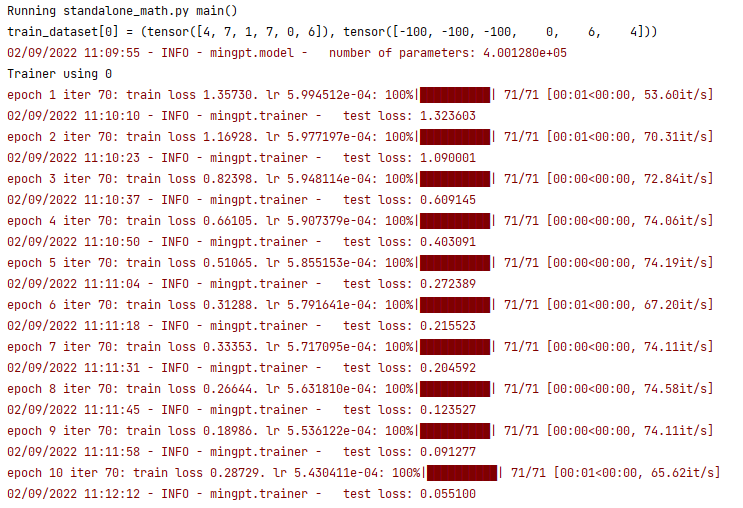
Need to download the MinGPT project and see if I can build it. It works! Now I need to load and save the model, then start playing around with the mask
Save and load the model
Create a reverse model
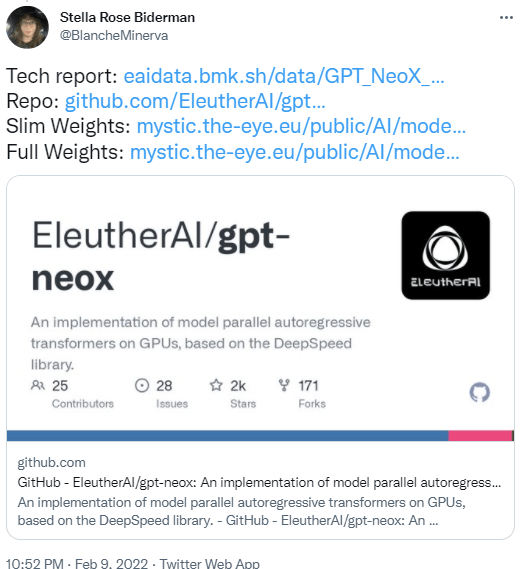
A working, from scratch, GPT
JuryRoom
Working with Zach a bit on framing out the concept and how much it might cost
More Transformers book. Need to look more deeply at MinGPT
GPT Agents
Now that I have the counts working, need to tie that back into the GPT output. I think I need some Parts-of-speech analysis to figure out what to count. The other part is to use the feedback to determine important points in the GPT response
BertViz: Visualize Attention in Transformer Models (BERT, GPT2, T5, etc.)
Found (I think) what I’m looking for: MinGPT: “A PyTorch re-implementation of GPT training. minGPT tries to be small, clean, interpretable and educational, as most of the currently available ones are a bit sprawling. GPT is not a complicated model and this implementation is appropriately about 300 lines of code, including boilerplate and a totally unnecessary custom causal self-attention module.“
GPT Agents
Continue with TwitterV2 count class. Good progress. I have basic functionality:
Chinese New Year!
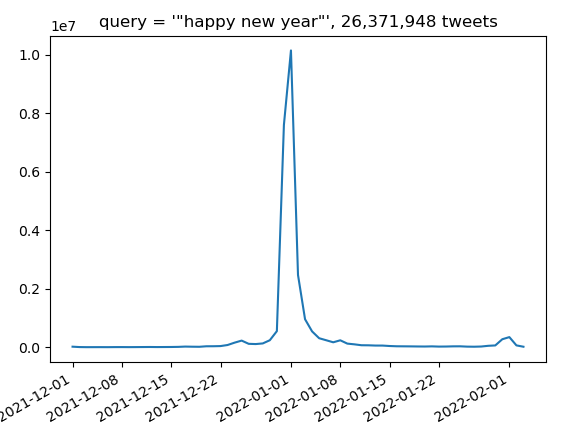
Need to work on the queries a bit to get phrases. Actually not hard, you just have to use escaped quotes ‘\”happy new year\”‘:
Got the counts query working with only a small amount of googling. The cool thing is that the items come back with a granularity, so this call (which has a default granularity of “day”:
This is very nice! I’m looking forward to doing some interesting things with the GPT. We can scan through responses to prompts and look at word-by-word Twitter frequencies after stop words, and then use those sentences for further prompting. We can also compare embeddings, cluster and other interesting things
Pretty much any data you want for general training at any scale
Datasets simplifies this process by providing a standard interface for thousands of datasets that can be found on the Hub. It also provides smart caching (so you don’t have to redo your preprocessing each time you run your code)and avoids RAM limitations by leveraging a special mechanism called memory mapping that stores the contents of a file in virtual memory and enables multiple processes to modify a file more efficiently.
Imbalanced-learn (imported as imblearn) is an open source, MIT-licensed library relying on scikit-learn (imported as sklearn) and provides tools when dealing with classification with imbalanced classes.
Nice NW job fair
Ack! Dreamhost has deleted my SVN repo. Very bad. Working on getting it back. Other options include RiouxSVN, but it may be moribund. Assembla hosts for $19/month with 500 GB, which is good because I store models. Alternatively, make a svn server, fix the IP address, and have it on Google Drive, OneDrive, or DropBox.
I think the upshot is to 1) Get the embedding topic narrative thing working, then run the gpt to generate keywords and count their occurrence on Twitter
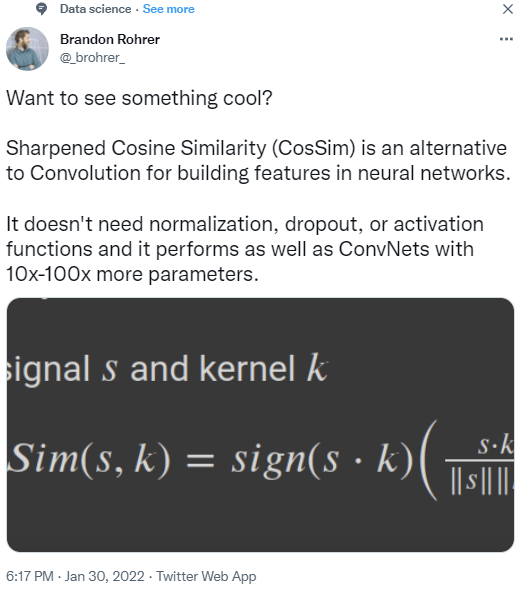
Sharpened Cosine Similarity (CosSim) is an alternative to Convolution for building features in neural networks. It performs as well as ConvNets with 10x-100x more parameters.
Examined the possibility that social-desirability-tainted responses emerge in the study of stereotypes. 60 white male undergraduates were randomly assigned to 1 of 4 experimental conditions. Ss were asked to indicate how characteristic each of 22 adjective traits was of either “Americans” or “Negroes.” 1/2 the Ss responded in a rating situation in which they were presumably free to distort their responses. The remaining Ss responded under “bogus pipeline” conditions; i.e., they were led to believe that the experimenter had an accurate, distortion-free physiological measure of their attitudes, and were asked to predict that measure. Results support the expectation that the stereotype ascribed to Negroes would be more favorable under rating than under bogus pipeline conditions. Americans were more favorably stereotyped under bogus pipeline than under rating conditions. A number of explanations for these results are discussed, and consideration is given to the relationship between verbally expressed attitudes and other, overt, behavior.
Recent decades have seen a rise in the use of physics methods to study different societal phenomena. This development has been due to physicists venturing outside of their traditional domains of interest, but also due to scientists from other disciplines taking from physics the methods that have proven so successful throughout the 19th and the 20th century. Here we characterise the field with the term ‘social physics’ and pay our respect to intellectual mavericks who nurtured it to maturity. We do so by reviewing the current state of the art. Starting with a set of topics that are at the heart of modern human societies, we review research dedicated to urban development and traffic, the functioning of financial markets, cooperation as the basis for our evolutionary success, the structure of social networks, and the integration of intelligent machines into these networks. We then shift our attention to a set of topics that explore potential threats to society. These include criminal behaviour, large-scale migration, epidemics, environmental challenges, and climate change. We end the coverage of each topic with promising directions for future research. Based on this, we conclude that the future for social physics is bright. Physicists studying societal phenomena are no longer a curiosity, but rather a force to be reckoned with. Notwithstanding, it remains of the utmost importance that we continue to foster constructive dialogue and mutual respect at the interfaces of different scientific disciplines.
What are the pathways for spreading disinformation on social media platforms? This article addresses this question by collecting, categorizing, and situating an extensive body of research on how application programming interfaces (APIs) provided by social media platforms facilitate the spread of disinformation. We first examine the landscape of official social media APIs, then perform quantitative research on the open‐source code repositories GitHub and GitLab to understand the usage patterns of these APIs. By inspecting the code repositories, we classify developers’ usage of the APIs as official and unofficial, and further develop a four‐stage framework characterizing pathways for spreading disinformation on social media platforms. We further highlight how the stages in the framework were activated during the 2016 US Presidential Elections, before providing policy re-commendations for issues relating to access to APIs, algorithmic content, advertisements, and suggest rapid response to coordinate campaigns, development of collaborative, and participatory approaches as well as government stewardship in the regulation of social media platforms.
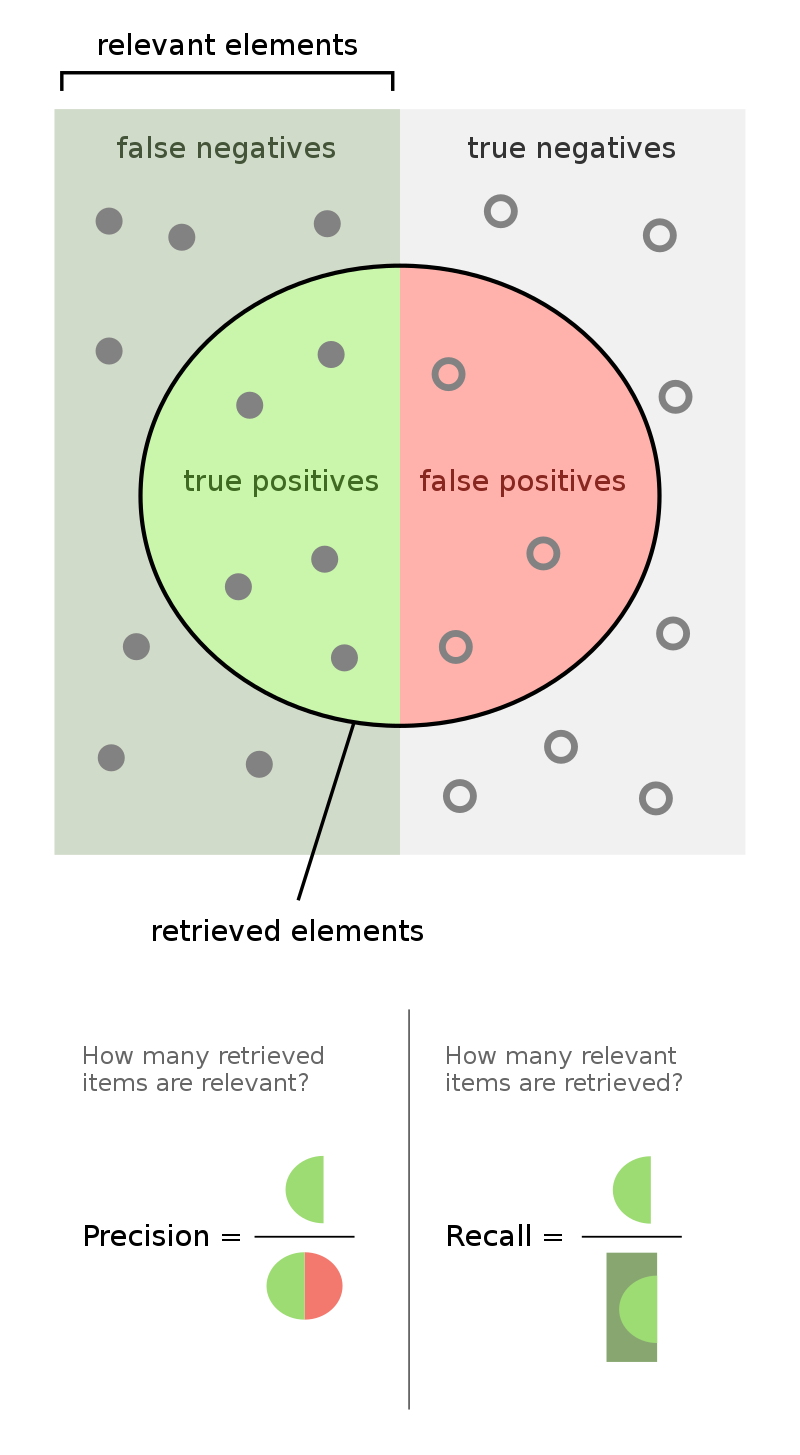
The Wikipedia folks have produced a very clear Precision/Recall diagram!
Had a nice chat with Rukan about how to partition models. Which made me think about RCS again. Maybe make a pyRCS library? I have the code written already, just need to pull it out of the PyBullet project
Polarization has become a force that feeds on itself, gaining strength from the hostility it generates, finding sustenance on both the left and the right. A series of recent analyses reveals the destructive power of polarization across the American political system.
GPT Agents
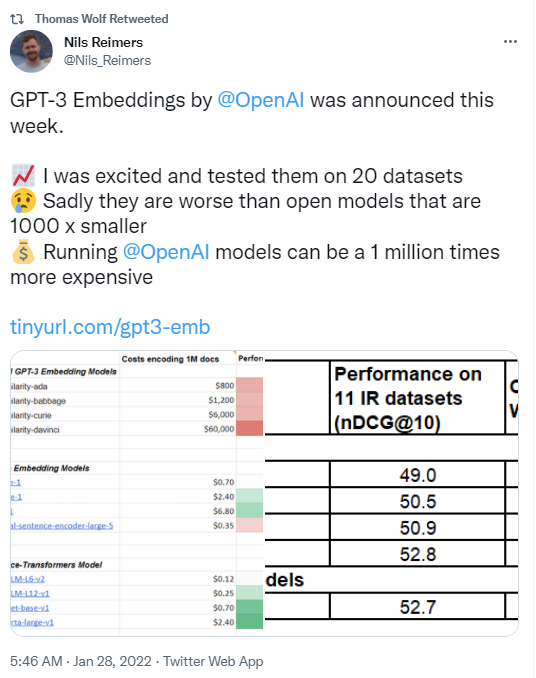
I think OpenAI’s embeddings may have gone public – Yes!
We’ve trained language models that are much better at following user intentions than GPT-3 while also making them more truthful and less toxic, using techniques developed through our alignment research. These InstructGPT models, which are trained with humans in the loop, are now deployed as the default language models on our API.
Had a long and winding talk about quality in Twitter data and whether using thread is a way to increase that. Shimei’s thought is that it will bias the data towards a different population. I think that’s reasonable, but I’m not sure that matters as long as you specify what population you’re polling.
Got the recent conversation search working
Working on historical queries
Getting historical Tweets using the v2 full-archive search endpoint
We invite submissions from the NLP and HCI communities as well as industry practitioners and professional writers on the topic of intelligent writing assistants: those that discuss innovations in building, improving, and evaluating intelligent and interactive writing assistants.
Specific topics include, but not limited to:
Combining NLP techniques (e.g. style transfer, text planning, controllability) with interaction paradigms between users and writing assistants (e.g. interfaces, iterative processes, feedback), such as a formality style transfer system for revising professional communications
Assistance on different stages of the writing process (e.g. planning, revising), different types of writing (e.g. expository, persuasive), and different applications (e.g. journalism, fiction)
Evaluation methodologies for writing assistants, writing process, and resultant text
Addressing underrepresentation of languages, types of writers (e.g. vernacular variations), and writing tasks for targeted writing assistance (note that for non-English systems, we request that the figures and examples be translated into English prior to review)
Writing assistant ownership issues, including legal issues with copyright and psychological sense of ownership
Practical challenges for building real-world systems such as Grammarly and WordTune (e.g. latency, near-perfect quality, personalization, and evolution of language)
User studies or ethnographic studies of writers who use writing assistants
Demonstration of simple prototypes of intelligent interfaces or design sketches
Book
Rewriting the first chapter around the concept that “belief is a place”
SBIRs
9:15 Stand up
Helped Aaron set up his DB, more today
Meeting with Rukan
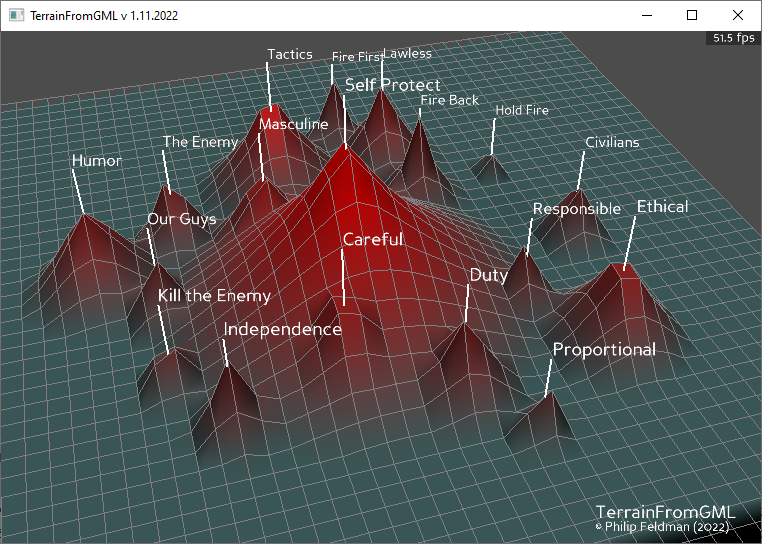
Do RoE map. Add nodes
The Enemy (“The enemy is”)
Fire Back (“If someone shoots at you”)
Masculine (“Be tough”)
Lawless (“Whatever it takes”)
Self Protect (“First, defend yourself”)
Kill the Enemy (“Don’t be complicated”)
Tactics (“Have a plan and execute it”)
Proportional (“Don’t escalate”)
Responsible (“Do the right thing”)
Independence (“Don’t just follow orders”)
Civilians (“What to do with non-combatants”)
Careful (“Don’t get into trouble”)
Our Guys (“We come first”)
Hold Fire (“Do not fire unless absolutely necessary”)







 viztales
You must be logged in to post a comment.