Category Archives: Machine Learning

Phil 11.15.18

ASRC PhD, NASA 7:00 – 5:00

  • Incorporate T’s changes – done!
  • Topic Modeling with LSA, PLSA, LDA & lda2Vec
    • This article is a comprehensive overview of Topic Modeling and its associated techniques.
  • More Grokking. Here’s the work for the day:
    # based on https://github.com/iamtrask/Grokking-Deep-Learning/blob/master/Chapter5%20-%20Generalizing%20Gradient%20Descent%20-%20Learning%20Multiple%20Weights%20at%20a%20Time.ipynb
    import numpy as np
    import matplotlib.pyplot as plt
    import random
    
    # methods ----------------------------------------------------------------
    def neural_network(input, weights):
        out = input @ weights
        return out
    
    def error_gt_epsilon(epsilon: float, error_array: np.array) -> bool:
        for i in range(len(error_array)):
            if error_array[i] > epsilon:
                return True
        return False
    
    # setup vars --------------------------------------------------------------
    #inputs
    toes_array =  np.array([8.5, 9.5, 9.9, 9.0])
    wlrec_array = np.array([0.65, 0.8, 0.8, 0.9])
    nfans_array = np.array([1.2, 1.3, 0.5, 1.0])
    
    #output goals
    hurt_array  = np.array([0.2, 0.0, 0.0, 0.1])
    wl_binary_array   = np.array([  1,   1,   0,   1])
    sad_array   = np.array([0.3, 0.0, 0.1, 0.2])
    
    weights_array = np.random.rand(3, 3) # initialise with random weights
    '''
    #initialized with fixed weights to compare with the book
    weights_array = np.array([ [0.1, 0.1, -0.3], #hurt?
                             [0.1, 0.2,  0.0], #win?
                             [0.0, 1.3,  0.1] ]) #sad?
    '''
    alpha = 0.01 # convergence scalar
    
    # just use the first element from each array fro training (for now?)
    input_array = np.array([toes_array[0], wlrec_array[0], nfans_array[0]])
    goal_array = np.array([hurt_array[0], wl_binary_array[0], sad_array[0]])
    
    line_mat = [] # for drawing plots
    epsilon = 0.01 # how close do we have to be before stopping
    #create and fill an error array that is big enough to enter the loop
    error_array = np.empty(len(input_array))
    error_array.fill(epsilon * 2)
    
    # loop counters
    iter = 0
    max_iter = 100
    
    while error_gt_epsilon(epsilon, error_array): # if any error in the array is big, keep going
    
        #right now, the dot product of the (3x1) input vector and the (3x3) weight vector that returns a (3x1) vector
        pred_array = neural_network(input_array, weights_array)
    
        # how far away are we linearly (3x1)
        delta_array = pred_array - goal_array
        # error is distance squared to keep positive and weight the system to fixing bigger errors (3x1)
        error_array = delta_array ** 2
    
        # Compute how far and in what direction (3x1)
        weights_d_array = delta_array * input_array
    
        print("\niteration [{}]\nGoal = {}\nPred = {}\nError = {}\nDelta = {}\nWeight Deltas = {}\nWeights: \n{}".format(iter, goal_array, pred_array, error_array, delta_array, weights_d_array, weights_array))
    
        #subtract the scaled (3x1) weight delta array from the weights array
        weights_array -= (alpha * weights_d_array)
    
        #build the data for the plot
        line_mat.append(np.copy(error_array))
        iter += 1
        if iter > max_iter:
            break
    
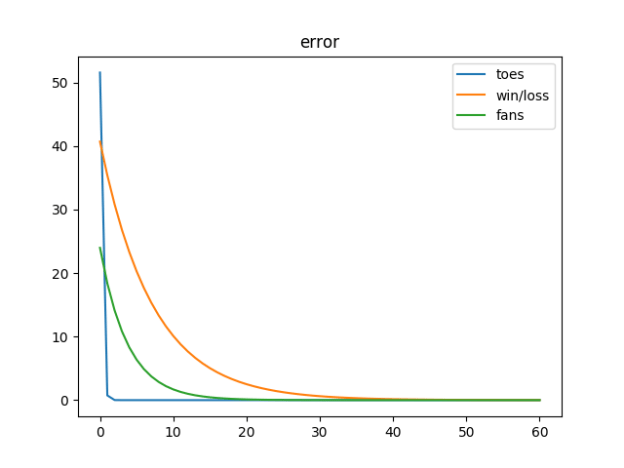
    plt.plot(line_mat)
    plt.title("error")
    plt.legend(("toes", "win/loss", "fans"))
    plt.show()
  • Here’s a chart! Learning
  • Continuing Characterizing Online Public Discussions through Patterns of Participant Interactions
Phil 11.14.18

7:00 – 4:00 ASRC PhD, NASA

  • Discovered Critical Roll D&D Youtube channel
  • Talk to Aaron about adding a time (or post?) constraint to dungeon runs. Faster runs/fewer posts get higher scores. This might be a way to highlight the difference between homogeneous and heterogeneous party composition lexical variance.
  • Added the conversation analytic link to the Belief Spaces doc
  • Added the following bit to my main blog post on Lists, Stories and Maps
  • Add to the Stories, Lists and Maps writeup something about the cognitive power of stories. There is, in many religions and philosophies, the concept of “being in the moment” where we become simply aware of what’s going on right now, without all the cognitive framing and context that we normally bring to every experience [citation needed]. This is different from “mindfulness”, where we try to be aware of the cognitive framing and context. To me, this is indicative of how we experience life through the lens of path dependency, which is a sort of a narrative. If this is true, then it explains the power of stories, because it allows us to literally step into another life. This explains phrases like “losing yourself in a story”.
  • This doesn’t happen with lists. It only happens in special cases in diagrams and maps, where you can see yourself in the map. Which is why the phrase “the map is not the territory” is different from “losing yourself in the story”. In the first case, you confuse your virtual and actual environment. In the latter, you confuse your virtual and actual identity. And since that story becomes part of your path through life, the virtual is incorporated into the actual life narrative, particularly if the story is vivid.
  • So narratives are an alignment mechanism. Simple stories that collapse information into a already existing beliefs can be confirming and reinforcing across a broad population. Complicated stories that challenge existing beliefs require a change in alignment to incorporate. That’s computationally expensive, and will affect fewer people, all things being equal.
  • Which leads me to thinking that the need for novelty is what creates the heading and velocity driven behavior we see in belief space behavior. I think this needs to be a chapter in the dissertation. Just looking for some background literature, I found these:
    • Novelty-Seeking in Rats-Biobehavioral Characteristics and Possible Relationship with the Sensation-Seeking Trait in Man
      • A behavioral trait in rats which resembles some of the features of high-sensation seekers in man has been characterized. Given that the response to novelty is the basis of the definition of sensation-seeking, individual differences in reactivity to novelty have been studied on behavioral and biological levels. Certain individuals labeled as high responders (HR) as opposed to low responders (LR) have been shown to be highly reactive when exposed to a novel environment. These groups were investigated for free-choice responses to novel environments differing in complexity and aversiveness, and to other kinds of reinforcement, i.e. food and a drug. The HR rats appeared to seek novelty, variety and emotional stimulation. Only HR individuals have been found to be predisposed to drug-taking: they develop amphetamine self-administration whereas LR individuals do not. They also exhibit a higher sensitivity to the reinforcing properties of food. On a biological level, compared to LR rats, HR animals have an enhanced level of dopaminergic activity in the nucleus accumbens both under basal conditions or following a tail-pinch stress. HR and LR rats differ in reactivity of the corticotropic axis: HR rats exposed to a novel environment have a prolonged secretion of corticosterone compared to LR rats. The association of novelty, drug and food seeking in the same individual suggests that these characteristics share common processes. Differences in dopaminergic activity between HR and LR rats are consistent with results implicating these dopaminergic neurons in response to novelty and in drug-taking behavior. Given that rats self-administer corticosterone and that HR rats are more sensitive to the reinforcing properties of corticoste-roids, it could be speculated that HR rats seek novelty for the reinforcing action of corticosterone. These characteristics may be analogous to some for the features found in human high-sensation seekers and this animal model may be useful in determinating the biological basis of this human trait.
    • The Psychology and Neuroscience of Curiosity
      • Curiosity is a basic element of our cognition, but its biological function, mechanisms, and neural underpinning remain poorly understood. It is nonetheless a motivator for learning, influential in decision-making, and crucial for healthy development. One factor limiting our understanding of it is the lack of a widely agreed upon delineation of what is and is not curiosity. Another factor is the dearth of standardized laboratory tasks that manipulate curiosity in the lab. Despite these barriers, recent years have seen a major growth of interest in both the neuroscience and psychology of curiosity. In this Perspective, we advocate for the importance of the field, provide a selective overview of its current state, and describe tasks that are used to study curiosity and information-seeking. We propose that, rather than worry about defining curiosity, it is more helpful to consider the motivations for information-seeking behavior and to study it in its ethological context.
    • Theory of Choice in Bandit, Information Sampling and Foraging Tasks
      • Decision making has been studied with a wide array of tasks. Here we examine the theoretical structure of bandit, information sampling and foraging tasks. These tasks move beyond tasks where the choice in the current trial does not affect future expected rewards. We have modeled these tasks using Markov decision processes (MDPs). MDPs provide a general framework for modeling tasks in which decisions affect the information on which future choices will be made. Under the assumption that agents are maximizing expected rewards, MDPs provide normative solutions. We find that all three classes of tasks pose choices among actions which trade-off immediate and future expected rewards. The tasks drive these trade-offs in unique ways, however. For bandit and information sampling tasks, increasing uncertainty or the time horizon shifts value to actions that pay-off in the future. Correspondingly, decreasing uncertainty increases the relative value of actions that pay-off immediately. For foraging tasks the time-horizon plays the dominant role, as choices do not affect future uncertainty in these tasks.
  • How Political Campaigns Weaponize Social Media Bots (IEEE)
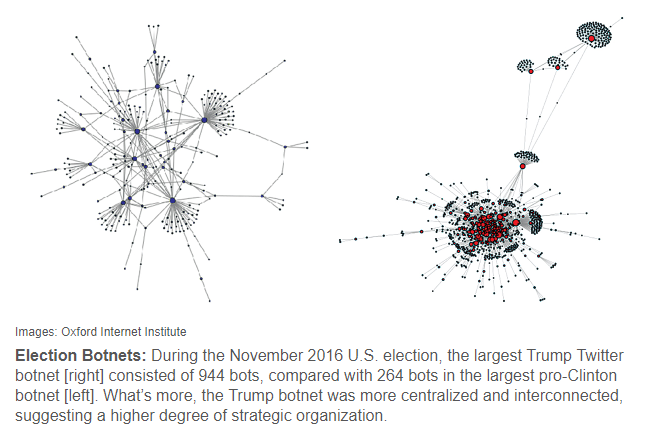
    • TrumpClintonBotnets
  • Starting Characterizing Online Public Discussions through Patterns of Participant Interactions
  • More Grokking ML

Phil 11.9.18

7:00 – ASRC PhD/BD/NASA

  • Started to write up the study design for Belief Spaces/Places in a Google doc
  • More Grokking ML – ok progress
  • Riot – a glossy Matrix collaboration client for the web. http://riot.im
  • Lets Chat is a persistent messaging application that runs on Node.js and MongoDB. It’s designed to be easily deployable and fits well with small, intimate teams. (GitHub)
  • Mattermost is an open source, self-hosted Slack-alternative. As an alternative to proprietary SaaS messaging, Mattermost brings all your team communication into one place, making it searchable and accessible anywhere. It’s written in Golang and React and runs as a production-ready Linux binary under an MIT license with either MySQL or Postgres. (GitHub)
  • PHPbb is hosted on Dreamhost
  • Sprint planning
  • Analysis of visitors’ mobility patterns through random walk in the Louvre museum
    • This paper proposes a random walk model to analyze visitors’ mobility patterns in a large museum. Visitors’ available time makes their visiting styles different, resulting in dissimilarity in the order and number of visited places and in path sequence length. We analyze all this by comparing a simulation model and observed data, which provide us the strength of the visitors’ mobility patterns. The obtained results indicate that shorter stay-type visitors exhibit stronger patterns than those with the longer stay-type, confirming that the former are more selective than the latter in terms of their visitation type.
  • Same Story, Different Story The Neural Representation of Interpretive Frameworks
    • Differences in people’s beliefs can substantially impact their interpretation of a series of events. In this functional MRI study, we manipulated subjects’ beliefs, leading two groups of subjects to interpret the same narrative in different ways. We found that responses in higher-order brain areas—including the default-mode network, language areas, and subsets of the mirror neuron system—tended to be similar among people who shared the same interpretation, but different from those of people with an opposing interpretation. Furthermore, the difference in neural responses between the two groups at each moment was correlated with the magnitude of the difference in the interpretation of the narrative. This study demonstrates that brain responses to the same event tend to cluster together among people who share the same views.
  • Similar neural responses predict friendship
    • Computational Social Neuroscience Lab 
      • The Computational Social Neuroscience Lab is located in the Department of Psychology at UCLA.We study how our brains allow us to represent and navigate the social world. We take a multidisciplinary approach to research that integrates theory and methods from cognitive neuroscience, machine learning, social network analysis, and social psychology.
    • Authors
    • Research has borne out this intuition: social ties are forged at a higher-than expected rate between individuals of the same age, gender, ethnicity, and other demographic categories. This assortativity in friendship networks is referred to as homophily and has been demonstrated across diverse contexts and geographic locations, including online social networks [2, 3, 4, 5(Page 2)
    • When humans do forge ties with individuals who are dissimilar from themselves, these relationships tend to be instrumental, task-oriented (e.g., professional collaborations involving people with complementary skill sets [7]), and short-lived, often dissolving after the individuals involved have achieved their shared goal. Thus, human social networks tend to be overwhelmingly homophilous [8]. (Page 2)
      • This means that groups can be more efficient, but prone to belief stampede
    • Remarkably, social network proximity is as important as genetic relatedness and more important than geographic proximity in predicting the similarity of two individuals’ cooperative behavioral tendencies [4] (Page 2)
    • how individuals interpret and respond to their environment increases the predictability of one another’s thoughts and actions during social interactions [14], since knowledge about oneself is a more valid source of information about similar others than about dissimilar others. (Page 2)
      • There is a second layer on top of this which may be more important. How individuals respond to social cues (which can have significant survival value in a social animal) may be more important than day-to-day reactions to the physical environment.
    • Here we tested the proposition that neural responses to naturalistic audiovisual stimuli are more similar among friends than among individuals who are farther removed from one another in a real-world social network. Measuring neural activity while people view naturalistic stimuli, such as movie clips, offers an unobtrusive window into individuals’ unconstrained thought processes as they unfold [16(page 2)
    • Social network proximity appears to be significantly associated with neural response similarity in brain regions involved in attentional allocation, narrative interpretation, and affective responding (Page 2)
    • We first characterized the social network of an entire cohort of students in a graduate program. All students (N = 279) in the graduate program completed an online survey in which they indicated the individuals in the program with whom they were friends (see Methods for further details). Given that a mutually reported tie is a stronger indicator of the presence of a friendship than an unreciprocated tie, a graph consisting only of reciprocal (i.e., mutually reported) social ties was used to estimate social distances between individuals. (Page 2)
      • I wonder if this changes as people age. Are there gender differences?
    • The videos presented in the fMRI study covered a range of topics and genres (e.g., comedy clips, documentaries, and debates) that were selected so that they would likely be unfamiliar to subjects, effectively constrain subjects’ thoughts and attention to the experiment (to minimize mind wandering), and evoke meaningful variability in responses across subjects (because different subjects attend to different aspects of them, have different emotional reactions to them, or interpret the content differently, for example). (Page 3)
      • I think this might make the influence more environmental than social. It would be interesting to see how a strongly aligned group would deal with a polarizing topic, even something like sports.
    • Mean response time series spanning the course of the entire experiment were extracted from 80 anatomical regions of interest (ROIs) for each of the 42 fMRI study subjects (page 3)
      • 80 possible dimensions. It would be interesting to see this in latent space. That being said, there is no dialog here, so no consensus building, which implies no dimension reduction.
    • To test for a relationship between fMRI response similarity and social distance, a dyad-level regression model was used. Models were specified either as ordered logistic regressions with categorical social distance as the dependent variable or as logistic regression with a binary indicator of reciprocated friendship as the dependent variable. We account for the dependence structure of the dyadic data (i.e., the fact that each fMRI subject is involved in multiple dyads), which would otherwise underestimate the standard errors and increase the risk of type 1 error [20], by clustering simultaneously on both members of each dyad [21, 22].
    • For the purpose of testing the general hypothesis that social network proximity is associated with more similar neural responses to naturalistic stimuli, our main predictor variable of interest, neural response similarity within each student dyad, was summarized as a single variable. Specifically, for each dyad, a weighted average of normalized neural response similarities was computed, with the contribution of each brain region weighted by its average volume in our sample of fMRI subjects. (Page 3)
    • To account for demographic differences that might impact social network structure, our model also included binary predictor variables indicating whether subjects in each dyad were of the same or different nationalities, ethnicities, and genders, as well as a variable indicating the age difference between members of each dyad. In addition, a binary variable was included indicating whether subjects were the same or different in terms of handedness, given that this may be related to differences in brain functional organization [23]. (page 3)
    • Logistic regressions that combined all non-friends into a single category, regardless of social distance, yielded similar results, such that neural similarity was associated with a dramatically increased likelihood of friendship, even after accounting for similarities in observed demographic variables. More specifically, a one SD increase in overall neural similarity was associated with a 47% increase in the likelihood of friendship (logistic regression: ß = 0.388; SE = 0.109; p = 0.0004; N = 861 dyads). Again, neural similarity improved the model’s predictive power above and beyond observed demographic similarities, χ2(1) = 7.36, p = 0.006. (Page 4)
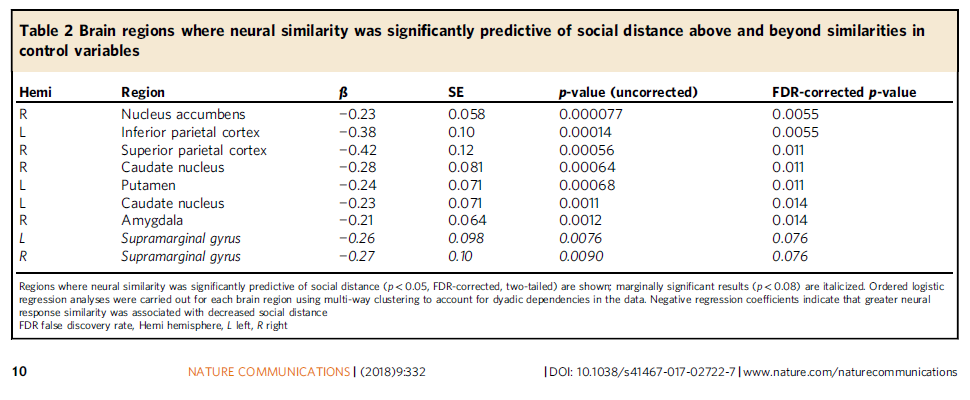
    • To gain insight into what brain regions may be driving the relationship between social distance and overall neural similarity, we performed ordered logistic regression analyses analogous to those described above independently for each of the 80 ROIs, again using cluster-robust standard errors to account for dyadic dependencies in the data. This approach is analogous to common fMRI analysis approaches in which regressions are carried out independently at each voxel in the brain, followed by correction for multiple comparisons across voxels. We employed false discovery rate (FDR) correction to correct for multiple comparisons across brain regions. This analysis indicated that neural similarity was associated with social network proximity in regions of the ventral and dorsal striatum … Regression coefficients for each ROI are shown in Fig. 6, and further details for ROIs that met the significance threshold of p < 0.05, FDR-corrected (two tailed) are provided in Table 2. (Page 4)
      • So the latent space that matters involves something on the order of 7 – 9 regions? I wonder if the actions across regions are similar enough to reduce further. I need to look up what each region does.
    • Table 2Figure6
    • Results indicated that average overall (weighted average) neural similarities were significantly higher among distance 1 dyads than dyads belonging to other social distance categories … distance 4 dyads were not significantly different in overall neural response similarity from dyads in the other social distance categories. All reported p-values are two-tailed. (Page 4)
    • Within the training data set for each data fold, a grid search procedure [24] was used to select the C parameter of a linear support vector machine (SVM) learning algorithm that would best separate dyads according to social distance. (Page 5)
    • As shown in Fig. 8, the classifier tended to predict the correct social distances for dyads in all distance categories at rates above the accuracy level that would be expected based on chance alone (i.e., 25% correct), with an overall classification accuracy of 41.25%. Classification accuracies for distance 1, 2, 3, and 4 dyads were 48%, 39%, 31%, and 47% correct, respectively. (Page 6)
    • where the classifier assigned the incorrect social distance label to a dyad, it tended to be only one level of social distance away from the correct answer: when friends were misclassified, they were misclassified most often as distance 2 dyads; when distance 2 dyads were misclassified, they were misclassified most often as distance 1 or 3 dyads, and so on. (Page 6)
    • The results reported here are consistent with neural homophily: people tend to be friends with individuals who see the world in a similar way. (Page 7)
    • Brain areas where response similarity was associated with social network proximity included subcortical areas implicated in motivation, learning, affective processing, and integrating information into memory, such as the nucleus accumbens, amygdala, putamen, and caudate nucleus [27, 28, 29]. Social network proximity was also associated with neural response similarity within areas involved in attentional allocation, such as the right superior parietal cortex [30,31], and regions in the inferior parietal lobe, such as the bilateral supramarginal gyri and left inferior parietal cortex (which includes the angular gyrus in the parcellation scheme used [32]), that have been implicated in bottom-up attentional control, discerning others’ mental states, processing language and the narrative content of stories, and sense-making more generally [33, 34, 35]. (Page 7)
    • However, the current results suggest that social network proximity may be associated with similarities in how individuals attend to, interpret, and emotionally react to the world around them. (Page 7)
      • Both the environmental and social world
    • A second, not mutually exclusive, possibility pertains to the “three degrees of influence rule” that governs the spread of a wide range of phenomena in human social networks [43]. Data from large-scale observational studies as well as lab-based experiments suggest that wide-ranging phenomena (e.g., obesity, cooperation, smoking, and depression) spread only up to three degrees of geodesic distance in social networks, perhaps due to social influence effects decaying with social distance to the extent that the they are undetectable at social distances exceeding three, or to the relative instability of long chains of social ties [43]. Although we make no claims regarding the causal mechanisms behind our findings, our results show a similar pattern. (Page 8)
      • Does this change with the level of similarity in the group?
    • pre-existing similarities in how individuals tend to perceive, interpret, and respond to their environment can enhance social interactions and increase the probability of developing a friendship via positive affective processes and by increasing the ease and clarity of communication [14, 15]. (Page 8)

Phil 11.7.18

Let the House Subcommittee investigations begin! Also, better redistricting?

7:00 – 5:00 ASRC PhD/BD

  • Rather than Deep Learning with Keras, I’m starting on Grokking Deep Learning. I need better grounding
    • Installed Jupyter
  • After lunch, send follow-up emails to the technical POCs. This will be the basis for the white paper: Tentative findings/implications for design. Modify it on the blog page first and then use to create the LaTex doc. Make that one project, with different mains that share overlapping content.
  • Characterizing Online Public Discussions through Patterns of Participant Interactions
    • Public discussions on social media platforms are an intrinsic part of online information consumption. Characterizing the diverse range of discussions that can arise is crucial for these platforms, as they may seek to organize and curate them. This paper introduces a computational framework to characterize public discussions, relying on a representation that captures a broad set of social patterns which emerge from the interactions between interlocutors, comments and audience reactions. We apply our framework to study public discussions on Facebook at two complementary scales. First, we use it to predict the eventual trajectory of individual discussions, anticipating future antisocial actions (such as participants blocking each other) and forecasting a discussion’s growth. Second, we systematically analyze the variation of discussions across thousands of Facebook sub-communities, revealing subtle differences (and unexpected similarities) in how people interact when discussing online content. We further show that this variation is driven more by participant tendencies than by the content triggering these discussions.
  • More latent space flocking from Innovation Hub
    • You Share Everything With Your Bestie. Even Brain Waves.
      •  Scientists have found that the brains of close friends respond in remarkably similar ways as they view a series of short videos: the same ebbs and swells of attention and distraction, the same peaking of reward processing here, boredom alerts there. The neural response patterns evoked by the videos — on subjects as diverse as the dangers of college football, the behavior of water in outer space, and Liam Neeson trying his hand at improv comedy — proved so congruent among friends, compared to patterns seen among people who were not friends, that the researchers could predict the strength of two people’s social bond based on their brain scans alone.

    • Similar neural responses predict friendship
      • Human social networks are overwhelmingly homophilous: individuals tend to befriend others who are similar to them in terms of a range of physical attributes (e.g., age, gender). Do similarities among friends reflect deeper similarities in how we perceive, interpret, and respond to the world? To test whether friendship, and more generally, social network proximity, is associated with increased similarity of real-time mental responding, we used functional magnetic resonance imaging to scan subjects’ brains during free viewing of naturalistic movies. Here we show evidence for neural homophily: neural responses when viewing audiovisual movies are exceptionally similar among friends, and that similarity decreases with increasing distance in a real-world social network. These results suggest that we are exceptionally similar to our friends in how we perceive and respond to the world around us, which has implications for interpersonal influence and attraction.
    • Brain-to-Brain coupling: A mechanism for creating and sharing a social world
      • Cognition materializes in an interpersonal space. The emergence of complex behaviors requires the coordination of actions among individuals according to a shared set of rules. Despite the central role of other individuals in shaping our minds, most cognitive studies focus on processes that occur within a single individual. We call for a shift from a single-brain to a multi-brain frame of reference. We argue that in many cases the neural processes in one brain are coupled to the neural processes in another brain via the transmission of a signal through the environment. Brain-to-brain coupling constrains and simplifies the actions of each individual in a social network, leading to complex joint behaviors that could not have emerged in isolation.
  • Started reading Similar neural responses predict friendship

Phil 11.6.18

7:00 – 2:00 ASRC PhD/BD

  • Today’s big though: Maps are going top be easier than I thought. We’ve been doing  them for thousands of years with board games.
  • Worked with Aaron on slides, including finding fault detection using our technologies. There is quite a bit, with pioneering work from NASA
  • Uploaded documents – done
  • Called and left messages for Dr. Wilkins and Dr. Palazzolo. Need to send a follow-up email to Dr. Palazzolo and start on the short white papers
  • Leaving early to vote
  • The following two papers seem to be addressing edge stiffness
  • Model of the Information Shock Waves in Social Network Based on the Special Continuum Neural Network
    • The article proposes a special class of continuum neural network with varying activation thresholds and a specific neuronal interaction mechanism as a model of message distribution in social networks. Activation function for every neuron is fired as a decision of the specific systems of differential equations which describe the information distribution in the chain of the network graph. This class of models allows to take into account the specific mechanisms for transmitting messages, where individuals who, receiving a message, initially form their attitude towards it, and then decide on the further transmission of this message, provided that the corresponding potential of the interaction of two individuals exceeds a certain threshold level. The authors developed the original algorithm for calculating the time moments of message distribution in the corresponding chain, which comes to the solution of a series of Cauchy problems for systems of ordinary nonlinear differential equations.
  • A cost-effective algorithm for inferring the trust between two individuals in social networks
    • The popularity of social networks has significantly promoted online individual interaction in the society. In online individual interaction, trust plays a critical role. It is very important to infer the trust among individuals, especially for those who have not had direct contact previously in social networks. In this paper, a restricted traversal method is defined to identify the strong trust paths from the truster and the trustee. Then, these paths are aggregated to predict the trust rate between them. During the traversal on a social network, interest topics and topology features are comprehensively considered, where weighted interest topics are used to measure the semantic similarity between users. In addition, trust propagation ability of users is calculated to indicate micro topology information of the social network. In order to find the topk most trusted neighbors, two combination strategies for the above two factors are proposed in this paper. During trust inference, the traversal depth is constrained according to the heuristic rule based on the “small world” theory. Three versions of the trust rate inference algorithm are presented. The first algorithm merges interest topics and topology features into a hybrid measure for trusted neighbor selection. The other two algorithms consider these two factors in two different orders. For the purpose of performance analysis, experiments are conducted on a public and widely-used data set. The results show that our algorithms outperform the state-of-the-art algorithms in effectiveness. In the meantime, the efficiency of our algorithms is better than or comparable to those algorithms.
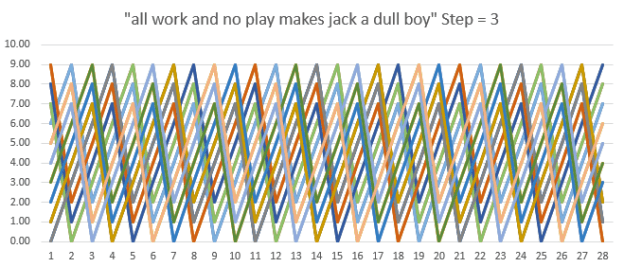
  • Back to LSTMs. Made a numeric version of “all work and no play in the jack_torrance generatorAWANPMJADB
  • Reading in and writing out weight files. The predictions seems to be working well, but I have no insight into the arguments that go into the LSTM model. Going to revisit the Deep Learning with Keras book

Phil 11.4.18

The Center for Midnight

  • Inspiration came from his most recent experiments on human/computer collaborative writing. Sloan is developing a sort of cyborg text editor, an algorithmic cure for writer’s block, a machine that reads what you’ve written so far and offers a few words that might come next. It does so by reaching into its model of language, a recurrent neural network trained on whatever collection of text seems appropriate, and trying to find sensible endings to the sentence you began.
  • rnn-writer
    • This is a package for the Atom text editor that works with torch-rnn-server to provide responsive, inline “autocomplete” powered by a recurrent neural network trained on a corpus of sci-fi stories, or another corpus of your choosing.
    • Writing with the machine
      •  I had to offer an extravagant analogy (and I do) I’d say it’s like writing with a deranged but very well-read parrot on your shoulder. Anytime you feel brave enough to ask for a suggestion, you press tab, and…

Phil 11.2.18

7:00 – 2:30 ASRC PhD (feeling burned out – went home early for a nap)

  • Continuing with my 810 assignment. Just found out about finite semiotics, which could be useful for trustworthiness detection (variance in terms and speed of adoption)
  • I like this! Creating a Perceptron From Scratch
    • In order to gain more insight as to how Neural Networks (NNs) are created and used, we must first understand how they work. It is important to always create a solid foundation as to why you are doing something, instead of navigating blindly. With the ubiquity of Tensorflow or Keras, sometimes it is easy to forget what you are actually building and how to best develop your NN. For this project I will be using Python to create a simple Perceptron that will implement the basics of Back-Propagation to Optimize our Synapse Weighting. I’ll be sure to explain everything along the way and always encourage you to reach out if you have any questions! I will assume no prior knowledge in NNs, but you will instead need to know some fundamentals of Python programming, low-level calculus, and a bit of linear algebra. If you aren’t quite sure what a NN is and how they are used in the field of AI, I encourage you to first read my article covering that topic before tackling this project. So let’s get to it!
  • And this is very interesting:
    • SHAP (SHapley Additive exPlanations) is a unified approach to explain the output of any machine learning model. SHAP connects game theory with local explanations, uniting several previous methods [1-7] and representing the only possible consistent and locally accurate additive feature attribution method based on expectations (see the SHAP NIPS paper for details).
  • Ok, back to generators. Here are several versions of Call of the Wild
    • Tokens
      index, token
      0, quivering
      1, scraped
      2, introspective
      3, confines
      4, restlessness
      5, pug
      6, mandate
      7, twisted
      8, part
      9, error
      10, thong
      11, resolved
      12, daunted
      13, spray
      14, trees
      15, caught
      16, fearlessly
      17, quite
      18, soft
      19, sounds
      20, slaying
    • Text sequences
      #confg: {"sequence_length":10, "step":1, "type":"words"}
      buck, did, not, read, the, newspapers, or, he, would, have
      did, not, read, the, newspapers, or, he, would, have, known
      not, read, the, newspapers, or, he, would, have, known, that
      read, the, newspapers, or, he, would, have, known, that, trouble
      the, newspapers, or, he, would, have, known, that, trouble, was
      newspapers, or, he, would, have, known, that, trouble, was, brewing
      or, he, would, have, known, that, trouble, was, brewing, not
      he, would, have, known, that, trouble, was, brewing, not, alone
      would, have, known, that, trouble, was, brewing, not, alone, for
      have, known, that, trouble, was, brewing, not, alone, for, himself
      known, that, trouble, was, brewing, not, alone, for, himself, but
      that, trouble, was, brewing, not, alone, for, himself, but, for
      trouble, was, brewing, not, alone, for, himself, but, for, every
      was, brewing, not, alone, for, himself, but, for, every, tidewater
      brewing, not, alone, for, himself, but, for, every, tidewater, dog
      not, alone, for, himself, but, for, every, tidewater, dog, strong
      alone, for, himself, but, for, every, tidewater, dog, strong, of
      for, himself, but, for, every, tidewater, dog, strong, of, muscle
      himself, but, for, every, tidewater, dog, strong, of, muscle, and


    • Index sequences
      #confg: {"sequence_length":10, "step":1, "type":"integer"}
      4686, 1720, 283, 1432, 1828, 1112, 4859, 3409, 3396, 379
      1720, 283, 1432, 1828, 1112, 4859, 3409, 3396, 379, 4004
      283, 1432, 1828, 1112, 4859, 3409, 3396, 379, 4004, 3954
      1432, 1828, 1112, 4859, 3409, 3396, 379, 4004, 3954, 4572
      1828, 1112, 4859, 3409, 3396, 379, 4004, 3954, 4572, 4083
      1112, 4859, 3409, 3396, 379, 4004, 3954, 4572, 4083, 3287
      4859, 3409, 3396, 379, 4004, 3954, 4572, 4083, 3287, 283
      3409, 3396, 379, 4004, 3954, 4572, 4083, 3287, 283, 1808
      3396, 379, 4004, 3954, 4572, 4083, 3287, 283, 1808, 975
      379, 4004, 3954, 4572, 4083, 3287, 283, 1808, 975, 532
      4004, 3954, 4572, 4083, 3287, 283, 1808, 975, 532, 973
      3954, 4572, 4083, 3287, 283, 1808, 975, 532, 973, 975
      4572, 4083, 3287, 283, 1808, 975, 532, 973, 975, 4678
      4083, 3287, 283, 1808, 975, 532, 973, 975, 4678, 3017
      3287, 283, 1808, 975, 532, 973, 975, 4678, 3017, 2108
      283, 1808, 975, 532, 973, 975, 4678, 3017, 2108, 984
      1808, 975, 532, 973, 975, 4678, 3017, 2108, 984, 1868
      975, 532, 973, 975, 4678, 3017, 2108, 984, 1868, 3407

Phil 11.1.18

7:00 – 4:30 ASRC PhD

  • Quick thought. Stampedes may be recognized not just from low variance (density of connections), but also the speed that a new term moves into the lexicon (stiffness)
  • The Junk News Aggregator, the Visual Junk News Aggregator and the Top 10 Junk News Aggregator are research projects of the Computational Propaganda group (COMPROP) of the Oxford Internet Institute (OII)at the University of Oxford.These aggregators are intended as tools to help researchers, journalists, and the public see what English language junk news stories are being shared and engaged with on Facebook, ahead of the 2018 US midterm elections on November 6, 2018.The aggregators show junk news posts along with how many reactions they received, for all eight types of post reactions available on Facebook, namely: Likes, Comments, Shares, and the five emoji reactions: Love, Haha, Wow, Angry, and Sad.
  • Reading Charles Perrow’s Normal Accidents. Riveting. All about dense, tightly connected networks with hidden information
    • From The Montreal Review
      • Normal Accident drew attention to two different forms of organizational structure that Herbert Simon had pointed to years before, vertical integration, and what we now call modularity. Examining risky systems in the Accident book, I focused upon the unexpected interactions of different parts of the system that no designer could have expected and no operator comprehend or be able to interdict. Reading Charles Perrow’s Normal Accidents. Riveting. All about dense, tightly connected networks with hidden information
  • Building generators.
    • Need to change the “stepsize” in the Torrance generator to be variable – done. Here’s my little ode to The Shining:
      #confg: {"rows":100, "sequence_length":26, "step":26, "type":"words"}
      all work and no play makes jack a dull boy all work and no play makes jack a dull boy all work and no play makes 
      jack a dull boy all work and no play makes jack a dull boy all work and no play makes jack a dull boy all work 
      and no play makes jack a dull boy all work and no play makes jack a dull boy all work and no play makes jack a 
      dull boy all work and no play makes jack a dull boy all work and no play makes jack a dull boy all work and no 
      play makes jack a dull boy all work and no play makes jack a dull boy all work and no play makes jack a dull boy 
      all work and no play makes jack a dull boy all work and no play makes jack a dull boy all work and no play makes 
      jack a dull boy all work and no play makes jack a dull boy all work and no play makes jack a dull boy all work 
      and no play makes jack a dull boy all work and no play makes jack a dull boy all work and no play makes jack a 
      dull boy all work and no play makes jack a dull boy all work and no play makes jack a dull boy all work and no 
      play makes jack a dull boy all work and no play makes jack a dull boy all work and no play makes jack a dull boy 
      all work and no play makes jack a dull boy all work and no play makes jack a dull boy all work and no play makes 
      jack a dull boy all work and no play makes jack a dull boy all work and no play makes jack a dull boy all work 
      and no play makes jack a dull boy all work and no play makes jack a dull boy all work and no play makes jack a 
      
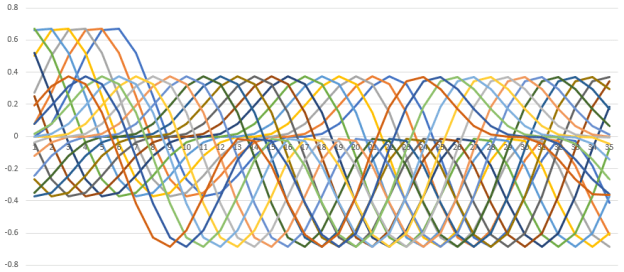
    • Need to be able to turn out a numeric equivalent. Done with floating point. This:
      #confg: {"function":math.sin(xx)*math.sin(xx/2.0)*math.cos(xx/4.0), "rows":100, "sequence_length":20, "step":1, "delta":0.4, "type":"floating_point"}
      0.0,0.07697897630719268,0.27378318599563484,0.5027638400821064,0.6604469814238397,0.6714800165989514,0.519596709539434,0.2524851001382131,-0.04065231596017931,-0.2678812526747579,-0.37181365763470914,-0.34898182120310306,-0.24382057359778858,-0.12182487479311599,-0.035942415169752356,-0.0027892469005274916,0.00019865778200507415,0.016268713740310237,0.07979661440830532,0.19146155036709192,
      0.07697897630719312,0.2737831859956355,0.5027638400821071,0.6604469814238401,0.6714800165989512,0.5195967095394334,0.2524851001382121,-0.04065231596018022,-0.26788125267475843,-0.37181365763470925,-0.3489818212031028,-0.24382057359778805,-0.12182487479311552,-0.0359424151697521,-0.0027892469005274395,0.0001986577820050832,0.016268713740310397,0.07979661440830574,0.19146155036709248,0.31158944024296154,
      0.2737831859956368,0.502763840082108,0.6604469814238405,0.6714800165989508,0.5195967095394324,0.25248510013821085,-0.04065231596018143,-0.2678812526747592,-0.37181365763470936,-0.34898182120310245,-0.24382057359778747,-0.12182487479311502,-0.03594241516975184,-0.002789246900527388,0.00019865778200509222,0.01626871374031056,0.07979661440830614,0.191461550367093,0.311589440242962,0.3760334615921674,
      0.5027638400821092,0.6604469814238411,0.6714800165989505,0.5195967095394312,0.25248510013820913,-0.040652315960182955,-0.26788125267476015,-0.37181365763470964,-0.348981821203102,-0.24382057359778667,-0.12182487479311428,-0.03594241516975145,-0.0027892469005273107,0.00019865778200510578,0.016268713740310803,0.07979661440830675,0.1914615503670939,0.3115894402429629,0.3760334615921675,0.3275646734005755,
      0.660446981423842,0.6714800165989498,0.5195967095394289,0.2524851001382062,-0.04065231596018568,-0.2678812526747618,-0.37181365763471,-0.34898182120310123,-0.24382057359778553,-0.1218248747931133,-0.03594241516975093,-0.0027892469005272066,0.00019865778200512388,0.016268713740311122,0.07979661440830756,0.19146155036709495,0.31158944024296387,0.3760334615921676,0.3275646734005745,0.1475692800414062,
      0.671480016598949,0.5195967095394267,0.25248510013820324,-0.04065231596018842,-0.2678812526747636,-0.3718136576347104,-0.34898182120310045,-0.24382057359778414,-0.12182487479311209,-0.03594241516975028,-0.002789246900527077,0.0001986577820051465,0.016268713740311528,0.07979661440830856,0.19146155036709636,0.3115894402429648,0.37603346159216783,0.32756467340057344,0.1475692800414041,-0.12805444308254293,
      0.5195967095394245,0.2524851001382003,-0.04065231596019116,-0.2678812526747653,-0.3718136576347107,-0.3489818212030998,-0.24382057359778303,-0.12182487479311109,-0.03594241516974975,-0.0027892469005269733,0.00019865778200516457,0.016268713740311847,0.07979661440830936,0.19146155036709747,0.3115894402429657,0.37603346159216794,0.32756467340057244,0.147569280041402,-0.1280544430825456,-0.41793663502550105,
      0.2524851001381973,-0.04065231596019389,-0.26788125267476703,-0.3718136576347111,-0.3489818212030989,-0.2438205735977817,-0.12182487479310988,-0.0359424151697491,-0.002789246900526843,0.00019865778200518717,0.01626871374031225,0.07979661440831039,0.1914615503670989,0.3115894402429671,0.3760334615921681,0.3275646734005709,0.14756928004139883,-0.1280544430825496,-0.41793663502550454,-0.6266831461371138,
      
    • Gives this: Waves
    • Need to write a generator that reads in text (words and characters) and produces data tables with stepsizes
    • Need to write a generator that takes an equation as a waveform
  • USPTO Meeting. Use NN to produce multiple centrality / laplacians that user interact with
  • Working on my 810 tasks
    • Potentially useful for mapmaking: Learning the Preferences of Ignorant, Inconsistent Agents
      • An important use of machine learning is to learn what people value. What posts or photos should a user be shown? Which jobs or activities would a person find rewarding? In each case, observations of people’s past choices can inform our inferences about their likes and preferences. If we assume that choices are approximately optimal according to some utility function, we can treat preference inference as Bayesian inverse planning. That is, given a prior on utility functions and some observed choices, we invert an optimal decision-making process to infer a posterior distribution on utility functions. However, people often deviate from approximate optimality. They have false beliefs, their planning is sub-optimal, and their choices may be temporally inconsistent due to hyperbolic discounting and other biases. We demonstrate how to incorporate these deviations into algorithms for preference inference by constructing generative models of planning for agents who are subject to false beliefs and time inconsistency. We explore the inferences these models make about preferences, beliefs, and biases. We present a behavioral experiment in which human subjects perform preference inference given the same observations of choices as our model. Results show that human subjects (like our model) explain choices in terms of systematic deviations from optimal behavior and suggest that they take such deviations into account when inferring preferences.
    • An Overview of the Schwartz Theory of Basic Values (Added to normative map making) Schwartz
      • This article presents an overview of the Schwartz theory of basic human values. It discusses the nature of values and spells out the features that are common to all values and what distinguishes one value from another. The theory identifies ten basic personal values that are recognized across cultures and explains where they come from. At the heart of the theory is the idea that values form a circular structure that reflects the motivations each value expresses. This circular structure, that captures the conflicts and compatibility among the ten values is apparently culturally universal. The article elucidates the psychological principles that give rise to it. Next, it presents the two major methods developed to measure the basic values, the Schwartz Value Survey and the Portrait Values Questionnaire. Findings from 82 countries, based on these and other methods, provide evidence for the validity of the theory across cultures. The findings reveal substantial differences in the value priorities of individuals. Surprisingly, however, the average value priorities of most societal groups exhibit a similar hierarchical order whose existence the article explains. The last section of the article clarifies how values differ from other concepts used to explain behavior—attitudes, beliefs, norms, and traits.

Phil 10.31.18

7:00 – ASRC PhD

  • Read this carefully today: Introducing AdaNet: Fast and Flexible AutoML with Learning Guarantees
    • Today, we’re excited to share AdaNet, a lightweight TensorFlow-based framework for automatically learning high-quality models with minimal expert intervention. AdaNet builds on our recent reinforcement learning and evolutionary-based AutoML efforts to be fast and flexible while providing learning guarantees. Importantly, AdaNet provides a general framework for not only learning a neural network architecture, but also for learning to ensemble to obtain even better models.
    • What about data from simulation?
    • Github repo
    • This looks like it’s based deeply the cloud AI and Machine Learning products, including cloud-based hyperparameter tuning.
    • Time series prediction is here as well, though treated in a more BigQuery manner
      • In this blog post we show how to build a forecast-generating model using TensorFlow’s DNNRegressor class. The objective of the model is the following: Given FX rates in the last 10 minutes, predict FX rate one minute later.
    • Text generation:
      • Cloud poetry: training and hyperparameter tuning custom text models on Cloud ML Engine
        • Let’s say we want to train a machine learning model to complete poems. Given one line of verse, the model should generate the next line. This is a hard problem—poetry is a sophisticated form of composition and wordplay. It seems harder than translation because there is no one-to-one relationship between the input (first line of a poem) and the output (the second line of the poem). It is somewhat similar to a model that provides answers to questions, except that we’re asking the model to be a lot more creative.
      • Codelab: Google Developers Codelabs provide a guided, tutorial, hands-on coding experience. Most codelabs will step you through the process of building a small application, or adding a new feature to an existing application. They cover a wide range of topics such as Android Wear, Google Compute Engine, Project Tango, and Google APIs on iOS.
        Codelab tools on GitHub

  • Add the Range and Length section in my notes to the DARPA measurement section. Done. I need to start putting together the dissertation using these parts
  • Read Open Source, Open Science, and the Replication Crisis in HCI. Broadly, it seems true, but trying to piggyback on GitHub seems like a shallow solution that repurposes something for coding – an ephemeral activity, to science, which is archival for a reason. Thought needs to be given to an integrated (collection, raw data, cleaned data, analysis, raw results, paper (with reviews?), slides, and possibly a recording of the talk with questions. What would it take to make this work across all science, from critical ethnographies to particle physics? How will it be accessible in 100 years? 500? 1,000? This is very much an HCI problem. It is about designing a useful socio-cultural interface. Some really good questions would be “how do we use our HCI tools to solve this problem?”, and, “does this point out the need for new/different tools?”.
  • NASA AIMS meeting. Demo in 2 weeks. AIMS is “time series prediction”, A2P is “unstructured data”. Proove that we can actually do ML, as opposed to saying things.
    • How about cross-point correlation? Could show in a sim?
    • Meeting on Friday with a package
    • We’ve solved A, here’s the vision for B – Z and a roadmap. JPSS is a near-term customer (JPSS Data)
    • Getting actionable intelligence from the system logs
    • Application portfolios for machine learning
    • Umbrella of capabilities for Rich Burns
    • New architectural framework for TTNC
    • Complete situational awareness. Access to commands and sensor streams
    • Software Engineering Division/Code 580
    • A2P as a toolbox, but needs to have NASA-relevant analytic capabilities
    • GMSEC overview

Phil 10.30.18

7:00 – 3:30 ASRC PhD

  • Search as embodies in the “Ten Blue Links” meets the requirements of a Parrow “Normal Accident”
    • The search results are densely connected. That’s how PageRank works. Even latent connections matter.
    • The change in popularity of a page rapidly affects the rank. So the connections are stiff
    • The relationships of the returned links both to each other and to the broader information landscape in general is hidden.
    • An additional density and stiffness issue is that everyone uses Google, so there is a dense, stiff connection between the search engine and the population of users
  • Write up something about how
    • ML can make maps, which decrease the likelihood of IR contributing to normal accidents
    • AI can use these maps to understand the shape of human belief space, and where the positive regions and dangerous sinks are.
  • Two measures for maps are the concepts or Range and length. Range is the distance that a trajectory can be placed on the map and remain contiguous. Length is the total distance that a trajectory travels, independent of the map its placed on.
  • Write up the basic algorithm of ML to map production
    • Take a set of trajectories that are known to be in the same belief region (why JuryRoom is needed) as the input
    • Generate an N-dimensional coordinate frame that best preserves length over the greatest range.
    • What is used as the basis for the trajectory may matter. The range (at a minimum), can go from letters to high-level topics. I think any map reconstruction based on letters would be a tangle, with clumps around TH, ER, ON, and AN. At the other end, an all-encompassing meta-topic, like WORDS would be a single, accurate, but useless single point. So the map reconstruction will become possible somewhere between these two extremes.
  • The Nietzsche text is pretty good. In particular, check out the way the sentences form based on the seed  “s when one is being cursed.
    • the fact that the spirit of the spirit of the body and still the stands of the world
    • the fact that the last is a prostion of the conceal the investion, there is our grust
    • the fact them strongests! it is incoke when it is liuderan of human particiay
    • the fact that she could as eudop bkems to overcore and dogmofuld
    • In this case, the first 2-3 words are the same, and random, semi-structured text. That’s promising, since the compare would be on the seed plus the generated text.
  • Today, see how fast a “Shining” (All work and no play makes Jack a dull boy.) text can be learned and then try each keyword as a start. As we move through the sentence, the probability of the next words should change.
    • Generate the text set
    • Train the Nietzsche model on the new text. Done. Here are examples with one epoch and a batch size of 32, with a temperature of 1.0:
      ----- diversity: 0.2
      ----- Generating with seed: "es jack a 
      dull boy all work and no play"
      es jack a 
      dull boy all work and no play makes jack a dull boy all work and no play makes jack a dull boy all work and no play makes jack a dull boy all work and no play makes 
      
      ----- diversity: 0.5
      ----- Generating with seed: "es jack a 
      dull boy all work and no play"
      es jack a 
      dull boy all work and no play makes jack a dull boy all work and no play makes jack a dull boy all work and no play makes jack a dull boy all work and no play makes 
      
      ----- diversity: 1.0
      ----- Generating with seed: "es jack a 
      dull boy all work and no play"
      es jack a 
      dull boy all work and no play makes jack a dull boy anl wory and no play makes jand no play makes jack a dull boy all work and no play makes jack a 
      
      ----- diversity: 1.2
      ----- Generating with seed: "es jack a 
      dull boy all work and no play"
      es jack a 
      dull boy all work and no play makes jack a pull boy all work and no play makes jack andull boy all work and no play makes jack a dull work and no play makes jack andull

      Note that the errors start with a temperature of 1.0 or greater

    • Rewrite the last part of the code to generate text based on each word in the sentence.
      • So I tried that and got gobbledygook. The issues is that the prediction only works on waveform-sized chunks. To verify this, I created a seed from the input text, truncating it to maxlen (20 in this case):
        sentence = "all work and no play makes jack a dull boy"[:maxlen]

        That worked, but it means that the character-based approach isn’t going to work

        ----- temperature: 0.2
        ----- Generating with seed: [all work and no play]
        all work and no play makes jack a dull boy all work and no play makes jack a dull boy all work and no play makes 
        
        ----- temperature: 0.5
        ----- Generating with seed: [all work and no play]
        all work and no play makes jack a dull boy all work and no play makes jack a dull boy all work and no play makes 
        
        ----- temperature: 1.0
        ----- Generating with seed: [all work and no play]
        all work and no play makes jack a dull boy all work and no play makes jack a dull boy pllwwork wnd no play makes 
        
        ----- temperature: 1.2
        ----- Generating with seed: [all work and no play]
        all work and no play makes jack a dull boy all work and no play makes jack a dull boy all work and no play makes


    • Based on this result and the ensuing chat with Aaron, we’re going to revisit the whole LSTM with numbers and build out a process that will support words instead of characters.
  • Looking for CMAC models, I found Self Organizing Feature Maps at NeuPy.com:
  • Here’s How Much Bots Drive Conversation During News Events
    • Late last week, about 60 percent of the conversation was driven by likely bots. Over the weekend, even as the conversation about the caravan was overshadowed by more recent tragedies, bots were still driving nearly 40 percent of the caravan conversation on Twitter. That’s according to an assessment by Robhat Labs, a startup founded by two UC Berkeley students that builds tools to detect bots online. The team’s first product, a Chrome extension called BotCheck.me, allows users to see which accounts in their Twitter timelines are most likely bots. Now it’s launching a new tool aimed at news organizations called FactCheck.me, which allows journalists to see how much bot activity there is across an entire topic or hashtag

Phil 10.21.18

Finished Meltdown. Need to write up some notes.

Think about using a CMAC or Deep CMAC for function learning, because NIST. Also, can it be used for multi-dimensional learning?

  • Cerebellar model articulation controller
  • Adaptive Noise Cancellation Using Deep Cerebellar Model Articulation Controller
  • RCMAC Hybrid Control for MIMO Uncertain Nonlinear Systems Using Sliding-Mode Technology
    • A hybrid control system, integrating principal and compensation controllers, is developed for multiple-input-multiple-output (MIMO) uncertain nonlinear systems. This hybrid control system is based on sliding-mode technique and uses a recurrent cerebellar model articulation controller (RCMAC) as an uncertainty observer. The principal controller containing an RCMAC uncertainty observer is the main controller, and the compensation controller is a compensator for the approximation error of the system uncertainty. In addition, in order to relax the requirement of approximation error bound, an estimation law is derived to estimate the error bound. The Taylor linearization technique is employed to increase the learning ability of RCMAC and the adaptive laws of the control system are derived based on Lyapunov stability theorem and Barbalat’s lemma so that the asymptotical stability of the system can be guaranteed. Finally, the proposed design method is applied to control a biped robot. Simulation results demonstrate the effectiveness of the proposed control scheme for the MIMO uncertain nonlinear system
  • Github CMAC TF projects


Phil 10.9.18

7:00 – 4:00 ASRC BD

  • Drive to work in Tesla. Ride to pick up Porsche lunch-ish. Drive home with bike. Ride to work. Drive home with bike. Who knew that the Towers of Hanoi would be such practical training?
  • Finish Antonio response and send it off. I think it needs a discussion of the structure of the paper and who is responsible for which section to be complete.
  • Artificial Intelligence and Social Simulation: Studying Group Dynamics on a Massive Scale
    • Recent advances in artificial intelligence and computer science can be used by social scientists in their study of groups and teams. Here, we explain how developments in machine learning and simulations with artificially intelligent agents can help group and team scholars to overcome two major problems they face when studying group dynamics. First, because empirical research on groups relies on manual coding, it is hard to study groups in large numbers (the scaling problem). Second, conventional statistical methods in behavioral science often fail to capture the nonlinear interaction dynamics occurring in small groups (the dynamics problem). Machine learning helps to address the scaling problem, as massive computing power can be harnessed to multiply manual codings of group interactions. Computer simulations with artificially intelligent agents help to address the dynamics problem by implementing social psychological theory in data-generating algorithms that allow for sophisticated statements and tests of theory. We describe an ongoing research project aimed at computational analysis of virtual software development teams.
    • This appears to be a simulation/real world project that models GitHub groups
  • Continue BAA work? I need to know what Matt’s found out about the topic.
    • Some good discussion. Got his email of notes from his meeting with Steve
    • Created a “Disruptioneering technical” template
    • Copied template and stated filling in sections for technical
  • DARPA announced its new initiative, AI Next, which will invest $2 billion in AI R&D to explore how machines can acquire human-like communication and reasoning capabilities, with the ability to recognize new situations and environments and adapt to them.” Since fiscal 2017, DARPA has stepped up its investment in artificial intelligence by almost 50 percent, from $307 million to $448 million.
  • DARPA’s move follows the Pentagon’s June decision to launch a $1.7 billion Joint Artificial Intelligence Center, or JAIC (pronounced “Jake”), to promote collaboration on AI-related R&D among military service branches, the private sector, and academia. The challenge is to transform relatively smaller contracts and some prototype systems development into large scale field deployment.

Phil 10.8.18

7:00 – 12:00, 2:00 – 5:00 ASRC Research

  • Finish up At Home in the Universe notes – done!
  • Get started on framing out Antonio’s paper – good progress!
    • Basically, Aaron and I think there is a spectrum of interaction that can occur in these systems. At one end is some kind of market, where communication is mediated through price, time, and convenience to the transportation user. At the other is a more top down, control system way of dealing with this. NIST RCS would be an example of this. In between these two extremes are control hierarchies that in turn interact through markets
  • Wrote up some early thoughts on how simulation and machine learning can be a thinking fast and slow solution to understandable AI

Phil 9.21.18

7:00 – 4:00 ASRC MKT

  • “Who’s idea was it to connect every idiot on the internet with every other idiot” PJ O’Rourke, Commonwealth Club, 2018
  • Running Programs In Reverse for Deeper A.I.” by Zenna Tavares
    • In this talk I show that inverse simulation, i.e., running programs in reverse from output to input, lies at the heart of the hardest problems in both human cognition and artificial intelligence. How humans are able to reconstruct the rich 3D structure of the world from 2D images; how we predict that it is safe to cross a street just by watching others walk, and even how we play, and sometimes win at Jenga, are all solvable by running programs backwards. The idea of program inversion is old, but I will present one of the first approaches to take it literally. Our tool ReverseFlow combines deep-learning and our theory of parametric inversion to compile the source code of a program (e.g., a TensorFlow graph) into its inverse, even when it is not conventionally invertible. This framework offers a unified and practical approach to both understand and solve the aforementioned problems in vision, planning and inference for both humans and machines.
  • Bot-ivistm: Assessing Information Manipulation in Social Media Using Network Analytics
    • Matthew Benigni 
    • Kenneth Joseph
    • Kathleen M. Carley (Scholar)
    • Social influence bot networks are used to effect discussions in social media. While traditional social network methods have been used in assessing social media data, they are insufficient to identify and characterize social influence bots, the networks in which they reside and their behavior. However, these bots can be identified, their prevalence assessed, and their impact on groups assessed using high dimensional network analytics. This is illustrated using data from three different activist communities on Twitter—the “alt-right,” ISIS sympathizers in the Syrian revolution, and activists of the Euromaidan movement. We observe a new kind of behavior that social influence bots engage in—repetitive @mentions of each other. This behavior is used to manipulate complex network metrics, artificially inflating the influence of particular users and specific agendas. We show that this bot behavior can affect network measures by as much as 60% for accounts that are promoted by these bots. This requires a new method to differentiate “promoted accounts” from actual influencers. We present this method. We also present a method to identify social influence bot “sub-communities.” We show how an array of sub-communities across our datasets are used to promote different agendas, from more traditional foci (e.g., influence marketing) to more nefarious goals (e.g., promoting particular political ideologies).
  • Pinged Aaron M. about writing an article
  • More iConf paper. Got a first draft on everything but the discussion section

Phil 8.16.18

7:00 – 4:30 ASRC MKT

  • R2D3 is an experiment in expressing statistical thinking with interactive design. Find us at @r2d3usR2D3
  • Foundations of Temporal Text Networks
    • Davide Vega (Scholar)
    • Matteo Magnani (Scholar)
    • Three fundamental elements to understand human information networks are the individuals (actors) in the network, the information they exchange, that is often observable online as text content (emails, social media posts, etc.), and the time when these exchanges happen. An extremely large amount of research has addressed some of these aspects either in isolation or as combinations of two of them. There are also more and more works studying systems where all three elements are present, but typically using ad hoc models and algorithms that cannot be easily transferred to other contexts. To address this heterogeneity, in this article we present a simple, expressive and extensible model for temporal text networks, that we claim can be used as a common ground across different types of networks and analysis tasks, and we show how simple procedures to produce views of the model allow the direct application of analysis methods already developed in other domains, from traditional data mining to multilayer network mining.
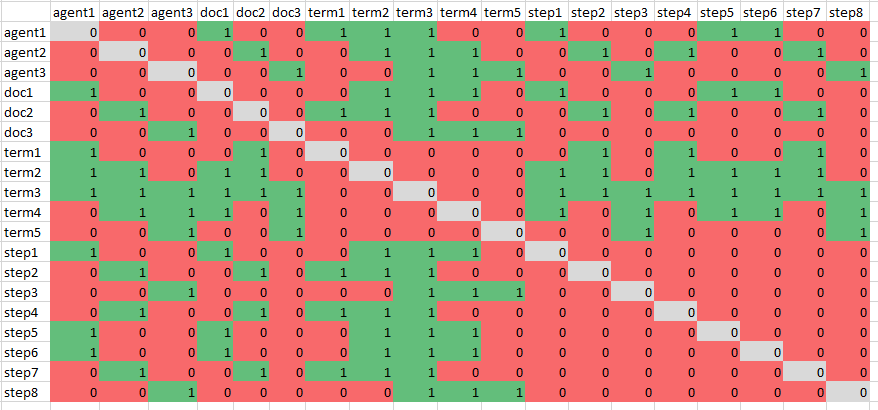
      • Ok, I’ve been reading the paper and if I understand it correctly, it’s pretty straightforward and also clever. It relates a lot to the way that I do term document matrices, and then extends the concept to include time, agents, and implicitly anything you want to. To illustrate, here’s a picture of a tensor-as-matrix: tensorIn2DThe important thing to notice is that there are multiple dimensions represented in a square matrix. We have:
        • agents
        • documents
        • terms
        • steps
      • This picture in particular is of an undirected adjacency matrix, but I think there are ways to handle in-degree and out-degree, though I think that’s probably better handled by having one matrix for indegree and one for out.
      • Because it’s a square matrix, we can calculate the steps between any node that’s on the matrix, and the centrality, simply by squaring the matrix and keeping track of the steps until the eigenvector settles. We can also weight nodes by multiplying that node’s row and column by the scalar. That changes the centrality, but ot the connectivity. We can also drop out components (steps for example) to see how that changes the underlying network properties.
      • If we want to see how time affects the development of the network, we can start with all the step nodes set to a zero weight, then add them in sequentially. This means, for example, that clustering could be performed on the nonzero nodes.
      • Some or all of the elements could be factorized using NMF, resulting in smaller, faster matrices.
      • Network embedding could be useful too. We get distances between nodes. And this looks really important: Network Embedding as Matrix Factorization: Unifying DeepWalk, LINE, PTE, and node2vec
      • I think I can use any and all of the above methods on the network tensor I’m describing. This is very close to a mapping solution.
  • The Shifting Discourse of the European Central Bank: Exploring Structural Space in Semantic Networks (cited by the above paper)
    • Convenient access to vast and untapped collections of documents generated by organizations is a valuable resource for research. These documents (e.g., Press releases, reports, speech transcriptions, etc.) are a window into organizational strategies, communication patterns, and organizational behavior. However, the analysis of such large document corpora does not come without challenges. Two of these challenges are 1) the need for appropriate automated methods for text mining and analysis and 2) the redundant and predictable nature of the formalized discourse contained in these collections of texts. Our article proposes an approach that performs well in overcoming these particular challenges for the analysis of documents related to the recent financial crisis. Using semantic network analysis and a combination of structural measures, we provide an approach that proves valuable for a more comprehensive analysis of large and complex semantic networks of formal discourse, such as the one of the European Central Bank (ECB). We find that identifying structural roles in the semantic network using centrality measures jointly reveals important discursive shifts in the goals of the ECB which would not be discovered under traditional text analysis approaches.
  • Comparative Document Analysis for Large Text Corpora
    • This paper presents a novel research problem, Comparative Document Analysis (CDA), that is, joint discovery of commonalities and differences between two individual documents (or two sets of documents) in a large text corpus. Given any pair of documents from a (background) document collection, CDA aims to automatically identify sets of quality phrases to summarize the commonalities of both documents and highlight the distinctions of each with respect to the other informatively and concisely. Our solution uses a general graph-based framework to derive novel measures on phrase semantic commonality and pairwise distinction, where the background corpus is used for computing phrase-document semantic relevance. We use the measures to guide the selection of sets of phrases by solving two joint optimization problems. A scalable iterative algorithm is developed to integrate the maximization of phrase commonality or distinction measure with the learning of phrase-document semantic relevance. Experiments on large text corpora from two different domains—scientific papers and news—demonstrate the effectiveness and robustness of the proposed framework on comparing documents. Analysis on a 10GB+ text corpus demonstrates the scalability of our method, whose computation time grows linearly as the corpus size increases. Our case study on comparing news articles published at different dates shows the power of the proposed method on comparing sets of documents.
  • Social and semantic coevolution in knowledge networks
    • Socio-semantic networks involve agents creating and processing information: communities of scientists, software developers, wiki contributors and webloggers are, among others, examples of such knowledge networks. We aim at demonstrating that the dynamics of these communities can be adequately described as the coevolution of a social and a socio-semantic network. More precisely, we will first introduce a theoretical framework based on a social network and a socio-semantic network, i.e. an epistemic network featuring agents, concepts and links between agents and between agents and concepts. Adopting a relevant empirical protocol, we will then describe the joint dynamics of social and socio-semantic structures, at both macroscopic and microscopic scales, emphasizing the remarkable stability of these macroscopic properties in spite of a vivid local, agent-based network dynamics.
  • Tensorflow 2.0 feedback request
    • Shortly, we will hold a series of public design reviews covering the planned changes. This process will clarify the features that will be part of TensorFlow 2.0, and allow the community to propose changes and voice concerns. Please join developers@tensorflow.org if you would like to see announcements of reviews and updates on process. We hope to gather user feedback on the planned changes once we release a preview version later this year.