Category Archives: Python

Phil 5.18.18

7:00 – 4:00 ASRC MKT

Phil 5.16.18

7:00 – 3:30 ASRC MKT

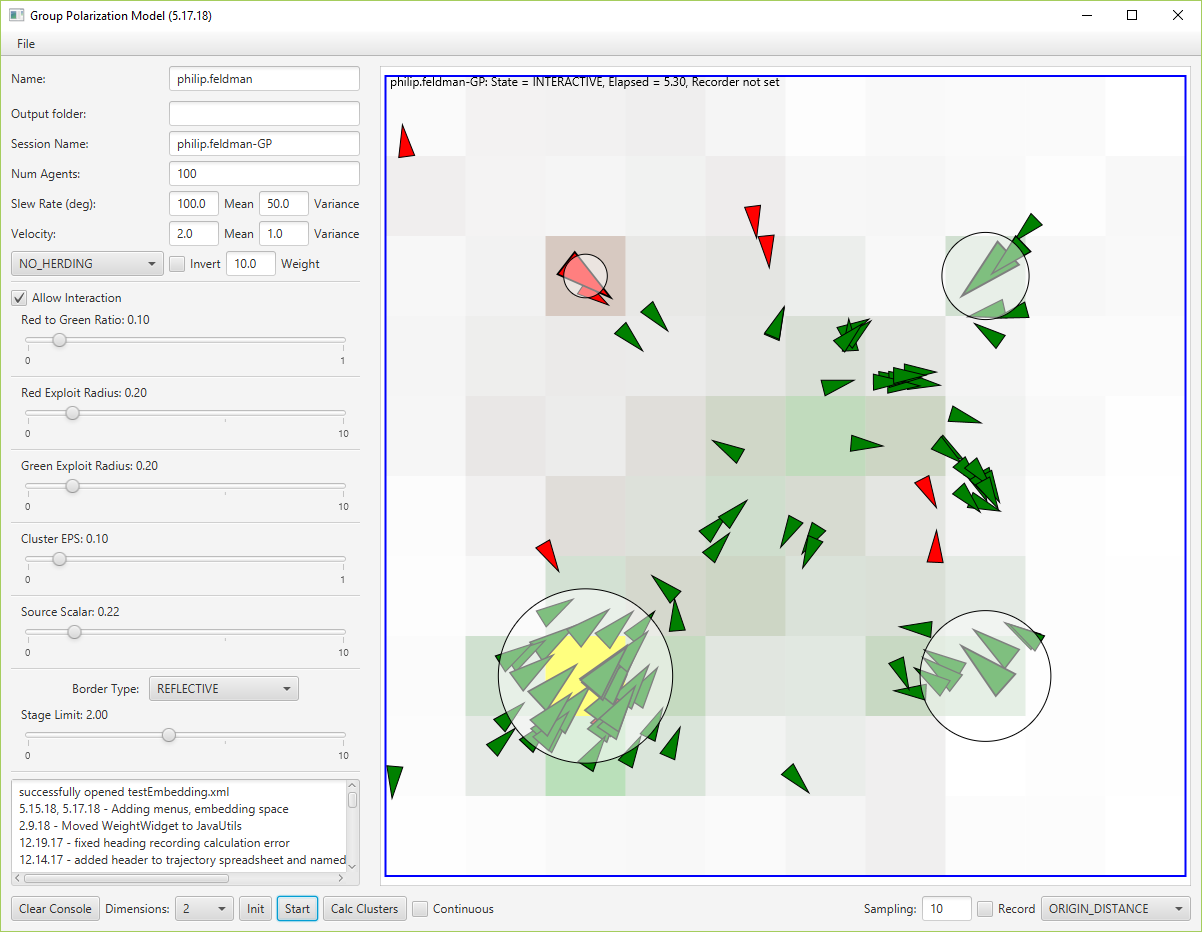
  • My home box has become very slow. 41 seconds to do a full recompile of GPM, while it takes 3 sec on a nearly identical machine at work. This may help?
  • Working on terms
  • Working on slides
  • Attending talk on Big Data, Security and Privacy – 11 am to 12 pm at ITE 459
    • Bhavani Thiraisingham
    • Big data management and analytics emphasizing GANs  and deep learning<- the new hotness
      • How do you detect attacks?
      • UMBC has real time analytics in cyber? IOCRC
    • Example systems
      • Cloud centric assured information sharing
    • Research challenges:
      • dynamically adapting and evolving policies to maintain privacy under a changing environment
      • Deep learning to detect attacks tat were previously not detectable
      • GANs or attacker and defender?
      • Scaleabe is a big problem, e.g. policies within Hadoop operatinos
      • How much information is being lost by not sharing data?
      • Fine grained access control with Hive RDF?
      • Distributed Search over Encrypted Big Data
    • Data Security & Privacy
      • Honypatching – Kevin xxx on software deception
      • Novel Class detection – novel class embodied in novel malware. There are malware repositories?
    • Lifecycle for IoT
    • Trustworthy analytics
      • Intel SGX
      • Adversarial SVM
      • This resembles hyperparameter tuning. What is the gradient that’s being descended?
      • Binary retrofitting. Some kind of binary man-in-the-middle?
      • Two body problem cybersecurity
    • Question –
      • discuss how a system might recognize an individual from session to session while being unable to identify the individual
      • What about multiple combinatorial attacks
      • What about generating credible false information to attackers, that also has steganographic components for identifying the attacker?
  • I had managed to not commit the embedding xml and the programs that made them, so first I had to install gensim and lxml at home. After that it’s pretty straightforward to recompute with what I currently have.
  • Moving ARFF and XLSX output to the menu choices. – done
  • Get started on rendering
    • Got the data read in and rendering, but it’s very brute force:
      if(getCurrentEmbeddings().loadSuccess){
          double posScalar = ResizableCanvas.DEFAULT_SCALAR/2.0;
          List<WordEmbedding> weList = currentEmbeddings.getEmbeddings();
          for (WordEmbedding we : weList){
              double size = 10.0 * we.getCount();
              SmartShape ss = new SmartShape(we.getEntry(), Color.WHITE, Color.BLACK);
              ss.setPos(we.getCoordinate(0)*posScalar, we.getCoordinate(1)*posScalar);
              ss.setSize(size, size);
              ss.setAngle(0);
              ss.setType(SmartShape.SHAPE_TYPE.OVAL);
              canvas.addShape(ss);
          }
      }

      It took a while to remember how shapes and agents work together. Next steps:

      • Extend SmartShape to SourceShape. It should be a stripped down version of FlockingShape
      • Extend BaseCA to SourceCA, again, it should be a stripped down version of FlockingBeliefCA
      • Add a sourceShapeList for FlockingAgentManager that then passes that to the FlockingShapes

Phil 5.15.18

7:00 – 4:00 ASRC MKT

Phil 5.14.18

7:00 – 3:00 ASRC MKT

    • Working on Zurich Travel. Ricardo is getting tix, and I got a response back from the conference on an extended stay
    • Continue with slides
    • See if there is a binary embedding reader in Java? Nope. Maybe in ml4j, but it’s easier to just write out the file in the format that I want
    • Done with the writer: Vim
  • Fika
  • Finished Simulacra and Simulation. So very, very French. From my perspective, there are so many different lines of thought coming out of the work that I can’t nail down anything definitive.
  • Started The Evolution of Cooperation

Phil 5.8.18

7:00 – 5:00 ASRC MKT

5:00 – 8:00 ASRC Tech Conference

Phil 5.7.18

7:00 – 5:00 ASRC MKT

  • Content Sharing within the Alternative Media Echo-System: The Case of the White Helmets
    • Kate Starbird
    • In June 2017 our lab began a research project looking at online conversations about the Syria Civil Defence (aka the “White Helmets”). Over the last 8–9 months, we have spent hundreds of hours conducting analysis on the tweets, accounts, articles, and websites involved in that discourse. Our first peer-reviewed paper was recently accepted to an upcoming conference (ICWSM-18). That paper focuses on a small piece of the structure and dynamics of this conversation, specifically looking at content sharing across websites. Here, I describe that research and highlight a few of the findings.
  • Matt Salganik on Open Review
  • Spent a lot of time getting each work to draw differently in the scatterplot. That took some digging into the gensim API to get vectors from the corpora. I then tried to plot the list of arrays, but matplotlib only likes ndarrays (apparently?). I’m now working on placing the words from each text into their own ndarray.
  • Also added a filter for short stop words and switched to a hash map for words to avoid redundant points in the plot.
  • Fika
    • Bryce Peake
    • ICA has a computational methods study area. How media lows through different spaces, etc. Python and [R]
    • Anne Balsamo – designing culture
    • what about language as an anti-colonial interaction
    • Human social scraping of data. There can be emergent themes that become important.
    • The ability of the user to delete all primary, secondary and tertiary data.
    • The third eye project (chyron crawls)

Phil 5.4.18

7:00 – 4:30 ASRC MKT

  • Listening to the Invisibilia episode on the stories we tell ourselves. (I, I, I. Him)
  • Listening to BBC Business Daily, on Economists in the doghouse. One of the people being interviewed is Mariana Mazzucato, who wrote The Entrepreneurial State: debunking public vs. private sector myths. She paraphrases Plato: “stories rule the world”. Oddly, this does not show up when you search through Plato’s work. It may be part of the Parable of the Cave, where the stories that the prisoners tell each other build a representation of the world?
  • Moby Dick, page 633 – a runaway condition:
    • They were one man, not thirty. For as the one ship that held them all; though it was put together of all contrasting things-oak, and maple, and pine wood; iron, and pitch, and hemp-yet all these ran into each other in the one concrete hull, which shot on its way, both balanced and directed by the long central keel; even so, all the individualities of the crew, this man’s valor, that man’s fear; guilt and guiltiness, all varieties were welded into oneness, and were all directed to that fatal goal which Ahab their one lord and keel did point to.
  • John Goodall, one of Wayne’s former students is deep into intrusion detection and visualization
  • Added comments to Aaron’s Reddit notes / CHI paper
  • Chris McCormick has a bunch of nice tutorials on his blog, including this one on Word2Vec:
    • This tutorial covers the skip gram neural network architecture for Word2Vec. My intention with this tutorial was to skip over the usual introductory and abstract insights about Word2Vec, and get into more of the details. Specifically here I’m diving into the skip gram neural network model.
    • He also did this:
    • wiki-sim-search: Similarity search on Wikipedia using gensim in Python.The goals of this project are the following two features:
      1. Create LSI vector representations of all the articles in English Wikipedia using a modified version of the make_wikicorpus.py script in gensim.
      2. Perform concept searches and other fun text analysis on Wikipedia, also using gensim functionality.
  • Slicing out columns in numpy:
    import numpy as np
    dimension = 3
    size = 10
    dataset = np.ndarray(shape=(size, dimension))
    for x in range(size):
        for y in range(dimension):
            val = (y+1) * 10 + x +1
            dataset[x,y] = val
    
    print(dataset)
    print(dataset[...,0])
    print(dataset[...,1])
    print(dataset[...,2])

    Results in:

    [[11. 21. 31.]
    [12. 22. 32.]
    [13. 23. 33.]
    [14. 24. 34.]
    [15. 25. 35.]
    [16. 26. 36.]
    [17. 27. 37.]
    [18. 28. 38.]
    [19. 29. 39.]
    [20. 30. 40.]]
    [11. 12. 13. 14. 15. 16. 17. 18. 19. 20.]
    [21. 22. 23. 24. 25. 26. 27. 28. 29. 30.]
    [31. 32. 33. 34. 35. 36. 37. 38. 39. 40.]
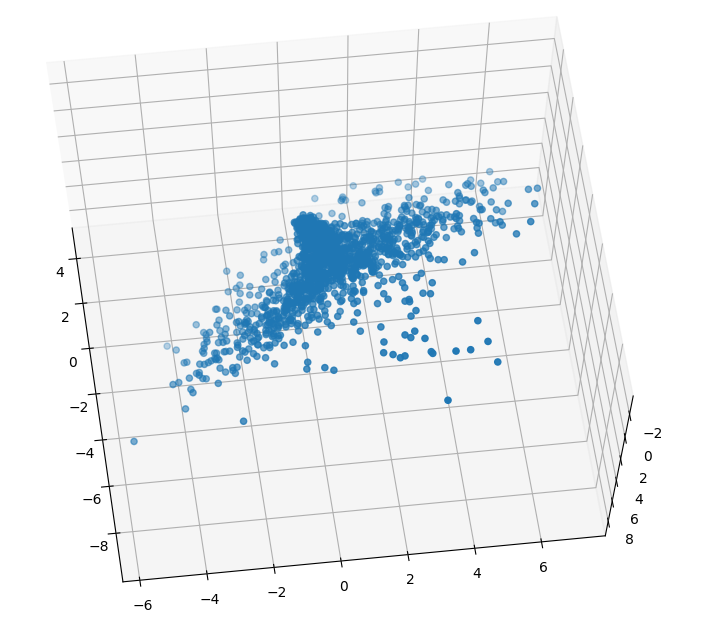
  • And that makes everything work. Here’s a screenshot of a 3D embedding space for the entire(?) Jack London corpora: 3D_corpora
  • A few things come to mind
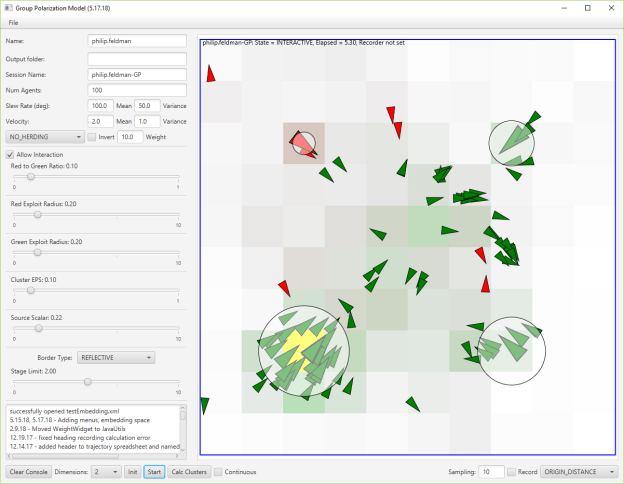
    • I’ll need to get the agents to stay in the space that the points are in. I think each point is an “attractor” with a radius (an agent without a heading). IN the presence of an attractor an agent’s speed is reduced by x%. It there are a lot of attractors (n), then the speed is reduced by xn%. Which should make for slower agents in areas of high density. Agents in the presence of attractors also expand their influence horizon, becoming more “attractive”
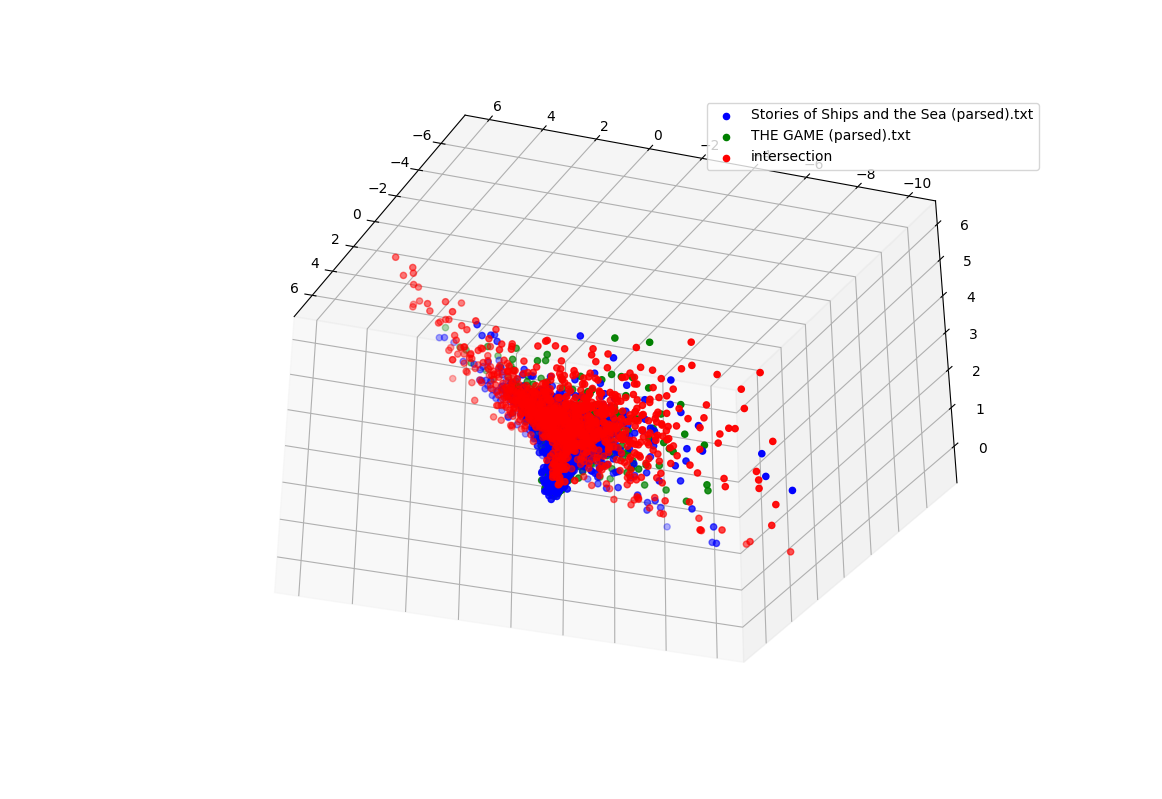
    • I should be able to draw the area covered by each book in the corpora by looking for the W2V coordinates and plotting them as I read through the (parsed) book. Each book gets a color.

Phil 5.3.18

7:30 – 5:00 ASRC MKT

Phil 5.2.18

7:00 – 4:30 ASRC MKT

    • I am going to start calling runaway echo chambers Baudrillardian Stampedes: https://en.wikipedia.org/wiki/Simulacra_and_Simulation
    • GECCO 2018 paper list is full of swarming optimizers
    • CORNELL NEWSROOM is a large dataset for training and evaluating summarization systems. It contains 1.3 million articles and summaries written by authors and editors in the newsrooms of 38 major publications. The summaries are obtained from search and social metadata between 1998 and 2017 and use a variety of summarization strategies combining extraction and abstraction.
    • More Ultimate Angular
      • Template Fundamentals (interpolation – #ref)
    • Now that I have my corpora, time to figure out how to build an embedding
    • Installing gensim
      • By now, gensim is—to my knowledge—the most robust, efficient and hassle-free piece of software to realize unsupervised semantic modelling from plain text. It stands in contrast to brittle homework-assignment-implementations that do not scale on one hand, and robust java-esque projects that take forever just to run “hello world”.
      • Big install. Didn’t break TF, which is nice
    • How to Develop Word Embeddings in Python with Gensim
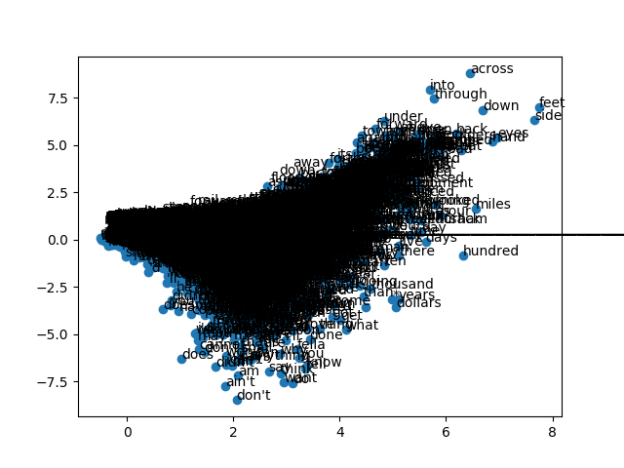
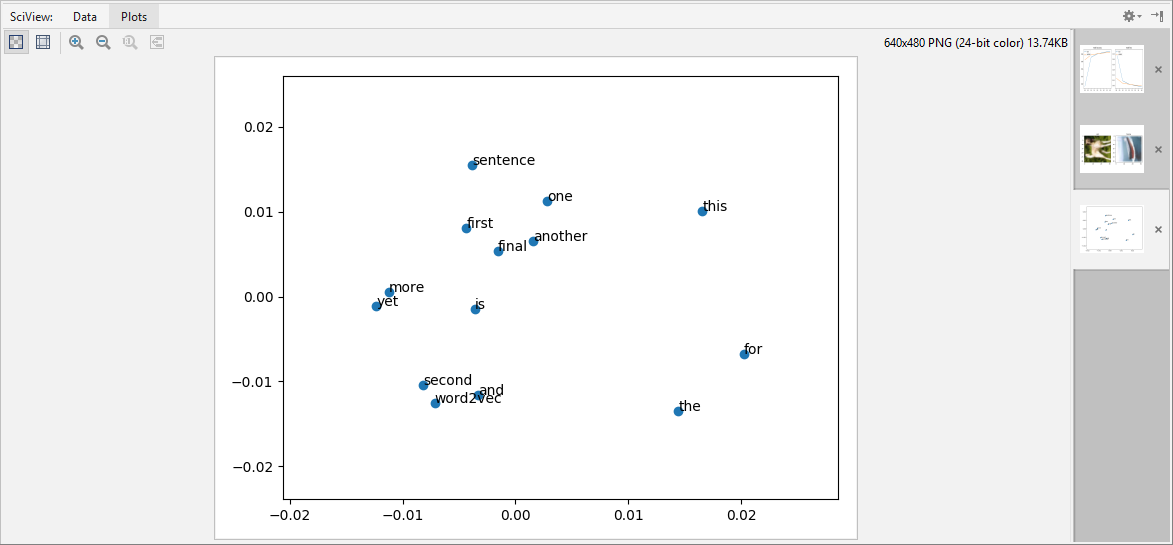
      • Following the tutorial. Here’s a plot! W2V
    • I need to redo the parser so that each file is one sentence.
      • sentences are strings that begin with a [CR] or [SPACE] + [WORD] and end with [WORD] + [.] or [“]
      • a [CR] preceded by anything other than a [.] or [“] is the middle of  a sentance
      • A fantastic regex tool! https://regex101.com/
        • regex = re.compile(r"([-!?\.]\"|[!?\.])")
      • After running into odd edge cases, I decided to load each book as a single string, parse it, then write out the individual lines. Works great except the last step, where I can’t seem to iterate over an array of strings. Calling it a day


Phil 5.1.18

7:00 – 4:30 ASRC MKT

  • Applications of big social media data analysis: An overview
    • Over the last few years, online communication has moved toward user-driven technologies, such as online social networks (OSNs), blogs, online virtual communities, and online sharing platforms. These social technologies have ushered in a revolution in user-generated data, online global communities, and rich human behavior-related content. Human-generated data and human mobility patterns have become important steps toward developing smart applications in many areas. Understanding human preferences is important to the development of smart applications and services to enable such applications to understand the thoughts and emotions of humans, and then act smartly based on learning from social media data. This paper discusses the role of social media data in comprehending online human data and in consequently different real applications of SM data for smart services are executed.
  • Explainable, Interactive Deep Learning
    • Recently, deep learning has been advancing the state of the art in artificial intelligence to yet another level, and humans are relying more and more on the outputs generated by artificial intelligence techniques than ever before. However, even with such unprecedented advancements, the lack of interpretability on the decisions made by deep learning models and no control over their internal processes act as a major drawback when utilizing them to critical decision-making processes such as precision medicine and law enforcement. In response, efforts are being made to make deep learning interpretable and controllable by humans. In this paper, we review recent studies relevant to this direction and discuss potential challenges and future research directions.
  • Building successful online communities: Evidence-based social design (book review)
    • In Building Successful Online Communities (2012), Robert Kraut, Paul Resnick, and their collaborators set out to draw links between the design of socio-technical systems with findings from social psychology and economics. Along the way, they set out a vision for the role of social sciences in the design of systems like mailing lists, discussion forums, wikis, and social networks, offering a way that behavior on those platforms might inform our understanding of human behavior.
  • Since I’ve forgotten my Angular stuff, reviewing UltimateAngular, Angular Fundamentals course. Finished the ‘Getting Started’ section
  • Strip out Guttenburg text from corpora – done!

Phil 3.28.18

7:00 – 5:00 ASRC MKT

    • Aaron found this hyperparameter optimization service: Sigopt
      • Improve ML models 100x faster
      • SigOpt’s API tunes your model’s parameters through state-of-the-art Bayesian optimization.
      • Exponentially faster and more accurate than grid search. Faster, more stable, and easier to use than open source solutions.
      • Extracts additional revenue and performance left on the table by conventional tuning.
    • A Strategy for Ranking Optimization Methods using Multiple Criteria
      • An important component of a suitably automated machine learning process is the automation of the model selection which often contains some optimal selection of hyperparameters. The hyperparameter optimization process is often conducted with a black-box tool, but, because different tools may perform better in different circumstances, automating the machine learning workflow might involve choosing the appropriate optimization method for a given situation. This paper proposes a mechanism for comparing the performance of multiple optimization methods for multiple performance metrics across a range of optimization problems. Using nonparametric statistical tests to convert the metrics recorded for each problem into a partial ranking of optimization methods, results from each problem are then amalgamated through a voting mechanism to generate a final score for each optimization method. Mathematical analysis is provided to motivate decisions within this strategy, and sample results are provided to demonstrate the impact of certain ranking decisions
    • World Models: Can agents learn inside of their own dreams?
      • We explore building generative neural network models of popular reinforcement learning environments[1]. Our world model can be trained quickly in an unsupervised manner to learn a compressed spatial and temporal representation of the environment. By using features extracted from the world model as inputs to an agent, we can train a very compact and simple policy that can solve the required task. We can even train our agent entirely inside of its own hallucinated dream generated by its world model, and transfer this policy back into the actual environment.
    • Tweaked the SingleNeuron spreadsheet
    • This came up again: A new optimizer using particle swarm theory (1995)
      • The optimization of nonlinear functions using particle swarm methodology is described. Implementations of two paradigms are discussed and compared, including a recently developed locally oriented paradigm. Benchmark testing of both paradigms is described, and applications, including neural network training and robot task learning, are proposed. Relationships between particle swarm optimization and both artificial life and evolutionary computation are reviewed.
      • New: Particle swarm optimization for hyper-parameter selection in deep neural networks
    • Working with the CIFAR10 data now. Tradeoff between filters and epochs:
      NB_EPOCH = 10
      NUM_FIRST_FILTERS = int(32/2)
      NUM_MIDDLE_FILTERS = int(64/2)
      OUTPUT_NEURONS = int(512/2)
      Test score: 0.8670728429794311
      Test accuracy: 0.6972
      Elapsed time =  565.9446044602014
      
      NB_EPOCH = 5
      NUM_FIRST_FILTERS = int(32/1)
      NUM_MIDDLE_FILTERS = int(64/1)
      OUTPUT_NEURONS = int(512/1)
      Test score: 0.8821897733688354
      Test accuracy: 0.6849
      Elapsed time =  514.1915690121759
      
      NB_EPOCH = 10
      NUM_FIRST_FILTERS = int(32/1)
      NUM_MIDDLE_FILTERS = int(64/1)
      OUTPUT_NEURONS = int(512/1)
      Test score: 0.7007060846328735
      Test accuracy: 0.765
      Elapsed time =  1017.0974014300725
      
      Augmented imagery
      NB_EPOCH = 10
      NUM_FIRST_FILTERS = int(32/1)
      NUM_MIDDLE_FILTERS = int(64/1)
      OUTPUT_NEURONS = int(512/1)
      Test score: 0.7243581249237061
      Test accuracy: 0.7514
      Elapsed time =  1145.673343808471
      
    • And yet, something is clearly wrong: wrongPNG
    • Maybe try this version? samyzaf.com/ML/cifar10/cifar10.html


Phil 3.27.18

7:00 – 6:00 ASRC MKT

  •  
  • Continuing with Keras
    • The training process can be stopped when a metric has stopped improving by using an appropriate callback:
      keras.callbacks.EarlyStopping(monitor='val_loss', min_delta=0, patience=0, verbose=0, mode='auto')
    • How to download and install quiver
    • Tried to get Tensorboard working, but it doesn’t connect to the data right?
    • Spent several hours building a neuron that learns in Excel. I’m very happy with it. What?! SingleNeuron
  • This is a really interesting thread. Stonekettle provoked a response that can be measured for variance, and also for the people (and bots?) who participate.
  • Listening to the World Affairs Council on The End of Authority, about social influence and misinformation
    • With so many forces undermining democratic institutions worldwide, we wanted a chance to take a step back and provide some perspective. Russian interference in elections here and in Europe, the rise in fake news and a decline in citizen trust worldwide all pose a danger. In this first of a three-part series, we focus on the global erosion of trust. Jennifer Kavanagh, political scientist at the RAND Corporation and co-author of “Truth Decay”, and Tom Nichols, professor at the US Naval War college and author of “The Death of Expertise,” are in conversation with Ray Suarez, former chief national correspondent for PBS NewsHour.
  • Science maps for kids
    • Dominic Walliman has created science infographics and animated videos that explore how the fields of biology, chemistry, computer science, physics, and mathematics relate.
  • The More you Know (Wikipedia) might serve as a template for diversity injection
  • A list of the things that Google knows about you via Twitter
  • Collective movement ecology
    • The collective movement of animals is one of the great wonders of the natural world. Researchers and naturalists alike have long been fascinated by the coordinated movements of vast fish schools, bird flocks, insect swarms, ungulate herds and other animal groups that contain large numbers of individuals that move in a highly coordinated fashion ([1], figure 1). Vividly worded descriptions of the behaviour of animal groups feature prominently at the start of journal articles, book chapters and popular science reports that deal with the field of collective animal behaviour. These descriptions reflect the wide appeal of collective movement that leads us to the proximate question of how collective movement operates, and the ultimate question of why it occurs (sensu[2]). Collective animal behaviour researchers, in collaboration with physicists, computer scientists and engineers, have often focused on mechanistic questions [37] (see [8] for an early review). This interdisciplinary approach has enabled the field to make enormous progress and revealed fundamental insights into the mechanistic basis of many natural collective movement phenomena, from locust ‘marching bands’ [9] through starling murmurations [10,11].
  • Starting to read Influence of augmented humans in online interactions during voting events
    • Massimo Stella (Scholar)
    • Marco Cristoforetti (Scholar)
    • Marco Cristoforetti (Scholar)
    • Abstract: Overwhelming empirical evidence has shown that online social dynamics mirrors real-world events. Hence, understanding the mechanisms leading to social contagion in online ecosystems is fundamental for predicting, and even manouvering, human behavior. It has been shown that one of such mechanisms is based on fabricating armies of automated agents that are known as social bots. Using the recent Italian elections as an emblematic case study, here we provide evidence for the existence of a special class of highly influential users, that we name “augmented humans”. They exploit bots for enhancing both their visibility and influence, generating deep information cascades to the same extent of news media and other broadcasters. Augmented humans uniformly infiltrate across the full range of identified clusters of accounts, the latter reflecting political parties and their electoral ranks.
    • Bruter and Harrison [19] shift the focus on the psychological in uence that electoral arrangements exert on voters by altering their emotions and behavior. The investigation of voting from a cognitive perspective leads to the concept of electoral ergonomics: Understanding optimal ways in which voters emotionally cope with voting decisions and outcomes leads to a better prediction of the elections.
    • Most of the Twitter interactions are from humans to bots (46%); Humans tend to interact with bots in 56% of mentions, 41% of replies and 43% of retweets. Bots interact with humans roughly in 4% of the interactions, independently on interaction type. This indicates that bots play a passive role in the network but are rather highly mentioned/replied/retweeted by humans.
    • bots’ locations are distributed worldwide and they are present in areas where no human users are geo-localized such as Morocco.
    • Since the number of social interactions (i.e., the degree) of a given user is an important estimator of the in uence of user itself in online social networks [17, 22], we consider a null model fixing users’ degree while randomizing their connections, also known as configuration model [23, 24].
    • During the whole period, bot bot interactions are more likely than random (Δ > 0), indicating that bots tend to interact more with other bots rather than with humans (Δ < 0) during Italian elections. Since interactions often encode the spread of a given content online [16], the positive assortativity highlights that bots share contents mainly with each other and hence can resonate with the same content, be it news or spam.

Phil 3.26.18

But this occasional timidity is characteristic of almost all herding creatures. Though banding together in tens of thousands, the lion-maned buffaloes of the West have fled before a solitary horseman. Witness, too, all human beings, how when herded together in the sheepfold of a theatre’s pit, they will, at the slightest alarm of fire, rush helter-skelter for the outlets, crowding, trampling, jamming, and remorselessly dashing each other to death. Best, therefore, withhold any amazement at the strangely gallied whales before us, for there is no folly of the beasts of the earth which is not infinitely outdone by the madness of men.

—-Moby Dick, The Grand Armada

8:30 – 4:30 ASRC MKT

  • Finished BIC and put the notes on Phlog
  • Exposure to Opposing Views can Increase Political Polarization: Evidence from a Large-Scale Field Experiment on Social Media
    • There is mounting concern that social media sites contribute to political polarization by creating “echo chambers” that insulate people from opposing views about current events. We surveyed a large sample of Democrats and Republicans who visit Twitter at least three times each week about a range of social policy issues. One week later, we randomly assigned respondents to a treatment condition in which they were offered financial incentives to follow a Twitter bot for one month that exposed them to messages produced by elected officials, organizations, and other opinion leaders with opposing political ideologies. Respondents were re-surveyed at the end of the month to measure the effect of this treatment, and at regular intervals throughout the study period to monitor treatment compliance. We find that Republicans who followed a liberal Twitter bot became substantially more conservative post-treatment, and Democrats who followed a conservative Twitter bot became slightly more liberal post-treatment. These findings have important implications for the interdisciplinary literature on political polarization as well as the emerging field of computational social science.
  • More Keras
  • hyperopt is a Python library for optimizing over awkward search spaces with real-valued, discrete, and conditional dimensions.
  • One Hidden Layer:
    training label size =  60000
    test label size =  10000
    60000 train samples
    10000 test samples
    _________________________________________________________________
    Layer (type)                 Output Shape              Param #   
    =================================================================
    dense_1 (Dense)              (None, 128)               100480    
    _________________________________________________________________
    activation_1 (Activation)    (None, 128)               0         
    _________________________________________________________________
    dense_2 (Dense)              (None, 128)               16512     
    _________________________________________________________________
    activation_2 (Activation)    (None, 128)               0         
    _________________________________________________________________
    dense_3 (Dense)              (None, 128)               16512     
    _________________________________________________________________
    activation_3 (Activation)    (None, 128)               0         
    _________________________________________________________________
    dense_4 (Dense)              (None, 10)                1290      
    _________________________________________________________________
    activation_4 (Activation)    (None, 10)                0         
    =================================================================
    Total params: 134,794
    Trainable params: 134,794
    Non-trainable params: 0
  • Two hidden layers:
    training label size =  60000
    test label size =  10000
    60000 train samples
    10000 test samples
    _________________________________________________________________
    Layer (type)                 Output Shape              Param #   
    =================================================================
    dense_1 (Dense)              (None, 128)               100480    
    _________________________________________________________________
    activation_1 (Activation)    (None, 128)               0         
    _________________________________________________________________
    dense_2 (Dense)              (None, 128)               16512     
    _________________________________________________________________
    activation_2 (Activation)    (None, 128)               0         
    _________________________________________________________________
    dense_3 (Dense)              (None, 128)               16512     
    _________________________________________________________________
    activation_3 (Activation)    (None, 128)               0         
    _________________________________________________________________
    dense_4 (Dense)              (None, 10)                1290      
    _________________________________________________________________
    activation_4 (Activation)    (None, 10)                0         
    =================================================================
    Total params: 134,794
    Trainable params: 134,794
    Non-trainable params: 0
Phil 3.23.18

7:00 – 5:00 ASRC MKT

  • Influence of augmented humans in online interactions during voting events
    • Overwhelming empirical evidence has shown that online social dynamics mirrors real-world events. Hence, understanding the mechanisms leading to social contagion in online ecosystems is fundamental for predicting, and even manouvering, human behavior. It has been shown that one of such mechanisms is based on fabricating armies of automated agents that are known as social bots. Using the recent Italian elections as an emblematic case study, here we provide evidence for the existence of a special class of highly influential users, that we name “augmented humans”. They exploit bots for enhancing both their visibility and influence, generating deep information cascades to the same extent of news media and other broadcasters. Augmented humans uniformly infiltrate across the full range of identified clusters of accounts, the latter reflecting political parties and their electoral ranks.
  • Reddit and the Struggle to Detoxify the Internet
    • “Does free speech mean literally anyone can say anything at any time?” Tidwell continued. “Or is it actually more conducive to the free exchange of ideas if we create a platform where women and people of color can say what they want without thousands of people screaming, ‘Fuck you, light yourself on fire, I know where you live’? If your entire answer to that very difficult question is ‘Free speech,’ then, I’m sorry, that tells me that you’re not really paying attention.”
    • This is the difference between discussion and stampede. That seems like it should be statistically detectable.
  • Metabolic Costs of Feeding Predictively Alter the Spatial Distribution of Individuals in Fish Schools
    • We examined individual positioning in groups of swimming fish after feeding
    • Fish that ate most subsequently shifted to more posterior positions within groups
    • Shifts in position were related to the remaining aerobic scope after feeding
    • Feeding-related constraints could affect leadership and group functioning
    • I wonder if this also keeps the hungrier fish at the front, increasing the effectiveness of gradient detections
  • Listening to Invisibilia: The Pattern Problem. There is a section on using machine learning for sociology. Listening to get the author of the ML and Sociology study. Predictions were not accurate. Not published?
  • The Coming Information Totalitarianism in China
    • The real-name system has two purposes. One is the chilling effect, and it works very well on average netizens but not so much on activists. The other and the main purpose is to be able to locate activists and eliminate them from certain information/opinion platforms, in the same way that opinions of dissident intellectuals are completely eradicated from the traditional media.
  • More BIC – Done! Need to assemble notes
    • It is a central component of resolute choice, as presented by McClennen, that (unless new information becomes available) later transient agents recognise the authority of plans made by earlier agents. Being resolute just is recognising that authority (although McClennen’ s arguments for the rationality and psychological feasibility of resoluteness apply only in cases in which the earlier agents’ plans further the common ends of earlier and later agents). This feature of resolute choice is similar to Bacharach’ s analysis of direction, explained in section 5. If the relationship between transient agents is modelled as a sequential game, resolute choice can be thought of as a form of direction, in which the first transient agent plays the role of director; the plan chosen by that agent can be thought of as a message sent by the director to the other agents. To the extent that each later agent is confident that this plan is in the best interests of the continuing person, that confidence derives from the belief that the first agent identified with the person and that she was sufficiently rational and informed to judge which sequence of actions would best serve the person’s objectives. (pg 197)
  • Meeting with celer scientific
  • More TF with Keras. Really good progress