Category Archives: Python

Phil8.12.19

7:00 – 5:00 ASRC GEOS

  • Another thought about groups thinking like neurons. Alcohol is like dopamine. It encourages connections between individuals, but the communication can become “noisier”
  • Call SSA
  • Dissertation/TAAS
    • Discuss survey
  • GEOS model
    • Finish control/simulation framework
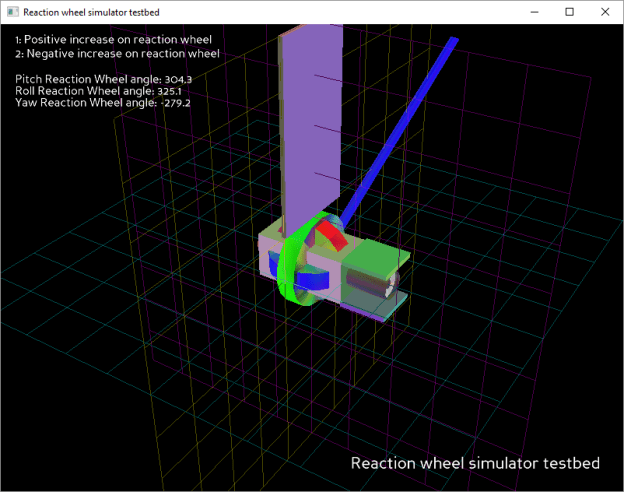
    • Get access to the rotation matrix and calculate transformations for (1, 0, 0), (0, 1, 0), and (0, 0, 1). Use those for pitch roll and yaw measurements
    • Write out these values (excel) and see if we can do a proof-of-concept that shows prediction of the reaction wheels from the PRY measurements
  • Helped Heera with her code
  • Read through and edited TAAS

Phil 8.9.19

7:00 – 5:00 ASRC GEOS

  • Something else for image repair: Deep Image Prior
    • Deep convolutional networks have become a popular tool for image generation and restoration. Generally, their excellent performance is imputed to their ability to learn realistic image priors from a large number of example images. In this paper, we show that, on the contrary, the structure of a generator network is sufficient to capture a great deal of low-level image statistics prior to any learning. In order to do so, we show that a randomly-initialized neural network can be used as a handcrafted prior with excellent results in standard inverse problems such as denoising, super-resolution, and inpainting. Furthermore, the same prior can be used to invert deep neural representations to diagnose them, and to restore images based on flash-no flash input pairs.
  • Dissertation/TAAS
  • GEOS Sim
    • Building RCS controllers!
    • Record data
    • Spark lines
    • Excel outputs
    • Start physics

Phil 8.8.19

7:00 – 4:00 ASRC GEOS

  • TAAS/Dissertation research_design
  • Paperwork for dad’s cert
  • More GEOS-R sim.
    • Fixed the camera rotation order
    • Create some classes to handle all this
      • GEOS-TopController
      • GEOS_Simulator
      • GEOS_R_Model
    • Record data
    • Spark lines
    • Excel outputs
    • Start physics

GEOS_sim

  • Meeting with Aaron to discuss cyber RFI

Phil 8.7.19

7:00 – 4:00 ASRC GEOS

  • TAAS/Dissertation research_design
  • Swing by Charlestown on the way to Mission Drive today? Done, but no luck. Did get a card though. Done!
  • Order cards – done
  • Read BAA, triage white paper – started
  • Got my STL travel report submitted
  • Got my education assistance reimbursement and pre-approval in
  • Uninstalled Panda3D and then pip installed it again. Now all python versions are aligned, so I have panda3d and numpy
  • More GEOS-R sim. Nope – didn’t check in all my changes last night.
    • Create some classes to handle all this
    • Record data
    • Spark lines
    • Excel outputs
    • Start physics
  • Super interesting discussion with a waitress about JuryRoom that started with Sriracha catsup

Phil 8.6.19

7:00 – 4:30 ASRC GEOS

  • Dissertation and TAAS – working out the research plan section
  • More satellite sim.
    • Got the graphics part done! Now for sparklines and the physics sim

GEOS_sim

  • Waikato meeting
    • Suggested added quote or snippet to notification
    • Arron can recruit antibubblers
    • Advertise on FB and Reddit? Twitter really isn’t a debate forum

Phil 8.5.19

7:00 – 3:30 ASRC GEOS

  • Was a rough weekend. Dad passed away after a decade or so with severe dementia. My feelings are… complex. He donated his body to the anatomy board, so expect remains in 2 months to 2 years. Also, I should be getting a letter shortly that has the information wrt getting death certificates. Sigh. At least I can stop freaking out every time the phone rings from the facility.
  • Wrote my review for Panos
  • Back to geometric primitives
    • Pulled out the tmesh so that it could be added as a set of Geoms to a single node
    • Sphere! Still need to fix the texture coords – doneSphere
    • Added the beginnings of the satellite create and control. I can manipulate 6DOF independently, but with respect to the global origin

Phil 8.2.19

7:00 – 3:30 ASRC GEOS

  • Send George a note about Dad
  • Scan hotel receipt (done) and fill out expense report – started, but couldn’t make it work. I need to get a new charge number. Spent hours on this trying to submit a travel expense report that didn’t have exceptions. SAP Concur is as bad an application as I have ever used.
  • Write down thoughts on inhibition and excitation in groups. Basically, when a group is engaged in discussion, some links are excitatory – a small group will engage in discussion, while others participate less or not at all – they are inhibited. These kind of discussions are almost always mediated by an explicit or implicit leader. The consensus that develops is greatly influenced by who is excited and who is inhibited. Also discuss typicality, or the clustering of belief around central items (examples of furniture have chairs and tables as high typicality examples)
  • Dissertation
    • Work on flowchart(s)
  • Generalize cube, size in 3 dimensions and normals from cross products
  • Change cylinder so that normals are from cross products – done, after considerable flailing.
  • Start on sphere and cone?
    • Cone! Cone

Phil 8.1.19

7:00 – 3:30 ASRC GEOS

  • Cancel service at Bob’s – done
  • Scan hotel receipt and fill out expense report
  • Write up some USPTO thoughts – done
  • School reimbursement and approval for 899 – forms filled out, waiting for signatures
  • Write down thoughts on inhibition and excitation in groups. Basically, when a group is engaged in discussion, some links are excitatory – a small group will engage in discussion, while others participate less or not at all – they are inhibited. These kind of discussions are almost always mediated by an explicit or implicit leader. The consensus that develops is greatly influenced by who is excited and who is inhibited.
  • July progress email – done
  • Dissertation
    • Work on flowchart(s)
  • Distributed Memory and the Representation of General and Specific Information
    • We describe a distributed model of information processing and memory and apply it to the representation of general and specific information. The model consists of a large number of simple processing elements which send excitatory and inhibitory signals to each other via modifiable connections. Information processing is thought of as the process whereby patterns of activation are formed over the units in the model through their excitatory and inhibitory interactions. The memory trace of a processing event is the change or increment to the strengths of the interconnections that results from the processing event. The traces of separate events are superimposed on each other in the values of the connection strengths that result from the entire set of traces stored in the memory. The model is applied to a number of findings related to the question of whether we store abstract representations or an enumeration of specific experiences in memory. The model simulates the results of a number of important experiments which have been taken as evidence for the enumeration of specific experiences. At the same time, it shows how the functional equivalent of abstract representations- prototypes, logogens, and even rules-can emerge from the superposition of traces of specific experiences, when the conditions are right for this to happen. In essence, the model captures the structure present in a set of input patterns; thus, it behaves as though it had learned prototypes or rules, to the extent that the structure of the environment it has learned about can be captured by describing it in terms of these abstractions.
  • Leveraging Meta Information in Short Text Aggregation
    • Analysing topics in short texts (e.g., tweets and new headings) is a challenging task because short texts often contain insufficient word co-occurrence information, which is important to learn good topics in conventional topic topics. To deal with the insufficiency, we propose a generative model that aggregates short texts into clusters by leveraging the associated meta information. Our model can generate more interpretable topics as well as document clusters. We develop an effective Gibbs sampling algorithm favoured by the fully local conjugacy in the model. Extensive experiments demonstrate that our model achieves better performance in terms of document clustering and topic coherence.

Phil 7.29.19

7:00 – 4:30 ASRC GEOS

  • Dissertation
    • Added paragraph on movement through information
    • Fill in section on my hut/contributions
    • Register for 899, check that I got the reimbursement
  • Get boarding pass at 9:35 – done
  • More data ingestor – done
  • Create TAAS folder and add Anthill and mapping papers, put in overleaf – done
  • Ping Aaron on IEEE paper and map comments – done
    • Aaaaaaaaaaaaand rejected, with no comments. Need to look for another venue. The Atlantic?
  • Ping David on Map comments and Tues/Wed cat sitting – done
  • Generalize cube, size in 3 dimensions and normals from cross products
  • Change cylinder so that normals are from cross products
  • Start on sphere and cone?
  • Rank JR ideas and send sql to Panos, Chris – done
  • Look at Panos paper? – not yet

Phil 7.26.19

7:00 – 4:30 ASRC

  • Dissertation – Finished Martindale
  • Ping Antonio about going the R&R route with ACM TAAS. – done
    • Find the right template
    • Fold in Simon’s Anthill (Probably the paper title)
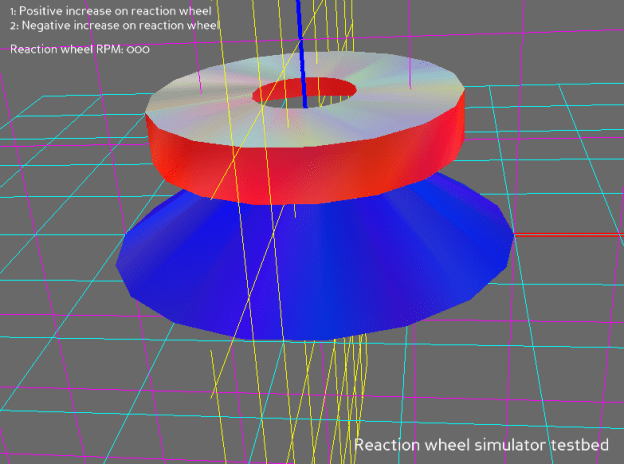
  • More graphics – got the disk working! Disk
  • Get Heera’s parser running?
    • Reading in the xml
    • Reading the files, though not really doing anything yet
  • Get replacement flapper – done

Phil 7.26.19

7:30 – 4:30 ASRC GEOS

PatWinston

Phil 7.24.19

7:00 – 4:00 ASRC GEOS

  • Write up my impression of yesterday’s game – done
  • Put together a Google Form to get everyone else’s impression – done
    • Understanding the map
    • Using the map
    • The effect of the map on gameplay and enjoyment
  • Send Don routes for ebike – done
  • Maybe get started on Martindale?
  • Start setting up Heera’s github – done
  • More graphics at Mission drive (bring fixee from home!)
    • Adding class to handle mouse button events – done
    • Refactoring the classes out of the Primitives.py file
    • Working on caps for the cylinder
  • Send Chris and Panos the anonymized sql, and rank the questions for difficulty
  • Various meetings

Phil 7.22.19

7:00 – 5:00 ASRC GEOS

conformity

Today’s timeline serendipity

  • The TdF is very exciting this year!
  • Met with Heera to discuss her work. I’m going to set up a GitHub project and add a parser that reads in an xml config file that then parses csv files into:
    • Spreadsheet for evaluation
    • Split-up csv files for analysis
  • Pick up air filter and oil change kit for the bike
  • Ran the random binary network code and generated figures for the text
  • Remind all the players about the run tomorrow – done
  • Getting the tmesh working – success!
  • Getting better camera controls

Phil 7.19.19

7:00 – 4:30 ASRC GEOS

StanfordNLP

  • Still looking at what’s wrong with my NK model. I found Random Boolean Networks, when looking for “random binary networks kauffman example“. It also has a bibliography that looks helpful as well
    • Introduction to Random Boolean Networks
      • The goal of this tutorial is to promote interest in the study of random Boolean networks (RBNs). These can be very interesting models, since one does not have to assume any functionality or particular connectivity of the networks to study their generic properties. Like this, RBNs have been used for exploring the configurations where life could emerge. The fact that RBNs are a generalization of cellular automata makes their research a very important topic. The tutorial, intended for a broad audience, presents the state of the art in RBNs, spanning over several lines of research carried out by different groups. We focus on research done within artificial life, as we cannot exhaust the abundant research done over the decades related to RBNs.
      • I can add a display that shows this: Trajectory
      • Got that working
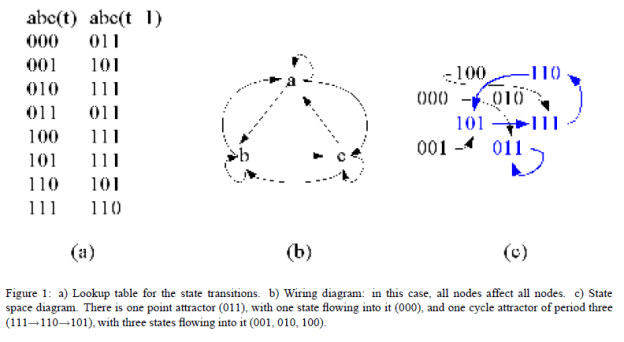
      • Rewrote so that there is an evolve without a fitness test. Trying to set up transition patterns like this: Transitions
      • The thing is, I don’t see how the K part works here…
      • I think I got it working!
    • Complex and Adaptive Dynamical Systems: A Primer
      • An thorough introduction is given at an introductory level to the field of quantitative complex system science, with special emphasis on emergence in dynamical systems based on network topologies. Subjects treated include graph theory and small-world networks, a generic introduction to the concepts of dynamical system theory, random Boolean networks, cellular automata and self-organized criticality, the statistical modeling of Darwinian evolution, synchronization phenomena and an introduction to the theory of cognitive systems. 
        It inludes chapter on Graph Theory and Small-World Networks, Chaos, Bifurcations and Diffusion, Complexity and Information Theory, Random Boolean Networks, Cellular Automata and Self-Organized Criticality, Darwinian evolution, Hypercycles and Game Theory, Synchronization Phenomena and Elements of Cognitive System Theory.

Phil 7.18.19

7:00 – 5:00 ASRC GEOS

  • Started to fold Wayne’s comments in
  • Working on the Kauffman section
  • Tried making it so K can be higher than N with resampling and I still can’t keep the system from converging, which makes me think that there is something wrong with the code.
  • Send reviews to Antonio – done
  • Back to work on the physics model. Make sure to include a data dictionary mapping system to support Bruce’s concept
  • Sent links to Panda3D to Vadim
  • Code autocompletion using deep learning
  • A lot of flailing today but no good progress:

N_20_K_6