Category Archives: IntelliJ

Phil 2.14.18

7:00 – 4:00 ASRC

  • Stampede? Herding? Twitter deleted 200,000 Russian troll tweets. Read them here.
    • Twitter doesn’t make it easy to track Russian propaganda efforts — this database can help
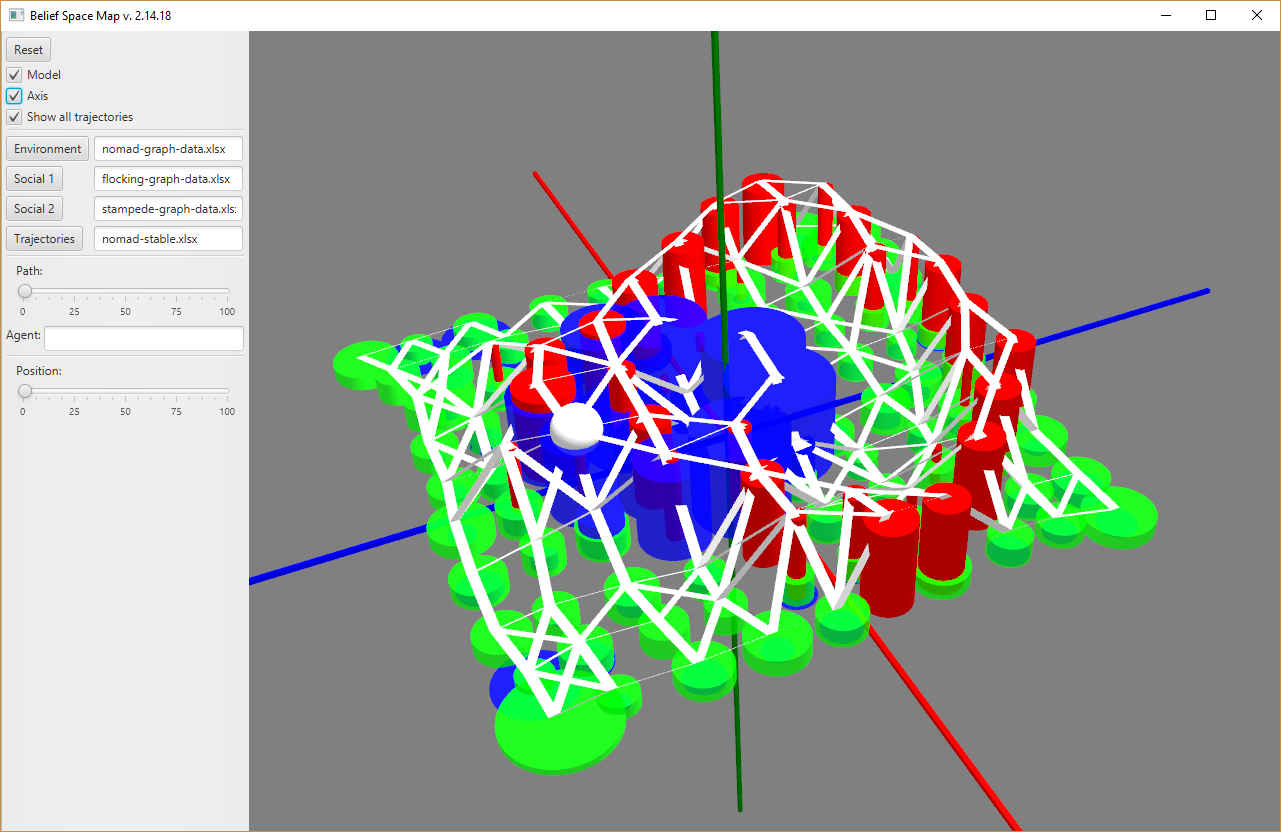
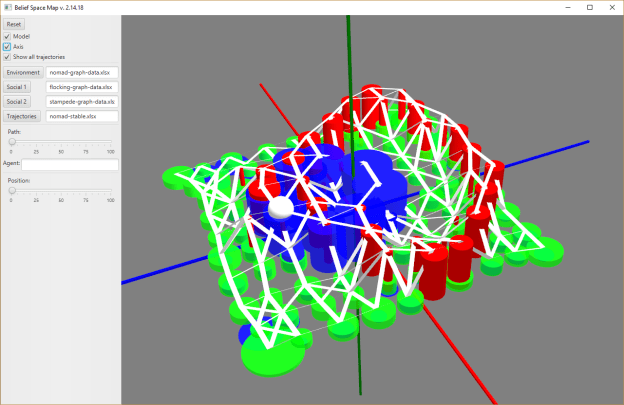
  • Add a “show all trajectories” checkbox.
    • That’s a nice visualization that shows the idea of the terrain uncovered by the trajectories: 2018-02-14
  • Continue with paper – down to 3 pages!
  • Continue with slides. Initial walkthrough with Aaron
  • 3:00 – 4:00 A2P meeting

Phil 2.12.18

7:00 – 4:00 ASRC MKT

  • The social structural foundations of adaptation and transformation in social–ecological systems
    • Social networks are frequently cited as vital for facilitating successful adaptation and transformation in linked social–ecological systems to overcome pressing resource management challenges. Yet confusion remains over the precise nature of adaptation vs. transformation and the specific social network structures that facilitate these processes. Here, we adopt a network perspective to theorize a continuum of structural capacities in social–ecological systems that set the stage for effective adaptation and transformation. We begin by drawing on the resilience literature and the multilayered action situation to link processes of change in social–ecological systems to decision making across multiple layers of rules underpinning societal organization. We then present a framework that hypothesizes seven specific social–ecological network configurations that lay the structural foundation necessary for facilitating adaptation and transformation, given the type and magnitude of human action required. A key contribution of the framework is explicit consideration of how social networks relate to ecological structures and the particular environmental problem at hand. Of the seven configurations identified, three are linked to capacities conducive to adaptation and three to transformation, and one is hypothesized to be important for facilitating both processes.
  • Starting to trim paper down to three pages
  • Starting on CHIIR slide stack – Still need to add future work
  • Springt Review
  • Rwanda radio transcripts
    • From October 1993 to late 1994, RTLM was used by Hutu leaders to advance an extremist Hutu message and anti-Tutsi disinformation, spreading fear of a Tutsi genocide against Hutu, identifying specific Tutsi targets or areas where they could be found, and encouraging the progress of the genocide. In April 1994, Radio Rwanda began to advance a similar message, speaking for the national authorities, issuing directives on how and where to kill Tutsis, and congratulating those who had already taken part.
  • Fika
    • Set up Fika Writing group that will meet Wednesdays at 4:00. We’ll see how that goes.

2.9.18

7:00 – 5:00 ASRC MKT

  • Add something about a population of ants – done
  • Add loaders for the three populations, and then one for trajectories
    • Promoted WeightWidget to JavaUtils
    • Moving 3d and UI building out of start
    • Ugh, new IntelliJ
    • Made the graph pieces selectable
    • Got drawmode (LINE) working
    • Reading in trajectories
    • Need to load each as a child and then draw all of them first, then make that selectable. Done!
  • Go over draft with Aaron. Hand off for rewrite 1? Nope – family emergency
  • 2:00 meeting with Aaron and IC team? Nope
  • Intro to deep learning course from MIT: introtodeeplearning.com
    • An introductory course on deep learning methods with applications to machine translation, image recognition, game playing, image generation and more. A collaborative course incorporating labs in TensorFlow and peer brainstorming along with lectures. Course concludes with project proposals with feedback from staff and panel of industry sponsors.
  • Topics, Events, Stories in Social Media
    • This thesis focuses on developing methods for social media analysis. Specifically, five directions are proposed here: 1) semi-supervised detection for targeted-domain events, 2) topical interaction study among multiple datasets, 3) discriminative learning about the identifications for common and distinctive topics, 4) epidemics modeling for flu forecasting with simulation via signals from social media data, 5) storyline generation for massive unorganized documents.
  • Communication by virus
    • The standard way to think about neurons is somewhat passive. Yes, they can exciteor inhibit the neurons they communicate with but, at the end of the day, they are passively relaying whatever information they contain. This is true not only in biologicalneurons but also in artificial neural networks. 

Phil 2.7/18

7:30 – 5:30 ASRC MKT

  • Freezing rain and general ick, so I’m working from home. Thus leading to the inevitable updating of IntelliJ
  • Working on the 3D mapping app.
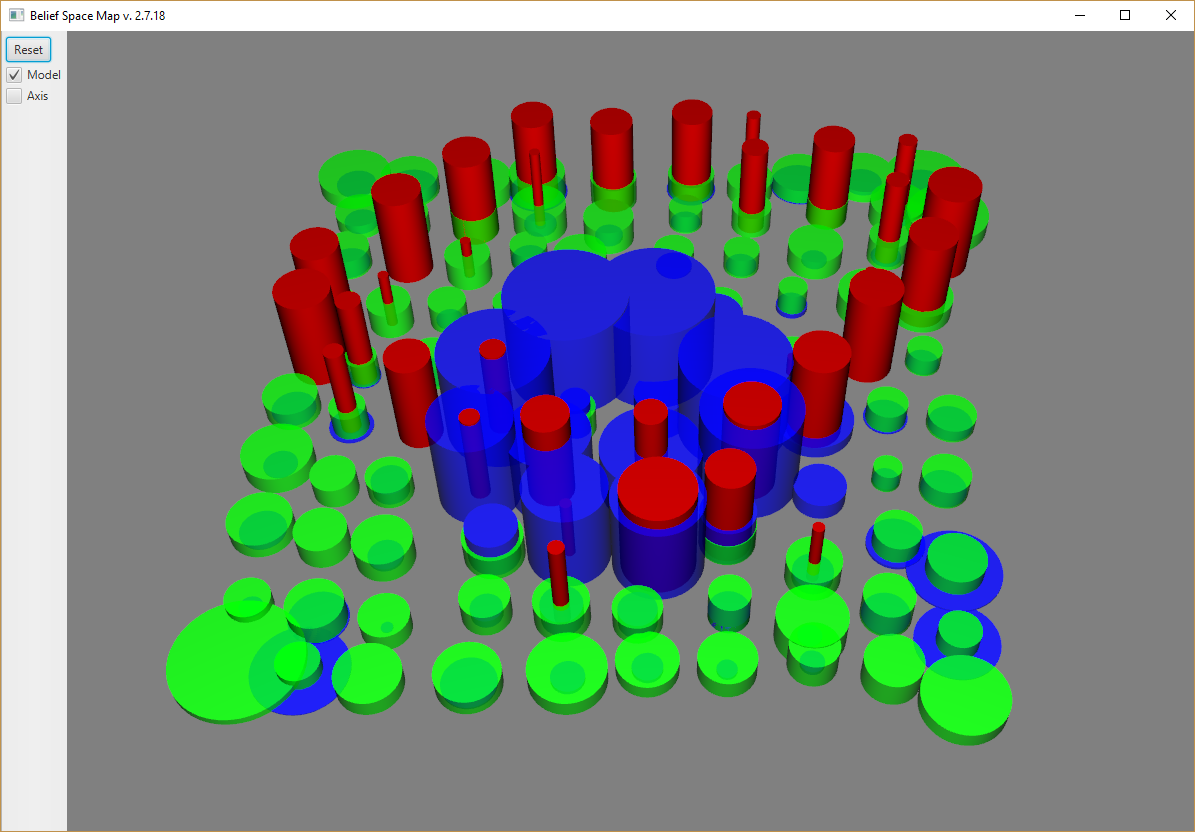
    • Reading in single spreadsheet with nomad graph info
    • Building a NodeInfo inner class to keep the nomad positions for the other populations
    • Working! 2018-02-07
    • Better: 2018-02-07 (2)
    • Resisting the urge to code more and getting back to the extended abstract. I also need to add a legend to the above pix.
  • Back to extended abstract
    • Added results and future work section
    • got all the pictures in
    • Currently at 3 pages plus. Not horrible.
  • Demographics and Dynamics of Mechanical Turk Workers
    • There are about 100K-200K unique workers on Amazon. On average, there are 2K-5K workers active on Amazon at any given time, which is equivalent to having 10K-25K full-time employees. On average, 50% of the worker population changes within 12-18 months. Workers exhibit widely different patterns of activity, with most workers being active only occasionally, and few workers being very active. Combining our results with the results from Hara et al, we see that MTurk has a yearly transaction volume of a few hundreds of millions of dollars.

Phil 2.6.18

7:30 – 5:00 ASRC MKT

  • Took four much needed days off on Sanibel island. Forgot to pack some things? Need to call the hotel at (239) 215-3401
  • Starting CI 2018 abstract. And oddly, the abstract isn’t showing??? Sent a note to the conference chair. IN the meantime, I have a subsection for the abstract. It appears to be acmlarge for the most part, so maybe use that????
  • Was going to get back to Angular, but stuck with 404s on CRUD operations: 404
  • Working on the 3D map application. Decided to go with JavaFX and their 3d implementation. It’s going quickly. MapApp1
  • I’ve also gotten the graph generator creating spreadsheets that the map app can read in. So the next job will be to wire everything together, where the position information is based off the nomad trajectories, with the size and visitor (height) data being overlayed with the different colors.

Phil 2.1.18

7:00 – 3:30 ASRC MKT

  • Communications Handbook for IPCC scientists
  • The Barnes-Hut Approximation
    • Efficient computation of N-body forces
      By: Jeffrey Heer
      Computers can serve as exciting tools for discovery, with which we can model and explore complex phenomena. For example, to test theories about the formation of the universe, we can perform simulations to predict how galaxies evolve. To do this, we could gather the estimated mass and location of stars and then model their gravitational interactions over time.
  • Need to get started on the extended abstract for Collective Intelligence 2018! One month! March 2, 2018!
    • Set up the LaTex template for the conference. Done
    • Think I want to call it Mapping Simon’s Anthill
  • Need to contact the CHIIR 2018 folks to see what is expected for the DC
  • More Angular, feeling my way through the Http code, which has been deprecated. Looked at the similar code in Tour of Heroes. We’ll see if the old stuff works and then try to update? Need to ask Jeremy.
  • Back to BIC. Evolutionary reasons for cooperation as group fitness, where group payoff is maximized. This makes the stag salient in stag hunt.
  • A thorough explanation of synchronization/phase locking. My mental model is this: Imaging a set of coaxial but randomly oscillating identical weights sliding back and forth in their section of lightweight tubing. From the outside, the tube would be stationary, as all the forces would be cancelling. If the weights can synchronize, then the lightweight tube will be doing most of the moving. Since the mass of the tube is lower than the mass of the combined weights,   The force required for the whole system will be lower, and as a result (I think?) the system will run more efficiently and longer. Need to work out the math.

Phil 1.31.18

7:00 – 7:00 ASRC MKT

  • The Matrix Calculus You Need For Deep Learning
    • Most of us last saw calculus in school, but derivatives are a critical part of machine learning, particularly deep neural networks, which are trained by optimizing a loss function. Pick up a machine learning paper or the documentation of a library such as PyTorch and calculus comes screeching back into your life like distant relatives around the holidays. And it’s not just any old scalar calculus that pops up—you need differential matrix calculus, the shotgun wedding of linear algebra and multivariate calculus.
  • Continuing BIC
    • Explaining the evolution of any human behavior trait (say, a tendency to play C in Prisoner’s Dilemmas) raises three questions. The first is the behavior selection question: why did this trait, rather than some other, get selected by natural selection? Answering this involves giving details of the selection process, and saying what made the disposition confer fitness in the ecology in which selection took place. But now note that ‘When a behavior evolves, a proximate mechanism also must evolve that allows the organism to produce the target behavior. Ivy plants grow toward the light. This is a behavior, broadly construed. For phototropism to evolve, there must be some mechanism inside of ivy plants that causes them to grow in one direction rather than in another’ (Sober and Wilson 1998, pp. 199-200). This raises the second question, the production question: how is the behavior produced within the individual-what is the ‘proximate mechanism’? In the human case, the interest is often in a psychological mechanism: we ask what perceptual, affective and cognitive processes issue in the behavior. Finally, note that these processes must also have evolved, so an answer to the second question brings a third: why did this proximate mechanism evolve rather than some other that could have produced the same behavior? This is the mechanism selection question. (pg 95)
      • These are good questions to answer, or at least address. Roughly, I thing my answers are
        • Selection Question: The three phases are a very efficient way to exploit an environment
        • Production Question: Neural coupling, as developed in physical swarms and moving on to cognitive clustering
        • Mechanism Question: Oscillator frequency locking provides a natural foundation for  collective behavior. Dimension reduction is how axis are selected for matching.
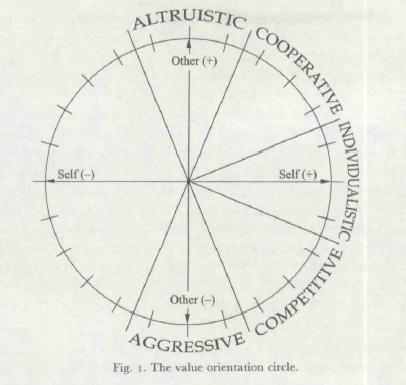
  • Value Orientations, Expectations and Voluntary Contributions in Public Goods
    • ValueOrientation
  • Discussion with Aaron about JuryRoom design
  • Observable is a better way to code.
    • Discover insights faster and communicate more effectively with interactive notebooks for data analysis, visualization, and exploration.
  • More Angular. Finished with module communication, starting with services
  • Meeting with Wayne
    • Submit to JASS
    • Abstract to CI 2018 July 7-8, 2018 at the University of Zurich, Switzerland

Phil 1.26.18

7:00 – 4:00 ASRC MKT

  • Tweaked my hypotheses from this post. I need to promote to a Phlog page.
  • Using Self-Organizing Maps to solve the Traveling Salesman Problem
    • The Traveling Salesman Problem is a well known challenge in Computer Science: it consists on finding the shortest route possible that traverses all cities in a given map only once. To solve it, we can try to apply a modification of the Self-Organizing Map (SOM) technique. Let us take a look at what this technique consists, and then apply it to the TSP once we understand it better.
  • Starting JuryRoom project with Jeremy.
    • Angular material  design
    • VerdictBox (Scenario and verdict)
    • Chat message
    • Live discussion cards (right gutter)
    • Topics (alphabetic, ranking, trending) with sparklines
    • Progress!!!!!! JuryRoom

Phil 1.23.18

7:00 – 5:00 ASRC MKT

  • Lesser-known trolley problem variations
  • News presented as a list: The 270 people connected to the Russia probes
  • continuing BIC
    • Group as Frame
    • Categorizatino and bias
  • Groups are defined by a common location, orientation, and velocity through a physical or virtual space. They influence each other dependent on awareness and trust. The lower the number of dimensions, the easier it is to produce a group.
  • Russia’s Full Spectrum Propaganda
    • This post examines one full spectrum case to illustrate the method. @DFRLab examined this case in an earlier post; since then, further evidence emerged, which changed and improved our understanding of the technique.
  • More Angular. Nice progress. I had some issues where I wanted to keep an old version of the app directory and did a refactor. This (of course) refactored the calling program, so I broke quite a few things figuring it out. That being said, Angular 1.5 is really, really nice.
  • Long chat about handling Trolls in the discussion app

Phil 1.19.18

7:00 – 5:00 ASRC

  • Look! Adversarial Herding: https://twitter.com/katestarbird/status/954802718018686976
  • Reconnected with Wayne. Arranging a time to meet the week of the 29th. Sent him a copy of the winter sim conference paper
  • Continuing with Beyond Individual Choice. Actually, wound up adding a section on how attention and awareness interplay, and how high social trust makes for much more efficient way to approach games such as the prisoner’s dilemma on my thoughts about trust and awareness
  • Starting Angular course
    • Architecture overview
  • Meeting with Jeremy, Heath and Aaron on Project structure/setup
  • More Angular. Yarn requires Python 2.x, which I hope doesn’t break my Python 3.x
  • Could not get the project to serve once built
  • Adversarial herding via The Opposition
    • Clint WattsClint is a consultant and researcher modeling and forecasting threat actor behavior and developing countermeasures for disrupting and defeating state and non-state actors. As a consultant, Clint designs and implements customized training and research programs for military, intelligence and law enforcement organizations at the federal, state and local level. In the private sector, he helps financial institutions develop best practices in cybersecurity intelligence operations. His research predominately focuses on terrorism forecasting and trends seeking to anticipate emerging extremist hotspots and anticipate appropriate counterterrorism responses. More recently, Clint used modeling to outline Russian influence operations via social media and the Kremlin’s return to Active Measures.

Phil 1.18.2018

7:30 – 4:30 ASRC MKT

  • Truth Decay (RAND corporation ebook)
    • An Initial Exploration of the Diminishing Role of Facts and Analysis in American Public Life
  • Reading more Beyond Individual Choice
    • TheoryDemands
  • Got my Angular setup running. Thanks, Jeremy!
  • Reading up on WSO2 IaaS – Done. Did not know that was a thing.
  • Helped Aaron a bit with his dev box horror show
  • Spent a good chunk of the afternoon jumping through hoops to get an online Angular course approved. It seems as though you get approval, send it to HR(?), buy (it) yourself, then submit the expense through Concur. That’s totally efficient…

Phil 1.17.18


7:00 – 3:30 ASRC MKT

  • Harbinger, another DiscussionGame comparable: We are investigating how people make predictions and how to improve forecasting of current events.
  • Working over time, constructing a project based on beliefs and ideas, can be regarded as working with a group of yourself. You communicate with your future self through construction. You perceive your past self through artifacts. Polarization should happen here as a matter of course, since the social similarity (and therefore influence) is very high.
  • Back to Beyond Individual Choice
    • Diagonals
    • Salience
  • Back to Angular – prepping for integration of PolarizationGame into the A2P platform. Speaking of which, there needs to be a REST API that will support registered, (optionally?) identified bots. A bot that is able to persuade a group of people over time to reach a unanimous vote would be an interesting Turing-style test. And a prize
    • Got Tour of Heroes running again, though it seems broken…
  • Nice chat with Jeremy.
    • He’ll talk to Heath about what it would take to set up an A2P instance for the discussion system that could scale to millions of players
    • Also mentioned that there would need to be a REST interface for bots
    • Look through Material Design
      • Don’t see any direct Forum (threaded discussion) details on the home site, but I found this Forum example GIF
    • Add meeting with Heath and Jeremy early in the sprint to lay out initial detailed design
    • Stub out non-functional pages as a deliverable for this (next?) sprint
    • He sent me an email with all the things to set up. Got the new Node, Yarn and CLI on my home machine. Will do that again tomorrow and test the VPN connections
  • Sprint planning
    • A2P GUI and Detailed Design are going to overlap

Phil 12.27.17

8:00 – 4:00 ASRC MKT

  • Granted permission for the CHIIR18 DC.
  • Continuing on white paper. And we’ll see what Aaron has to say about the stampede paper today?
  • It occurs to be that it could make sense to read the trajectories in using the ARFF format. Looks straightforward, though I’d have to output each agent on an axis-by-axis basis. That would in turn mean that we’d have to save each ParticleStatement and save it out .
  • A new optimizer using particle swarm theory (1995)
    • The optimization of nonlinear functions using particle swarm methodology is described. Implementations of two paradigms are discussed and compared, including a recently developed locally oriented paradigm. Benchmark testing of both paradigms is described, and applications, including neural network training and robot task learning, are proposed. Relationships between particle swarm optimization and both artificial life and evolutionary computation are reviewed.
    • Cited by 12155

Phil 12.18.17

7:15 – 4:15 ASRC MKT

  • I’m having old iPhone problems. Trying a wipe and restart.
  • Exploring the ChestXray14 dataset: problems
    • Interesting article on using tagged datasets. What if the tags are wrong? Something to add to the RB is a random re-introduction of a previously tagged item to see if tagging remains consistent.
  • Continuing Consensus and Cooperation in Networked Multi-Agent Systems here
  • Visualizing the Temporal Evolution of Dynamic Networks (ACM MLG 2011)
    • Many developments have recently been made in mining dynamic networks; however, effective visualization of dynamic networks remains a significant challenge. Dynamic networks are typically visualized via a sequence of static graph layouts. In addition to providing a visual representation of the network topology at each time step, the sequence should preserve the “mental map” between layouts of consecutive time steps to allow a human to interpret the temporal evolution of the network and gain valuable insights that are difficult to convey by summary statistics alone. We propose two regularized layout algorithms for visualizing dynamic networks, namely dynamic multidimensional scaling (DMDS) and dynamic graph Laplacian layout (DGLL). These algorithms discourage node positions from moving drastically between time steps and encourage nodes to be positioned near other members of their group. We apply the proposed algorithms on several data sets to illustrate the benefit of the regularizers for producing interpretable visualizations.
    • These look really straightforward to implement. May be handy in the new flocking paper
  • Opinion and community formation in coevolving networks (Phys Review E)
    • In human societies, opinion formation is mediated by social interactions, consequently taking place on a network of relationships and at the same time influencing the structure of the network and its evolution. To investigate this coevolution of opinions and social interaction structure, we develop a dynamic agent-based network model by taking into account short range interactions like discussions between individuals, long range interactions like a sense for overall mood modulated by the attitudes of individuals, and external field corresponding to outside influence. Moreover, individual biases can be naturally taken into account. In addition, the model includes the opinion-dependent link-rewiring scheme to describe network topology coevolution with a slower time scale than that of the opinion formation. With this model, comprehensive numerical simulations and mean field calculations have been carried out and they show the importance of the separation between fast and slow time scales resulting in the network to organize as well-connected small communities of agents with the same opinion.
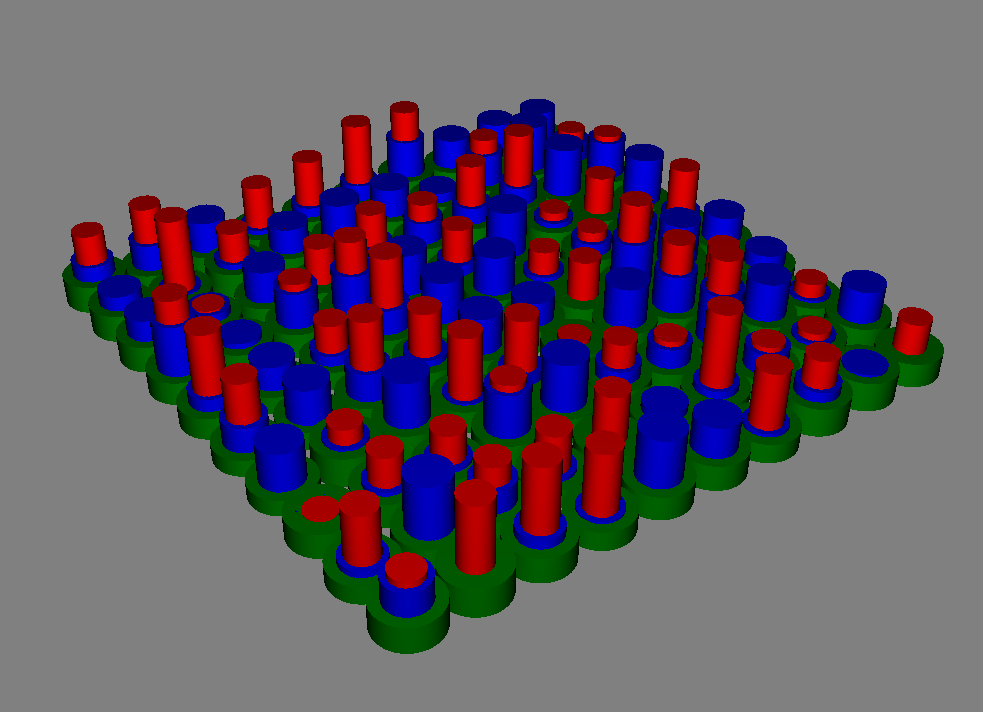
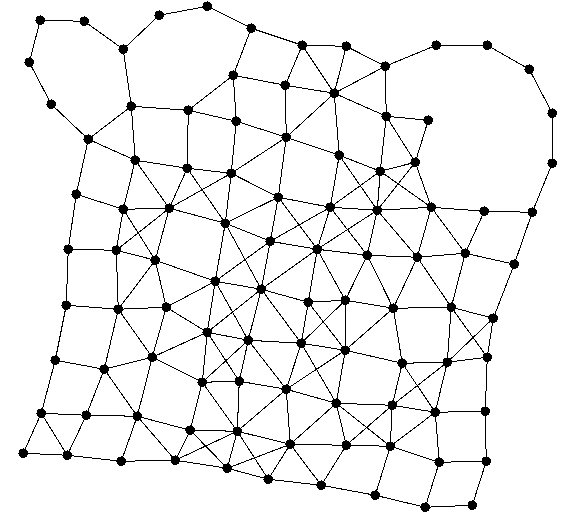
  • I can build maps from trajectories of agents through a labeled belief space: mapFromTrajectories
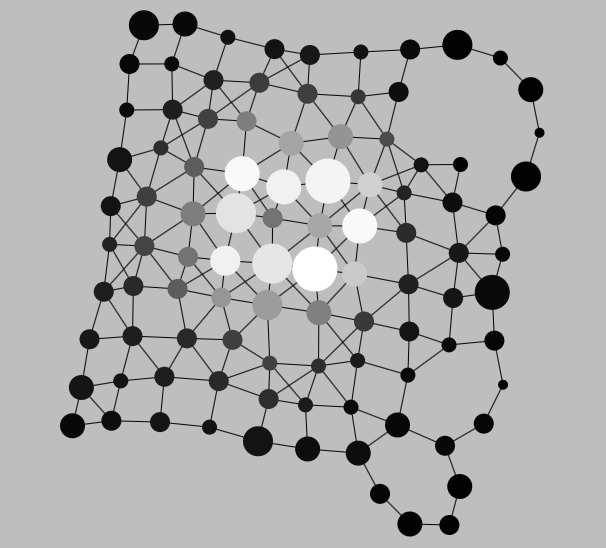
    • This would be analogous to building a map based on terms or topics used by people during multiple group polarization discussion. Densely connected central area where all the discussions begin, sparse ‘outer region’ where the poles live. In this case, you can clearly see the underlying grid that was used to generate the ‘terms’
  • Progress for today. Size is the average time spent ‘over’ a topic/term. Brightness is the number of distinct visitors: mapFromTrajectories2

Phil 12/15/17

9:00 – 1:30 ASRC MKT

  • Looong day yesterday
  • Sprint review
  • This looks like an interesting alternative to blockchain for document security: A Cryptocurrency Without a Blockchain Has Been Built to Outperform Bitcoin
    • The controversial currency IOTA rests on a mathematical “tangle” that its creators say will make it much faster and more efficient to run.
  • Also this: Can AI Win the War Against Fake News?
    • Developers are working on tools that can help spot suspect stories and call them out, but it may be the beginning of an automated arms race. 
    • Mentions adverifai.com
      • FakeRank is like PageRank for Fake News detection, only that instead of links between web pages, the network consists of facts and supporting evidence. It leverages knowledge from the Web with Deep Learning and Natural Language Processing techniques to understand the meaning of a news story and verify that it is supported by facts.