7:00 – 5:00 ASRC
- Dissertation – finished the robot stampedes and the need for diversity section
- GOES – Working on GSAW extended abstract – done!

7:00 – 5:00 ASRC
ASRC GOES 7:00 – 5:30
7:00 – ASRC GOES
\makeatletter
\def\set@curr@file#1{%
	\begingroup
	\escapechar\m@ne
	\xdef\@curr@file{\expandafter\string\csname #1\endcsname}%
	\endgroup
}
\def\quote@name#1{"\quote@@name#1\@gobble""}
\def\quote@@name#1"{#1\quote@@name}
\def\unquote@name#1{\quote@@name#1\@gobble"}
\makeatother
7:00 – ASRC GOES



7:00 – 7:00 School
7:00 – 5:00 ASRC
7:00 – 4:00 ASRC GOES
7:00 – 5:00 ASRC
Dissertation – more work on the research design section. Adding unexpected results
FAA
GOES
7:00 – 5:00 ASRC GOES


AmeriSpeak® is a research panel where members get rewards when they share their opinions. Members represent their communities when they answer surveys online, through the AmeriSpeak App, or by phone. Membership on the AmeriSpeak Panel is by invitation only. Policymakers and business leaders use AmeriSpeak survey results to make decisions that impact our lives. Tell us your thoughts on issues important to you, your everyday life, and topics in the news such as health care, finance, education, technology, and society.
Commission launches call to create the European Digital Media Observatory The European Commission has published a call for tenders to create the first core service of a digital platform to help fighting disinformation in Europe. The European Digital Media Observatory will serve as a hub for fact-checkers, academics and researchers to collaborate with each other and actively link with media organisations and media literacy experts, and provide support to policy makers. The call for tenders opened on 1 October and will run until 16 December 2019.
ASRC GOES 7:00 – 7:00
7:00 – 2:00 ASRC GOES
7:00 – 10:00 ASRC FAA
ASRC GOES 7:00 – 5:00
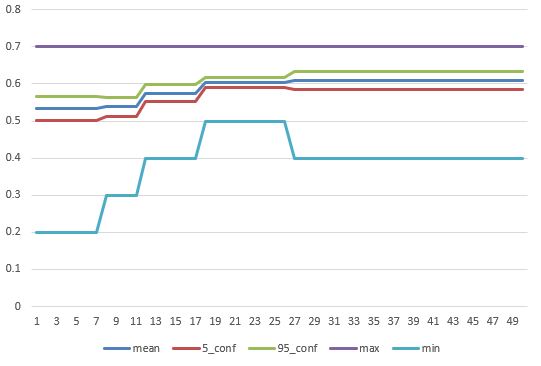
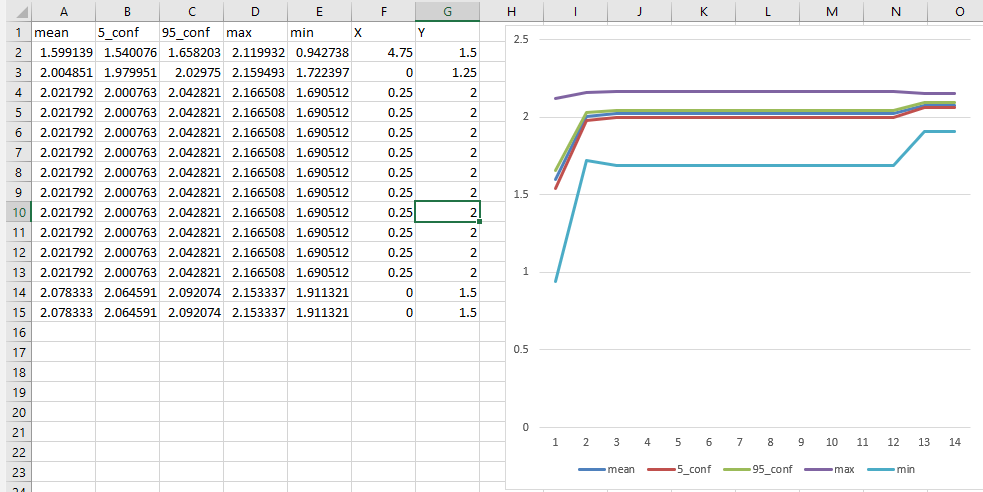
def calc_fitness_stats(self, resample_size:int = 100):
    boot = resample(self.population, replace=True, n_samples=resample_size, random_state=1)
    s = pd.Series(boot)
    conf = st.t.interval(0.95, len(boot)-1, loc=s.mean(), scale= st.sem(boot))
    self.meta_info = {'mean':s.mean(), '5_conf':conf[0], '95_conf':conf[1], 'max':s.max(), 'min':s.min()}
    self.fitness = s.mean()
# randomly breed new genomes with a chance of mutation
while len(self.current_genome_list) < self.num_genomes:
    g1i = random.randrange(len(self.best_genome_list))
    g2i = random.randrange(len(self.best_genome_list))
    g1 = self.best_genome_list[g1i]
    g2 = self.best_genome_list[g2i]
    g = self.breed_genomes(g1, g2, crossover_rate, mutation_rate)
    match = False
    for gtest in self.all_genomes_list:
        if g.chromosome_dict == gtest.chromosome_dict:
            match = True
            break
    if not match:
        self.current_genome_list.append(g)
        self.all_genomes_list.append(g)
Crap – It’s October already!
7:00 – 4:00 ASRC GOES

7:00 – 7:00 ASRC GOES

RANDOM.ORG offers true random numbers to anyone on the Internet. The randomness comes from atmospheric noise, which for many purposes is better than the pseudo-random number algorithms typically used in computer programs. People use RANDOM.ORG for holding drawings, lotteries and sweepstakes, to drive online games, for scientific applications and for art and music. The service has existed since 1998 and was built by Dr Mads Haahr of the School of Computer Science and Statistics at Trinity College, Dublin in Ireland. Today, RANDOM.ORG is operated by Randomness and Integrity Services Ltd.
 viztales
You must be logged in to post a comment.