Phil 6.19.17

7:00 – 8:00 Research

  • Nice trip back from the conference. I think my take home messages are:
    • What I’m working on is non-obvious
    • Agent-based simulation is becoming a norm in this field
    • Creating a useful knowledge map makes sense to everyone(?) working in the field
    • The concept of explore, flock, and stampede have good resonance
    • Gate-keeping in agent design/distribution and information retrieval are SERIOUS problems
  • Brought in the code that I wrote on the laptop. Compiles and runs nicely
  • Creating a poster (24×36) version of the PosterPage. Also creating a dual-sided handout. Done, and sent out for printing.
  • Ordered a poster tube with strap

8:30 – 3:30 BRC

  • Expense Report. Done. Maybe? The app doesn’t take street address without barfing. May have to go back in and re-edit? Or is that only for mileage?
  • Continue to work on setting up Linux Python/Tensorflow env
  • Got IntelliJ up, but had to point at the ‘Development’ files for windows due to the crippling download rates.
  • Apparently we have new data on CI. Recluster?
  • Then I let Windows update and everything stopped. Went home to continue
  • Installing python
  • Installing Java
  • Installing xampp

Misc

  • Register van – done!

Phil 6.16.17

5:30 – 6:30 BRI

  • Catching up on email, etc.

Research

  • Implementing LETHAL and RESPAWN options
  • Poster presentation! See if I can get a space near a table/outlet
  • Talks
  • Ece Kamar Humans to the rescue
    • Troubleshooting of ML systems
    • What happens when systems are functioning in the wild
    • Biases in ML – minority representations of well, minorities (blind spots – unknown unknown)
    • Beat the machine Attenberg 2011
    • Multi-armed bandit – exploration – but how? What is the source to explore
    • Hard to debug. What about AI making models that are understandable and effective. E.g. build low-variable systems using GP
  • Nick Ouellette – Validating Models of Collective Behavior
    • Flocks and swarms
      • Movement + interaction rules+interaction range -> group structure function
      • Vivsek et. al. PRL (1995) alignment only
      • How to benchmark. What is a good/bad model
    • ‘web.stanford.edu/~nto
  • Creating Collective Intelligence – Dan Weld (Relevant to curating and BRI)
    • Provisioning mixed computer – human teams
    • Objective -> initial workflow -> improve, repeat (Self-optimizing workflow)
    • Sliders as a way of understanding the sers, then a place to clarify. IMPORTANT. Then cluster on the confusions, and update the query/ Sample from the confusion results to test improvement.
    • Gold questions (flags) that are known. What percentage get inserted for optimal user response
    • Partially Observable Makkov decision process (Belief state as input)/ Build a policy that provides the optimal result
    • Explore/Exploit strategy since partial information
    • MicroTalk Test Task <- serendipity injection
    • Select for discerning worker Flesch-Kincaid model?. Need to look into that.
    • Conclusions
      • Tools for creating collective intelligence
      • Self-Optimizing Workflows
      • Getting workers to argue
  • Chris Welty – Google – moderator for session 4
  • Andres Abeliuk – Controlling Collective Behavior through Position Bias
    • display policies affect what customers choose
    • Youtube, spotify, etc use ratings/reviews, PageRank, etc form feedback loops
    • How do we mitigate these biases
    • Salgannik MusicLab Science (2006?) runaway feedback loops to first user advantage
    • This study ranks by listens/downloads. Does this affect the result. Four ranking policies, and yesy/no social signals
    • Random ordering with no social signal seems to provide most consistent ranking with least inequality
  • Brent Hecht: The Role of Human Geography in Collective Intelligence
    • Physical Geography
    • Spatial Computing
    • Human Geography
      • Spatial homophily – we live and spend time near people like us. Impossible to overstate
        • Worker location
        • Location of the work
        • Distance between these two
        • If a bank account is required, for example, you will have spatial bias. Pokemon Go was influenced by a biased crowdsourced dataset
        • Interaction decreases with distance
        • Structured variation population density
        • Highest in urban cores lower in suburbs, lowest in rural.
        • Johnson Et al SIGCHI 2016
        • Mental maps, region theory
  • Hila Lifshitz-Assaf Delineating Role Behaviors in Wikipedia
    • Emergent roles determined by clusters of activity
      • Temporal distance is as influential as geographic distance
      • Watching what people do over time – how much chaos, how much order
      • Need to dig up these papers
      • Why did you choose the motivation axis?
  • Mehdi Moussaid – The Propagation of accurate judgements in Experimental Transmission Chains
    • Judgement propagation – well known
    • Behavioral processes affect the level of influence – poorly known
    • Experiment is sequential, but each person is exposed to the judgement of the prior results.
    • Visual perception task, where the user determines the overall direction of a cluster of dots
    • First person has an easy task – clear movement, but the others have a noisier version of the task, but the same answer
    • Propagation slows down with social distance and falls to zero around 3
  • Yue Han – Collective exploration: Remixing with human-based search Algorithms
    • This is mapping. Not sure how the semantic spoace is mapped WRT what. Amd what i you run it in reverse?
  • Kennith Huang – Real Time On-Demand Crowd powered entity extraction
    •  Output agreement mechanism – agreement gets reward.
  • John Harlow – Proactively Identifying and Correcting for Social Biases in Datasets Proliferating into Civic Technology
    • Identify biases of the past algorithmically and initiate corrections
    • Being digitally invisible
    • How people in a place understand the world around them?
  • Yun Huang – BandCaption: Crowdsourcing  Video Caption Corrections
  • John Prpic – Unpacking Blockchain
  • The poster went well!
  • Kate Starbird Online rumouring
    • Overlapping narratives and websites supporting alternative narratives
    • Shooting related search terms for 9 months of twitter
    • Gun takeaway agenda.
    • False Triangulation – same information distributed across different sources
    • Is there some sort of evolution of low dimension attractors?
  • Gamification became co opted by efficiency and lost its game-like option Efficiency destroys diversity.

The Russian “Firehose of Falsehood” Propaganda Model Why It Might Work and Options to Counter It

  • Is there a difference between ‘diversity’, ‘noise’, and disinformation/alt narratives. I think there is some kind of monitoring the ‘native population’ and then figuring ways to amplify? What is the adversary signaling
  • Can you build a high-engagement game that will attract those in the alt-narratives an expands their perspective? Deliberation that is not tied directly to the outcome
  • The alt-narrative ecosystem is not about signalling capability. It’s about signalling reach. And through the reach to powerful players, instigating uncertainty and disruption..

Phil 6.15.17

5:30 – 6:30 BRI

  • Catching up on email, etc.

8:00 – Research

  • Patching IntelliJ
  • enabling ‘no borders’ option
  • Collective Intelligence 2017 Notes
  • Geoff Mulligan
    • Copernicus EU project
    • AIME – Disease outbreak prediction
    • MetaSUB
    • English cancer xxx xxx?
    • ORID (Taiwan) Uses slideshare, discourse, pol.is, livehouse.in
    • Economics has been hopeless WRT developing models that pay for such collective intelligence assemblies
    • The enemies of collective intelligence
    • The economics of algorithmic decision making and human decisions queresha
    • Rare disease patients are driving this technology because of the need and low funds
    • Icelandic collective intelligence Iceland democracy is a good example?
    • Link into action and feedback is a problem common across many of these projects
  • Tom Kalil
    • Prize – driven development
    • Prediction markets for technology forecasting
    • Philanthropy: Nimble, Prizes over grants and contracts. People who know how to build an effective prize
    • Bullet points as a way of driving through change. Magic laptop experiment. Any press release you write will come true. Look up. (Is this gamification?)
      • Provides Agency
      • Value of concreteness
      • Articulate who needs to do what
      • Has to be at least plausible (the entities could be expected to do these things)
    • Tony Bright(?) Networking of improvement communities.
    • R&D and pilots.
    • User-driven innovation (contributing to economies)
    • Funds to focus on access and participation
  • Dana Lewit
    • Artificial intelligence is everywhere – stop waiting
    • DIY artificial pancrias
    • Inability to sway manufacturers
    • Twitter as a source of technical fixes? How?
    • Gateway technology – Rasbery PI is very cheap, good community makes it easy to work with
    • #OpenAPS maker movement for DIY medical devices
    • Thousands of hours of development
    • What about the risk/reward of sharing data – targeting ads at low blood sugar
  • Darlene Cavalier
    • Citizen Science Projects
    • TPBS – The Crowd in the Cloud
    • 1500 projects (What about power law issues and bias from the main contributors?)
    • Charismatic vs. invisible science needs?
    • Facilitator – make the process attractive for users
    • Scistarter Solutions Lab
    • ECAST Citizen science ecastnetwork.org
  • The field of ‘Frugal Science’ (low cost tools) Tool making science?
  • Jordan Barelow
    • CA State Fullerton
    • Woolley et. al. 2010 – no correlation or small between individual and group intelligence
    • What happens at the limit? Minimum threshold, max ceiling?
    • Performance on one task may not correlate with performance on another task. Why? What is it about highly structured tools?
    • Production work being individual – what about pair programming?
  • Carsten Bergen-Holtz – Ikea effect agent-based simulation
    • Ikea effect – we tend to overvalue our sulutions
    • Efficient vs. inefficient networks efficient – all information is seen (is this bad?)
  • Then the batteries died
  • Mark Ackerman
    • New architecture for crowdsourcing knowledge
    • 8chan’s /pol/community -> kicked off 4chan for being too extreme
    • Beginnings of PizzaGate/Podesta/etc
    • Dog-whistle memes
    • Every post is anonymous
    • Outraged that something bad is happening to america. Sense of rage. Conspiracy thinking
    • Deliberate gaming of the Facebook algorithms and media sources.
    • Click based advertising is heavily selected for
    • Overton Window
  • Some Assembly Required: Organizing in the 20th Century
    • Noshir Contractor
    • Match.com for teams
  • Noshir Contractor
    • too much too fast. Team building, but needs some disentangling, I think
  • Hila Lifshitz–Assaf
    • Is innovation different at different scales and platforms
    • Best R&D practice fail with ‘makeathons’????

Phil 6.14.17

Research

  • Got turned down for CSCW
  • On my way to CI 2017. Arrived! Spent a lovely afternoon/evening wandering around lower Manhattan. It’s noting like I remember. Traffic is light except at the tunnels. Almost no honking. A driver stopped for me as I crossed the street! Very little graffiti. I kinda feel like a time traveller.

Phil 6.12.17

8:30 – 5:30 BRI

Phil 6.10.17

6:00 – 7:30 Research

A little BRI:

Phil 6.9.17

5:30 – 7:30 Research

  • Finishing up poster. The PNG export is a bit weird. The Excel chart won’t come to the foreground.. Fixed!CI_GP_Poster2

Phil 6.8.17

5:30 – 8:00 Research

  • Kinda done with the first pass. I think it’s more poster like….

BRI 3:30 – 4:30

  • Status update from Aaron

Phil 6.7.17

Research 4:30 – 9:30

  • Continuing along the flocking line of thought, I’m wondering how similar a stampede is to a runaway echo chamber. In both cases, they work best if the ‘shared knowledge’ is simple and clear. In a stampede, the idea is reduced to its simplest base – run! Although there may have been a reason at the beginning, at some point the group runs because it is running. Stopping will get you trampled. The only way to escape a stampede is to peel away from the edges, but that may not b possible due to environmental constraints (e.g. walls). Once started, they are hard to stop and ‘have a mind of their own’.
  • Added to the lit review folder for P&C considered harmful
  • Working on CI 2017 poster, making it more visual. Took a wrong turn incorporating too much new data from the HCIC poster. Cleaning and simplifying.

Phil 6.6.17

Research about one hour

  • Broke apart the assets for the CI 2017 poster V2. What about the relationships from the P&C considered harmful outline? That’s not in the abstract…

phil 6.5.17

Research (2 hours)

  • I am thinking about flocking as a form of group decision making under uncertainty., kind of like the Multi-armed bandit problem parallelized. So in this context:
  • Explore: Assumption of unknown information
  • Flocking: Assumption of incomplete information
  • Exploit: Assumption of complete information

Phil 6.1.17

7:00 – 8:00 Research

  • Converted poster to PDF and test printed. And then noticed some things. And did it again. And then noticed some things. And did it again. And then noticed some things. And did it again. I think I’m done now. Need to send off this evening.

9:00 – 4:00 BRI

  • Sprint planning

Phil 5.31.17

7:00 – 8:00 Research

8:30 – 4:00 BRI

  • The Meaning of Underscores in Python
  • Tried to add research code to timesheet. No luck. Let T know.
  • Tried to access new Jira and Confluence pages, They are visible thought the OpenVPN tunnel. but the login/password does not work
  • Reading the Ketos User guide and annotating. Finished – sending to Aaron
  • TEM meeting at 2:00
  • Meeting with CCRi. Lead dev: Vivek Dhand
    • String matching, BOW, LSI competitors
    • Based on word2vec, combined with a TF-IDF scoring
      Trained on wikipedia
    • Trained on seperate training server?
    • Apps on the training server? Train one classifier for each field
  • Things we did in 2016
    • StanfordNLP+jsoup tool to categorize and tag web pages for statistical analysis
    • Statistical analysis of said pages, include backlink and other meta data analysis
    • Google CSE interface, plus cleaning tools
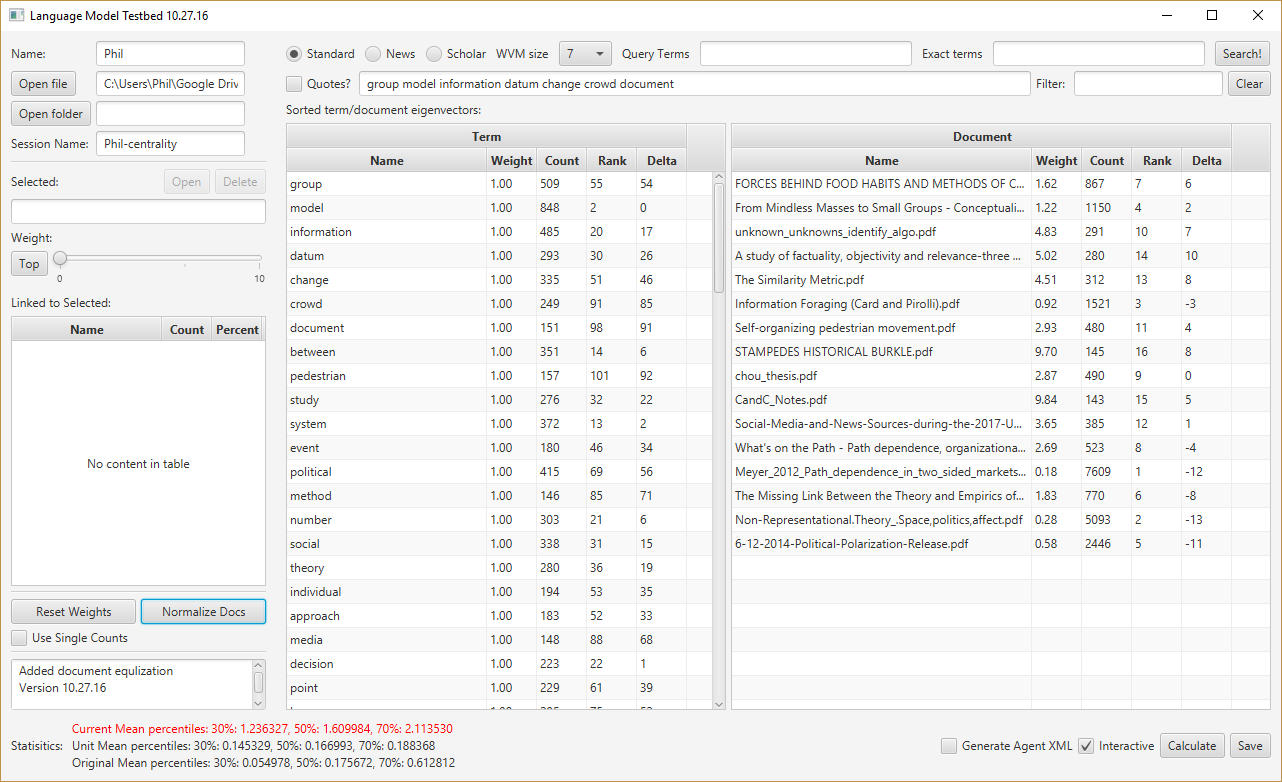
    • Document centrality analysis tool (JavaFX! Woohoo!) (LSI, TF-IDF, PageRank, adjacency, etc calculations at interactive rates)(outputs for WEKA)
    • Use of above tool to create CSE search terms that improved craw precision by 500% (https://viztales.com/wp-content/uploads/2016/05/extracting-better-search-terms.docx)
    • Tagged hundreds of web pages because someone had to.
    • Proposal writing
    • Group polarization modeling using flocking agent-based simulation
    • Microservices
    • Classifiers in WEKA and the WEKA api
    • Research Browser prototype
    • NMF tool for topic extraction based on UTOPIAN paper

Phil 5.30.17

7:00 – 8:30 Research

  • Really tempted to call the HCIC poster ‘Precision and Recall Considered Harmful’. Maybe the CHIIR paper insted?
  • Got a good deal of work done over the weekend. Here’s my latest abstract: AbstractCover
  • Also made good progress on the poster. Will need to re-run the text for LMN -done: PosterPage
  • Sent both mockups off to Wayne
  • Anatomy of news consumption on Facebook
    • In this paper, we explore the anatomy of the information space on Facebook by characterizing on a global scale the news consumption patterns of 376 million users over a time span of 6 y (January 2010 to December 2015). We find that users tend to focus on a limited set of pages, producing a sharp community structure among news outlets. We also find that the preferences of users and news providers differ. By tracking how Facebook pages “like” each other and examining their geolocation, we find that news providers are more geographically confined than users. We devise a simple model of selective exposure that reproduces the observed connectivity patterns.

9:00 – 4:00 BRI

  • Send T my schedule – done
  • Clustering has been kicked under the bus. Need to respond, but also look for new work? Working on that with Aaron.
  •  I’m getting a ’99’ charge number for research.
  • Helping Aaron put his accounts back together
  • Meeting with Chris Y, T, Aaron and me
    • How do we segment off the Aaron/Phil work
    • Figure out BRC and tell them they’re wrong? How to make this about success?
  • Fixed a bug with CorpusManager where the code broke it the kept percent is 100%