Category Archives: Talks

Phil 2.28.18

7:00 – 4:00 ASRC MKT

  • More BIC
    • One of the things that MB seems to be saying here is that group identification has two parts. First is the self-identification with the group. Second is the mechanism that supports that framing. You can’t belong to a group you don’t see.
    • To generalize the notions of team mechanism and team to unreliable contexts, we need the idea of the profile that gets enacted if all the agents function under a mechanism. Call this the protocol delivered by the mechanism. The protocol is , roughly, what everyone is supposed to do, what everyone does if the mechanism functions without any failure. But because there may well be failures, the protocol of a mechanism may not get enacted, some agents not playing their part but doing their default actions instead. For this reason the best protocol to have is not in general the first-best profile o*. In judging mechanisms we must take account of the states of the world in which there are failures, with their associated probabilities. How? Put it this way: if we are choosing a mechanism, we want one that delivers the protocol that maximizes the expected value of U. (pg 131)
    • Group identification is a framing phenomenon. Among the many different dimensions of the frame of a decision-maker is the ‘unit of agency’ dimension: the framing agent may think of herself as an individual doer or as part of some collective doer. The first type of frame is operative in ordinary game-theoretic, individualistic reasoning, and the second in team reasoning. The concept-clusters of these two basic framings center round ‘I/ she/he’ concepts and ‘we’ concepts respectively. Players in the two types of frame begin their reasoning with the two basic conceptualizations of the situation, as a ‘What shall I do?’ problem, and a ‘What shall we do?’ problem, respectively. (pg 137)
  • Analyzing the Digital Traces of Political Manipulation: The 2016 Russian Interference Twitter Campaign
    • Until recently, social media was seen to promote democratic discourse on social and political issues. However, this powerful communication platform has come under scrutiny for allowing hostile actors to exploit online discussions in an attempt to manipulate public opinion. A case in point is the ongoing U.S. Congress investigation of Russian interference in the 2016 U.S. election campaign, with Russia accused of, among other things, using trolls (malicious accounts created for the purpose of manipulation) and bots (automated accounts) to spread misinformation and politically biased information. In this study, we explore the effects of this manipulation campaign, taking a closer look at users who re-shared the posts produced on Twitter by the Russian troll accounts publicly disclosed by U.S. Congress investigation. We collected a dataset with over 43 million elections-related posts shared on Twitter between September 16 and October 21, 2016 by about 5.7 million distinct users. This dataset included accounts associated with the identified Russian trolls. We use label propagation to infer the ideology of all users based on the news sources they shared. This method enables us to classify a large number of users as liberal or conservative with precision and recall above 90%. Conservatives retweeted Russian trolls about 31 times more often than liberals and produced 36 times more tweets. Additionally, most retweets of troll content originated from two Southern states: Tennessee and Texas. Using state-of-the-art bot detection techniques, we estimated that about 4.9% and 6.2% of liberal and conservative users respectively were bots. Text analysis on the content shared by trolls reveals that they had a mostly conservative, pro-Trump agenda. Although an ideologically broad swath of Twitter users were exposed to Russian Trolls in the period leading up to the 2016 U.S. Presidential election, it was mainly conservatives who helped amplify their message.
  • CHIIR Talk
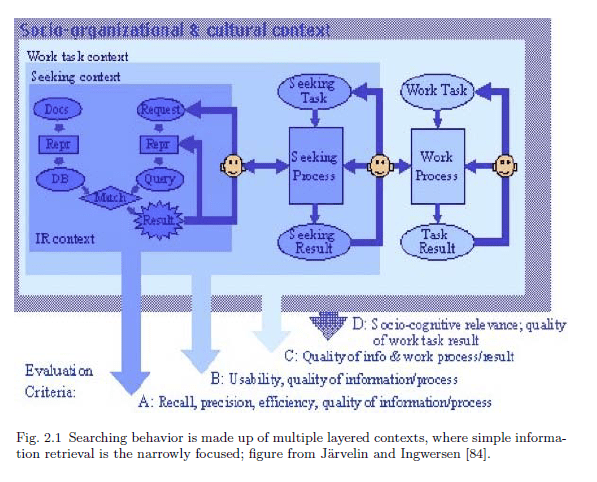
    • Make new IR-Context graphic – done!
    • De-uglify JuryRoom – done!
  • TensorFlow’s Machine Learning Crash Course
Phil 2.27.18

7:00 – 5:00 ASRC MKT

  • More BIC
    • A mechanism is a general process. The idea (which I here leave only roughly stated) is of a causal process which determines (wholly or partly) what the agents do in any simple coordination context. It will be seen that all the examples I have mentioned are of this kind; contrast a mechanism that applies, say, only in two-person cases, or only to matching games, or only in business affairs. In particular, team reasoning is this kind of thing. It applies to any simple coordination context whatsoever. It is a mode of reasoning rather than an argument specific to a context. (pg 126)
    • In particular, [if U is Paretian] the correct theory of Hi-Lo says that all play A. In short, an intuition in favour of C’ supports A-playing in Hi-Lo if we believe that all players are rational and there is one rationality. (pg 130)
      • Another form of dimension reduction – “We are all the same”
  • Machine Theory of Mind
    • We design a Theory of Mind neural network – a ToMnet – which uses meta-learning to build models of the agents it encounters, from observations of their behaviour alone. Through this process, it acquires a strong prior model for agents’ behaviour, as well as the ability to bootstrap to richer predictions about agents’ characteristics and mental states using only a small number of behavioural observations. We apply the ToMnet to agents behaving in simple gridworld environments, showing that it learns to model random, algorithmic, and deep reinforcement learning agents from varied populations, and that it passes classic ToM tasks such as the “SallyAnne” test of recognising that others can hold false beliefs about the world
  • Classifier Technology and the Illusion of Progress (David Hand, 2006)
    • A great many tools have been developed for supervised classification, ranging from early methods such as linear discriminant analysis through to modern developments such as neural networks and support vector machines. A large number of comparative studies have been conducted in attempts to establish the relative superiority of these methods. This paper argues that these comparisons often fail to take into account important aspects of real problems, so that the apparent superiority of more sophisticated methods may be something of an illusion. In particular, simple methods typically yield performance almost as good as more sophisticated methods, to the extent that the difference in performance may be swamped by other sources of uncertainty that generally are not considered in the classical supervised classification paradigm.
  • Sensitivity and Generalization in Neural Networks: an Empirical Study
    • Neural nets generalize better when they’re larger and less sensitive to their inputs, are less sensitive near training data than away from it, and other results from massive experiments. (From @Jascha)
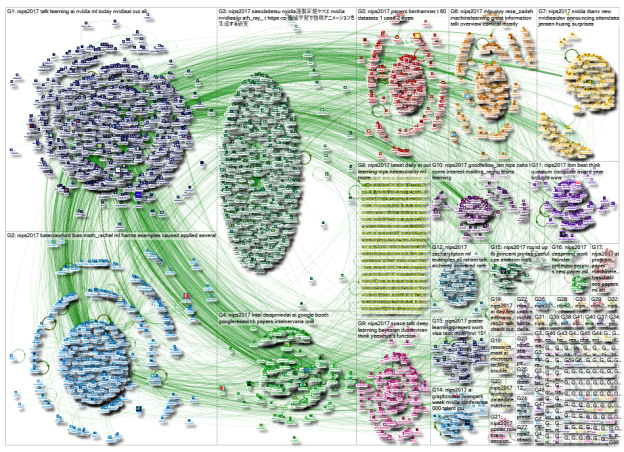
  • Graph-131941
    • The graph represents a network of 6,716 Twitter users whose recent tweets contained “#NIPS2017”, or who were replied to or mentioned in those tweets, taken from a data set limited to a maximum of 18,000 tweets. The network was obtained from Twitter on Friday, 08 December 2017 at 15:30 UTC.
  • Back to Basics: Benchmarking Canonical Evolution Strategies for Playing Atari
    • Evolution Strategies (ES) have recently been demonstrated to be a viable alternative to reinforcement learning (RL) algorithms on a set of challenging deep RL problems, including Atari games and MuJoCo humanoid locomotion benchmarks. While the ES algorithms in that work belonged to the specialized class of natural evolution strategies (which resemble approximate gradient RL algorithms, such as REINFORCE), we demonstrate that even a very basic canonical ES algorithm can achieve the same or even better performance. This success of a basic ES algorithm suggests that the state-of-the-art can be advanced further by integrating the many advances made in the field of ES in the last decades. 
      We also demonstrate qualitatively that ES algorithms have very different performance characteristics than traditional RL algorithms: on some games, they learn to exploit the environment and perform much better while on others they can get stuck in suboptimal local minima. Combining their strengths with those of traditional RL algorithms is therefore likely to lead to new advances in the state of the art.
  • Copied over SheetToMap to the Applications file on TOSHIBA
  • Created a Data folder, which has all the input and output files for the various applications
  • Need to add a curDir variable to LMN
  •  Presentation:
    • I need to put together a 2×2 payoff matrix that covers nomad/flock/stampede – done
    • Some more heat map views, showing nomad, flocking – done
    • De-uglify JuryRoom
    • Timeline of references – done
    • Collapse a few pages 22.5 minutes for presentation and questions – done
  • Start on white paper

Phil 2.26.18

7:00 – 6:00 ASRC MKT

  • Spread of information is dominated by search ranking f1-large
    • Twitter thread
      • The spreading process was linear because the background search rate is roughly constant day to day for discounts, and any viral element turned out to be quite small.
    • Paper
  •  BIC
    • There are many conceivable team mechanisms apart from simple direction and team reasoning; they differ in the way in which computation is distributed and the pattern of message sending. For example, one agent might compute o* and send instructions to the others. With the exception of team reasoning, these mechanisms involve the communication of information. If they do I shall call them modes of organization or protocols. (pg 125)
    • A mechanism is a general process. The idea (which I here leave only roughly stated) is of a causal process which determines (wholly or partly) what the agents do in any simple coordination context. It will be seen that all the examples I have mentioned are of this kind; contrast a mechanism that applies, say, only in two-person cases, or only to matching games, or only in business affairs. In particular, team reasoning is this kind of thing. It applies to any simple coordination context whatsoever. It is a mode of reasoning rather than an argument specific to a context. (pg 126)
  •  Presentation:
    • I need to put together a 2×2 payoff matrix that covers nomad/flock/stampede
    • Some more heat map views, showing nomad, flocking
    • De-uglify JuryRoom
    • Timeline of references
    • Collapse a few pages 22.5 minutes for presentation and questions
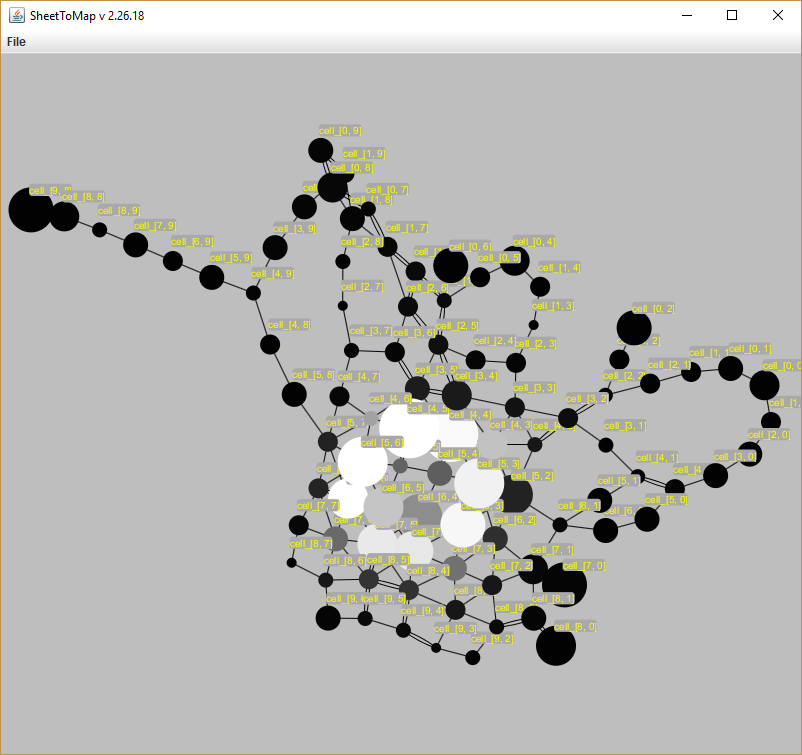
  • Work on getting SheetToMap in a swing app? Less figuring things out…
    • Slower going than I hoped, but mostly working now. As always, StackOverflow to the rescue: How to draw graph inside swing with GraphStream actually?
    • Adding load and save menu choices. Done! Had a few issues with getting the position of the nodes saved out. It seems like you should do this?
      GraphicNode gn = viewer.getGraphicGraph().getNode(name);
      row.createCell(cellIndex++).setCellValue(gn.getX());
      row.createCell(cellIndex++).setCellValue(gn.getY());
    • Anyway, pretty pix: 2018-02-26
  • Start on white paper
  • Fika

Phil 2.23.18

6:30 – 8:30, 11:00 – 5:00 ASRC MKT

  • Graphstream with javafx? https://github.com/graphstream/gs-ui-javafx
  • Learning to Cooperate, Compete, and Communicate
    • Multiagent environments where agents compete for resources are stepping stones on the path to AGI. Multiagent environments have two useful properties: first, there is a natural curriculum — the difficulty of the environment is determined by the skill of your competitors (and if you’re competing against clones of yourself, the environment exactly matches your skill level). Second, a multiagent environment has no stable equilibrium: no matter how smart an agent is, there’s always pressure to get smarter. These environments have a very different feel from traditional environments, and it’ll take a lot more research before we become good at them.
  • Storytelling and Politics: How History, Myths and Narratives Drive Our Decisions (video)
    • A narrative with historical overtones, an emotive connection and credibility not only convinces people, it frames the points of reference they use to evaluate the decision they are being asked to make.
    • Logos Pathos Ethos?
  • Continuing with rewrite. Had to fire up the MiKTex admin console to install wrapfig. Permissions issue?
    • Need to take the description of the maps at the end of the results section and turn into a paragraph.
  • Walk through of presentation this afternoon. Need to set up a skype session and bridge. Went well, I need to make a few fixes. Most importantly I need to put together a 2×2 payoff matrix that covers nomad/flock/stampede

Phil 2.22.18

7:00 – ASRC MKT

  • Long chat with Wajant about the CI 2018 paper. going to work up a new version
    • Started in Docs, but wound up saving out and reworking the LaTex version to keep track of the length.
  • Coincidentally, ONR is soliciting white papers for theoretically-based decision making tools. Five pages plus references for the paper, and a one-page resume.
    • The 5-page body of the white paper shall include the following information:
      • Principal Investigator(s);
      • Relevance of the proposed effort to the research areas described in Section II; (Topic 2, Research Focus Area 1)
        • relationship of the proposed work to current state of art.
      • Technical objective of the proposed effort;
      • Technical approach that will be pursued to meet the objective;
      • A summary of recent relevant technical breakthroughs; and
      • A funding plan showing requested funding per fiscal year.
  • Need to register for TF conference when Aaron gets in. Got hotel and $$ approval.
  • More dimension reduction and belief vectors on twitter

Phil 2.21.18

7:00 – 6:00 ASRC MKT

  • Wow – I’m going to the Tensorflow Summit! Need to get a hotel.
  • Dimension reduction + velocity in this thread
  • Global Pose Estimation with an Attention-based Recurrent Network
    • The ability for an agent to localize itself within an environment is crucial for many real-world applications. For unknown environments, Simultaneous Localization and Mapping (SLAM) enables incremental and concurrent building of and localizing within a map. We present a new, differentiable architecture, Neural Graph Optimizer, progressing towards a complete neural network solution for SLAM by designing a system composed of a local pose estimation model, a novel pose selection module, and a novel graph optimization process. The entire architecture is trained in an end-to-end fashion, enabling the network to automatically learn domain-specific features relevant to the visual odometry and avoid the involved process of feature engineering. We demonstrate the effectiveness of our system on a simulated 2D maze and the 3D ViZ-Doom environment.
  •  Slides
    • Location
    • Orientation
    • Velocity
    • IR context -> Sociocultural context
  • Writing Fika. Make a few printouts of the abstract
    • It kinda happened. W
  • Write up LMN4A2P thoughts. Took the following and put them in a LMN4A2P roadmap document in Google Docs
    • Storing a corpora (raw text, BoW, TF-IDF, Matrix)
      • Uploading from file
      • Uploading from link/crawl
      • Corpora labeling and exploring
    • Index with ElasticSearch
    • Production of word vectors or ‘effigy documents’
    • Effigy search using Google CSE for public documents that are similar
      • General
      • Site-specific
      • Semantic (Academic, etc)
    • Search page
      • Lists (reweightable) or terms and documents
      • Cluster-based map (pan/zoom/search)
  • I’m as enthusiastic about the future of AI as (almost) anyone, but I would estimate I’ve created 1000X more value from careful manual analysis of a few high quality data sets than I have from all the fancy ML models I’ve trained combined. (Thread by Sean Taylor on Twitter, 8:33 Feb 19, 2018)
  • Prophet is a procedure for forecasting time series data. It is based on an additive model where non-linear trends are fit with yearly and weekly seasonality, plus holidays. It works best with daily periodicity data with at least one year of historical data. Prophet is robust to missing data, shifts in the trend, and large outliers.
  • Done with Angular fundamentals. reDirectTo isn’t working though…
    • zone.js:405 Unhandled Promise rejection: Invalid configuration of route '': redirectTo and component cannot be used together ; Zone: <root> ; Task: Promise.then ; Value: Error: Invalid configuration of route '': redirectTo and component cannot be used together

Phil 2.20.18

7:00 – 5:00 ASRC MKT

  • Diversity injection: How to Inoculate the Public Against Fake News
    • Cambridge researchers developed a game to help people understand, broadly, how fake news works by having users play trolls and create misinformation. By “placing news consumers in the shoes of (fake) news producers, they are not merely exposed to small portions of misinformation,” the researchers write in their accompanying paper.
  • Physics of human cooperation: experimental evidence and theoretical models
    • Angel Sánchez (Scholar)
    • In recent years, many physicists have used evolutionary game theory combined with a complex systems perspective in an attempt to understand social phenomena and challenges. Prominent among such phenomena is the issue of the emergence and sustainability of cooperation in a networked world of selfish or self-focused individuals. The vast majority of research done by physicists on these questions is theoretical, and is almost always posed in terms of agent-based models. Unfortunately, more often than not such models ignore a number of facts that are well established experimentally, and are thus rendered irrelevant to actual social applications. I here summarize some of the facts that any realistic model should incorporate and take into account, discuss important aspects underlying the relation between theory and experiments, and discuss future directions for research based on the available experimental knowledge.
  • What We Read, What We Search: Media Attention and Public Attention Among 193 Countries
    • We investigate the alignment of international attention of news media organizations within 193 countries with the expressed international interests of the public within those same countries from March 7, 2016 to April 14, 2017. We collect fourteen months of longitudinal data of online news from Unfiltered News and web search volume data from Google Trends and build a multiplex network of media attention and public attention in order to study its structural and dynamic properties. Structurally, the media attention and the public attention are both similar and different depending on the resolution of the analysis. For example, we find that 63.2% of the country-specific media and the public pay attention to different countries, but local attention flow patterns, which are measured by network motifs, are very similar. We also show that there are strong regional similarities with both media and public attention that is only disrupted by significantly major worldwide incidents (e.g., Brexit). Using Granger causality, we show that there are a substantial number of countries where media attention and public attention are dissimilar by topical interest. Our findings show that the media and public attention toward specific countries are often at odds, indicating that the public within these countries may be ignoring their country-specific news outlets and seeking other online sources to address their media needs and desires.
  • Sent Jen a note about carpooling to CHIIR. Need to check out one day earlier
  • Add slides
    • Two phases – theoretical model building, then study
    • Implications for design based on Search Context
    • Something about velocity? Academic journal papers (slow production, slow consumption) at one end and twitter on the other (fast production, fast consumption)
  • Ingesting Documents (pdf, word, txt, etc) Into ElasticSearch
  • More Angular
  • Discussions with Aaron about getting some LMN capability into A2P.