Category Archives: Talks

Phil 7.23.18

7:00 – ASRC MKT

  • Starting on the SASO slides. Found my diversity injection slide story:
    • Max Hawkins
      • (From NPR’s Invisibilia) “I just started thinking about these loops that we get into,” he says. “And about how the structure of your life … completely determines what happens in it.” Max’s once beautiful routine suddenly seemed unfulfilling. He felt like he was growing closer to people in his own bubble and becoming isolated from those outside of it. “There was something … that just made me feel trapped,” he says. “Like I was reading a story that I’d read before or I was playing out someone else’s script.” As any computer developer would do, Max turned to technology to craft his way out — a series of randomization applications.
    • Reading Review: Totalitarianism: The Revised Standard Version
      • …they have chosen to identify totalitarianism in terms of a set of six interrelated traits or characteristics-Fried- rich’s oft-referred-to “totalitarian syndrome” (9-io).25 The syndrome includes an official ideology (orientation), a single party typically led by one man (dimension reduction), a terroristic police (herding), a communications monopoly (social influence horizon), a weapons monopoly (??) and a centrally directed economy (dimension reduction)
  • Continued to spin up on LSTM effort. Got my dev environment COMPLETELY up to date. Continued with Deep learning & Keras

3:00 – 5:00 Fika & meeting with Wayne

  • Worked on the slides for PhD status. I realize that this is actually a good time to have demos with conclusions.
  • Talked about options if IRAD falls through
  • Need to think about what are the best ways for the work to have impact

Phil 7.20.18

Listening to We Can’t Talk Anymore? Understanding the Structural Roots of Partisan Polarization and the Decline of Democratic Discourse in 21st Century America. Very Tajfel

  • David Peritz
  • Political polarization, accompanied by negative partisanship, are striking features of the current political landscape. Perhaps these trends were originally confined to politicians and the media, but we recently reached the point where the majority of Americans report they would consider it more objectionable if their children married across party lines than if they married someone of another faith. Where did this polarization come from? And what it is doing to American democracy, which is housed in institutions that were framed to encourage open deliberation, compromise and consensus formation? In this talk, Professor David Peritz will examine some of the deeper forces in the American economy, the public sphere and media, political institutions, and even moral psychology that best seem to account for the recent rise in popular polarization.

Sent out a Doodle to nail down the time for the PhD review

Went looking for something that talks about the cognitive load for TIT-FOR-TAT in the Iterated Prisoner’s Dilemma and can’t find anything. Did find this though, that is kind of interesting: New tack wins prisoner’s dilemma. It’s a collective intelligence approach:

  • Teams could submit multiple strategies, or players, and the Southampton team submitted 60 programs. These, Jennings explained, were all slight variations on a theme and were designed to execute a known series of five to 10 moves by which they could recognize each other. Once two Southampton players recognized each other, they were designed to immediately assume “master and slave” roles – one would sacrifice itself so the other could win repeatedly.
  • Nick Jennings
    • Professor Jennings is an internationally-recognized authority in the areas of artificial intelligence, autonomous systems, cybersecurity and agent-based computing. His research covers both the science and the engineering of intelligent systems. He has undertaken fundamental research on automated bargaining, mechanism design, trust and reputation, coalition formation, human-agent collectives and crowd sourcing. He has also pioneered the application of multi-agent technology; developing real-world systems in domains such as business process management, smart energy systems, sensor networks, disaster response, telecommunications, citizen science and defence.
  • Sarvapali D. (Gopal) Ramchurn
    • I am a Professor of Artificial Intelligence in the Agents, Interaction, and Complexity Group (AIC), in the department of Electronics and Computer Science, at the University of Southampton and Chief Scientist for North Star, an AI startup.  I am also the director of the newly created Centre for Machine Intelligence.  I am interested in the development of autonomous agents and multi-agent systems and their application to Cyber Physical Systems (CPS) such as smart energy systems, the Internet of Things (IoT), and disaster response. My research combines a number of techniques from Machine learning, AI, Game theory, and HCI.

7:00 – 4:30 ASRC MKT

  • SASO Travel request
  • SASO Hotel – done! Aaaaand I booked for August rather than September. Sent a note to try and fix using their form. If nothing by COB try email.
  • Potential DME repair?
  • Starting Deep Learning with Keras. Done with chapter one
  • Two seedbank lstm text examples:
    • Generate Shakespeare using tf.keras
      • This notebook demonstrates how to generate text using an RNN with tf.keras and eager execution.This notebook is an end-to-end example. When you run it, it will download a dataset of Shakespeare’s writing. The notebook will then train a model, and use it to generate sample output.
    • CharRNN
      • This notebook will let you input a file containing the text you want your generator to mimic, train your model, see the results, and save it for future use all in one page.


Phil 7.19.18

7:00 – 3:00 ASRC MKT

  • More on augmented athletics: Pinarello Nytro electric road bike review m2_0229_670
  • WhatsApp Research Awards for Social Science and Misinformation ($50k – Applications are due by August 12, 2018, 11:59pm PST)
  • Setting up meeting with Don for 3:30 Tuesday the 24th. He also gave me some nice leads on potential people for Dance my PhD:
    • Dr. Linda Dusman
      • Linda Dusman’s compositions and sonic art explore the richness of contemporary life, from the personal to the political. Her work has been awarded by the International Alliance for Women in Music, Meet the Composer, the Swiss Women’s Music Forum, the American Composers Forum, the International Electroacoustic Music Festival of Sao Paulo, Brazil, the Ucross Foundation, and the State of Maryland in 2004, 2006, and 2011 (in both the Music: Composition and the Visual Arts: Media categories). In 2009 she was honored as a Mid- Atlantic Arts Foundation Fellow for a residency at the Virginia Center for the Creative Arts. She was invited to serve as composer in residence at the New England Conservatory’s Summer Institute for Contemporary Piano in 2003. In the fall of 2006 Dr. Dusman was a Visiting Professor at the Conservatorio di musica “G. Nicolini” in Piacenza, Italy, and while there also lectured at the Conservatorio di musica “G. Verdi” in Milano. She recently received a Maryland Innovation Initiative grant for her development of Octava, a real-time program note system (octavaonline.com).
    • Doug Hamby
      • A choreographer who specializes in works created in collaboration with dancers, composers, visual artists and engineers. Before coming to UMBC he performed in several New York dance companies including the Martha Graham Dance Company and Doug Hamby Dance. He is the co-artistic director of Baltimore Dance Project, a professional dance company in residence at UMBC. Hamby’s work has been presented in New York City at Lincoln Center Out-of-Doors, Riverside Dance Festival, New York International Fringe Festival and in Brooklyn’s Prospect Park. His work has also been seen at Fringe Festivals in Philadelphia, Edinburgh, Scotland and Vancouver, British Columbia, as well as in Alaska. He has received choreography awards from the National Endowment for the Arts, Maryland State Arts Council, New York State Council for the Arts, Arts Council of Montgomery County, and the Baltimore Mayor’s Advisory Committee on Arts and Culture. He has appeared on national television as a giant slice of American Cheese.
  • Sent out a note with dates and agenda to the committee for the PhD review thing. Thom can open up August 6th
  • Continuing extraction of seed terms for the sentence generation. And it looks like my tasking for next sprint will be to put together a nice framework for plugging in predictive patterns systems like LSTM and multi-layer perceptrons.
  • This seems to be working:
    agentRelationships GreenFlockSh_1
    	 sampleData 0.0
    		 cell cell_[4, 6]
    		 influences AGENT
    			 influence GreenFlockSh_0 val =  0.8778825396520958
    			 influence GreenFlockSh_2 val =  0.8859173062045552
    			 influence GreenFlockSh_3 val =  0.9390368569108515
    			 influence GreenFlockSh_4 val =  0.9774328763377834
    		 influences SOURCE
    			 influence UL_point val =  0.032906293611796644
  • Sprint planning
    • VP-613: Develop general TensorFlow/Keras NN format
      • LSTM
      • MLP
      • CNN
    • VP-616: SASO Preparation
      • Slides
      • Poster
      • Demo


Phil 7.18.18

divylmzuyaeqjbk

There was no colusion“…”Anyone involved in that meddling to justice.

Premises for Data Science Magical Realism

  • What follows are some premises for data science magical realism stories based (very, very loosely) on experiences I’ve had or heard about — premises, that is, for stories about impossible, absurd, magical things happening to data scientists in ordinary data science situations. Enjoy!
  • More from David Masad

Program Synthesis in 2017-18

  • A high-level overview of the recent ideas and representative papers in program synthesis as of mid-2018.
  • Alex (Oleksandr) Polozov, a researcher in the Deep Procedural Intelligence group at Microsoft Research AI, Redmond. I work on neural program synthesis from input-output examples and natural language, intersections of machine learning and software engineering, and neuro-symbolic architectures. I am particularly interested in combining neural and symbolic techniques to tackle the next generation of AI problems, including program synthesis, planning, and reasoning.

UMAP Uniform Manifold Approximation and Projection for Dimension Reduction | SciPy 2018 |(video) (paper)

  • UMAP (Uniform Manifold Approximation and Projection) is a novel manifold learning technique for dimension reduction. UMAP is constructed from a theoretical framework based in Riemannian geometry and algebraic topology. The result is a practical scalable algorithm that applies to real world data. The UMAP algorithm is competitive with t-SNE for visualization quality, and arguably preserves more of the global structure with superior run time performance. Furthermore, UMAP as described has no computational restrictions on embedding dimension, making it viable as a general purpose dimension reduction technique for machine learning.
  • This could be nice for building maps

7:00 – 5:00 ASRC MKT

  • Progress on getting my keys back!
  • Got everyone’s response on the Doodle, but only 4 of the 5 line up…
  • Finish first pass through PhD review slides
  • Start SASO slides and poster?
  • Continue with exporting terms from the sim and importing them into python. One of the things that will matter is the tagging of the data with the seed terms from the sim as well as the cell name so that reconstructions can be compared for accuracy.
  • Added the cell location to each <sampleData> so that there can be some kind of tagging/ground truth about the maps we’re inferring.
  • Working on iterating through the etree hierarchy. I can now read in the file, parse it and get elements that I’m looking for.
  • Tomorrow will be pulling the seed words out of the code in an ordered list. Generated sentences will need to be timestamped to that conversations can be reconstructed. That being said, it could be interesting to take seed words out of a generated sentence and add them to the embedding seed words. Something to think about.

Phil 7.17.18

I wrote up some thoughts about Trump’s press conference with Putin.

7:00 – 4:30 ASRC MKT

  • Still can’t connect to the Service center (Betriebsdienst Zentrum) at Zurich U. Tried pinging the conference organizer, who appears to be based on the campus – done. And some progress!
  • Travel report for SASO – done
  • Hotel in Trento – wait till tomorrow.
  • Ping Aaron M. about Doodle – Done
  • Set up meeting with Don – done
  • Start on slides – started

Phil 7.7.18

8:00 – 9:00 ASRC MKT

  • At CI 2018. Hell of a time setting up eduroam. Nice venue, though. Winston Churchill called for the unification of Europe from that podium. Probably without PowerPoint DSCN0310
  • Patrick Meier – keynote – Digital humanitarian efforts
    • Mission is to pioneer the next generation of humanitarian technology
    • DSCN0313
    • DSCN0315
  • Poster pitches
    • Multiple barriers to crowdsourcing, ranging from operational to strategic
    • Anita Wollie – trust in AI Embedded agency, Virtual agency, Physical Agency
    • Croudoscope – qualitative and quantitative surveys – open coments. Not lists, but graphs
    • Market volitility with High-Frequency trading an hmans
    • How many people constitutes a ‘crowd’
    • Is novelty an advantage in crowdfunding
    • QUEST – annotating questions on stackoverflow-style probles’
    • Cyber-physical systems – e.g. smart transportation systems
  • Papers
  • Keynote 2
    • Optimizing the Human-Machine Partnership with Zooniverse DSCN0321 DSCN0322
      • Lucy Fortson
      • Galaxy Zoo
      • Zooniverse is on its third iteration and now supports project building
      • Can also point to a project
  • Session 2
    • Collective Intelligence for Deep Reinforcement Learning (MIT, mostly)
      • Evolutionary strategies (Salimans 2017) DSCN0327
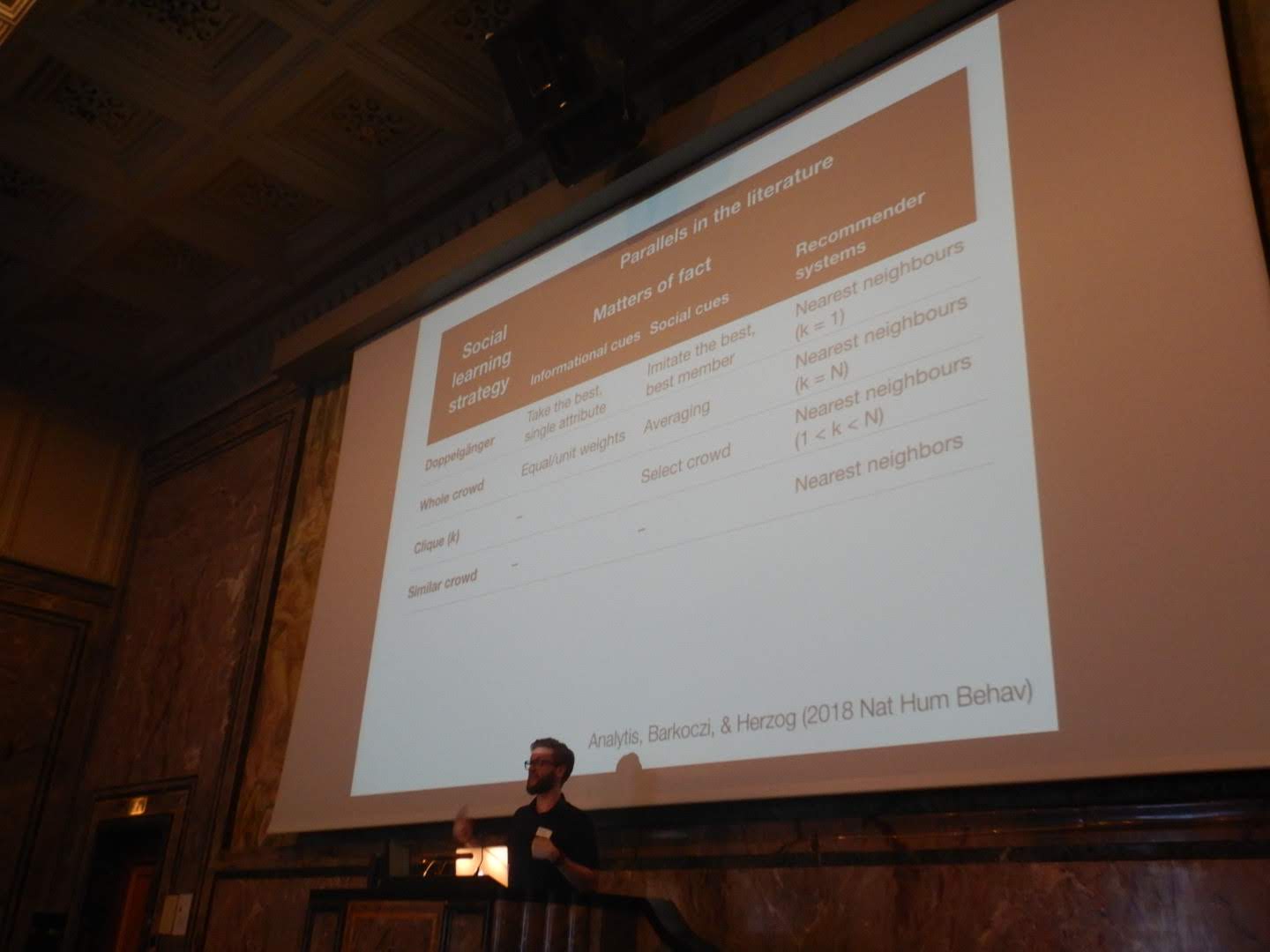
    • Social learning strategies for matters of taste (This is a must-read!)
      • DSCN0326DSCN0325DSCN0324
    • Photo Sleuth: Combining Collective Intelligence and Computer Vision to
      Identify Historical Portraits

      • Good discussion of how to blend human and ML person identification
    • Toward Safer Crowdsourced Content Moderation
    • How Intermittent Breaks in Interaction Improve Collective

Phil 6.19.18

7:00 – 9:00, 4:00 – 5:00 ASRC MKT

  • Here’s a list of organizations that are mobilizing to help immigrant children separated from their families
  • SASO trip
  • Rebuilt all the binaries, now I need to put them on the thumb drive – done
  • Added knobs to the implications slide. They sit next to the dimension and SIH lines. I realize that my slide deck is becoming a physical version of a memory palace.
  • Continuing Irrational Exuberance, though feeling like I should be reading Axelrod. Bring Evolution of Cooperation on the flight?
  • Naive Diversification Strategies in Defined Contribution Saving Plans
    • There is a worldwide trend toward defined contribution saving plans and growing interest in privatized social security plans. In both environments, individuals are given some responsibility to make their own asset allocation decisions, raising concerns about how well they do at this task. This paper investigates one aspect of the task, namely diversification. We show that many investors have very naive notions about diversification. For example, some investors follow what we call the 1/n strategy: they divide their contributions evenly across the funds offered in the plan. When this strategy (or others only slightly more sophisticated) is used, the assets chosen depend greatly on the make-up of the funds offered in the plan. We find evidence of naive diversification strategies both in experiments using employees at the University of California and the actual behavior of participants in a wide range of savings plans. In particular, we find the proportion of the assets the participants invest in stocks depends strongly on the proportion of stock funds in the plan. The results raise very serious questions about how privatized social security systems should be designed, questions that would be ignored in most economic analyses.
    • This is very much a dimension reduction exercise.
  • A2P maintenance proposal

9:00 – 4:00 ASRC A2P

  • Coming up to speed on the Angular interface
    • Logging into CI and QA
    • Dashboard configurations

Phil 6.18.18

ASRC MKT 7:00 – 8:00

  • Nice ride on Saturday on Skyline drive
  • Using Social Network Information in Bayesian Truth Discovery
    • We investigate the problem of truth discovery based on opinions from multiple agents who may be unreliable or biased. We consider the case where agents’ reliabilities or biases are correlated if they belong to the same community, which defines a group of agents with similar opinions regarding a particular event. An agent can belong to different communities for different events, and these communities are unknown a priori. We incorporate knowledge of the agents’ social network in our truth discovery framework and develop Laplace variational inference methods to estimate agents’ reliabilities, communities, and the event states. We also develop a stochastic variational inference method to scale our model to large social networks. Simulations and experiments on real data suggest that when observations are sparse, our proposed methods perform better than several other inference methods, including majority voting, the popular Bayesian Classifier Combination (BCC) method, and the Community BCC method.
  • Scale-free correlations in starling flocks
    • From bird flocks to fish schools, animal groups often seem to react to environmental perturbations as if of one mind. Most studies in collective animal behavior have aimed to understand how a globally ordered state may emerge from simple behavioral rules. Less effort has been devoted to understanding the origin of collective response, namely the way the group as a whole reacts to its environment. Yet, in the presence of strong predatory pressure on the group, collective response may yield a significant adaptive advantage. Here we suggest that collective response in animal groups may be achieved through scale-free behavioral correlations. By reconstructing the 3D position and velocity of individual birds in large flocks of starlings, we measured to what extent the velocity fluctuations of different birds are correlated to each other. We found that the range of such spatial correlation does not have a constant value, but it scales with the linear size of the flock. This result indicates that behavioral correlations are scale free: The change in the behavioral state of one animal affects and is affected by that of all other animals in the group, no matter how large the group is. Scale-free correlations provide each animal with an effective perception range much larger than the direct inter-individual interaction range, thus enhancing global response to perturbations. Our results suggest that flocks behave as critical systems, poised to respond maximally to environmental perturbations.
  • Interaction ruling animal collective behavior depends on topological rather than metric distance: Evidence from a field study
    • By reconstructing the three-dimensional positions of individual birds in airborne flocks of a few thousand members, we show that the interaction does not depend on the metric distance, as most current models and theories assume, but rather on the topological distance. In fact, we discovered that each bird interacts on average with a fixed number of neighbors (six to seven), rather than with all neighbors within a fixed metric distance. We argue that a topological interaction is indispensable to maintain a flock’s cohesion against the large density changes caused by external perturbations, typically predation. …
  • Thread on the failure to replicate the Stanford Prison Experiment by Alex Haslam (scholar) (home page). Paper coming soon
    • The Stanford Prison Experience—as it is presented in textbooks—presents human nature as naturally conforming to oppressive systems. This is a lesson that extends well beyond prison systems and the field criminology—but it’s wrong. Alex and his colleagues (especially Steve Reicher) have been arguing for years that conformity often emerges when leaders cultivate a sense of shared identity. This is an active, engaged process—very different from automatic and mindless conformity.
  • Started Irrational Exuberance, by Robert Shiller
  • Send note to Don, Aaron and Shimei
  • Read Ego-motion in Self-Aware Deep Learning on Medium. It’s about reflective learning of navigation in physical spaces, though I wonder if there is an equivalent process in belief spaces. Looked through scholar and
  • Slide prep and Fika walkthrough
    • Went well. Ravi suggested adding another slide that discusses the methods in detail, while Sy pretty much demanded that I get rid of “Questions” and put the title of the paper in its place
    • When adding the detail for Ravi, I discovered that the simulator and map reconstruction did not handle single, high dimensional agents well, so I spent a few hours fixing bugs to get the screen captures to build the slides.

Phil 6.15.18

7:00 – 6:00 ASRC MKT

  • Montaigne and the Art of Conversation held on June 11, 2018
    • Michel de Montaigne, the inventor of the essay and the greatest philosopher of the Renaissance, who is often imagined to be a solitary figure, lost in his library, writing to himself. However, his understanding of the practice of philosophy and the cultivation of the self were deeply social and tied to the give and take of debate and disputation among friends. Hampton’s talk—his “conversation”—will focus on one of Montaigne’s greatest essays, “On the Art of Conversation.” It will place the essay in Montaigne’s thought, and in the tradition of “philosophical conversation” that underpins the humanist tradition in the European West.
  • Dynamical Isometry and a Mean Field Theory of CNNs: How to Train 10,000-Layer Vanilla Convolutional Neural Networks (Thread overview)
    • Moreover, convolutional networks have precisely the same order-to-chaos transition as fully-connected networks, with vanishing gradients in the ordered phase and exploding gradients in the chaotic phase.
  • Susan Li (ML articles on Medium)
  • Working on slides. Walk through with Wayne today at 4:00
  • Re-read the paper. I’ve forgotten what’s in it!
  • Forward the Yao article, since it’s an example of what I’m modelling. It belongs up with the Strava maps
  • Strava maps are about discerning environment from behavior. Physical and social structures are visible (shorelines, mountains, and borders), from the perspective of road cyclists, who have simple rules:
    • Up is fun
    • Stations of the cross
    • Different populations on Strava (Commuter, mtn, road, etc)
    • Maps to Hofstede’s cultural dimensions
  • Meeting with Wayne to go over slides. Lots of rework. There is a difference in proposal and DC slides, which are showing a research direction, and a paper, which is showing a result.

Phil 6.14.18

7:00 – ASRC MKT

  • dads taxes!
  • Rolled in Aaron’s corrections. Spell check doesn’t seem to work as well in captions?
  • Put together beginnings of the LaTex presentation
  • Slides
  • Fika burgers & bowling

Phil 6.13.18

7:00 – 4:00 ASRC MKT

  • International driver’s license – done
  • Add visually-impaired labels to paper – done
  • Start slides
  • Interesting article on dimension reduction: The faces of God in America: Revealing religious diversity across people and politics What strikes me about this study is actually how similar the depictions are. In belief space, this would be a closely woven neighborhood. It would be interesting to see an equivalent study on a less anthropomorphic deity like Vishnu… journal.pone.0198745.g002
    • Literature and art have long depicted God as a stern and elderly white man, but do people actually see Him this way? We use reverse correlation to understand how a representative sample of American Christians visualize the face of God, which we argue is indicative of how believers think about God’s mind. In contrast to historical depictions, Americans generally see God as young, Caucasian, and loving, but perceptions vary by believers’ political ideology and physical appearance. Liberals see God as relatively more feminine, more African American, and more loving than conservatives, who see God as older, more intelligent, and more powerful. All participants see God as similar to themselves on attractiveness, age, and, to a lesser extent, race. These differences are consistent with past research showing that people’s views of God are shaped by their group-based motivations and cognitive biases. Our results also speak to the broad scope of religious differences: even people of the same nationality and the same faith appear to think differently about God’s appearance.
  • Finished paper
  • Working on talk

personal

  • Shopping – done
  • taxes
  • laundry – done
  • generator/un-grounded short extension cord – done. Works!

Phil 5.18.18

7:00 – 4:00 ASRC MKT

Phil 5.17.18

7:00 – 4:00 ASRC MKT

  • How artificial intelligence is changing science – This page contains pointers to a bunch of interesting projects:
  • Multi-view Discriminative Learning via Joint Non-negative Matrix Factorization
    • Multi-view learning attempts to generate a classifier with a better performance by exploiting relationship among multiple views. Existing approaches often focus on learning the consistency and/or complementarity among different views. However, not all consistent or complementary information is useful for learning, instead, only class-specific discriminative information is essential. In this paper, we propose a new robust multi-view learning algorithm, called DICS, by exploring the Discriminative and non-discriminative Information existing in Common and view-Specific parts among different views via joint non-negative matrix factorization. The basic idea is to learn a latent common subspace and view-specific subspaces, and more importantly, discriminative and non-discriminative information from all subspaces are further extracted to support a better classification. Empirical extensive experiments on seven real-world data sets have demonstrated the effectiveness of DICS, and show its superiority over many state-of-the-art algorithms.
  • Add Nomadic, Flocking, and Stampede to terms. And a bunch more
  • Slides
  • Embedding navigation
    • Extend SmartShape to SourceShape. It should be a stripped down version of FlockingShape
    • Extend BaseCA to SourceCA, again, it should be a stripped down version of FlockingBeliefCA
    • Add a sourceShapeList for FlockingAgentManager that then passes that to the FlockingShapes
  • And it’s working! Well, drawing. Next is the interactions: Influence
  • Finally went and joined the IEEE

Phil 5.16.18

7:00 – 3:30 ASRC MKT

  • My home box has become very slow. 41 seconds to do a full recompile of GPM, while it takes 3 sec on a nearly identical machine at work. This may help?
  • Working on terms
  • Working on slides
  • Attending talk on Big Data, Security and Privacy – 11 am to 12 pm at ITE 459
    • Bhavani Thiraisingham
    • Big data management and analytics emphasizing GANs  and deep learning<- the new hotness
      • How do you detect attacks?
      • UMBC has real time analytics in cyber? IOCRC
    • Example systems
      • Cloud centric assured information sharing
    • Research challenges:
      • dynamically adapting and evolving policies to maintain privacy under a changing environment
      • Deep learning to detect attacks tat were previously not detectable
      • GANs or attacker and defender?
      • Scaleabe is a big problem, e.g. policies within Hadoop operatinos
      • How much information is being lost by not sharing data?
      • Fine grained access control with Hive RDF?
      • Distributed Search over Encrypted Big Data
    • Data Security & Privacy
      • Honypatching – Kevin xxx on software deception
      • Novel Class detection – novel class embodied in novel malware. There are malware repositories?
    • Lifecycle for IoT
    • Trustworthy analytics
      • Intel SGX
      • Adversarial SVM
      • This resembles hyperparameter tuning. What is the gradient that’s being descended?
      • Binary retrofitting. Some kind of binary man-in-the-middle?
      • Two body problem cybersecurity
    • Question –
      • discuss how a system might recognize an individual from session to session while being unable to identify the individual
      • What about multiple combinatorial attacks
      • What about generating credible false information to attackers, that also has steganographic components for identifying the attacker?
  • I had managed to not commit the embedding xml and the programs that made them, so first I had to install gensim and lxml at home. After that it’s pretty straightforward to recompute with what I currently have.
  • Moving ARFF and XLSX output to the menu choices. – done
  • Get started on rendering
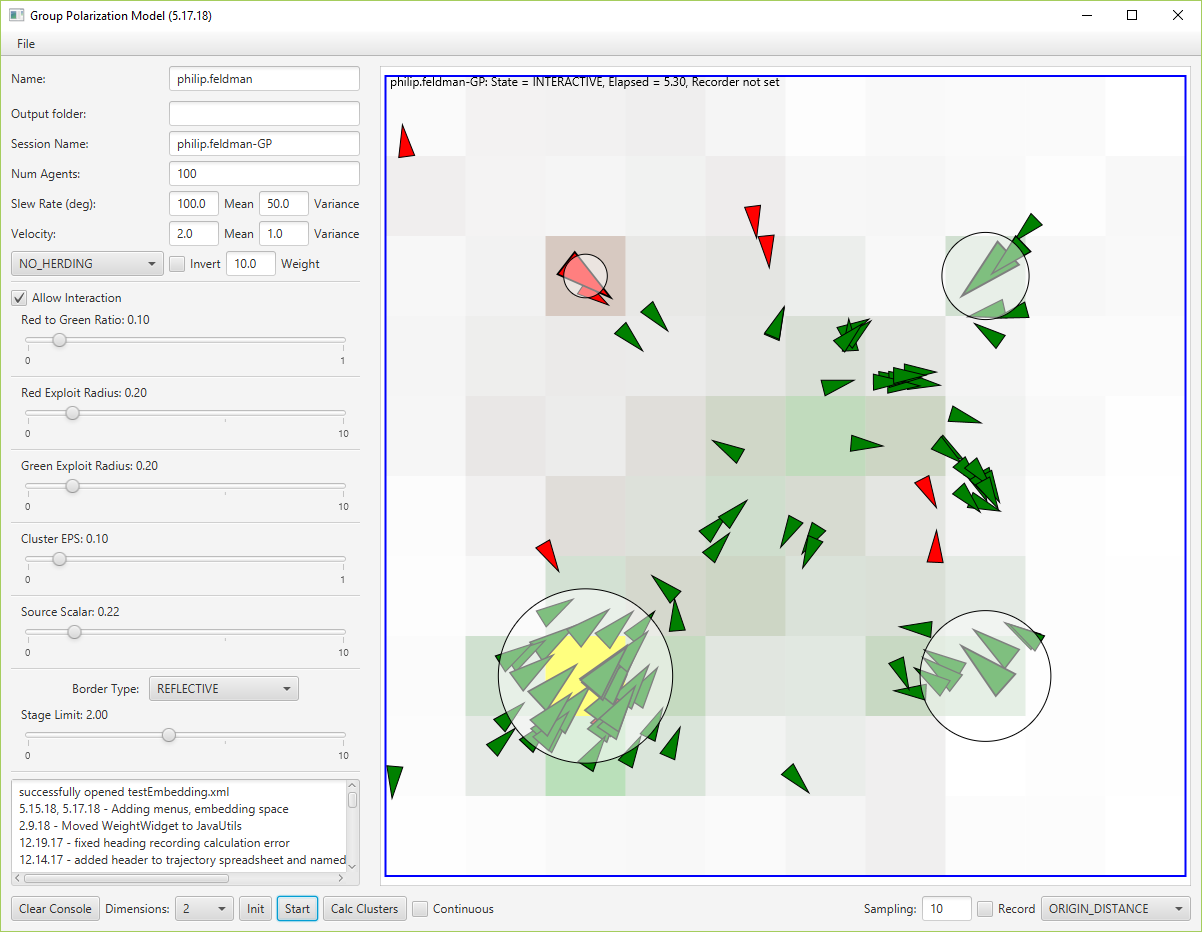
    • Got the data read in and rendering, but it’s very brute force:
      if(getCurrentEmbeddings().loadSuccess){
          double posScalar = ResizableCanvas.DEFAULT_SCALAR/2.0;
          List<WordEmbedding> weList = currentEmbeddings.getEmbeddings();
          for (WordEmbedding we : weList){
              double size = 10.0 * we.getCount();
              SmartShape ss = new SmartShape(we.getEntry(), Color.WHITE, Color.BLACK);
              ss.setPos(we.getCoordinate(0)*posScalar, we.getCoordinate(1)*posScalar);
              ss.setSize(size, size);
              ss.setAngle(0);
              ss.setType(SmartShape.SHAPE_TYPE.OVAL);
              canvas.addShape(ss);
          }
      }

      It took a while to remember how shapes and agents work together. Next steps:

      • Extend SmartShape to SourceShape. It should be a stripped down version of FlockingShape
      • Extend BaseCA to SourceCA, again, it should be a stripped down version of FlockingBeliefCA
      • Add a sourceShapeList for FlockingAgentManager that then passes that to the FlockingShapes