Category Archives: Phil

Phil 5.8.2023

May! Lovely weather today

Had an interesting talk with Aaron that moved my thinking forward on LLMs as life forms.

It’s not the LLMs – that’s the substrate

The living process is the prompt. Which feeds back on itself. Prompt grow interactively, in a complex way based (currently) on the previous text in the prompt. The prompt is ‘living information’ that can adapt based on additions to the prompt, as occurs in chat.

SBIRs

  • 9:00 Sprint review
  • Stories for next sprint
  • Start on Q5 report, which is mostly going to be about moving the server
  • Story prep
  • 2:00 MDA Meeting
  • Back to slides starting tomorrow?

GPT Agents

  • Tweaked topicNode a bit to set the domain of a question

Phil 5.6.2023

MPT-7B
MPT-7B is a decoder-style transformer pretrained from scratch on 1T tokens of English text and code. This model was trained by MosaicML and is open-sourced for commercial use (Apache-2.0).

MPT-7B is part of the family of MosaicPretrainedTransformer (MPT) models, which use a modified transformer architecture optimized for efficient training and inference.

These architectural changes include performance-optimized layer implementations and the elimination of context length limits by replacing positional embeddings with Attention with Linear Biases (ALiBi). Thanks to these modifications, MPT models can be trained with high throughput efficiency and stable convergence. MPT models can also be served efficiently with both standard HuggingFace pipelines and NVIDIA’s FasterTransformer.

This model uses the MosaicML LLM codebase, which can be found in the llm-foundry repository. It was trained by MosaicML’s NLP team on the MosaicML platform for LLM pretraining, finetuning, and inference.

Phil viernes, el cinco de mayo

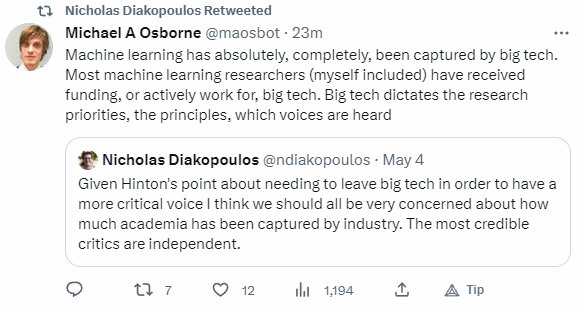
What other agendas should there be for ML? What role should government play in developing models for the common good? For the common defense?

SBIRs

  • 9:00 meeting with Ron – couldn’t get the DB running on Azure
  • Slides for sprint review – done
  • Work with Aaron? Got everything working!
  • Some good discussions with Zach. I’m beginning to thing that summaries are more work than paragraphs without much more of a payoff. Embed at a sentence and paragraph level, and skip the summaries.

Phil 4.4.2023

Went to the USNA Capstone day yesterday, which was fun. Except for when the bus broke.

I’ve been reading Metaphors we live by. It’s central idea is that most of our communication is based on metaphors – that GOOD IS UP, IDEAS ARE FOOD, or TIME IS AN OBJECT. Because we are embodied beings in a physical world, the irreducible foundation of the metaphors we use are physically based – UP/DOWN, FORWARD/BACK, NEAR/FAR, etc.

This makes me think of LLMs, which are so effective at communicating with us that it is very easy to believe that they are intelligent – AI. But as I’m reading the book, I wonder if that’s the right framing. I don’t think that these systems are truly intelligent in the way that we can be (some of the time). I’m beginning to think that they may be alive though.

Life as we understand it emerges from chemistry following complex rules. Once over a threshold, living things can direct their chemistry to perform actions. That in turn leads to physical embodiment and the irreducible concept of up.

Deep neural networks could be regarded as a form of digital chemistry. Simple systems (e.g. logic gates) are used to create more complex systems adders and multipliers. Add a lot of time, development, and data and you get large language models that you can chat with.

The metaphor of biochemistry seems to be emerging in the words we use to describe how these models behave – data can be poisoned or refined. Prompt creation and tuning is not like traditional programming. Words are added and removed to produce the desired behavior more in the way that alchemists worked with their compounds or that drug researchers work with animal models.

These large (foundational) models are true natives of the digital information domain. They are now producing behavior that is not predictable based on the inputs in the way that arithmetic can be understood. Their behavior is more understandable in aggregate – use the same prompt 1,000 times and your get a distribution of responses. That’s more in line with how living things respond to a stimulus.

I think if we reorient ourselves from the metaphor that MACHINES ARE INTELLIGENT to MACHINES ARE EARLY LIFE, we might find ourselves in a better position to understand what is currently going on in machine learning and make better decisions about what to do going forward.

Metaphorically, of course.

SBIRs

  • Submit paper!
  • Work on slides
  • Expense report!
  • 9:15 meeting

Phil 5.2.2023

Need to set up a time to drop of the work box to get more drive space while I’m riding the Eastern Shore

Drop off the truck!

I think I have a chart that explains somewhat how red states can easily avoid action on gun violence. It’s the number of COVID-19 deaths vs. gun deaths in Texas. This is a state that pushed back very hard about any public safety measures for the pandemic, and that was killing roughly 10 times more citizens. I guess the question is “how many of which people will prompt state action? For anything?”

For comparison purposes, Texas had almost 600,000 registered guns in 2022 out of a population of 30 million, or just about 2% of the population if distributed evenly (source). This is probably about 20 times too low, since according to the Pew Center, gun ownership in Texas is about 45%. That percentage seems to be enough people to prevent almost any meaningful action on gun legislation. Though that doesn’t prevent the introduction of legislation to mandate bleeding control stations in schools in case of a shooting event.

So something greater than 2% and less than 45%. Just based on my research, I’d guess something between 10%-20% mortality would be acted on, as long as the demographics of the powerful were affected in those percentages.

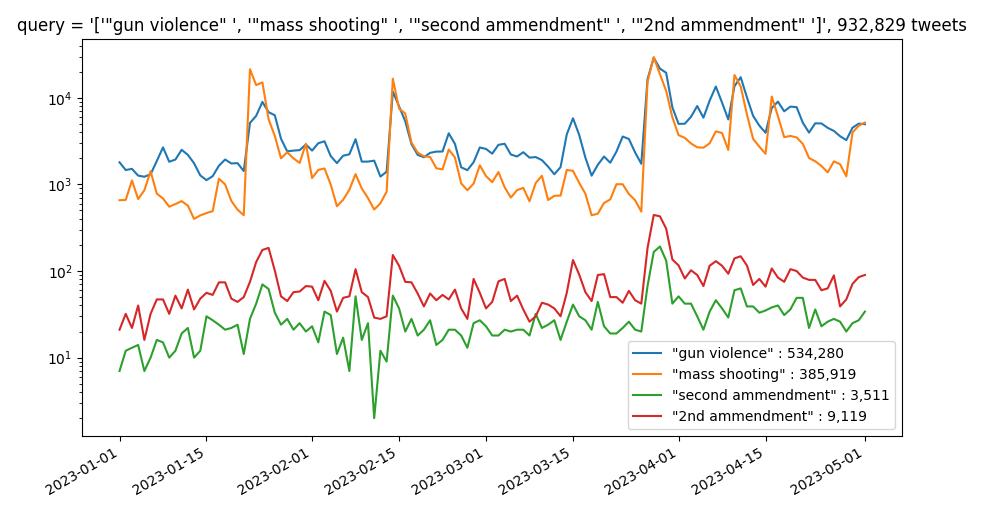
BTW, the wordpress bot just published this to twitter, so that part is still working? And since that is working, here’s a plot:

Gee, I wonder what happened where all those spikes are.

Jsonformer: A Bulletproof Way to Generate Structured JSON from Language Models.

SBIRs

  • Going through the JMOR submission requirements, I found that the citation style is non-numeric. I now need to trim off 3 paragraphs or so.
  • Good progress on the slides yesterday. More work today
  • Did Eric V. really try to steal the paper?
  • 1:00 Meeting
  • Write up notes from yesterday’s meeting
  • USNA tonight

GPT Agents

Phil 5.1.2023

Call Jim Donnies – done

SBIRs

  • Hotel for MORS – done
  • Ping Zach to set up a demo – done. Long chat. We’re moving forward
  • Working on Slides
  • MDA Meeting – I think everything has been worked out?

Phil 4.28.2023

“Source: ChatGPT”

This is a good thread, but it misses some important context. ArXiv isn’t all that easy to publish too. It really helps to have an .edu email address. You need to know how to use LaTeX. The author is a professor at a New Zealand University, with a long publishing history and a solid h-index. When you’re in a hurry and just skimming the abstract looking to bolster your reference section, this could easily pass the test.

And there’s another thing. As someone in the AI/ML space, the ability to get published in a high-profile conference or journal is getting much harder these days. Getting accepted often means having a result that improves on some benchmark. Poking around in new directions means not getting accepted and publishing on ArXiv. For example, Deep residual learning for image recognition has currently been cited over 150,000 times.

This is almost my avatar from the new paper

SBIRs

  • Went to the Microsoft/OpenAI thing yesterday. Mostly advertising, but it’s interesting to note that the Azure account has access to the 32k token input buffer model. Also, there are exactly two instances of the running inference model. It’s too big to be easily replicated. One really good things to see was how you can use the GPT to turn unstructured text into a JSON string that can be consumed by traditional programs. And the reverse is true too – anything can be used to generate a contextual prompt. THings are moving fast.
  • Great chat with Zach. We’re going to try to ingest the NOAA financial regs to throw the chatbot against. Also, some good discussion on how to use big models for assistive interfaces for the vision-impaired. We’ll try to set up something for Monday
  • 9:00 Meeting with Lauren
  • 10:00 Meeting with Aaron and Eric
  • Maybe something in the afternoon with Steve?

GPT Agents

  • Clean out NarrativeExplorer and start ListExplorer and SequenceExplorer. Will probably need some new tables?
  • Make a thread tonight!

Phil 4.27.2023

Calibrated Chaos: Variance Between Runs of Neural Network Training is Harmless and Inevitable

  • Typical neural network trainings have substantial variance in test-set performance between repeated runs, impeding hyperparameter comparison and training reproducibility. We present the following results towards understanding this variation. (1) Despite having significant variance on their test-sets, we demonstrate that standard CIFAR-10 and ImageNet trainings have very little variance in their performance on the test-distributions from which those test-sets are sampled, suggesting that variance is less of a practical issue than previously thought. (2) We present a simplifying statistical assumption which closely approximates the structure of the test-set accuracy distribution. (3) We argue that test-set variance is inevitable in the following two senses. First, we show that variance is largely caused by high sensitivity of the training process to initial conditions, rather than by specific sources of randomness like the data order and augmentations. Second, we prove that variance is unavoidable given the observation that ensembles of trained networks are well-calibrated. (4) We conduct preliminary studies of distribution-shift, fine-tuning, data augmentation and learning rate through the lens of variance between runs.

SBIRs

  • Spending the day at Explore Azure OpenAI & ChatGPT for Federal Agencies
  • Need to get back to slides

GPT Agents

  • After getting lists to work in the TopicNode class yesterday, I realize that I need a ListExplorer and SequenceExplorer app. It will be to confusing to stuff everything into NarrativeExplorer.

Phil 4.26.2023

U.S. is concerned about rivals’ space threats, leaked documents show

  • “Russian companies attempted to create space-rated components for select satellites,” the document asserts. “But the low quality of the components led to on-orbit malfunctions.” It did not identify specific failings.
  • This makes me think that Russia will focus on the weapons that it has more trust in, like misinformation. Very low cost, and how bad can the blowback be?

I changed my password and am currently locked out of all my work accounts as the change ripples through. Sigh. “Technology company” Again with the sigh.

SBIRs

  • 3:00 AI Ethics. Good discussion. I think we are leaning towards an “Ethics Review Board” as part of the gate review for proposals
  • Looking at using Metro tomorrow rather than driving to/from Arlington. I can park at Glenmont

GPT Agents

  • Continue with TopicNode
    • Get the inbound and outbound linkages working – done?
    • Write a lot of stack operations to put the network together. Going to take a break before I try it
    • 4:00 Meeting with Alden
      • Good discussion. We started looking at virality as a related work, but in the end got into a discussion about what it means to do a PhD, and that while methods&results is fine for an MS, a PhD is about proving that you have done original research, which means motivation, background, methods&results, discussion, conclusions, and often a discussion of ethics. Without the surrounding parts, you can’t show that the work is original and advances knowledge, and why that matters. I really do need to write this up, because a lot of this is unsaid at the time PhD students need to hear it.

Book

  • Got the final PDF today!

Phil 4.25.2023

Based at Salve Regina University’s Pell Center for International Relations and Public Policy, the Nationhood Lab is an interdisciplinary research, writing, testing and dissemination project focused on counteracting the authoritarian threat to American democracy and the centrifugal forces threatening the federation’s stability. The project delivers more effective tools with which to describe and defend the American liberal democratic tradition and better understand the forces undermining it.

Seventy years ago today: The 25 April 1953 issue of the journal Nature published a series of five articles giving the Watson and Crick double-helix structure DNA and evidence supporting it.[209] The structure was reported in a letter titled “MOLECULAR STRUCTURE OF NUCLEIC ACIDS A Structure for Deoxyribose Nucleic Acid“, in which they said, “It has not escaped our notice that the specific pairing we have postulated immediately suggests a possible copying mechanism for the genetic material.”[9] This letter was followed by a letter from Franklin and Gosling, which was the first publication of their own X-ray diffraction data and of their original analysis method.[47][210] Then followed a letter by Wilkins and two of his colleagues, which contained an analysis of in vivo B-DNA X-ray patterns, and which supported the presence in vivo of the Watson and Crick structure.[48] (From Wikipedia)

SBIRs

  • Figuring out how to get data to our server. Ron maybe? Need to check
  • Looks like I’m going to the USNA Capstone day again
  • Need to put together my stories
  • Finish getting Eric set up

GPT Agents

  • Start adjusting NarrativeExplorer
    • Read in additional info
    • Run sequences for a number of iterations
    • Run lists to a depth of recursions. The code is in GPT-2_Agents: InteractiveNode.py, and InteractiveGraphBuilder.py. I’ll need to move to an embedding model. That will need some testing and development.
    • Support making new contexts in the NarrativeExplorer.

Progress on the embedding model!

'vaccines cause autism' is 0.0000 away from 'vaccines cause autism'
'vaccines cause autism' is 0.0412 away from 'autism is caused by vaccines'
'vaccines cause autism' is 0.0659 away from 'autism is caused by the vax'
'vaccines cause autism' is 0.1111 away from 'the cause for autism is unknown'
'vaccines cause autism' is 0.2772 away from 'the earth is flat'

Done for the day. This is a fantastic result, though:

TopicNode.__init__()
TopicNode.add_known_good_list()
	reject threshold = 0.0655 dists = [0.02887398 0.01906836 0.03049576 0.03277439 0.02816651 0.03090093]
'vaccines cause autism' is 0.1030 away from 'the cause for autism is unknown' REJECT
'vaccines cause autism' is 0.2552 away from 'the earth is flat' REJECT
Topic 'vaccines cause autism' includes:
	'vaccines cause autism'
	'Vaccinations lead to autism'
	'Immunizations are linked to autism'
	'Autism is a result of vaccines'
	'Autism is triggered by vaccinations'
	'There's a connection between vaccines and autism'
	reject_threshold = 0.06555

Process finished with exit code 0

Phil 4.24.2023

Saw this on Twitter: Can We Build An AI Chatbot For Journalism?

  • Early Lessons In Accuracy, Sourcing, and Delight From A (Draft) Chatbot Based on NPR’s Planet Money Archives

Cancel hotel

SBIRs

  • 9:00 Sprint demos
  • 11:00 BMD tagup
  • 12:00 Customer meeting
  • 2:00 Weekly MDA meeting

GPT Agents

  • Name the regexes and make them global – done
  • Export the regexes and type along with the experiment – done
  • I realize that because the context is exported, that making new ones in the NarrativeExplorer will have to be an option.

Book

  • Tweet thread

Phil 3.22.2023

Finished all my tasks and my legs are still tired. I need to take the fixee out more.

Anyway, this is going to be one of those things that historians are going to have to explain:

Evaluating Verifiability in Generative Search Engines

  • Generative search engines directly generate responses to user queries, along with in-line citations. A prerequisite trait of a trustworthy generative search engine is verifiability, i.e., systems should cite comprehensively (high citation recall; all statements are fully supported by citations) and accurately (high citation precision; every cite supports its associated statement). We conduct human evaluation to audit four popular generative search engines — Bing Chat, NeevaAI, this http URL, and YouChat — across a diverse set of queries from a variety of sources (e.g., historical Google user queries, dynamically-collected open-ended questions on Reddit, etc.). We find that responses from existing generative search engines are fluent and appear informative, but frequently contain unsupported statements and inaccurate citations: on average, a mere 51.5% of generated sentences are fully supported by citations and only 74.5% of citations support their associated sentence. We believe that these results are concerningly low for systems that may serve as a primary tool for information-seeking users, especially given their facade of trustworthiness. We hope that our results further motivate the development of trustworthy generative search engines and help researchers and users better understand the shortcomings of existing commercial systems.

Phil 4.20.2023

We are a month into Spring already!

Inside the secret list of websites that make AI like ChatGPT sound smart

  • we analyzed Google’s C4 data set, a massive snapshot of the contents of 15 million websites that have been used to instruct some high-profile English-language AIs, called large language models, including Google’s T5 and Facebook’s LLaMA. (OpenAI does not disclose what datasets it uses to train the models backing its popular chatbot, ChatGPT)

Automatic Gradient Descent: Deep Learning without Hyperparameters

  • The architecture of a deep neural network is defined explicitly in terms of the number of layers, the width of each layer and the general network topology. Existing optimisation frameworks neglect this information in favour of implicit architectural information (e.g. second-order methods) or architecture-agnostic distance functions (e.g. mirror descent). Meanwhile, the most popular optimiser in practice, Adam, is based on heuristics. This paper builds a new framework for deriving optimisation algorithms that explicitly leverage neural architecture. The theory extends mirror descent to non-convex composite objective functions: the idea is to transform a Bregman divergence to account for the non-linear structure of neural architecture. Working through the details for deep fully-connected networks yields automatic gradient descent: a first-order optimiser without any hyperparameters. Automatic gradient descent trains both fully-connected and convolutional networks out-of-the-box and at ImageNet scale. A PyTorch implementation is available at this https URL and also in Appendix B. Overall, the paper supplies a rigorous theoretical foundation for a next-generation of architecture-dependent optimisers that work automatically and without hyperparameters.

One Small Step for Generative AI, One Giant Leap for AGI: A Complete Survey on ChatGPT in AIGC Era

  • OpenAI has recently released GPT-4 (a.k.a. ChatGPT plus), which is demonstrated to be one small step for generative AI (GAI), but one giant leap for artificial general intelligence (AGI). Since its official release in November 2022, ChatGPT has quickly attracted numerous users with extensive media coverage. Such unprecedented attention has also motivated numerous researchers to investigate ChatGPT from various aspects. According to Google scholar, there are more than 500 articles with ChatGPT in their titles or mentioning it in their abstracts. Considering this, a review is urgently needed, and our work fills this gap. Overall, this work is the first to survey ChatGPT with a comprehensive review of its underlying technology, applications, and challenges. Moreover, we present an outlook on how ChatGPT might evolve to realize general-purpose AIGC (a.k.a. AI-generated content), which will be a significant milestone for the development of AGI

JPEG Compressed Images Can Bypass Protections Against AI Editing

  • Recently developed text-to-image diffusion models make it easy to edit or create high-quality images. Their ease of use has raised concerns about the potential for malicious editing or deepfake creation. Imperceptible perturbations have been proposed as a means of protecting images from malicious editing by preventing diffusion models from generating realistic images. However, we find that the aforementioned perturbations are not robust to JPEG compression, which poses a major weakness because of the common usage and availability of JPEG. We discuss the importance of robustness for additive imperceptible perturbations and encourage alternative approaches to protect images against editing.

Book

  • Review updates and approve – DONE!!!!

SBIRs

  • Finish training – done
  • Moar slides and paper review – progress, but not done. more on Saturday

GPT agents

  • Work on getting context for lists
  • Export prompt and regex to the NarrativeExplorer input file
  • Fix regex to avoid parsing on “GPT-3” – done
  • Fixed (well, worked around) the bug that had the callback for a ListField being called from other TextComboExts. Can’t figure out what’s going on. The result is not horrible, though:

Phil 4.19.2023

Went to get my physical this morning. It appears I am still alive

SBIRs

  • Training – finished 2 of the three courses. Sooooo painful!

Book

  • Carefully review the chapters. On first pass it looks good, and the hand-rolled tweets look very credible

GPT Agents

  • 2:30 Aldin meeting – done. We’re going to set up something for next Wednesday
  • 4:00 LLM meeting – done. Need to formalize the idea of using aggregation for finding hallucinations vs. well-grounded generation
  • Need to fix the regex so it doesn’t split on “GPT-3”