Category Archives: research

Phil 1.26.18

7:00 – 4:00 ASRC MKT

  • Tweaked my hypotheses from this post. I need to promote to a Phlog page.
  • Using Self-Organizing Maps to solve the Traveling Salesman Problem
    • The Traveling Salesman Problem is a well known challenge in Computer Science: it consists on finding the shortest route possible that traverses all cities in a given map only once. To solve it, we can try to apply a modification of the Self-Organizing Map (SOM) technique. Let us take a look at what this technique consists, and then apply it to the TSP once we understand it better.
  • Starting JuryRoom project with Jeremy.
    • Angular material  design
    • VerdictBox (Scenario and verdict)
    • Chat message
    • Live discussion cards (right gutter)
    • Topics (alphabetic, ranking, trending) with sparklines
    • Progress!!!!!! JuryRoom

Phil 1.25.18

ASRC MKT 7:00 –

  • Domo arigato, Mr. Roboto, tell us your secret (good article on recognizing behavior patterns, rather than words)
    • Everybody that has an interest in influencing public opinion will happily pay a handful of Dollars to amplify their voices. Governments, political groups, corporations, traders, and just simple plain trolls will continue to shout through bot armies—as long as it is so cheap. Bots are cheaper than buying ad space, less risky than a network of spies, more efficient and less prone to failure than creating 50 fake accounts by hand. If bots could be identified and tagged, the fake news industry would suffer a heavy blow. Here is how we can make this happen.
  • More Angular
  • Wireframing with Jeremy

Phil 1.24.18

7:00 – 5:00 ASRC MKT

  • H1: Groups are defined by a common location, orientation, and velocity (LOV) through a navigable physical or cognitive space. The amount of group cohesion and identification is proportional to the amount of similarity along all three axis.
  • H2: Group Behavior emerges from mutual influence, based on awareness and trust. Mutual influence is facilitated by Dimension Reduction: The lower the number of dimensions, the easier it is to produce a group.
  • H3: Group behavior has three distinct patterns: Nomadic, Flocking and Stampeding. These behaviors are dictated by the level of trust and awareness between individuals having similar LOVs
    • H3a: The trustworthiness of the underlying information space can be inferred from the group behaviors through belief space. All agents  seek out fitness peaks (reward gradients) and avoids valleys (risk gradients) within the space. (Risk = negative heading alignment, increase speed. Reward = positive heading alignment, decrease speed.)
      • Nomadic emphasizes environmental gradients as an individual or small group of agents. This supports the broadest awareness of the belief space, though it may be difficult to infer fitness peaks. Gradient discovery is  less influences by additional social effects,
      • Flocking behavior results from environmentally constrained social gradient seeking. For example, distance attenuates social influence. If an agent finds a risk or reward, that information cascades through the population as a function of the environmental constraints. (Note: In-group and out group could be manifestations of pure social gradient creation.)
      • Stampede emphasizes social gradients. This becomes easier as groups become larger and a strong ‘social reality’ occurs. When social influence is dominant at the expense of environmental awareness, a runaway stampede can occur. The beliefs and associated information that underlie a stampede can be inferred to be untrustworthy.
  • H4: Individual trajectories through these spaces, when combined with large numbers of other individual trajectories produce maps which reflect the dimensions that define the groups in that space.
  • These conclusions can be derived though
  • Continuing with BIC
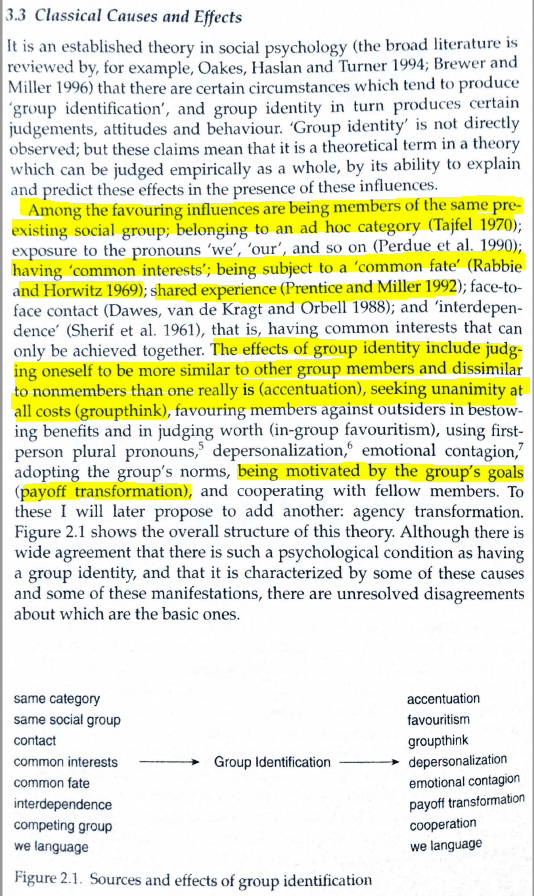
    • GroupIdentification
  • Fundamentals of Data Visualization
    • I’m very excited to announce my latest project, a book on data visualization. The working title is “Fundamentals of Data Visualization”. The book will be published with O’Reilly, and a preview is available here. The entire book is written in R Markdown, and the figures are made with ggplot2. The source for the book is available on github.
  • Sex differences in the use of social information emerge under conditions of risk
    • Social learning provides an effective route to gaining up-to-date information, particularly when information is costly to obtain asocially. Theoretical work predicts that the willingness to switch between using asocial and social sources of information will vary between individuals according to their risk tolerance. We tested the prediction that, where there are sex differences in risk tolerance, altering the variance of the payoffs of using asocial and social information differentially influences the probability of social information use by sex. In a computer-based task that involved building a virtual spaceship, men and women (N = 88) were given the option of using either asocial or social sources of information to improve their performance. When the asocial option was risky (i.e., the participant’s score could markedly increase or decrease) and the social option was safe (i.e., their score could slightly increase or remain the same), women, but not men, were more likely to use the social option than the asocial option. In all other conditions, both women and men preferentially used the asocial option to a similar degree. 
  • Thinking Fast and Slow on Networks: Co-evolution of Cognition and Cooperation in Structured Populations
    •  In line with past work in well-mixed populations, we find that selection favors either the intuitive defector (ID) strategy which never deliberates, or the dual-process cooperator (DC) strategy which intuitively cooperates but uses deliberation to switch to defection in Prisoner’s Dilemma games. We find that sparser networks (i.e. smaller average degree) facilitate the success of DC over ID, while also reducing the level of deliberation that DC agents engage in; and that these results generalize across different kinds of networks.
  • Joanna J Bryson 7:30 AM – 24 Jan 2018: This didn’t happen because humans are evil. It happens because intelligence is computation—an expensive physical process—and therefore limited. Thread very worth reading.
  • A bit more Angular
  • Compared the speed of execution for LSTM on my and Aaron’s boxes. His newer card is a bit faster than my TITAN
  • Most of the day was spent putting together the ppt for the ML/AI workshop on Monday

Phil 1.19.18

7:00 – 5:00 ASRC

  • Look! Adversarial Herding: https://twitter.com/katestarbird/status/954802718018686976
  • Reconnected with Wayne. Arranging a time to meet the week of the 29th. Sent him a copy of the winter sim conference paper
  • Continuing with Beyond Individual Choice. Actually, wound up adding a section on how attention and awareness interplay, and how high social trust makes for much more efficient way to approach games such as the prisoner’s dilemma on my thoughts about trust and awareness
  • Starting Angular course
    • Architecture overview
  • Meeting with Jeremy, Heath and Aaron on Project structure/setup
  • More Angular. Yarn requires Python 2.x, which I hope doesn’t break my Python 3.x
  • Could not get the project to serve once built
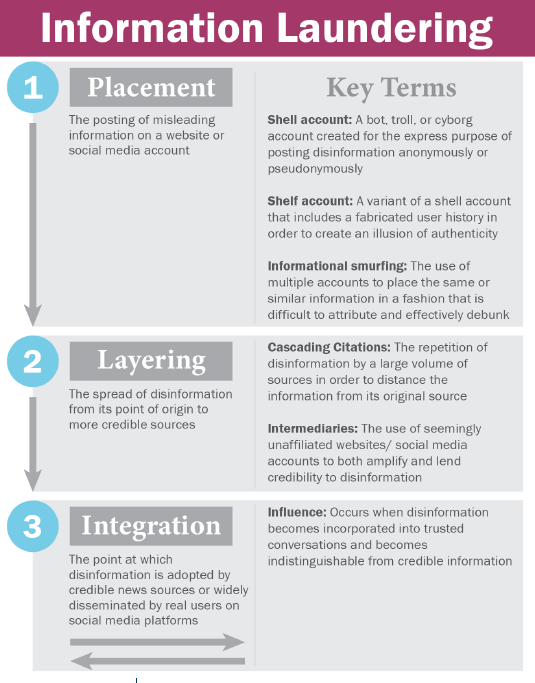
  • Adversarial herding via The Opposition
    • Clint WattsClint is a consultant and researcher modeling and forecasting threat actor behavior and developing countermeasures for disrupting and defeating state and non-state actors. As a consultant, Clint designs and implements customized training and research programs for military, intelligence and law enforcement organizations at the federal, state and local level. In the private sector, he helps financial institutions develop best practices in cybersecurity intelligence operations. His research predominately focuses on terrorism forecasting and trends seeking to anticipate emerging extremist hotspots and anticipate appropriate counterterrorism responses. More recently, Clint used modeling to outline Russian influence operations via social media and the Kremlin’s return to Active Measures.

Phil 1.18.2018

7:30 – 4:30 ASRC MKT

  • Truth Decay (RAND corporation ebook)
    • An Initial Exploration of the Diminishing Role of Facts and Analysis in American Public Life
  • Reading more Beyond Individual Choice
    • TheoryDemands
  • Got my Angular setup running. Thanks, Jeremy!
  • Reading up on WSO2 IaaS – Done. Did not know that was a thing.
  • Helped Aaron a bit with his dev box horror show
  • Spent a good chunk of the afternoon jumping through hoops to get an online Angular course approved. It seems as though you get approval, send it to HR(?), buy (it) yourself, then submit the expense through Concur. That’s totally efficient…

Phil 1.17.18


7:00 – 3:30 ASRC MKT

  • Harbinger, another DiscussionGame comparable: We are investigating how people make predictions and how to improve forecasting of current events.
  • Working over time, constructing a project based on beliefs and ideas, can be regarded as working with a group of yourself. You communicate with your future self through construction. You perceive your past self through artifacts. Polarization should happen here as a matter of course, since the social similarity (and therefore influence) is very high.
  • Back to Beyond Individual Choice
    • Diagonals
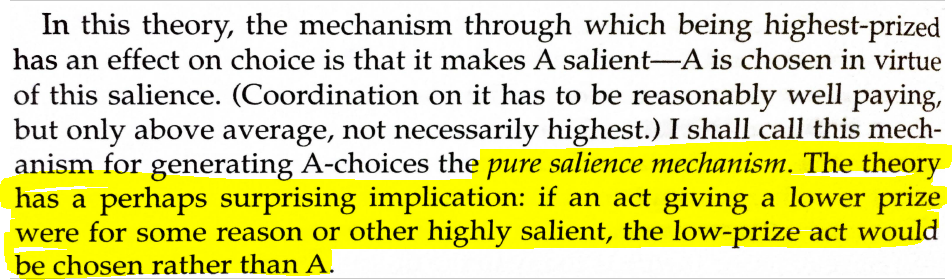
    • Salience
  • Back to Angular – prepping for integration of PolarizationGame into the A2P platform. Speaking of which, there needs to be a REST API that will support registered, (optionally?) identified bots. A bot that is able to persuade a group of people over time to reach a unanimous vote would be an interesting Turing-style test. And a prize
    • Got Tour of Heroes running again, though it seems broken…
  • Nice chat with Jeremy.
    • He’ll talk to Heath about what it would take to set up an A2P instance for the discussion system that could scale to millions of players
    • Also mentioned that there would need to be a REST interface for bots
    • Look through Material Design
      • Don’t see any direct Forum (threaded discussion) details on the home site, but I found this Forum example GIF
    • Add meeting with Heath and Jeremy early in the sprint to lay out initial detailed design
    • Stub out non-functional pages as a deliverable for this (next?) sprint
    • He sent me an email with all the things to set up. Got the new Node, Yarn and CLI on my home machine. Will do that again tomorrow and test the VPN connections
  • Sprint planning
    • A2P GUI and Detailed Design are going to overlap

Phil 1.16.2018

ASRC MKT 7:00 – 4:30

  • Tit for tat in heterogeneous populations
    • The “iterated prisoner’s dilemma” is now the orthodox paradigm for the evolution of cooperation among selfish individuals. This viewpoint is strongly supported by Axelrod’s computer tournaments, where ‘tit for tat’ (TFT) finished first. This has stimulated interest in the role of reciprocity in biological societies. Most theoretical investigations, however, assumed homogeneous populations (the setting for evolutionary stable strategies) and programs immune to errors. Here we try to come closer to the biological situation by following a program that takes stochasticities into account and investigates representative samples. We find that a small fraction of TFT players is essential for the emergence of reciprocation in a heterogeneous population, but only paves the way for a more generous strategy. TFT is the pivot, rather than the aim, of an evolution towards cooperation.
    • It’s a Nature Note, so a quick read. In this case, the transition is from AllD->TFT->GTFT, where evolution stops.
  • A strategy of win-stay, lose-shift that outperforms tit-for-tat in the Prisoner’s Dilemma game
    • The Prisoner’s Dilemma is the leading metaphor for the evolution of cooperative behaviour in populations of selfish agents, especially since the well-known computer tournaments of Axelrod and their application to biological communities. In Axelrod’s simulations, the simple strategy tit-for-tat did outstandingly well and subsequently became the major paradigm for reciprocal altruism. Here we present extended evolutionary simulations of heterogeneous ensembles of probabilistic strategies including mutation and selection, and report the unexpected success of another protagonist: Pavlov. This strategy is as simple as tit-for-tat and embodies the fundamental behavioural mechanism win-stay, lose-shift, which seems to be a widespread rule. Pavlov’s success is based on two important advantages over tit-for-tat: it can correct occasional mistakes and exploit unconditional cooperators. This second feature prevents Pavlov populations from being undermined by unconditional cooperators, which in turn invite defectors. Pavlov seems to be more robust than tit-for-tat, suggesting that cooperative behaviour in natural situations may often be based on win-stay, lose-shift.
    • win-stay = exploit, lose-shift = explore
  • Five rules for the evolution of cooperation
    • Cooperation is needed for evolution to construct new levels of organization. The emergence of genomes, cells, multi-cellular organisms, social insects and human society are all based on cooperation. Cooperation means that selfish replicators forgo some of their reproductive potential to help one another. But natural selection implies competition and therefore opposes cooperation unless a specific mechanism is at work. Here I discuss five mechanisms for the evolution of cooperation: kin selection, direct reciprocity, indirect reciprocity, network reciprocity and group selection. For each mechanism, a simple rule is derived which specifies whether natural selection can lead to cooperation.
  • Added a paragraph to the previous work section to include Tit-for-Tat and Milti-armed Bandit previous work.
  • Worked with Aaron on setting up sprint goals

Phil 1.14.18

Pondering what a good HI-LO game would be for a presentation:

  • Ask the audience to choose A or B, based on what they think the most likely answer is. Show of hands, B, then A.
  • Describe the H/L chart and cooperative game theory, and how traditional game theory can’t account for why LL makes less sense to us than HH
  • fig-1-2x

Phil 1.10.18

7:00 – 10:00 ASRC MKT

  • Send Marie paper and link to venues – done
  • Write up alignment thoughts. Done and in Phlog
  • I also need to write up something on the spectrum that narratives cover between maps and lists. Why a scientific paper is more “mapish” than a murder mystery.
  • And this, from Beyond Individual Choice, page 24: SchellingAlign
  • And this, because it’s cool and I fit in here somewhere:

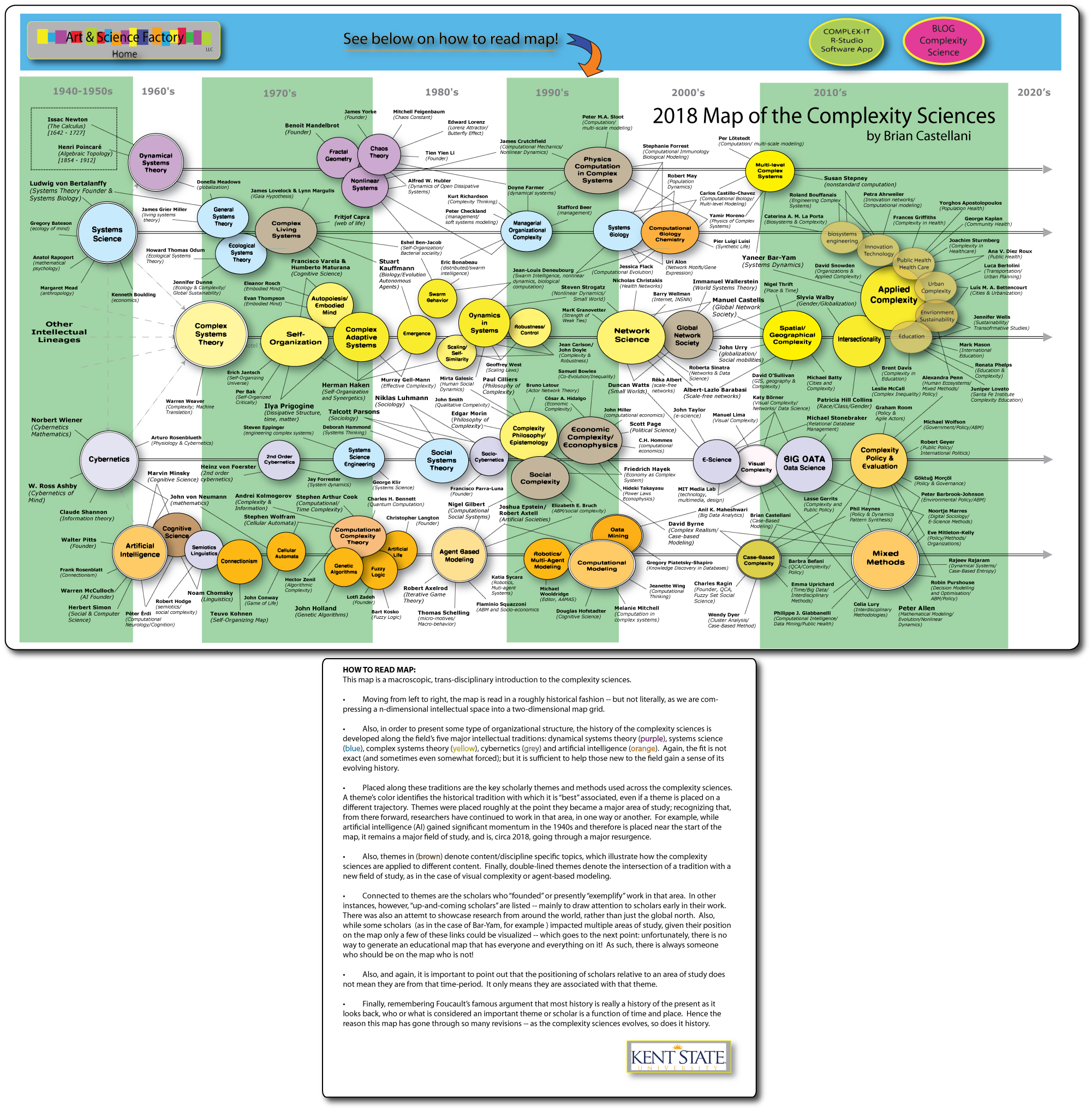
complexity-map_jan2018


Phil 12.26.17

8:00 – 4:00 ASRC MKT

  • Gotta get a new keyboard
  • Working on the additional thoughts section. Add paragraph describing how the evolutionary benefits of groups are visible at nearly every level of interaction. However, with these benefits comes the additional burden of control. Evolution has provided mechanisms that are calibrated to match communication to the optimal(?) group behavior. This timeframe has been short-circuited by technology. Coordination based on the trust of a neighbor no longer works when the neighbor isn’t near.
    • Patchwork alignment?
    • Information and its use by animals in evolutionary ecology
      • Information is a crucial currency for animals from both a behavioural and evolutionary perspective. Adaptive behaviour relies upon accurate estimation of relevant ecological parameters; the better informed an individual, the better it can develop and adjust its behaviour to meet the demands of a variable world. Here, we focus on the burgeoning interest in the impact of ecological uncertainty on adaptation, and the means by which it can be reduced by gathering information, from both ‘passive’ and ‘responsive’ sources. Our overview demonstrates the value of adopting an explicitly informational approach, and highlights the components that one needs to develop useful approaches to studying information use by animals. We propose a quantitative framework, based on statistical decision theory, for analysing animal information use in evolutionary ecology. Our purpose is to promote an integrative approach to studying information use by animals, which is itself integral to adaptive animal behaviour and organismal biology.
    • Evolutionary Explanations for Cooperation
      • Natural selection favours genes that increase an organism’s ability to survive and reproduce. This would appear to lead to a world dominated by selfish behaviour. However, cooperation can be found at all levels of biological organisation: genes cooperate in genomes, organelles cooperate to form eukaryotic cells, cells cooperate to make multicellular organisms, bacterial parasites cooperate to overcome host defences, animals breed cooperatively, and humans and insects cooperate to build societies. Over the last 40 years, biologists have developed a theoretical framework that can explain cooperation at all these levels. Here, we summarise this theory, illustrate how it may be applied to real organisms and discuss future directions.
    • Thomas Valone (Scholar)
      • Much of Valone’s work in arid ecosystems has examined desertification and factors that affect the biodiversity. He is particularly interested in livestock effects on soil chemical and physical processes that then affect plant and animal populations. Valone’s examination of behavior is frequently centered on understanding how animals perceive their environment. Much of his behavioral work examines information use in social animals who differ from solitary individuals in that they can acquire public information to estimate the quality of resources by noting the activities of other individuals.
      • Group foraging, public information, and patch estimation
        • Public information is information about the quality of a patch that can be obtained by observing the foraging success of other individuals in that patch. I examine the influence of the use of public information on patch departure and foraging efficiency of group members. When groups depart a patch with the first individual to leave, the use of public information can prevent the underutilization of resource patches.
      • Public Information: From Nosy Neighbors to Cultural Evolution
        • Psychologists, economists, and advertising moguls have long known that human decision-making is strongly influenced by the behavior of others. A rapidly accumulating body of evidence suggests that the same is true in animals. Individuals can use information arising from cues inadvertently produced by the behavior of other individuals with similar requirements. Many of these cues provide public information about the quality of alternatives. The use of public information is taxonomically widespread and can enhance fitness. Public information can lead to cultural evolution, which we suggest may then affect biological evolution.
  • Get started on Polarization Game proposal. Include Moral Machine. Read the papers into LMN and started to poke at the structure.
  • Speaking of which, here’s a labeled map: LabeledMap
  • Which clearly provides more relational (map-ish) information than a word cloud using the same data: wordcloud

Phil 12.20.17

7:00 – 5:00 ASRC MKT

  • Today’s Sunrise 7:23 AM and sunset 4:47 PM. Not a fan of winter.
  • Promoted the venues and journals post to its own page here.
  • Added The Emergence of Consensus: A Primer to the lit review. Nothing new in there, but it’s a fast overview with good references
  • Working on flocking and herding paper. Reasonable progress. Adding the herding parts and the self-driving car stampede. Finished first pass through methods, next is results.
  • Need to rerun the sim so that the heading and distance charts line up. Done!
  • Well, that’s pretty research-browser-ish: Inventing the “Google” for predictive analytics The company is Endor.com, and these pages are pretty informative (social physics) (jobs)
  • The Birth of A Conspiracy Theory.
    • Right after yesterday’s train derailment, a conspiracy theory was born, we tracked it in real time.

Phil 12.19.17

7:00 – 5:00 ASRC MKT

  • Trust, Identity Politics and the Media
    • Essential to a free and functioning democracy is an independent press, a crucial civil society actor that holds government to account and provides citizens access to the impartial information they need to make informed judgments, reason together, exercise their rights and responsibilities, and engage in collective action. In times of crisis, the media fulfills the vital role of alerting the public to danger and connecting citizens to rescue efforts, as Ushahidi has done in Kenya. Or, it can alert the international community to human rights abuses as does Raqqa is Being Slaughtered Silently. But, the very capabilities that allow the media to alert and inform, also allow it to sow division – as it did in Rwanda leading up to and during the genocide– by spreading untruths, and, through “dog whistles,” targeting ethnic groups and inciting violence against them. This panel will focus on two topics: the role of media as a vehicle for advancing or undermining social cohesion, and the use of media to innovate, organize and deepen understanding, enabling positive collective action.
      • Abdalaziz Alhamza, Co-Founder, Raqqa is Being Slaughtered Silently
      • Uzodinma Iweala, CEO and Editor-in-Chief, Ventures Africa; Author, Beasts of No Nation; Producer, Waiting for Hassana (moderator)
      • Ben Rattray, Founder and CEO, Change.org
      • Malika Saada Saar, Senior Counsel on Civil and Human Rights, Google
  • Continuing Consensus and Cooperation in Networked Multi-Agent Systems here Done! Promoted to phlog.
  • An Agent-Based Model of Indirect Minority Influence on Social Change and Diversity
    • The present paper describes an agent-based model of indirect minority influence. It examines whether indirect minority influence can lead to social change as a function of cognitive rebalancing, a process whereby related attitudes are affected when one attitude is changed. An attitude updating algorithm was modelled with minimal assumptions drawing on social psychology theories of indirect minority influence. Results revealed that facing direct majority influence, indirect minority influence along with cognitive rebalancing is a recipe for social change. Furthermore, indirect minority influence promotes and maintains attitudinal diversity in local ingroups and throughout the society. We discuss the findings in terms of social influence theories and suggest promising avenues for model extensions for theory building in minority influence and social change.
  • Ok, time to switch gears and start on the flocking paper. And speaking of which, is this a venue?
    • Winter Simulation Conference 2017 – INFORMS Meetings Browser times out right now, so is it still valid?
    • Created a new LaTex project, since this is a modification of the CHIIR paper and started to slot pieces in. It is *hard* switching gears. Leaving it in the sigchi format for now.
    • I went to change out the echo chamber distance from average with heading from average (which looks way better), but everything was zero in the spreadsheet. After poking around a bit, I was “fixing” the angle cosine to lie on (-1, 1), by forcing it to be 1.0 all the time. Fixed. EchoChamberAngle
  • Sprint planning. I’m on the hook for writing up the mapping white paper and strawman design

Phil 12.18.17

7:15 – 4:15 ASRC MKT

  • I’m having old iPhone problems. Trying a wipe and restart.
  • Exploring the ChestXray14 dataset: problems
    • Interesting article on using tagged datasets. What if the tags are wrong? Something to add to the RB is a random re-introduction of a previously tagged item to see if tagging remains consistent.
  • Continuing Consensus and Cooperation in Networked Multi-Agent Systems here
  • Visualizing the Temporal Evolution of Dynamic Networks (ACM MLG 2011)
    • Many developments have recently been made in mining dynamic networks; however, effective visualization of dynamic networks remains a significant challenge. Dynamic networks are typically visualized via a sequence of static graph layouts. In addition to providing a visual representation of the network topology at each time step, the sequence should preserve the “mental map” between layouts of consecutive time steps to allow a human to interpret the temporal evolution of the network and gain valuable insights that are difficult to convey by summary statistics alone. We propose two regularized layout algorithms for visualizing dynamic networks, namely dynamic multidimensional scaling (DMDS) and dynamic graph Laplacian layout (DGLL). These algorithms discourage node positions from moving drastically between time steps and encourage nodes to be positioned near other members of their group. We apply the proposed algorithms on several data sets to illustrate the benefit of the regularizers for producing interpretable visualizations.
    • These look really straightforward to implement. May be handy in the new flocking paper
  • Opinion and community formation in coevolving networks (Phys Review E)
    • In human societies, opinion formation is mediated by social interactions, consequently taking place on a network of relationships and at the same time influencing the structure of the network and its evolution. To investigate this coevolution of opinions and social interaction structure, we develop a dynamic agent-based network model by taking into account short range interactions like discussions between individuals, long range interactions like a sense for overall mood modulated by the attitudes of individuals, and external field corresponding to outside influence. Moreover, individual biases can be naturally taken into account. In addition, the model includes the opinion-dependent link-rewiring scheme to describe network topology coevolution with a slower time scale than that of the opinion formation. With this model, comprehensive numerical simulations and mean field calculations have been carried out and they show the importance of the separation between fast and slow time scales resulting in the network to organize as well-connected small communities of agents with the same opinion.
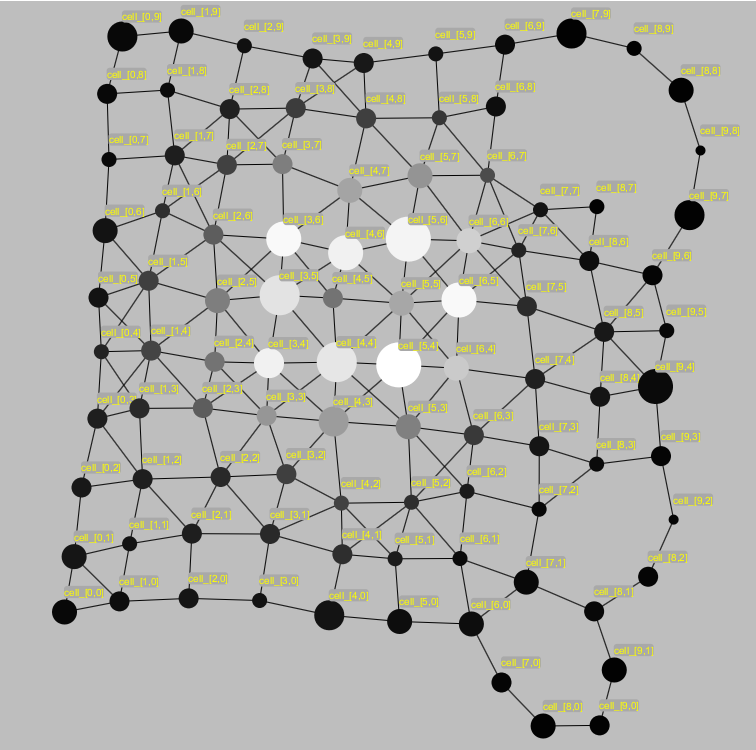
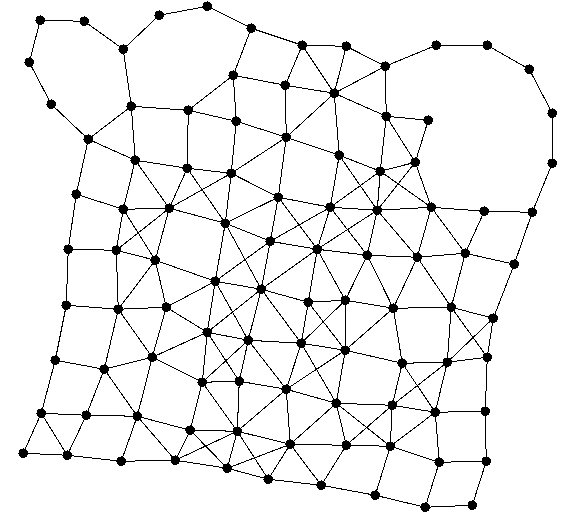
  • I can build maps from trajectories of agents through a labeled belief space: mapFromTrajectories
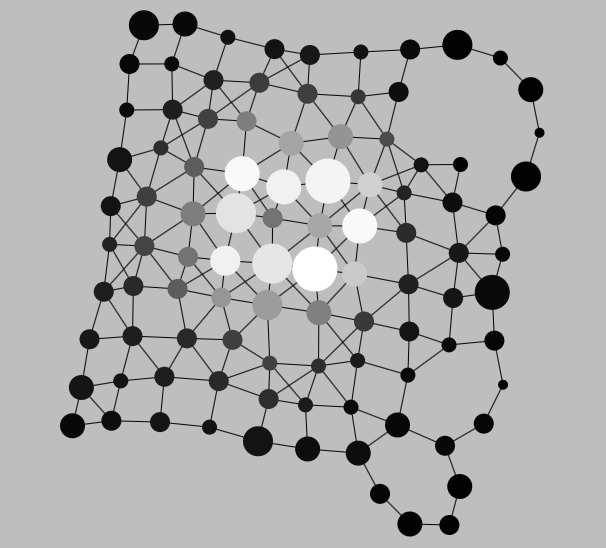
    • This would be analogous to building a map based on terms or topics used by people during multiple group polarization discussion. Densely connected central area where all the discussions begin, sparse ‘outer region’ where the poles live. In this case, you can clearly see the underlying grid that was used to generate the ‘terms’
  • Progress for today. Size is the average time spent ‘over’ a topic/term. Brightness is the number of distinct visitors: mapFromTrajectories2

Phil 12/15/17

9:00 – 1:30 ASRC MKT

  • Looong day yesterday
  • Sprint review
  • This looks like an interesting alternative to blockchain for document security: A Cryptocurrency Without a Blockchain Has Been Built to Outperform Bitcoin
    • The controversial currency IOTA rests on a mathematical “tangle” that its creators say will make it much faster and more efficient to run.
  • Also this: Can AI Win the War Against Fake News?
    • Developers are working on tools that can help spot suspect stories and call them out, but it may be the beginning of an automated arms race. 
    • Mentions adverifai.com
      • FakeRank is like PageRank for Fake News detection, only that instead of links between web pages, the network consists of facts and supporting evidence. It leverages knowledge from the Web with Deep Learning and Natural Language Processing techniques to understand the meaning of a news story and verify that it is supported by facts.

Phil 12.14.17

7:00 – 11:00 ASRC MKT