Category Archives: Lit Review

Phil 11.23.17

Nice – I can get my notes of the Kindle by plugging it into my computer. I never found that on the help pages.

More than a Million Pro-Repeal Net Neutrality Comments were Likely Faked

  • I used natural language processing techniques to analyze net neutrality comments submitted to the FCC from April-October 2017, and the results were disturbing.
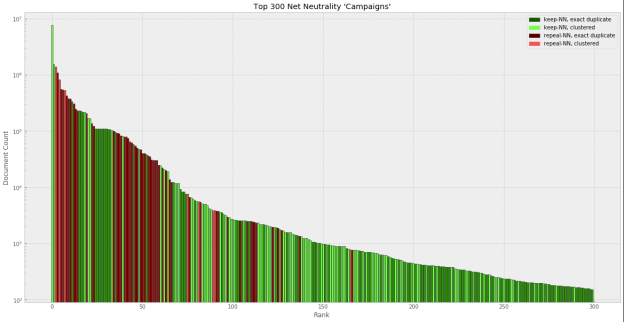
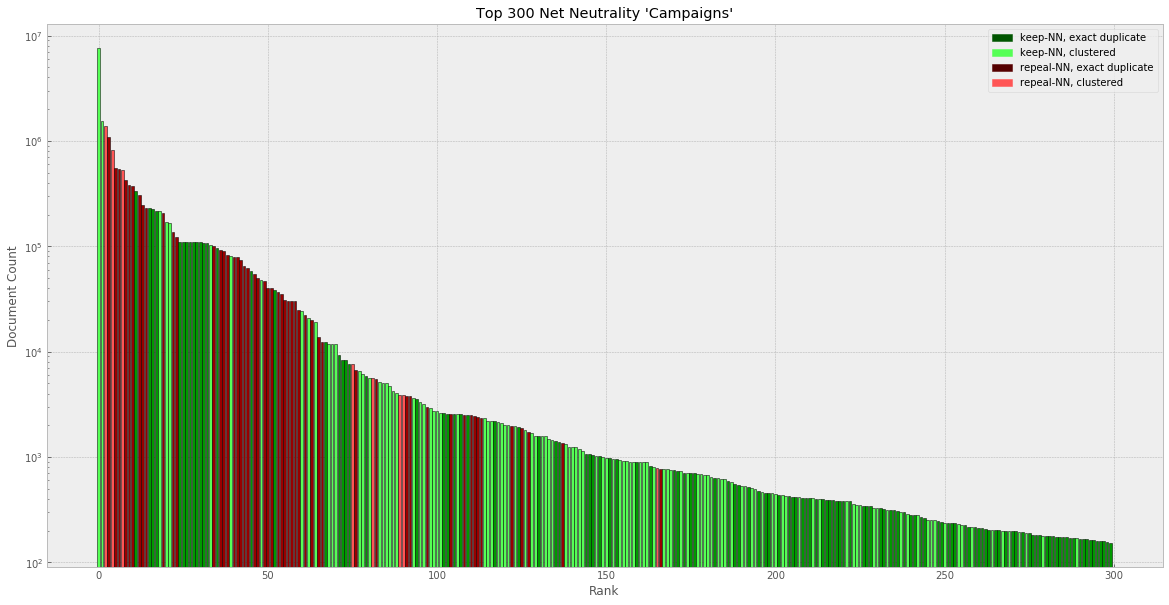
  • BotPlusOrganicI think that this kind of long-tail distribution is going to be what herding looks like.
Speaker–listener neural coupling underlies successful communication

    • Greg J. Stephens
    • Lauren J. Silbert
    • Uri Hasson (HassonLab at Princeton)
    • Verbal communication is a joint activity; however, speech production and comprehension have primarily been analyzed as independent processes within the boundaries of individual brains. Here, we applied fMRI to record brain activity from both speakers and listeners during natural verbal communication. We used the speaker’s spatiotemporal brain activity to model listeners’ brain activity and found that the speaker’s activity is spatially and temporally coupled with the listener’s activity. This coupling vanishes when participants fail to communicate. Moreover, though on average the listener’s brain activity mirrors the speaker’s activity with a delay, we also find areas that exhibit predictive anticipatory responses. We connected the extent of neural coupling to a quantitative measure of story comprehension and find that the greater the anticipatory speaker–listener coupling, the greater the understanding. We argue that the observed alignment of production- and comprehension-based processes serves as a mechanism by which brains convey information.
      • This seems to be the root article for neural coupling. It seems to be an area of vigorous study, with lots of work coming out from the three authors.
      • The study design is also really good.
    • In this study we directly examine the spatial and temporal coupling between production and comprehension across brains during natural verbal communication. (pp 14425)
    • Using fMRI, we recorded the brain activity of a speaker telling an unrehearsed real-life story and the brain activity … (n = 11) of a listener listening to the recorded audio of the spoken story, thereby capturing the time-locked neural dynamics from both sides of the communication. Finally, we used a detailed questionnaire to assess the level of comprehension of each listener. (pp 14425)
    • …because communication unfolds over time, this coupling will exhibit important temporal structure. In particular, because the speaker’s production-based processes mostly precede the listener’s comprehension-based processes, the listener’s neural dynamics will mirror the speaker’s neural dynamics with some delay. Conversely, when listeners use their production system to emulate and predict the speaker’s utterances, we expect the opposite: the listener’s dynamics will precede the speaker’s dynamics. (pp 14425)
    • To analyze the direct interaction of production and comprehension mechanisms, we considered only spatially local models that measure the degree of speaker–listener coupling within the same Talairach location. (pp 14426)
    • we also observed significant speaker–listener coupling in a collection of extralinguistic areas known to be involved in the processing of semantic and social aspects of the story (19), including the precuneus, dorsolateral prefrontal cortex, orbitofrontal cortex, striatum, and medial prefrontal cortex. (pp 14426)
    • In agreement with previous work, the story evoked highly reliable activity inmany brain areas across all listeners (8, 11, 12) (Fig. 2B, yellow). We note that the agreement with previous work is far from assured: the story here was both personal and spontaneous, and was recorded in the noisy environment of the scanner. The similarity in the response patterns across all listeners underscores a strong tendency to process incoming verbal information in similar ways. A comparison between the speaker–listener and the listener–listenermaps reveals an extensive overlap (Fig. 2B, orange). These areas include many of the sensory related, classic linguistic-related and extralinguistic-related brain areas, demonstrating that many of the areas involved in speech comprehension (listener–listener coupling) are also aligned during communication (speaker–listener coupling). (pp 14426)
    • To test whether the extensive speaker–listener coupling emerges only when information is transferred across interlocutors, we blocked the communication between speaker and listener. We repeated the experiment while recording a Russian speaker telling a story in the scanner, and then played the story to non–Russian speaking listeners (n = 11). In this experimental setup, although the Russian speaker is trying to communicate information, the listeners are unable to extract the information from the incoming acoustic sounds. Using identical analysis methods and statistical thresholds, we found no significant coupling between the speaker and the listeners or among the listeners. At significantly lower thresholds we found that the non–Russian-speaking listener–listener coupling was confined to early auditory cortices. This indicates that the reliable activity in most areas, besides early auditory cortex, depends on a successful processing of the incoming information, and is not driven by the low-level acoustic aspects of the stimuli. (pp 14426)
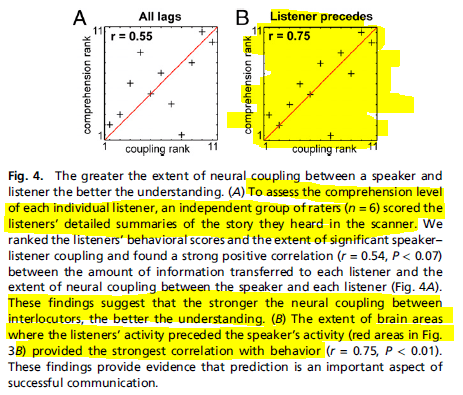
    • Neural Coupling
      • In my model, the anticipation is modeled by the alignment and velocity, but others come to similar conclusions. It may be a way of dealing with noisy environments. Which would be another way of saying group dynamics with incomplete information.
    • Our analysis also identifies a subset of brain regions in which the activity in the listener’s brain precedes the activity in the speaker’s brain. The listener’s anticipatory responses were localized to areas known to be involved in predictions and value representation (pp 14428)
    • Such findings are in agreement with the theory of interactive linguistic alignment (1). According to this theory, production and comprehension become tightly aligned on many different levels during verbal communication, including the phonetic, phonological, lexical, syntactic, and semantic representations. Accordingly, we observed neural coupling during communication at many different processing levels, including low-level auditory areas (induced by the shared input), production-based areas (e.g., Broca’s area), comprehension based areas (e.g., Wernicke’s area and TPJ), and high-order extralinguistic areas (e.g., precuneus and mPFC) that can induce shared contextual model of the situation (34). Interestingly, some of these extralinguistic areas are known to be involved in processing social information crucial for successful communication, including, among others, the capacity to discern the beliefs, desires, and goals of others. (pp 14429)


Brain-to-Brain coupling: A mechanism for creating and sharing a social world

  • Cognition materializes in an interpersonal space. The emergence of complex behaviors requires the coordination of actions among individuals according to a shared set of rules. Despite the central role of other individuals in shaping our minds, most cognitive studies focus on processes that occur within a single individual. We call for a shift from a single-brain to a multi-brain frame of reference. We argue that in many cases the neural processes in one brain are coupled to the neural processes in another brain via the transmission of a signal through the environment. Brain-to-brain coupling constrains and simplifies the actions of each individual in a social network, leading to complex joint behaviors that could not have emerged in isolation

Phil 11.17.17

7:00 – ASRC MKT

  • Reuters Tracer: Toward Automated News Production Using Large Scale Social Media Data
    • To deal with the sheer volume of information and gain competitive advantage, the news industry has started to explore and invest in news automation. In this paper, we present Reuters Tracer, a system that automates end-to-end news production using Twitter data. It is capable of detecting, classifying, annotating, and disseminating news in real time for Reuters journalists without manual intervention. In contrast to other similar systems, Tracer is topic and domain agnostic. It has a bottom-up approach to news detection, and does not rely on a predefined set of sources or subjects. Instead, it identifies emerging conversations from 12+ million tweets per day and selects those that are news-like. Then, it contextualizes each story by adding a summary and a topic to it, estimating its newsworthiness, veracity, novelty, and scope, and geotags it. Designing algorithms to generate news that meets the standards of Reuters journalists in accuracy and timeliness is quite challenging. But Tracer is able to achieve competitive precision, recall, timeliness, and veracity on news detection and delivery. In this paper, we reveal our key algorithm designs and evaluations that helped us achieve this goal, and lessons learned along the way.
  • Maybe the adjacency matrix that we think we can produce from the trajectories can be used as the basis for a self-organizing map?
  • Gobo: TL;DR: This is a MIT research project to study how people filter their social media feeds. We are tracking your use of the site, but will only publish it anonymously and in aggregate. We might follow up with you to hear more about what you think about Gobo. The MIT Institutional Review Board has approved of this study. Gobo
  • This, plus , makes me think that MIT may be starting to focus on these issues.
  • Back to The Group Polarization Phenomenon
    •  David G. Myers
    • Pictures may be important as part of an argument. Need to be able to support that.
    • This polarization concept should also be distinguished from a related concept, extremization. Whereas polarization refers to shifts toward the already preferred pole, extremization has been used to refer to movement away from neutrality, regardless of direction. Since all instances of group polarization are instances of extremization, but not vice versa, extremization may be easier to demonstrate than polarization. (pp 603)
    • For convenience we have organized these studies into seven categories: attitudes, jury decisions, ethical decisions, judgments, person perceptions, negotiation behavior, and risk measures other than the choice dilemmas. This categorization is admittedly somewhat arbitrary. (pp 604)
    • In other studies, however, it is possible to infer the direction of initial preferences. Robinson (1941) conducted lengthy discussions of two attitudes. On attitude toward war, where students were initially quite pacifistic, there was a nonsignificant shift to even more pacifism following discussion. On attitude toward capital punishment, to which students were initially opposed, there was a significant shift to even stronger opposition. (pp 604)
    • Varying the stimulus materials. Myers and Kaplan (1976) engaged their subjects in discussion of stimulus materials which elicited a dominant predisposition of guilty or not guilty. After discussing traffic cases in which the defendants were made to appear as low in guilt, the Subjects Were even more definite in their judgments of innocence and more lenient in recommended punishment. After discussing “high-guilt” cases, the subjects polarized toward harsher judgments of guilt and punishment. (pp 605)
    • Group composition studies. Vidmar composed groups of jurors high or low in dogmatism. The high-dogmatism juries shifted toward harsher sentences following discussion, and the low-dogmatism groups shifted toward more lenient sentences, despite the fact that the high- and low-dogmatism juries did not differ in their predeliberation judgments. (pp 606)
    • Main and Walker (1973) observed that these constitutionality decisions were also more libertarian in the group condition (65% versus 45%). Although a minority of the single-judge decisions were prolibertarian, Walker and Main surmised that the preexisting private values of the judges were actually prolibertarian and that their decisions made alone were compromised in the face of antilibertarian public pressure. Their private values were then supposedly released and reinforced in the professional group context (pp 606)
    • From what we have been able to perceive thus far, the process is an interesting combination of rational persuasion, sheer social pressure, and the psychological mechanism by which individual perceptions undergo change when exposed to group discussion (pp 606)
    • Myers (1975) also used a faculty evaluation task. The subjects responded to 200 word descriptions of “good” or “bad” faculty with a scale judgment and by distributing a pay increase budget among the hypothetical faculty. As predicted by the group polarization hypothesis, good faculty were rated and paid even more favorably after the group interaction, and contrariwise for the bad faculty. (pp 608)
    • in general, the work on person perception supports the group polarization hypothesis, especially when the stimulus materials are more complex than just a single adjective. (pp 608)
    • Myers and Bach (1976) compared the conflict behavior of individuals and groups, using an expanded prisoner’s dilemma matrix cast in the language of a gas war. There was no difference in their conflict behavior (both individuals and groups were highly noncooperative). But on postexperimental scales assessing the subjects’ evaluations of themselves and their opponents, individuals tended to justify their own behavior, and groups were even more inclined toward self-justification. This demonstration of group polarization supports Janis’s (1972) contention that in situations of intergroup conflict, group members are likely to develop a strengthened belief in the inherent morality of their actions.  (pp 608)
    • Skewness cannot account for group polarization. This is particularly relevant to the majority rule scheme, which depends on a skewed distribution of initial choices. On choice dilemmas, positively skewed distributions (i.e., with a risky majority) should produce risky shift, and negatively skewed distributions should yield a conservative shift. Several findings refute this prediction. (pp 612)
    • Shifts in the group median, although slightly attenuated, are not significantly smaller than shifts in the group mean (pp 612)
    • Group shift has also been shown to occur in dyads (although somewhat reduced), where obviously there can be no skewness in the initial responses (pp 612)
    • while group decision models may be useful in other situations in which discussion is minimal or absent and the task is to reach agreement (e.g., Lambert, 1969), the models (or at least the majority rule model stressed in this analysis) are not a sufficient explanation of the group polarization findings we are seeking to explain. There are still a variety of other decision schemes that can be explored and with other specific tasks. But clearly, group induced shift on choice dilemmas is something more than a statistical artifact. (pp 612)
    • Interpersonal Comparisons theory suggests that a subject changes when he discovers that others share his inclinations more than he would have supposed, either because the group norm is discovered to be more in the preferred direction than previously imagined or because the subject is released to more strongly act out his preference after observing someone else who models it more extremely than himself. This theory, taken by itself, suggests that relevant new information which emerges during the discussion is of no consequence. Group polarization is a source effect, not a message effect. (pp 614)
      • This is very close to the flocking theory where one agent looks at the alignment and velocity of nearby agents.
    • Differences between self, presumed other, and ideal scores. One well-known and widely substantiated assumption of the interpersonal comparisons approach is the observation from choice-dilemmas research that if, after responding, the subjects go back over the items and guess how their average peer would respond and then go back over the items a third time and indicate what response they would actually admire most, they tend to estimate the group norm as more neutral than their own initial response and their ideal as more extreme (pp 613)
    • Lamm et al. (1972) have also shown that not only do subjects indicate their ideal as more extreme than their actual response, but they also suspect that the same is true of their peers. The tendency of people to perceive themselves as more in what they consider to be the socially desirable direction than their average peer extends beyond the choice dilemmas (see Codol, Note 13). For example, most businessmen believe themselves to be more ethical than the average businessman (Baumhart, 1968), and there is evidence that people perceive their own views as less prejudiced than the norm of their community (Lenihan, Note 14). (pp 613)
    • The tendency to perceive others as “behind” oneself exists only when the self response is made prior to estimating the group norm (McCauley, Kogan, & Teger, 1971; Myers, 1974). Evidently it is after one has decided for himself that there is then a tendency to consider one’s action as relatively admirable (by perceiving the average person as less admirable than oneself). (pp 613)
    • it has been reliably demonstrated that subjects perceive other persons who have responded more extremely than themselves (in the direction of their ideal) as more socially desirable than persons who have not (Baron, Monson, & Baron, 1973; Jellison & Davis, 1973; Jellison & Riskind, 1970, 1971; Madaras & Bern, 1968). A parallel finding exists in the attitude literature (Eisinger & Mills, 1968): An extreme communicator on one’s side of an issue tends to be perceived as more sincere and competent than a moderate. (pp 614)
    • Burnstein, Vinokur, and Pichevin (1974) took an informational influence viewpoint and showed that people who adopt extreme choices are presumed to possess cogent arguments and are then presumably admired for their ability. They also demonstrated that subjects have much less confidence in others’ choices than in their own, suggesting that the tendency to perceive others as more neutral than oneself simply reflects ignorance about others’ choices (pp 614)
    • self-ideal difference scores are less affected by order of measurement than self versus perceived other differences (Myers, 1974)—suggest that the self-ideal discrepancy may be the more crucial element of a viable interpersonal comparisons approach. (pp 614)
    • One set of studies has manipulated the information about others’ responses by providing fake norms. More than a dozen separate studies all show that subjects will move toward the manipulated norm (see Myers, 1973) (pp 615)
      • Can’t find this paper, but herding!
    • Consistent with this idea, they observed that exposure to others’ choices produced shift only when subjects then wrote arguments on the item. If knowledge of others’ choices was denied or if an opportunity to rethink the item was denied, no shift occurred. (pp 615)
    • On the other hand, it may be reasoned that in each of the studies producing minimal or nonexistent shift after exposure to others’ attitudes, the subjects were first induced to bind themselves publicly to a pretest choice and then simply exposed to others’ choices. It takes only a quick recall of some classic conformity studies (e.g., Asch, 1956) to realize that this was an excellent procedure for inhibiting response change. (pp 615)
    • Bishop and Myers (1974) have formulated mathematical models of the presumed informational influence mechanisms. These models assume that the amount of group shift will be determined by three factors: the direction of each argument (which alternative it favors), the persuasiveness of each argument, and the originality of each argument (the extent to which it is not already known by the group members before discussion). In discussion, the potency of an argument will be zero if either the rated persuasiveness is zero (it is trivial or irrelevant) or if all group members considered the argument before discussion (pp 616)
    • the simple direction of arguments is such an excellent predictor of shift (without considering persuasiveness and originality), it is not easy to demonstrate the superiority of the models over a simple analysis of argument direction as undertaken by Ebbesen and Bowers (1974). (pp 617)
      • This supports the notion that alignment and heading, as used in the model may really be sufficient to model polarizing behavior
    • A group that is fairly polarized on a particular item before discussion is presumably already in general possession of those arguments which polarize a group. A less extreme group has more to gain from the expression of partially shared persuasive arguments. (pp 617)
    • Passive receipt of arguments outside an interactive discussion context generally produces reduced shift (e.g., Bishop & Myers, 1974; Burnstein & Vinokur, 1973; St. Jean, 1970; St. Jean & Percival, 1974). Likewise, listening to a group discussion generally elicits less shift than actual participation (pp 617)
      • There may be implications here with respect to what’s being seen and read on the news having a lower influence than items that are being discussed on social media. A good questions is at what point does the reception of information feel ‘interactive’? Is clicking ‘like enough? My guess is that it is.
    • Verbal commitment could produce the increased sense of involvement and certainty that Moscovici and Zavolloni (1969) believe to be inherent in group polarization. (pp 618)
      • This reinforces the point above, but we need to know what the minimum threshold of what can be considered ‘verbal commitment’.
    • By offering arguments that tend toward the outer limits of his range of acceptability, the individual tests his ideals and also presents himself favorably to the group since, as we noted earlier, extremity in the direction of the ideal connotes knowledgeability and competence. (pp 618)
    • Diagram (pp 619) PolarazationDiagram
    • Arguments spoken in discussion more decisively favor the dominant alternative than do written arguments. The tendency for discussion arguments to be one-sided is probably not equal for all phases of a given discussion. Studies in speech-communications (see Fisher, 1974) suggest that one-sided discussion is especially likely after a choice direction has implicitly emerged and group members mutually reinforce their shared inclination. (pp 619)
      • This review is pre IRC, and views writing as non-interactive. THis may not be true any more.
    • The strength of the various vectors is expected to vary across situations. In more fact-oriented judgment tasks (group problem solving tasks being the extreme case), the cognitive determinants will likely be paramount, although people will still be motivated to demonstrate their abilities. On matters of social preference, in which the social desirability of actions is more evident, the direct and indirect attitudinal effects of social motivation are likely to appear. The direct impact will occur in situations in which the individual has ideals that may be compromised by presumed norms but in which exposure to others’ positions informs him that his ideals are shared more strongly or widely than he would have supposed. These situations—in which expressed ideals are a step ahead of prior responses—will also tend to elicit discussion content that is biased toward the ideals. (pp 620)
    • What is the extent of small group influence on attitudes? McGuire (1969) noted, “It is clear that any impact that the mass media have on opinion is less than that produced by informal face-to-face communication of the person with his primary groups, his family, friends, co-workers, and neighbors (p. 231,).” (pp 220)
  • Back to Angular
    • Got all of the CRUD functions working and updates the subversion repo
    • Got search running. Finished tutorial!

Phil 11.16.2017

7:00 – ASRC MKT

  • Data & Society to Launch Disinformation Action Lab Supported by Knight Foundation
    • The lab will use research to explore issues such as: how fake news narratives propagate; how to detect coordinated social media campaigns; and how to limit adversaries who are deliberately spreading misinformation. To understand where online manipulation is headed, it will analyze the technology and tactics being used by players at the international and domestic level.This project builds off the ongoing work of the Media Manipulation initiative at Data & Society, which examines how groups use social media and the participatory culture of the internet to spread and amplify misinformation and disinformation. Recent releases from this initiative include Lexicon of Lies and Media Manipulation and Disinformation Online.The funding is part of today’s announcement that the John S. and James L. Knight Foundation is giving $4.5 million in new funding to eight leading organizations working to create more informed and engaged communities through innovative use of technology. The other organizations receiving support include: Code2040, Code for Science & Society, Columbia Journalism School, DocumentCloud, Emblematic Group, HistoryPin and mRelief.
  • Before I restart on The Group Polarization Phenomenon, I’m going to take a look at how much work it would be to add the recording of trajectories through cells by agent.
  • And updates
  • Done! The name incorporates the n-dimensional cell position. In this case it’s 2D
    GreenFlockSh_10: GreenFlock[6, 3], RedFlock[6, 4], GreenFlock[7, 4], GreenFlock[7, 4], GreenFlock[7, 4], RedFlock[8, 4], GreenFlock[8, 5], GreenFlock[8, 5], GreenFlock[8, 5], RedFlock[8, 6], RedFlock[8, 6], RedFlock[8, 6], RedFlock[8, 6], GreenFlock[8, 7], GreenFlock[8, 7], RedFlock[7, 7], RedFlock[7, 7], GreenFlock[7, 8], GreenFlock[7, 8], RedFlock[6, 8], RedFlock[6, 8], RedFlock[6, 8], GreenFlock[5, 8], GreenFlock[5, 8], GreenFlock[5, 8], RedFlock[4, 8], RedFlock[4, 8], RedFlock[4, 8], RedFlock[4, 8], RedFlock[3, 7], RedFlock[3, 7], RedFlock[3, 7], RedFlock[3, 7], GreenFlock[3, 6], GreenFlock[3, 6], GreenFlock[3, 6], RedFlock[3, 5], RedFlock[3, 5], GreenFlock[2, 5], GreenFlock[2, 5], RedFlock[2, 4], RedFlock[2, 4], RedFlock[2, 4], GreenFlock[2, 3], GreenFlock[2, 3], GreenFlock[2, 3], GreenFlock[3, 2], GreenFlock[3, 2], GreenFlock[3, 2], GreenFlock[3, 2], GreenFlock[3, 2], RedFlock[4, 2], GreenFlock[4, 1], GreenFlock[4, 1], RedFlock[5, 1], GreenFlock[5, 2], GreenFlock[5, 2], RedFlock[6, 2], RedFlock[6, 2], RedFlock[6, 2], GreenFlock[6, 3], GreenFlock[6, 3], GreenFlock[6, 3], RedFlock[7, 3], GreenFlock[7, 4], GreenFlock[7, 4], GreenFlock[7, 4], RedFlock[7, 5], RedFlock[7, 5], RedFlock[7, 5], GreenFlock[8, 5], RedFlock[8, 6], RedFlock[8, 6], RedFlock[8, 6], GreenFlock[8, 7], GreenFlock[8, 7], GreenFlock[8, 7], GreenFlock[8, 7], GreenFlock[9, 8], GreenFlock[9, 8], GreenFlock[9, 8], RedFlock[9, 9], RedFlock[9, 9], RedFlock[9, 9], RedFlock[9, 9], RedFlock[9, 9], RedFlock[9, 9], RedFlock[9, 9], GreenFlock[9, 8], GreenFlock[9, 8], GreenFlock[9, 8], GreenFlock[9, 8], GreenFlock[8, 7], GreenFlock[8, 7], GreenFlock[8, 7], GreenFlock[8, 7], RedFlock[7, 7], RedFlock[7, 7], RedFlock[7, 7]
    
  • Some additional thoughts about building maps from trajectories
    • Incorporating trajectories allows determination of otherwise difficult problems. An example of this is pictures of war crimes. If the trajectory originates in a legal belief space, then it’s evidence to be saved. If it comes from an extremist belief space, it’s propaganda to be deleted.
    • The simplest way to do this is to look at all the trajectories where a landmark is shared. Every item that is adjacent to that landmark on a trajectory must be adjacent in the environment. If we build a graph with the lowest crossing number, we should have our best reconstruction.
    • Time can be an important dimension, and may provide useful information where just sequence may not
    • It is possible, even likely, that the map is not fixed, so the environment should also be allowed to morph over time to support optimal relations. Think of it as agents surfing on a wave. There is an outer frame (the shore) that waves and surfers can’t exist. Within that frame, waves move and follow different rules from surfers. Surfers in turn are influenced by the waves, and in our case, waves may be influenced by the surfers as well as the external environment.
    • Trajectories point both ways. In addition to being able to infer a destination for an agent, it may be possible to infer an origin.
    • Discussing this with Aaron, we realized that it might be possible to build a map by constructing a network from the adjacency of paths. In other words, if one path goes from C1->C2->C3 and another goes from B2->C2->D2, then we know that C2 is adjacent to all those points. That information can be used to build a graph. If the graph can be arranged so that it has a low crossing number, then it should approximate the original map. The (relative) size of the areas could be related to the crossing times averaged out for all agents.
  • And I just found this in Reinforcement Learning : An Introduction (1st edition linked here): ReinforcementLearningPP2
  • Back to Angular
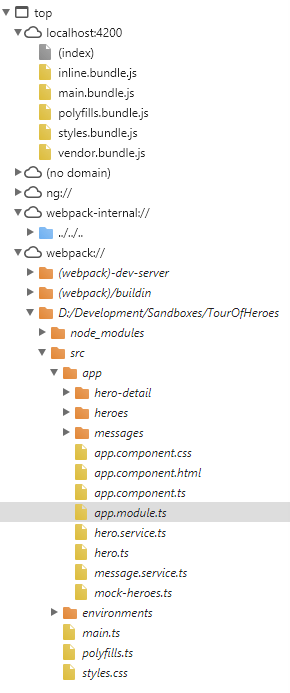
    • Found where the typescript files live on the browser/webpack: FoundTheFiles
    • Got routes working, with minimal confusion. The framework generates a lot of code though…
    • To get npm install angularinmemorywebapi save to install something visible for the IDE, I had to add the -g option. Still got weird errors though: 
      D:\Development\Sandboxes\TourOfHeroes>npm install angular-in-memory-web-api --save -g
      npm WARN angular-in-memory-web-api@0.5.1 requires a peer of @angular/common@>=2.0.0 <6.0.0 but none is installed. You must install peer dependencies yourself. npm WARN angular-in-memory-web-api@0.5.1 requires a peer of @angular/core@>=2.0.0 <6.0.0 but none is installed. You must install peer dependencies yourself. npm WARN angular-in-memory-web-api@0.5.1 requires a peer of @angular/http@>=2.0.0 <6.0.0 but none is installed. You must install peer dependencies yourself.
      npm WARN angular-in-memory-web-api@0.5.1 requires a peer of rxjs@^5.1.0 but none is installed. You must install peer dependencies yourself.
      
    • Here’s how you generate a service
      ng generate service in-memory-data --flat --module=app


Phil 11.15.17

7:00 – 4:30 ASRC MKT

  • How A Russian Troll Fooled America Reconstructing the life of a covert Kremlin influence account (Herding behavior???)
  • Psychological targeting as an effective approach to digital mass persuasion
    • People are exposed to persuasive communication across many different contexts: Governments, companies, and political parties use persuasive appeals to encourage people to eat healthier, purchase a particular product, or vote for a specific candidate. Laboratory studies show that such persuasive appeals are more effective in influencing behavior when they are tailored to individuals’ unique psychological characteristics. However, the investigation of large-scale psychological persuasion in the real world has been hindered by the questionnaire-based nature of psychological assessment. Recent research, however, shows that people’s psychological characteristics can be accurately predicted from their digital footprints, such as their Facebook Likes or Tweets. Capitalizing on this form of psychological assessment from digital footprints, we test the effects of psychological persuasion on people’s actual behavior in an ecologically valid setting. In three field experiments that reached over 3.5 million individuals with psychologically tailored advertising, we find that matching the content of persuasive appeals to individuals’ psychological characteristics significantly altered their behavior as measured by clicks and purchases. Persuasive appeals that were matched to people’s extraversion or openness-to experience level resulted in up to 40% more clicks and up to 50% more purchases than their mismatching or unpersonalized counterparts. Our findings suggest that the application of psychological targeting makes it possible to influence the behavior of large groups of people by tailoring persuasive appeals to the psychological needs of the target audiences. We discuss both the potential benefits of this method for helping individuals make better decisions and the potential pitfalls related to manipulation and privacy
  • Wrote up notes from yesterday
  •  (MIT) is a tool that tries to engage users in constructive debate. The questions were devised by Jonathan Haidt and his team for YourMorals.org – a site that collects data on moral sense.
    • CollectiveDebate
    • CollectiveDebate2
    • After using it some, it seems awkward, and requires a good deal of busywork. Much delayed gratification, and you seem to only select the arguments that work best for you. The visualizations, based on the 5 axis are pretty cool, could be some default axis to play with.
  • Continuing with From Keyword Search to Exploration – finished. Need to get my notes over from the Kindle, which is not posting them….
  • Banging away at Angular. Basically figuring out what I did yesterday. Ok, done. I think it makes more sense now.

Phil 11.14.17

7:00 – 4:00 ASRC MKT

  • Reinforcement Learning: An Introduction (2nd Edition)
    • Richard S. Sutton (Scholar): I am seeking to identify general computational principles underlying what we mean by intelligence and goal-directed behavior. I start with the interaction between the intelligent agent and its environment. Goals, choices, and sources of information are all defined in terms of this interaction. In some sense it is the only thing that is real, and from it all our sense of the world is created. How is this done? How can interaction lead to better behavior, better perception, better models of the world? What are the computational issues in doing this efficiently and in realtime? These are the sort of questions that I ask in trying to understand what it means to be intelligent, to predict and influence the world, to learn, perceive, act, and think. In practice, I work primarily in reinforcement learning as an approach to artificial intelligence. I am exploring ways to represent a broad range of human knowledge in an empirical form–that is, in a form directly in terms of experience–and in ways of reducing the dependence on manual encoding of world state and knowledge.
    • Andrew G. Barto : Most of my recent work has been about extending reinforcement learning methods so that they can work in real-time with real experience, rather than solely with simulated experience as in many of the most impressive applications to date. Of particular interest to me at present is what psychologists call intrinsically motivated behavior, meaning behavior that is done for its own sake rather than as a step toward solving a specific problem of clear practical value. What we learn during intrinsically motivated behavior is essential for our development as competent autonomous entities able to efficiently solve a wide range of practical problems as they arise. Recent work by my colleagues and me on what we call intrinsically motivated reinforcement learning is aimed at allowing artificial agents to construct and extend hierarchies of reusable skills that form the building blocks for open-ended learning. Visit the Autonomous Learning Laboratory page for some more details.
  • There was a piece on BBC Business Daily on social network moderators. Aside from it being a horrible job, the show touched on how international criminal cases often rest on video uploaded to services like Twitter and Facebook. This process worked as long as the moderators were human and could tell the difference between criminal activity and the documentation of criminal activity, but now with ML solutions being implemented, these videos are being deleted. First, this shows how ad-hoc the usage of these networks are as a place for legal and journalistic activity. Second, it shows the need for a mechanism that is built to support these activities, where there is a more expansive role of reporter/researcher and editor. This is near the center of gravity for the TACJOUR project.
  • Flying home yesterday, I was thinking about how the maps need to get built. One way of thinking about it is that you are given a set of directions that run through a geographic area and have to build a map from that. We know the adjacencies by the sequence of the directions. It follows that we should be able to build a map by overlaying all the routes in an n-dimensional space. I was then reading Technical Perspective: Exploring a Kingdom by Geodesic Measures, and at least some of the concepts appear related. In the case of the game at least, we have the center ‘post’, which is the discussion starting point. The discussion is (can be) a random walk towards the poles created in that iteration. Multiple walks create multiple paths over this unknown Manifold.  I’m thinking that this should be enough information to build a self organizing map. This might help: Visual analysis of self-organizing maps
    • Had some discussions with Arron about this. It should be pretty straightforward to build a map, grid or hex that trajectories can be recorded from. Then the trajectories can be used to reconstruct the map. Success is evaluated by the similarity between the source map and the reconstructed one.
    • I could also add recorded trajectories to the generated spreadsheet. It could be a list of cells that the agent traverses. Comparing explore, flocking and stampede behaviors in their reconstructed maps?
  • Continuing with From Keyword Search to Exploration
    • The mSpace Browser is a multi faceted column based client for exploring large data sets in the way that makes sense to you. You decide the columns and the order that best suits your browsing needs.
    • Yippy search
    • Exalead search
    • pg 62, animation
  • Continuing along with Angular
  • Multiple discussions with Aaron about next steps, particularly for anomaly detection

Phil 9.21.17

6:00 – 10:30, 1:00 – 6:00 ASRC MKT

  • I think there is a difference between exploring, a deliberate exposing to things unknown and serendipity, an accidental encounter with the unknown. In the first case, the mind is prepared for the situation. In the second, the mind needs to be receptive to the serendipity. I think that design may matter a lot here. A serendipitous result low on a list may not have the same impact as a point on a map or a line in a story.
  • Oxford English dictionary’’s definitions of:
    • serendipity: “the faculty of making happy and unexpected discoveries by accident”.  
    • explore:  An act of exploring an unfamiliar place; an exploration, an excursion. 
    • discoverTo disclose, reveal, etc., to others or (later) oneself; to find out. 
    • sagacity: Acuteness of mental discernment; aptitude for investigation or discovery; keenness and soundness of judgement in the estimation of persons and conditions, and in the adaptation of means to ends; penetration, shrewdness.
    • synchronicity: the phenomenon of events which coincide in time and appear meaningfully related but have no discoverable causal connection.
  • Skimming these
    • The bohemian bookshelf: supporting serendipitous book discoveries through information visualization
      • A ThudtU HinrichsS Carpendale
      • Serendipity, a trigger of exciting discoveries when we least expect it, is currently being discussed as an often neglected but still important factor in information seeking processes, research, and ideation. In this paper we explore serendipity as an information visualization goal. In particular, we introduce the Bohemian Bookshelf visualization that aims to support serendipitous exploration of digital book collections. The Bohemian Bookshelf consists of five interlinked visualizations, each representing a unique (over)view of the collection. It facilitates serendipitous discoveries by (1) offering multiple access points by providing visualizations of different perspectives on the book collection, (2) enticing curiosity through abstract, metaphorical, and visually distinct representations of the collection, (3) highlighting alternate adjacencies between books, (4) providing multiple pathways for exploring the data collection in a flexible way, (5) supporting immediate previews of books, and (6) enabling a playful approach to information exploration. Our design goals and their exploration through the Bohemian Bookshelf visualization opens up a discussion on how to promote serendipity through information visualization.
      • six design goals that we have derived for promoting serendipitous discoveries through information visualization.
      • Austin coined the term altamirage that describes serendipitous discoveries as a result of chance paired with individual traits of the exploring person [2, 29].
      • This is closely related to the notion of synchronicity where related ideas may manifest as simultaneous occurrences that seem acausal but still meaningful [29].
      • The prevalence of these ideas of chance, fortuity, and coincidence in the discussion around serendipity has led to a tendency to trivialize this complex concept by assuming that serendipity can be supported simply through the introduction of randomness.
      • The design of the Bohemian Bookshelf offers multiple pathways through the book collection by (1) providing multiple interactive overviews of the book collection that can guide the information seeker into different and interesting directions, (2) the presentation of adjacent data that can act as visual signposts providing alternatives for the viewer to move through the dataset by following up on related books, and (3) emphasizing cross visualization attributes by mutual highlighting as in coordinated views [3, 7]
      • multiple pathways through the book collection that can provide guidance in a serendipitous way. The visual overviews can provide one way of exploring books. For instance, visitors can systematically browse through all books of their favourite colour and, in this way, possibly encounter books that are of interest to them but that they did not think of to search for directly. Furthermore, emphasizing adjacent books can be considered as visual signposts. For instance, following up on highlighted books in the Book Pile is likely to rapidly guide people serendipitously to different topical areas of the book collection. As a third approach to multiple pathways, all visualizations of the Bohemian Bookshelf are interlinked with each other. Therefore, every selection of a book in one visualization can be considered a cross road to the other visualizations that highlight this selection as well in their particular context.
      • We deliberately designed the Bohemian Bookshelf to provide multiple overviews of the entire book collection to provide opportunities to discover unexpected trends and relations within the collection.
    • Discovery is never by chance: designing for (un)serendipity – finished. Good paper!
      • P AndréJ TeevanST Dumais
      • Serendipity has a long tradition in the history of science as having played a key role in many significant discoveries. Computer scientists, valuing the role of serendipity in discovery, have attempted to design systems that encourage serendipity. However, that research has focused primarily on only one aspect of serendipity: that of chance encounters. In reality, for serendipity to be valuable chance encounters must be synthesized into insight. In this paper we show, through a formal consideration of serendipity and analysis of how various systems have seized on attributes of interpreting serendipity, that there is a richer space for design to support serendipitous creativity, innovation and discovery than has been tapped to date. We discuss how ideas might be encoded to be shared or discovered by “association-hunting” agents. We propose considering not only the inventor‘s role in perceiving serendipity, but also how that inventor‘s perception may be enhanced to increase the opportunity for serendipity. We explore the role of environment and how we can better enable serendipitous discoveries to find a home more readily and immediately.
        • there is “no discovery of a thing you are looking for
        • However, most systems designed to induce or facilitate serendipity have focused on the first aspect, subtly encouraging chance encounters, while ignoring the second part, making use of those encounters in a productive way.
        • Especially, however, we want to offer approaches to get at
          the desired effect of serendipity: insight
        • For us, serendipity is:
          1. the finding of unexpected information (relevant to the goal or not) while engaged in any information activity,
          2. the making of an intellectual leap of understanding with that information to arrive at an insight
        • In our study, a number of participants remarked that they thought of themselves as ‘serendipitous’, and were surprised to find no instances of it in their search behaviour.
          • This is because exploring is not serendipity. See first point above
        • Click entropy, a direct measure of how varied the result clicks are for the query, was found to be significant. That is, a positive correlation between entropy and the number of potentially serendipitous results suggests that people may have clicked varied results not just because they could not find what they wanted, but because they considered more things interesting, or were more willing to go off at a tangent.
        • Arguably however, almost all visualization systems are designed to support such a goal: identifying interesting, but unknown, trends or patterns in data that would not have been visible otherwise.
        • Erdelez‘s [12] so-called ‘super-encounterers’, encountering unexpected information on a regular basis, even counting on it as an important element in information acquisition.
        • Instead of treating serendipity as arcane, mysterious and accidental, we embrace the ability of computers to help us perceive connections and opportunities in various pieces of information
        • presenting such information to users has the potential to increase the overall information the user must interact with. This can lead to two problems: distraction or overload, and the negative consequences of incorrect or problematic recommendations or assumptions
        • It is widely acknowledged that serendipitous discoveries are preceded by a period of preparation and incubation [7]. They are, in that respect, not as ‗serendipitous‘ as we might expect, being the product of mental preparation as well as of an open and questioning mind
        • The challenge from a design perspective may not necessarily be discovering domain literature opportunities, but defining mechanisms for presenting these suggestions in ways that are effective for the investigator. Further to creating a reading list is defining the space to deliver them opportunistically
        • This idea again supposes a form of common language model, a way to express interest or expertise in particular areas, and a way to search for results.
        • In this spectrum, we have also demonstrated that computer science has spent most of it’s design effort perhaps overly focused on trying to create insight (effect of serendipity), by recreating the cause (chance), rather than on, for instance, increasing the rate and accuracy of proposed candidates for serendipitous insight, or developing domain expertise
  • Ordered this, too: Information Visualization: Beyond the Horizon. Has quite a bit on maps that’s going to be needed in the implications for design section
  • What is a Diagram?
    • This paper responds to renewed interest in the centuries old question of what is a diagram. Existing status of our understanding of diagrams is seen as unsatisfactory and confusing. This paper responds to this by proposing a framework for understanding diagrams based on symbolic and spatial mapping. The framework deals with some complex problems any useful definition of diagrams has to deal with. These problems are the variety of diagrams, meaningful dynamics of diagramming, handling change in diagrams in a well formed way, and all of this in the context of semantically mixed diagrams. A brief description of the framework is given discussing how it addresses the problems.
  • Supporting serendipity: Using ambient intelligence to augment user exploration for data mining and web browsing.
    • Has some very Research-Browser-ish bits in it
    • an agent-based system to support internet browsing. It models the user‘s behaviour to look ahead at linked web pages and their word frequencies, using a Bayesian approach to determine relevance. It then colours links on the page depending on their relevance. In evaluation, the colouring was seen as successful, with people tending to follow the strongly advised links most of the time.
  • Retroactive answering of search queries
    • Major search engines currently use the history of a user’s actions (e.g., queries, clicks) to personalize search results. In this paper, we present a new personalized service, query-specific web recommendations (QSRs), that retroactively answers queries from a user’s history as new results arise. The QSR system addresses two important subproblems with applications beyond the system itself: (1) Automatic identification of queries in a user’s history that represent standing interests and unfulfilled needs. (2) Effective detection of interesting new results to these queries. We develop a variety of heuristics and algorithms to address these problems, and evaluate them through a study of Google history users. Our results strongly motivate the need for automatic detection of standing interests from a user’s history, and identifies the algorithms that are most useful in doing so. Our results also identify the algorithms, some which are counter-intuitive, that are most useful in identifying interesting new results for past queries, allowing us to achieve very high precision over our data set.

Phil 9.14.17

7:00 – 4:00 ASRC MKT

  • Reducing Dimensionality from Dimensionality Reduction Techniques
    • In this post I will do my best to demystify three dimensionality reduction techniques; PCA, t-SNE and Auto Encoders. My main motivation for doing so is that mostly these methods are treated as black boxes and therefore sometime are misused. Understanding them will give the reader the tools to decide which one to use, when and how.
      I’ll do so by going over the internals of each methods and code from scratch each method (excluding t-SNE) using TensorFlow. Why TensorFlow? Because it’s mostly used for deep learning, lets give it some other challenges 🙂
      Code for this post can be found in this notebook.
    • This seems important to read in preparation for the Normative Mapping effort.
  • Stanford  deep learning tutorial. This is where I got the links to PCA and Auto Encoders, above.
  • Ok, back to writing:
    • The Exploration-Exploitation Dilemma: A Multidisciplinary Framework
    • Got hung up explaining the relationship of the social horizon radius, so I’m going to change it to the exploit radius. Also changed the agent flocks to red and green: GPM
    • There is a bug, too – when I upped the CellAccumulator hypercube size from 10-20. The max row is not getting set

Phil 9.12.17

7:00 – 5:00 ASRC MKT

  • Meeting with Wayne yesterday after Fika. Get him a draft by the end of the week to discuss Monday?
  • More writing
  • Herding in humans (Ramsey M. Raafat, Nick Chater, and Chris Frith)
    • Herding is a form of convergent social behaviour that can be broadly defined as the alignment of the thoughts or behaviours of individuals in a group (herd) through local interaction and without centralized coordination. We suggest that herding has a broad application, from intellectual fashion to mob violence; and that understanding herding is particularly pertinent in an increasingly interconnected world. An integrated approach to herding is proposed, describing two key issues: mechanisms of transmission of thoughts or behaviour between agents, and patterns of connections between agents. We show how bringing together the diverse, often disconnected, theoretical and methodological approaches illuminates the applicability of herding to many domains of cognition and suggest that cognitive neuroscience offers a novel approach to its study.
  • Alignment in social interactions (M.Gallotti, M.T.Fairhurst, C.D.Frith)
    • According to the prevailing paradigm in social-cognitive neuroscience, the mental states of individuals become shared when they adapt to each other in the pursuit of a shared goal. We challenge this view by proposing an alternative approach to the cognitive foundations of social interactions. The central claim of this paper is that social cognition concerns the graded and dynamic process of alignment of individual minds, even in the absence of a shared goal. When individuals reciprocally exchange information about each other’s minds processes of alignment unfold over time and across space, creating a social interaction. Not all cases of joint action involve such reciprocal exchange of information. To understand the nature of social interactions, then, we propose that attention should be focused on the manner in which people align words and thoughts, bodily postures and movements, in order to take one another into account and to make full use of socially relevant information.
  • Herding and escaping responses of juvenile roundfish to square mesh window in a trawl cod end (This is the only case I can find of 3-D stampeding. Note the [required?] dimension reduction)
    • The movements of juvenile roundfish, mainly haddock Melanogrammus aeglefinus and whiting Merlangius merlangus, reacting to a square mesh window in the cod end of a bottom trawl were observed during fishing experiments in the North Sea. Two typical behavioral responses of roundfish are described as the herding response and the escaping response, which were analyzed from video recordings by time sequences of the movement parameters. It was found that most of the actively escaping fish approached the square mesh window at right angles by swimming straight ahead with very little change in direction, while most of the herded fish approached the net at obtuse angles and retreated by sharp turning. The herding and escaping responses showed significant difference when characterized by frequency distributions of swimming speed and angular velocity, and both responses showed large and irregular variations in swimming movement parameters like the panic erratic responses. It is concluded that an escaping or herding response to the square mesh window could be decided by an interaction between the predictable parameters that describe the stimuli of net and angular changes of fish response, such as approaching angle, turning angle and angular velocity.
  • Assessing the Effect of “Disputed” Warnings and Source Salience on Perceptions of Fake News Accuracy
    • What are effective techniques for combating belief in fake news? Tagging fake articles with “Disputed by 3rd party fact-checkers” warnings and making articles’ sources more salient by adding publisher logos are two approaches that have received large-scale rollouts on social media in recent months. Here we assess the effect of these interventions on perceptions of accuracy across seven experiments (total N=7,534). With respect to disputed warnings, we find that tagging articles as disputed did significantly reduce their perceived accuracy relative to a control without tags, but only modestly (d=.20, 3.7 percentage point decrease in headlines judged as accurate). Furthermore, we find a backfire effect – particularly among Trump supporters and those under 26 years of age – whereby untagged fake news stories are seen as more accurate than in the control. We also find a similar spillover effect for real news, whose perceived accuracy is increased by the presence of disputed tags on other headlines. With respect to source salience, we find no evidence that adding a banner with the logo of the headline’s publisher had any impact on accuracy judgments whatsoever. Together, these results suggest that the currently deployed approaches are not nearly enough to effectively undermine belief in fake news, and new (empirically supported) strategies are needed.
  • Some meetings on marketing. Looks like we’re trying to get on this panel. Wrote bioblurbs!
  • More writing. Reasonable progress.

Phil 9.5.17

7:00 – 4:00 ASRC IRAD

  • Read some more Understanding Ignorance. He hasn’t talked about it, but it makes me look at game theory in a different way. GT is about making decisions with incomplete information. Ignorance results in decisions made using no or incorrect information. This is a modellable condition, and should result in observable results. Maybe something about output behaviors not mapping (at all? statistically equal to chance or worse?) to input information.
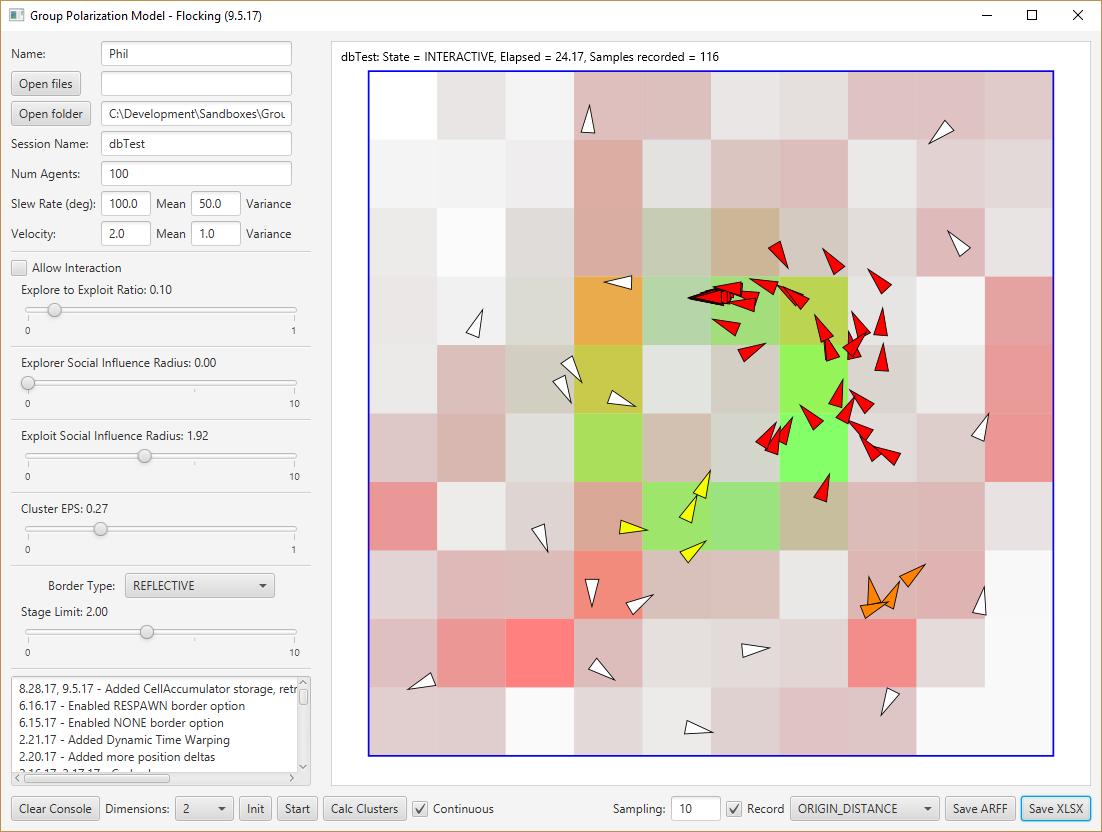
  • Heat maps!!!! 2017-09-05
  • Playing around with the drawing so we’re working off of a white background. Not sure if it’s better?
  • Adding a decay factor so new patterns don’t get overwhelmed by old ones 0.999 seems to be pretty good.
  • Need to export to excel – Done!2017-09-06
  • Advanced Analytic Status meeting.
  • NOAA meeting. Looks like they want VISIBILITY. Need to write up scenarios from spreadsheet generation to complete integration from allocation to contract to deliverable. With dashboards.
  • Latest version of the heatmaps, This produced the excel sheets above (dbTest_09_06_17-07_01_51) Going to leave it like this while I write the paper: 2017-09-06 (1)

Phil 8.16.17

7:00 – 8:00 Research

  • Added takeaway thoughts to my C&C writeup.
  • Working out how to add capability to the sim for P&RCH paper. My thoughts from vacation:
    • The agents contribution is the heading and speed
    • The UI is what the agent’s can ‘see’
    • The IR is what is available to be seen
    • An additional part might be to add the ability to store data in the space. Then the behavior of the IR (e.g. empty areas) would b more apparent, as would the effects of UI (only certain data is visible, or maybe only nearby data is visible) Data could be a vector field in Hilbert space, and visualized as color.
  • Updated IntelliJ
  • Working out how to to have a voxel space for the agents to move through that can also be drawn. It’s any number of dimensions, but it has to project to 2D. In the case of the agents, I just choose the first two axis. Each agent has an array of statements that are assembled into a belief vector. The space can be an array of beliefs. Are these just constructed so that they fill a space according to a set of rules? Then the xDimensionName and yDimensionName axis would go from (0, 1), which would scale to stage size? IR would still be a matter of comparing the space to the agent’s vector. Hmm.
  • This looks really good from an information horizon perspective: The Role of the Information Environment in Partisan Voting
    • Voters are often highly dependent on partisanship to structure their preferences toward political candidates and policy proposals. What conditions enable partisan cues to “dominate” public opinion? Here I theorize that variation in voters’ reliance on partisanship results, in part, from the opportunities their environment provides to learn about politics. A conjoint experiment and an observational study of voting in congressional elections both support the expectation that more detailed information environments reduce the role of partisanship in candidate choice

9:00 – 5:00 BRI

  • Good lord, the BoA corporate card comes with SIX seperate documents to read.
  • Onward to Chapter Three and Spring database interaction
  • Well that’s pretty clean. I do like the JdbcTemplate behaviors. Not sure I like the way you specify the values passed to the query, but I can’t think of anything better if you have more than one argument:
    @Repository
    public class EmployeeDaoImpl implements EmployeeDao {
        @Autowired
        private DataSource dataSource;
    
        @Autowired
        private JdbcTemplate jdbcTemplate;
    
        private RowMapper<Employee> employeeRowMapper = new RowMapper<Employee>() {
            @Override
            public Employee mapRow(ResultSet rs, int i) throws SQLException {
                Employee employee = new EmployeeImpl();
                employee.setEmployeeAge(rs.getInt("Age"));
                employee.setEmployeeId(rs.getInt("ID"));
                employee.setEmployeeName(rs.getString("FirstName") + " " + rs.getString("LastName"));
                return employee;
            }
        };
    
        @Override
        public Employee getEmployeeById(int id) {
            Employee employee = null;
    
            employee = jdbcTemplate.queryForObject(
                    "select * from Employee where id = ?",
                    new Object[]{id},
                    employeeRowMapper
            );
            return employee;
        }
    
        public List<Employee> getAllEmployees() {
            List<Employee> eList = jdbcTemplate.query(
                    "select * from Employee",
                    employeeRowMapper
            );
            return eList;
        }
    }
  • Here’s the xml to wire the thing up:
    <context:component-scan base-package="org.springframework.chapter3.dao"/>
    <bean id="employeeDao" class="org.springframework.chapter3.dao.EmployeeDaoImpl"/>
    
    <bean id="dataSource"
          class="org.springframework.jdbc.datasource.DriverManagerDataSource">
        <property name="driverClassName" value="${jdbc.driverClassName}" />
        <property name="url" value="${jdbc.url}" />
        <property name="username" value="xxx"/>
        <property name="password" value="yyy"/>
    </bean>
    
    <bean id="jdbcTemplate" class="org.springframework.jdbc.core.JdbcTemplate">
        <property name="dataSource" ref="dataSource" />
    </bean>
    
    <context:property-placeholder location="jdbc.properties" />
  • And here’s the properties. Note that I had to disable SSL:
    jdbc.driverClassName=com.mysql.jdbc.Driver
    jdbc.url=jdbc:mysql://localhost:3306/sandbox?autoReconnect=true&useSSL=false

Phil 7.18.16

7:00 – 3:30 VTX

  • Writing and reworking Lit Review 2. After that, I need to rework the research plan so that RQs and Hs are interchanged.
  • Meeting with Ned Thursday evening?
  • Meeting with Thom second week of August.
  • If there is time today, try to add color change to the table cells to reflect rank. Failing that, add a column that shows relative motion? Both?
    • Added a Rank and Delta field. That seems to be working fine.
  • Finished lockout task
  • Starting Gateway exposes old APIs task

Phil 6.20.16

7:00 – 7:00 VTX

  • Building chair corpus = Current and Cited
  • Filled MostCited.
  • Rating a few more pages. Still not getting any name hits.
  • Going to advanced search and entering items into each field, I get a different looking query:
    https://www.google.ca/search?as_q=New+York&as_epq=Nader+Golian&as_oq=+license+board+practice+patient+physician+order+health+practitioner+medicine+medical
    • These seem to be the important differences
    • as_q=New+York — This is a ‘normal’ query
    • as_epq=Nader+Golian — This must be in the results
    • as_oq=+license+board+practice+patient+physician+order+health+practitioner+medicine+medical — at least one of these must be in the result
  • Going to add a test to look for the name in the query (and the state?) and at least check the NA box and throw up a dialog. Could also list the number of occurrences by default in the notes

1:00 – Patrick’s proposal

  • Framing of problem and researcher
  • Overview of the problem space
    • Ready to Hand
    • Extension of self
  • Assistive technology abandonment
    • Ease of Acquisition
    • Device Performance
    • Cost and Maintenance
    • Stigma
    • Alignment with lifestyles
  • Prior Work
    • Technology Use
    • Methods Overview
      • Formative User Needs
      • Design Focus Groups
      • Design Evaluation and Configuration Interviews
    • Summary of Findings
    • Priorities
      • Maintain form factor
      • Different controls for different regions
      • Familiarity
      • Robustness to environmental changes
    • Potential of the wheelchair
      • Nice diagram. Shows the mapping from a chair to a smartphone
    • Inputs to wheelchair-mounted devices
    • Force sensitive device, new gestures and insights
    • Summary (This looks like research through design. Why no mention?)
      • Prototypes
      • Gestures
      • Demonstration
  • Proposed Work
    • Passive Haptic Rehabilitation
      • Can it be done
      • How effective
      • User perception
      • Study design!!!
    • Physical Activity and Athletic Performance
      • Completed: Accessibility of fitness trackers. (None of this actually tracks to papers in the presentation)
      • Body location and sensing
      • Misperception
        • Semi-structured interviews
        • Low experience / High interest (Lack of system trust!)
    • Chairable Computing for Basketball
      • Research Methods
        • Observations
        • Semi-structured interviews
        • Prototyping
        • Data presentation – how does one decide what they want from what is available?
  • What is the problem – Helena
    • Assistive technologies are not being designed right. We need to improve the design process.
    • That’s too general – give me a citation that says that technology abandonment WRT wheelchair use has high abandonment
    • Patrick responds with a bad design
    • Helena – isn’t the principal user-centered design. How has the HCI community done this before WRT other areas than wheelchairs to interact with computing systems
    • Helena – Embodied interaction is not a new thing, this is just a new area.Why didn’t you group your work. Is the prior analysis not embodied? Is your prior work not aligned with this perspective
  • How were the design principles used o develop an refine the pressure sensors?

More Reading

  • Creating Friction: Infrastructuring Civic Engagement in Everyday Life
    • This is the confirming information bubble of the ‘ten blue links’: Because infrastructures reflect the standardization of practices, the social work they do is also political: “a number of significant political, ethical and social choices have without doubt been folded into its development” ([67]: 233). The further one is removed from the institutions of standardization, the more drastically one experiences the values embedded into infrastructure—a concept Bowker and Star term ‘torque’ [9]. More powerful actors are not as likely to experience torque as their values more often align with those embodied in the infrastructure. Infrastructures of civic engagement that are designed and maintained by those in power, then, tend to reflect the values and biases held by those in power.
  • Meeting with Wayne. My hypothesis and research questions are backwards but otherwise good.

Phil 6.15.16

7:00 – 10:00, 12:00 – 4:00 VTX

  • Got the official word that I should be charging the project for research. Saved the email this time.
  • Continuing to work on the papers list
  • And in the process of looking at Daniele Quercia‘s work, I found Auralist: introducing serendipity into music recommendation which was cited by
    An investigation on the serendipity problem in recommender systems. Which has the following introduction:

    • In the book ‘‘The Filter Bubble: What the Internet Is Hiding from You’’, Eli Pariser argues that Internet is limiting our horizons (Parisier, 2011). He worries that personalized filters, such as Google search or Facebook delivery of news from our friends, create individual universes of information for each of us, in which we are fed only with information we are familiar with and that confirms our beliefs. These filters are opaque, that is to say, we do not know what is being hidden from us, and may be dangerous because they threaten to deprive us from serendipitous encounters that spark creativity, innovation, and the democratic exchange of ideas. Similar observations have been previously made by Gori and Witten (2005) and extensively developed in their book ‘‘Web Dragons, Inside the Myths of Search Engine Technology’’ (Witten, Gori, & Numerico, 2006), where the metaphor of search engines as modern dragons or gatekeepers of a treasure is justified by the fact that ‘‘the immense treasure they guard is society’s repository of knowledge’’ and all of us accept dragons as mediators when having access to that treasure. But most of us do not know how those dragons work, and all of us (probably the search engines’ creators, either) are not able to explain the reason why a specific web page ranked first when we issued a query. This gives rise to the so called bubble of Web visibility, where people who want to promote visibility of a Web site fight against heuristics adopted by most popular search engines, whose details and biases are closely guarded trade secrets.
    • Added both papers to the corpus. Need to read and code. What I’m doing is different in that I want to add a level of interactivity to the serendipity display that looks for user patterns in how they react to the presented serendipity and incorporate that pattern into a trustworthiness evaluation of the web content. I’m also doing it in Journalism, which is a bit different in its constraints. And I’m trying to tie it back to Group Polarization and opinion drift.
  • Also, Raz Schwartx at Facebook: , Editorial Algorithms: Using Social Media to Discover and Report Local News
  • Working on getting all html and pdf files in one matrix
  • Spent the day chasing down a bug where if the string being annotated is too long (I’ve set the  number of wordes to 60), then we skip. THis leads to a divide by zero issue. Fixed now

Phil 6.4.16

7:30 – 1:30 Writing

  • More on libraries and serendipity. Found lots, and then went on to look for metions in electronic retrieval. Found Foster’s A Nonlinear Model of Information-Seeking Behavior, which also has some spiffy citations. Going to take a break from writing and actually read this one. Because, I just realized that interdisciplinary researchers are the rough academic equivalent of the explorer pattern.
  • Investigating Information Seeking BehaviorUsing the Concept of Information Horizons
    • Page 3 – To design and develop a new research method we used Sonnenwald’s (1999) framework for human information behavior as a theoretical foundation. This theoretical framework suggests that within a context and situation is an ‘information horizon’ in which we can act. For a particular individual, a variety of information resources may be encompassed within his/her information horizon. They may include social networks, documents, information retrieval tools, and experimentation and observation in the world. Information horizons, and the resources they encompass, are determined socially and individually. In other words, the opinions that one’s peers hold concerning the value of a particular resource will influence one’s own opinions about the value of that resource and, thus, its position within one’s information horizon.