Category Archives: Phil

Phil 5.30.18

7:15 – 6:00 ASRC MKT

  • More Bit by Bit
  • An interesting tweet about the dichotomy between individual and herd behaviors.
  • More white paper. Add something about awareness horizon, and how maps change that from a personal to a shared reality (cite understanding ignorance?)
  • Great discussion with Aaron about incorporating adversarial herding. I think that there will be three areas
    • Thunderdome – affords adversarial herding. Users have to state their intent before joining a discussion group. Bots and sock puppets allowed
    • Clubhouse – affords discussion with chosen individuals. THis is what I thought JuryRoom was
    • JuryRoom – fully randomized members and topics, based on activity in the Clubhouse and Thunderdome

Phil 5.29.18

Insane, catastrophic rain this weekend. That’s the top of a guardrail in the middle of the scene below:

7:00 – 4:30 ASRC MKT

  • The Neural Representation of Social Networks
    • The computational demands associated with navigating large, complexly bonded social groups are thought to have significantly shaped human brain evolution. Yet, research on social network representation and cognitive neuroscience have progressed largely independently. Thus, little is known about how the human brain encodes the structure of the social networks in which it is embedded. This review highlights recent work seeking to bridge this gap in understanding. While the majority of research linking social network analysis and neuroimaging has focused on relating neuroanatomy to social network size, researchers have begun to define the neural architecture that encodes social network structure, cognitive and behavioral consequences of encoding this information, and individual differences in how people represent the structure of their social world.
  • This website is amazing, linear algebra with interactive examples. Vectors, matrix, dot product, etc, cool resource for learning
  • Web Literacy for Student Fact-Checkers: …and other people who care about facts.
    • Author: Mike Caulfield
    • We Should Put Fact-Checking Tools In the Core Browser
      • Years ago when the web was young, Netscape (Google it, noobs!) decided on its metaphor for the browser: it was a “navigator”. <—— this!!!!
        • Navigator: a person who directs the route or course of a ship, aircraft, or other form of transportation, especially by using instruments and maps.
        • Browser: a person who looks casually through books or magazines or at things for sale.
  • Deep Learning Hunts for Signals Among the Noise
    • Interesting article that indicates that deep learning generalizes through some form of compression. If that’s true, then the teurons and layers are learning how to coordinate (who recognizes what), which means dimension reduction and localized alignment (what are the features that make a person vs. a ship). Hmmm.
  • More Bit by Bit
  • Really enjoying Casualties of Cool, btw. Lovely sound layering. Reminds me of Dark Side of the Moon / Wish you were here Pink Floyd
  • Why you need to improve your training data, and how to do it
    • sleep_lost1
  • No scrum today
  • Travel briefing – charge to conference code
  • Complexity Explorables
    • Ride my Kuramotocycle!
      • This explorable illustrates the Kuramoto model for phase coupled oscillators. This model is used to describe synchronization phenomena in natural systems, e.g. the flash synchronization of fire flies or wall-mounted clocks. The model is defined as a system of NN oscillators. Each oscillator has a phase variable θn(t)θn(t) (illustrated by the angular position on a circle below), and an angular frequency ωnωn that captures how fast the oscillator moves around the circle.
    • Into the Dark
      • This explorable illustrates how a school of fish can collectively find an optimal location, e.g. a dark, unexposed region in their environment simply by light-dependent speed control. The explorable is based on the model discussed in Flock’n Roll, which you may want to explore first. This is how it works: The swarm here consists of 100 individuals. Each individual moves around at a constant speed and changes direction according to three rules
  • More cool software: Kepler.gl is a powerful open source geospatial analysis tool for large-scale data sets.
  • White paper. Good progress! I like the conclusions

Phil 5.24.18

7:00 ASRC

  • Is Bitcoin alive? Local organization and global entropy: bitcoin-hash-rate-jan-2016-jan-2018-768x594
  • Tweaked my terms page a bit
  • Continuing Bit by Bit. Nicely written. currently reading about the pros and cons of using big data. It’s making me think about how to structure the Jury Room data so that it lends itself better to prolonged research.
  • A gentle introduction to Doc2Vec
    • In this post you will learn what is doc2vec, how it’s built, how it’s related to word2vec, what can you do with it, hopefully with no mathematic formulas.
    • The combination of tags and paragraph/document ID could make this very nice for JuryRoom
  • 1:30 CoE meeting
  • 2:00 Meeting with Anton

Phil 5.25.18

7:00 – 6:00 ASRC MKT

  • Starting Bit by Bit
  • I realized the hook for the white paper is the military importance of maps. I found A Revolution in Military Cartography?: Europe 1650-1815
    • Military cartography is studied in order to approach the role of information in war. This serves as an opportunity to reconsider the Military Revolution and in particular changes in the eighteenth century. Mapping is approached not only in tactical, operational and strategic terms, but also with reference to the mapping of war for public interest. Shifts in the latter reflect changes in the geography of European conflict.
  • Reconnoitering sketch from Instructions in the duties of cavalry reconnoitring an enemy; marches; outposts; and reconnaissance of a country; for the use of military cavalry. 1876 (pg 83) reconnoitering_sketch
  • rutter is a mariner’s handbook of written sailing directions. Before the advent of nautical charts, rutters were the primary store of geographic information for maritime navigation.
    • It was known as a periplus (“sailing-around” book) in classical antiquity and a portolano (“port book”) to medieval Italian sailors in the Mediterranean Sea. Portuguese navigators of the 16th century called it a roteiro, the French a routier, from which the English word “rutter” is derived. In Dutch, it was called a leeskarte (“reading chart”), in German a Seebuch (“sea book”), and in Spanish a derroterro
    • Example from ancient Greece:
      • From the mouth of the Ister called Psilon to the second mouth is sixty stadia.
      • Thence to the mouth called Calon forty stadia.
      • From Calon to Naracum, which last is the name of the fourth mouth of the Ister, sixty stadia.
      • Hence to the fifth mouth a hundred and twenty stadia.
      • Hence to the city of Istria five hundred stadia.
      • From Istria to the city of Tomea three hundred stadia.
      • From Tomea to the city of Callantra, where there is a port, three hundred stadia
  • Battlespace
  • Cyber-Human Systems (CHS)
    • In a world in which computers and networks are increasingly ubiquitous, computing, information, and computation play a central role in how humans work, learn, live, discover, and communicate. Technology is increasingly embedded throughout society, and is becoming commonplace in almost everything we do. The boundaries between humans and technology are shrinking to the point where socio-technical systems are becoming natural extensions to our human experience – second nature, helping us, caring for us, and enhancing us. As a result, computing technologies and human lives, organizations, and societies are co-evolving, transforming each other in the process. Cyber-Human Systems (CHS) research explores potentially transformative and disruptive ideas, novel theories, and technological innovations in computer and information science that accelerate both the creation and understanding of the complex and increasingly coupled relationships between humans and technology with the broad goal of advancing human capabilities: perceptual and cognitive, physical and virtual, social and societal.
  • Reworked Section 1 to incorporate all this in a single paragraph
  • Long discussion about all of the above with Aaron
  • Worked on getting the CoE together by CoB
  • Do Diffusion Protocols Govern Cascade Growth?
    • Large cascades can develop in online social networks as people share information with one another. Though simple reshare cascades have been studied extensively, the full range of cascading behaviors on social media is much more diverse. Here we study how diffusion protocols, or the social exchanges that enable information transmission, affect cascade growth, analogous to the way communication protocols define how information is transmitted from one point to another. Studying 98 of the largest information cascades on Facebook, we find a wide range of diffusion protocols – from cascading reshares of images, which use a simple protocol of tapping a single button for propagation, to the ALS Ice Bucket Challenge, whose diffusion protocol involved individuals creating and posting a video, and then nominating specific others to do the same. We find recurring classes of diffusion protocols, and identify two key counterbalancing factors in the construction of these protocols, with implications for a cascade’s growth: the effort required to participate in the cascade, and the social cost of staying on the sidelines. Protocols requiring greater individual effort slow down a cascade’s propagation, while those imposing a greater social cost of not participating increase the cascade’s adoption likelihood. The predictability of transmission also varies with protocol. But regardless of mechanism, the cascades in our analysis all have a similar reproduction number ( 1.8), meaning that lower rates of exposure can be offset with higher per-exposure rates of adoption. Last, we show how a cascade’s structure can not only differentiate these protocols, but also be modeled through branching processes. Together, these findings provide a framework for understanding how a wide variety of information cascades can achieve substantial adoption across a network.
  • Continuing with creating the Simplest LSTM ever
    • All work and no play makes jack a dull boy indexes alphabetically as : AllWork

Phil 5.22.18

8:00 – 5:00 ASRC MKT

  • EAMS meeting
    • Rational
    • Sensitivity knn. Marching cubes, or write into space. Pos lat/lon altitude speed lat lon (4 dimensions)
    • Do they have flight path?
    • Memory
    • Retraining (batch)
    • inference real time
    • How will time be used
    • Much discussion of simulation
  • End-to-end Machine Learning with Tensorflow on GCP
    • In this workshop, we walk through the process of building a complete machine learning pipeline covering ingest, exploration, training, evaluation, deployment, and prediction. Along the way, we will discuss how to explore and split large data sets correctly using BigQuery and Cloud Datalab. The machine learning model in TensorFlow will be developed on a small sample locally. The preprocessing operations will be implemented in Cloud Dataflow, so that the same preprocessing can be applied in streaming mode as well. The training of the model will then be distributed and scaled out on Cloud ML Engine. The trained model will be deployed as a microservice and predictions invoked from a web application. This lab consists of 7 parts and will take you about 3 hours. It goes along with this slide deck
    • Slides
    • Codelab
  • Added in JuryRoom Text rough. Next is Research Browser
  • Worked with Aaron on LSTM some more. More ndarray slicing experience:
    import numpy as np
    dimension = 3
    size = 10
    dataset1 = np.ndarray(shape=(size, dimension))
    dataset2 = np.ndarray(shape=(size, dimension))
    for x in range(size):
        for y in range(dimension):
            val = (y+1) * 10 + x +1
            dataset1[x,y] = val
            val = (y+1) * 100 + x +1
            dataset2[x,y] = val
    
    
    dataset1[:, 0:1] = dataset2[:, -1:]
    print(dataset1)
    print(dataset2)
  • Results in:
    [[301.  21.  31.]
     [302.  22.  32.]
     [303.  23.  33.]
     [304.  24.  34.]
     [305.  25.  35.]
     [306.  26.  36.]
     [307.  27.  37.]
     [308.  28.  38.]
     [309.  29.  39.]
     [310.  30.  40.]]
    [[101. 201. 301.]
     [102. 202. 302.]
     [103. 203. 303.]
     [104. 204. 304.]
     [105. 205. 305.]
     [106. 206. 306.]
     [107. 207. 307.]
     [108. 208. 308.]
     [109. 209. 309.]
     [110. 210. 310.]]


Phil 5.18.18

7:00 – 4:00 ASRC MKT

Phil 5.17.18

7:00 – 4:00 ASRC MKT

  • How artificial intelligence is changing science – This page contains pointers to a bunch of interesting projects:
  • Multi-view Discriminative Learning via Joint Non-negative Matrix Factorization
    • Multi-view learning attempts to generate a classifier with a better performance by exploiting relationship among multiple views. Existing approaches often focus on learning the consistency and/or complementarity among different views. However, not all consistent or complementary information is useful for learning, instead, only class-specific discriminative information is essential. In this paper, we propose a new robust multi-view learning algorithm, called DICS, by exploring the Discriminative and non-discriminative Information existing in Common and view-Specific parts among different views via joint non-negative matrix factorization. The basic idea is to learn a latent common subspace and view-specific subspaces, and more importantly, discriminative and non-discriminative information from all subspaces are further extracted to support a better classification. Empirical extensive experiments on seven real-world data sets have demonstrated the effectiveness of DICS, and show its superiority over many state-of-the-art algorithms.
  • Add Nomadic, Flocking, and Stampede to terms. And a bunch more
  • Slides
  • Embedding navigation
    • Extend SmartShape to SourceShape. It should be a stripped down version of FlockingShape
    • Extend BaseCA to SourceCA, again, it should be a stripped down version of FlockingBeliefCA
    • Add a sourceShapeList for FlockingAgentManager that then passes that to the FlockingShapes
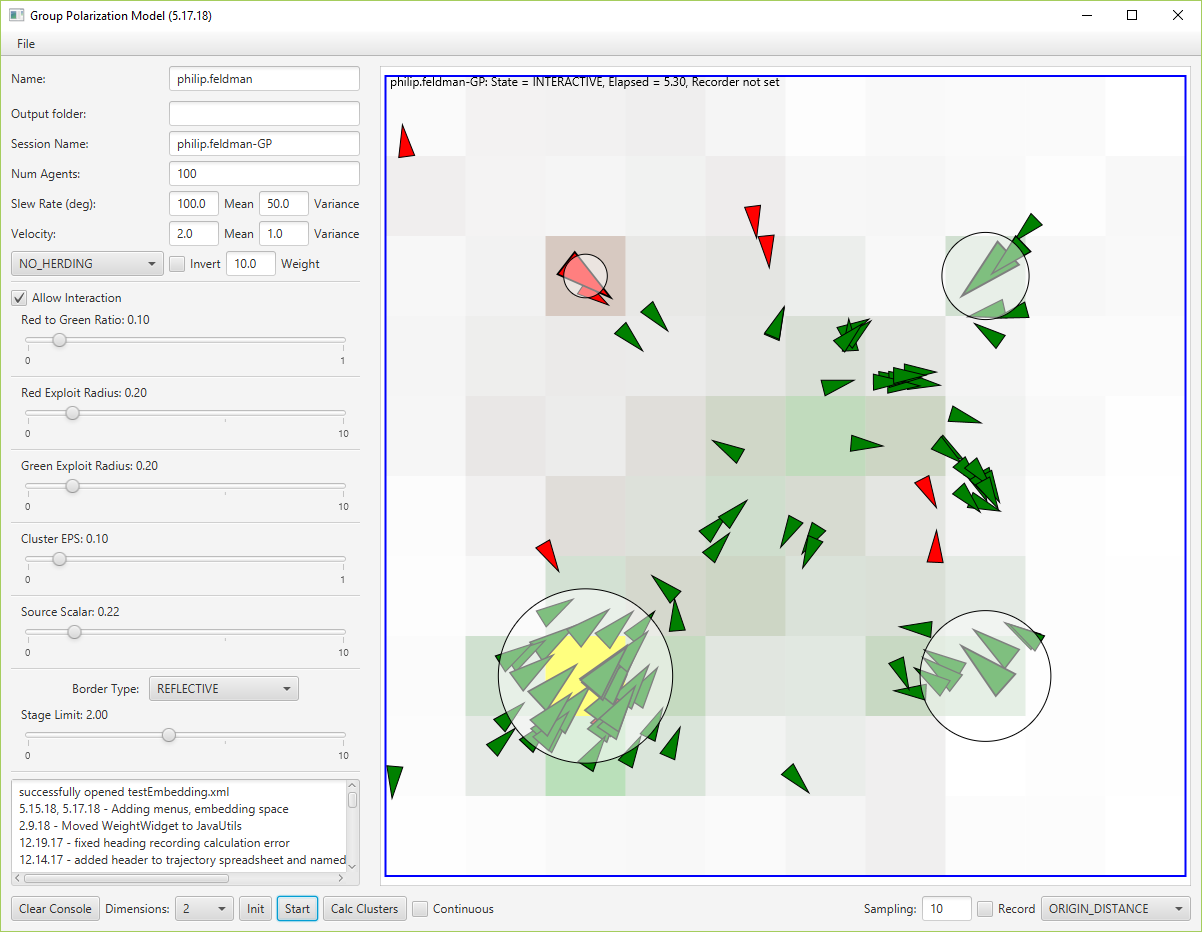
  • And it’s working! Well, drawing. Next is the interactions: Influence
  • Finally went and joined the IEEE

Phil 5.16.18

7:00 – 3:30 ASRC MKT

  • My home box has become very slow. 41 seconds to do a full recompile of GPM, while it takes 3 sec on a nearly identical machine at work. This may help?
  • Working on terms
  • Working on slides
  • Attending talk on Big Data, Security and Privacy – 11 am to 12 pm at ITE 459
    • Bhavani Thiraisingham
    • Big data management and analytics emphasizing GANs  and deep learning<- the new hotness
      • How do you detect attacks?
      • UMBC has real time analytics in cyber? IOCRC
    • Example systems
      • Cloud centric assured information sharing
    • Research challenges:
      • dynamically adapting and evolving policies to maintain privacy under a changing environment
      • Deep learning to detect attacks tat were previously not detectable
      • GANs or attacker and defender?
      • Scaleabe is a big problem, e.g. policies within Hadoop operatinos
      • How much information is being lost by not sharing data?
      • Fine grained access control with Hive RDF?
      • Distributed Search over Encrypted Big Data
    • Data Security & Privacy
      • Honypatching – Kevin xxx on software deception
      • Novel Class detection – novel class embodied in novel malware. There are malware repositories?
    • Lifecycle for IoT
    • Trustworthy analytics
      • Intel SGX
      • Adversarial SVM
      • This resembles hyperparameter tuning. What is the gradient that’s being descended?
      • Binary retrofitting. Some kind of binary man-in-the-middle?
      • Two body problem cybersecurity
    • Question –
      • discuss how a system might recognize an individual from session to session while being unable to identify the individual
      • What about multiple combinatorial attacks
      • What about generating credible false information to attackers, that also has steganographic components for identifying the attacker?
  • I had managed to not commit the embedding xml and the programs that made them, so first I had to install gensim and lxml at home. After that it’s pretty straightforward to recompute with what I currently have.
  • Moving ARFF and XLSX output to the menu choices. – done
  • Get started on rendering
    • Got the data read in and rendering, but it’s very brute force:
      if(getCurrentEmbeddings().loadSuccess){
          double posScalar = ResizableCanvas.DEFAULT_SCALAR/2.0;
          List<WordEmbedding> weList = currentEmbeddings.getEmbeddings();
          for (WordEmbedding we : weList){
              double size = 10.0 * we.getCount();
              SmartShape ss = new SmartShape(we.getEntry(), Color.WHITE, Color.BLACK);
              ss.setPos(we.getCoordinate(0)*posScalar, we.getCoordinate(1)*posScalar);
              ss.setSize(size, size);
              ss.setAngle(0);
              ss.setType(SmartShape.SHAPE_TYPE.OVAL);
              canvas.addShape(ss);
          }
      }

      It took a while to remember how shapes and agents work together. Next steps:

      • Extend SmartShape to SourceShape. It should be a stripped down version of FlockingShape
      • Extend BaseCA to SourceCA, again, it should be a stripped down version of FlockingBeliefCA
      • Add a sourceShapeList for FlockingAgentManager that then passes that to the FlockingShapes

Phil 5.15.18

7:00 – 4:00 ASRC MKT

Phil 5.14.18

7:00 – 3:00 ASRC MKT

    • Working on Zurich Travel. Ricardo is getting tix, and I got a response back from the conference on an extended stay
    • Continue with slides
    • See if there is a binary embedding reader in Java? Nope. Maybe in ml4j, but it’s easier to just write out the file in the format that I want
    • Done with the writer: Vim
  • Fika
  • Finished Simulacra and Simulation. So very, very French. From my perspective, there are so many different lines of thought coming out of the work that I can’t nail down anything definitive.
  • Started The Evolution of Cooperation

Phil 10.11.18

Neural Network Evolution Playground with Backprop NEAT

  • The genetic algorithm called NEAT will be used to evolve our neural nets from a very simple one at the beginning to more complex ones over many generations. The weights of the neural nets will be solved via back propagation. The awesome recurrent.js library made by karpathy, makes it possible to build computational graph representation of arbitrary neural networks with arbitrary activation functions. I implemented the NEAT algorithm to generate representations of neural nets that recurrent.js can process, so that the library can be used to forward pass through the neural nets that NEAT has discovered, and also to backprop the neural nets to optimise for their weights.

Thread on opacity and how we don’t know where our FB advertising is coming from

Meeting with Wayne

  • Walked through the terms. I need to add citations
  • Discussed What to do After the PhD. Setting up a program to study and implement trustworthy anonymous citizen journalism came up, which is very cool
  • Quite a bit of logistical discussion on how to bridge from UMBC to UMD
  • Showed Wayne my copy of Bit by Bit.

Continuous Profile Models (CPM) Matlab Toolbox and a matlab to python converter, as well as how to call MATLAB from python

Phil 5.10.18

Worked on my post on terms

Navigating with grid-like representations in artificial agents

  • Most animals, including humans, are able to flexibly navigate the world they live in – exploring new areas, returning quickly to remembered places, and taking shortcuts. Indeed, these abilities feel so easy and natural that it is not immediately obvious how complex the underlying processes really are. In contrast, spatial navigation remains a substantial challenge for artificial agents whose abilities are far outstripped by those of mammals.

7:30am – 8:00pm ASRC Tech conference

  • Maybe generate an fft waveform that can be arbitrarily complex, but repeating and repeatable as a function to learn. We then find the simplest, smallest representation that we can then run hyperparameter tuning algorithms on.
  • IoT marketplace is apparently a thing
  • IMG_4292

Phil 5.9.18

Listening to an interview with Kate Crawford of MIT on bias in machine learning and risks with AI in general

7:30am – 8:00pm ASRC Tech conference

  • Need to demo LMN for USPTO
  • We can get interns!
  • Presentation with Deltek was actually pretty interesting. Need to ask if they can run an analysis that finds the change in words associating AI terms is increasing, decreasing, or staying the same.
  • Aaron got ‘technologist of the year’, which was cool
  • Way too much sitting!