Category Archives: Phil

Phil 3.30.20

Today’s study in contrasts: Italy and the US:

COVID-19 projections for the US, from the The Institute for Health Metrics and Evaluation (IHME):
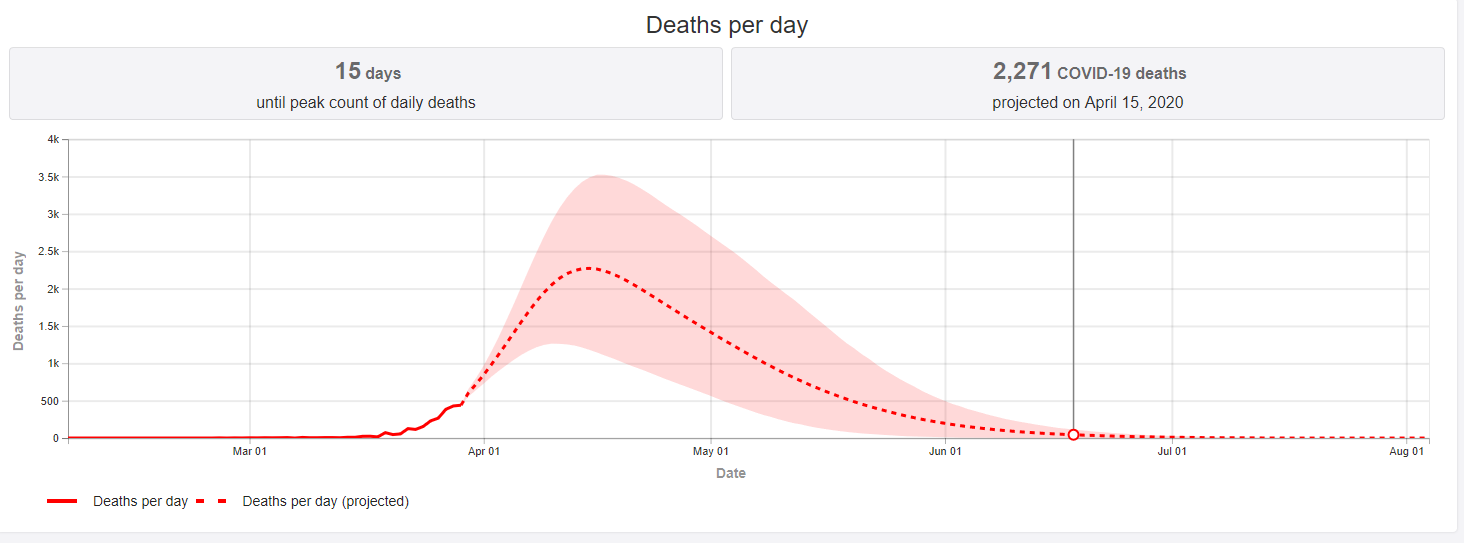
IHME

Work on converting the ETS json file into spreadsheets to evaluate thresholds and labels – spreadsheet conversion is working. done! Now I need to figure out what those ETS parameters do!

Add a short bit to the D20 writeup that explains why linear interpolation isn’t the best option, and why we went with ETS – done

Work with Zach to get the website up today – working

Work this article into the exploit-space writeup: Why Is Cybersecurity Not a Human-Scale Problem Anymore?. Wow, actually, the company (Balbix) that was founded by the author (Gaurav Banga) seems to be doing most of what I was going to write about. Sent Darren a note to see if I should continue

Got a note from ProQuest saying my file needed to have blank pages at the beginning and end of the document. Fixed. And accepted!

  • Congratulations. Your submission, xxxxx has cleared all of the necessary checks and will soon be delivered to ProQuest for publishing.

Ok, back to Docker and building an InfluxDB image. Wow, that seems like a lifetime ago I was doing this

  • To save a custom image, create the container from a base image and then docker save image_name > image_name.tar. This puts it wherever you run the command in the system, Linux or Windows

#COVID-19 meeting at 1:30 today – proposal’s in. We have twitter data from January

SDaaS meeting at 4:00 today – postponed
Phil 3.28.20

From today’s spreadsheet: countries_2020-03-28_07-38

US_3.28_2020

Italy_3.28_2020

NY Times is starting to use rates as well Some U.S. Cities Could Have Coronavirus Outbreaks Worse Than Wuhan’s

Interesting chat as an expert(?) on developing code in the future

Working on the ssh transfer in code using paramiko. This seems to be a good one.

It works!

import paramiko

filename = "C:/Development/Sandboxes/DaysToZero/data/external/countries_2020-03-28_07-38.xlsx"
remote_dir = "/home/some_place.com/d20/countries_2020-03-28_07-38.xlsx"
client = paramiko.SSHClient()
client.set_missing_host_key_policy(paramiko.AutoAddPolicy())
client.connect('ssh.some_place.com', username='some_login', password='some_password')
ftp_client = client.open_sftp()
#l = ftp_client.listdir()
#print(l)
ftp_client.put(filename, remote_dir)
ftp_client.close()
client.close()

I should try to put all the pieces together, but I am just done, and am stress-scrolling through Twitter, which really doesn’t help. Getting away from the computer for a while

Phil 3.27.20

Working with Zach and Aaron on the app. I think we’ll have something by this weekend

  • Added a starting zero on the regression
  • Added the regression to the json file, and posted to see if Zach can reach
  • Set up the hooks for export to excel workbook, with one tab per active country. I’ll work on that later today – done! countries

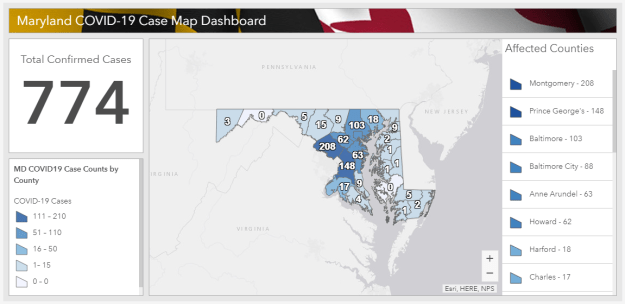
Got clarification from Wayne on some edits. Going to turn those around this morning and try to submit before COB today. Maryland is at 580 confirmed cases as of yesterday. I’d expect to see nearly 800 when they update the site this morning. Sent over all the edits. It’s in!

Maryland_3.26_2020

Yup

Maryland_3.27_2020

ProQuest submission site.

Phil 3.26.20

Updated the proposal

Found an example of diversity injection in the wild: the-syllabus.com. Here’s a story about it from The Correspondent.

Working on the parser today

  • Tried using my ExcelUtils, which are barfing on all the text in the csv
  • Discovered DictReader from the csv library, which works perfectly!
  • Throwing away rows that have less than three data points
  • Collecting rows into countries – done
  • Parsing out dates and values – done
  • Working on getting totals – done
  • Working on calculating rates – done
  • Seeing if I can do a least squares regression to calculate a first pass -done? It doesn’t seem to quite work right on the actual data
  • Aaron added his pieces in and everything seems to be kind of working

Phil 3.25.20

Waking up to the news these days makes me want to stay in bed with the radio off

Working on automating the process of downloading the spreadsheet, parsing out the countries, and calculating daily rates. The goal is to have a website up this weekend so you can see how your country is doing.

Tasks

  • Set up converter class – done
  • download spreadsheet – done
  • parse out countries – working on it
  • Made mockups of the mobile and webpage displays, and refined a few times based on comments

Got notes for Chapter 11 from Wayne. Switching gears and rolling that in. Put in changes for all the items I could read. There are a few still outstanding. I’ll submit tonight if Wayne doesn’t come back for a discussion.

Back to Docker. Need to connect to the WLS. Done!

Meetings

  • AIMS – status for all, plus technichal glitches. We’ll try Teams next time. Vadim has made GREAT progress. We might be able to get a real Yaw Flip soon as well
  • A2P – Infor demo. Meh.

Stampede theory proposal deadline was delayed a couple of days

Phil 3.24.20

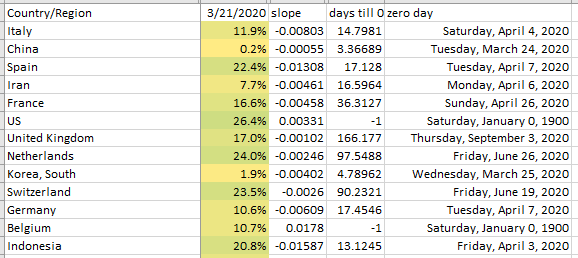
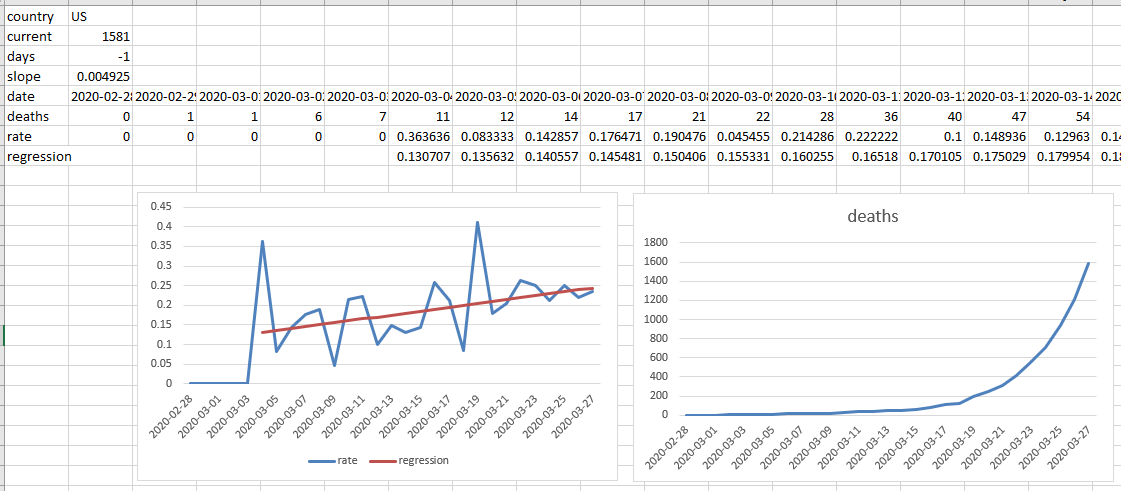
Well, I’ve got more predictions using death rates as described in this post. Based on the latest dataset from here (Github), I’ve created a spreadsheet that does a linear (least squares) extrapolation for when the number of new deaths per day drops to zero:

predictions_3.24.20

China is in this group as a sanity check, and as you can see, it’s very near zero, and so is South Korea. Italy, Germany, Spain, Iran, and Indonesia are currently all in the middle, with 2-3 weeks to go if nothing changes. France, the Netherlands, and Switzerland are far enough out that I think these may be low confinance values. The UK seems to be doing terribly. The worst performers are Belgium and the US, whose death rates are still going up, as indicated by the “-1” in the “days till” column.

Here are plots of the data used to calculate the table. Due to the way that excel labels axis, I don’t have dates for the x-axis for all the charts. They all end on the seme date (3/21, the last day in the dataset with the two days I need to calculate rates), but some of them have fewer tata points so that the time before the outbreak doesn’t influence the calculations:

prediction_charts_3.24.20

Working on Hours for misinfo proposal

ASRC

  • Had a good chat with Biruh about InfluxDB running in Docker. Since I’m running the Windows version, things are different enough that I’m going to need to download a linux distro image and run my own version of InfluxDB2 inside that. Which means I need to get smarter on Docker and making a custom image, etc. Got this book. We’ll see how that goes today.

ML Webex meeting

BART is the new BERT!

BART

Phil 2.27.20

ASRC GOES 7:00 – 8:00

GOES

PhD

  • Meeting with Wayne. I got the (preliminary)
    • Combine the Limitations and Future Work chapters into a new chapter that explores where my research has landed. I think that a beachhead analogy might work here.
      • Preliminary, early work that lives in the space between computational sociology and HCC (socio-technical, from From Keyword Search to Exploration). Add discussions about wormholes, weathermaps, and maps that connect distant places, like air travel maps.
      • Diversity science
      • Gathering data on online consensus in various sized groups and within different cultures
      • Extending simulations into human belief spaces, such as with GPT-2 agents
    • Add a “my hut, revisited” section to the contributions that discusses the contributions from the perspective of the spaces defined by Kauffman, Martindale, and Bacharach in particular, but also the literature in general

Tie into this as well

Some general reworking of the contributions text to reflect the slides: This also requires expansion of the current text in CH11. In particular slides 49-52 are a stronger synopsis than is provided in your CH10 discussion. Slides 53-56 are a more thoughtful framing of your contributions, both theoretical and practical (can you weave this back in your literature from CH2 to show specific knowledge contribution?). The “bookend” revisiting ofthe trustworthy anonymous citizen journalism was also more effective in the presentation than the document. Consider capturing this.

Phil 2.19.20

7:00 – 8:00 ASRC GOES

disinfoOps
  • Defense practice and tweaking
  • Continue setting up workstation
    • Java – done
    • Python – done
      • Pandas3d
      • Panda
      • Scikit-learn
      • TF 2.0
      • etc
    • TortoiseSVN – done
    • WinSCP – done
    • PuTTY – done
    • XAMPP – done
    • gVIM – done
    • MikTex – done
    • TexStudio – done
    • Adobe Creative Cloud – done
      • Acrobat- done
      • Illustrator- done
      • Photoshop – done
    • Intellij
    • Office- done
    • Project
    • Chrome- done
    • FF
    • GitHub desktop
    • Set up non-admin user
  • Mission Drive meetings

Phil 2.19.20

8:00 – 7:00 ASRC GOES

  • I have a cold. Yuck!
  • How to build a brain from scratch
    • This advanced option course discusses the search for a general theory of learning and inference in biological brains. It draws upon diverse themes in the fields of psychology, neuroscience, machine learning and artificial intelligence research. We begin by posing broad questions. What are brains for, and what does it mean to ask how they “work”? Then, over a series of lectures, we discuss parallel computational approaches in machine learning/AI and psychology/neuroscience, including reinforcement learning, deep learning, and Bayesian methods. We contrast computational and representational approaches to understanding neuroscience data. We ask whether current approaches in machine learning are feasible and scaleable, and which methods – if any – resemble the computations observed in biological brains. We review how high-level cognitive functions – attention, episodic memory, concept formation, reasoning and executive control – are being instantiated in artificial agents, and how their implementation draws upon what we know about the mammalian brain. Finally, we contemplate the outlook for the future, and whether AI will be “solved” in the near future.
  • Start writing GVSETS simulation white paper for March 3
  • Finish setting up workstation
    • Soooooo, that turned out to be a bigger problem. The way that admin is set up is that there are two levels, an “install software” level, and an “install hardware level”. I had been given the former. When I installed the new SSD, it had to be formatted with NTFS. I could launch the device manager, but could not access the drive. I took the box down to HQ, and their IT folks were mystified. I stopped by the shop that had fixed the power supply, and for another $50, they put the drive in another machine, formatted and named it. Then it worked. Wheee.
    • I then start re-installing software and find that although I can log in as admin, I can’t run anything as admin. That requires going back to HQ so that they can set permissions on the local network, and install a VPN. Now our local network is horrible. There is some kind of whitelist/blacklist filter that is so slow that web pages often timeout rather than load.
    • At this point, I decided that it was easier to reset the machine and start over. So I’ll be doing that for a few days. Today, I got the NVIDIA and CUDA drivers installed.
  • Verify TF and multi-gpu optevolver
  • ML Seminar

Phil 2.17.20

Pinged Aaron about getting together today – 3:00

  • Went through the talk he says it seems pretty solid
  • Also dropped by Don’s office to say hi

Generated a new map where a stampede stops when it hits the edge

Played around with the “Curse of Dimensionality” slide

Added some background on fact-checking to the RQ slide

Start fixing Alienware

  • Mount drive – done
  • Plug everything in and connect network – done
  • Copy files
  • Fix environment variables

Online Conspiracy Theories: The WIRED Guide

  • Everything you need to know about George Soros, Pizzagate, and the Berenstain Bears.


Phil 2.16.20

Bringing Stories Alive: Generating Interactive Fiction Worlds

  • World building forms the foundation of any task that requires narrative intelligence. In this work, we focus on procedurally generating interactive fiction worlds—text-based worlds that players “see” and “talk to” using natural language. Generating these worlds requires referencing everyday and thematic commonsense priors in addition to being semantically consistent, interesting, and coherent throughout. Using existing story plots as inspiration, we present a method that first extracts a partial knowledge graph encoding basic information regarding world structure such as locations and objects. This knowledge graph is then automatically completed utilizing thematic knowledge and used to guide a neural language generation model that fleshes out the rest of the world. We perform human participant-based evaluations, testing our neural model’s ability to extract and fill-in a knowledge graph and to generate language conditioned on it against rule-based and human-made baselines. Our code is available at this https URL.

The Obligation To Experiment

  • Tech companies should test the effects of their products on our safety and civil liberties. We should also test them ourselves.

Ran through the presentation with David. He pointed out that stampedes bouncing off the edge of the environment look like flocking, so I generated a new map where the stampede gathers and runs off the edge

flock_2_stampede_map_legend

Phil 2.14.20

7:00 – 8:30 ASRC GOES

This document describes the Facebook Full URL shares dataset, resulting from a collaboration between Facebook and Social Science One. It is for Social Science One grantees and describes the dataset’s scope, structure, fields, and privacy-preserving characteristics. This is the second of two planned steps in the release of this “Full URLs dataset”, which we described at socialscience.one/blog/update-social-science-one.

Judging Truth

    • Deceptive claims surround us, embedded in fake news, advertisements, political propaganda, and rumors. How do people know what to believe? Truth judgments reflect inferences drawn from three types of information: base rates, feelings, and consistency with information retrieved from memory. First, people exhibit a bias to accept incoming information, because most claims in our environments are true. Second, people interpret feelings, like ease of processing, as evidence of truth. And third, people can (but do not always) consider whether assertions match facts and source information stored in memory. This three-part framework predicts specific illusions (e.g., truthiness, illusory truth), offers ways to correct stubborn misconceptions, and suggests the importance of converging cues in a post-truth world, where falsehoods travel further and faster than the truth.


  •  Dissertation
    • Practice! 52 minutes, 57 seconds
    • Maybe meeting with Wayne? Nope
  • Pack, move, unpack, setup
    • Bring ethernet cables! done
    • Moved out – done
    • Moved in – not done, but ready to unpack
  • Recovered my information for GSAW and TFDev
  • Write quick proposals for:
    • cybermap – done
    • Synthetic data as a service – done
    • White paper – kinda?

Phil 2.13.20

7:00 – 4:00 ASRC (charge number?)

  • AI/ML workshop
  • Color code timeline – done
  • Pick up computer? – done.
    • It turns out that the alienware OEM power supply uses standard connectors in a non-standard way. When I had to use the OEM SATA low-profile connector, I tripped the power supply and also blew out the HD. Ordered a replacement SATA SSD
    • Rebuild travel folders
    • Copy laptop’s d: dev and program files folders onto new SSD

Phil 2.12.20

7:00 – 8:00pm ASRC PhD, GOES

  • Create figures that show an agent version of the dungeon
  • Replicate the methods and detailed methods of the cartography slides
  • Text for each group by room can be compared by the rank difference between them and the overall. Put that in a spreadsheet, plot and maybe determine the DTW value?
    • Add the sim version of the dungeon and the rank comparison to the dissertation
  • Put all ethics on one slide – done
  • Swapped out power supply, but now the box won’t start. Dropped off to get repaired
  • Corporate happy hour

Phil 2.11.20

7:00 – 9:00 ASRC GOES

The brains of birds synchronize when they sing duets

  • When a male or female white-browed sparrow-weaver begins its song, its partner joins in at a certain time. They duet with each other by singing in turn and precisely in tune. A team led by researchers from the Max Planck Institute for Ornithology in Seewiesen used mobile transmitters to simultaneously record neural and acoustic signals from pairs of birds singing duets in their natural habitat. They found that the nerve cell activity in the brain of the singing bird changes and synchronizes with its partner when the partner begins to sing. The brains of both animals then essentially function as one, which leads to the perfect duet. (original article: Duets recorded in the wild reveal that interindividually coordinated motor control enables cooperative behavior)

Bottom-Up and Top-Down Attention for Image Captioning and Visual Question Answering

  • Top-down visual attention mechanisms have been used extensively in image captioning and visual question answering (VQA) to enable deeper image understanding through fine-grained analysis and even multiple steps of reasoning. In this work, we propose a combined bottom-up and top down attention mechanism that enables attention to be calculated at the level of objects and other salient image regions. This is the natural basis for attention to be considered. Within our approach, the bottom-up mechanism (based on Faster R-CNN) proposes image regions, each with an associated feature vector, while the top-down mechanism determines feature weightings. Applying this approach to image captioning, our results on the MSCOCO test server establish a new state-of-the-art for the task, achieving CIDEr / SPICE / BLEU-4 scores of 117.9, 21.5 and 36.9, respectively. Demonstrating the broad applicability of the method, applying the same approach to VQA we obtain first place in the 2017 VQA Challenge


  •  Defense
    • Need to think about how to discuss maps like the T-O and belief space maps (flocking and stampeding projections?) are attention maps as well. Emphasizing well-triangulated but less-attended areas is a potential good. Compare to how maps opened up areas for exploration and exploitation, but this is constructive and not extractive
  • Admin -done
  • Walkthrough of Aaron’s slides
    • Showed him how to outline boxes and reduce the filesize
  • Shimei’s group
    • Walkthrough of the slides
    • Strengthen the connection between the sim and the human study