Category Archives: Development

Phil 7.26.19

7:00 – 4:30 ASRC

  • Dissertation – Finished Martindale
  • Ping Antonio about going the R&R route with ACM TAAS. – done
    • Find the right template
    • Fold in Simon’s Anthill (Probably the paper title)
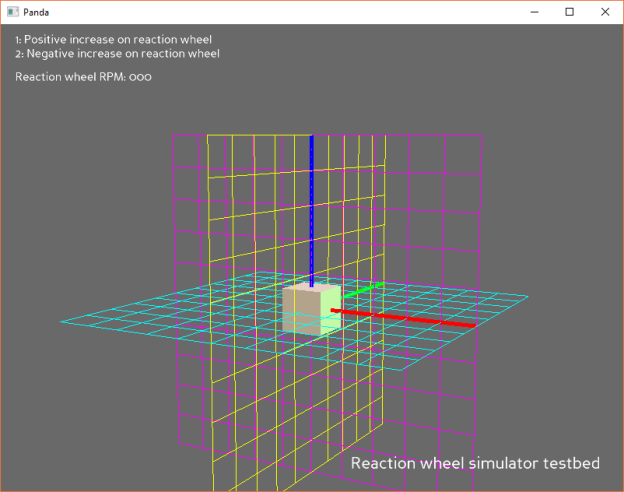
  • More graphics – got the disk working! Disk
  • Get Heera’s parser running?
    • Reading in the xml
    • Reading the files, though not really doing anything yet
  • Get replacement flapper – done

Phil 7.26.19

7:30 – 4:30 ASRC GEOS

PatWinston

Phil 7.24.19

7:00 – 4:00 ASRC GEOS

  • Write up my impression of yesterday’s game – done
  • Put together a Google Form to get everyone else’s impression – done
    • Understanding the map
    • Using the map
    • The effect of the map on gameplay and enjoyment
  • Send Don routes for ebike – done
  • Maybe get started on Martindale?
  • Start setting up Heera’s github – done
  • More graphics at Mission drive (bring fixee from home!)
    • Adding class to handle mouse button events – done
    • Refactoring the classes out of the Primitives.py file
    • Working on caps for the cylinder
  • Send Chris and Panos the anonymized sql, and rank the questions for difficulty
  • Various meetings

Phil 7.22.19

7:00 – 5:00 ASRC GEOS

conformity

Today’s timeline serendipity

  • The TdF is very exciting this year!
  • Met with Heera to discuss her work. I’m going to set up a GitHub project and add a parser that reads in an xml config file that then parses csv files into:
    • Spreadsheet for evaluation
    • Split-up csv files for analysis
  • Pick up air filter and oil change kit for the bike
  • Ran the random binary network code and generated figures for the text
  • Remind all the players about the run tomorrow – done
  • Getting the tmesh working – success!
  • Getting better camera controls

Phil 7.19.19

7:00 – 4:30 ASRC GEOS

StanfordNLP

  • Still looking at what’s wrong with my NK model. I found Random Boolean Networks, when looking for “random binary networks kauffman example“. It also has a bibliography that looks helpful as well
    • Introduction to Random Boolean Networks
      • The goal of this tutorial is to promote interest in the study of random Boolean networks (RBNs). These can be very interesting models, since one does not have to assume any functionality or particular connectivity of the networks to study their generic properties. Like this, RBNs have been used for exploring the configurations where life could emerge. The fact that RBNs are a generalization of cellular automata makes their research a very important topic. The tutorial, intended for a broad audience, presents the state of the art in RBNs, spanning over several lines of research carried out by different groups. We focus on research done within artificial life, as we cannot exhaust the abundant research done over the decades related to RBNs.
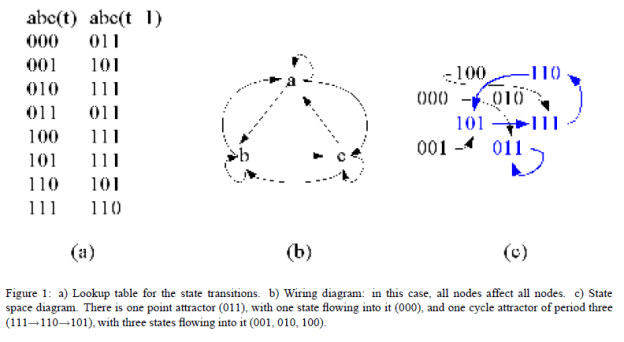
      • I can add a display that shows this: Trajectory
      • Got that working
      • Rewrote so that there is an evolve without a fitness test. Trying to set up transition patterns like this: Transitions
      • The thing is, I don’t see how the K part works here…
      • I think I got it working!
    • Complex and Adaptive Dynamical Systems: A Primer
      • An thorough introduction is given at an introductory level to the field of quantitative complex system science, with special emphasis on emergence in dynamical systems based on network topologies. Subjects treated include graph theory and small-world networks, a generic introduction to the concepts of dynamical system theory, random Boolean networks, cellular automata and self-organized criticality, the statistical modeling of Darwinian evolution, synchronization phenomena and an introduction to the theory of cognitive systems. 
        It inludes chapter on Graph Theory and Small-World Networks, Chaos, Bifurcations and Diffusion, Complexity and Information Theory, Random Boolean Networks, Cellular Automata and Self-Organized Criticality, Darwinian evolution, Hypercycles and Game Theory, Synchronization Phenomena and Elements of Cognitive System Theory.

Phil 7.18.19

7:00 – 5:00 ASRC GEOS

  • Started to fold Wayne’s comments in
  • Working on the Kauffman section
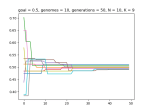
  • Tried making it so K can be higher than N with resampling and I still can’t keep the system from converging, which makes me think that there is something wrong with the code.
  • Send reviews to Antonio – done
  • Back to work on the physics model. Make sure to include a data dictionary mapping system to support Bruce’s concept
  • Sent links to Panda3D to Vadim
  • Code autocompletion using deep learning
  • A lot of flailing today but no good progress:

N_20_K_6

Phil 7.17.19

7:00 – 7:00 ASRC GEOS

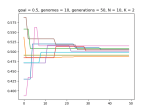
  • Got some nice NK model network plots working:
  • Added a long jump mutation when plateaus are hit:
  • Generally, fixed a lot of bugs in the code, but I think I understand the NK model thing. I do want to try and find how they did the traveling salesman problem
  • AI/ML Meeting
    • NASA? Air Force(?) are putting together a reinforcement learning model for autonomous spacecraft control, that requires a simulator.
  • Meeting with Wayne
    • Lots of work on the dissertation
    • Walked through JuryRoom prototype

Phil 7,11,19

7:00 – 4:30 ASRC GEOS

  • Ping Antonio – Done
  • Dissertation
    • More Bones in a Hut. Found the online version of the Hi-Lo chapter from BIC. Explaining why Hi-Lo is different from IPD.
  • More reaction wheel modeling
  • Get flight and hotel for July 30 trip – Done
  • So this is how you should install Panda3d and examples:
    • First, make sure that you have Python 3.7 (64 bit! The default is 32 bit). Make sure that your path environment points to this, and not any other 3.x versions that you’re hoarding on your machine.
    • pip install panda3d==1.10.3
    • Then download the installer and DON’T select the python 3.7 support: Panda3d_install
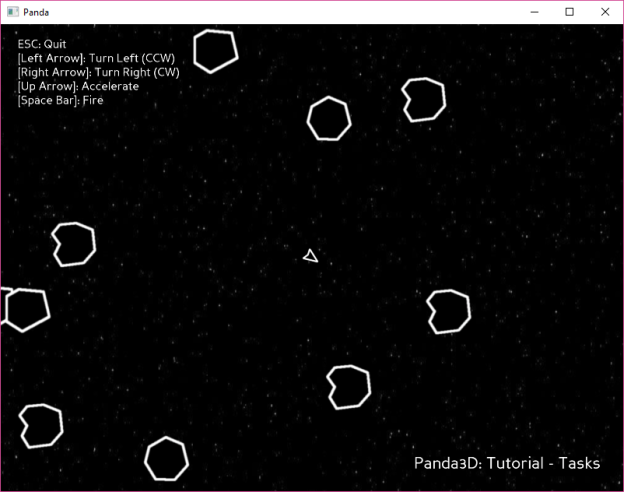
    • Finish the install and verify that the demos run (e.g. python \Panda3D-1.10.3-x64\samples\asteroids\main.py): asteroids
    • That’s it!
  • Discussed DARPA solicitation HR001119S0053 with Aaron. We know the field of study – logistics and supply chain, but BD has totally dropped the ball on deadlines and setting up any kind of relationship with the points of contact. We countered that we could write a paper and present at a venue to gain access and credibility that way.
    • There is a weekly XML from the FBO. Downloading this week’s to see if it’s easy to parse and search

Phil 7.10.19

7:00 – 5:00 ASRC

  • BP&S is up! Need to ping Antonio
  • Need to fix DfS to de-emphasize the mapping part. Including things like, uh, changing the title…
  • Pix at HQ – Done
  • Greenbelt today, which means getting Panda3D up and running on my laptop – Done. Had to point the IDE at the python in the install.
  • Need to add some thoughts to JuryRoom concepts
  • Send dungeon invites for the 23rd, and ping Aaron M. Done. Wayne can’t make it! Drat!
  • Dissertation working on the Bacharach section
  • Got the sim working on the laptop. I realize that the reaction wheel can be modeled as weights on a stick. Long discussion with Bruce T

Phil 7.9.19

7:00 – 5:30 ASRC GEOS

  • BP&S is “on hold” in ArXiv. Hoping that it’s overlap with DfS. I took the mapping text out of the DfS paper and resubmitted. Once that’s done I can send Antonio a link and get advice.
  • Code review with Chris
  • Contact David and see if he’s ok with July 23 – Nope. Trying Aaron M. as a replacement
  • More dissertation. Folded in most of the BP&S paper
  • Look! More mapping of latent spaces! Unsupervised word embeddings capture latent knowledge from materials science literature41586_2019_1335_fig4_esm
    • Here we show that materials science knowledge present in the published literature can be efficiently encoded as information-dense word embeddings11,12,13 (vector representations of words) without human labelling or supervision. Without any explicit insertion of chemical knowledge, these embeddings capture complex materials science concepts such as the underlying structure of the periodic table and structure–property relationships in materials. Furthermore, we demonstrate that an unsupervised method can recommend materials for functional applications several years before their discovery. This suggests that latent knowledge regarding future discoveries is to a large extent embedded in past publications. Our findings highlight the possibility of extracting knowledge and relationships from the massive body of scientific literature in a collective manner, and point towards a generalized approach to the mining of scientific literature.
  • More Panda3D
    • Intervals and sequences
    • Panda3D forum
    • Programming with Panda3D
      • Well, this is looking a lot like the way I would have written it
      • You can convert a NodePath into a “regular” pointer at any time by calling nodePath.node(). However, there is no unambiguous way to convert back. That’s important: sometimes you need a NodePath, sometimes you need a node pointer. Because of this, it is recommended that you store NodePaths, not node pointers. When you pass parameters, you should probably pass NodePaths, not node pointers. The callee can always convert the NodePath to a node pointer if it needs to.
      • Nodepath
    • Huh. It looks like there is no support for procedurally generated primitives. Well, I know what I’m going to be doing…
      • Origin – done
      • Grid
      • Cube (x, y, z size), color (texture?), Boolean for endcaps
      • Cylinder (radius+steps, length), color
      • Sphere  (radius+steps), color
      • Skybox (texture)
      • Then try making a satellite from parts
    • JuryRoom Meeting
      • A lot of discussion on UI issues – how to vote for/against, the right panel layout, and the questions that should be asked for Chris’ studyCapture

Phil 7.8.19

7:00 – 4:30 ASRC GEOS

  • Read and commented on Shimei’s proposal. It’s interesting to see how she’s weaving all these smaller threads together into one larger narrative. I find that my natural approach is to start with an encompassing vision and figure out how to break it down into its component parts. Which sure seems like stylistic vs. primordial. Interestingly, this implies that stylistic is more integrative? Transdisciplinary, primordial work, because it has no natural home, is more disruptive. It makes me think of this episode of Shock of the New about Paul Cezanne.
  • Working on getting BP&S into one file for ArXiv, then back to the dissertation.
    • Flailed around with some package mismatches, and had a upper/lowercase (.PNG vs. .png) problem. Submitted!
  • Need to ping Antonio about BP&S potential venues
  • The Redirect Method uses Adwords targeting tools and curated YouTube videos uploaded by people all around the world to confront online radicalization. It focuses on the slice of ISIS’ audience that is most susceptible to its messaging, and redirects them towards curated YouTube videos debunking ISIS recruiting themes. This open methodology was developed from interviews with ISIS defectors, respects users’ privacy and can be deployed to tackle other types of violent recruiting discourses online.
  • Pushed TimeSeriesML to the git repo, so we’re redundently backed up. Did not send data yet
  • Starting on the PyBullet tutorial
    • Trying to install pybullet.
      • Got this error: error: command ‘C:\\Program Files (x86)\\Microsoft Visual Studio 14.0\\VC\\BIN\\x86_amd64\\link.exe’ failed with exit status 1158
      • Updating my Visual Studio (suggested here), in the hope that it fixes that. Soooooo Slooooow
      • Link needs rc.exe/rc.dll
      • Copied the most recent rc.exe and rcdll.dll (from into C:\\Program Files (x86)\\Microsoft Visual Studio 14.0\\VC\\BIN\\x86_amd64\
      • Giving up
  • Trying Panda3d
    • Downloaded and ran the installer. It couldn’t tell that I had Python 3.7.x, but otherwise was fine. Maybe that’s because my Python is on my D: drive?
    • Ran:
      pip install panda3d==1.10.3

      Which worked just fine

    • Had to add the D:\Panda3D-1.10.3-x64\bin and D:\Panda3D-1.10.3-x64\panda3d to the path to get all the imports to work right. This could be because I’m using a global, separately installed Python 3.7.x
    • Hmmm. Getting ModuleNotFoundError: No module named ‘panda3d.core.Point3’; ‘panda3d.core’ is not a package. The IDE can find it though….
    • In a very odd sequence of events, I tried using
      • from pandac.PandaModules import Point3, which worked, but gave me a deprecated warning.
    • Then, while fooling around, I tried the preferred
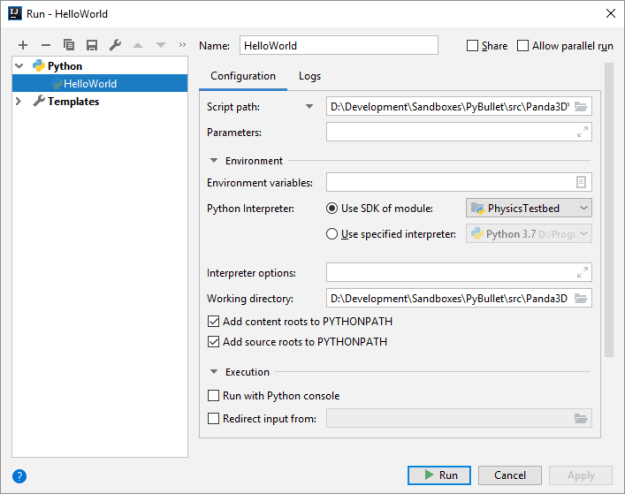
      • from panda3d.core import Point3, which now works. No idea what fixed it. Here’s the config that I’m using to run: Panda3dConfig
    • Nice performance, too: Pandas3D
    • And it has bullet in it, so maybe it will work here?
    • Starting on the manual

Phil 7.5.19

7:00 – 5:00 ASRC GEOS

  • Got a desk reject from JASSS. Finding a home for this is turning out to be hard
  • Adjust Belief Places and Spaces for a straight ArXiv submission (article, endquote, fix cites). I’m doing this partially out of spite – I don’t want to see JASSS looking back at me in my svn repo. But I also need to get all the parts fixed so that it can be folded into the dissertation. \citep doesn’t play well, and I need to replace all the quotes with \enquote{}.
  • Start folding BP&S into dissertation
  • Look for Collective Intelligence venue?
  • Updated Pandas, which was where I got hung on Tuesday. Now I can use DataFrame.to_numpy() instead of Dataframe.values
  • Continuing on TimeSeriesNormalizer – done! Below is the original file with the data in columns (left) and the normalized file with the data in rows (right): Normalized
  • Learning about PyBullet
  • Thought for the day. Find the snippet for each room/group with the most positive and most negative sentiment, and use that instead of the three words.

Phil 7.2.19

7:00 – 3:30 ASRC GEOS

  • Wrote up some preliminary notes about the run yesterday
  • Need to set up a schedule for another run in the last half of July
  • Added a “Bones in a Hut” section that follows the main lit review
  • Clustering today
    • Wrote up a workflow.txt file for the whole process.
    • Building TimeSeriesNormalizer class
    • Looks like I lost admin. Stalled

Phil 6.28.19

7:00 – 8:00 ASRC GEOS

  • Early timesheet
  • Sent Aaron a writeup on the clustering results

8:00 – 5:00 PhD

  • Made a poster of the map for the run on Monday
  • Dissertation for the rest of the day
    • Created a chapter and equation directory. Things are getting messy
    • Working on the simulation study chapter – I think the main part of the work is in there. Now I need to add the adversarial herding