Category Archives: Conferences

Phil 7.31.18

7:00 – 6:00 ASRC MKT

  • Thinking that I need to forward the opinion dynamics part of the work. How heading differs from position and why that matters
  • Found a nice adversarial herding chart from The EconomistBrexit
  • Why Do People Share Fake News? A Sociotechnical Model of Media Effects
    • Fact-checking sites reflect fundamental misunderstandings about how information circulates online, what function political information plays in social contexts, and how and why people change their political opinions. Fact-checking is in many ways a response to the rapidly changing norms and practices of journalism, news gathering, and public debate. In other words, fact-checking best resembles a movement for reform within journalism, particularly in a moment when many journalists and members of the public believe that news coverage of the 2016 election contributed to the loss of Hillary Clinton. However, fact-checking (and another frequently-proposed solution, media literacy) is ineffectual in many cases and, in other cases, may cause people to “double-down” on their incorrect beliefs, producing a backlash effect.
  • Epistemology in the Era of Fake News: An Exploration of Information Verification Behaviors among Social Networking Site Users
    • Fake news has recently garnered increased attention across the world. Digital collaboration technologies now enable individuals to share information at unprecedented rates to advance their own ideologies. Much of this sharing occurs via social networking sites (SNSs), whose members may choose to share information without consideration for its authenticity. This research advances our understanding of information verification behaviors among SNS users in the context of fake news. Grounded in literature on the epistemology of testimony and theoretical perspectives on trust, we develop a news verification behavior research model and test six hypotheses with a survey of active SNS users. The empirical results confirm the significance of all proposed hypotheses. Perceptions of news sharers’ network (perceived cognitive homogeneity, social tie variety, and trust), perceptions of news authors (fake news awareness and perceived media credibility), and innate intentions to share all influence information verification behaviors among SNS members. Theoretical implications, as well as implications for SNS users and designers, are presented in the light of these findings.
  • Working on plan diagram – done
  • Organizing PhD slides. I think I’m getting near finished
  • Walked through slides with Aaron. Need to practice the demo. A lot.

Phil 7.27.18

Ted Underwood

  • my research is as much about information science as literary criticism. I’m especially interested in applying machine learning to large digital collections
  • Git repo with code for upcoming book: Distant Horizons: Digital Evidence and Literary Change
  • Do topic models warp time?
    • The key observation I wanted to share is just that topic models produce a kind of curved space when applied to long timelines; if you’re measuring distances between individual topic distributions, it may not be safe to assume that your yardstick means the same thing at every point in time. This is not a reason for despair: there are lots of good ways to address the distortion. The mathematics of cosine distance tend to work better if you average the documents first, and then measure the cosine between the averages (or “centroids”).
  • The Historical Significance of Textual Distances
    • Measuring similarity is a basic task in information retrieval, and now often a building-block for more complex arguments about cultural change. But do measures of textual similarity and distance really correspond to evidence about cultural proximity and differentiation? To explore that question empirically, this paper compares textual and social measures of the similarities between genres of English-language fiction. Existing measures of textual similarity (cosine similarity on tf-idf vectors or topic vectors) are also compared to new strategies that use supervised learning to anchor textual measurement in a social context.

7:00 – 8:00 ASRC MKT

  • Continued on slides. I think I have the basics. Need to start looking for pictures
  • Sent response to the SASO folks about who’s presenting what.

9:00 – ASRC IRAD

Phil 7.23.18

7:00 – ASRC MKT

  • Starting on the SASO slides. Found my diversity injection slide story:
    • Max Hawkins
      • (From NPR’s Invisibilia) “I just started thinking about these loops that we get into,” he says. “And about how the structure of your life … completely determines what happens in it.” Max’s once beautiful routine suddenly seemed unfulfilling. He felt like he was growing closer to people in his own bubble and becoming isolated from those outside of it. “There was something … that just made me feel trapped,” he says. “Like I was reading a story that I’d read before or I was playing out someone else’s script.” As any computer developer would do, Max turned to technology to craft his way out — a series of randomization applications.
    • Reading Review: Totalitarianism: The Revised Standard Version
      • …they have chosen to identify totalitarianism in terms of a set of six interrelated traits or characteristics-Fried- rich’s oft-referred-to “totalitarian syndrome” (9-io).25 The syndrome includes an official ideology (orientation), a single party typically led by one man (dimension reduction), a terroristic police (herding), a communications monopoly (social influence horizon), a weapons monopoly (??) and a centrally directed economy (dimension reduction)
  • Continued to spin up on LSTM effort. Got my dev environment COMPLETELY up to date. Continued with Deep learning & Keras

3:00 – 5:00 Fika & meeting with Wayne

  • Worked on the slides for PhD status. I realize that this is actually a good time to have demos with conclusions.
  • Talked about options if IRAD falls through
  • Need to think about what are the best ways for the work to have impact

Phil 7.18.18

divylmzuyaeqjbk

There was no colusion“…”Anyone involved in that meddling to justice.

Premises for Data Science Magical Realism

  • What follows are some premises for data science magical realism stories based (very, very loosely) on experiences I’ve had or heard about — premises, that is, for stories about impossible, absurd, magical things happening to data scientists in ordinary data science situations. Enjoy!
  • More from David Masad

Program Synthesis in 2017-18

  • A high-level overview of the recent ideas and representative papers in program synthesis as of mid-2018.
  • Alex (Oleksandr) Polozov, a researcher in the Deep Procedural Intelligence group at Microsoft Research AI, Redmond. I work on neural program synthesis from input-output examples and natural language, intersections of machine learning and software engineering, and neuro-symbolic architectures. I am particularly interested in combining neural and symbolic techniques to tackle the next generation of AI problems, including program synthesis, planning, and reasoning.

UMAP Uniform Manifold Approximation and Projection for Dimension Reduction | SciPy 2018 |(video) (paper)

  • UMAP (Uniform Manifold Approximation and Projection) is a novel manifold learning technique for dimension reduction. UMAP is constructed from a theoretical framework based in Riemannian geometry and algebraic topology. The result is a practical scalable algorithm that applies to real world data. The UMAP algorithm is competitive with t-SNE for visualization quality, and arguably preserves more of the global structure with superior run time performance. Furthermore, UMAP as described has no computational restrictions on embedding dimension, making it viable as a general purpose dimension reduction technique for machine learning.
  • This could be nice for building maps

7:00 – 5:00 ASRC MKT

  • Progress on getting my keys back!
  • Got everyone’s response on the Doodle, but only 4 of the 5 line up…
  • Finish first pass through PhD review slides
  • Start SASO slides and poster?
  • Continue with exporting terms from the sim and importing them into python. One of the things that will matter is the tagging of the data with the seed terms from the sim as well as the cell name so that reconstructions can be compared for accuracy.
  • Added the cell location to each <sampleData> so that there can be some kind of tagging/ground truth about the maps we’re inferring.
  • Working on iterating through the etree hierarchy. I can now read in the file, parse it and get elements that I’m looking for.
  • Tomorrow will be pulling the seed words out of the code in an ordered list. Generated sentences will need to be timestamped to that conversations can be reconstructed. That being said, it could be interesting to take seed words out of a generated sentence and add them to the embedding seed words. Something to think about.

Phil 7.17.18

I wrote up some thoughts about Trump’s press conference with Putin.

7:00 – 4:30 ASRC MKT

  • Still can’t connect to the Service center (Betriebsdienst Zentrum) at Zurich U. Tried pinging the conference organizer, who appears to be based on the campus – done. And some progress!
  • Travel report for SASO – done
  • Hotel in Trento – wait till tomorrow.
  • Ping Aaron M. about Doodle – Done
  • Set up meeting with Don – done
  • Start on slides – started

Phil 7.16.18

Vacation is over. Here are some pix

7:00 – 3:00 ASRC MKT

  • No problem logging into timesheet or email from the US. Odd.
  • Expense Report. Bring Receipts!
  • Call Zurich about keys – called. No one there today, call tomorrow before 9:00 +41 44 634 03 09
  • Get hotel in Trento

3:00 – 6:00 Fika, then meeting with Wayne

  • Schedule a meeting with Don to discuss LSTM agent text, and composer/choreographer for Dance my PhD
  • Put together a proposal for the mid-PhD that includes
    • Current work
    • LSTM next step
    • The Wayne Problem
      • Keep the committee as is (defend summer of 2019)
      • Adjust committee (who becomes co-chair?)
    • What to do about JuryRoom
      • Make it post-PhD work
      • Build an instantiation of the theory, but don’t do anything with it (unpublishable, but next steps would be)
      • Build a low-fi version of the website for lab testing
      • Build a 1,000 – 10,000 user version (MySQL, PHP, Angular)
      • Build a 10,000 – 1,000,000 user version
      • Build a fully scaled version

phil 7.12.18

Stampede thinking:

  • Lazy, not biased: Susceptibility to partisan fake news is better explained by lack of reasoning than by motivated reasoning
    • Gordon Pennycook
    • David Rand
    • Why do people believe blatantly inaccurate news headlines (“fake news”)? Do we use our reasoning abilities to convince ourselves that statements that align with our ideology are true, or does reasoning allow us to effectively differentiate fake from real regardless of political ideology? Here we test these competing accounts in two studies (total N = 3446 Mechanical Turk workers) by using the Cognitive Reflection Test (CRT) as a measure of the propensity to engage in analytical reasoning. We find that CRT performance is negatively correlated with the perceived accuracy of fake news, and positively correlated with the ability to discern fake news from real news – even for headlines that align with individuals’ political ideology. Moreover, overall discernment was actually better for ideologically aligned headlines than for misaligned headlines. Finally, a headline-level analysis finds that CRT is negatively correlated with perceived accuracy of relatively implausible (primarily fake) headlines, and positively correlated with perceived accuracy of relatively plausible (primarily real) headlines. In contrast, the correlation between CRT and perceived accuracy is unrelated to how closely the headline aligns with the participant’s ideology. Thus, we conclude that analytic thinking is used to assess the plausibility of headlines, regardless of whether the stories are consistent or inconsistent with one’s political ideology. Our findings therefore suggest that susceptibility to fake news is driven more by lazy thinking than it is by partisan bias per se – a finding that opens potential avenues for fighting fake news.

From Alessandro Bozzon (Scholar):

  • I am Assistant Professor with the Web Information Systemsgroup, at the Delft University of Technology. I am Research Fellow at the AMS Amsterdam Institute for Advanced Metropolitan Solutions, and a Faculty Fellow with the IBM Benelux Center of Advanced Studies.

    My research lies at the intersection of crowdsourcing, user modeling, and web information retrieval. I study and build novel Social Data science methods and tools that combine the cognitive and reasoning abilities of individuals and crowds, with the computational powers of machines, and the value of big amounts of heterogeneous data.

    I am currently active in three investigation lines related to Social Data Science: Intelligent Cities (SocialGlass; Crowdsourced Knowledge Creation in Online Social Communities (SEALINCMedia COMMIT/StackOverflow); and Enterprise Crowdsourcing (with IBM Benelux CAS).

  • Modeling CrowdSourcing Scenarios in Socially-Enabled Human Computation Applications
    • User models have been defined since the 1980s, mainly for the purpose of building context-based, user-adaptive applications. However, the advent of social networked media, serious games, and crowdsourcing/human computation platforms calls for a more pervasive notion of user model, capable of representing the multiple facets of social users and performers, including their social ties, interests, capabilities, activity history, and topical affinities. In this paper, we define a comprehensive model able to cater for all the aspects relevant for applications involving social networks and human computation; we capitalize on existing social user models and content description models, enhancing them with novel models for human computation and gaming activities representation. Finally, we report on our experiences in adopting the proposed model in the design and implementation of three socially enabled human computation platforms.
  • Sparrows and Owls: Characterisation of Expert Behaviour in StackOverflow
    • Question Answering platforms are becoming an important repository of crowd-generated knowledge. In these systems a relatively small subset of users is responsible for the majority of the contributions, and ultimately, for the success of the Q/A system itself. However, due to built-in incentivization mechanisms, standard expert identification methods often misclassify very active users for knowledgable ones, and misjudge activeness for expertise. This paper contributes a novel metric for expert identification, which provides a better characterisation of users’ expertise by focusing on the quality of their contributions. We identify two classes of relevant users, namely sparrows and owls, and we describe several behavioural properties in the context of the StackOverflow Q/A system. Our results contribute new insights to the study of expert behaviour in Q/A platforms, that are relevant to a variety of contexts and applications.

Phil 7.8.18

Scott Klemmer Keynote 2

  • What are interesting things that we can do with computers and teaching – 2011
  • Objective truth <-> Contextual truth
  • Design is in the middle, between objective and subjective truth
  • The act of assessing work is a good way to improve understanding
  • Problem finding as opposed to problem solving
  • “A negotiation around the valuation criteria” Jeff Nicholson
  • Negotiations also happen between the creators and the users, particularly in software design. The initial design is the starting point of that journey
  • What counts as preferred shifts over time
  • Talkabout – The subway model. Pick a time that you’re going to show up, and we’ll put you in a group. Small groups discuss topics.
  • Assigning to globally diverse discussion groups increase grades by greater amounts than more local, less diverse groups. Open-ended questions
  • DSCN0348DSCN0349DSCN0350DSCN0351DSCN0352

Participated in the panel on innovation in crowds (invited). There is a video, so I can figure out who to add:

  • Christopher Tucci,
  • Gianluigi Viscusi (GG)
  • Rosy Mondardini
  • Thomas Malone
  • Joel Chan
  • Philip Feldman

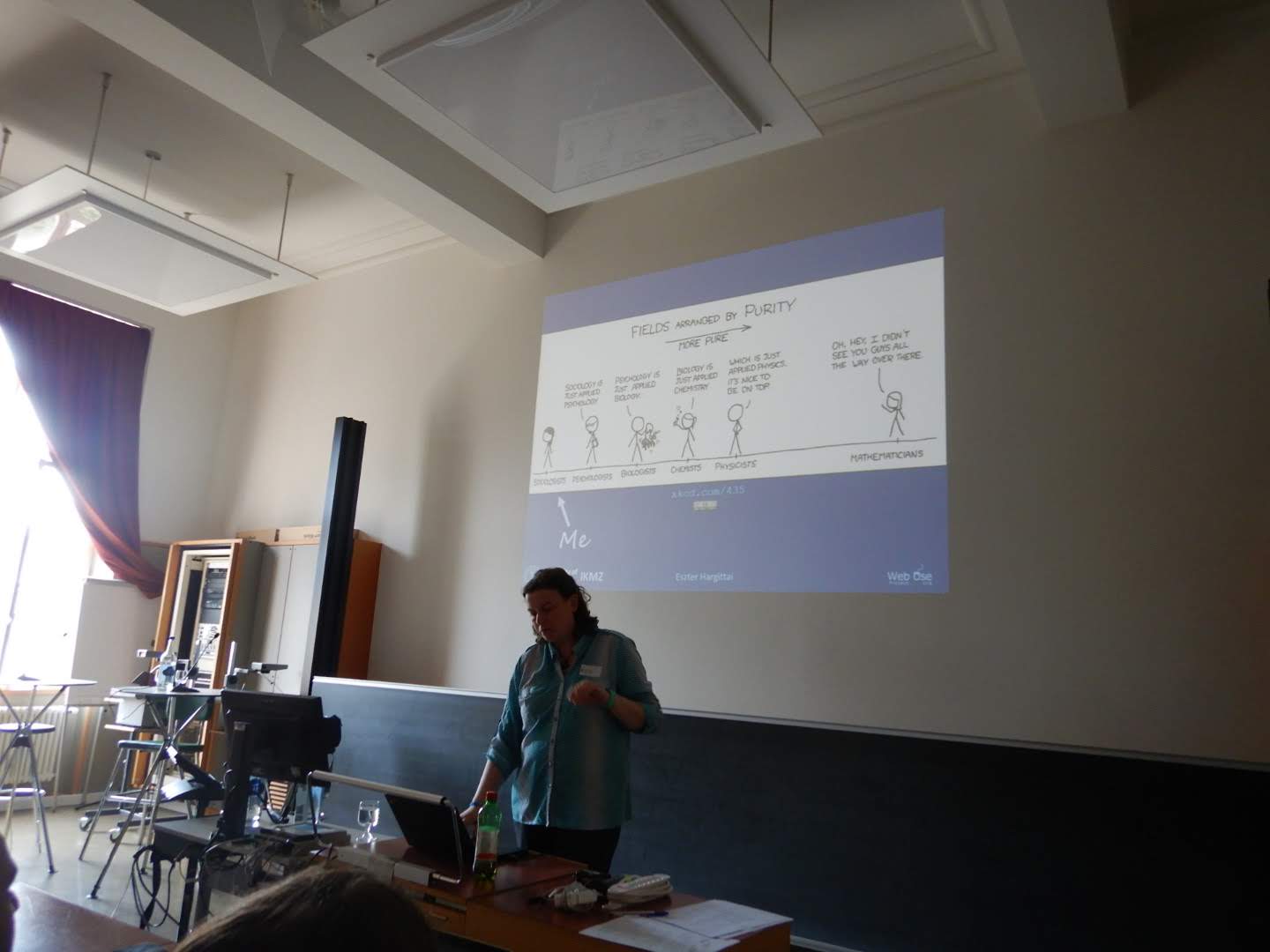
Eszter Hargitti – U of Zurich

  • Awareness of what is possible
  • The ability to create and share content
  • Wikigroan?
  • DSCN0353DSCN0354DSCN0355

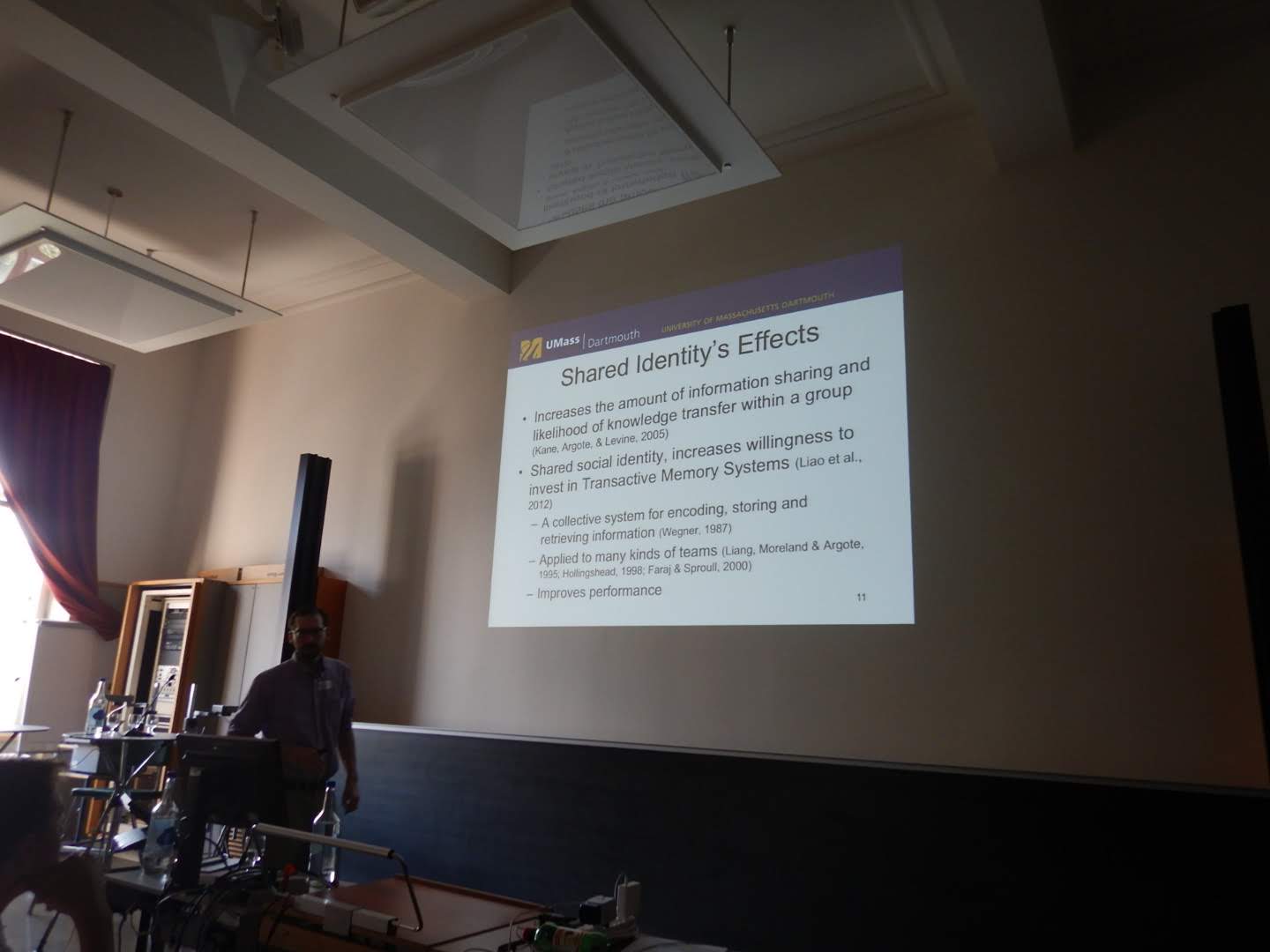
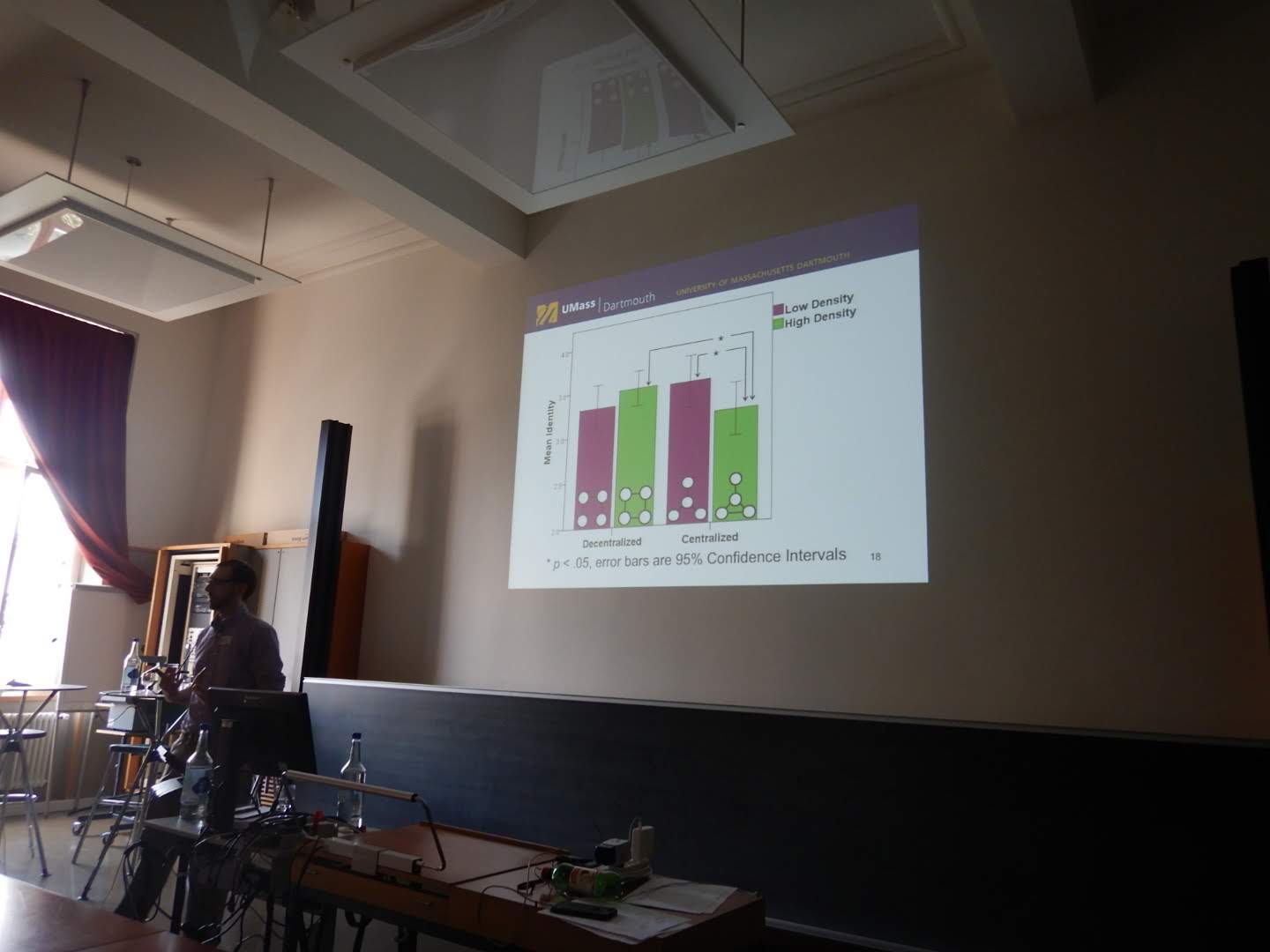
When Ties Bind And When Ties Divide: The Effects Of Communication Networks On Group Processes And Performance DSCN0356.JPG_1DSCN0357.JPG_2

  • Network structural variance

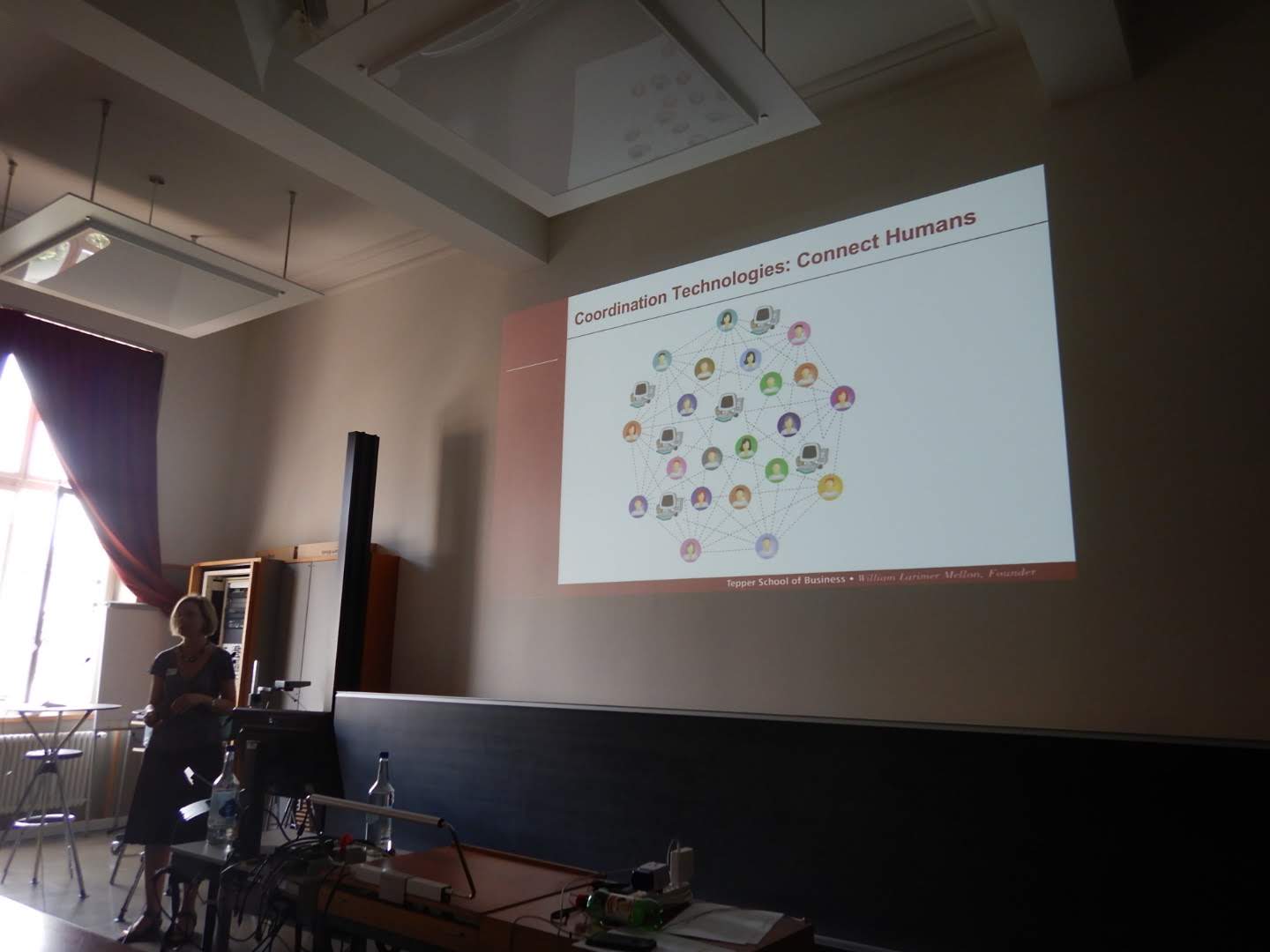
Enhancing Collective Intelligence of Human-Machine Teams DSCN0358DSCN0359

  • Cognitive and ethnic diversity predict collective intelligence
  • Group structure, high level communication and equality of communication
  • It’s the quality of the individuals and the quality of the connections
  • Coordination technologies – connect humans

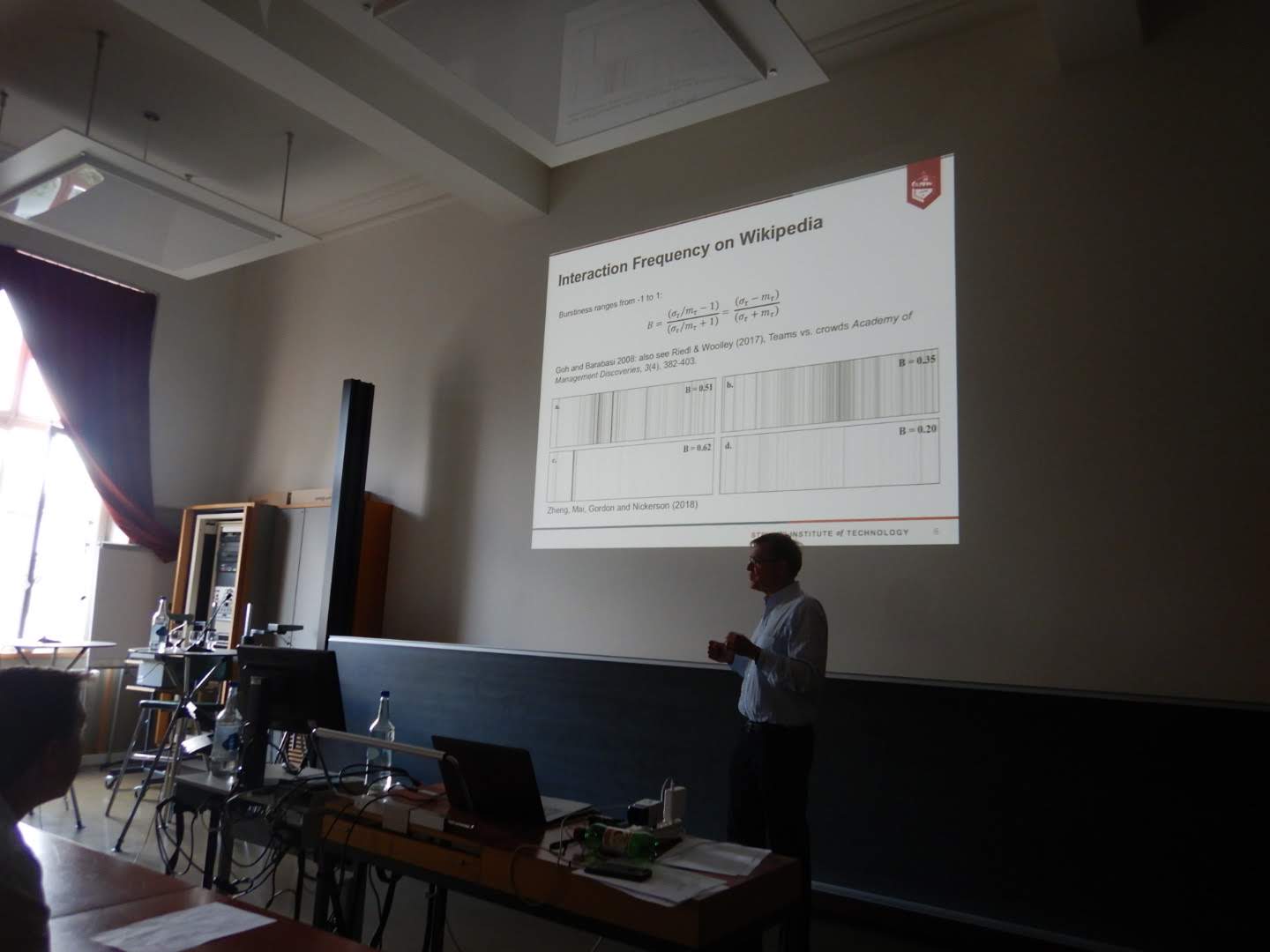
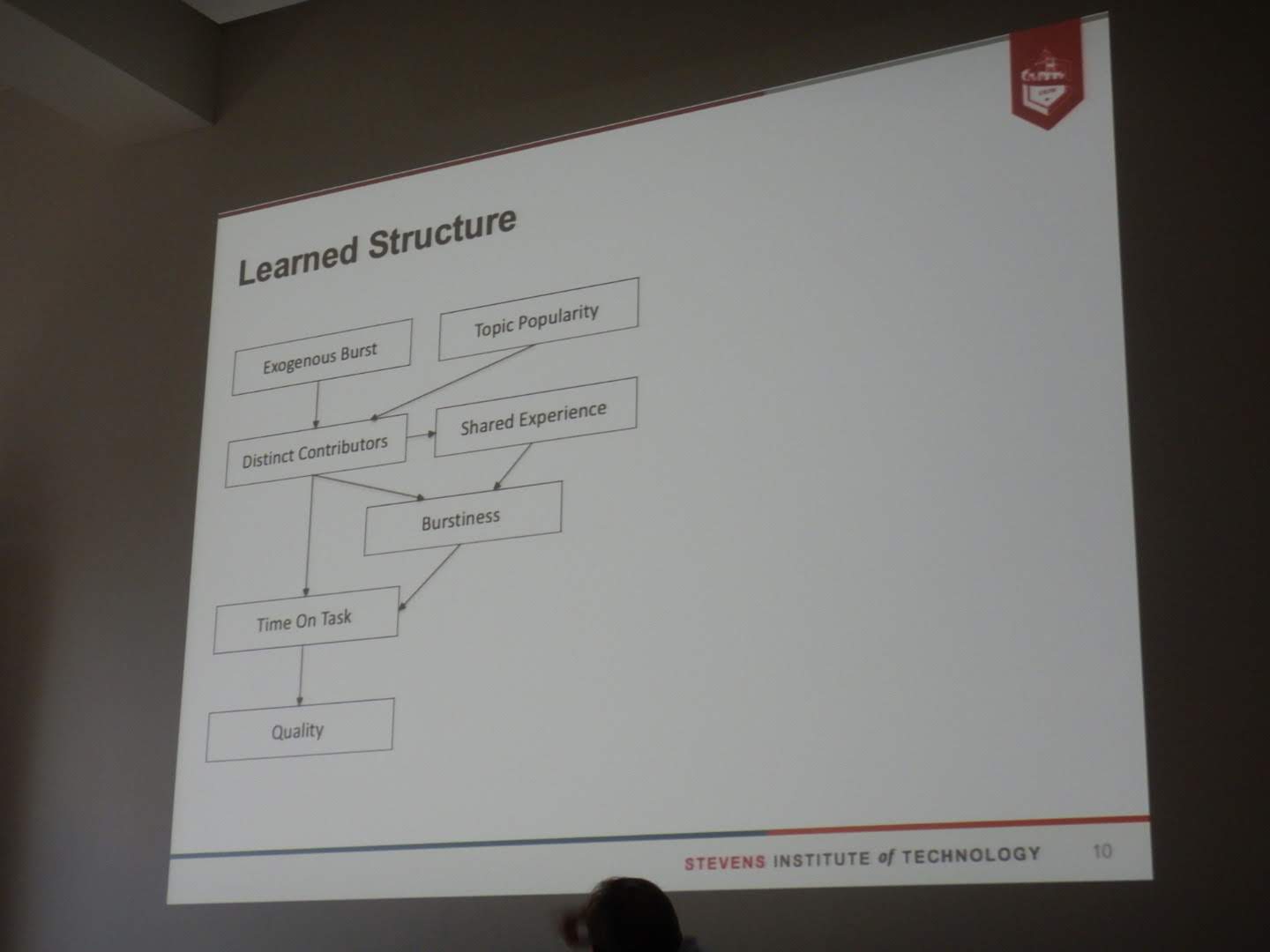
Implicit Coordination in Peer Production Networks DSCN0360DSCN0361DSCN0362DSCN0363

Collective Intelligence Systems for Analogical Search (must read! Joel Chan is at UMD)

  • Really interesting, worth reading. Purpose and mechanism may be related to belief spaces. Definitely trainable using NN to find purpose mechanism

Rational Collective Learning in the Laboratory

  • Groupthink. as a failure of design
  • Randomy constructed groups can make good design choices given failing parts with a history.

Phil 7.7.18

8:00 – 9:00 ASRC MKT

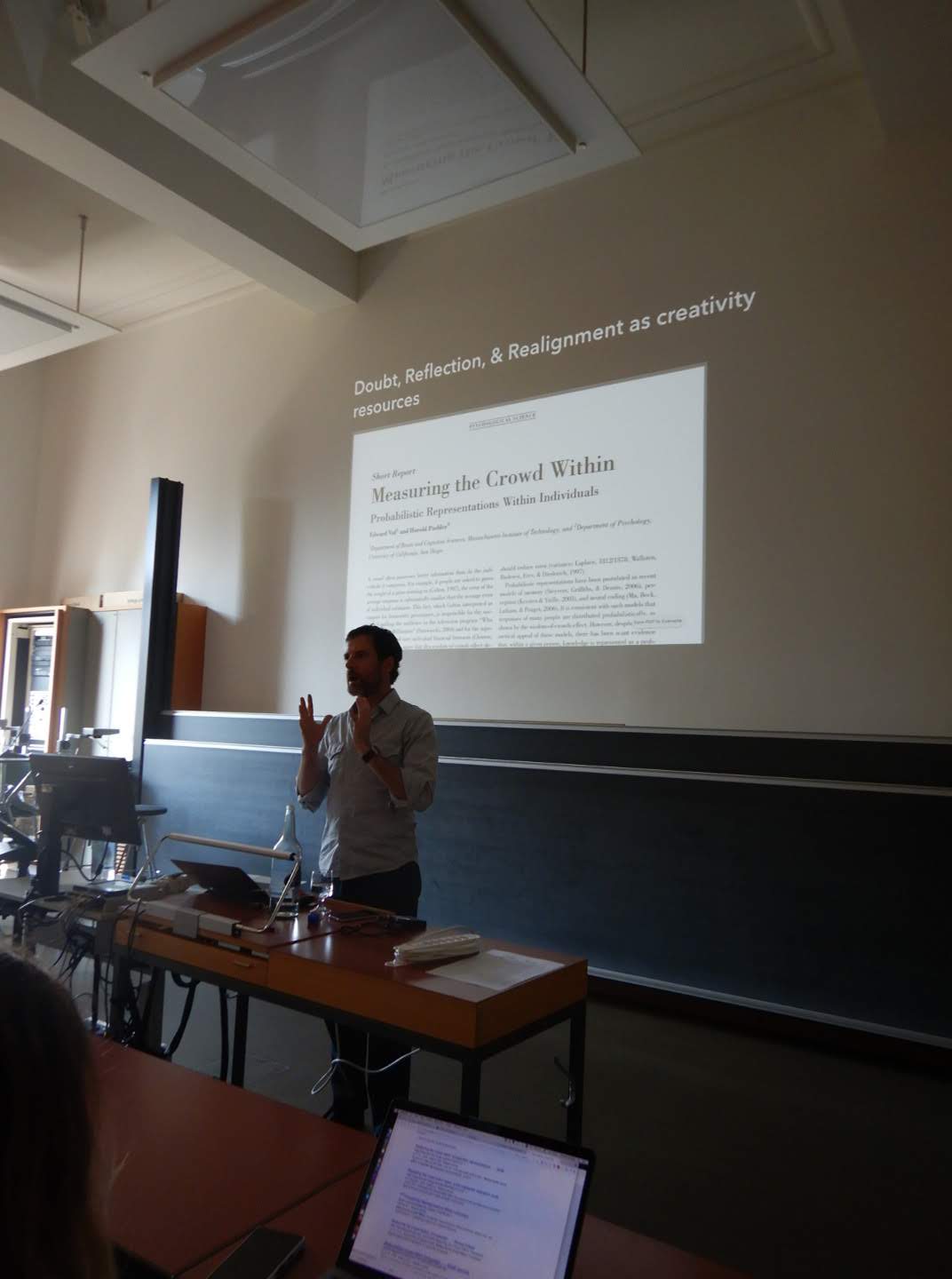
  • At CI 2018. Hell of a time setting up eduroam. Nice venue, though. Winston Churchill called for the unification of Europe from that podium. Probably without PowerPoint DSCN0310
  • Patrick Meier – keynote – Digital humanitarian efforts
    • Mission is to pioneer the next generation of humanitarian technology
    • DSCN0313
    • DSCN0315
  • Poster pitches
    • Multiple barriers to crowdsourcing, ranging from operational to strategic
    • Anita Wollie – trust in AI Embedded agency, Virtual agency, Physical Agency
    • Croudoscope – qualitative and quantitative surveys – open coments. Not lists, but graphs
    • Market volitility with High-Frequency trading an hmans
    • How many people constitutes a ‘crowd’
    • Is novelty an advantage in crowdfunding
    • QUEST – annotating questions on stackoverflow-style probles’
    • Cyber-physical systems – e.g. smart transportation systems
  • Papers
  • Keynote 2
    • Optimizing the Human-Machine Partnership with Zooniverse DSCN0321 DSCN0322
      • Lucy Fortson
      • Galaxy Zoo
      • Zooniverse is on its third iteration and now supports project building
      • Can also point to a project
  • Session 2
    • Collective Intelligence for Deep Reinforcement Learning (MIT, mostly)
      • Evolutionary strategies (Salimans 2017) DSCN0327
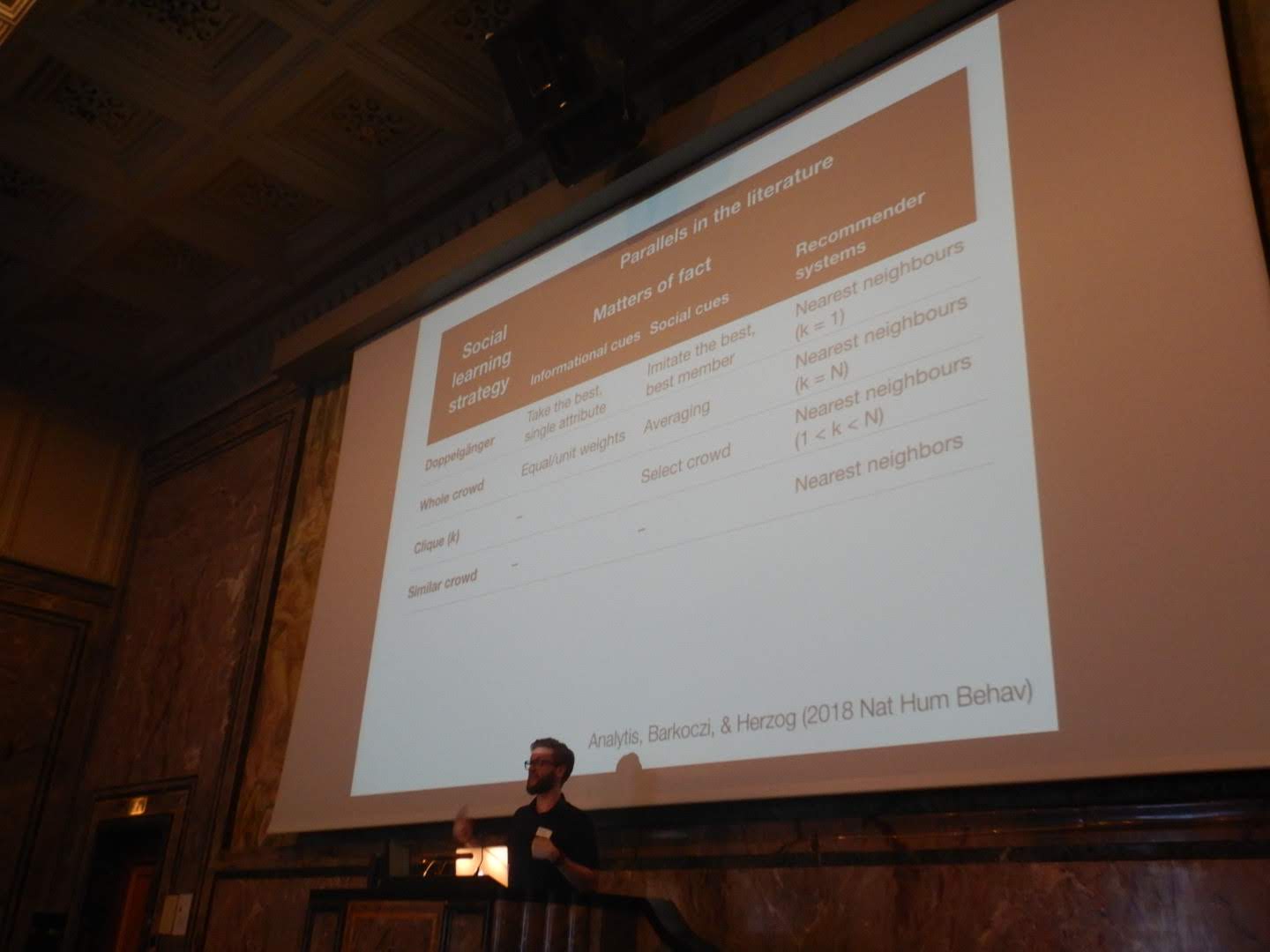
    • Social learning strategies for matters of taste (This is a must-read!)
      • DSCN0326DSCN0325DSCN0324
    • Photo Sleuth: Combining Collective Intelligence and Computer Vision to
      Identify Historical Portraits

      • Good discussion of how to blend human and ML person identification
    • Toward Safer Crowdsourced Content Moderation
    • How Intermittent Breaks in Interaction Improve Collective

Phil 7.1.18

On vacation, but oddly enough, I’m back on my morning schedule, so here I am in Bormio, Italy at 4:30 am.

I forgot my HDMI adaptor for the laptop. Need to order one and have it delivered to Zurich – Hmmm. Can’t seem to get it delivered from Amazon to a hotel. Will have to buy in Zurich

Need to add Gamerfate to the lit review timeline to show where I started to get interested in the problem – tried it but didn’t like it. I’d have to redo the timeline and I’m not sure I have the excel file

Add vacation pictures to slides – done!

Some random thoughts

  • When using the belief space example of the table, note that if we sum up all the discussions about tables, we would be able to build a pretty god map of what matters to people with regards to tables
  • Manifold learning is what intelligent systems do as a way of determining relationships between things (see curse of dimensionality). As groups of individuals, we need to coordinate our manifold learning activities so that we can us the power of group cognition. When looking at how manifold learning schemes like t-sne and particularly embedding systems such as word2vec create their own unique embeddings, it becomes clear that our machines are not yet engaged in group cognition, except in the simplest way of re-using trained networks and copied hyperparameters. This is very prone to stampedes
  • In conversation at dinner, Mike M mentioned that he’d like a language app that is able to indicate the centrality of a term an order that list so that it’s possible to learn a language in a “prioritized” way that can be context-dependent. I think that LMN with a few tweaks could do that.

Continuing the Evolution of Cooperation. A thing that strikes me is that once a TIT FOR TAT successfully takes over, then it becomes computationally easier to ALWAYS COOPERATE. That could evolve to become dominant and be completely vulnerable to ALWAYS DEFECT

Phil 6.27.18

7:00 – 12:00 ASRC MKT

  • Print out documents! Done. Got passport drive too.
  • Need to write an extractor that lets the user navigate the xml file containing influences of selected agents. This could be a sample-by sample network. Maybe two modes?
    • Select an agent and see all the other agents come in and out of influcene
    • Select an number of agents and only watch the mutual influence.
    • There is an integrated JavaFX charts that I could use, or it could be an uploaded webapp? JavaFX would be easier in the short term, but a webapp would help more with JuryRoom…
    • Another option would be Python, since that’s where the LSTM code will live.
    • On the whole, two days before leaving on travel is probably the wrong time to start coding
  • Fixed a bug in the xml file generation
  • copied the new jar file onto the thumb drive
  • copied the xml file onto the thumb drive

12:00 – 4:00 ASRC A2P

  • Pomoting things to QA – done! Or at least, up to date with the excel files

Phil 6.23.18

Registered for SASO

ArXive papers with Github repos

Mapping interest communities in Russian Facebook Ads. Preliminary visualisation reveals a number of broad interest groups around ethnicity; reveals a bit of Internet Research Agency’s strategy...

  • Dr Bharath Ganesh
    • Bharath is a political geographer focusing on data science and local government and the ethics and politics of researching violent online extremism.

More good stuff from Ian Couzin

  • Revealing the hidden networks of interaction in mobile animal groups allows prediction of complex behavioral contagion
    • We know little about the nature of the evolved interaction networks that give rise to the rapid coordinated collective response exhibited by many group-living organisms. Here, we study collective evasion in schooling fish using computational techniques to reconstruct the scene from the perspective of the organisms themselves. This method allows us to establish how the complex social scene is translated into behavioral response at the level of individuals and to visualize, and analyze, the resulting complex communication network as behavioral change spreads rapidly through groups. Thus, we can map, for any moment in time, the extent to which each individual is socially influential during collective evasion and predict the magnitude of such behavioral epidemics before they actually occur

This playlist contains tutorials to learn how to use Keras, a neural network API written in Python. Each video focuses on a specific concept and shows how the full implementation is done in code using Keras and Python.


Phil 6.21.18

7:00 – 4:00 ASRC MKT

  • Add an attractor scalar for agents that’s normally zero. A vector to each agent within the SIH is calculated and scaled by the attractor scalar. That vector is then added to the direction vector to the agent – done
  • Remove the heading influence based on site – done
  • Add a white circle to the center of the agent that is the size of the attraction scalar. Done
  • Add attraction radius slider that is independent of the SIH. -done
  • Add a ‘site trajectory’ to the spreadsheet that will have the site lists (and their percentage?)
  • There is now an opportunity for a poster and a demo at SASO
  • Add stories, lists and maps to implication slides – done
  • Got all my connections set up
  • Successfully converted and deployed cosmos-2
  • Voted!

Phil 6.14.18

7:00 – ASRC MKT

  • dads taxes!
  • Rolled in Aaron’s corrections. Spell check doesn’t seem to work as well in captions?
  • Put together beginnings of the LaTex presentation
  • Slides
  • Fika burgers & bowling

Phil 6.13.18

7:00 – 4:00 ASRC MKT

  • International driver’s license – done
  • Add visually-impaired labels to paper – done
  • Start slides
  • Interesting article on dimension reduction: The faces of God in America: Revealing religious diversity across people and politics What strikes me about this study is actually how similar the depictions are. In belief space, this would be a closely woven neighborhood. It would be interesting to see an equivalent study on a less anthropomorphic deity like Vishnu… journal.pone.0198745.g002
    • Literature and art have long depicted God as a stern and elderly white man, but do people actually see Him this way? We use reverse correlation to understand how a representative sample of American Christians visualize the face of God, which we argue is indicative of how believers think about God’s mind. In contrast to historical depictions, Americans generally see God as young, Caucasian, and loving, but perceptions vary by believers’ political ideology and physical appearance. Liberals see God as relatively more feminine, more African American, and more loving than conservatives, who see God as older, more intelligent, and more powerful. All participants see God as similar to themselves on attractiveness, age, and, to a lesser extent, race. These differences are consistent with past research showing that people’s views of God are shaped by their group-based motivations and cognitive biases. Our results also speak to the broad scope of religious differences: even people of the same nationality and the same faith appear to think differently about God’s appearance.
  • Finished paper
  • Working on talk

personal

  • Shopping – done
  • taxes
  • laundry – done
  • generator/un-grounded short extension cord – done. Works!