Author Archives: pgfeldman

Phil 10.15.18

7:00 – ASRC BD

  • Heard about some interesting things this morning on BBC Business Daily – Is the Internet Fit for Purpose?:
    • Future in Review Conference: The leading global conference on the intersection of technology and the economy. New partnerships, projects, and plans you can’t afford to miss. If your success depends on having an accurate view of the future, or you’d like to meet others who are able and motivated to forge action-based alliances, this is the most important conference you will attend. Be one of the thought leaders in the FiRe conversation, analyzing and creating the future of technology, economics, pure science, the environment, genomics, education, and more.
    • Berit Anderson. Created the science fact/fiction magazine Scout, which, interestingly enough, has a discussion space for JuryRoom-style questions
  • More DARPA proposal

Phil 8.11.18

7:00 – ASRC BD

  • Finishing up notes on the Evolution of Cooperation
  • More proposal writing. Come at it from the creation of belief space maps, the benefits they provide in uncertain information (prediction, known topography, etc), what it takes to create them, and how they integrate with GIS
  • 10:00 – 12:00 Will’s proposal
  • haircut!
  • 4:00 flu shot
  • plot2In this codebook we will investigate the macro-structure of philosophical literature. As a base for our investigation I have collected about fifty-thousand records from the Web of Science collection, spanning from the late forties to this very day.

Phil 10.10.18

7:00 – 4:30 ASRC BD

  • Starting to add content to the proposal. Going to put together a section on game theory that ties together Beyond Individual Choice, The Evolution of Cooperation, and Consensus and Cooperation in Networked Multi-Agent Systems
    • Got some good writing done, but didn’t upload!
  • And also, voter influencing from this post
  • And I just saw this! Structure of Decision: The Cognitive Maps of Political Elites. It’s another book by Robert Axelrod. Ordered.
  • Putting together my notes on the Evolution of Cooperation. Can’t believe I haven’t done that yet
  • Got a good response from Antonio. Need to respond
  • Found some good stuff on market-oriented programming for Antonio’s workshop. The person who seems to really own this space is Michael Wellman (Scholar). Downloaded several of his papers.
  • From Benjamin Schmidt, via Twitter:
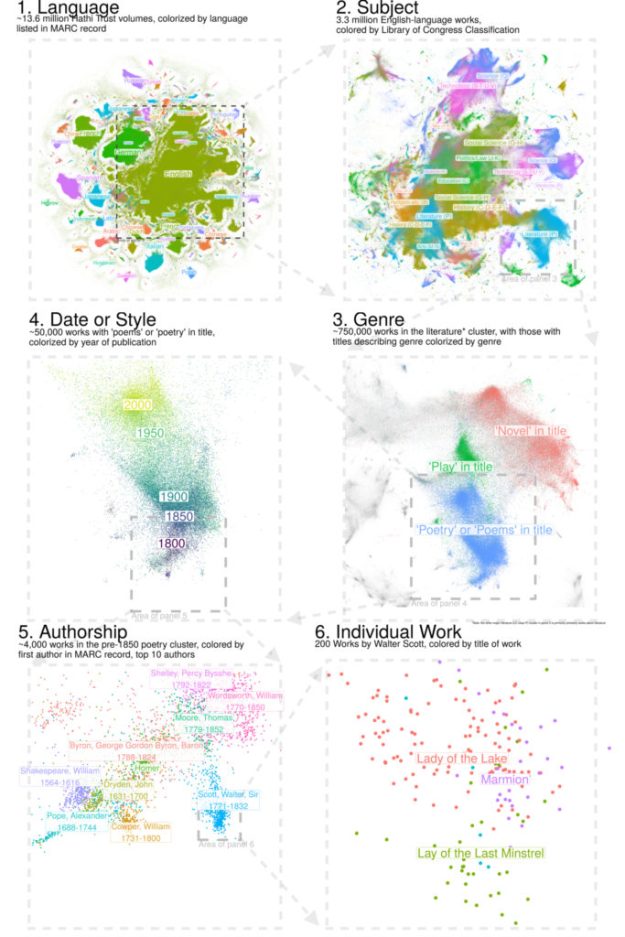
    • I have a new article in CA on dimensionality reduction for digital libraries. . Let me walk through one figure, Eames power-of-10 style, that shows a machine clustering of all 14 million books in the collection–including most of the books you’ve read.
    • 1-hathi_zoom_marked-683x1024 This is very close to mapping as I understand it. There is the ability to zoom in and out at different levels of structure. His repo is here, but its for [R]
    • Random Projection in Scikit-learn
    • Here’s the paper its based on: Visualizing Large-scale and High-dimensional Data
      • We study the problem of visualizing large-scale and high-dimensional data in a low-dimensional (typically 2D or 3D) space. Much success has been reported recently by techniques that first compute a similarity structure of the data points and then project them into a low-dimensional space with the structure preserved. These two steps suffer from considerable computational costs, preventing the state-of-the-art methods such as the t-SNE from scaling to large-scale and high-dimensional data (e.g., millions of data points and hundreds of dimensions). We propose the LargeVis, a technique that first constructs an accurately approximated K-nearest neighbor graph from the data and then layouts the graph in the low-dimensional space. Comparing to t-SNE, LargeVis significantly reduces the computational cost of the graph construction step and employs a principled probabilistic model for the visualization step, the objective of which can be effectively optimized through asynchronous stochastic gradient descent with a linear time complexity. The whole procedure thus easily scales to millions of high-dimensional data points. Experimental results on real-world data sets demonstrate that the LargeVis outperforms the state-of-the-art methods in both efficiency and effectiveness. The hyper-parameters of LargeVis are also much more stable over different data sets.

Phil 10.9.18

7:00 – 4:00 ASRC BD

  • Drive to work in Tesla. Ride to pick up Porsche lunch-ish. Drive home with bike. Ride to work. Drive home with bike. Who knew that the Towers of Hanoi would be such practical training?
  • Finish Antonio response and send it off. I think it needs a discussion of the structure of the paper and who is responsible for which section to be complete.
  • Artificial Intelligence and Social Simulation: Studying Group Dynamics on a Massive Scale
    • Recent advances in artificial intelligence and computer science can be used by social scientists in their study of groups and teams. Here, we explain how developments in machine learning and simulations with artificially intelligent agents can help group and team scholars to overcome two major problems they face when studying group dynamics. First, because empirical research on groups relies on manual coding, it is hard to study groups in large numbers (the scaling problem). Second, conventional statistical methods in behavioral science often fail to capture the nonlinear interaction dynamics occurring in small groups (the dynamics problem). Machine learning helps to address the scaling problem, as massive computing power can be harnessed to multiply manual codings of group interactions. Computer simulations with artificially intelligent agents help to address the dynamics problem by implementing social psychological theory in data-generating algorithms that allow for sophisticated statements and tests of theory. We describe an ongoing research project aimed at computational analysis of virtual software development teams.
    • This appears to be a simulation/real world project that models GitHub groups
  • Continue BAA work? I need to know what Matt’s found out about the topic.
    • Some good discussion. Got his email of notes from his meeting with Steve
    • Created a “Disruptioneering technical” template
    • Copied template and stated filling in sections for technical
  • DARPA announced its new initiative, AI Next, which will invest $2 billion in AI R&D to explore how machines can acquire human-like communication and reasoning capabilities, with the ability to recognize new situations and environments and adapt to them.” Since fiscal 2017, DARPA has stepped up its investment in artificial intelligence by almost 50 percent, from $307 million to $448 million.
  • DARPA’s move follows the Pentagon’s June decision to launch a $1.7 billion Joint Artificial Intelligence Center, or JAIC (pronounced “Jake”), to promote collaboration on AI-related R&D among military service branches, the private sector, and academia. The challenge is to transform relatively smaller contracts and some prototype systems development into large scale field deployment.

Phil 10.8.18

7:00 – 12:00, 2:00 – 5:00 ASRC Research

  • Finish up At Home in the Universe notes – done!
  • Get started on framing out Antonio’s paper – good progress!
    • Basically, Aaron and I think there is a spectrum of interaction that can occur in these systems. At one end is some kind of market, where communication is mediated through price, time, and convenience to the transportation user. At the other is a more top down, control system way of dealing with this. NIST RCS would be an example of this. In between these two extremes are control hierarchies that in turn interact through markets
  • Wrote up some early thoughts on how simulation and machine learning can be a thinking fast and slow solution to understandable AI

Phil 10.5.18

7:00 – 5:00 ASRC MKT

  • Seasucker.com for roof racks?
  • Continuing to write up notes from At Home in the Universe.
  • Discussion with Matt about the deliverables for the Serial Interactions in Imperfect Information Games Applied to Complex Military Decision-Making (SI3-CMD) request
  • DARPA proposal template
  • Resized images for Aaron
  • Biodiversity and the Balance of Nature
    • As we destroy biological diversity, what else are we doing to the environment, what is being changed, and how will those changes affect us? One part of the answers to these questions is provided by Lawton and Brown’s consideration of redundancy (Chap. 12). Part of what the environment does for us involves “ecosystem services” — the movement of energy and nutrients through the air, water, and land, and through the food chains (Ehrlich, Foreword). Just how much biological diversity we need to keep the movement at approximately natural levels is a question of critical importance. Nonetheless, it is not a question that is commonly asked. A major synthesis of theories on the dynamics of nutrient cycling (DeAngelis 1991) devotes little space to the consequences of changes in the numbers of species per trophic level: It is the number of trophic levels that receives the attention. One might well conclude that, over broad limits, ecosystem services will continue to be provided, so long as there are some plants, some animals, some decomposers, and so on. Lawton and Brown conclude that numerous species are redundant.

Phil 10.4.18

7:00 – 5:30 ASRC MKT

  • Join PCA! Write classified! Done
  • There are 56 work days until Jan 1. My 400 hours is 50 days. So I go full time on research around the 22nd.
  • Got a note from Wayne saying that there were 25 blue sky papers and 3 slots. THat might me expanded to 6 slots
  • Write up notes on “At Home in the Universe” – started
  • Finish speaking notes for BAA – Done
  • Matt found a couple of things that might be good. One is due on October 16th, which is waaaaaaaaaaaaayyyyyyyy too tight.
  • Looked at the Health.mil Connected Health clearinghouse effort and website. It sounds a lot like a military version of PubMed, with the ability to request reports on demand, plus some standardized reports as well. These reports seem to source back to other agencies like the CDC, with external SMEs.

Phil 10.3.18

7:00 – 5:30 ASRC MKT

  • Finished At Home in the Universe. Really good. I’ll work on writing up notes this evening. The Kindle clippings feature is awesome
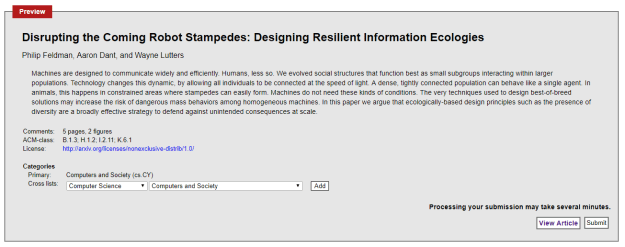
  • The stampeding robots paper is up on ArXiv: Disrupting the Coming Robot Stampedes: Designing Resilient Information Ecologies
  • Dopamine modulates novelty seeking behavior during decision making.
  • Need to finish Antonio’s paper, but my sense at this point is to add our work as a discussion of edge conditions that come up in the discussion section?
    • Done. Sent a letter discussing NIST RCS
  • Need to write up the fitness landscape thoughts. One axis is distance to model which is has a decay radius from each agent. Another axis is the price of an item(with future discounting?). Another axis is cost by agent to acquire the item. Cluster behavior emerges from local agents trying to find the best model and acquire the most value? There is also some kind of explicit connection between individuals that needs to be handled (a tanker and a plane have a client-server relationship that requires them to move in a coordinated way)
    • There is also information that is within the agents, and information that is in the environment. There may be other types of information as well.
  • Get Matt rolling on the whitepaper? – done!
  • Watson backend to A2P?
  • Kibitzed Aaron on how to access style sheets
  • Got about halfway through speaking notes on Army BAA

Phil 10.2.18

7:00 – 5:00 ASRC Research

  • Graph laplacian dissertation
    • The spectrum of the normalized graph Laplacian can reveal structural properties of a network and can be an important tool to help solve the structural identification problem. From the spectrum, we attempt to develop a tool that helps us to understand the network structure on a deep level and to identify the source of the network to a greater extent. The information about different topological properties of a graph carried by the complete spectrum of the normalized graph Laplacian is explored. We investigate how and why structural properties are reflected by the spectrum and how the spectrum changes when compairing different networks from different sources.
  • Universality classes in nonequilibrium lattice systems
    • This article reviews our present knowledge of universality classes in nonequilibrium systems defined on regular lattices. The first section presents the most important critical exponents and relations, as well as the field-theoretical formalism used in the text. The second section briefly addresses the question of scaling behavior at first-order phase transitions. In Sec. III the author looks at dynamical extensions of basic static classes, showing the effects of mixing dynamics and of percolation. The main body of the review begins in Sec. IV, where genuine, dynamical universality classes specific to nonequilibrium systems are introduced. Section V considers such nonequilibrium classes in coupled, multicomponent systems. Most of the known nonequilibrium transition classes are explored in low dimensions between active and absorbing states of reaction-diffusion-type systems. However, by mapping they can be related to the universal behavior of interface growth models, which are treated in Sec. VI. The review ends with a summary of the classes of absorbing-state and mean-field systems and discusses some possible directions for future research.
  • “The Government Spies Using Our Webcams:” The Language of Conspiracy Theories in Online Discussions
    • Conspiracy theories are omnipresent in online discussions—whether to explain a late-breaking event that still lacks official report or to give voice to political dissent. Conspiracy theories evolve, multiply, and interconnect, further complicating efforts to limit their propagation. It is therefore crucial to develop scalable methods to examine the nature of conspiratorial discussions in online communities. What do users talk about when they discuss conspiracy theories online? What are the recurring elements in their discussions? What do these elements tell us about the way users think? This work answers these questions by analyzing over ten years of discussions in r/conspiracy—an online community on Reddit dedicated to conspiratorial discussions. We focus on the key elements of a conspiracy theory: the conspiratorial agents, the actions they perform, and their targets. By computationally detecting agent–action–target triplets in conspiratorial statements, and grouping them into semantically coherent clusters, we develop a notion of narrative-motif to detect recurring patterns of triplets. For example, a narrative-motif such as “governmental agency–controls–communications” appears in diverse conspiratorial statements alleging that governmental agencies control information to nefarious ends. Thus, narrative-motifs expose commonalities between multiple conspiracy theories even when they refer to different events or circumstances. In the process, these representations help us understand how users talk about conspiracy theories and offer us a means to interpret what they talk about. Our approach enables a population-scale study of conspiracy theories in alternative news and social media with implications for understanding their adoption and combating their spread
  • Need to upload to ArXiv (try multiple tex files) – done!Arxiv
  • If I’m charging my 400 hours today, then start putting together text prediction. I’d like to try the Google prediction series to see what happens. Otherwise, there are two things I’d like to try with LSTMs, since they take 2 coordinates as inputs
    • Use a 2D embedding space
    • Use NLP to get a parts-of-speech (PoS) analysis of the text so that there can be a (PoS, Word) coordinate.
    • Evaluate the 2 approaches on their ability to converge?
  • Coordinating with Antonio about workshops. It’s the 2019 version of this: International Workshop on Massively Multi-Agent Systems (MMAS2018) in conjunction with IJCAI/ECAI/AAMAS/ICML 2018

Phil 10.1.18

7:00 – 8:30 ASRC MKT?

  • Last Friday, Aaron was told by division leadership (Mike M) that R&D is being terminated as of Jan 1st and to get on billable projects. This is going against our impression of how things were going, so it’s unclear what will actually happen. So I’m not looking for a job just yet… Personally, I blame putting a deposit down on this: Tesla3
  • This looks interesting:
    • Launched in October 2015 by founding editor Robert Kadar with support from Joe Brewer, David Sloan Wilson, The Evolution Institute, and Steve Roth — who now serves as publisher — Evonomics has emerged as a powerful voice for the sea change that is sweeping through economics.
  • Working my way through At Home in the Universe
    • Fontana Lab
      • Molecular biology offers breathtaking views of the parts and processes that undergird life and its evolution. It is vexing, then, that we seem unable to analytically grasp the principles that would make the nature of cellular phenotypes more intelligible and their control more deliberate. One can always blame insufficient knowledge, but we also entertain the idea that physics and chemistry need formal and conceptual enrichment from computer science to become an appropriate foundation for systems biology. This view arises from the belief that computation is a natural phenomenon, like gravity or boiling water. We need adequate formalisms and models to reason about computation in the wild.This view guides many of our lab’s interests, which span the development and application of rule-based formalisms for modeling complex systems of molecular interaction, causality in concurrent systems, the interplay between network growth and network dynamics, phenotypic plasticity and evolvability, learning, and aging. Our approach is computational and theoretical. In the past we also conducted experimental work using C. elegans as a model system. Outside collaborations are essential to our group. The size of our team can fluctuate considerably, as we chase grants in pursuit of our passions, not opportunistically. Read more about our research.
  • Due date for the iConference Paper. Submitted last night just to be safe, but I expect to tweak today.
    • incorporating Wayne’s changes
    • Final push with Wayne on campus
    • Done! Submitted
    • Need to upload to ArXive (try multiple tex files)
  • From The Atlantic – stampede end condition:
    • It is impossible at this moment to envisage the Republican Party coming back. Like a brontosaurus with some brain-eating disorder it might lumber forward in the direction dictated by its past, favoring deregulation of businesses here and standing up to a rising China there, but there will be no higher mental functioning at work. And so it will plod into a future in which it is detested in a general way by women, African Americans, recent immigrants, and the educated young as well as progressives pure and simple. It might stumble into a political tar pit and cease to exist or it might survive as a curious, decaying relic of more savage times and more primitive instincts, lashing out and crushing things but incapable of much else.

Phil 9.28.18

7:30 – 4:00 ASRC MKT

  • Stumbled on this podcast this morning: How Small Problems Snowball Into Big Disasters
  • How to Prepare for a Crisis You Couldn’t Possibly Predict
  • I’m trying to think about how this should be applied to human/machine ecologies. I think that simulation is really important because it lets one model patch compare itself against another model without real-world impacts. This has something to do with a shared, multi-instance environment simulation as well. The environment provides one level of transparent interaction, but there also needs to be some level of inadvertent social information that shows some insight into how a particular system is working.
    • When the simulation and the real world start to diverge for a system, that needs to be signaled
    • Systems need to be able to “look into” other simulations and compare like with like. So a tagged item (bicycle) in one sim is the same in another.
    • Is there an OS that hands out environments?
    • How does a decentralized system coordinate? Is there an answer in MMOGs?
  • Kate Starbird’s presentation was interesting as always. We had a chance to talk afterwards, and she’d like to see our work, so I’ve sent her links to the last two papers.
    I also met Bill Braniff, who is the director of the UMD Study of Terrorism and responses to Terrorism. He got papers too, with a brief description about how mapping could aid in the detection of radicalization patterns
    Then at lunch, I had a chance to meet with Roger Bostelman from NIST. He’s interested in writing standards for fleet and swarm vehicles, and is interested in making sure that standards mitigate the chance of stampeding autonomous vehicles, so I sent him the Blue Sky draft.
    And lastly, I got a phone call from Aaron who says that our project will be terminated December 31, after which there will be no more IR&D at ASRC. It was a nice run while it lasted. And they may change their minds, but I doubt it.

Phil 9.27.18

7:00 – 6:00 ASRC MKT

  • Writing your own LaTex class
  • Multiple facets of biodiversity drive the diversity–stability relationship
    • A substantial body of evidence has demonstrated that biodiversity stabilizes ecosystem functioning over time in grassland ecosystems. However, the relative importance of different facets of biodiversity underlying the diversity–stability relationship remains unclear. Here we use data from 39 grassland biodiversity experiments and structural equation modelling to investigate the roles of species richness, phylogenetic diversity and both the diversity and community-weighted mean of functional traits representing the ‘fast–slow’ leaf economics spectrum in driving the diversity–stability relationship. We found that high species richness and phylogenetic diversity stabilize biomass production via enhanced asynchrony in the performance of co-occurring species. Contrary to expectations, low phylogenetic diversity enhances ecosystem stability directly, albeit weakly. While the diversity of fast–slow functional traits has a weak effect on ecosystem stability, communities dominated by slow species enhance ecosystem stability by increasing mean biomass production relative to the standard deviation of biomass over time. Our in-depth, integrative assessment of factors influencing the diversity–stability relationship demonstrates a more multicausal relationship than has been previously acknowledged.
  • Computer Algorithms, Market Manipulation and the Institutionalization of High Frequency Trading (adversarial herding?)
    • The article discusses the use of algorithmic models in finance (algo or high frequency trading). Algo trading is widespread but also somewhat controversial in modern financial markets. It is a form of automated trading technology, which critics claim can, among other things, lead to market manipulation. Drawing on three cases, this article shows that manipulation also can happen in the reverse way, meaning that human traders attempt to make algorithms ‘make mistakes’ by ‘misleading’ them. These attempts to manipulate are very simple and immediately transparent to humans. Nevertheless, financial regulators increasingly penalize such attempts to manipulate algos. The article explains this as an institutionalization of algo trading, a trading practice which is vulnerable enough to need regulatory protection.
  • Karin Knorr Cetina is interested in financial markets, knowledge and information, as well as in globalization, theory and culture. Her current projects include a book on global foreign exchange markets and on post-social knowledge societies. She continues to do research on the information architecture of financial markets, on their “global microstructures” (the global social and cultural form these markets take) and on trader markets in contrast to producer markets. She also studies globalization from a microsociological perspective, using an ethnographic approach, and she continues to be interested in “laboratory studies,” the study of science, technology and information at the site of knowledge production – particularly in the life sciences and in particle physics.
  • Reading A Sociology of Algorithms: High-Frequency Trading and the Shaping of Markets
    • Markets are politics,” (pg 8). I’d reverse that and say that politics are a market for power/influence, though that may be too glib.
    • three main types of algorithm discussed here (trading venues’ matching engines, which consummate trades; execution algorithms used by institutional investors to buy or sell large blocks of shares; and HFT algorithms), (pg 11)
    • a “lit” venue is one in which the electronic order book is visible to the humans and algorithms that trade on the venue; in a “dark” venue it is not visible.  (pg 11)
  • Meeting with USPTO folks. I went over their heads, but Aaron found the right level.

Phil 9.26.18

7:00 – 5:00 ASRC MKT

  • The Publisher’s Patron: How Google’s News Initiative Is Re-Defining Journalism
    • Facebook, Twitter, Amazon and Google – many tech companies are involved in journalism. A major force, however, is Google’s News Initiative. But where does Google’s money go? We can reveal that the typical recipient of Google funding is a commercial legacy institution in Western Europe. Meanwhile, non-profit news organisations and public-service media rarely receive funding. The only question is: what is Google trying to achieve with its sponsorship?
  • Introduction to Machine Learning for Coders: Launch
    • Today we’re launching our newest (and biggest!) course, Introduction to Machine Learning for Coders. The course, recorded at the University of San Francisco as part of the Masters of Science in Data Science curriculum, covers the most important practical foundations for modern machine learning. There are 12 lessons, each of which is around two hours long—a list of all the lessons along with a screenshot from each is at the end of this post.
    • There are some excellent machine learning courses already, most notably the wonderful Coursera course from Andrew Ng. But that course is showing its age now, particularly since it uses Matlab for coursework. This new course uses modern tools and libraries, including python, pandas, scikit-learn, and pytorch. Unlike many educational materials in the field, our approach is “code first” rather than “math first”. It’s well suited to people who are writing code every day, but perhaps aren’t practicing their math chops quite as often (although we do cover all the necessary theory when appropriate). Perhaps most importantly, this course is very opinionated—rather than being a complete survey of every type of model, we focus on those that really matter in practice.
  • Been thinking about libraries being a marker for production code, and it strikes me that GitHub could be a set of “conversations”. There are markers for popularity (pulls), and markers for quality (pushes). We know how many people are contributing (plus followers and following), and there are tags. There is also a marketplace now.  There is also an API. My sense is that it should be possible to build maps of:
    • Language relationships and use (X Y Z + color?)
    • Relationships within languages?
    • Cross-linked projects across languages
    • NLP analysis of README
  • There are also other types of measures of consensus like dependency graphs (who’s actually using) and releases (more info here)
  • More iConf paper – it’s the right length. Now tweaking
  • Put Zach on JuryRoom until he is moved to A2P?
  • Reading A Sociology of Algorithms: High-Frequency Trading and the Shaping of Markets
  • Reading Antonio’s ACM Paper. Surprising alignment with our work

Phil 9.25.18

7:00 – 5:00 ASRC MKT

  • Wayne’s notes from yesterday:
    • Part of the wrapper for this will be why these issues might matter for the iSchool’s research future. I can help with the framing there.
      Yikes, 4 pages in this format? That is nothing!
      Will really have to shave this down to the absolute minimum.
      To that end I think the scenarios get fleshed out in their fullest now to capture all of the ideas and then hacked brutally into 1-2 paragraphs.
      The abstract probably goes to 4 sentences.
      Images stay, but no larger.
      We’ll work this out, but, man, that is barely 1500 words. Who was thinking when they put this together? 😉
  • Want to redo the designed system chart so that the complexity zone is concave – done.
  • More writing. Figured out that cars would be crashing at a rate of 3-4/sec based on 2016 data. Yikes!
  • Worked with Aaron on response to Antonio’s proposal. IEEE Software is a “production” magazine. And a nice marker for production is what kind of libraries are available, because then articles can be written on how to use them.
  • Kate Starbird this Friday! 10:00am – 12:00pm 2119 Hornbake Library South Wing
  • There is a world nomad games