Author Archives: pgfeldman

Phil 1.22.20

7:00 – 6:00 ASRC GOES

Check Copenhagen Wheel serial number for this recall

Contact Dreamhost about missing folders – done Fixed!

Phil 1.21.20

7:00 – 6:00 ASRC GOES

  • Dissertation
    • Chasing TODOs
    • TODO: Add transition paragraph (ch_background.tex) – done
    • TODO: stiff, moving platform (ch_background.tex) – done
    • TODO: clarify multicellular vs individuals vs dangerous stampedes Connect the lists. (sec_biological_basis.tex) – done
  • GSAW prep
    • Tix and hotel
  • TF Dev Conf
    • Tix and hotel

Phil 1.20.20

Transformers from Scratch

  • Transformers are a very exciting family of machine learning architectures. Many good tutorials exist, but in the last few years transformers have mostly become simpler, so that it is now much more straightforward to explain how modern architectures work. This post is an attempt to explain directly how modern transformers work, and why, without some of the historical baggage.

Dissertation

  • Folding in Wayne’s edits
    • Made the Arendt paragraph of velocity less reflective and more objective.
    • TODO: Defend facts to opinion with examples of language, framing, what is interesting, etc.-done
    • TODO: Heavy thoughts, light and frivolous, etc. We ascribe these, but they are not there – done
    • TODO: We have a MASSIVE physical bias. Computers don’t. Done
    • TODO: COmputers and people must work together
  • Title case all refs (Section, Table, etc) – done
  • \texttt all urls (reddit, etc) – done
  • search for and / or slashes
  • Fix underlines as per here– done!
    % for better underlining
    \usepackage[outline]{contour}
    \usepackage{ulem}
    \normalem % use classical emph
    
    \newcommand \myul[4]{%
    	\begingroup%
    	\renewcommand \ULdepth {#1}%
    	\renewcommand \ULthickness {#2}%
    	\contourlength{#3}%
    	\uline{\phantom{#4}}\llap{\contour{white}{#4}}%
    	\endgroup%
    }


Phil 1.17.20

An ant colony has memories that its individual members don’t have

  • Like a brain, an ant colony operates without central control. Each is a set of interacting individuals, either neurons or ants, using simple chemical interactions that in the aggregate generate their behaviour. People use their brains to remember. Can ant colonies do that? 

7:00 – ASRC

  •  Dissertation
    • More edits
    • Changed all the overviews so that they also reference the section by name. It reads better now, I think
    • Meeting with Thom
  • GPT-2 Agents
  • GSAW Slide deck

Phil 1.16.20

Optuna: An open source hyperparameter optimization framework to automate hyperparameter search

  • Medium writeup. It looks like this is Bayesian, and is better than hyperopt?

7:00 – 5:00 ASRC GOES

  • Dissertation
    • Starting to add Wayne’s comments
    • Finished the intro, starting motivation
  • NSOF Meeting with Isaac & Bruce
    • Still looking at the optimal scenario to use the current simulators (running over a weekend) to generate data
    • Data sets are used to train and evaluate, then progressively simplified until they can no longer recognize the source data. This will let us estimate the fidelity of the simulations we need.
  • JuryRoom meeting. Looking into adding UX faculty. Meeting is expanding to 6:00 – 8:00

Phil 1.15.20

I got invited to the TF Dev conference!

The HKS Misinformation Review is a new format of peer-reviewed, scholarly publication. Content is produced and “fast-reviewed” by misinformation scientists and scholars, released under open access, and geared towards emphasizing real-world implications. All content is targeted towards a specialized audience of researchers, journalists, fact-checkers, educators, policy makers, and other practitioners working in the information, media, and platform landscape.

  • For the essays, a length of 1,500 to 3,000 words (excluding footnotes and methodology appendix) is appropriate, but the HKS Misinformation Review will consider and publish longer articles. Authors of articles with more than 3,000 words should consult the journal’s editors before submission.

7:00 – ASRC GOES

  •  Dissertation
    • It looks like I fixed my LaTeX problems. I went to C:\Users\phil\AppData\Roaming\MiKTeX\2.9\tex\latex, and deleted the ifvtex folder. Re-ran, things installed, and all is better now
    • Slides
  • GOES
    • Pinged Isaac about the idea of creating scenarios that incorporate the NASA simulators
    • Meeting
  • GSAW
    • Slides
    • Speakers presenting in a plenary session are scheduled to speak for 15 minutes, with five additional minutes allowed for questions and answers from the audience
    • Our microphones work best when the antenna unit is clipped to a belt and the microphone is attached near the center of your chest.
    • We are NOT providing network capabilities such as WiFi. If you require WiFi, you are responsible for purchasing it from the hotel and ensuring that it works for the presentation.
    • Charts produced by the PC version of Microsoft PowerPoint 2013, 2016 or 365 are preferred
    • . In creating your slides, note that the presentation room is large and you should consider this in your selection of larger fonts, diagram size, etc. At a minimum, a 20-point font is recommended
  • GPT-2 – Maybe do something with Aaron today?

Phil 1.14.20

7:00 – 5:00 ASRC GOES/PhD

  • Finishing touches on the dissertation. Need to lint the bibtex – done
    • The work machine is not behaving. Had to move to Overleaf
  • Call commonvision to schedule printing and binding – done
  • Order some thumb drives – done
  • Meeting with Don. Discovered that he’s a digital format guy. Discovered that the Lit Review was missing from the exec summary
  • Corresponding with Thom. Hardcopy. Meeting still on Friday?

Phil 1.11.20

On the Relationship between Self-Attention and Convolutional Layers

  • Recent trends of incorporating attention mechanisms in vision have led researchers to reconsider the supremacy of convolutional layers as a primary building block. Beyond helping CNNs to handle long-range dependencies, Ramachandran et al. (2019) showed that attention can completely replace convolution and achieve state-of-the-art performance on vision tasks. This raises the question: do learned attention layers operate similarly to convolutional layers? This work provides evidence that attention layers can perform convolution and, indeed, they often learn to do so in practice. Specifically, we prove that a multi-head self-attention layer with sufficient number of heads is at least as powerful as any convolutional layer. Our numerical experiments then show that the phenomenon also occurs in practice, corroborating our analysis. Our code is publicly available.
  • I’ve just started to think about how machines and humans could serve as different attention heads, which is why we concentrate into populations with shared features. Attention, given the right conditions, may be an emergent phenomena. Need to look at Kauffman.

Dissertation

  • More Forward – done!
  • Dedication – done
  • Acknowledgements – started!
  • Sometime between the end of the forward and meeting with Aaron, move over to the new template

Phil 1.10.20

7:00 – 4:30 ASRC PhD, BD, GOES

  • Dissertation
    • Stampedes are a form of runaway attention, and precision/recall aid that process
    • Starting on forward. Using the Arab Spring and GamerGate as the framing
  • 11:00 VOLPE Meeting
    • Pursuing the resilience proposal was well received. Next, go up and meet with the folks?
  • Install card – done! Passed the smoke test

Phil 1.9.20

7:00 – 5:00 ASRC PhD, GOES

metaphorNLP highlights podcast

Dissertation

  • Fix H3a-c – look at the heatmaps to see if there is some way of showing cell visitation as trustworthy, low border cells as safe, and stampede conditions as untrustworthy. Otherwise, use DTW
  • Helpful information on Excel Histograms

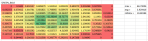
Nomad, flocking, and stampeding heatmaps

  • A border/core ratio explains this nicely. when border dwell time (BDT) > 1,  dangerous stampede. When BDT = 1, then nomads, When BDT < 1, flocking.
  • Updated the simulation results section. Now I need to update the conclusion hypothesis. – done!

Got my graphics card!

Phil 1.8.20

7:00- 4:00 ASRC PhD, GOES

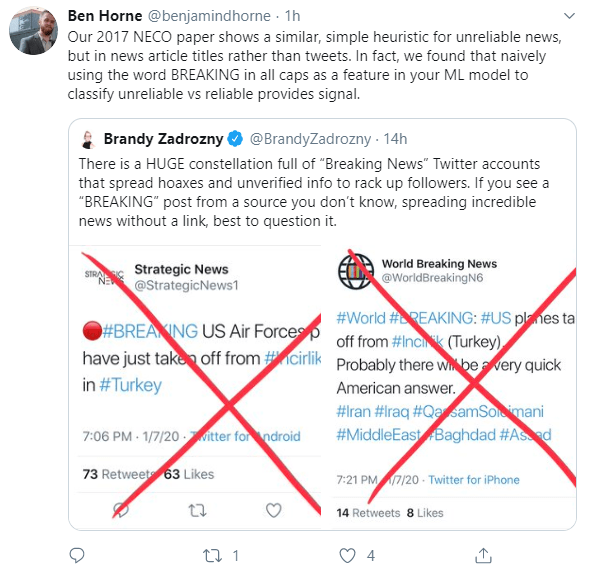
BREAKING

  • Dissertation
    • Finishing discussion – done
    • Rolling in TACJ from introduction – done
    • Adding conclusions – done
    • Fix H3a-c
  • Reimbursement for fall – done
  • Mission Drive meeting (need to get time for dissertation and GSAW prep)

Phil 1.7.20

ASRC PhD 7:00 – 7:00

WP

  • Dissertation
    • Started the exec summary. I think the formatting is fine and it doesn’t show up in the TOC
    • Started the discussion overview
    • Fixed a bunch of orphan numbers, figure references and other formatting

Phil 1.6.20

7:00 – 8:00 ASRC PhD

  • Dr. Yueh is Fellow in Economics at St Edmund HallOxford University and Adjunct Professor of Economics at London Business School.
  • Dissertation
    • Adding more chapter summaries
      • Maps – done
      • Human Study – done
      • Discussion
      • Conclusions
  • Long chat with Aaron M
    • The front matter is your cover letter
    • Search and replace et. al. -> at al., “. -> .”, and check all footnotes
    • Exec summary can be done as a renumber after main doc

Phil 1.5.20


MAGA

  • Roger pointed me at ‘Most advanced, yet acceptable’: Typicality and novelty as joint predictors of aesthetic preference in industrial design
    • Typicality and novelty have often been shown to be related to aesthetic preference of human artefacts. Since a typical product is rarely new and, conversely, a novel product will not often be designated as typical, the positive effects of both features seem incompatible. In three studies it was shown that typicality (operationalized as ‘goodness of example’) and novelty are jointly and equally effective in explaining the aesthetic preference of consumer products, but that they suppress each other’s effect. Direct correlations between both variables and aesthetic preference were not significant, but each relationship became highly significant when the influence of the other variable was partialed out. In Study 2, it was furthermore demonstrated that the expertise level of observers did not affect the relative contribution of novelty and typicality. It was finally shown (Study 3) that a more ‘objective’ measure of typicality, central tendency — operationalized as an exemplar’s average similarity to all other members of the category — yielded the same effect of typicality on aesthetic preference. In sum, all three studies showed that people prefer novel designs as long as the novelty does not affect typicality, or, phrased differently, they prefer typicality given that this is not to the detriment of novelty. Preferred are products with an optimal combination of both aspects.
  • Trust is earned in the smallest of moments. It is earned not through heroic deeds, or even highly visible actions, but through paying attention, listening, and gestures of genuine care and connection. Brené Brown
  • If we share group membership with other across a range of social settings it becomes more likely that the actors will face future exchanges with reversed roles (Resnick, 2002). Repeated interactions with stable identities also allow the trustor to accumulate knowledge about the trustee and to make better predictions about his behavior. Thus, by extrapolating from past behavior trust in future encounters can grow. The mechanics of trust: A framework for research and design
  • Dissertation
    • Adding more chapter summaries
      • Simulation – done
      • Adversarial Herding – done
      • Maps
      • Human Study
      • Discussion
      • Conclusions
  • Read “I Just Google It”: Folk Theories of Distributed Discovery