Monthly Archives: February 2022

Phil 2.7.2022

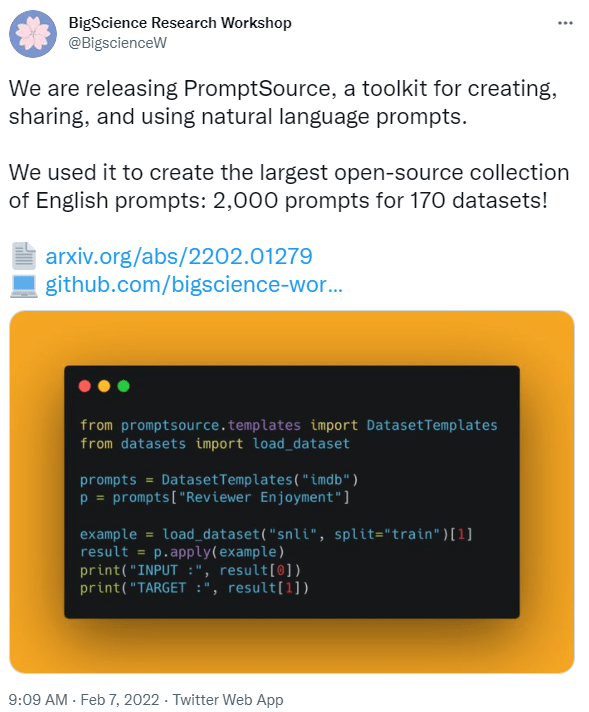
We are releasing PromptSource, a toolkit for creating, sharing, and using natural language prompts.

SBIRs

  • Continuing with Transformers book
  • Quick meeting with Aaron and Rukan to deal with his training problems
  • Grabbed some papers for Steve

Book

  • Fixing more chapters that I didn’t realize still sounded like a dissertation

Phil 2.4.2022

Downloading the svn backup – Done!. Going to try to install following these directions: www.if-not-true-then-false.com/2012/svn-subversion-backup-and-restore

SBIRs

  • 10:00 Meeting with Rukan
  • More Transformers book. Need to look more deeply at MinGPT

GPT Agents

  • Now that I have the counts working, need to tie that back into the GPT output. I think I need some Parts-of-speech analysis to figure out what to count. The other part is to use the feedback to determine important points in the GPT response

Phil 2.3.2022

Data Stuff – It’s stuff I made with data! (@erindataviz)

Tasks

  • The Planets
  • Spanish – done
  • So we find out what’s going on with SVN?
  • JCS – done

SBIRs

  • 9:15 standup
  • Meeting with Aaron
  • More Transformers book
    • Chapter 3
    • BertViz: Visualize Attention in Transformer Models (BERT, GPT2, T5, etc.)
    • Found (I think) what I’m looking for: MinGPT: “A PyTorch re-implementation of GPT training. minGPT tries to be small, clean, interpretable and educational, as most of the currently available ones are a bit sprawling. GPT is not a complicated model and this implementation is appropriately about 300 lines of code, including boilerplate and a totally unnecessary custom causal self-attention module.

GPT Agents

  • Continue with TwitterV2 count class. Good progress. I have basic functionality:
Chinese New Year!

Need to work on the queries a bit to get phrases. Actually not hard, you just have to use escaped quotes ‘\”happy new year\”‘:
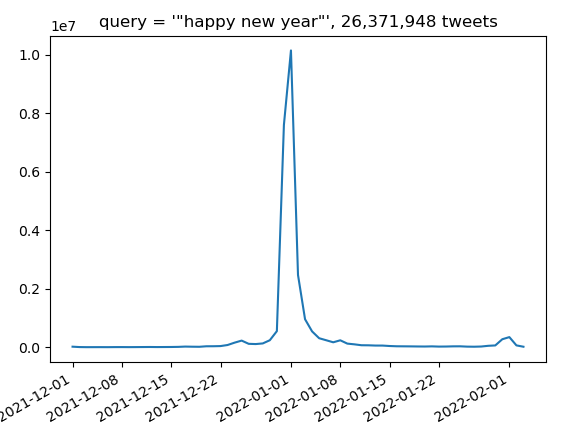
Happy New Year!

Phil 2.2.22

Looking forward to 2.22.22. Almost as exciting as 11.11.11

This IS VERY COOL!! It’s an entire book written using Jupyter Notebooks that you can read on github: GitHub – fastai/fastbook: The fastai book, published as Jupyter Notebooks

GPT Agents.

  • Got the counts query working with only a small amount of googling. The cool thing is that the items come back with a granularity, so this call (which has a default granularity of “day”:
query = "from:twitterdev"
start_time = "2021-05-01T00:00:00Z"
end_time = "2021-06-01T00:00:00Z"
url = create_counts_url(query, start_time, end_time)
json_response = connect_to_endpoint(url)
print_response("Get counts", json_response)
  • returns a json object that has the daily volume of tweets from @twitterdev (There were 24 total time periods, and then the total tweet count was 22) :
response:
{
    "data": [
        {
            "end": "2021-05-02T00:00:00.000Z",
            "start": "2021-05-01T00:00:00.000Z",
            "tweet_count": 0
        },

        {
            "end": "2021-05-13T00:00:00.000Z",
            "start": "2021-05-12T00:00:00.000Z",
            "tweet_count": 6
        },
        {
            "end": "2021-05-14T00:00:00.000Z",
            "start": "2021-05-13T00:00:00.000Z",
            "tweet_count": 1
        },
        {
            "end": "2021-05-15T00:00:00.000Z",
            "start": "2021-05-14T00:00:00.000Z",
        {
            "end": "2021-05-21T00:00:00.000Z",
            "start": "2021-05-20T00:00:00.000Z",
            "tweet_count": 8
        },
        {
            "end": "2021-05-29T00:00:00.000Z",
            "start": "2021-05-28T00:00:00.000Z",
            "tweet_count": 2
        },
        {
            "end": "2021-06-01T00:00:00.000Z",
            "start": "2021-05-31T00:00:00.000Z",
            "tweet_count": 0
        }
    ],
    "meta": {
        "total_tweet_count": 22
    }
}
  • This is very nice! I’m looking forward to doing some interesting things with the GPT. We can scan through responses to prompts and look at word-by-word Twitter frequencies after stop words, and then use those sentences for further prompting. We can also compare embeddings, cluster and other interesting things

SBIRs

Pretty much any data you want for general training at any scale
  • Datasets simplifies this process by providing a standard interface for thousands of datasets that can be found on the Hub. It also provides smart caching (so you don’t have to redo your preprocessing each time you run your code)and avoids RAM limitations by leveraging a special mechanism called memory mapping that stores the contents of a file in virtual memory and enables multiple processes to modify a file more efficiently.
  • Imbalanced-learn (imported as imblearn) is an open source, MIT-licensed library relying on scikit-learn (imported as sklearn) and provides tools when dealing with classification with imbalanced classes.
  • Nice NW job fair

Ack! Dreamhost has deleted my SVN repo. Very bad. Working on getting it back. Other options include RiouxSVN, but it may be moribund. Assembla hosts for $19/month with 500 GB, which is good because I store models. Alternatively, make a svn server, fix the IP address, and have it on Google Drive, OneDrive, or DropBox.

Phil 2.1.2022

Spanish

SBIRs

GPT Agents

  • 3:30 Meeting
    • I think the upshot is to 1) Get the embedding topic narrative thing working, then run the gpt to generate keywords and count their occurrence on Twitter