BP&S is “on hold” in ArXiv. Hoping that it’s overlap with DfS. I took the mapping text out of the DfS paper and resubmitted. Once that’s done I can send Antonio a link and get advice.
Code review with Chris
Contact David and see if he’s ok with July 23 – Nope. Trying Aaron M. as a replacement
More dissertation. Folded in most of the BP&S paper
Here we show that materials science knowledge present in the published literature can be efficiently encoded as information-dense word embeddings11,12,13 (vector representations of words) without human labelling or supervision. Without any explicit insertion of chemical knowledge, these embeddings capture complex materials science concepts such as the underlying structure of the periodic table and structure–property relationships in materials. Furthermore, we demonstrate that an unsupervised method can recommend materials for functional applications several years before their discovery. This suggests that latent knowledge regarding future discoveries is to a large extent embedded in past publications. Our findings highlight the possibility of extracting knowledge and relationships from the massive body of scientific literature in a collective manner, and point towards a generalized approach to the mining of scientific literature.
Well, this is looking a lot like the way I would have written it
You can convert a NodePath into a “regular” pointer at any time by calling nodePath.node(). However, there is no unambiguous way to convert back. That’s important: sometimes you need a NodePath, sometimes you need a node pointer. Because of this, it is recommended that you store NodePaths, not node pointers. When you pass parameters, you should probably pass NodePaths, not node pointers. The callee can always convert the NodePath to a node pointer if it needs to.
Huh. It looks like there is no support for procedurally generated primitives. Well, I know what I’m going to be doing…
Origin – done
Grid
Cube (x, y, z size), color (texture?), Boolean for endcaps
Cylinder (radius+steps, length), color
Sphere (radius+steps), color
Skybox (texture)
Then try making a satellite from parts
JuryRoom Meeting
A lot of discussion on UI issues – how to vote for/against, the right panel layout, and the questions that should be asked for Chris’ study
Read and commented on Shimei’s proposal. It’s interesting to see how she’s weaving all these smaller threads together into one larger narrative. I find that my natural approach is to start with an encompassing vision and figure out how to break it down into its component parts. Which sure seems like stylistic vs. primordial. Interestingly, this implies that stylistic is more integrative? Transdisciplinary, primordial work, because it has no natural home, is more disruptive. It makes me think of this episode of Shock of the New about Paul Cezanne.
Working on getting BP&S into one file for ArXiv, then back to the dissertation.
Flailed around with some package mismatches, and had a upper/lowercase (.PNG vs. .png) problem. Submitted!
Need to ping Antonio about BP&S potential venues
The Redirect Method uses Adwords targeting tools and curated YouTube videos uploaded by people all around the world to confront online radicalization. It focuses on the slice of ISIS’ audience that is most susceptible to its messaging, and redirects them towards curated YouTube videos debunking ISIS recruiting themes. This open methodology was developed from interviews with ISIS defectors, respects users’ privacy and can be deployed to tackle other types of violent recruiting discourses online.
In order to serve as an antidote to extremist messages, counter-messages (CM) are placed in the same online environment as extremist content. Often, they are even tagged with similar keywords. Given that automated algorithms may define putative relationships between videos based on mutual topics, CM can appear directly linked to extremist content. This poses severe challenges for prevention programs using CM. This study investigates the extent to which algorithms influence the interrelatedness of counter- and extremist messages. By means of two exemplary information network analyses based on YouTube videos of two CM campaigns, we demonstrate that CM are closely—or even directly—connected to extremist content. The results hint at the problematic role of algorithms for prevention campaigns.
Downloaded and ran the installer. It couldn’t tell that I had Python 3.7.x, but otherwise was fine. Maybe that’s because my Python is on my D: drive?
Ran:
pip install panda3d==1.10.3
Which worked just fine
Had to add the D:\Panda3D-1.10.3-x64\bin and D:\Panda3D-1.10.3-x64\panda3d to the path to get all the imports to work right. This could be because I’m using a global, separately installed Python 3.7.x
Hmmm. Getting ModuleNotFoundError: No module named ‘panda3d.core.Point3’; ‘panda3d.core’ is not a package. The IDE can find it though….
In a very odd sequence of events, I tried using
from pandac.PandaModules import Point3, which worked, but gave me a deprecated warning.
Then, while fooling around, I tried the preferred
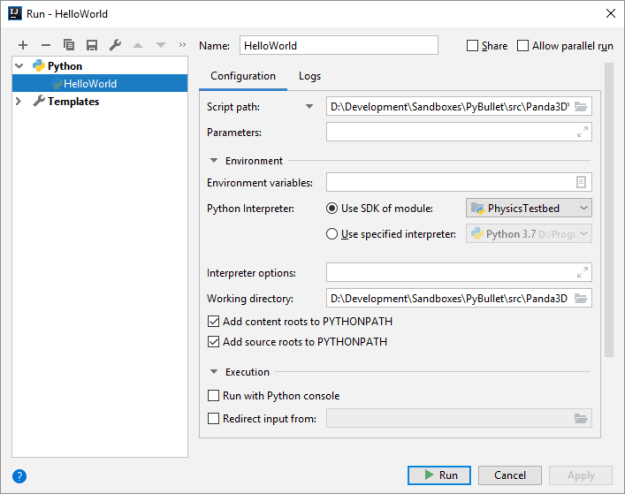
from panda3d.core import Point3, which now works. No idea what fixed it. Here’s the config that I’m using to run:
Nice performance, too:
And it has bullet in it, so maybe it will work here?
Got a desk reject from JASSS. Finding a home for this is turning out to be hard
Adjust Belief Places and Spaces for a straight ArXiv submission (article, endquote, fix cites). I’m doing this partially out of spite – I don’t want to see JASSS looking back at me in my svn repo. But I also need to get all the parts fixed so that it can be folded into the dissertation. \citep doesn’t play well, and I need to replace all the quotes with \enquote{}.
Start folding BP&S into dissertation
Look for Collective Intelligence venue?
Updated Pandas, which was where I got hung on Tuesday. Now I can use DataFrame.to_numpy() instead of Dataframe.values
Continuing on TimeSeriesNormalizer – done! Below is the original file with the data in columns (left) and the normalized file with the data in rows (right):
Continuing with the ICML 2019 Tutorial: Recent Advances in Population-Based Search for Deep Neural Networks. Wow. Lots of implications for diversity science. They need to read Martindale though.
Quality-Diversity optimization is a new family of optimization algorithms that, instead of searching for a single optimal solution to solving a task, searches for a large collection of solutions that all solve the task in a different way. This approach is particularly promising for learning behavioral repertoires in robotics, as such a diversity of behaviors enables robots to be more versatile and resilient. However, these algorithms require the user to manually define behavioral descriptors, which is used to determine whether two solutions are different or similar. The choice of a behavioral descriptor is crucial, as it completely changes the solution types that the algorithm derives. In this paper, we introduce a new method to automatically define this descriptor by combining Quality-Diversity algorithms with unsupervised dimensionality reduction algorithms. This approach enables robots to autonomously discover the range of their capabilities while interacting with their environment. The results from two experimental scenarios demonstrate that robot can autonomously discover a large range of possible behaviors, without any prior knowledge about their morphology and environment. Furthermore, these behaviors are deemed to be similar to handcrafted solutions that uses domain knowledge and significantly more diverse than when using existing unsupervised methods.
Discovered the ComSES Network. It’s a repository for models, a job board, and a schedule with deadlines for ABM-related conferences and workshops!
First Tymora run with the map today!
It went well, I think. My main takeaway is that the place terms are working fine, but the space terms may need more context. It may be that an excerpt from the story that reflects the most common terms may be better than the terms in isolation.
The players stayed away from the stairs, and actually turned them to their advantage, using them as a defensive position.
The players went through the orb room very fast, and seemed to base their thinking on aspects of the map.
The crypticness of the map seems to help the games aspects. The terms are interpretable, and the ambiguity supports the agency of the players




 viztales
You must be logged in to post a comment.