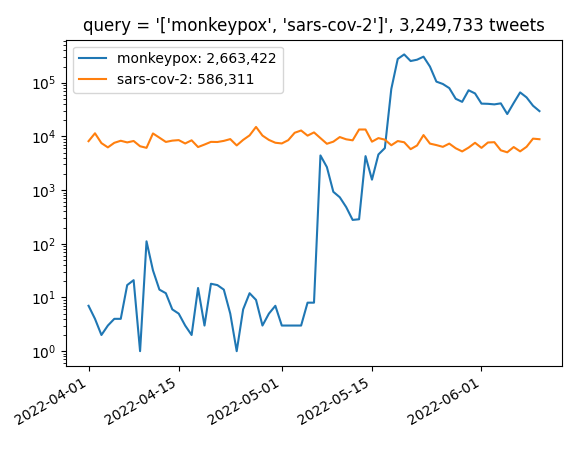
Work on getting keyword tweets in fine granular samples (e.g. 5 minutes four times a day at semi-random intervals. Mostly done, though there are all kinds of odd behaviors that involve making too many requests. Working through the options.
Compare proportions of samples to full counts for the same time periods
Train a model!
SBIRs
Sprint review – done
Write up stories. Probably go back to RCSNN – done
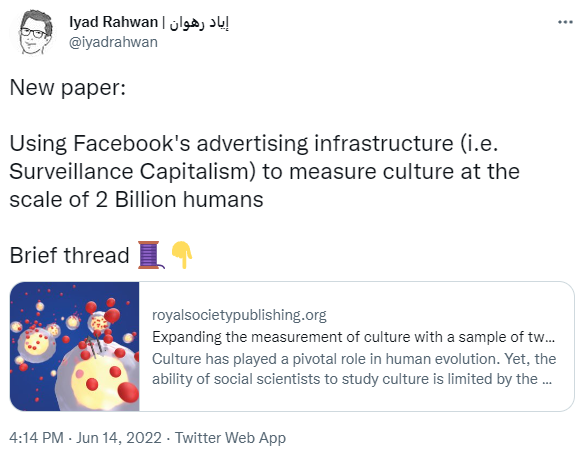
This paper surveys five human societal types – mobile foragers, horticulturalists, pre-state agriculturalists, state-based agriculturalists and liberal democracies – from the perspective of three core social problems faced by interacting individuals: coordination problems, social dilemmas and contest problems. We characterise the occurrence of these problems in the different societal types and enquire into the main force keeping societies together given the prevalence of these. To address this, we consider the social problems in light of the theory of repeated games, and delineate the role of intertemporal incentives in sustaining cooperative behaviour through the reciprocity principle. We analyse the population, economic and political structural features of the five societal types, and show that intertemporal incentives have been adapted to the changes in scope and scale of the core social problems as societies have grown in size. In all societies, reciprocity mechanisms appear to solve the social problems by enabling lifetime direct benefits to individuals for cooperation. Our analysis leads us to predict that as societies increase in complexity, they need more of the following four features to enable the scalability and adaptability of the reciprocity principle: nested grouping, decentralised enforcement and local information, centralised enforcement and coercive power, and formal rules.
There is something really deep in that kind of thinking. It would be a micro stampede for sure. Could the AI herd the person into a harmless area? Would that be ethical?
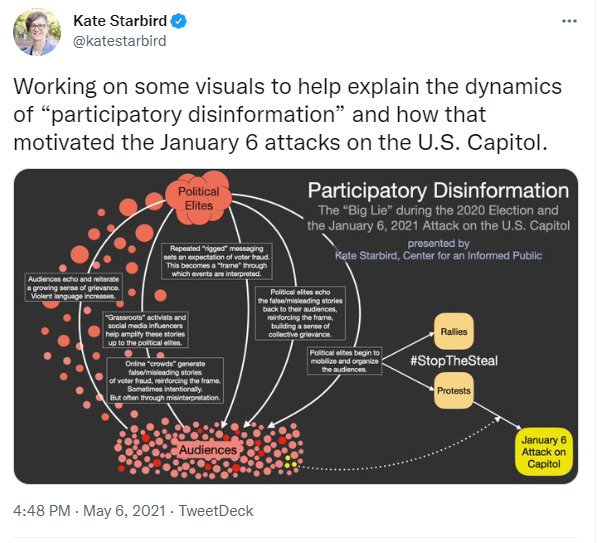
In social networks, users often engage with like-minded peers. This selective exposure to opinions might result in echo chambers, i.e., political fragmentation and social polarization of user interactions. When echo chambers form, opinions have a bimodal distribution with two peaks on opposite sides. In certain issues, where either extreme positions contain a degree of misinformation, neutral consensus is preferable for promoting discourse. In this paper, we use an opinion dynamics model that naturally forms echo chambers in order to find a feedback mechanism that bridges these communities and leads to a neutral consensus. We introduce the random dynamical nudge (RDN), which presents each agent with input from a random selection of other agents’ opinions and does not require surveillance of every person’s opinions. Our computational results in two different models suggest that the RDN leads to a unimodal distribution of opinions centered around the neutral consensus. Furthermore, the RDN is effective both for preventing the formation of echo chambers and also for depolarizing existing echo chambers. Due to the simple and robust nature of the RDN, social media networks might be able to implement a version of this self-feedback mechanism, when appropriate, to prevent the segregation of online communities on complex social issues.
Chat with Mike today? Good discussion. Most important is to put a summary at the end of each chapter
SBIRs
Multiple meetings on getting the server up and running
Getting content from Rukan and Loren
Some discussion with Aaron on the JSC. Need to go over the COPERNICUS paper tomorrow morning
GPT Agents
Decided to shelve keywords for a while and get back to pulling tweets. Need to get that part of the API working (keyword list, location, start/stop times). I think it should be possible to get a valid sample by just limiting the duration of the sample, so something like 24 5-minute samples per day? Need to see if that is possible.
My contribution to the mass shooting discussion. Let’s try placing taxes on 2nd amendment products (guns, ammo, etc.) based on the number killed and wounded in the last, say, 100 days. For each person (or child) killed, add 10% each, and for each person (or child) wounded add 5% maybe? Seems reasonable, no? If no one is killed or injured in a mass shooting in the last 100 days, no taxes! Just leave it up to the manufacturers and gun owners to decide what they need to do to keep their taxes down. After all, they keep telling us they understand the problem better than anyone.
Maybe we use the proceeds for funding free mental healthcare for all? After all, that’s the current excuse for gun violence.
Liberals should pay less attention to what right-wingers say and more attention to what they mean. Liberals should presume the principle there is the one that isn’t there. And they should spell it out for normal people in order to ask if this is the kind of country they want to live in.
This article is right in line with my thinking on dominance displays
SBIRs
Standup
Meeting with Rukan. Went over the design of the config mgr and set up for adding autoencoding sections to the quarterly report
Refactored the quarterly report to match previous submissions
Sent email to Dr. J to see if he’d like a presentation as well
JSC meeting with Aaron this afternoon
Book
Finished section 1! Need to send it out to some folks
Need to write some code that lets me play with a bullet tax based on this insanity
GPT Agents
Nice meeting with Jimmy and Shimei. Need to contact a librarian to get insights for overall keyword search, and get a first pass of the protocol done to try next week
Got one of those text-to-image accounts:
A “hello world” program written in shapes and light
Book
Working on Hierarchies, Networks, and Technology. Last section of Part I!
SBIRs
Send email to Dr. J – oops! Tomorrow
Continue on JSC proposal – about 2 hours
Read the CDRLs and start the quarterly report – done
Political bots are social media algorithms that impersonate political actors and interact with other users, aiming to influence public opinion. This study investigates the ability to differentiate bots with partisan personas from humans on Twitter. Our online experiment (N = 656) explores how various characteristics of the participants and of the stimulus profiles bias recognition accuracy. The analysis reveals asymmetrical partisan-motivated reasoning, in that conservative profiles appear to be more confusing and Republican participants perform less well in the recognition task. Moreover, Republican users are more likely to confuse conservative bots with humans, whereas Democratic users are more likely to confuse conservative human users with bots. We discuss implications for how partisan identities affect motivated reasoning and how political bots exacerbate political polarization.
You must be logged in to post a comment.