Category Archives: Writing

Phil 12.24.19

ASRC PhD 6:30 – 9:30

  • The Worldwide Web of Chinese and Russian Information Controls
    • The global diffusion of Chinese and Russian information control technology and techniques has featured prominently in the headlines of major international newspapers.1 Few stories, however, have provided a systematic analysis of both the drivers and outcomes of such diffusion. This paper does so – and finds that these information controls are spreading more efficiently to countries with hybrid or authoritarian regimes, particularly those that have ties to China or Russia. Chinese information controls spread more easily to countries along the Belt and Road Initiative; Russian controls spread to countries within the Commonwealth of Independent States. In arriving at these findings, this working paper first defines the Russian and Chinese models of information control and then traces their diffusion to the 110 countries within the countries’ respective technological spheres, which are geographical areas and spheres of influence to which Russian and Chinese information control technology, techniques of handling information, and law have diffused.
  • Wrote up some preliminary thoughts on Antonio’s Autonomous Shuttles concept. Need to share the doc
  • Listening to World Affairs Council, and the idea of B-Corporations came up, which are a kind of contractual mechanism for diversity injection?
    • Certified B Corporations are a new kind of business that balances purpose and profit. They are legally required to consider the impact of their decisions on their workers, customers, suppliers, community, and the environment. This is a community of leaders, driving a global movement of people using business as a force for good.
    • Deciding to leave this out of the dissertation, since I’m more focussed on individual interfaces with global effects as opposed to corporate legal structures. It’s just too tangential.
  • Dissertation
    • H3 conclusions – done!


Phil 11.25.19

7:00 – 7:00 ASRC GOES

  • Dissertation – more discussion
    • Added Clark’s Grounding in communication to the lit review
    • Added more to the diversity section. Need to fold ecosystem thinking in
  • Evolver – get copied state nailed down
    • That seems to be working in the test harness:
      vzfunc[0]: Zfunc
      d1={'Zfunc': 2.5, 'Zfunc_function': 'plus_func', 'Zvals1': 1.0, 'Zvals2': 1.5}
      d2={'Zfunc': 2.5, 'Zfunc_function': 'plus_func', 'Zvals1': 1.0, 'Zvals2': 1.5}
      ------------
      vzfunc[1]: Zfunc
      d1={'Zfunc': 4.5, 'Zfunc_function': 'div_func', 'Zvals1': 4.5, 'Zvals2': 1.0}
      d2={'Zfunc': 4.5, 'Zfunc_function': 'div_func', 'Zvals1': 4.5, 'Zvals2': 1.0}
      ------------
      vzfunc[2]: Zfunc
      d1={'Zfunc': 3.5, 'Zfunc_function': 'mult_func', 'Zvals1': 1.0, 'Zvals2': 3.5}
      d2={'Zfunc': 3.5, 'Zfunc_function': 'mult_func', 'Zvals1': 1.0, 'Zvals2': 3.5}
      ------------
      vzfunc[3]: Zfunc
      d1={'Zfunc': 7.5, 'Zfunc_function': 'plus_func', 'Zvals1': 3.5, 'Zvals2': 4.0}
      d2={'Zfunc': 7.5, 'Zfunc_function': 'plus_func', 'Zvals1': 3.5, 'Zvals2': 4.0}
    • Still not setting the values of the EvolveAxis History_list correctly when breeding genomes, I think
  • Fika – slides are done-ish
  • ML – seminar
    • Good point – I need to visit with each of the committee to walk them through the dissertation (possibly with slides?) some time in January. Also, use the conclusions to build a TL;DR version.
  • Meeting with Aaron – nope


Phil 11.7.19

7:00 – 5:00 ASRC GOES

  • Dissertation
  • ML+Sim
    • Save actual and inferred efficiency to excel and plot
    • Create an illustration that shows how the network is trained, validated against the sim, then integrated into the operating system. (maybe show a physical testbed for evaluation?)
    • Demo at the NSOF
      • Went ok. Next steps are a sufficiently realistic model that can interpret an actual malfunction
      • Put together a Google Doc/Sheet that has the common core elements that we can model most satellites (LEO, MEO, GEO, and HEO?). What are the common components between cubesats and the James Webb?
      • Detection of station-keeping failure is a possibility
      • Also, high-dynamic phases, like orbit injection might be low-ish fruit
    • Tomorrow, continue on the GPU assignment in the evolver

Phil10.29.19

7:00 – 5:00 ASRC GOES

  • Dissertation – more maps
  • CTO presentation at 2:00
    • Delayed a bit, but I think it went well. A lot of the things that Eric tried to put in place look to be resurfacing. I wonder if it will work this time?
  • Meeting with Wayne? Yep – got his signature! Need to email Nicole and see where this goes – done
  • Starting to negotiate the new-ish “expensive information” paper with Aaron M

Phil 10.28.19

Language

Capacity, Bandwidth, and Compositionality in Emergent Language Learning

  • Many recent works have discussed the propensity, or lack thereof, for emergent languages to exhibit properties of natural languages. A favorite in the literature is learning compositionality. We note that most of those works have focused on communicative bandwidth as being of primary importance. While important, it is not the only contributing factor. In this paper, we investigate the learning biases that affect the efficacy and compositionality of emergent languages. Our foremost contribution is to explore how capacity of a neural network impacts its ability to learn a compositional language. We additionally introduce a set of evaluation metrics with which we analyze the learned languages. Our hypothesis is that there should be a specific range of model capacity and channel bandwidth that induces compositional structure in the resulting language and consequently encourages systematic generalization. While we empirically see evidence for the bottom of this range, we curiously do not find evidence for the top part of the range and believe that this is an open question for the community.

Radiolab: Tit for Tat

  • In the early 60s, Robert Axelrod was a math major messing around with refrigerator-sized computers. Then a dramatic global crisis made him wonder about the space between a rock and a hard place, and whether being good may be a good strategy. With help from Andrew Zolli and Steve Strogatz, we tackle the prisoner’s dilemma, a classic thought experiment, and learn about a simple strategy to navigate the waters of cooperation and betrayal. Then Axelrod, along with Stanley Weintraub, takes us back to the trenches of World War I, to the winter of 1914, and an unlikely Christmas party along the Western Front.
    • Need to send a note for them to look into Axelrod’s “bully” saddle point

7:00 – ASRC GOES

  • Dissertation – Nearly done with the agent cartography section?
  • CTO Rehearsal – 10:30 – 12:00 done
  • ML Dinner – 4:30 fun! 20191028_173214
  • Meeting With Aaron M
    • More thinking about what to do with the paper. We decided to try for the CHI4EVIL workshop, and then try something like IEEE Spectrum. I think I’d like to reframe it around the concept of Expensive Information and Automation. Try to tie together AI weapons, spam filters, and deepfakes
      • Automation makes negotiation more difficult, locks in trajectories
      • Handing off responsibility to automation amplifies opportunities and destructive potential
      • OODA loop could be generalized if you look at it from the perspective of attention.

Phil 10.22.19

7:00 – 4:00 ASRC

  • Dissertation – starting the maps section
  • Need to finish the financial OODA loop section
  • Spending the day at a Navy-sponsored miniconference on AI, ethics and the military (no wifi at Annapolis, so I’ll put up notes later). This was an odd mix of higher-level execs in suits, retirees, and midshipmen, with a few technical folks sprinkled in. It is clear that for these people, the technology(?) is viewed as AI/ml. The idea that AI is a thing that we don’t do yet does not emerge at this level. Rather, AI is being implemented using machine learning, and in particular deep learning.

Phil 8.14.19

7:00 – 8:00 ASRC GOES

  • pyforest – lazy-import of all popular Python Data Science libraries. Stop writing the same imports over and over again.
    • pyforest lazy-imports all popular Python Data Science libraries so that they are always there when you need them. If you don’t use a library, it won’t be imported. When you are done with your script, you can export the Python code for the import statements.
  • Ping Antonio about TAAS. Important points are round-tripping ABS, and enabling navigation as a way of prediction
  • Transition text from TAAS to Dissertation
  • Mission Drive – nope, couldn’t get in
    • Show Bruce model and control
    • Meeting
    • pip3 install openpyxl, for some reason
    • Pretty pictures!

TimeSeries

  • Meeting with Will this evening
    • after a moderate amount of flailing, got his Slack message files into a database

Phil 8.13.19

7:00 – 5:00ASRC GOES

  • TAAS/DIssertation
    • Rolling in changes. At Belief Space Cartography
    • Done! Need to ping Antonio
  • Nice Jersey! Sizing chart
  • More control system work
    • Add data dictionary – done
    • Add main controller – done
    • Put sim under controller – done
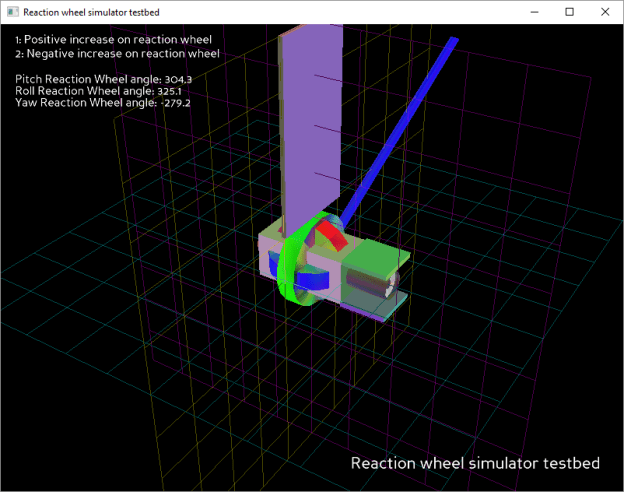
    • Add “Attitude Controller” for reaction wheels and sensors
    • Add “Reaction Wheel” controller?
  • Leaving early
  • Wakaito meeting

Phil8.12.19

7:00 – 5:00 ASRC GEOS

  • Another thought about groups thinking like neurons. Alcohol is like dopamine. It encourages connections between individuals, but the communication can become “noisier”
  • Call SSA
  • Dissertation/TAAS
    • Discuss survey
  • GEOS model
    • Finish control/simulation framework
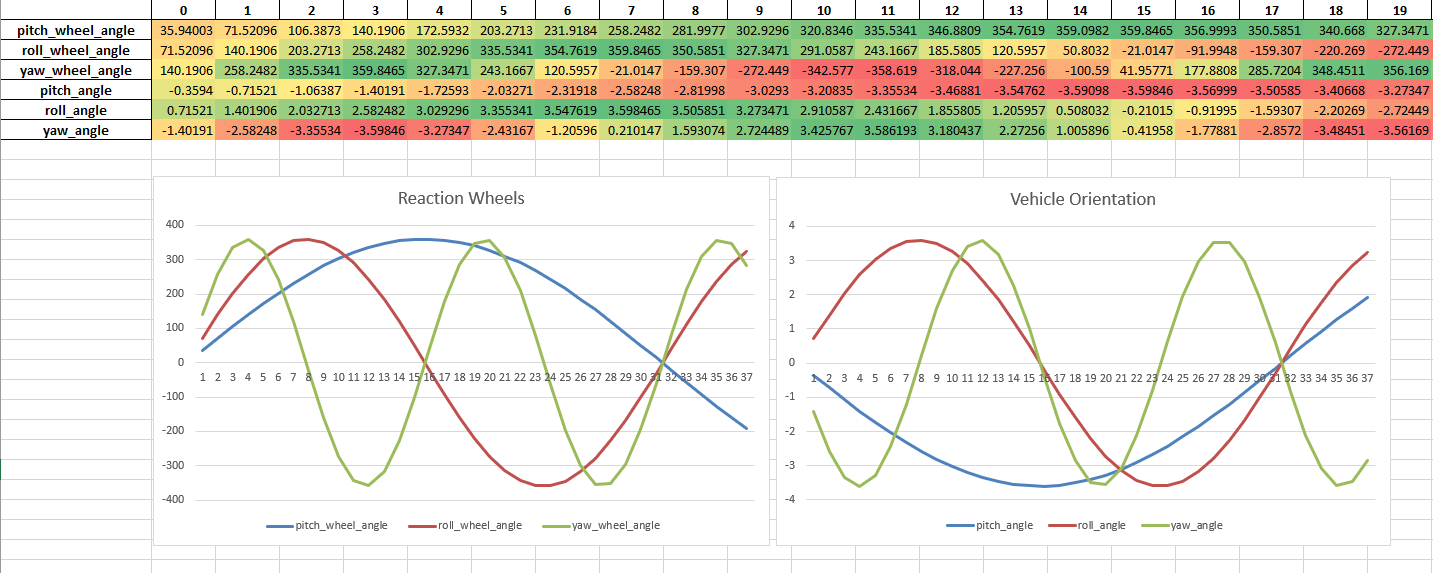
    • Get access to the rotation matrix and calculate transformations for (1, 0, 0), (0, 1, 0), and (0, 0, 1). Use those for pitch roll and yaw measurements
    • Write out these values (excel) and see if we can do a proof-of-concept that shows prediction of the reaction wheels from the PRY measurements
  • Helped Heera with her code
  • Read through and edited TAAS

Phil 8.9.19

7:00 – 5:00 ASRC GEOS

  • Something else for image repair: Deep Image Prior
    • Deep convolutional networks have become a popular tool for image generation and restoration. Generally, their excellent performance is imputed to their ability to learn realistic image priors from a large number of example images. In this paper, we show that, on the contrary, the structure of a generator network is sufficient to capture a great deal of low-level image statistics prior to any learning. In order to do so, we show that a randomly-initialized neural network can be used as a handcrafted prior with excellent results in standard inverse problems such as denoising, super-resolution, and inpainting. Furthermore, the same prior can be used to invert deep neural representations to diagnose them, and to restore images based on flash-no flash input pairs.
  • Dissertation/TAAS
  • GEOS Sim
    • Building RCS controllers!
    • Record data
    • Spark lines
    • Excel outputs
    • Start physics

Phil 8.8.19

7:00 – 4:00 ASRC GEOS

  • TAAS/Dissertation research_design
  • Paperwork for dad’s cert
  • More GEOS-R sim.
    • Fixed the camera rotation order
    • Create some classes to handle all this
      • GEOS-TopController
      • GEOS_Simulator
      • GEOS_R_Model
    • Record data
    • Spark lines
    • Excel outputs
    • Start physics

GEOS_sim

  • Meeting with Aaron to discuss cyber RFI

Phil 8.7.19

7:00 – 4:00 ASRC GEOS

  • TAAS/Dissertation research_design
  • Swing by Charlestown on the way to Mission Drive today? Done, but no luck. Did get a card though. Done!
  • Order cards – done
  • Read BAA, triage white paper – started
  • Got my STL travel report submitted
  • Got my education assistance reimbursement and pre-approval in
  • Uninstalled Panda3D and then pip installed it again. Now all python versions are aligned, so I have panda3d and numpy
  • More GEOS-R sim. Nope – didn’t check in all my changes last night.
    • Create some classes to handle all this
    • Record data
    • Spark lines
    • Excel outputs
    • Start physics
  • Super interesting discussion with a waitress about JuryRoom that started with Sriracha catsup

Phil 7.16.19

7:00 – 6:30ASRC GEOS

  • Working more on NK Models. I have the original paper – Towards a general theory of adaptive walks on rugged landscapes, and I’ve pulled out my copy of The Origins of Order
    • Determine if I have the evaluation function right
    • Add mutation
    • Draw the networks
    • Draw an N/K/Fitness landscape?
    • As an aside, I think that an NK model can be modified to use backpropagation rather than mutation. That could be interesting.
    • Ok, here’s everything working the way I think it should work, but I’m not sure it’s right….
  • Need to get back to Antonio about authorship and roles. I think that it makes sense if he can get a sense of what – done
  • Discovered the trumptwitterarchive, which is downloadable. Would like to build a network of the retweets and tagging by sentiment, gender and race.
  • Code review with Chris. Unfortunately, it was more like an interrogation than a tour. My sense is that he was expecting us to ask questions and we were expecting a presentation.
    • It went ok, but the audio connection was terrible

Phil 7.10.19

7:00 – 5:00 ASRC

  • BP&S is up! Need to ping Antonio
  • Need to fix DfS to de-emphasize the mapping part. Including things like, uh, changing the title…
  • Pix at HQ – Done
  • Greenbelt today, which means getting Panda3D up and running on my laptop – Done. Had to point the IDE at the python in the install.
  • Need to add some thoughts to JuryRoom concepts
  • Send dungeon invites for the 23rd, and ping Aaron M. Done. Wayne can’t make it! Drat!
  • Dissertation working on the Bacharach section
  • Got the sim working on the laptop. I realize that the reaction wheel can be modeled as weights on a stick. Long discussion with Bruce T