Category Archives: research

Phil 4.3.18

ASRC MKT 7:00 – 5:30

  • Integrating airplane notes on Influence of augmented humans in online interactions during voting events
  • Follow up on pointing logs
  • World Affairs Council (Part II. Part I is Jennifer Kavanagh and Tom Nichols: The End of Authority)
    • With so many forces undermining democratic institutions worldwide, we wanted a chance to take a step back and provide some perspective. Russian interference in elections here and in Europe, the rise in fake news and a decline in citizen trust worldwide pose a danger. In this second of a three part series, we look at the role of social media and the ways in which it was exploited for the purpose of sowing distrust. Janine Zacharia, former Jerusalem bureau chief and Middle East correspondent for The Washington Post, and Roger McNamee, managing director at Elevation Partners and an early stage investor in Google and Facebook, are in conversation with World Affairs CEO Jane Wales.
    • “The ultimate combination of propaganda and gambling … powered by machine learning”
  • The emergence of consensus: a primer (No Moscovici – odd)
    • The origin of population-scale coordination has puzzled philosophers and scientists for centuries. Recently, game theory, evolutionary approaches and complex systems science have provided quantitative insights on the mechanisms of social consensus. However, the literature is vast and widely scattered across fields, making it hard for the single researcher to navigate it. This short review aims to provide a compact overview of the main dimensions over which the debate has unfolded and to discuss some representative examples. It focuses on those situations in which consensus emerges ‘spontaneously’ in the absence of centralized institutions and covers topics that include the macroscopic consequences of the different microscopic rules of behavioural contagion, the role of social networks and the mechanisms that prevent the formation of a consensus or alter it after it has emerged. Special attention is devoted to the recent wave of experiments on the emergence of consensus in social systems.
  • Need to write up diversity injection proposal
    • Basically updated PSAs for social media
    • Intent is to expand the information horizon, not to counter anything in particular. So it’s not political
    • Presented in a variety of ways (maps, stories and lists)
    • Goes identically into everyone’s feed
    • Can be blocked, but blockers need to be studied
    • More injection as time on site goes up. Particularly with YouTube & FB
  • Working on SASO paper. Made it through discussion

Phil 3.28.18

7:00 – 5:00 ASRC MKT

    • Aaron found this hyperparameter optimization service: Sigopt
      • Improve ML models 100x faster
      • SigOpt’s API tunes your model’s parameters through state-of-the-art Bayesian optimization.
      • Exponentially faster and more accurate than grid search. Faster, more stable, and easier to use than open source solutions.
      • Extracts additional revenue and performance left on the table by conventional tuning.
    • A Strategy for Ranking Optimization Methods using Multiple Criteria
      • An important component of a suitably automated machine learning process is the automation of the model selection which often contains some optimal selection of hyperparameters. The hyperparameter optimization process is often conducted with a black-box tool, but, because different tools may perform better in different circumstances, automating the machine learning workflow might involve choosing the appropriate optimization method for a given situation. This paper proposes a mechanism for comparing the performance of multiple optimization methods for multiple performance metrics across a range of optimization problems. Using nonparametric statistical tests to convert the metrics recorded for each problem into a partial ranking of optimization methods, results from each problem are then amalgamated through a voting mechanism to generate a final score for each optimization method. Mathematical analysis is provided to motivate decisions within this strategy, and sample results are provided to demonstrate the impact of certain ranking decisions
    • World Models: Can agents learn inside of their own dreams?
      • We explore building generative neural network models of popular reinforcement learning environments[1]. Our world model can be trained quickly in an unsupervised manner to learn a compressed spatial and temporal representation of the environment. By using features extracted from the world model as inputs to an agent, we can train a very compact and simple policy that can solve the required task. We can even train our agent entirely inside of its own hallucinated dream generated by its world model, and transfer this policy back into the actual environment.
    • Tweaked the SingleNeuron spreadsheet
    • This came up again: A new optimizer using particle swarm theory (1995)
      • The optimization of nonlinear functions using particle swarm methodology is described. Implementations of two paradigms are discussed and compared, including a recently developed locally oriented paradigm. Benchmark testing of both paradigms is described, and applications, including neural network training and robot task learning, are proposed. Relationships between particle swarm optimization and both artificial life and evolutionary computation are reviewed.
      • New: Particle swarm optimization for hyper-parameter selection in deep neural networks
    • Working with the CIFAR10 data now. Tradeoff between filters and epochs:
      NB_EPOCH = 10
      NUM_FIRST_FILTERS = int(32/2)
      NUM_MIDDLE_FILTERS = int(64/2)
      OUTPUT_NEURONS = int(512/2)
      Test score: 0.8670728429794311
      Test accuracy: 0.6972
      Elapsed time =  565.9446044602014
      
      NB_EPOCH = 5
      NUM_FIRST_FILTERS = int(32/1)
      NUM_MIDDLE_FILTERS = int(64/1)
      OUTPUT_NEURONS = int(512/1)
      Test score: 0.8821897733688354
      Test accuracy: 0.6849
      Elapsed time =  514.1915690121759
      
      NB_EPOCH = 10
      NUM_FIRST_FILTERS = int(32/1)
      NUM_MIDDLE_FILTERS = int(64/1)
      OUTPUT_NEURONS = int(512/1)
      Test score: 0.7007060846328735
      Test accuracy: 0.765
      Elapsed time =  1017.0974014300725
      
      Augmented imagery
      NB_EPOCH = 10
      NUM_FIRST_FILTERS = int(32/1)
      NUM_MIDDLE_FILTERS = int(64/1)
      OUTPUT_NEURONS = int(512/1)
      Test score: 0.7243581249237061
      Test accuracy: 0.7514
      Elapsed time =  1145.673343808471
      
    • And yet, something is clearly wrong: wrongPNG
    • Maybe try this version? samyzaf.com/ML/cifar10/cifar10.html


Phil 3.23.18

7:00 – 5:00 ASRC MKT

  • Influence of augmented humans in online interactions during voting events
    • Overwhelming empirical evidence has shown that online social dynamics mirrors real-world events. Hence, understanding the mechanisms leading to social contagion in online ecosystems is fundamental for predicting, and even manouvering, human behavior. It has been shown that one of such mechanisms is based on fabricating armies of automated agents that are known as social bots. Using the recent Italian elections as an emblematic case study, here we provide evidence for the existence of a special class of highly influential users, that we name “augmented humans”. They exploit bots for enhancing both their visibility and influence, generating deep information cascades to the same extent of news media and other broadcasters. Augmented humans uniformly infiltrate across the full range of identified clusters of accounts, the latter reflecting political parties and their electoral ranks.
  • Reddit and the Struggle to Detoxify the Internet
    • “Does free speech mean literally anyone can say anything at any time?” Tidwell continued. “Or is it actually more conducive to the free exchange of ideas if we create a platform where women and people of color can say what they want without thousands of people screaming, ‘Fuck you, light yourself on fire, I know where you live’? If your entire answer to that very difficult question is ‘Free speech,’ then, I’m sorry, that tells me that you’re not really paying attention.”
    • This is the difference between discussion and stampede. That seems like it should be statistically detectable.
  • Metabolic Costs of Feeding Predictively Alter the Spatial Distribution of Individuals in Fish Schools
    • We examined individual positioning in groups of swimming fish after feeding
    • Fish that ate most subsequently shifted to more posterior positions within groups
    • Shifts in position were related to the remaining aerobic scope after feeding
    • Feeding-related constraints could affect leadership and group functioning
    • I wonder if this also keeps the hungrier fish at the front, increasing the effectiveness of gradient detections
  • Listening to Invisibilia: The Pattern Problem. There is a section on using machine learning for sociology. Listening to get the author of the ML and Sociology study. Predictions were not accurate. Not published?
  • The Coming Information Totalitarianism in China
    • The real-name system has two purposes. One is the chilling effect, and it works very well on average netizens but not so much on activists. The other and the main purpose is to be able to locate activists and eliminate them from certain information/opinion platforms, in the same way that opinions of dissident intellectuals are completely eradicated from the traditional media.
  • More BIC – Done! Need to assemble notes
    • It is a central component of resolute choice, as presented by McClennen, that (unless new information becomes available) later transient agents recognise the authority of plans made by earlier agents. Being resolute just is recognising that authority (although McClennen’ s arguments for the rationality and psychological feasibility of resoluteness apply only in cases in which the earlier agents’ plans further the common ends of earlier and later agents). This feature of resolute choice is similar to Bacharach’ s analysis of direction, explained in section 5. If the relationship between transient agents is modelled as a sequential game, resolute choice can be thought of as a form of direction, in which the first transient agent plays the role of director; the plan chosen by that agent can be thought of as a message sent by the director to the other agents. To the extent that each later agent is confident that this plan is in the best interests of the continuing person, that confidence derives from the belief that the first agent identified with the person and that she was sufficiently rational and informed to judge which sequence of actions would best serve the person’s objectives. (pg 197)
  • Meeting with celer scientific
  • More TF with Keras. Really good progress

Phil 3.7.18

7:00 – 5:00 ASRC MKT

  • Some surprising snow
  • Meeting with Sy at 1:30 slides
  • Meeting with Dr. DesJardins at 4:00
  • Nice chat with Wajanat about the presentation of the Saudi Female self in physical and virtual environments
  • Sprint planning
    • Finish ONR Proposal VP-331
    • CHIIR VP-332
    • Prep for TF dev conf VP-334
    • TF dev conf VP-334
  • Working on the ONR proposal
  • Oxford Internet Institute – Computational Propaganda Research Project
    • The Computational Propaganda Research Project (COMPROP) investigates the interaction of algorithms, automation and politics. This work includes analysis of how tools like social media bots are used to manipulate public opinion by amplifying or repressing political content, disinformation, hate speech, and junk news. We use perspectives from organizational sociology, human computer interaction, communication, information science, and political science to interpret and analyze the evidence we are gathering. Our project is based at the Oxford Internet Institute, University of Oxford.
    • Polarization, Partisanship and Junk News Consumption over Social Media in the US
      • What kinds of social media users read junk news? We examine the distribution of the most significant sources of junk news in the three months before President Donald Trump’s first State of the Union Address. Drawing on a list of sources that consistently publish political news and information that is extremist, sensationalist, conspiratorial, masked commentary, fake news and other forms of junk news, we find that the distribution of such content is unevenly spread across the ideological spectrum. We demonstrate that (1) on Twitter, a network of Trump supporters shares the widest range of known junk news sources and circulates more junk news than all the other groups put together; (2) on Facebook, extreme hard right pages—distinct from Republican pages—share the widest range of known junk news sources and circulate more junk news than all the other audiences put together; (3) on average, the audiences for junk news on Twitter share a wider range of known junk news sources than audiences on Facebook’s public pages
      • Need to look at the variance in the articles. Are these topical stampedes? Or is this source-oriented?
  • Understanding and Addressing the Disinformation Ecosystem
    • This workshop brings together academics, journalists, fact-checkers, technologists, and funders to better understand the challenges produced by the current disinformation ecosystem. The facilitated discussions will highlight relevant research, share best-practices, identify key questions of scholarly and practical concern regarding the nature and implications of the disinformation ecosystem, and outline a potential research agenda designed to answer these questions.
  • More BIC
    • The psychology of group identity allows us to understand that group identification can be due to factors that have nothing to do with the individual preferences. Strong interdependence and other forms of common individual interest are one sort of favouring condition, but there are many others, such as comembership of some existing social group, sharing a birthday, and the artificial categories of the minimal group paradigm. (pg 150)
    • Wherever we may expect group identity we may also expect team reasoning. The effect of team reasoning on behavior is different from that of individualistic reasoning. We have already seen this for Hi-Lo. This has wide implications. It makes the theory of team reasoning a much more powerful explanatory and predictive theory than it would be if it came on line only in games with th3e right kind of common interest. To take just one example, if management brings it about so that the firm’s employees identify with the firm, we may expect for them to team-reason and so to make choices that are not predicted by the standard theories of rational choice. (pg 150)
    • As we have seen, the same person passes through many group identities in the flux of life, and even on a single occasion more than one of these identities may be stimulated. So we will need a model of identity in which the probability of a person’s identification is distributed over not just two alternatives-personal self-identity or identity with a fixed group-but, in principle, arbitrarily many. (pg 151)

Phil 2.19.18

7:30 – 4:30 ASRC MKT

  • Back to BIC.
    • BIC_102 (page 102)
    • BIC107 (pg 107)
    • BIC107b (pg 107)
    • Sociality: Coordinating bodies, minds and groups
      • Human interaction, as opposed to aggregation, occurs in face-to-face groups. “Sociality theory” proposes that such groups have a nested, hierarchical structure, consisting of a few basic variations, or “core configurations.” These function in the coordination of human behavior, and are repeatedly assembled, generation to generation, in human ontogeny, and in daily life. If face-to-face groups are “the mind’s natural environment,” then we should expect human mental systems to correlate with core configurations. Features of groups that recur across generations could provide a descriptive paradigm for testable and non-intuitive evolutionary hypotheses about social and cognitive processes. This target article sketches three major topics in sociality theory, roughly corresponding to the interests of biologists, psychologists, and social scientists. These are (1) a multiple levels-of-selection view of Darwinism, part group selectionism, part developmental systems theory; (2) structural and psychological features of repeatedly assembled, concretely situated face-to-face coordination; and (3) superordinate, “unsituated” coordination at the level of large-scale societies. Sociality theory predicts a tension, perhaps unresolvable, between the social construction of knowledge, which facilitates coordination within groups, and the negotiation of the habitat, which requires some correspondence with contingencies in specific situations. This tension is relevant to ongoing debates about scientific realism, constructivism, and relativism in the philosophy and sociology of knowledge.
        • These definitions seem to span atomic (mother/child, etc), small group (situated, environmental), and societal (unsituated, normative)
      • Coordination occurs to the extent that knowledge and practice domains overlap or are complementary. I suggest that values serve as a medium. Humans live in a value-saturated environment; values are known from interactions with people, natural objects, and artifacts
        • Dimension reduction
  •  I’m starting to think that agents as gradient descent machines within networks is something to look for:
    • Individual Strategy Update and Emergence of Cooperation in Social Networks
      • In this article, we critically study whether social networks can explain the emergence of cooperative behavior. We carry out an extensive simulation program in which we study the most representative social dilemmas. For the Prisoner’s Dilemma, it turns out that the emergence of cooperation is dependent on the microdynamics. On the other hand, network clustering mostly facilitates global cooperation in the Stag Hunt game, whereas degree heterogeneity promotes cooperation in Snowdrift dilemmas. Thus, social networks do not promote cooperation in general, because the macro-outcome is not robust under change of dynamics. Therefore, having specific applications of interest in mind is crucial to include the appropriate microdetails in a good model.
    • Alex Peysakhovich and Adam Lerer
      • Prosocial learning agents solve generalized Stag Hunts better than selfish ones
        • Deep reinforcement learning has become an important paradigm for constructing agents that can enter complex multi-agent situations and improve their policies through experience. One commonly used technique is reactive training – applying standard RL methods while treating other agents as a part of the learner’s environment. It is known that in general-sum games reactive training can lead groups of agents to converge to inefficient outcomes. We focus on one such class of environments: Stag Hunt games. Here agents either choose a risky cooperative policy (which leads to high payoffs if both choose it but low payoffs to an agent who attempts it alone) or a safe one (which leads to a safe payoff no matter what). We ask how we can change the learning rule of a single agent to improve its outcomes in Stag Hunts that include other reactive learners. We extend existing work on reward-shaping in multi-agent reinforcement learning and show that that making a single agent prosocial, that is, making them care about the rewards of their partners can increase the probability that groups converge to good outcomes. Thus, even if we control a single agent in a group making that agent prosocial can increase our agent’s long-run payoff. We show experimentally that this result carries over to a variety of more complex environments with Stag Hunt-like dynamics including ones where agents must learn from raw input pixels.
      • The Good, the Bad, and the Unflinchingly Selfish: Cooperative Decision-Making Can Be Predicted with High Accuracy Using Only Three Behavioral Types
        • The human willingness to pay costs to benefit anonymous others is often explained by social preferences: rather than only valuing their own material payoff, people also care in some fashion about the outcomes of others. But how successful is this concept of outcome-based social preferences for actually predicting out-of-sample behavior? We investigate this question by having 1067 human subjects each make 20 cooperation decisions, and using machine learning to predict their last 5 choices based on their first 15. We find that decisions can be predicted with high accuracy by models that include outcome-based features and allow for heterogeneity across individuals in baseline cooperativeness and the weights placed on the outcome-based features (AUC=0.89). It is not necessary, however, to have a fully heterogeneous model — excellent predictive power (AUC=0.88) is achieved by a model that allows three different sets of baseline cooperativeness and feature weights (i.e. three behavioral types), defined based on the participant’s cooperation frequency in the 15 training trials: those who cooperated at least half the time, those who cooperated less than half the time, and those who never cooperated. Finally, we provide evidence that this inclination to cooperate cannot be well proxied by other personality/morality survey measures or demographics, and thus is a natural kind (or “cooperative phenotype”)
        • “least”, “intermediate” and “most” cooperative. Doesn’t give percentages, though it says that 17.8% were cooperative?


  • Talk Susan Gregurick (susan.gregurick@nih.gov)
    • All of Us research program
    • Opiod epidemic – trajectory modeling?
    • PZM21 computational drug
    • Develop advanced software and tools. Specialized generalizable and accessible tools for biomedicing (finding stream). Includes mobile, data indexing, etc.
    • NIH Data Fellows? Postdocs to senior industry
    • T32 funding? Mike Summers at UMBC
    • ncbi-hackathons.github.io (look for data?
    • Primary supporter for machine learning is NIMH (imaging), then NIGNS, and NCI Team science (Multi-PI) is a developing thing
    • $400m in computing enabled interactions (human in the loop decision tools. Research Browser?
    • Big Data to Knowledge Initiative (BD2K) datascience.nih.gov/bd2k
    • Interagency Modeling and Analysis Group (IMAG) imagewiki,nibib.nih.gov
    • funding: bisti.nih.gov
    • NIH RePorter projectreporter.nih.gov Check out matchmaker. What’s the ranking algorithm?
    • NIDDK predictive analytics for budgeting <- A2P-ish?
    • Most of thi srequires preliminary data and papers to be considered for funding. There is one opportunity for getting funding to get preliminary data. Need to get more specific infor here.
    • Each SRO normalizes grade as a percentile, not the score, since some places inflate, and others are hard.
    • Richard Aargon at NIGMS
    • Office of behavioral and social science – NIH center Francis Collins. Also agent-based simulation
    • Really wants a Research Browser to go through proposals
  • Fika – study design
    • IRB – you can email and chat with the board if you have a tricky study

Phil 2.17.18

Snow today

Random thought. Marches help because they literally put people in the same position, align them in a direction and enforce a common velocity.

Found this item about compromised Trump company servers. I think this could be framed as an example of excessive trust bringing high social inertia. This would be different from explicit command and control.

So why would the organization allow this? If it’s not fear, then it’s trust. Kramer describes trust arising from incremental and repeated exchanges. I’d like to extend that thought. These incremental and repeated exchanges need to happen in dimension-reduced spaces that are similar or appear to map to each other, and occur with respect to orientation alignment, position, and velocity. The more alignment in these three axis, the greater the trust, and the lower the perceived need for awareness outside the relationship.

Twitter is just full of this stuff today: How A Russian Troll Fooled America

  • Reconstructing the life of a covert Kremlin influence account (TEN_GOP)
  • The Atlantic Council’s Digital Forensic Research Lab (DFRLab) has operationalized the study of disinformation by exposing falsehoods and fake news, documenting human rights abuses, and building digital resilience worldwide.


Phil 2.16.18

7:00 – 3:00 ASRC MKT

  • Finished the first draft of the CI 2018 extended abstract!
  • And I also figured out how to run the sub projects in the Ultimate Angular src collection. You need to go to the root directory for the chapter, run yarn install, then yarn start. Everything works then.
  • Trolls on Twitter: How Mainstream and Local News Outlets Were Used to Drive a Polarized News Agenda
    • This is the kind of data that compels us to rethink how we understand Twitter — and what I feel are more influential platforms for reaching regular people that include Facebook, Instagram, Google, and Tumblr, as well as understand ad tech tracking and RSS feedharvesting as part of the greater propaganda ecosystem.
  • NELA News credibility classification toolkit
    • The News Landscape (NELA) Toolkit is an open source toolkit for the systematic exploration of the news landscape. The goal of NELA is to both speed up human fact-checking efforts and increase the understanding of online news as a whole. NELA is made up of multiple indepedent modules, that work at article level granularity: reliability prediction, political impartiality prediction, text objectivity prediction, and reddit community interest prediction. As well as, modules that work at source level granularity: reliability prediction, political impartiality prediction, content-based feature visualization. 
  • New benchmarks for approximate nearest neighbors
    • I built ANN-benchmarksto address this. It pits a bunch of implementations (including Annoy) against each other in a death match: which one can return the most accurate nearest neighbors in the fastest time possible. It’s not a new project, but I haven’t actively worked on it for a while.
  • Systems of Global Governance in the Era of Human-Machine Convergence
    • Technology is increasingly shaping our social structures and is becoming a driving force in altering human biology. Besides, human activities already proved to have a significant impact on the Earth system which in turn generates complex feedback loops between social and ecological systems. Furthermore, since our species evolved relatively fast from small groups of hunter-gatherers to large and technology-intensive urban agglomerations, it is not a surprise that the major institutions of human society are no longer fit to cope with the present complexity. In this note we draw foundational parallelisms between neurophysiological systems and ICT-enabled social systems, discussing how frameworks rooted in biology and physics could provide heuristic value in the design of evolutionary systems relevant to politics and economics. In this regard we highlight how the governance of emerging technology (i.e. nanotechnology, biotechnology, information technology, and cognitive science), and the one of climate change both presently confront us with a number of connected challenges. In particular: historically high level of inequality; the co-existence of growing multipolar cultural systems in an unprecedentedly connected world; the unlikely reaching of the institutional agreements required to deviate abnormal trajectories of development. We argue that wise general solutions to such interrelated issues should embed the deep understanding of how to elicit mutual incentives in the socio-economic subsystems of Earth system in order to jointly concur to a global utility function (e.g. avoiding the reach of planetary boundaries and widespread social unrest). We leave some open questions on how techno-social systems can effectively learn and adapt with respect to our understanding of geopolitical complexity.

Phil 2.13.18

7:00 – 4:00 ASRC MKT

  • UMAP: Uniform Manifold Approximation and Projection for Dimension Reduction
    • UMAP (Uniform Manifold Approximation and Projection) is a novel manifold learning technique for dimension reduction. UMAP is constructed from a theoretical framework based in Riemannian geometry and algebraic topology. The result is a practical scalable algorithm that applies to real world data. The UMAP algorithm is competitive with t-SNE for visualization quality, and arguably preserves more of the global structure with superior run time performance. Furthermore, UMAP as described has no computational restrictions on embedding dimension, making it viable as a general purpose dimension reduction technique for machine learning.
  • How Prevalent are Filter Bubbles and Echo Chambers on Social Media? Not as Much as Conventional Wisdom Has It
    • Yet, as Rasmus points out, conventional wisdom seems to be stuck with the idea that social media constitute filter bubbles and echo chambers, where most people only, or mostly, see political content they already agree with. It is definitely true that there is a lot of easily accessible, clearly identifiable, highly partisan content on social media. It is also true that, to some extent, social media users can make choices as to which sources they follow and engage with. Whether people use these choice affordances solely to flock to content reinforcing their political preferences and prejudices, filtering out or avoiding content that espouses other viewpoints, is, however, an empirical question—not a destiny inscribed in the way social media and their algorithms function.
  • He Predicted The 2016 Fake News Crisis. Now He’s Worried About An Information Apocalypse.
    • That future, according to Ovadya, will arrive with a slew of slick, easy-to-use, and eventually seamless technological tools for manipulating perception and falsifying reality, for which terms have already been coined — “reality apathy,” “automated laser phishing,” and “human puppets.”
  • Finish first pass at DC slides – done!
  • Begin trimming paper – good progress.
  • Add a slider that lets the user interactively move a token along the selected trajectory path – done. Yes, it looks like a golf ball on a tee… Capture
  • Sprint planning

Phil 2.12.18

7:00 – 4:00 ASRC MKT

  • The social structural foundations of adaptation and transformation in social–ecological systems
    • Social networks are frequently cited as vital for facilitating successful adaptation and transformation in linked social–ecological systems to overcome pressing resource management challenges. Yet confusion remains over the precise nature of adaptation vs. transformation and the specific social network structures that facilitate these processes. Here, we adopt a network perspective to theorize a continuum of structural capacities in social–ecological systems that set the stage for effective adaptation and transformation. We begin by drawing on the resilience literature and the multilayered action situation to link processes of change in social–ecological systems to decision making across multiple layers of rules underpinning societal organization. We then present a framework that hypothesizes seven specific social–ecological network configurations that lay the structural foundation necessary for facilitating adaptation and transformation, given the type and magnitude of human action required. A key contribution of the framework is explicit consideration of how social networks relate to ecological structures and the particular environmental problem at hand. Of the seven configurations identified, three are linked to capacities conducive to adaptation and three to transformation, and one is hypothesized to be important for facilitating both processes.
  • Starting to trim paper down to three pages
  • Starting on CHIIR slide stack – Still need to add future work
  • Springt Review
  • Rwanda radio transcripts
    • From October 1993 to late 1994, RTLM was used by Hutu leaders to advance an extremist Hutu message and anti-Tutsi disinformation, spreading fear of a Tutsi genocide against Hutu, identifying specific Tutsi targets or areas where they could be found, and encouraging the progress of the genocide. In April 1994, Radio Rwanda began to advance a similar message, speaking for the national authorities, issuing directives on how and where to kill Tutsis, and congratulating those who had already taken part.
  • Fika
    • Set up Fika Writing group that will meet Wednesdays at 4:00. We’ll see how that goes.

2.9.18

7:00 – 5:00 ASRC MKT

  • Add something about a population of ants – done
  • Add loaders for the three populations, and then one for trajectories
    • Promoted WeightWidget to JavaUtils
    • Moving 3d and UI building out of start
    • Ugh, new IntelliJ
    • Made the graph pieces selectable
    • Got drawmode (LINE) working
    • Reading in trajectories
    • Need to load each as a child and then draw all of them first, then make that selectable. Done!
  • Go over draft with Aaron. Hand off for rewrite 1? Nope – family emergency
  • 2:00 meeting with Aaron and IC team? Nope
  • Intro to deep learning course from MIT: introtodeeplearning.com
    • An introductory course on deep learning methods with applications to machine translation, image recognition, game playing, image generation and more. A collaborative course incorporating labs in TensorFlow and peer brainstorming along with lectures. Course concludes with project proposals with feedback from staff and panel of industry sponsors.
  • Topics, Events, Stories in Social Media
    • This thesis focuses on developing methods for social media analysis. Specifically, five directions are proposed here: 1) semi-supervised detection for targeted-domain events, 2) topical interaction study among multiple datasets, 3) discriminative learning about the identifications for common and distinctive topics, 4) epidemics modeling for flu forecasting with simulation via signals from social media data, 5) storyline generation for massive unorganized documents.
  • Communication by virus
    • The standard way to think about neurons is somewhat passive. Yes, they can exciteor inhibit the neurons they communicate with but, at the end of the day, they are passively relaying whatever information they contain. This is true not only in biologicalneurons but also in artificial neural networks. 

Phil 2.7/18

7:30 – 5:30 ASRC MKT

  • Freezing rain and general ick, so I’m working from home. Thus leading to the inevitable updating of IntelliJ
  • Working on the 3D mapping app.
    • Reading in single spreadsheet with nomad graph info
    • Building a NodeInfo inner class to keep the nomad positions for the other populations
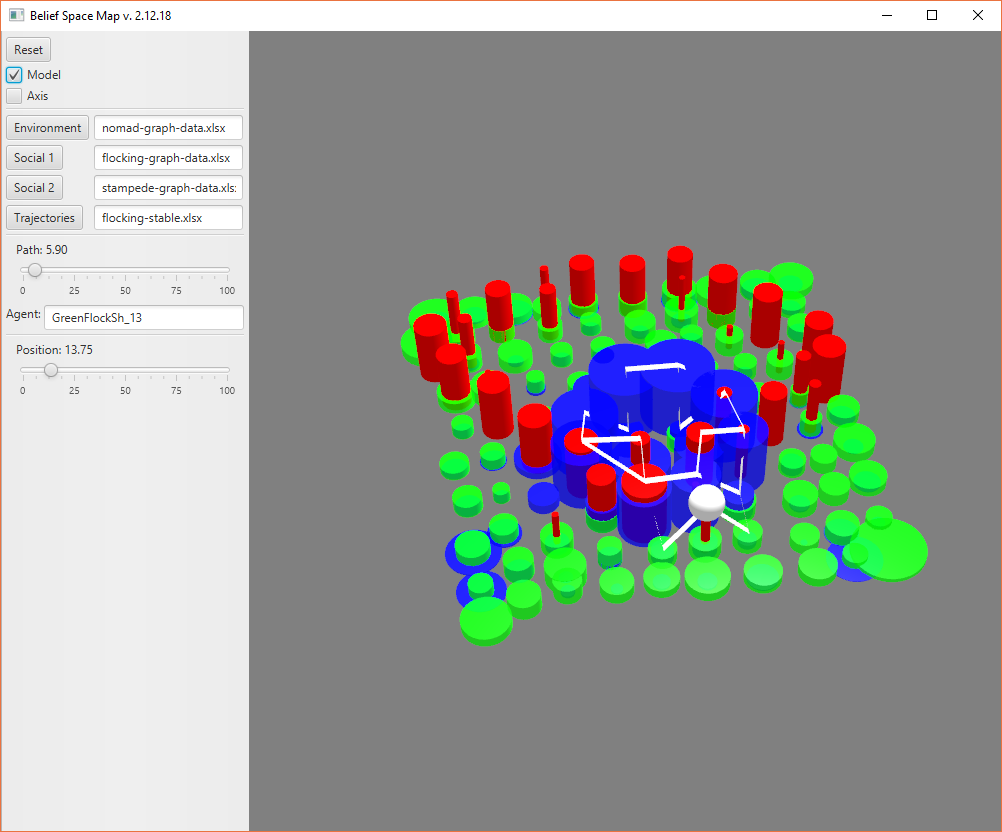
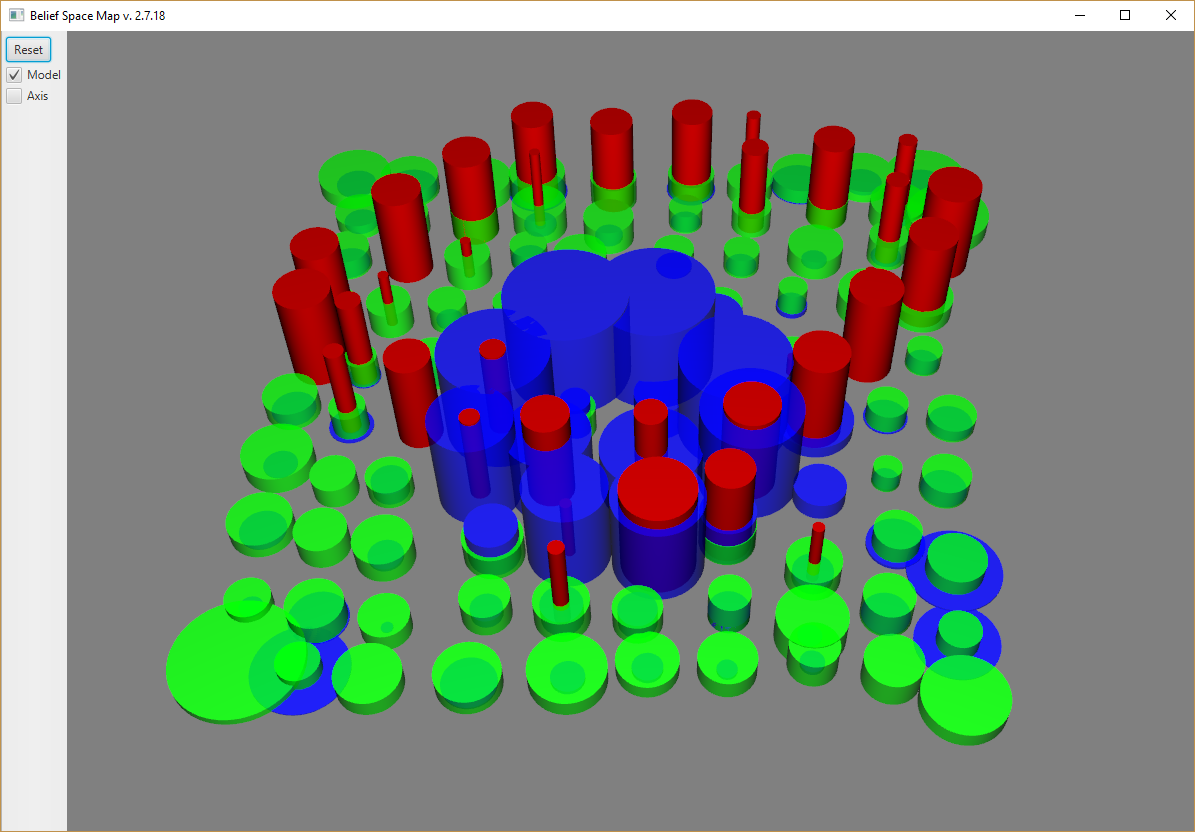
    • Working! 2018-02-07
    • Better: 2018-02-07 (2)
    • Resisting the urge to code more and getting back to the extended abstract. I also need to add a legend to the above pix.
  • Back to extended abstract
    • Added results and future work section
    • got all the pictures in
    • Currently at 3 pages plus. Not horrible.
  • Demographics and Dynamics of Mechanical Turk Workers
    • There are about 100K-200K unique workers on Amazon. On average, there are 2K-5K workers active on Amazon at any given time, which is equivalent to having 10K-25K full-time employees. On average, 50% of the worker population changes within 12-18 months. Workers exhibit widely different patterns of activity, with most workers being active only occasionally, and few workers being very active. Combining our results with the results from Hara et al, we see that MTurk has a yearly transaction volume of a few hundreds of millions of dollars.

Phil 2.1.18

7:00 – 3:30 ASRC MKT

  • Communications Handbook for IPCC scientists
  • The Barnes-Hut Approximation
    • Efficient computation of N-body forces
      By: Jeffrey Heer
      Computers can serve as exciting tools for discovery, with which we can model and explore complex phenomena. For example, to test theories about the formation of the universe, we can perform simulations to predict how galaxies evolve. To do this, we could gather the estimated mass and location of stars and then model their gravitational interactions over time.
  • Need to get started on the extended abstract for Collective Intelligence 2018! One month! March 2, 2018!
    • Set up the LaTex template for the conference. Done
    • Think I want to call it Mapping Simon’s Anthill
  • Need to contact the CHIIR 2018 folks to see what is expected for the DC
  • More Angular, feeling my way through the Http code, which has been deprecated. Looked at the similar code in Tour of Heroes. We’ll see if the old stuff works and then try to update? Need to ask Jeremy.
  • Back to BIC. Evolutionary reasons for cooperation as group fitness, where group payoff is maximized. This makes the stag salient in stag hunt.
  • A thorough explanation of synchronization/phase locking. My mental model is this: Imaging a set of coaxial but randomly oscillating identical weights sliding back and forth in their section of lightweight tubing. From the outside, the tube would be stationary, as all the forces would be cancelling. If the weights can synchronize, then the lightweight tube will be doing most of the moving. Since the mass of the tube is lower than the mass of the combined weights,   The force required for the whole system will be lower, and as a result (I think?) the system will run more efficiently and longer. Need to work out the math.

Phil 1.31.18

7:00 – 7:00 ASRC MKT

  • The Matrix Calculus You Need For Deep Learning
    • Most of us last saw calculus in school, but derivatives are a critical part of machine learning, particularly deep neural networks, which are trained by optimizing a loss function. Pick up a machine learning paper or the documentation of a library such as PyTorch and calculus comes screeching back into your life like distant relatives around the holidays. And it’s not just any old scalar calculus that pops up—you need differential matrix calculus, the shotgun wedding of linear algebra and multivariate calculus.
  • Continuing BIC
    • Explaining the evolution of any human behavior trait (say, a tendency to play C in Prisoner’s Dilemmas) raises three questions. The first is the behavior selection question: why did this trait, rather than some other, get selected by natural selection? Answering this involves giving details of the selection process, and saying what made the disposition confer fitness in the ecology in which selection took place. But now note that ‘When a behavior evolves, a proximate mechanism also must evolve that allows the organism to produce the target behavior. Ivy plants grow toward the light. This is a behavior, broadly construed. For phototropism to evolve, there must be some mechanism inside of ivy plants that causes them to grow in one direction rather than in another’ (Sober and Wilson 1998, pp. 199-200). This raises the second question, the production question: how is the behavior produced within the individual-what is the ‘proximate mechanism’? In the human case, the interest is often in a psychological mechanism: we ask what perceptual, affective and cognitive processes issue in the behavior. Finally, note that these processes must also have evolved, so an answer to the second question brings a third: why did this proximate mechanism evolve rather than some other that could have produced the same behavior? This is the mechanism selection question. (pg 95)
      • These are good questions to answer, or at least address. Roughly, I thing my answers are
        • Selection Question: The three phases are a very efficient way to exploit an environment
        • Production Question: Neural coupling, as developed in physical swarms and moving on to cognitive clustering
        • Mechanism Question: Oscillator frequency locking provides a natural foundation for  collective behavior. Dimension reduction is how axis are selected for matching.
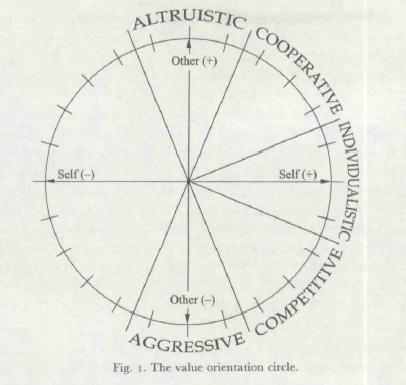
  • Value Orientations, Expectations and Voluntary Contributions in Public Goods
    • ValueOrientation
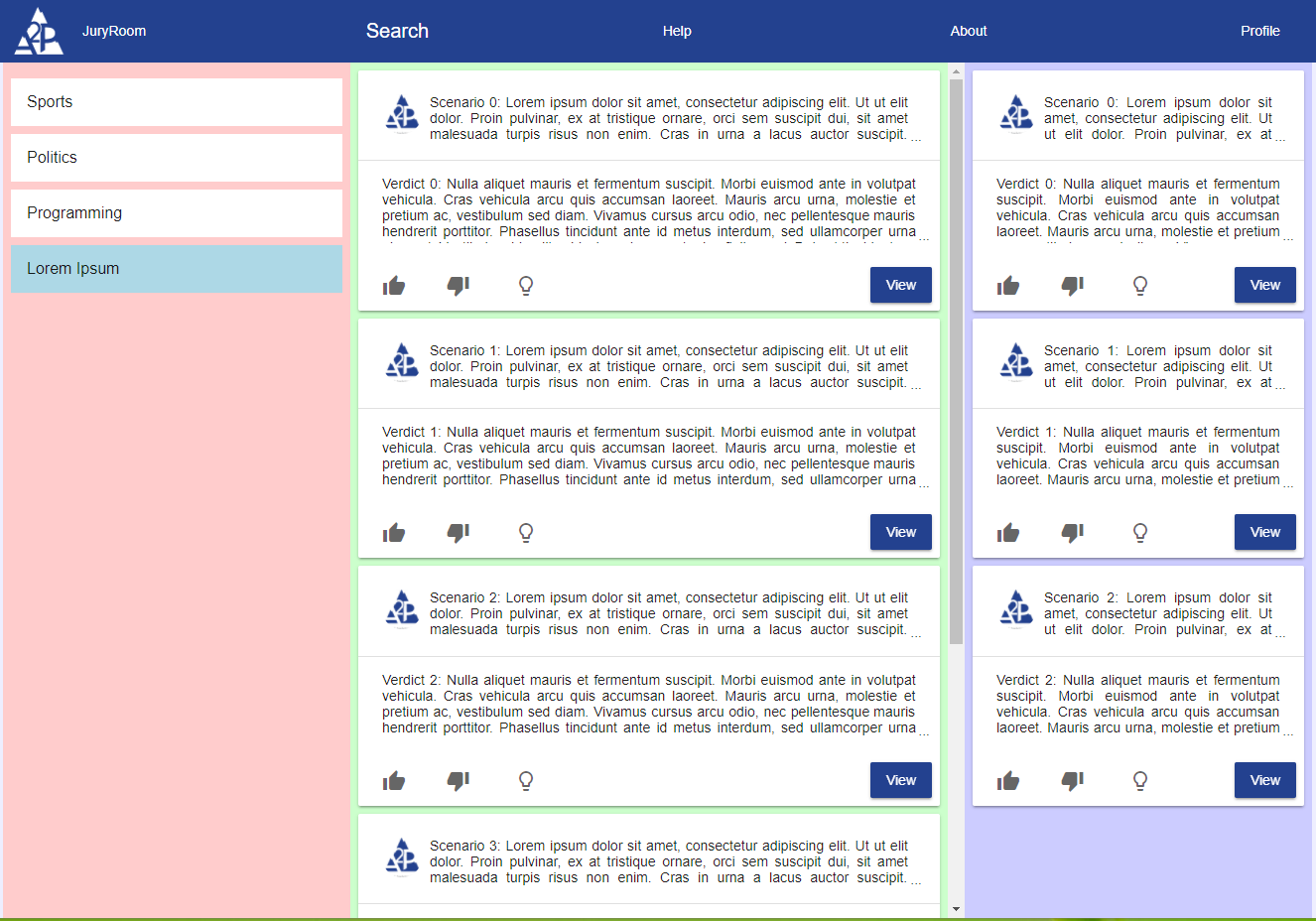
  • Discussion with Aaron about JuryRoom design
  • Observable is a better way to code.
    • Discover insights faster and communicate more effectively with interactive notebooks for data analysis, visualization, and exploration.
  • More Angular. Finished with module communication, starting with services
  • Meeting with Wayne
    • Submit to JASS
    • Abstract to CI 2018 July 7-8, 2018 at the University of Zurich, Switzerland

Phil 1.30.18

7:00 – 5:00 ASRC MKT

  • Big thought for today.In a civilization context, the three phases of collective intelligence work like this. These phases relate to computational effort which is proportional to the number of dimensions that an individual has to consider in their existential calculus. The assumption is that lower computational effort is selected for at natural explore/exploit ratios.
    • Exploration phase. Nomadic explorers are introduced to a new environment. Can be physical, informational, cognitive, etc. This phase has the highest dimensional processing required for the individual.
    • Exploitation phase. Social patterns increase the hill climbing power of agents in the environment. This results in a sufficiently optimal access to resources. This employs lower dimensions to support consensus and polarization.
    • Inertial phase. Social influence becomes dominant and environmental influence wains. Local diversity drops as similar agents cluster tightly together. Resources wane. This employs the most dimension reduction and the highest polarization, resulting in high implicit coordination.
    • Collapse. Implied, since the Inertial phase is unsustainable. If the previous population produced explorers that found new, productive environments, the cycle can repeat elsewhere.
  • Continuing BIC
    • “We need to know, in detail, what deliberations are like that people engage in when they group-identify”. Also, agency transformationAgencyTransformation
  • Rules, norms and institutional erosion: Of non-compliance, enforcement and lack of rule of law
    • What I am seeing right now in the US (a steady and slow erosion of democratic norms and a systematic violation of rules by the President Elect, in particular as though “they don’t apply to him“) is something that I’ve seen in other countries where I have studied formal and informal rules and institution building (and decay). This, in my view, is worrisome. If the US is going to want to continue having a functioning democracy where compliance with rules and norms is an expectation at the societal level, it’s going to have to do something major to stop this systematic rule violation.
  • Evaluation of Interactive Machine Learning Systems
    • The evaluation of interactive machine learning systems remains a difficult task. These systems learn from and adapt to the human, but at the same time, the human receives feedback and adapts to the system. Getting a clear understanding of these subtle mechanisms of co-operation and co-adaptation is challenging. In this chapter, we report on our experience in designing and evaluating various interactive machine learning applications from different domains. We argue for coupling two types of validation: algorithm-centered analysis, to study the computational behaviour of the system; and human-centered evaluation, to observe the utility and effectiveness of the application for end-users. We use a visual analytics application for guided search, built using an interactive evolutionary approach, as an exemplar of our work. We argue that human-centered design and evaluation complement algorithmic analysis, and can play an important role in addressing the “black-box” effect of machine learning. Finally, we discuss research opportunities that require human-computer interaction methodologies, in order to support both the visible and hidden roles that humans play in interactive machine learning.
  • Jensen–Shannon divergence – I think I can use this to show the distance between a full coordination matrix and one that contains only the main diagonal.
  • Evolution of social behavior in finite populations: A payoff transformation in general n-player games and its implications
    • The evolution of social behavior has been the focus of many theoretical investigations, which typically have assumed infinite populations and specific payoff structures. This paper explores the evolution of social behavior in a finite population using a general n-player game. First, we classify social behaviors in a group of n individuals based on their effects on the actor’s and the social partner’s payoffs, showing that in general such classification is possible only for a given composition of strategies in the group. Second, we introduce a novel transformation of payoffs in the general n-player game to formulate explicitly the effects of a social behavior on the actor’s and the social partners’ payoffs. Third, using the transformed payoffs, we derive the conditions for a social behavior to be favored by natural selection in a well-mixed population and in the presence of multilevel selection.
  • Got the data for the verdicts and live verdicts set up right, or at least closer: JuryRoom
  • Booked a room for the CHIIR Hotel
  • Got farther on UltimateAngular:
    •  UltimateAngular

Phil 1.29.18

7:00 – 5:30 ASRC MKT

  • The phrase “Epistemic Game Theory” occurred to me in the shower. Looked it up and found these two things:
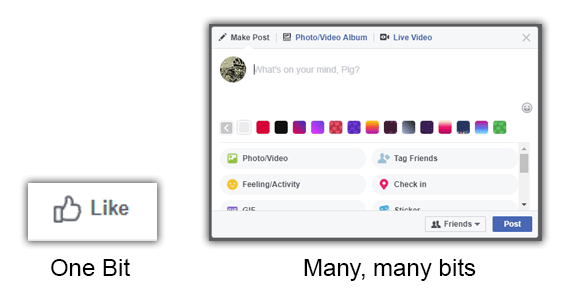
  • When it’s easier to agree than discuss, it should be easier to stampede:
  • Like vs. words
  • This is also a piece of Salganik’s work as described in Leading the Herd Astray: An Experimental Study of Self-Fulfilling Prophecies in an Artificial Cultural Market
  • An article on FB optimization and how to change the ratio of likes to comments, etc
  • I don’t think people did. It’s just that it’s easier to not think too much 🙂 people are busy selling tools that do everything for people, and people are happy buying tools to limit thinking. The analogy of replacing cognitive load with perception by VIS misleads in this regard. (Twitter)
  • Continuing BIC
    • Dimension reduction is a form of induced conceptual myopia (pg 89)? Conceptual Myopia
  • AI Roundup workshop today
    • Zenpeng, Biruh, Phil, Aaron, Eric, Eric, Kevin
    • Eric – Introductory remarks. Budget looks good for 2018. Direction, chance to overlap, get leaders together for unique differentiators and something that we can build a business around. There has to be a really good business case with revenue in the out years
    • Aaron – CDS for A2P. Collaborate on analytics, ML, etc. Non corporate focused. Emerging technologies and trends. Helping each other out. Background in IC software dev.
    • Pam Scheller – SW Aegis. BD. EE, MS Computer engineering.
    • Biruh, TF, LIDAR, Generalized AI as hobby.
    • Zhenpeng Lee – Physics, Instrument Data Processing for GOES-R. FFT. GOES_R radiometric analysis. 7k detector rows? Enormous data sets. Attempting to automate processing the analysis of these data sets. Masters in Computer Science from JHU. Written most of his code from scratch.
    • Kevin Wainwright. Software engineering Aegis. C&C, etc. Currently working on a cloud based analytics with ML for big data, anomaly detection, etc. Looking for deviation from known flight paths
    • Eric Velte. History degree. Aegis. Situational awareness. Chief technologists for missions solutions group. Software mostly. Data analytics for the last two years. Big Data Analytics Platform.
    • Cornel as engineer, Zero G heat transfer, spacecraft work. Technology roadmaps for thermal control. Then business development, mostly for DoD. Research Sports research – head of Olympic Committee research kayaks, women’s 8, horse cooling, bobsleds.
    • Mike Beduck. Chemical Engineering and computer science. Visualization, new to big data. Closed system sensor fusion. RFP response, best practices. Repository for analytics
    • George. Laser physics. Cardiac imaging analysis. Software development, 3D graphics. Medical informatics. CASI ground systems. More GOES-R/S. Image and signal processing and analysis.
    • Anton is lurling and listening. Branding and marketing.
  • A2P WIP
    • Put a place on sharepoint for papers and other documents – annotated bibliography.
    • Floated the JuryRoom app. Need to mention that the polarizing discussion closes at consensus.
  • Zhenpeng Lee AIMS – GOES-R. What went wrong and how to fix. ML to find pattern change in 20k sensor streams. Full training on each day’s data, then large scale clustering. Trends are seasonal? Relationships between sensors? Channel has 200-600 detectors. “Machine Learning of Situational Awareness” MLP written in Java. TANH activation function.
    • Eric Haught: Long term quest for condition-based maintenance.
    • Aaron – we are all trying to come up with a useful cross platform approach to anomaly detection.
    • Training size: 100k samples? Sample selection reduce to 200? Not sure what the threshold sensitivity is
  • Eric Velte – Devops. Centralize SW dev and support into a standardized framework. NO SECURITY STACK!!!!!
  • Dataforbio? Video series