And that seems to straight up work (assuming that multiple GPUs can be called. Here’s an example of training:
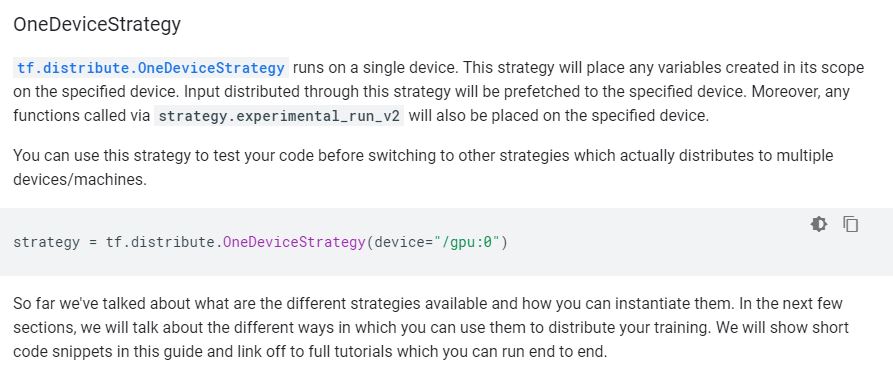
strategy = tf.distribute.OneDeviceStrategy(device="/gpu:0")
with strategy.scope():
    model = tf.keras.Sequential()
    # Adds a densely-connected layer with 64 units to the model:
    model.add(layers.Dense(sequence_length, activation='relu', input_shape=(sequence_length,)))
    # Add another:
    model.add(layers.Dense(200, activation='relu'))
    model.add(layers.Dense(200, activation='relu'))
    # Add a layer with 10 output units:
    model.add(layers.Dense(sequence_length))

    loss_func = tf.keras.losses.MeanSquaredError()
    opt_func = tf.keras.optimizers.Adam(0.01)
    model.compile(optimizer= opt_func,
                  loss=loss_func,
                  metrics=['accuracy'])

    noise = 0.0
    full_mat, train_mat, test_mat = generate_train_test(num_funcs, rows_per_func, noise)

    model.fit(train_mat, test_mat, epochs=70, batch_size=13)
    model.evaluate(train_mat, test_mat)

    model.save(model_name)
And here’s an example of predicting
strategy = tf.distribute.OneDeviceStrategy(device="/gpu:0")
with strategy.scope():
    model = tf.keras.models.load_model(model_name)
    full_mat, train_mat, test_mat = generate_train_test(num_funcs, rows_per_func, noise)

    predict_mat = model.predict(train_mat)

    # Let's try some immediate inference
    for i in range(10):
        pitch = random.random()/2.0 + 0.5
        roll = random.random()/2.0 + 0.5
        yaw = random.random()/2.0 + 0.5
        inp_vec = np.array([[pitch, roll, yaw]])
        eff_mat = model.predict(inp_vec)
        print("input: pitch={:.2f}, roll={:.2f}, yaw={:.2f}  efficiencies: pitch={:.2f}%, roll={:.2f}%, yaw={:.2f}%".
              format(inp_vec[0][0], inp_vec[0][1], inp_vec[0][2], eff_mat[0][0]*100, eff_mat[0][1]*100, eff_mat[0][2]*100))








 viztales
You must be logged in to post a comment.