Category Archives: Mapping

Phil 5.30.18

7:15 – 6:00 ASRC MKT

  • More Bit by Bit
  • An interesting tweet about the dichotomy between individual and herd behaviors.
  • More white paper. Add something about awareness horizon, and how maps change that from a personal to a shared reality (cite understanding ignorance?)
  • Great discussion with Aaron about incorporating adversarial herding. I think that there will be three areas
    • Thunderdome – affords adversarial herding. Users have to state their intent before joining a discussion group. Bots and sock puppets allowed
    • Clubhouse – affords discussion with chosen individuals. THis is what I thought JuryRoom was
    • JuryRoom – fully randomized members and topics, based on activity in the Clubhouse and Thunderdome

Phil 5.25.18

7:00 – 6:00 ASRC MKT

  • Starting Bit by Bit
  • I realized the hook for the white paper is the military importance of maps. I found A Revolution in Military Cartography?: Europe 1650-1815
    • Military cartography is studied in order to approach the role of information in war. This serves as an opportunity to reconsider the Military Revolution and in particular changes in the eighteenth century. Mapping is approached not only in tactical, operational and strategic terms, but also with reference to the mapping of war for public interest. Shifts in the latter reflect changes in the geography of European conflict.
  • Reconnoitering sketch from Instructions in the duties of cavalry reconnoitring an enemy; marches; outposts; and reconnaissance of a country; for the use of military cavalry. 1876 (pg 83) reconnoitering_sketch
  • rutter is a mariner’s handbook of written sailing directions. Before the advent of nautical charts, rutters were the primary store of geographic information for maritime navigation.
    • It was known as a periplus (“sailing-around” book) in classical antiquity and a portolano (“port book”) to medieval Italian sailors in the Mediterranean Sea. Portuguese navigators of the 16th century called it a roteiro, the French a routier, from which the English word “rutter” is derived. In Dutch, it was called a leeskarte (“reading chart”), in German a Seebuch (“sea book”), and in Spanish a derroterro
    • Example from ancient Greece:
      • From the mouth of the Ister called Psilon to the second mouth is sixty stadia.
      • Thence to the mouth called Calon forty stadia.
      • From Calon to Naracum, which last is the name of the fourth mouth of the Ister, sixty stadia.
      • Hence to the fifth mouth a hundred and twenty stadia.
      • Hence to the city of Istria five hundred stadia.
      • From Istria to the city of Tomea three hundred stadia.
      • From Tomea to the city of Callantra, where there is a port, three hundred stadia
  • Battlespace
  • Cyber-Human Systems (CHS)
    • In a world in which computers and networks are increasingly ubiquitous, computing, information, and computation play a central role in how humans work, learn, live, discover, and communicate. Technology is increasingly embedded throughout society, and is becoming commonplace in almost everything we do. The boundaries between humans and technology are shrinking to the point where socio-technical systems are becoming natural extensions to our human experience – second nature, helping us, caring for us, and enhancing us. As a result, computing technologies and human lives, organizations, and societies are co-evolving, transforming each other in the process. Cyber-Human Systems (CHS) research explores potentially transformative and disruptive ideas, novel theories, and technological innovations in computer and information science that accelerate both the creation and understanding of the complex and increasingly coupled relationships between humans and technology with the broad goal of advancing human capabilities: perceptual and cognitive, physical and virtual, social and societal.
  • Reworked Section 1 to incorporate all this in a single paragraph
  • Long discussion about all of the above with Aaron
  • Worked on getting the CoE together by CoB
  • Do Diffusion Protocols Govern Cascade Growth?
    • Large cascades can develop in online social networks as people share information with one another. Though simple reshare cascades have been studied extensively, the full range of cascading behaviors on social media is much more diverse. Here we study how diffusion protocols, or the social exchanges that enable information transmission, affect cascade growth, analogous to the way communication protocols define how information is transmitted from one point to another. Studying 98 of the largest information cascades on Facebook, we find a wide range of diffusion protocols – from cascading reshares of images, which use a simple protocol of tapping a single button for propagation, to the ALS Ice Bucket Challenge, whose diffusion protocol involved individuals creating and posting a video, and then nominating specific others to do the same. We find recurring classes of diffusion protocols, and identify two key counterbalancing factors in the construction of these protocols, with implications for a cascade’s growth: the effort required to participate in the cascade, and the social cost of staying on the sidelines. Protocols requiring greater individual effort slow down a cascade’s propagation, while those imposing a greater social cost of not participating increase the cascade’s adoption likelihood. The predictability of transmission also varies with protocol. But regardless of mechanism, the cascades in our analysis all have a similar reproduction number ( 1.8), meaning that lower rates of exposure can be offset with higher per-exposure rates of adoption. Last, we show how a cascade’s structure can not only differentiate these protocols, but also be modeled through branching processes. Together, these findings provide a framework for understanding how a wide variety of information cascades can achieve substantial adoption across a network.
  • Continuing with creating the Simplest LSTM ever
    • All work and no play makes jack a dull boy indexes alphabetically as : AllWork

Phil 5.18.18

7:00 – 4:00 ASRC MKT

Phil 5.16.18

7:00 – 3:30 ASRC MKT

  • My home box has become very slow. 41 seconds to do a full recompile of GPM, while it takes 3 sec on a nearly identical machine at work. This may help?
  • Working on terms
  • Working on slides
  • Attending talk on Big Data, Security and Privacy – 11 am to 12 pm at ITE 459
    • Bhavani Thiraisingham
    • Big data management and analytics emphasizing GANs  and deep learning<- the new hotness
      • How do you detect attacks?
      • UMBC has real time analytics in cyber? IOCRC
    • Example systems
      • Cloud centric assured information sharing
    • Research challenges:
      • dynamically adapting and evolving policies to maintain privacy under a changing environment
      • Deep learning to detect attacks tat were previously not detectable
      • GANs or attacker and defender?
      • Scaleabe is a big problem, e.g. policies within Hadoop operatinos
      • How much information is being lost by not sharing data?
      • Fine grained access control with Hive RDF?
      • Distributed Search over Encrypted Big Data
    • Data Security & Privacy
      • Honypatching – Kevin xxx on software deception
      • Novel Class detection – novel class embodied in novel malware. There are malware repositories?
    • Lifecycle for IoT
    • Trustworthy analytics
      • Intel SGX
      • Adversarial SVM
      • This resembles hyperparameter tuning. What is the gradient that’s being descended?
      • Binary retrofitting. Some kind of binary man-in-the-middle?
      • Two body problem cybersecurity
    • Question –
      • discuss how a system might recognize an individual from session to session while being unable to identify the individual
      • What about multiple combinatorial attacks
      • What about generating credible false information to attackers, that also has steganographic components for identifying the attacker?
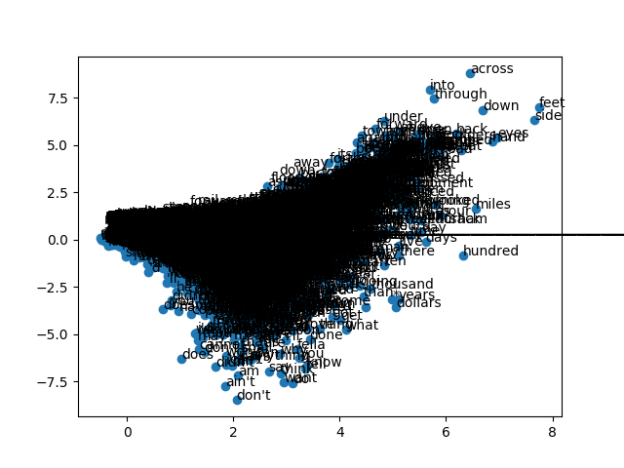
  • I had managed to not commit the embedding xml and the programs that made them, so first I had to install gensim and lxml at home. After that it’s pretty straightforward to recompute with what I currently have.
  • Moving ARFF and XLSX output to the menu choices. – done
  • Get started on rendering
    • Got the data read in and rendering, but it’s very brute force:
      if(getCurrentEmbeddings().loadSuccess){
          double posScalar = ResizableCanvas.DEFAULT_SCALAR/2.0;
          List<WordEmbedding> weList = currentEmbeddings.getEmbeddings();
          for (WordEmbedding we : weList){
              double size = 10.0 * we.getCount();
              SmartShape ss = new SmartShape(we.getEntry(), Color.WHITE, Color.BLACK);
              ss.setPos(we.getCoordinate(0)*posScalar, we.getCoordinate(1)*posScalar);
              ss.setSize(size, size);
              ss.setAngle(0);
              ss.setType(SmartShape.SHAPE_TYPE.OVAL);
              canvas.addShape(ss);
          }
      }

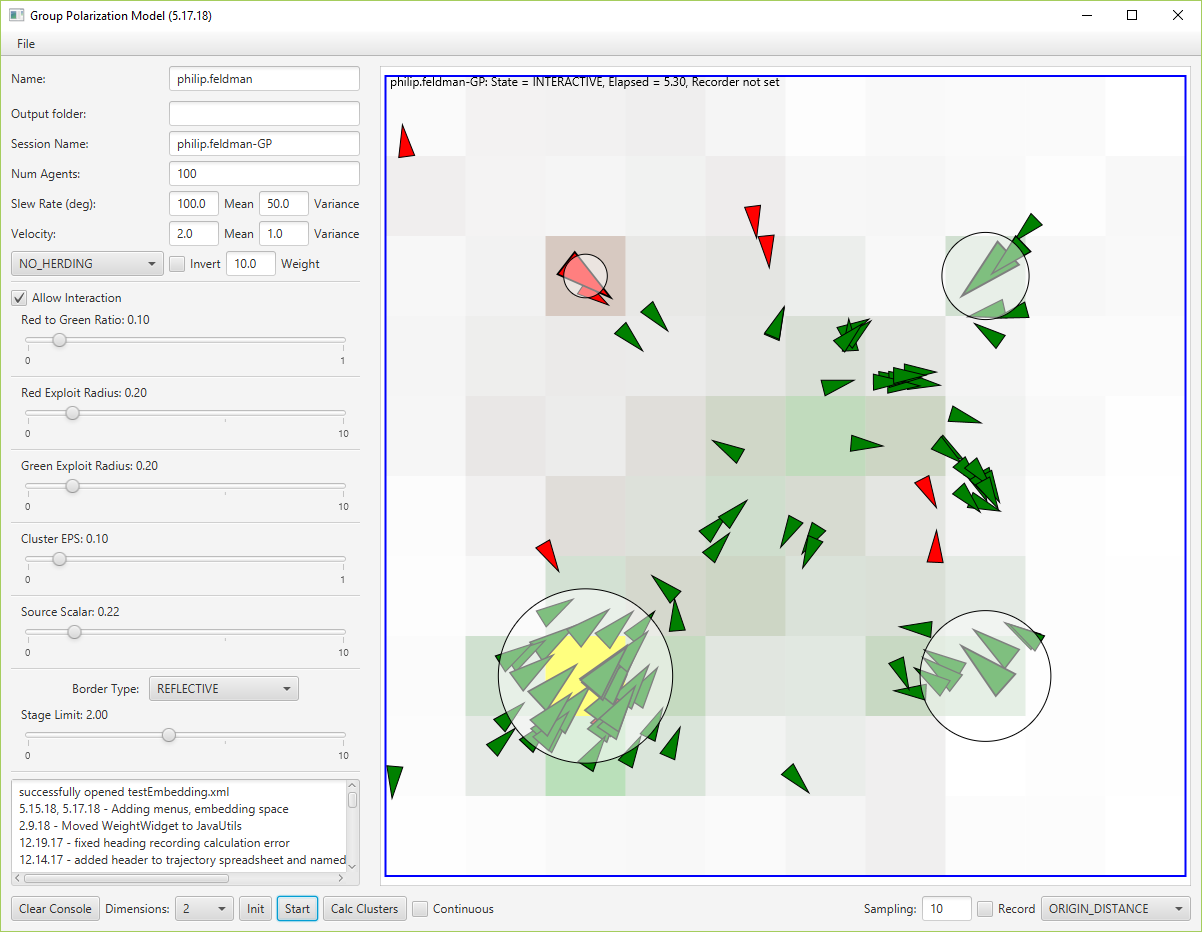
      It took a while to remember how shapes and agents work together. Next steps:

      • Extend SmartShape to SourceShape. It should be a stripped down version of FlockingShape
      • Extend BaseCA to SourceCA, again, it should be a stripped down version of FlockingBeliefCA
      • Add a sourceShapeList for FlockingAgentManager that then passes that to the FlockingShapes

Phil 5.15.18

7:00 – 4:00 ASRC MKT

Phil 5.8.18

7:00 – 5:00 ASRC MKT

5:00 – 8:00 ASRC Tech Conference

Phil 5.7.18

7:00 – 5:00 ASRC MKT

  • Content Sharing within the Alternative Media Echo-System: The Case of the White Helmets
    • Kate Starbird
    • In June 2017 our lab began a research project looking at online conversations about the Syria Civil Defence (aka the “White Helmets”). Over the last 8–9 months, we have spent hundreds of hours conducting analysis on the tweets, accounts, articles, and websites involved in that discourse. Our first peer-reviewed paper was recently accepted to an upcoming conference (ICWSM-18). That paper focuses on a small piece of the structure and dynamics of this conversation, specifically looking at content sharing across websites. Here, I describe that research and highlight a few of the findings.
  • Matt Salganik on Open Review
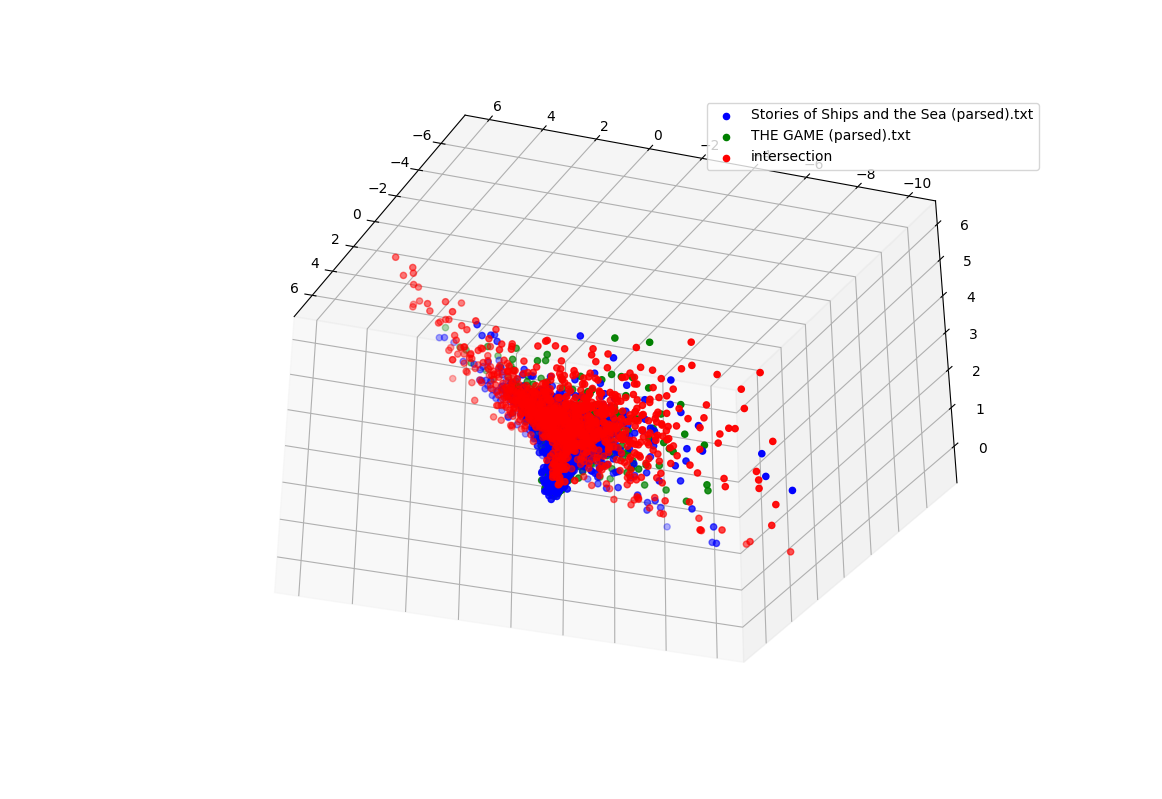
  • Spent a lot of time getting each work to draw differently in the scatterplot. That took some digging into the gensim API to get vectors from the corpora. I then tried to plot the list of arrays, but matplotlib only likes ndarrays (apparently?). I’m now working on placing the words from each text into their own ndarray.
  • Also added a filter for short stop words and switched to a hash map for words to avoid redundant points in the plot.
  • Fika
    • Bryce Peake
    • ICA has a computational methods study area. How media lows through different spaces, etc. Python and [R]
    • Anne Balsamo – designing culture
    • what about language as an anti-colonial interaction
    • Human social scraping of data. There can be emergent themes that become important.
    • The ability of the user to delete all primary, secondary and tertiary data.
    • The third eye project (chyron crawls)

Phil 5.4.18

7:00 – 4:30 ASRC MKT

  • Listening to the Invisibilia episode on the stories we tell ourselves. (I, I, I. Him)
  • Listening to BBC Business Daily, on Economists in the doghouse. One of the people being interviewed is Mariana Mazzucato, who wrote The Entrepreneurial State: debunking public vs. private sector myths. She paraphrases Plato: “stories rule the world”. Oddly, this does not show up when you search through Plato’s work. It may be part of the Parable of the Cave, where the stories that the prisoners tell each other build a representation of the world?
  • Moby Dick, page 633 – a runaway condition:
    • They were one man, not thirty. For as the one ship that held them all; though it was put together of all contrasting things-oak, and maple, and pine wood; iron, and pitch, and hemp-yet all these ran into each other in the one concrete hull, which shot on its way, both balanced and directed by the long central keel; even so, all the individualities of the crew, this man’s valor, that man’s fear; guilt and guiltiness, all varieties were welded into oneness, and were all directed to that fatal goal which Ahab their one lord and keel did point to.
  • John Goodall, one of Wayne’s former students is deep into intrusion detection and visualization
  • Added comments to Aaron’s Reddit notes / CHI paper
  • Chris McCormick has a bunch of nice tutorials on his blog, including this one on Word2Vec:
    • This tutorial covers the skip gram neural network architecture for Word2Vec. My intention with this tutorial was to skip over the usual introductory and abstract insights about Word2Vec, and get into more of the details. Specifically here I’m diving into the skip gram neural network model.
    • He also did this:
    • wiki-sim-search: Similarity search on Wikipedia using gensim in Python.The goals of this project are the following two features:
      1. Create LSI vector representations of all the articles in English Wikipedia using a modified version of the make_wikicorpus.py script in gensim.
      2. Perform concept searches and other fun text analysis on Wikipedia, also using gensim functionality.
  • Slicing out columns in numpy:
    import numpy as np
    dimension = 3
    size = 10
    dataset = np.ndarray(shape=(size, dimension))
    for x in range(size):
        for y in range(dimension):
            val = (y+1) * 10 + x +1
            dataset[x,y] = val
    
    print(dataset)
    print(dataset[...,0])
    print(dataset[...,1])
    print(dataset[...,2])

    Results in:

    [[11. 21. 31.]
    [12. 22. 32.]
    [13. 23. 33.]
    [14. 24. 34.]
    [15. 25. 35.]
    [16. 26. 36.]
    [17. 27. 37.]
    [18. 28. 38.]
    [19. 29. 39.]
    [20. 30. 40.]]
    [11. 12. 13. 14. 15. 16. 17. 18. 19. 20.]
    [21. 22. 23. 24. 25. 26. 27. 28. 29. 30.]
    [31. 32. 33. 34. 35. 36. 37. 38. 39. 40.]
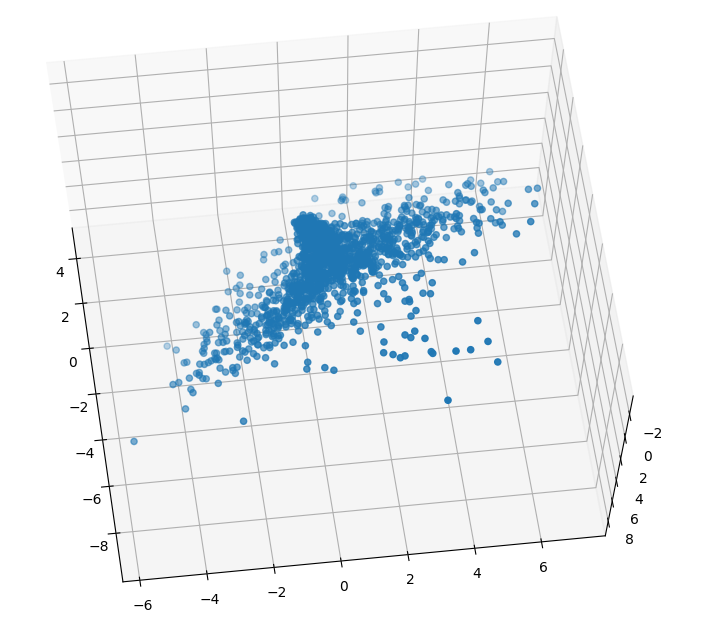
  • And that makes everything work. Here’s a screenshot of a 3D embedding space for the entire(?) Jack London corpora: 3D_corpora
  • A few things come to mind
    • I’ll need to get the agents to stay in the space that the points are in. I think each point is an “attractor” with a radius (an agent without a heading). IN the presence of an attractor an agent’s speed is reduced by x%. It there are a lot of attractors (n), then the speed is reduced by xn%. Which should make for slower agents in areas of high density. Agents in the presence of attractors also expand their influence horizon, becoming more “attractive”
    • I should be able to draw the area covered by each book in the corpora by looking for the W2V coordinates and plotting them as I read through the (parsed) book. Each book gets a color.

Phil 5.3.18

7:30 – 5:00 ASRC MKT

Phil 4.25.18

7:00 – 3:30 ASRC MKT

  • Google’s Workshop on AI/ML Research and Practice in India:
    Ganesh Ramakrishnan (IIT Bombay) presented research on human assisted machine learning.
  • From I to We: Group Formation and Linguistic Adaption in an Online Xenophobic Forum
    • Much of identity formation processes nowadays takes place online, indicating that intergroup differentiation may be found in online communities. This paper focuses on identity formation processes in an open online xenophobic, anti-immigrant, discussion forum. Open discussion forums provide an excellent opportunity to investigate open interactions that may reveal how identity is formed and how individual users are influenced by other users. Using computational text analysis and Linguistic Inquiry Word Count (LIWC), our results show that new users change from an individual identification to a group identification over time as indicated by a decrease in the use of “I” and increase in the use of “we”. The analyses also show increased use of “they” indicating intergroup differentiation. Moreover, the linguistic style of new users became more similar to that of the overall forum over time. Further, the emotional content decreased over time. The results indicate that new users on a forum create a collective identity with the other users and adapt to them linguistically.
    • Social influence is broadly defined as any change – emotional, behavioral, or attitudinal – that has its roots in others’ real or imagined presence (Allport, 1954). (pg 77)
    • Regardless of why an individual displays an observable behavioral change that is in line with group norms, social identification with a group is the basis for the change. (pg 77)
    • In social psychological terms, a group is defined as more than two people that share certain goals (Cartwright & Zander, 1968). (pg 77)
    • Processes of social identification, intergroup differentiation and social influence have to date not been studied in online forums. The aim of the present research is to fill this gap and provide information on how such processes can be studied through language used on the forum. (pg 78)
    • The popularity of social networking sites has increased immensely during the last decade. At the same time, offline socializing has shown a decline (Duggan & Smith, 2013). Now, much of the socializing actually takes place online (Ganda, 2014). In order to be part of an online community, the individual must socialize with other users. Through such socializing, individuals create self-representations (Enli & Thumim, 2012). Hence, the processes of identity formation, may to a large extent take place on the Internet in various online forums. (pg 78)
    • For instance, linguistic analyses of American Nazis have shown that use of third person plural pronouns (they, them, their) is the single best predictor of extreme attitudes (Pennebaker & Chung, 2008). (pg 79)
    • Because language can be seen as behavior (Fiedler, 2008), it may be possible to study processes of social influence through linguistic analysis. Thus, our second hypothesis is that the linguistic style of new users will become increasingly similar to the linguistic style of the overall forum over time (H2). (pg 79)
    • This indicates that the content of the posts in an online forum may also change over time as arguments become more fine-tuned and input from both supporting and contradicting members are integrated into an individual’s own beliefs. This is likely to result (linguistically) in an increase in indicators of cognitive complexity. Hence, we hypothesize that the content of the posts will change over time, such that indicators of complex thinking will increase (H3a). (pg 80)
      • I’m not sure what to think about this. I expect from dimension reduction, that as the group becomes more aligned, the overall complex thinking will reduce, and the outliers will leave, at least in the extreme of a stampede condition.
    • This result indicates that after having expressed negativity in the forum, the need for such expressions should decrease. Hence, we expect that the content of the posts will change such that indicators of negative emotions will decrease, over time (H3b). (pg 80)
    • the forum is presented as a “very liberal forum”, where people are able to express their opinions, whatever they may be. This “extreme liberal” idea implies that there is very little censorship the forum is presented as a “very liberal forum”, where people are able to express their opinions, whatever they may be. This “extreme liberal” idea implies that there is very little censorship, which has resulted in that the forum is highly xenophobic. Nonetheless, due to its liberal self-presentation, the xenophobic discussions are not unchallenged. For example, also anti-racist people join this forum in order to challenge individuals with xenophobic attitudes. This means that the forum is not likely to function as a pure echo chamber, because contradicting arguments must be met with own arguments. Hence, individuals will learn from more experienced users how to counter contradicting arguments in a convincing way. Hence, they are likely to incorporate new knowledge, embrace input and contribute to evolving ideas and arguments. (pg 81)
      • Open debate can lead to the highest level of polarization (M&D)
      • There isn’t diverse opinion. The conversation is polarized, with opponents pushing towards the opposite pole. The question I’d like to see answered is has extremism increased in the forum?
    • Natural language analyses of anonymous social media forums also circumvent social desirability biases that may be present in traditional self-rating research, which is a particular important concern in relation to issues related to outgroups (Maass, Salvi, Arcuri, & Semin, 1989; von Hippel, Sekaquaptewa, & Vargas, 1997, 2008). The to-be analyzed media uses “aliases”, yielding anonymity of the users and at the same time allow us to track individuals over time and analyze changes in communication patterns. (pg 81)
      • After seeing “Ready Player One”, I also wonder if the aliases themselves could be looked at using an embedding space built from the terms used by the users? Then you get distance measurements, t-sne projections, etc.
    • Linguistic Inquiry Word Count (LIWC; Pennebaker et al., 2007; Chung & Pennebaker, 2007; Pennebaker, 2011b; Pennebaker, Francis, & Booth, 2001) is a computerized text analysis program that computes a LIWC score, i.e., the percentage of various language categories relative to the number of total words (see also www.liwc.net). (pg 81)
      • LIWC2015 ($90) is the gold standard in computerized text analysis. Learn how the words we use in everyday language reveal our thoughts, feelings, personality, and motivations. Based on years of scientific research, LIWC2015 is more accurate, easier to use, and provides a broader range of social and psychological insights compared to earlier LIWC versions
    • Figure 1c shows words overrepresented in later posts, i.e. words where the usage of the words correlates positively with how long the users has been active on the forum. The words here typically lack emotional content and are indicators of higher complexity in language. Again, this analysis provides preliminary support for the idea that time on the forum is related to more complex thinking, and less emotionality.
      • WordCloud
    • The second hypothesis was that the linguistic style of new users would become increasingly similar to other users on the forum over time. This hypothesis is evaluated by first z-transforming each LIWC score, so that each has a mean value of zero and a standard deviation of one. Then we measure how each post differs from the standardized values by summing the absolute z-values over all 62 LIWC categories from 2007. Thus, low values on these deviation scores indicate that posts are more prototypical, or highly similar, to what other users write. These deviation scores are analyzed in the same way as for Hypothesis 1 (i.e., by correlating each user score with the number of days on the forum, and then t-testing whether the correlations are significantly different from zero). In support of the hypothesis, the results show an increase in similarity, as indicated by decreasing deviation scores (Figure 2). The mean correlation coefficient between this measure and time on the forum was -.0086, which is significant, t(11749) = -3.77, p < 0.001. (pg 85)
      • ForumAlignmentI think it is reasonable to consider this a measure of alignment
    • Because individuals form identities online and because we see this in the use of pronouns, we also expected to see tendencies of social influence and adaption. This effect was also found, such that individuals’ linguistic style became increasingly similar to other users’ linguistic style over time. Past research has shown that accommodation of communication style occurs automatically when people connect to people or groups they like (Giles & Ogay 2007; Ireland et al., 2011), but also that similarity in communicative style functions as cohesive glue within a group (Reid, Giles, & Harwood, 2005). (pg 86)
    • Still, the results could not confirm an increase in cognitive complexity. It is difficult to determine why this was not observed even though a general trend to conform to the linguistic style on the forum was observed. (pg 87)
      • This is what I would expect. As alignment increases, complexity, as expressed by higher dimensional thinking should decrease.
    • This idea would also be in line with previous research that has shown that expressing oneself decreases arousal (Garcia et al., 2016). Moreover, because the forum is not explicitly racist, individuals may have simply adapted to the social norms on the forum prescribing less negative emotional displays. Finally, a possible explanation for the decrease in negative emotional words might be that users who are very angry leave the forum, because of its non-racist focus, and end up in more hostile forums. An interesting finding that was not part of the hypotheses in the present research is that the third person plural category correlated positively with all four negative emotions categories, suggesting that people using for example ‘they’ express more negative emotions (pg 87)
    • In line with social identity theory (Tajfel & Turner, 1986), we also observe linguistic adaption to the group. Hence, our results indicate that processes of identity formation may take place online. (pg 87)
  • Me, My Echo Chamber, and I: Introspection on Social Media Polarization
    • Homophily — our tendency to surround ourselves with others who share our perspectives and opinions about the world — is both a part of human nature and an organizing principle underpinning many of our digital social networks. However, when it comes to politics or culture, homophily can amplify tribal mindsets and produce “echo chambers” that degrade the quality, safety, and diversity of discourse online. While several studies have empirically proven this point, few have explored how making users aware of the extent and nature of their political echo chambers influences their subsequent beliefs and actions. In this paper, we introduce Social Mirror, a social network visualization tool that enables a sample of Twitter users to explore the politically-active parts of their social network. We use Social Mirror to recruit Twitter users with a prior history of political discourse to a randomized experiment where we evaluate the effects of different treatments on participants’ i) beliefs about their network connections, ii) the political diversity of who they choose to follow, and iii) the political alignment of the URLs they choose to share. While we see no effects on average political alignment of shared URLs, we find that recommending accounts of the opposite political ideology to follow reduces participants’ beliefs in the political homogeneity of their network connections but still enhances their connection diversity one week after treatment. Conversely, participants who enhance their belief in the political homogeneity of their Twitter connections have less diverse network connections 2-3 weeks after treatment. We explore the implications of these disconnects between beliefs and actions on future efforts to promote healthier exchanges in our digital public spheres.
  • What We Read, What We Search: Media Attention and Public Attention Among 193 Countries
    • We investigate the alignment of international attention of news media organizations within 193 countries with the expressed international interests of the public within those same countries from March 7, 2016 to April 14, 2017. We collect fourteen months of longitudinal data of online news from Unfiltered News and web search volume data from Google Trends and build a multiplex network of media attention and public attention in order to study its structural and dynamic properties. Structurally, the media attention and the public attention are both similar and different depending on the resolution of the analysis. For example, we find that 63.2% of the country-specific media and the public pay attention to different countries, but local attention flow patterns, which are measured by network motifs, are very similar. We also show that there are strong regional similarities with both media and public attention that is only disrupted by significantly major worldwide incidents (e.g., Brexit). Using Granger causality, we show that there are a substantial number of countries where media attention and public attention are dissimilar by topical interest. Our findings show that the media and public attention toward specific countries are often at odds, indicating that the public within these countries may be ignoring their country-specific news outlets and seeking other online sources to address their media needs and desires.
  • “You are no Jack Kennedy”: On Media Selection of Highlights from Presidential Debates
    • Our findings indicate that there exist signals in the textual information that untrained humans do not find salient. In particular, highlights are locally distinct from the speaker’s previous turn, but are later echoed more by both the speaker and other participants (Conclusions)
      • This sounds like dimension reduction and alignment
  • Algorithms, bots, and political communication in the US 2016 election – The challenge of automated political communication for election law and administration
    • Philip N. Howard (Scholar)
    • Samuel C. Woolley (Scholar)
    • Ryan Calo (Scholar)
    • Political communication is the process of putting information, technology, and media in the service of power. Increasingly, political actors are automating such processes, through algorithms that obscure motives and authors yet reach immense networks of people through personal ties among friends and family. Not all political algorithms are used for manipulation and social control however. So what are the primary ways in which algorithmic political communication—organized by automated scripts on social media—may undermine elections in democracies? In the US context, what specific elements of communication policy or election law might regulate the behavior of such “bots,” or the political actors who employ them? First, we describe computational propaganda and define political bots as automated scripts designed to manipulate public opinion. Second, we illustrate how political bots have been used to manipulate public opinion and explain how algorithms are an important new domain of analysis for scholars of political communication. Finally, we demonstrate how political bots are likely to interfere with political communication in the United States by allowing surreptitious campaign coordination, illegally soliciting either contributions or votes, or violating rules on disclosure.
  • Ok, back to getting HTTPClient posts to play with PHP cross domain
  • Maybe I have to make a proxy?
    • Using the proxying support in webpack’s dev server we can highjack certain URLs and send them to a backend server. We do this by passing a file to --proxy-config
    • Well, that fixes the need to have all the server options set, but the post still doesn’t send data. But since this is the Right way to do things, here’s the steps:
    • To proxy localhost:4200/uli -> localhost:80/uli
      • Create a proxy.conf.json file in the same directory as package.json
        {
          "/uli": {
            "target": "http://localhost:80",
            "secure": false
          }
        }

        This will cause any explicit request to localhost:4200/uli to be mapped to localhost:80/uli and appear that they are coming from localhost:80/uli

      • Set the npm start command in the package.json file to read as
        "scripts": {
          "start": "ng serve --proxy-config proxy.conf.json",
          ...
        },

        Start with “npm start”, rather than “ng serve”

      • Call from Angular like this:
        this.http.post('http://localhost:4200/uli/script.php', payload, httpOptions)
      • Here’s the PHP code (script.php): it takes POST and GET input and feeds it back with some information about the source :
        function getBrowserInfo(){
             $browserData = array();
             $ip = htmlentities($_SERVER['REMOTE_ADDR']);
             $browser = htmlentities($_SERVER['HTTP_USER_AGENT']);
             $referrer = "No Referrer";
             if(isset($_SERVER['HTTP_REFERER'])) {
                 //do what you need to do here if it's set
                 $referrer = htmlentities($_SERVER['HTTP_REFERER']);         if($referrer == ""){
                     $referrer = "No Referrer";
                 }
             }
             $browserData["ipAddress"] = $ip;
             $browserData["browser"] = $browser;
             $browserData["referrer"] = $referrer;
             return $browserData;
         }
         function getPostInfo(){
             $postInfo = array();
             foreach($_POST as $key => $value) {
                if(strlen($value) < 10000) {               $postInfo[$key] = $value;           }else{               $postInfo[$key] = "string too long";           }       }       return $postInfo;   }   function getGetInfo(){       $getInfo = array();       foreach($_GET as $key => $value) {
                if(strlen($value) < 10000) {
                    $getInfo[$key] = $value;
                }else{
                    $getInfo[$key] = "string too long";
                }
            }
            return $getInfo;
        }
        
        /**************************** MAIN ********************/
        $toReturn = array();
        $toReturn['getPostInfo'] = getPostInfo();
        $toReturn['getGetInfo'] = getGetInfo();
        $toReturn['browserInfo'] = getBrowserInfo();
        $toReturn['time'] = date("h:i:sa");
        $jstr =  json_encode($toReturn);
        echo($jstr);
      • And it arrives at localhost:80/uli/script.php. The following is the javascript console of the Angular CLI code running on localhost:4200
        {getPostInfo: Array(0), getGetInfo: {…}, browserInfo: {…}, time: "05:17:16pm"}
        browserInfo:
        	browser:"Mozilla/5.0 (Windows NT 10.0; Win64; x64) AppleWebKit/537.36 (KHTML, like Gecko) Chrome/65.0.3325.181 Safari/537.36"
        	ipAddress:"127.0.0.1"
        	referrer:"http://localhost:4200/"
        getGetInfo:
        	message:"{"title":"foo","body":"bar","userId":1}"
        getPostInfo:[]
        time:"05:17:16pm"
        
      • Got the pieces parsing in @Component and displaying, so the round trip is done. Wan’t expecting to wind up using GET, but until I can figure out what the deal is with POST, that’s what it’s going to be. Here are the two methods that send and then parse the message:
        doGet(event) {
          let payload = {
            title: 'foo',
            body: 'bar',
            userId: 1
          };
          let message = 'message='+encodeURIComponent(JSON.stringify(payload));
          let target = 'http://localhost:4200/uli/script.php?';
        
          //this.http.get(target+'title=\'my title\'&body=\'the body\'&userId=1')
          this.http.get(target+message)
            .subscribe((data) => {
              console.log('Got some data from backend ', data);
              this.extractMessage(data, "getGetInfo");
            }, (error) => {
              console.log('Error! ', error);
            });
        }
        
        extractMessage(obj, name: string){
          let item = obj[name];
          try {
            if (item) {
              let mstr = item.message;
              this.mobj = JSON.parse(mstr);
            }
          }catch(err){
            this.mobj = {};
            this.mobj["message"] = "Error extracting 'message' from ["+name+"]";
          }
          this.mkeys = Object.keys(this.mobj);
        }
      • And here’s the html code: html
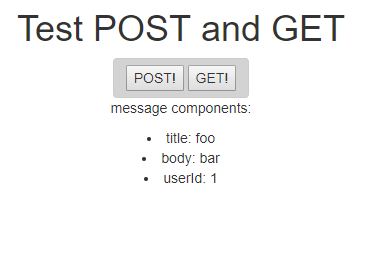
      • Here’s a screenshot of everything working: PostGetTest

Phil 4.21.18

Today’s ride

“Writing is Thinking”—an annotated twitter thread

  • Another in the series of State, Orientation and Velocity. In this case discussing the differences between stories and maps:
  • It is really incredible the amount of pushback I see from companies, startups to big, about writing. In particular around the notion that writing is the antithesis of agile. Writing ossifies and cements decision or plans that should change, it is said. My view is that agility comes from planning. Without plans, activities are just brownian motion. And you can’t have plans, especially shared plans, without writing.

Ervin Staub

  • In The Roots of Goodness and Resistance to Evil, Ervin Staub draws on his extensive experiences in scholarship and intervention to illuminate the socializing experiences, education, and trainings that lead children and adults to become helpers/active bystanders and rescuers, acting to prevent violence and create peaceful and harmonious societies. The book collects Staub’s most important and influential articles and essays in the field together with newly written chapters, with wide-ranging examples of helping behaviors as well as discussions of why we should help and not harm others. He addresses many examples of such behaviors, from helping people in everyday physical or psychological distress, to active bystandership in response to harmful actions by youth toward their peers (bullying), to endangering one’s life to save someone in immediate danger, or rescuing intended victims of genocide.

Train Your Machine Learning Models on Google’s GPUs for Free — Forever

  • The first step is to download the notebook (or another notebook of your choice)

  • Then, head over to Google Colab, sign into your google account (or create one if you somehow made it this far through life without one)

Phil 4.20.18

7:00 – ASRC MKT

  • Executing gradient descent on the earth
    • But the important question is: how well does gradient descent perform on the actual earth?
    • This is nice, because it suggests that we can compare GD algorithms on recognizable and visualizable terrains. Terrain locations can have multiple visualizable factors, height and luminance could be additional dimensions
  • Minds is the anti-facebook that pays you for your time
    • In a refreshing change from Facebook, Twitter, Instagram, and the rest of the major platforms, Minds has also retained a strictly reverse-chronological timeline. The core of the Minds experience, though, is that users receive “tokens” when others interact with their posts, or simply by spending time on the platform.
  • Continuing along with the Angular/PHP tutorial here. Nicely, there is also a Git repo
    • Had to add some styling to get the upload button to show
    • The HttpModule is deprecated, but sticking with it for now
    • Will need to connect/verify PHP server within IntelliJ, described here.
    • How to connect Apache, to IntelliJ
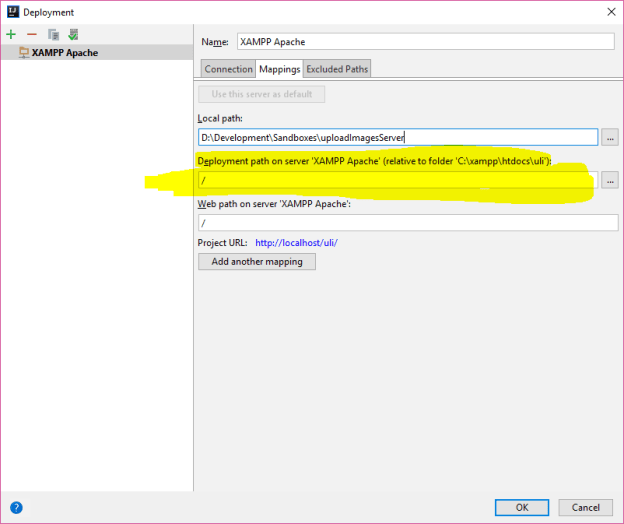
  • Installing and Configuring XAMPP with PhpStorm IDE. Don’t forget about deployment path: deploy

Phil 4.19.18

8:00 – ASRC MKT/BD

    • Good discussion with Aaron about the agents navigating embedding space. This would be a great example of creating “more realistic” data from simulation that bridges the gap between simulation and human data. This becomes the basis for work producing text for inputs such as DHS input streams.
      • Get the embedding space from the Jack London corpora (crawl here)
      • Train a classifier that recognizes JL using the embedding vectors instead of the words. This allows for contextual closeness. Additionally, it might allow a corpus to be trained “at once” as a pattern in the embedding space using CNNs.
      • Train an NN(what type?) to produce sentences that contain words sent by agents that fool the classifier
      • Record the sentences as the trajectories
      • Reconstruct trajectories from the sentences and compare to the input
      • Some thoughts WRT generating Twitter data
        • Closely aligned agents can retweet (alignment measure?)
        • Less closely aligned agents can mention/respond, and also add their tweet
    • Handed off the proposal to Red Team. Still need to rework the Exec Summary. Nope. Doesn’t matter that the current exec summary does not comply with the requirements.
    • A dog with high social influence creates an adorable stampede:
    • Using Machine Learning to Replicate Chaotic Attractors and Calculate Lyapunov Exponents from Data
      • This is a paper that describes how ML can be used to predict the behavior of chaotic systems. An implication is that this technique could be used for early classification of nomadic/flocking/stampede behavior
    • Visualizing a Thinker’s Life
      • This paper presents a visualization framework that aids readers in understanding and analyzing the contents of medium-sized text collections that are typical for the opus of a single or few authors.We contribute several document-based visualization techniques to facilitate the exploration of the work of the German author Bazon Brock by depicting various aspects of its texts, such as the TextGenetics that shows the structure of the collection along with its chronology. The ConceptCircuit augments the TextGenetics with entities – persons and locations that were crucial to his work. All visualizations are sensitive to a wildcard-based phrase search that allows complex requests towards the author’s work. Further development, as well as expert reviews and discussions with the author Bazon Brock, focused on the assessment and comparison of visualizations based on automatic topic extraction against ones that are based on expert knowledge.


Phil 4.18.18

7:00 – 6:30 ASRC MKT/BD

  • Meeting with James Foulds. We talked about building an embedding space for a literature body (The works of Jack London, for example) that agents can then navigate across. At the same time, train an LSTM on the same corpora so that the ML system, when given the vector of terms from the embedding (with probabilities/similarities?), produce a line that could be from the work that incorporates those terms. This provides a much more realistic model of the agent output that could be used for mapping. Nice paper to continue the current work while JuryRoom comes up to speed.
  • Recurrent Neural Networks for Multivariate Time Series with Missing Values
    • Multivariate time series data in practical applications, such as health care, geoscience, and biology, are characterized by a variety of missing values. In time series prediction and other related tasks, it has been noted that missing values and their missing patterns are often correlated with the target labels, a.k.a., informative missingness. There is very limited work on exploiting the missing patterns for effective imputation and improving prediction performance. In this paper, we develop novel deep learning models, namely GRUD, as one of the early attempts. GRU-D is based on Gated Recurrent Unit (GRU), a state-of-the-art recurrent neural network. It takes two representations of missing patterns, i.e., masking and time interval, and effectively incorporates them into a deep model architecture so that it not only captures the long-term temporal dependencies in time series, but also utilizes the missing patterns to achieve better prediction results. Experiments of time series classification tasks on real-world clinical datasets (MIMIC-III, PhysioNet) and synthetic datasets demonstrate that our models achieve state-of-the-art performance and provide useful insights for better understanding and utilization of missing values in time series analysis.
  •  The fall of RNN / LSTM
    • We fell for Recurrent neural networks (RNN), Long-short term memory (LSTM), and all their variants. Now it is time to drop them!
  • JuryRoom
  • Back to proposal writing
  • Done with section 5! LaTex FTW!
  • Clean up Abstract, Exec Summary and Transformative Impact tomorrow

Phil 4.14.18

Text Embedding Models Contain Bias. Here’s Why That Matters.

  • It occurs to me that bias may be a way of measuring societal dimension reduction. Need to read this carefully.
  • Neural network models can be quite powerful, effectively helping to identify patterns and uncover structure in a variety of different tasks, from language translation to pathology to playing games. At the same time, neural models (as well as other kinds of machine learning models) can contain problematic biases in many forms. For example, classifiers trained to detect rude, disrespectful, or unreasonable comments may be more likely to flag the sentence “I am gay” than “I am straight” [1]; face classification models may not perform as well for women of color [2]; speech transcription may have higher error rates for African Americans than White Americans [3].

Visual Analytics for Explainable Deep Learning

  • Recently, deep learning has been advancing the state of the art in artificial intelligence to a new level, and humans rely on artificial intelligence techniques more than ever. However, even with such unprecedented advancements, the lack of explanation regarding the decisions made by deep learning models and absence of control over their internal processes act as major drawbacks in critical decision-making processes, such as precision medicine and law enforcement. In response, efforts are being made to make deep learning interpretable and controllable by humans. In this paper, we review visual analytics, information visualization, and machine learning perspectives relevant to this aim, and discuss potential challenges and future research directions.

Submitted final version of the CI 2018 paper and also put a copy up on ArXive. Turns out that you can bundle everything into a tar file and upload once.