Category Archives: Machine Learning

Phil 5.31.18

7:00 – ASRC MKT

  • Via BBC Business Daily, found this interesting post on diversity injection through lunch table size:
  • KQED is playing America Abroad – today on russian disinfo ops:
    • Sowing Chaos: Russia’s Disinformation Wars 
      • Revelations of Russian meddling in the 2016 US presidential election were a shock to Americans. But it wasn’t quite as surprising to people in former Soviet states and the EU. For years they’ve been exposed to Russian disinformation and slanted state media; before that Soviet propaganda filtered into the mainstream. We don’t know how effective Russian information warfare was in swaying the US election. But we do know these tactics have roots going back decades and will most likely be used for years to come. This hour, we’ll hear stories of Russian disinformation and attempts to sow chaos in Europe and the United States. We’ll learn how Russia uses its state-run media to give a platform to conspiracy theorists and how it invites viewers to doubt the accuracy of other news outlets. And we’ll look at the evolution of internet trolling from individuals to large troll farms. And — finally — what can be done to counter all this?
  • Some interesting papers on the “Naming Game“, a form of coordination where individuals have to agree on a name for something. This means that there is some kind of dimension reduction involved from all the naming possibilities to the agreed-on name.
    • The Grounded Colour Naming Game
      • Colour naming games are idealised communicative interactions within a population of artificial agents in which a speaker uses a single colour term to draw the attention of a hearer to a particular object in a shared context. Through a series of such games, a colour lexicon can be developed that is sufficiently shared to allow for successful communication, even when the agents start out without any predefined categories. In previous models of colour naming games, the shared context was typically artificially generated from a set of colour stimuli and both agents in the interaction perceive this environment in an identical way. In this paper, we investigate the dynamics of the colour naming game in a robotic setup in which humanoid robots perceive a set of colourful objects from their own perspective. We compare the resulting colour ontologies to those found in human languages and show how these ontologies reflect the environment in which they were developed.
    • Group-size Regulation in Self-Organised Aggregation through the Naming Game
      • In this paper, we study the interaction effect between the naming game and one of the simplest, yet most important collective behaviour studied in swarm robotics: self-organised aggregation. This collective behaviour can be seen as the building blocks for many others, as it is required in order to gather robots, unable to sense their global position, at a single location. Achieving this collective behaviour is particularly challenging, especially in environments without landmarks. Here, we augment a classical aggregation algorithm with a naming game model. Experiments reveal that this combination extends the capabilities of the naming game as well as of aggregation: It allows the emergence of more than one word, and allows aggregation to form a controllable number of groups. These results are very promising in the context of collective exploration, as it allows robots to divide the environment in different portions and at the same time give a name to each portion, which can be used for more advanced subsequent collective behaviours.
  • More Bit by Bit. Could use some worked examples. Also a login so I’m not nagged to buy a book I own.
    • Descriptive and injunctive norms – The transsituational influence of social norms.
      • Three studies examined the behavioral implications of a conceptual distinction between 2 types of social norms: descriptive norms, which specify what is typically done in a given setting, and injunctive norms, which specify what is typically approved in society. Using the social norm against littering, injunctive norm salience procedures were more robust in their behavioral impact across situations than were descriptive norm salience procedures. Focusing Ss on the injunctive norm suppressed littering regardless of whether the environment was clean or littered (Study 1) and regardless of whether the environment in which Ss could litter was the same as or different from that in which the norm was evoked (Studies 2 and 3). The impact of focusing Ss on the descriptive norm was much less general. Conceptual implications for a focus theory of normative conduct are discussed along with practical implications for increasing socially desirable behavior. 
    • Construct validity centers around the match between the data and the theoretical constructs. As discussed in chapter 2, constructs are abstract concepts that social scientists reason about. Unfortunately, these abstract concepts don’t always have clear definitions and measurements.
      • Simulation is a way of implementing theoretical constructs that are measurable and testable.
  • Hyperparameter Optimization with Keras
  • Recognizing images from parts Kaggle winner
  • White paper
  • Storyboard meeting
  • The advanced analytics division(?) needs a modeling and simulation department that builds models that feed ML systems.
  • Meeting with Steve Specht – adding geospatial to white paper

Phil 5.22.18

8:00 – 5:00 ASRC MKT

  • EAMS meeting
    • Rational
    • Sensitivity knn. Marching cubes, or write into space. Pos lat/lon altitude speed lat lon (4 dimensions)
    • Do they have flight path?
    • Memory
    • Retraining (batch)
    • inference real time
    • How will time be used
    • Much discussion of simulation
  • End-to-end Machine Learning with Tensorflow on GCP
    • In this workshop, we walk through the process of building a complete machine learning pipeline covering ingest, exploration, training, evaluation, deployment, and prediction. Along the way, we will discuss how to explore and split large data sets correctly using BigQuery and Cloud Datalab. The machine learning model in TensorFlow will be developed on a small sample locally. The preprocessing operations will be implemented in Cloud Dataflow, so that the same preprocessing can be applied in streaming mode as well. The training of the model will then be distributed and scaled out on Cloud ML Engine. The trained model will be deployed as a microservice and predictions invoked from a web application. This lab consists of 7 parts and will take you about 3 hours. It goes along with this slide deck
    • Slides
    • Codelab
  • Added in JuryRoom Text rough. Next is Research Browser
  • Worked with Aaron on LSTM some more. More ndarray slicing experience:
    import numpy as np
    dimension = 3
    size = 10
    dataset1 = np.ndarray(shape=(size, dimension))
    dataset2 = np.ndarray(shape=(size, dimension))
    for x in range(size):
        for y in range(dimension):
            val = (y+1) * 10 + x +1
            dataset1[x,y] = val
            val = (y+1) * 100 + x +1
            dataset2[x,y] = val
    
    
    dataset1[:, 0:1] = dataset2[:, -1:]
    print(dataset1)
    print(dataset2)
  • Results in:
    [[301.  21.  31.]
     [302.  22.  32.]
     [303.  23.  33.]
     [304.  24.  34.]
     [305.  25.  35.]
     [306.  26.  36.]
     [307.  27.  37.]
     [308.  28.  38.]
     [309.  29.  39.]
     [310.  30.  40.]]
    [[101. 201. 301.]
     [102. 202. 302.]
     [103. 203. 303.]
     [104. 204. 304.]
     [105. 205. 305.]
     [106. 206. 306.]
     [107. 207. 307.]
     [108. 208. 308.]
     [109. 209. 309.]
     [110. 210. 310.]]


Phil 5.17.18

7:00 – 4:00 ASRC MKT

  • How artificial intelligence is changing science – This page contains pointers to a bunch of interesting projects:
  • Multi-view Discriminative Learning via Joint Non-negative Matrix Factorization
    • Multi-view learning attempts to generate a classifier with a better performance by exploiting relationship among multiple views. Existing approaches often focus on learning the consistency and/or complementarity among different views. However, not all consistent or complementary information is useful for learning, instead, only class-specific discriminative information is essential. In this paper, we propose a new robust multi-view learning algorithm, called DICS, by exploring the Discriminative and non-discriminative Information existing in Common and view-Specific parts among different views via joint non-negative matrix factorization. The basic idea is to learn a latent common subspace and view-specific subspaces, and more importantly, discriminative and non-discriminative information from all subspaces are further extracted to support a better classification. Empirical extensive experiments on seven real-world data sets have demonstrated the effectiveness of DICS, and show its superiority over many state-of-the-art algorithms.
  • Add Nomadic, Flocking, and Stampede to terms. And a bunch more
  • Slides
  • Embedding navigation
    • Extend SmartShape to SourceShape. It should be a stripped down version of FlockingShape
    • Extend BaseCA to SourceCA, again, it should be a stripped down version of FlockingBeliefCA
    • Add a sourceShapeList for FlockingAgentManager that then passes that to the FlockingShapes
  • And it’s working! Well, drawing. Next is the interactions: Influence
  • Finally went and joined the IEEE

Phil 5.14.18

7:00 – 3:00 ASRC MKT

    • Working on Zurich Travel. Ricardo is getting tix, and I got a response back from the conference on an extended stay
    • Continue with slides
    • See if there is a binary embedding reader in Java? Nope. Maybe in ml4j, but it’s easier to just write out the file in the format that I want
    • Done with the writer: Vim
  • Fika
  • Finished Simulacra and Simulation. So very, very French. From my perspective, there are so many different lines of thought coming out of the work that I can’t nail down anything definitive.
  • Started The Evolution of Cooperation

Phil 10.11.18

Neural Network Evolution Playground with Backprop NEAT

  • The genetic algorithm called NEAT will be used to evolve our neural nets from a very simple one at the beginning to more complex ones over many generations. The weights of the neural nets will be solved via back propagation. The awesome recurrent.js library made by karpathy, makes it possible to build computational graph representation of arbitrary neural networks with arbitrary activation functions. I implemented the NEAT algorithm to generate representations of neural nets that recurrent.js can process, so that the library can be used to forward pass through the neural nets that NEAT has discovered, and also to backprop the neural nets to optimise for their weights.

Thread on opacity and how we don’t know where our FB advertising is coming from

Meeting with Wayne

  • Walked through the terms. I need to add citations
  • Discussed What to do After the PhD. Setting up a program to study and implement trustworthy anonymous citizen journalism came up, which is very cool
  • Quite a bit of logistical discussion on how to bridge from UMBC to UMD
  • Showed Wayne my copy of Bit by Bit.

Continuous Profile Models (CPM) Matlab Toolbox and a matlab to python converter, as well as how to call MATLAB from python

Phil 5.10.18

Worked on my post on terms

Navigating with grid-like representations in artificial agents

  • Most animals, including humans, are able to flexibly navigate the world they live in – exploring new areas, returning quickly to remembered places, and taking shortcuts. Indeed, these abilities feel so easy and natural that it is not immediately obvious how complex the underlying processes really are. In contrast, spatial navigation remains a substantial challenge for artificial agents whose abilities are far outstripped by those of mammals.

7:30am – 8:00pm ASRC Tech conference

  • Maybe generate an fft waveform that can be arbitrarily complex, but repeating and repeatable as a function to learn. We then find the simplest, smallest representation that we can then run hyperparameter tuning algorithms on.
  • IoT marketplace is apparently a thing
  • IMG_4292

Phil 5.8.18

7:00 – 5:00 ASRC MKT

5:00 – 8:00 ASRC Tech Conference

Phil 5.7.18

7:00 – 5:00 ASRC MKT

  • Content Sharing within the Alternative Media Echo-System: The Case of the White Helmets
    • Kate Starbird
    • In June 2017 our lab began a research project looking at online conversations about the Syria Civil Defence (aka the “White Helmets”). Over the last 8–9 months, we have spent hundreds of hours conducting analysis on the tweets, accounts, articles, and websites involved in that discourse. Our first peer-reviewed paper was recently accepted to an upcoming conference (ICWSM-18). That paper focuses on a small piece of the structure and dynamics of this conversation, specifically looking at content sharing across websites. Here, I describe that research and highlight a few of the findings.
  • Matt Salganik on Open Review
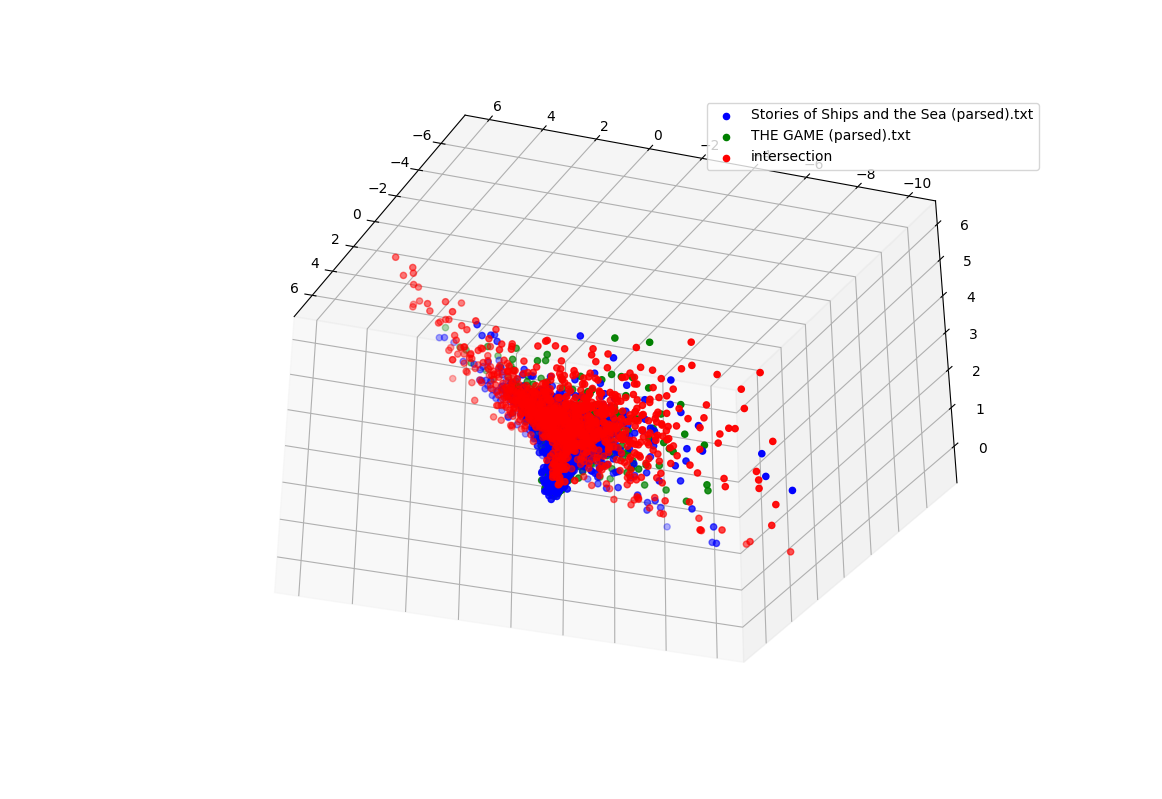
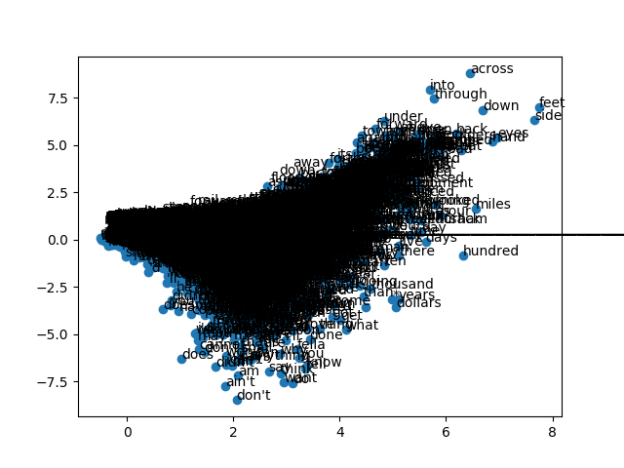
  • Spent a lot of time getting each work to draw differently in the scatterplot. That took some digging into the gensim API to get vectors from the corpora. I then tried to plot the list of arrays, but matplotlib only likes ndarrays (apparently?). I’m now working on placing the words from each text into their own ndarray.
  • Also added a filter for short stop words and switched to a hash map for words to avoid redundant points in the plot.
  • Fika
    • Bryce Peake
    • ICA has a computational methods study area. How media lows through different spaces, etc. Python and [R]
    • Anne Balsamo – designing culture
    • what about language as an anti-colonial interaction
    • Human social scraping of data. There can be emergent themes that become important.
    • The ability of the user to delete all primary, secondary and tertiary data.
    • The third eye project (chyron crawls)

Phil 5.6.18

Sentiment detection with Keras, word embeddings and LSTM deep learning networks

  • Read this blog post to get an overview over SaaS and open source options for sentiment detection. Learn an easy and accurate method relying on word embeddings with LSTMs that allows you to do state of the art sentiment analysis with deep learning in Keras.

Which research results will generalize?

  • One approach to AI research is to work directly on applications that matter — say, trying to improve production systems for speech recognition or medical imaging. But most research, even in applied fields like computer vision, is done on highly simplified proxies for the real world. Progress on object recognition benchmarks — from toy-ish ones like MNISTNORB, and Caltech101, to complex and challenging ones like ImageNet and Pascal VOC — isn’t valuable in its own right, but only insofar as it yields insights that help us design better systems for real applications.

Revisiting terms:

  • Belief Space – A subset of information space that is associated with opinions. For example, there is little debate about what a table is, but the shape of the table has often been a source of serious diplomatic contention
  • Medium – the technology that mediates the communication that coordinates the group. There are properties that seem to matter:
    • Reach – How many individuals are connected directly. Evolutionarily we may be best suited to 7 +/- 2
    • Directionality – connections can be one way (broadcast) or two way (face to face)
    • Transparency – How ‘visible’ is the individual on the other side of the communication? There are immediate perception and historical interaction aspects.
    • Friction – How difficult is it to use the medium? For example in physical space, it is trivial to interact with someone nearby, but becomes progressively difficult with distance. Broadcasting makes it trivial for a small number of people to reach large numbers, but not the reverse. Computer mediated designs typically try to reduce the friction of interaction.
  • Dimension Reduction – The process by which groups decide where to coordinate. The lower the dimensions, the easier (less calculation) it takes to act together
  • State – a multidimensional measure of current belief and interest
  • Orientation – A vector constructed of two measures of state. Used to determine alignment with others
  • Velocity – The amount of change in state over time
  • Diversity Injection – The addition of random, factual information to the Information Retrieval Interfaces (IRIs) using mechanisms currently used to deliver advertising. This differs from Serendipity Injection, which attempts to find stochastically relevant information for an individual’s implicit information needs.
    • Level 1: population targeted –  Based on Public Service Announcements (PSAs), information presentation should range from simple, potentially gamified presentations to deep exploration with citations. The same random information is presented by the IRIs to the using population at the same time similarly to the Google Doodle.
    • Level 2: group targeted – based on detecting a group’s behaviors. For example, a stampeding group may require information that is more focussed on pointing at where flocking activity is occuring.
    • Level 3: individual targeted –  Depending on where in the belief space the individual is, there may be different reactions. In a sparsely traveled space, information that lies in the general direction of travel might be a form of useful serendipity. Conversely, when on a path that often leads to violent radicalization, information associated with disrupting the progression of other individuals with similar vectors could be applied.
  • Map – a type of diagram that supports the plotting of trajectories. In this work, maps of belief space are constructed based on the dimension reduction used by humans in discussion. These maps are assumed to be dynamic over time and may consists of many interrelated, though not necessarily congruent, layers.
  • Herding – Deliberate creation of stampede conditions in groups. Can be an internal process to consolidate a group, or an external, adversarial process.

Trump as Enron (Twitter)

Phil 5.3.18

7:30 – 5:00 ASRC MKT

Phil 5.2.18

7:00 – 4:30 ASRC MKT

    • I am going to start calling runaway echo chambers Baudrillardian Stampedes: https://en.wikipedia.org/wiki/Simulacra_and_Simulation
    • GECCO 2018 paper list is full of swarming optimizers
    • CORNELL NEWSROOM is a large dataset for training and evaluating summarization systems. It contains 1.3 million articles and summaries written by authors and editors in the newsrooms of 38 major publications. The summaries are obtained from search and social metadata between 1998 and 2017 and use a variety of summarization strategies combining extraction and abstraction.
    • More Ultimate Angular
      • Template Fundamentals (interpolation – #ref)
    • Now that I have my corpora, time to figure out how to build an embedding
    • Installing gensim
      • By now, gensim is—to my knowledge—the most robust, efficient and hassle-free piece of software to realize unsupervised semantic modelling from plain text. It stands in contrast to brittle homework-assignment-implementations that do not scale on one hand, and robust java-esque projects that take forever just to run “hello world”.
      • Big install. Didn’t break TF, which is nice
    • How to Develop Word Embeddings in Python with Gensim
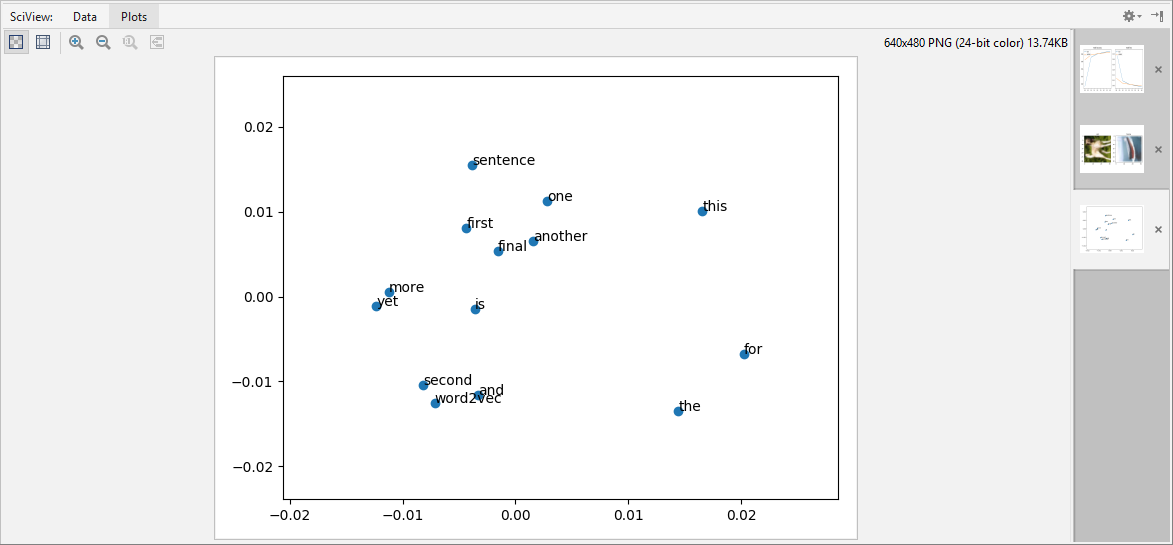
      • Following the tutorial. Here’s a plot! W2V
    • I need to redo the parser so that each file is one sentence.
      • sentences are strings that begin with a [CR] or [SPACE] + [WORD] and end with [WORD] + [.] or [“]
      • a [CR] preceded by anything other than a [.] or [“] is the middle of  a sentance
      • A fantastic regex tool! https://regex101.com/
        • regex = re.compile(r"([-!?\.]\"|[!?\.])")
      • After running into odd edge cases, I decided to load each book as a single string, parse it, then write out the individual lines. Works great except the last step, where I can’t seem to iterate over an array of strings. Calling it a day


Phil 5.1.18

7:00 – 4:30 ASRC MKT

  • Applications of big social media data analysis: An overview
    • Over the last few years, online communication has moved toward user-driven technologies, such as online social networks (OSNs), blogs, online virtual communities, and online sharing platforms. These social technologies have ushered in a revolution in user-generated data, online global communities, and rich human behavior-related content. Human-generated data and human mobility patterns have become important steps toward developing smart applications in many areas. Understanding human preferences is important to the development of smart applications and services to enable such applications to understand the thoughts and emotions of humans, and then act smartly based on learning from social media data. This paper discusses the role of social media data in comprehending online human data and in consequently different real applications of SM data for smart services are executed.
  • Explainable, Interactive Deep Learning
    • Recently, deep learning has been advancing the state of the art in artificial intelligence to yet another level, and humans are relying more and more on the outputs generated by artificial intelligence techniques than ever before. However, even with such unprecedented advancements, the lack of interpretability on the decisions made by deep learning models and no control over their internal processes act as a major drawback when utilizing them to critical decision-making processes such as precision medicine and law enforcement. In response, efforts are being made to make deep learning interpretable and controllable by humans. In this paper, we review recent studies relevant to this direction and discuss potential challenges and future research directions.
  • Building successful online communities: Evidence-based social design (book review)
    • In Building Successful Online Communities (2012), Robert Kraut, Paul Resnick, and their collaborators set out to draw links between the design of socio-technical systems with findings from social psychology and economics. Along the way, they set out a vision for the role of social sciences in the design of systems like mailing lists, discussion forums, wikis, and social networks, offering a way that behavior on those platforms might inform our understanding of human behavior.
  • Since I’ve forgotten my Angular stuff, reviewing UltimateAngular, Angular Fundamentals course. Finished the ‘Getting Started’ section
  • Strip out Guttenburg text from corpora – done!

Phil 4.30.18

7:00 – 4:30 ASRC MKT

  • Some new papers from ICLR 2018
  • Need to write up a quick post for communicating between Angular and a (PHP) server, with an optional IntelliJ configuration section
  • JuryRoom this morning and then GANs + Agents this afternoon?
  • Next steps for JuryRoom
    • Start up the AngularPro course
    • Set up PHP access to DB, returning JSON objects
  • Starting Agent/GAN project
    • Need to set up an ACM paper to start dumping things into – done.
    • Looking for a good source for Jack London. Gutenberg looks nice, but there is a no-scraping rule, so I guess, we’ll do this by hand…
    • We will need to check for redundant short stories
    • We will need to strip the front and back matter that pertains to project Gutenburg
      • *** START OF THIS PROJECT GUTENBERG EBOOK BROWN WOLF AND OTHER JACK ***
      • *** END OF THIS PROJECT GUTENBERG EBOOK BROWN WOLF AND OTHER JACK ***
  • Fika: Accessibility at the Intersection of Users and Data
    • Nice talk and followup discussion with Dr. Hernisa Kacorri, who’s combining machine learning and HCC
      • My research goal is to build technologies that address real-world problems by integrating data-driven methods and human-computer interaction. I am interested in investigating human needs and challenges that may benefit from advancements in artificial intelligence. My focus is both in building new models to address these challenges and in designing evaluation methodologies that assess their impact. Typically my research involves application of machine learning and analytics research to benefit people with disabilities, especially assistive technologies that model human communication and behavior such as sign language avatars and independent mobility for the blind.

Phil 4.19.18

8:00 – ASRC MKT/BD

    • Good discussion with Aaron about the agents navigating embedding space. This would be a great example of creating “more realistic” data from simulation that bridges the gap between simulation and human data. This becomes the basis for work producing text for inputs such as DHS input streams.
      • Get the embedding space from the Jack London corpora (crawl here)
      • Train a classifier that recognizes JL using the embedding vectors instead of the words. This allows for contextual closeness. Additionally, it might allow a corpus to be trained “at once” as a pattern in the embedding space using CNNs.
      • Train an NN(what type?) to produce sentences that contain words sent by agents that fool the classifier
      • Record the sentences as the trajectories
      • Reconstruct trajectories from the sentences and compare to the input
      • Some thoughts WRT generating Twitter data
        • Closely aligned agents can retweet (alignment measure?)
        • Less closely aligned agents can mention/respond, and also add their tweet
    • Handed off the proposal to Red Team. Still need to rework the Exec Summary. Nope. Doesn’t matter that the current exec summary does not comply with the requirements.
    • A dog with high social influence creates an adorable stampede:
    • Using Machine Learning to Replicate Chaotic Attractors and Calculate Lyapunov Exponents from Data
      • This is a paper that describes how ML can be used to predict the behavior of chaotic systems. An implication is that this technique could be used for early classification of nomadic/flocking/stampede behavior
    • Visualizing a Thinker’s Life
      • This paper presents a visualization framework that aids readers in understanding and analyzing the contents of medium-sized text collections that are typical for the opus of a single or few authors.We contribute several document-based visualization techniques to facilitate the exploration of the work of the German author Bazon Brock by depicting various aspects of its texts, such as the TextGenetics that shows the structure of the collection along with its chronology. The ConceptCircuit augments the TextGenetics with entities – persons and locations that were crucial to his work. All visualizations are sensitive to a wildcard-based phrase search that allows complex requests towards the author’s work. Further development, as well as expert reviews and discussions with the author Bazon Brock, focused on the assessment and comparison of visualizations based on automatic topic extraction against ones that are based on expert knowledge.


Phil 4.18.18

7:00 – 6:30 ASRC MKT/BD

  • Meeting with James Foulds. We talked about building an embedding space for a literature body (The works of Jack London, for example) that agents can then navigate across. At the same time, train an LSTM on the same corpora so that the ML system, when given the vector of terms from the embedding (with probabilities/similarities?), produce a line that could be from the work that incorporates those terms. This provides a much more realistic model of the agent output that could be used for mapping. Nice paper to continue the current work while JuryRoom comes up to speed.
  • Recurrent Neural Networks for Multivariate Time Series with Missing Values
    • Multivariate time series data in practical applications, such as health care, geoscience, and biology, are characterized by a variety of missing values. In time series prediction and other related tasks, it has been noted that missing values and their missing patterns are often correlated with the target labels, a.k.a., informative missingness. There is very limited work on exploiting the missing patterns for effective imputation and improving prediction performance. In this paper, we develop novel deep learning models, namely GRUD, as one of the early attempts. GRU-D is based on Gated Recurrent Unit (GRU), a state-of-the-art recurrent neural network. It takes two representations of missing patterns, i.e., masking and time interval, and effectively incorporates them into a deep model architecture so that it not only captures the long-term temporal dependencies in time series, but also utilizes the missing patterns to achieve better prediction results. Experiments of time series classification tasks on real-world clinical datasets (MIMIC-III, PhysioNet) and synthetic datasets demonstrate that our models achieve state-of-the-art performance and provide useful insights for better understanding and utilization of missing values in time series analysis.
  •  The fall of RNN / LSTM
    • We fell for Recurrent neural networks (RNN), Long-short term memory (LSTM), and all their variants. Now it is time to drop them!
  • JuryRoom
  • Back to proposal writing
  • Done with section 5! LaTex FTW!
  • Clean up Abstract, Exec Summary and Transformative Impact tomorrow