Author Archives: pgfeldman

Phil 7.7.18

8:00 – 9:00 ASRC MKT

  • At CI 2018. Hell of a time setting up eduroam. Nice venue, though. Winston Churchill called for the unification of Europe from that podium. Probably without PowerPoint DSCN0310
  • Patrick Meier – keynote – Digital humanitarian efforts
    • Mission is to pioneer the next generation of humanitarian technology
    • DSCN0313
    • DSCN0315
  • Poster pitches
    • Multiple barriers to crowdsourcing, ranging from operational to strategic
    • Anita Wollie – trust in AI Embedded agency, Virtual agency, Physical Agency
    • Croudoscope – qualitative and quantitative surveys – open coments. Not lists, but graphs
    • Market volitility with High-Frequency trading an hmans
    • How many people constitutes a ‘crowd’
    • Is novelty an advantage in crowdfunding
    • QUEST – annotating questions on stackoverflow-style probles’
    • Cyber-physical systems – e.g. smart transportation systems
  • Papers
  • Keynote 2
    • Optimizing the Human-Machine Partnership with Zooniverse DSCN0321 DSCN0322
      • Lucy Fortson
      • Galaxy Zoo
      • Zooniverse is on its third iteration and now supports project building
      • Can also point to a project
  • Session 2
    • Collective Intelligence for Deep Reinforcement Learning (MIT, mostly)
      • Evolutionary strategies (Salimans 2017) DSCN0327
    • Social learning strategies for matters of taste (This is a must-read!)
      • DSCN0326DSCN0325DSCN0324
    • Photo Sleuth: Combining Collective Intelligence and Computer Vision to
      Identify Historical Portraits

      • Good discussion of how to blend human and ML person identification
    • Toward Safer Crowdsourced Content Moderation
    • How Intermittent Breaks in Interaction Improve Collective

Phil 7.1.18

On vacation, but oddly enough, I’m back on my morning schedule, so here I am in Bormio, Italy at 4:30 am.

I forgot my HDMI adaptor for the laptop. Need to order one and have it delivered to Zurich – Hmmm. Can’t seem to get it delivered from Amazon to a hotel. Will have to buy in Zurich

Need to add Gamerfate to the lit review timeline to show where I started to get interested in the problem – tried it but didn’t like it. I’d have to redo the timeline and I’m not sure I have the excel file

Add vacation pictures to slides – done!

Some random thoughts

  • When using the belief space example of the table, note that if we sum up all the discussions about tables, we would be able to build a pretty god map of what matters to people with regards to tables
  • Manifold learning is what intelligent systems do as a way of determining relationships between things (see curse of dimensionality). As groups of individuals, we need to coordinate our manifold learning activities so that we can us the power of group cognition. When looking at how manifold learning schemes like t-sne and particularly embedding systems such as word2vec create their own unique embeddings, it becomes clear that our machines are not yet engaged in group cognition, except in the simplest way of re-using trained networks and copied hyperparameters. This is very prone to stampedes
  • In conversation at dinner, Mike M mentioned that he’d like a language app that is able to indicate the centrality of a term an order that list so that it’s possible to learn a language in a “prioritized” way that can be context-dependent. I think that LMN with a few tweaks could do that.

Continuing the Evolution of Cooperation. A thing that strikes me is that once a TIT FOR TAT successfully takes over, then it becomes computationally easier to ALWAYS COOPERATE. That could evolve to become dominant and be completely vulnerable to ALWAYS DEFECT

Phil 6.28.18

7:00 – ASRC MKT

  • Updated the change list to mention the xml fix
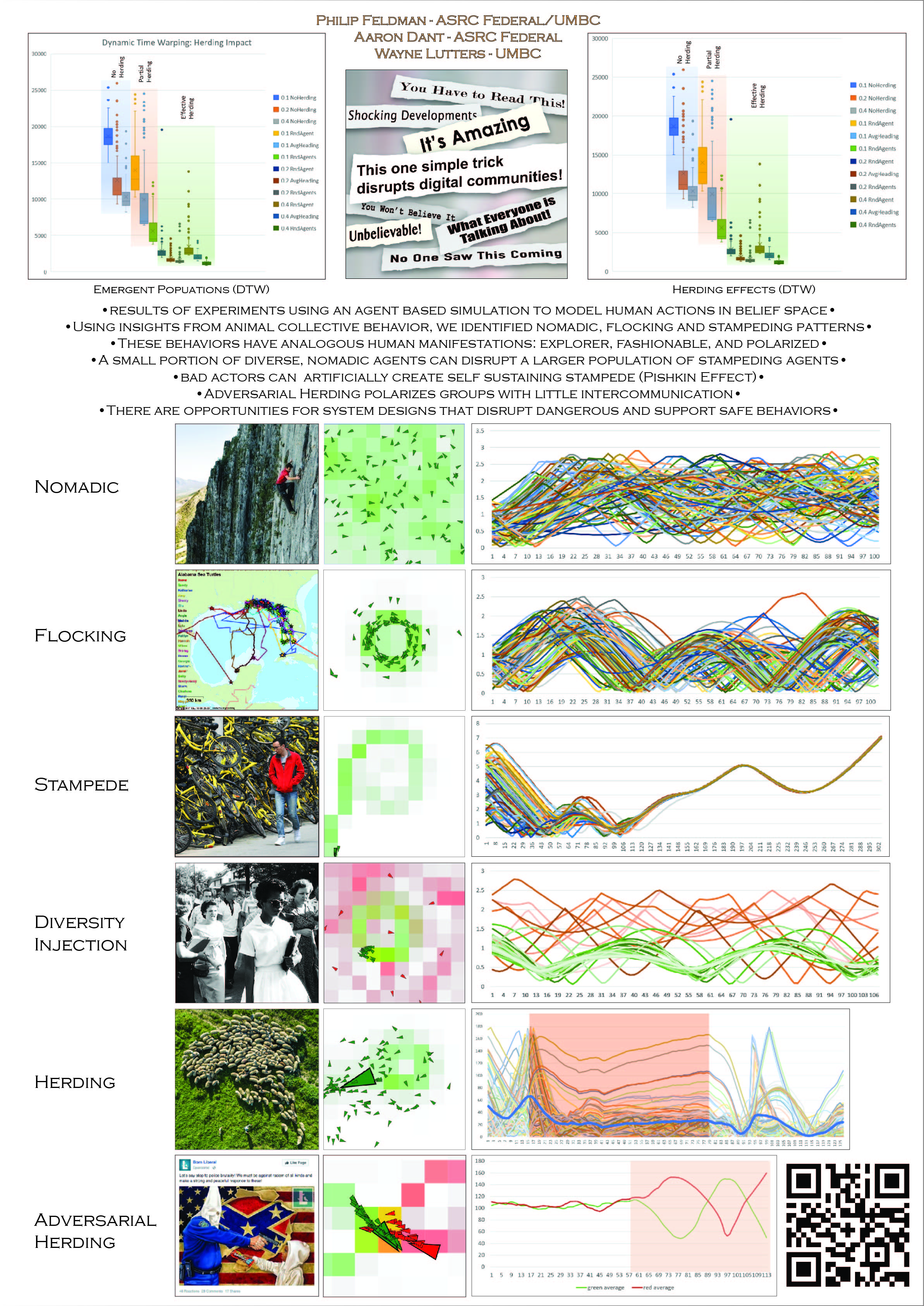
  • The new version of “This One Simple Trick” is on ArXive
  • Last minute stuff for travel
  • Call TW Ellis $250
  • Cal Ben Cardin

Phil 6.27.18

7:00 – 12:00 ASRC MKT

  • Print out documents! Done. Got passport drive too.
  • Need to write an extractor that lets the user navigate the xml file containing influences of selected agents. This could be a sample-by sample network. Maybe two modes?
    • Select an agent and see all the other agents come in and out of influcene
    • Select an number of agents and only watch the mutual influence.
    • There is an integrated JavaFX charts that I could use, or it could be an uploaded webapp? JavaFX would be easier in the short term, but a webapp would help more with JuryRoom…
    • Another option would be Python, since that’s where the LSTM code will live.
    • On the whole, two days before leaving on travel is probably the wrong time to start coding
  • Fixed a bug in the xml file generation
  • copied the new jar file onto the thumb drive
  • copied the xml file onto the thumb drive

12:00 – 4:00 ASRC A2P

  • Pomoting things to QA – done! Or at least, up to date with the excel files

Phil 6.26.18

7:00 – 5:00 ASRC MKT

  • Started back with the Evolution of Cooperation
  • Social loafing (Scholar results)
    • In social psychologysocial loafing is the phenomenon of a person exerting less effort to achieve a goal when they work in a group than when they work alone. This is seen as one of the main reasons groups are sometimes less productive than the combined performance of their members working as individuals, but should be distinguished from the accidental coordination problems that groups sometimes experience. Research on social loafing began with rope pulling experiments by Ringelmann, who found that members of a group tended to exert less effort in pulling a rope than did individuals alone. In more recent research, studies involving modern technology, such as online and distributed groups, have also shown clear evidence of social loafing. Many of the causes of social loafing stem from an individual feeling that his or her effort will not matter to the group.
  • NELA2017 contains almost every news article from 92 sources between April 2017 and October 2017, amounting to over 136K articles. This data set is the first release of NELA datasets. This version of the data set can be found on github and a full description and use cases can be found in our 2018 ICWSM paper.
  • Submitted “One Simple Trick” final to SASO
  • Updated ArXive
  • Fixed a bug that prevented population interactions in FlockingAgentManager.initializeAgents():
                // add to the global list
                allBoidsList.add(fs);
    
                // add a pointer to the global list to each shape
                fs.setFlockingShapeList(allBoidsList);
    
                // Add to the flock so that we can get flock headings
                List flock = flockListsMap.get(flockName);
                flock.add(fs);

    Seriously, what was I thinking?

  • Continued GUI tweaking. I think it looks pretty good, and it fits (mostly) on my laptop Version6.26.18
  • Verified that the influences record agents from different flocks and sources.
  • Copied all CI 2018 things I can think of onto the thumb drive

Phil 6.25.18

7:00 – 9:00 ASRC MKT

  • Update laptop – Intellij, Java, GroupPolarazation codebase
  • Add XML output for influence – done!
  • Refactored the GUI to work with smaller (laptop) screens)

9:00 – 2:30 ASRC A2P

  • Debug what’s going on with the excel reading. Try a new config file first?
  • Ground slowly through options
    • Replaced the config file
    • Stepped through the debugger, and noticed that the worksheet was null. Tried a different worksheet/config, and that was *not* null
    • Created a new workbook and copied everything over without formatting. That worked on the converter, but didn’t work with A2P
    • Reformatted the new workbook and wound up using the Funding Summary Details data with the formatting, which is *crazy*….
    • Had some issues getting connected to the server. Pageant forgot my key.

3:00 – 4:00 ASRC MKT

  • Fika. No, not really. Wound up chatting with Will

Phil 6.23.18

Registered for SASO

ArXive papers with Github repos

Mapping interest communities in Russian Facebook Ads. Preliminary visualisation reveals a number of broad interest groups around ethnicity; reveals a bit of Internet Research Agency’s strategy...

  • Dr Bharath Ganesh
    • Bharath is a political geographer focusing on data science and local government and the ethics and politics of researching violent online extremism.

More good stuff from Ian Couzin

  • Revealing the hidden networks of interaction in mobile animal groups allows prediction of complex behavioral contagion
    • We know little about the nature of the evolved interaction networks that give rise to the rapid coordinated collective response exhibited by many group-living organisms. Here, we study collective evasion in schooling fish using computational techniques to reconstruct the scene from the perspective of the organisms themselves. This method allows us to establish how the complex social scene is translated into behavioral response at the level of individuals and to visualize, and analyze, the resulting complex communication network as behavioral change spreads rapidly through groups. Thus, we can map, for any moment in time, the extent to which each individual is socially influential during collective evasion and predict the magnitude of such behavioral epidemics before they actually occur

This playlist contains tutorials to learn how to use Keras, a neural network API written in Python. Each video focuses on a specific concept and shows how the full implementation is done in code using Keras and Python.


Phil 6.22.18

7:00 – 5:30 ASRC MKT

  • Twitter experiment on a fake Gary Indiana secession. IFTTT retweeting leads to interesting behavior.
  • Fixed FlockingShape casting by adding a customDrawStep(GraphicsContext gc) to the SmartShape base class that’s called from draw().
  • Add records to each agent that store a list of source and agent influences at each time sample. It should include the name of the item and the amount of influence. Probably save as an XML file, since it has too many dimensions. The file could then be used to create terms or spreadsheets.
    • Started on CAInfluence class which will be added to CA classes in an arrayList in BaseCA;
  • More file conversion with Bob – and everything worked great until I try one after Bob leaves. Ka-BOOM!
    • Installed all the packages to get everything to run in the debugger. Found what appears to be a perfectly good line “range” that causes the problem? Will start debugging on Wednesday.
  • Project MERCATOR proposal
  • Meeting with Sy

Phil 6.21.18

7:00 – 4:00 ASRC MKT

  • Add an attractor scalar for agents that’s normally zero. A vector to each agent within the SIH is calculated and scaled by the attractor scalar. That vector is then added to the direction vector to the agent – done
  • Remove the heading influence based on site – done
  • Add a white circle to the center of the agent that is the size of the attraction scalar. Done
  • Add attraction radius slider that is independent of the SIH. -done
  • Add a ‘site trajectory’ to the spreadsheet that will have the site lists (and their percentage?)
  • There is now an opportunity for a poster and a demo at SASO
  • Add stories, lists and maps to implication slides – done
  • Got all my connections set up
  • Successfully converted and deployed cosmos-2
  • Voted!

Phil 6.20.18

7:00 – 9:00 2:00 – 5:00 ASRC MKT

  • Redo doodle for all of August – done
  • Schooling Fish May Offer Insights Into Networked Neurons
    • Iain Couzin is deciphering the rules that govern group behavior. The results might provide a fresh perspective on how networks of neurons work together.
  • City arts and lectures: The New Science Of Psychedelics With Michael Pollan
    • Psychedelics reduce the section of the brain that have to do with the sense of self. Pollan thinks that this also happens with certain types of rhythmic music and in crowd situations. This could be related to stampedes and flocking.
    • LSD May Chip Away at the Brain’s “Sense of Self” Network
      • Brain imaging suggests LSD’s consciousness-altering traits may work by hindering some brain networks and boosting overall connectivity
  • Add an attractor scalar for agents that’s normally zero. A vector to each agent within the SIH is calculated and scaled by the attractor scalar. That vector is then added to the direction vector to the agent – done?
  • Remove the heading influence based on site – done
  • Add a white circle to the center of the agent that is the size of the attraction scalar. Done
  • Add a ‘site trajectory’ to the spreadsheet that will have the site lists (and their percentage?)
  • Worked on A2P white paper with Aaron.
  • Worked on a response to Dr. Li’s response

ASRC IRAD 9:00 – 2:00

  • Mind meld with Bob
    • Revisit Yarn
    • Excel stuff?
    • Connect to AWS using bastion. Look in FoxyProxy how to. I need certs
    • Drop on rabbit to deploy to CI and QA and NESDIS  ONE (production)
    • Don’t want sensitive information in Git. We use sharepoint instead
    • Notes and screenshots in document.

Phil 6.19.18

7:00 – 9:00, 4:00 – 5:00 ASRC MKT

  • Here’s a list of organizations that are mobilizing to help immigrant children separated from their families
  • SASO trip
  • Rebuilt all the binaries, now I need to put them on the thumb drive – done
  • Added knobs to the implications slide. They sit next to the dimension and SIH lines. I realize that my slide deck is becoming a physical version of a memory palace.
  • Continuing Irrational Exuberance, though feeling like I should be reading Axelrod. Bring Evolution of Cooperation on the flight?
  • Naive Diversification Strategies in Defined Contribution Saving Plans
    • There is a worldwide trend toward defined contribution saving plans and growing interest in privatized social security plans. In both environments, individuals are given some responsibility to make their own asset allocation decisions, raising concerns about how well they do at this task. This paper investigates one aspect of the task, namely diversification. We show that many investors have very naive notions about diversification. For example, some investors follow what we call the 1/n strategy: they divide their contributions evenly across the funds offered in the plan. When this strategy (or others only slightly more sophisticated) is used, the assets chosen depend greatly on the make-up of the funds offered in the plan. We find evidence of naive diversification strategies both in experiments using employees at the University of California and the actual behavior of participants in a wide range of savings plans. In particular, we find the proportion of the assets the participants invest in stocks depends strongly on the proportion of stock funds in the plan. The results raise very serious questions about how privatized social security systems should be designed, questions that would be ignored in most economic analyses.
    • This is very much a dimension reduction exercise.
  • A2P maintenance proposal

9:00 – 4:00 ASRC A2P

  • Coming up to speed on the Angular interface
    • Logging into CI and QA
    • Dashboard configurations

Phil 6.18.18

ASRC MKT 7:00 – 8:00

  • Nice ride on Saturday on Skyline drive
  • Using Social Network Information in Bayesian Truth Discovery
    • We investigate the problem of truth discovery based on opinions from multiple agents who may be unreliable or biased. We consider the case where agents’ reliabilities or biases are correlated if they belong to the same community, which defines a group of agents with similar opinions regarding a particular event. An agent can belong to different communities for different events, and these communities are unknown a priori. We incorporate knowledge of the agents’ social network in our truth discovery framework and develop Laplace variational inference methods to estimate agents’ reliabilities, communities, and the event states. We also develop a stochastic variational inference method to scale our model to large social networks. Simulations and experiments on real data suggest that when observations are sparse, our proposed methods perform better than several other inference methods, including majority voting, the popular Bayesian Classifier Combination (BCC) method, and the Community BCC method.
  • Scale-free correlations in starling flocks
    • From bird flocks to fish schools, animal groups often seem to react to environmental perturbations as if of one mind. Most studies in collective animal behavior have aimed to understand how a globally ordered state may emerge from simple behavioral rules. Less effort has been devoted to understanding the origin of collective response, namely the way the group as a whole reacts to its environment. Yet, in the presence of strong predatory pressure on the group, collective response may yield a significant adaptive advantage. Here we suggest that collective response in animal groups may be achieved through scale-free behavioral correlations. By reconstructing the 3D position and velocity of individual birds in large flocks of starlings, we measured to what extent the velocity fluctuations of different birds are correlated to each other. We found that the range of such spatial correlation does not have a constant value, but it scales with the linear size of the flock. This result indicates that behavioral correlations are scale free: The change in the behavioral state of one animal affects and is affected by that of all other animals in the group, no matter how large the group is. Scale-free correlations provide each animal with an effective perception range much larger than the direct inter-individual interaction range, thus enhancing global response to perturbations. Our results suggest that flocks behave as critical systems, poised to respond maximally to environmental perturbations.
  • Interaction ruling animal collective behavior depends on topological rather than metric distance: Evidence from a field study
    • By reconstructing the three-dimensional positions of individual birds in airborne flocks of a few thousand members, we show that the interaction does not depend on the metric distance, as most current models and theories assume, but rather on the topological distance. In fact, we discovered that each bird interacts on average with a fixed number of neighbors (six to seven), rather than with all neighbors within a fixed metric distance. We argue that a topological interaction is indispensable to maintain a flock’s cohesion against the large density changes caused by external perturbations, typically predation. …
  • Thread on the failure to replicate the Stanford Prison Experiment by Alex Haslam (scholar) (home page). Paper coming soon
    • The Stanford Prison Experience—as it is presented in textbooks—presents human nature as naturally conforming to oppressive systems. This is a lesson that extends well beyond prison systems and the field criminology—but it’s wrong. Alex and his colleagues (especially Steve Reicher) have been arguing for years that conformity often emerges when leaders cultivate a sense of shared identity. This is an active, engaged process—very different from automatic and mindless conformity.
  • Started Irrational Exuberance, by Robert Shiller
  • Send note to Don, Aaron and Shimei
  • Read Ego-motion in Self-Aware Deep Learning on Medium. It’s about reflective learning of navigation in physical spaces, though I wonder if there is an equivalent process in belief spaces. Looked through scholar and
  • Slide prep and Fika walkthrough
    • Went well. Ravi suggested adding another slide that discusses the methods in detail, while Sy pretty much demanded that I get rid of “Questions” and put the title of the paper in its place
    • When adding the detail for Ravi, I discovered that the simulator and map reconstruction did not handle single, high dimensional agents well, so I spent a few hours fixing bugs to get the screen captures to build the slides.

Phil 6.15.18

7:00 – 6:00 ASRC MKT

  • Montaigne and the Art of Conversation held on June 11, 2018
    • Michel de Montaigne, the inventor of the essay and the greatest philosopher of the Renaissance, who is often imagined to be a solitary figure, lost in his library, writing to himself. However, his understanding of the practice of philosophy and the cultivation of the self were deeply social and tied to the give and take of debate and disputation among friends. Hampton’s talk—his “conversation”—will focus on one of Montaigne’s greatest essays, “On the Art of Conversation.” It will place the essay in Montaigne’s thought, and in the tradition of “philosophical conversation” that underpins the humanist tradition in the European West.
  • Dynamical Isometry and a Mean Field Theory of CNNs: How to Train 10,000-Layer Vanilla Convolutional Neural Networks (Thread overview)
    • Moreover, convolutional networks have precisely the same order-to-chaos transition as fully-connected networks, with vanishing gradients in the ordered phase and exploding gradients in the chaotic phase.
  • Susan Li (ML articles on Medium)
  • Working on slides. Walk through with Wayne today at 4:00
  • Re-read the paper. I’ve forgotten what’s in it!
  • Forward the Yao article, since it’s an example of what I’m modelling. It belongs up with the Strava maps
  • Strava maps are about discerning environment from behavior. Physical and social structures are visible (shorelines, mountains, and borders), from the perspective of road cyclists, who have simple rules:
    • Up is fun
    • Stations of the cross
    • Different populations on Strava (Commuter, mtn, road, etc)
    • Maps to Hofstede’s cultural dimensions
  • Meeting with Wayne to go over slides. Lots of rework. There is a difference in proposal and DC slides, which are showing a research direction, and a paper, which is showing a result.

Phil 6.14.18

7:00 – ASRC MKT

  • dads taxes!
  • Rolled in Aaron’s corrections. Spell check doesn’t seem to work as well in captions?
  • Put together beginnings of the LaTex presentation
  • Slides
  • Fika burgers & bowling