Monthly Archives: October 2021

Phil 10.7.2021

Call outlaw about spare tire mount and compressor

Slowed canonical progress in large fields of science

  • The size of scientific fields may impede the rise of new ideas. Examining 1.8 billion citations among 90 million papers across 241 subjects, we find a deluge of papers does not lead to turnover of central ideas in a field, but rather to ossification of canon. Scholars in fields where many papers are published annually face difficulty getting published, read, and cited unless their work references already widely cited articles. New papers containing potentially important contributions cannot garner field-wide attention through gradual processes of diffusion. These findings suggest fundamental progress may be stymied if quantitative growth of scientific endeavors—in number of scientists, institutes, and papers—is not balanced by structures fostering disruptive scholarship and focusing attention on novel ideas.

SBIRs

  • 9:15 Standup
  • 11:00 LAIC Tagup. Send Aaron a screenshot for the paper – done and integrated into report
  • Adding ForceNodes to MapGroups -done!
Nodes!
  • Adding connections. Done! That took a while. some of my states did not make sense, so the parent node would change. Need to test with successive iterations, but I’m done for the day
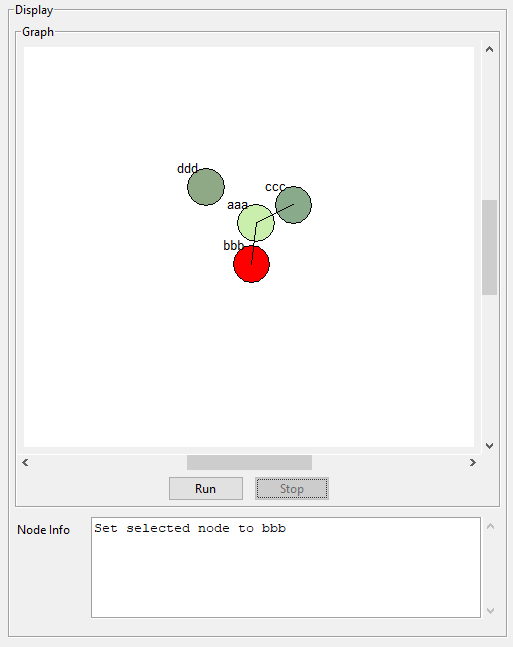
Connections!

Phil 10.6.2021

Book

SBIRs

  • More bug hunting. Trying different types of callbacks. Nope, that didn’t work. In a way, I’m kind of relieved. Moving on to getting nodes to appear with links
  • Got seed and topic MapGroups adding members correctly, now adding connections between MapGroups. Done.
  • I think things are mostly working. Going to try to hook up ForceNodes tomorrow
So far, so good!

Phil 10.5.2021

Had a wild dream last night. It began with Prince and I talking motorcycles, though I have to say that Prince looked more like Little Richard. There was a nice red motorcycle too, with spinning parts on the motor that don’t really make much sense now when I think about it.

At some point later, I was walking down a rural road and into a church(?). There was some kind christening-type thing going on, but it involved surgically implanting a line between the pelvis and the shoulder so that the child would grow up visibly stunted. This was presented as a price paid by the child for the parents belonging to the wrong group. That way, the group could always be recognized, and the individuals would be in a constant level of pain. My sense was that the original intent was that this was originally done so that the child would grow to reject the group so that its children wouldn’t have the procedure. But instead it had become a ritualized tradition and insisted on by the parents. Maybe a bit like foot binding?

Book

GPT-Agents

  • Need to see if I can do Z-tests in Excel – you can (tutorial)!
  • Had to add the American data
  • Finished correlation, t-test, and z-test

SBIRs

  • still working on the logic for setting parent group and selected node/topic. There is some kind of problem with callbacks on the tk.Text widget. I can fix all my bugs by turning off all the Text callbacks. It may be because I create a callback for an in-class method that in turn calls an optional method that is passed into the class. Tomorrow I’ll try binding directly and see if that fixes things, otherwise proceed with only the select callback in the raw text

Phil 10.4.2021

Wheel!

Book

GPT-Agents

  • Start LIWC csv reader – got the reader and counts done. Need to see if I can do the rese in Excel
  • Ping Andreea – done!

SBIRs

  • Expense report – done again, fingers crossed!
  • current parent/child node logic
  • Got most of the logic together for setting parent group and selected node. I’m not really happy about this, there are too many states and hidden relationships. This will need a cleanup once it is working. I may be able to do a good deal with looking at the node info though

Phil 10.2.2021

Rubrix is a production-ready Python framework for exploring, annotating, and managing data in NLP projects.

Key features:

  • Open: Rubrix is free, open-source, and 100% compatible with major NLP libraries (Hugging Face transformers, spaCy, Stanford Stanza, Flair, etc.). In fact, you can use and combine your preferred libraries without implementing any specific interface.
  • End-to-end: Most annotation tools treat data collection as a one-off activity at the beginning of each project. In real-world projects, data collection is a key activity of the iterative process of ML model development. Once a model goes into production, you want to monitor and analyze its predictions, and collect more data to improve your model over time. Rubrix is designed to close this gap, enabling you to iterate as much as you need.
  • User and Developer Experience: The key to sustainable NLP solutions is to make it easier for everyone to contribute to projects. Domain experts should feel comfortable interpreting and annotating data. Data scientists should feel free to experiment and iterate. Engineers should feel in control of data pipelines. Rubrix optimizes the experience for these core users to make your teams more productive.
  • Beyond hand-labeling: Classical hand labeling workflows are costly and inefficient, but having humans-in-the-loop is essential. Easily combine hand-labeling with active learning, bulk-labeling, zero-shot models, and weak-supervision in novel data annotation workflows.

Phil 10.1.2021

I’m really not ready for October

JuryRoom

  • Aaron, Panos and I had a walkthrough of Jarod’s SLR. It needs a lot of organizing and framing. The information is all there, but it’s more like a collection of notes than a paper.

SBIRs

  • LAIC meeting went well, but it got a little shaky. The upshot is that we will probably demo the navigator app first, and the builder app second. The use case can still be rules of engagement, where we can show a script unfolding where the rules are followed (staying close) in response to an event, and the rules being disregarded. Then we can show how the map is made.
  • Need to start wiring up the text to the graph
  • Working out adding seeds or topics to groups and getting details