Monthly Archives: April 2019

Phil 4.14.19

An interesting take on diversity science that I had never heard of:

talmud

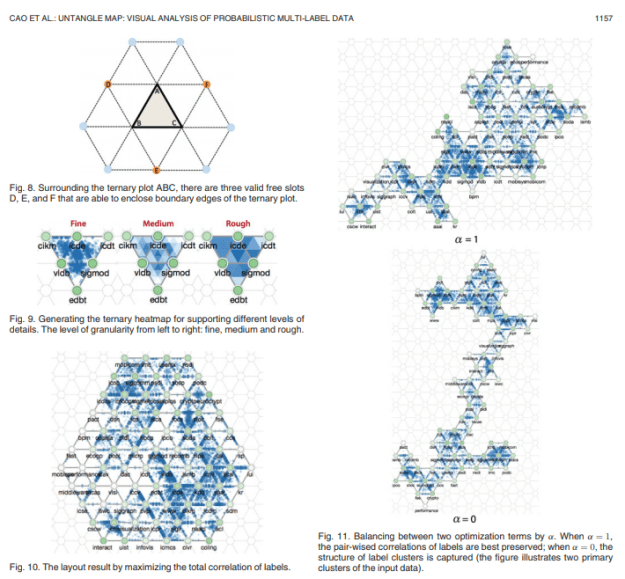
UnTangle Map: Visual Analysis of Probabilistic Multi-Label Data

  • Data with multiple probabilistic labels are common in many situations. For example, a movie may be associated with multiple genres with different levels of confidence. Despite their ubiquity, the problem of visualizing probabilistic labels has not been adequately addressed. Existing approaches often either discard the probabilistic information, or map the data to a low-dimensional subspace where their associations with original labels are obscured. In this paper, we propose a novel visual technique, UnTangle Map, for visualizing probabilistic multi-labels. In our proposed visualization, data items are placed inside a web of connected triangles, with labels assigned to the triangle vertices such that nearby labels are more relevant to each other. The positions of the data items are determined based on the probabilistic associations between items and labels. UnTangle Map provides both (a) an automatic label placement algorithm, and (b) adaptive interactions that allow users to control the label positioning for different information needs. Our work makes a unique contribution by providing an effective way to investigate the relationship between data items and their probabilistic labels, as well as the relationships among labels. Our user study suggests that the visualization effectively helps users discover emergent patterns and compare the nuances of probabilistic information in the data labels. untangle

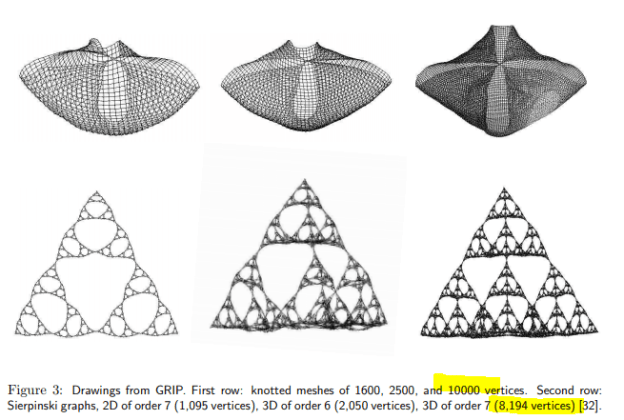
Spring Embedders and Force Directed Graph Drawing Algorithms

  • Force-directed algorithms are among the most flexible methods for calculating layouts of simple undirected graphs. Also known as spring embedders, such algorithms calculate the layout of a graph using only information contained within the structure of the graph itself, rather than relying on domain-specific knowledge. Graphs drawn with these algorithms tend to be aesthetically pleasing, exhibit symmetries, and tend to produce crossing-free layouts for planar graphs. In this survey we consider several classical algorithms, starting from Tutte’s 1963 barycentric method, and including recent scalable multiscale methods for large and dynamic graphs. spring

Phil 4.12.19

9:00 – 5:00 ASRC TL

  • Finished the BAA white paper(?), and asked for hours to write the full paper for the Symposium on Technologies for Homeland Security
  • These are appropriate:
    • Meaningful Human Control over Autonomous Systems: A Philosophical Account
      • In this paper, we provide an analysis of the sort of control humans need to have over (semi)autonomous systems such that unreasonable risks are avoided, that human responsibility will not evaporate, and that is there is a place to turn to in case of untoward outcomes. We argue that higher levels of autonomy of systems can and should be combined with human control and responsibility. We apply the notion of guidance control that has been developed by Fischer and Ravizza (1998) in the philosophical debate about moral responsibility and free will, and we adapt it as to cover actions mediated by the use of (semi)autonomous robotic systems. As we will show, this analysis can be fruitfully applied in the context of autonomous weapon systems as well as of autonomous systems more generally. We think we herewith provide a first full-fledged philosophical account of “meaningful human control over autonomous systems.”
    • The following is the preprint PDF of our paper on driver functional vigilance during Tesla Autopilot assisted driving: Human Side of Tesla Autopilot: Exploration of Functional Vigilance in Real-World Human-Machine Collaboration. It is part of the MIT-AVT large-scale naturalistic driving study
    • What I Learned from a Year of ChinAI
      • Finally, Chinese thinkers are engaged on broader issues of AI ethics, including the risks of human-level machine intelligence and beyond. Zhao Tingyang, an influential philosopher at the Chinese Academy of Social Sciences, has written a long essay on near-term and long-term AI safety issues, including the prospect of superintelligence. Professor Zhihua Zhou, who leads an impressive lab at Nanjing University, argued in an article for the China Computer Federation that even if strong AI is possible, it is something that AI researchers should stay away from.
  • And so ends a long, hectic, but satisfying week.

Phil 4.11.19

7:00 – 9:00 ASRC TL

  • Continuing with the BAA
  • Fixed the acknowledgements section and updated ArXiv
  • Meeting/presentation with Wayne at noon
  • ML seminar, presenting robot stampede
  • Wound up having an impromptu meeting with Aaron M.

Phil 4.10.19

9:00 – 5:00 ASRC TL

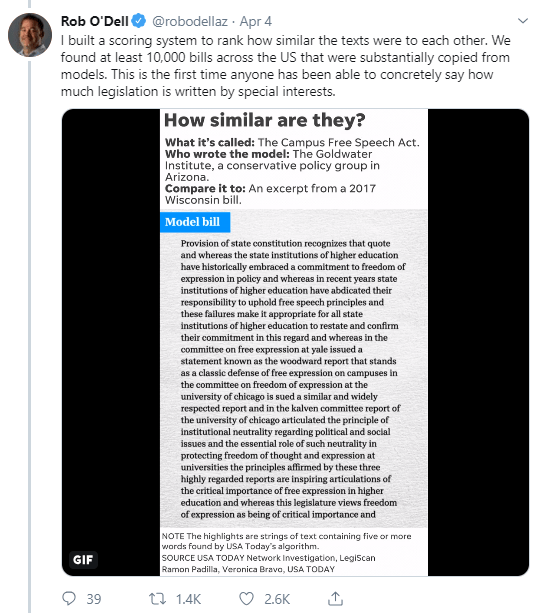
  • Adversarial herding and density-stiffness in legislation LegislationHerding
  • Need to make ArXive version of the DfS paper
  • NASA Meeting
  • Pivot to BAA
      • Refamiliarizing myself with the Call “BROAD AGENCY ANNOUNCEMENT (BAA) TITLE:  MASTERING COMPLEXITY IN MULTI- DOMAIN COMMAND & CONTROL” BAA FA8750-18-S-7014
      • FOCUS AREA 3- Machine Intelligence Harnessing the speed and scale of machines to exponentially increase human capacity to command & control in an increasingly complex battlespace. The complexity of MD operations will quickly exceed human capacity and will require machine reasoning to augment the human decision maker across all stages of the C&C Monitor, Assess, Plan, and Execute (MAPE) cycle.
    • CONTENT AND FORMAT:  Offerors are required to submit 3 copies of a 3 to 5 page white paper summarizing their proposed approach/solution. The purpose of the white paper is to preclude unwarranted effort on the part of an offeror whose proposed work is not of interest to the Government.
    • The white paper will be formatted as follows:Section A: Title, Period of Performance, Estimated Cost, Name/Address of Company, Technical and Contracting Points of Contact (phone and email)(this section is NOT included in the page count);
      • Section B: Task Objective; and
      • Section C: Technical Summary and Proposed Deliverables.


    • All white papers shall be double spaced with a font no smaller than 12 point.  In addition, respondents are requested to provide their Commercial and Government Entity (CAGE) Code, their unique entity identifier and electronic funds transfer (EFT) indicator (if applicable), an e-mail address and reference BAA FA8750-18-S-7014 with their submission.

Phil 4.9.19

7:00 – 9:30 ASRC PhD

  • Banging away at the paper. It’s starting to look less incoherent
  • Added a section to the mapbuilding that links back to the FTRPG framing
  • Aaaaaand it’s in! Need to make a version for ArXive now

Phil 4.8.19

7:00 – ASRC PhD

  • Meeting with Wayne and Aaron last night. Wayne doesn’t think the venue is right for the papers in the current form. Rewrite combining papers as a “using FTRPGs” as a source for science.
  • Still need a venue for the mapping:

Phil 4.6.19

Added a section on calculating belief terms in the trap room. And then worked on the paper for the rest of the day. It’s currently 7:45, and the first draft is DONE!

Sent drafts off to Wayne

Working on the lit review. Reading Foucault’s Of Other Spaces:

  • We are in the epoch of simultaneity: we are in the epoch of juxtaposition, the epoch of the near and far, of the side-by-side, of the dispersed. We are at a moment, I believe, when our experience of the world is less that of a long life developing through time than that of a network that connects points and intersects with its own skein. (Page 22)
  • Today the site has been substituted for extension which itself had replaced emplacement. The site is defined by relations of proximity between points or elements; formally, we can describe these relations as series, trees, or grids (Page 23)
  • …we do not live in a homogeneous and empty space, but on the contrary in a space thoroughly imbued with quantities and perhaps thoroughly fantasmatic as well. The space of our primary perception, the space of our dreams and that of our passions hold within themselves qualities that seem intrinsic: there is a light, ethereal, transparent space, or again a dark, rough, encumbered space; a space from above, of summits, or on the contrary a space from below, of mud; or again a space that can be flowing like sparkling water, or a space that is fixed, congealed, like stone or crystal. (Page 23)
  • Places of this kind are outside of all places, even though it may be possible to indicate their location in reality. Because these places are absolutely different from all the sites that they reflect and speak about, I shall call them, by way of contrast to utopias, heterotopias. I believe that between utopias and these quite other sites, these heterotopias, there might be a sort of mixed, joint experience, which would be the mirror (Page 24)
  • the study, analysis, description, and “reading” (as some like to say nowadays) of these different spaces, of these other places. As a sort of simultaneously mythic and real contestation of the space in which we live, this description could be called heterotopology (Page 24)
  • But these heterotopias of crisis are disappearing today and are being replaced, I believe, by what we might call heterotopias of deviation: those in which individuals whose behavior is deviant in re 1:ition to the required mean or norm are placed. Cases of this are rest homes and psychiatric hospitals, and of course prisons; and one should perhaps add retirement homes that are, as it were, on the borderline between the heterotopia of crisis and the heterotopia of deviation since, after all, old age is a crisis, but is also a deviation since, in our society where leisure is the rule, idleness is a sort of deviation. (Page 25)
  • Third principle. The heterotopia is capable of juxtaposing in a single real place several spaces, several sites that are in themselves incompatible. Thus it is that the theater brings onto the rectangle of the stage, one after the other, a whole series of places that are foreign to one another; thus it is that the cinema is a very odd rectangular room, at the end of which, on a two-dimensional screen, one sees the projection of a three-dimensional space; but perhaps the oldest example of these heterotopias that take the form of contradictory sites is the garden. We must not forget that in the Orient the garden, an astonishing creation that is now a thousand years old, had very deep and seemingly superimposed meanings. (Page 25)
  • Fourth principle. Heterotopias are most often linked to slices in time-which is to say that they open onto what might be termed, for the sake of symmetry, heterochronies. (page 26)
  • Fifth principle. Heterotopias always presuppose a system of opening and closing that both isolates them and makes them penetrable. In general, the heterotopic site is not freely accessible like a public place. Either the entry is compulsory, as in the case of entering a barracks or a prison, or else the individual has to submit to rites and purifications. To get in one must have a certain permission and make certain gestures. (Page 26)
    • This limitation is why it is possible to come to consensus in reasonable timeframes
  • The last trait of heterotopias is that they have a function in relation to all the space that remains. This function unfolds between two extreme poles. Either their role is to create a space of illusion that exposes every real space, all the sites inside of which human life is partitioned, as still more illusory (perhaps that is the role that was played by those famous brothels of which we are now deprived). Or else, on the contrary, their role is to create a space that is other, another real space, as perfect, as meticulous, as well arranged as ours is messy, ill constructed, and jumbled. This latter type would be the heterotopia, not of illusion, but of compensation (Page 27)
  • The ship is the heterotopia par excellence. In civilizations without boats, dreams dry up, espionage takes the place of adventure, and the police take the place of pirates. (Page 27)

Foucault’s Heterotopias as Play Spaces

  • Tim Hutchings – Western Oregon University
  • Jason Giardino – Games to Gather
  • However, if the game was set on the deck of an aircraft carrier, we might find Foucault better abled to address the significance of that setting through his interest in social and architectural spaces. A Magic Circle is created when players ‘other’ themselves for the purpose of a game, a heterotopia is created when ‘others’ find a space within a larger structure in order to engage their othered selves. (page 12)
    • We are using games to map structuctures in larger spaces
  • “Heterotopias have a specific function that is a reflection of the society in which they exist.” (Page 12)
  • A heterotopia exists within a larger architectural and social space but is apart from it. However, a heterotopia operates in reaction to this larger framework – it considers the world from the margins and found spaces between the controls and intentions of society as a whole. Dungeons & Dragons remains blissfully ignorant of the space which hosts it. (Page 12)
    • Our aim of using these collective and repeated actions to produce maps of both place and space, when combined with aspects such as the explicit acceptance of the IRB meet this requirement, I think.


Phil 4.5.19

7:00 – ASRC PhD

  • Fixed my bug in chain for producing graphs
  • Pinged Wayne for the final push schedule
  • Ping Dr. Bryson about JuryRoom for AI ethics? Done
  • Nothing on the schedule, so writing all day!
    • Closing in. Mostly the lit review and previous work to do

Phil 4.4.19

6:00 – 1:30, 3:30 – 7:00 ASRC PhD 1:30 – 2:30 NASA

    • Woke up early, so here we are
    • I have the permutation code running, but I don’t like it. I can tell the overall stability of the terms, which is really good. We go from the terms in one set:
      ---------------- [('Group 1',), ('tymora1',), ('tymora2',), ('tymora3',), ('tymora4',)]
      new_set = {'something', 'dragon', 'grogg'}, master_set = {'something', 'dragon', 'grogg'}, sub_channel_list = ['Group 1']
      new_set = {'light', 'dragon', 'coins'}, master_set = {'light', 'dragon', 'grogg', 'something', 'coins'}, sub_channel_list = ['tymora1']
      new_set = {'eyes', 'coins', 'barrier'}, master_set = {'light', 'dragon', 'eyes', 'grogg', 'something', 'coins', 'barrier'}, sub_channel_list = ['tymora2']
      new_set = {'dragon', 'coins', 'barrier'}, master_set = {'grogg', 'something', 'coins', 'barrier', 'light', 'eyes', 'dragon'}, sub_channel_list = ['tymora3']
      new_set = {'platform', 'dragon', 'coins'}, master_set = {'grogg', 'something', 'coins', 'barrier', 'light', 'eyes', 'platform', 'dragon'}, sub_channel_list = ['tymora4']
    • To just two groups
      ---------------- [('Group 1', 'tymora1'), ('Group 1', 'tymora2'), ('Group 1', 'tymora3'), ('Group 1', 'tymora4'), ('tymora1', 'Group 1'), ('tymora1', 'tymora2'), ('tymora1', 'tymora3'), ('tymora1', 'tymora4'), ('tymora2', 'Group 1'), ('tymora2', 'tymora1'), ('tymora2', 'tymora3'), ('tymora2', 'tymora4'), ('tymora3', 'Group 1'), ('tymora3', 'tymora1'), ('tymora3', 'tymora2'), ('tymora3', 'tymora4'), ('tymora4', 'Group 1'), ('tymora4', 'tymora1'), ('tymora4', 'tymora2'), ('tymora4', 'tymora3')]
      new_set = {'light', 'something', 'dragon', 'coins'}, master_set = {'light', 'dragon', 'something', 'coins'}, sub_channel_list = ['Group 1', 'tymora1']
      new_set = {'eyes', 'dragon', 'something', 'coins', 'barrier'}, master_set = {'something', 'coins', 'barrier', 'light', 'eyes', 'dragon'}, sub_channel_list = ['Group 1', 'tymora2']
      new_set = {'dragon', 'coins', 'barrier'}, master_set = {'something', 'coins', 'barrier', 'light', 'eyes', 'dragon'}, sub_channel_list = ['Group 1', 'tymora3']
      new_set = {'platform', 'something', 'dragon', 'coins'}, master_set = {'something', 'coins', 'barrier', 'light', 'eyes', 'platform', 'dragon'}, sub_channel_list = ['Group 1', 'tymora4']
      new_set = {'light', 'something', 'dragon', 'coins'}, master_set = {'something', 'coins', 'barrier', 'light', 'eyes', 'platform', 'dragon'}, sub_channel_list = ['tymora1', 'Group 1']
      new_set = {'light', 'dragon', 'coins'}, master_set = {'something', 'coins', 'barrier', 'light', 'eyes', 'platform', 'dragon'}, sub_channel_list = ['tymora1', 'tymora2']
      new_set = {'light', 'dragon', 'coins'}, master_set = {'something', 'coins', 'barrier', 'light', 'eyes', 'platform', 'dragon'}, sub_channel_list = ['tymora1', 'tymora3']
      new_set = {'light', 'dragon', 'coins'}, master_set = {'something', 'coins', 'barrier', 'light', 'eyes', 'platform', 'dragon'}, sub_channel_list = ['tymora1', 'tymora4']
      new_set = {'eyes', 'dragon', 'something', 'coins', 'barrier'}, master_set = {'something', 'coins', 'barrier', 'light', 'eyes', 'platform', 'dragon'}, sub_channel_list = ['tymora2', 'Group 1']
      new_set = {'eyes', 'dragon', 'coins', 'barrier'}, master_set = {'something', 'coins', 'barrier', 'light', 'eyes', 'platform', 'dragon'}, sub_channel_list = ['tymora2', 'tymora1']
      new_set = {'eyes', 'dragon', 'coins', 'barrier'}, master_set = {'something', 'coins', 'barrier', 'light', 'eyes', 'platform', 'dragon'}, sub_channel_list = ['tymora2', 'tymora3']
      new_set = {'eyes', 'dragon', 'coins', 'barrier'}, master_set = {'something', 'coins', 'barrier', 'light', 'eyes', 'platform', 'dragon'}, sub_channel_list = ['tymora2', 'tymora4']
      new_set = {'dragon', 'coins', 'barrier'}, master_set = {'something', 'coins', 'barrier', 'light', 'eyes', 'platform', 'dragon'}, sub_channel_list = ['tymora3', 'Group 1']
      new_set = {'dragon', 'coins', 'barrier'}, master_set = {'something', 'coins', 'barrier', 'light', 'eyes', 'platform', 'dragon'}, sub_channel_list = ['tymora3', 'tymora1']
      new_set = {'dragon', 'coins', 'barrier'}, master_set = {'something', 'coins', 'barrier', 'light', 'eyes', 'platform', 'dragon'}, sub_channel_list = ['tymora3', 'tymora2']
      new_set = {'platform', 'dragon', 'coins', 'barrier'}, master_set = {'something', 'coins', 'barrier', 'light', 'eyes', 'platform', 'dragon'}, sub_channel_list = ['tymora3', 'tymora4']
      new_set = {'platform', 'something', 'dragon', 'coins'}, master_set = {'something', 'coins', 'barrier', 'light', 'eyes', 'platform', 'dragon'}, sub_channel_list = ['tymora4', 'Group 1']
      new_set = {'platform', 'dragon', 'coins'}, master_set = {'something', 'coins', 'barrier', 'light', 'eyes', 'platform', 'dragon'}, sub_channel_list = ['tymora4', 'tymora1']
      new_set = {'platform', 'dragon', 'coins'}, master_set = {'something', 'coins', 'barrier', 'light', 'eyes', 'platform', 'dragon'}, sub_channel_list = ['tymora4', 'tymora2']
      new_set = {'platform', 'dragon', 'coins'}, master_set = {'something', 'coins', 'barrier', 'light', 'eyes', 'platform', 'dragon'}, sub_channel_list = ['tymora4', 'tymora3']
    • As you can see, it settles very fast. I’d just like to figure out a way to get intermediate numbers out of it.
    • Creativity Machine
      • Summary – An artificial neural network that has been trained upon some body of knowledge, and then perturbed in a specially prescribed way, tends to activate into concepts and/or strategies (e.g., new ideas) generalized from that conceptual space. These continuously perturbed networks are called ‘imagination engines‘ or ‘imagitrons‘. If another computational agent, such as a traditional rule-based algorithm or, even better, another trained neural network is allowed to filter for the very best of these emerging ideas, in terms of novelty, utility, or value, we arrive at an extremely valuable neural architecture, the patented Creativity Machine. Optional feedback connections between this latter computational agent and the imagination engine assure swift convergence toward useful ideas or strategies. This new AI paradigm is vastly more powerful than genetic algorithms (GA), efficiently generating new concepts on mere desktop computers rather than on the computational clusters required of GAs. This generative neural network paradigm can and has been extended to whole assemblies of perturbed neural nets generating complex ideas as a multitude of neural modules watch, selectively reinforcing those notions offering novelty, utility, or value of any kind.
    • node2vec: Scalable Feature Learning for Networks


Phil 4.3.19

7:00 – 1:30, ASRC PhD 1:30 – 4:30 NASA, 4:30 – 8:00 PhD

Phil 4.2.19

A lot of the weekend – ASRC PhD

  • Most of the past few days has been putting together the iConference talk, which Aaron, Wane and I pulled off yesterday. I need to send Keith Marzullo the paper he was asking about, but I’d like to close the loop with Wayne first.
  • And back to the CHI play paper!
  • Generate permutation table for convergence of place terms by number of groups