
Copyright Office Releases Part 2 of Artificial Intelligence Report
- Today, the U.S. Copyright Office is releasing Part 2 of its Report on the legal and policy issues related to copyright and artificial intelligence (AI). This Part of the Report addresses the copyrightability of outputs created using generative AI. The Office affirms that existing principles of copyright law are flexible enough to apply to this new technology, as they have applied to technological innovations in the past. It concludes that the outputs of generative AI can be protected by copyright only where a human author has determined sufficient expressive elements. This can include situations where a human-authored work is perceptible in an AI output, or a human makes creative arrangements or modifications of the output, but not the mere provision of prompts. The Office confirms that the use of AI to assist in the process of creation or the inclusion of AI-generated material in a larger human-generated work does not bar copyrightability. It also finds that the case has not been made for changes to existing law to provide additional protection for AI-generated outputs.
- An AI research team from the University of California, Berkeley, led by Ph.D. candidate Jiayi Pan, claims to have reproduced DeepSeek R1-Zero’s core technologies for just $30, showing how advanced models could be implemented affordably. According to Jiayi Pan on Nitter, their team reproduced DeepSeek R1-Zero in the Countdown game, and the small language model, with its 3 billion parameters, developed self-verification and search abilities through reinforcement learning.
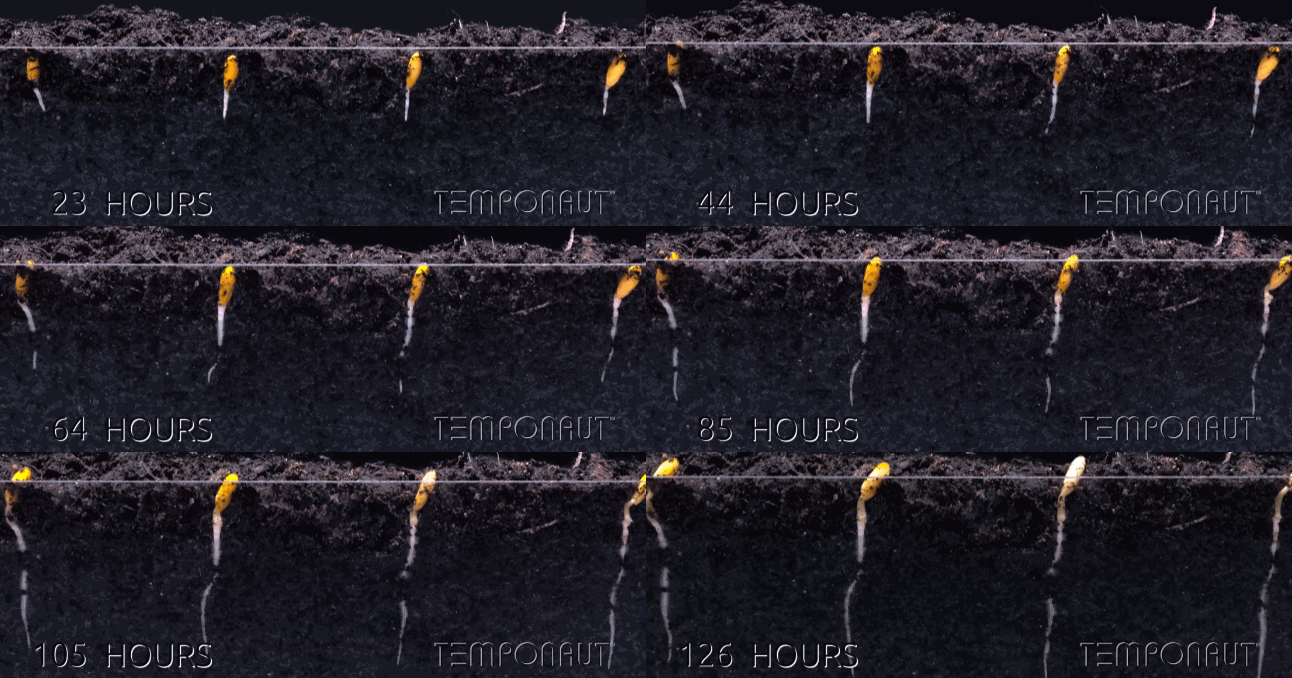
Made a gif of a root growing as a metaphor for an LLM generating text from the same prompt four times (from this video):
P33
- Added no confidence voting
GPT Agents
- Arms control – finished!
SBIRs
- 9:00 standup
- 12:50 – 1:20 USNA
- 4:30 book club
- More RTAT – Worked out how to iterate along the line segments as a function of t.
 viztales
You must be logged in to post a comment.